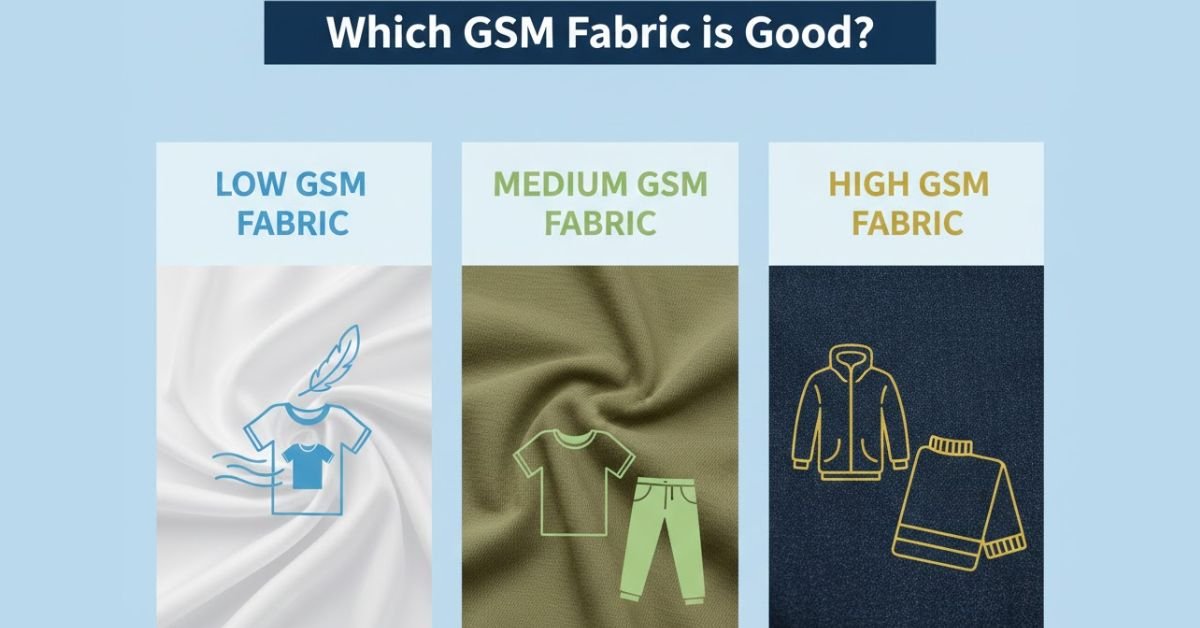

Introduction–
When you have ever purchased a T-shirt that was too thin, a bedsheet that was too prone to wear out, or a towel that was incapable of absorbing water, then you have already been exposed to the significance of GSM in fabric, although you may not have been aware of it then. Which GSM fabric is good is one of the most asked questions by the shoppers, designers and manufacturers of textiles. This depends on the way and the location of the fabric usage.
The weight and density of fabric is measured using GSM, a term that means grams per square meter. It contributes significantly to the thickness, breathability, durability and comfort of a piece of fabric. Be it putting together summer clothes, winter wear, bedsheets, towels, or even export quality clothes, knowledge of GSM will enable you to make a better and long lasting decision.
This is the all-inclusive guide where you will be informed of GSM meaning, how to select the appropriate GSM in various applications, and the spectrums of GSM that are effective in clothing, home textiles and the production process. At the end, you can make a choice of the fabric with certainty and select the clothing that corresponds to your weather, purpose, and quality impression.
What Is GSM in Fabric?
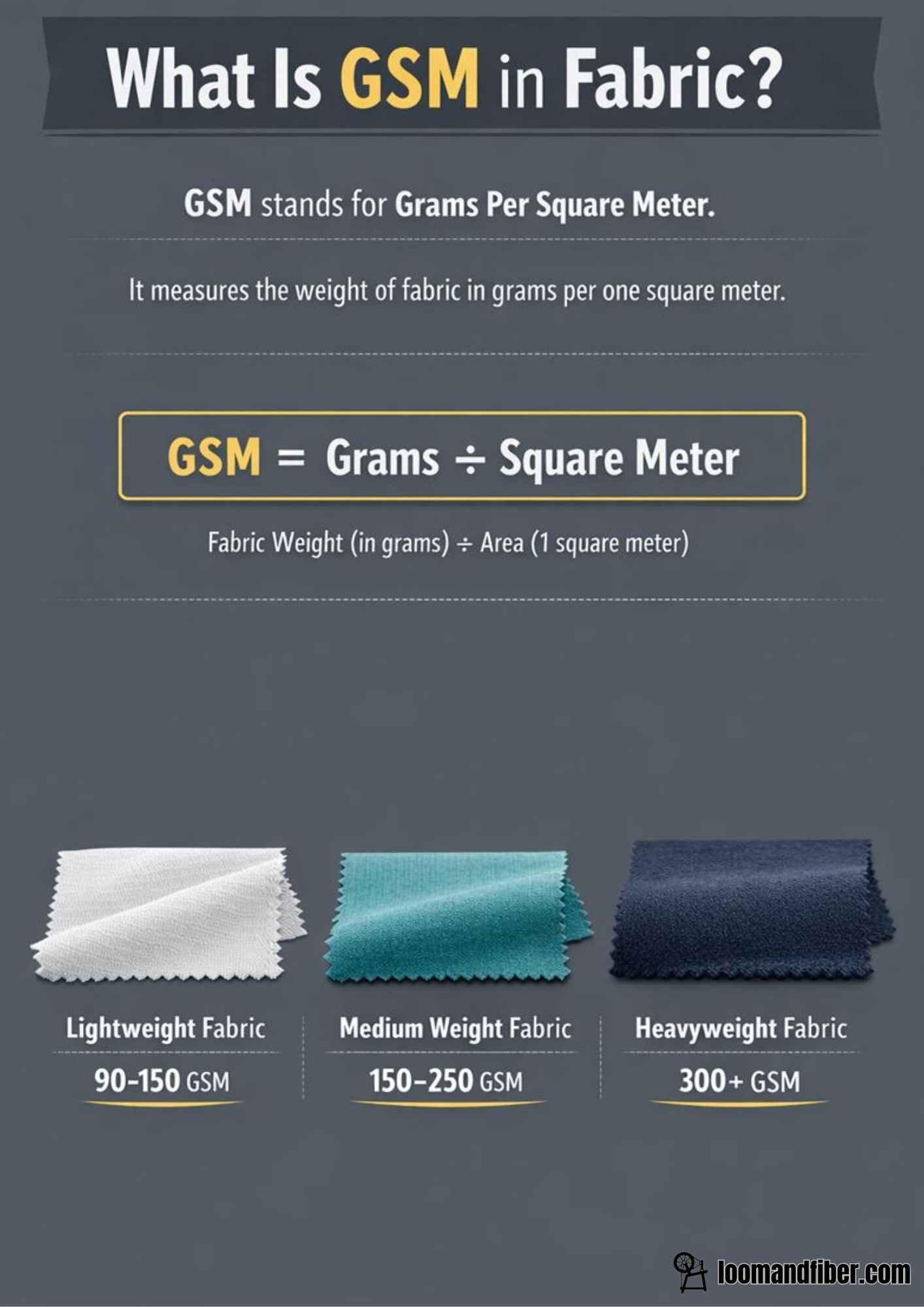
GSM is an abbreviation of Grams per Square Meter. It is the weight of cloth in grams per square meter of cloth. Simply put, GSM makes you know the weight or lightness of a piece of cloth.
For example:
- GSM 120 is a light, breathable fabric.
- A 300 GSM fabric is thick, heavy and warm.
GSM contrasts with thread count. The thread count is determined by the number of threads that are stitched in a square inch of fabric with the GSM measuring the actual weight and density. The thread count of two fabrics may be equal yet the GSM values can be very different due to the thickness of fibers, type of weaving, and type of material.
Imagine GSM as the thickness of paper. Notebook paper is light, whereas cardboard is heavy. The same applies with fabric where the higher the GSM the heavier and denser the fabric, and the lower the GSM the lighter the fabric is.
Which GSM Fabric Is Good?
The best GSM fabric depends on what you plan to use it for. There is no single “perfect” GSM for all purposes. Instead, different uses require different GSM ranges.
Here’s a quick guide:
| Use Case | Ideal GSM Range |
|---|
| Summer clothing | 120–160 GSM |
| T-shirts | 160–180 GSM |
| Shirts | 130–170 GSM |
| Winter clothing | 220–350 GSM |
| Hoodies & sweatshirts | 280–350 GSM |
| Bedsheets | 130–180 GSM |
| Towels | 400–600 GSM |
| Curtains | 180–300 GSM |
| Denim & jeans | 300–450 GSM |
In short:
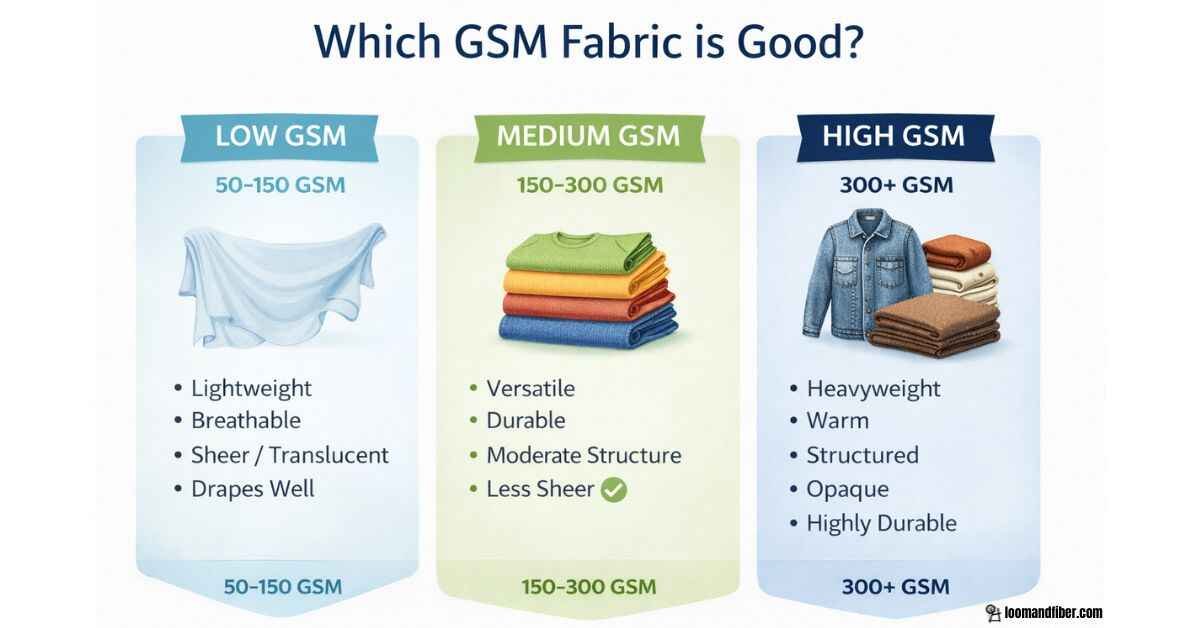
- Low GSM = Light, breathable, cool
- Medium GSM = Balanced comfort and durability
- High GSM = Thick, warm, and heavy-duty
GSM Fabric Chart by Clothing and Home Textile Type
Understanding GSM by product category makes it much easier to choose the right fabric. Below is a detailed chart covering popular clothing and household textile items.
Clothing GSM Guide
| Clothing Type | Recommended GSM | Features |
| T-shirts | 160–180 GSM | Soft, breathable, durable |
| Polo shirts | 180–220 GSM | Slightly thicker, structured |
| Formal shirts | 130–170 GSM | Lightweight, crisp feel |
| Hoodies | 280–350 GSM | Warm, heavy, long-lasting |
| Jackets | 300–400 GSM | Insulating, protective |
| Jeans | 350–450 GSM | Strong, durable, rugged |
| Sportswear | 140–180 GSM | Moisture-wicking, light |
| School uniforms | 180–240 GSM | Balanced durability |
Home Textile GSM Guide
| Item | Recommended GSM | Features |
| Bedsheets | 130–180 GSM | Soft, breathable |
| Towels | 400–600 GSM | Absorbent, plush |
| Curtains | 180–300 GSM | Light control, privacy |
| Sofa covers | 250–350 GSM | Strong, long-lasting |
| Tablecloths | 180–250 GSM | Durable, easy care |
This chart is especially useful for buyers, textile students, garment manufacturers, and exporters who want consistent fabric quality.
Best GSM Fabric for Different Seasons
Climate will also have a significant role in the selection of appropriate GSM fabric. High-GSM fabric is not comfortable to wear in hot weather and low-GSM fabric will be not comfortable in winter.
Best GSM for Summer Fabrics
In hot and humid weather, like South Asia or tropical zones, it is best to wear lightweight fabrics.
Recommended Range: 120–160 GSM
Benefits:
- Breathable
- Quick-drying
- Comfortable in hot climate
The best fabrics that can be used in this range are cotton, linen and light blends.
Best GSM for Winter Fabrics
The winter season necessitates warmer clothes in the ability to retain heat and act as an insulator.
Recommended Range: 220–350 GSM
Benefits:
- Warm and cozy
- Wind-resistant
- Long-lasting
Fleece, wool blends, heavy cotton and thick polyester materials are the best here.
All-Season GSM Range
If someone wants to wear a piece of cloth all year round:
Recommended Range: 170–220 GSM
This range is a balance between breathability and durability; thus, ideal in uniforms, casual presentation, and home textile.
Best GSM for Popular Fabric Materials
The same GSM has different behaviors with different materials. This is the effect of GSM on everyday cloths:
Cotton Fabric GSM Guide
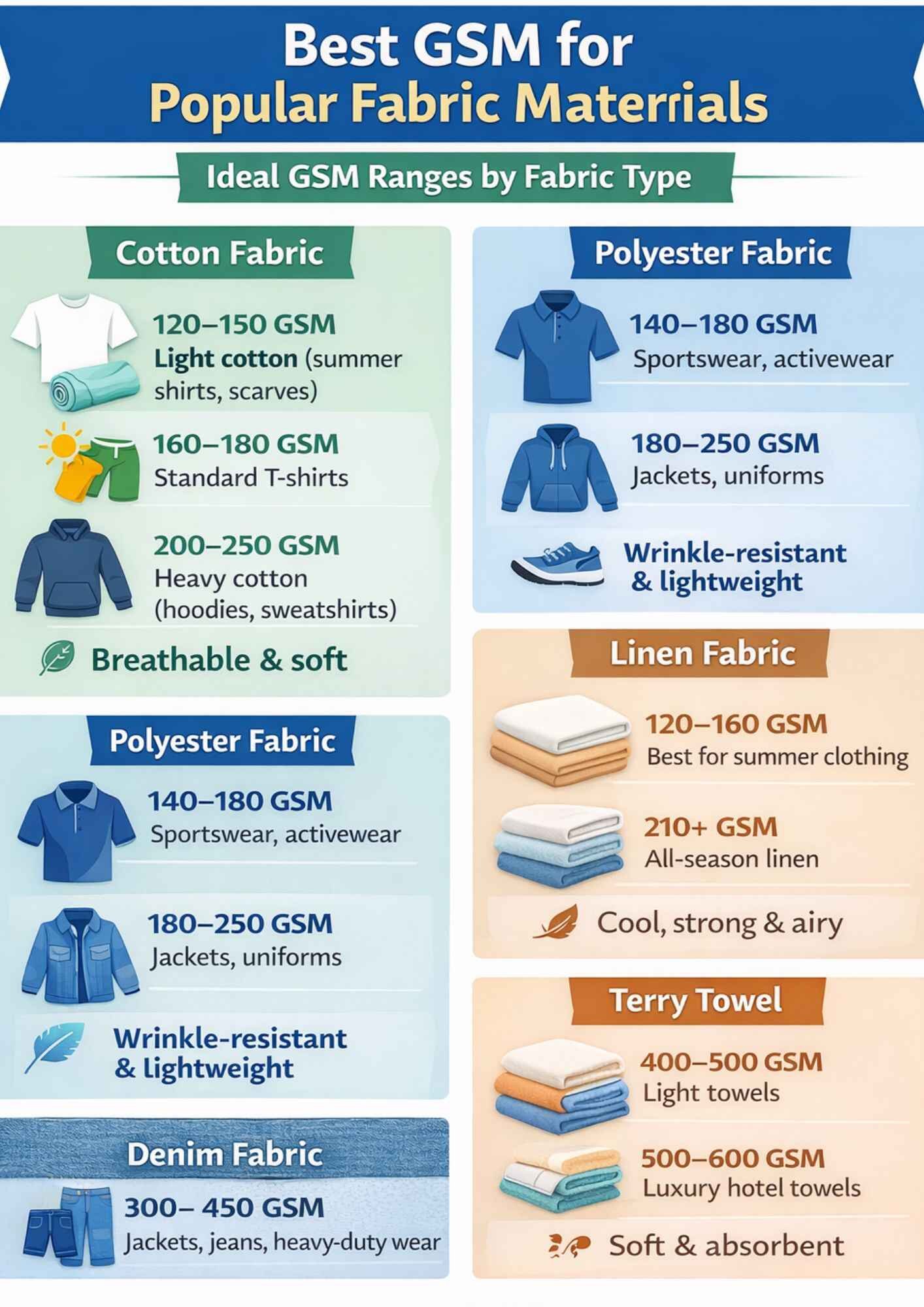
- 120-150 GSM: Light cotton (summer shirts, scarves)
- 160–180 GSM: Standard cotton T-shirts
- 200-250 GSM: heavy cotton (hoodies, sweatshirts)
Cotton is breathable, soft and this suits it well in the low as well as medium GSM.
Polyester Fabric GSM Guide
- 140–180 GSM: Sportswear, activewear
- 180–250 GSM: Jackets, uniforms
Polyester is also less heavy than cotton at an equal GSM; it is also more wrinkle-resistant.
Linen Fabric GSM Guide
- 120–160 GSM: Best for summer clothing
A good all-season linen fabric is often around 210 GSM.
Linen is best with lower GSM since it is strong due to the quality of fibers and not thickness.
Denim Fabric GSM Guide
- 300-450 GSM: Jackets, heavy duty wear, jeans.
Denser GSM denim is better and endures wear and tear.
Terry Towel GSM Guide
- 400–500 GSM: Light towels
- 500–600 GSM: Luxury hotel towels
The GSM towels are thicker and fluffy.
Lightweight vs Medium vs Heavy GSM – Which Is Better?
| GSM Type | Range (GSM) | Best For | Pros | Cons |
|---|---|---|---|---|
| Lightweight | 0–150 | Summer tops, sportswear | Highly breathable; quick-drying; very flexible | Low warmth; less durable under stress |
| Medium-weight | 150–300 | Everyday shirts, dresses, uniforms | Good balance of comfort and durability | May be too warm in high heat or too light for extreme cold |
| Heavyweight | 300+ | Winter coats, sweaters, workwear | Very warm and durable; holds shape well | Bulky; can restrict movement and breathe poorly |
Practically, select the category based on climate and application. Light weight fabrics are heat friendly, medium fabrics are ideal in situations that are standard, and heavy fabrics are used in cold or hard-duty situations. In general, the right GSM will make sure that your clothes work as you want.
How to Choose the Right GSM Fabric (Buyer’s Guide)
Climate & Season:
Start with your environment. When the weather is hot and humid wear low GSM (100-160) to keep cool. During cold seasons, wear heavier GSM (>200) to keep warm. An example is that in tropical summer, light cotton (low gsm) is required but in winter, heavy wool or fleece (high gsm) is essential.
Purpose & Use:
Determine what the fabric should do. In the case of everyday T-shirts and dresses, medium GSM (150-250) is typically required to balance between comfort and longevity. The higher GSM should be applied to outdoor or industrial clothes (such as working shirts or heavy uniforms). Very low GSM fabrics, on the other hand, are useful in beachwear and active wear.
Breathability and Comfort:
The lower GSM fabric permits greater airflow. When you require the moisture-wicking or very breathable fabric, seek lighter weight. On the other hand, when insulation is a major factor (blankets, winter clothes), a high GSM material is preferable.
Durability & Maintenance:
Greater GSM tends to equate to a greater durability which will withstand wear and tear. When clothes are washed frequently or are likely to be used intensively, medium to heavy GSM should be used. Remember, the GSM that is of higher quality is more likely to dry slowly and is more expensive, but it is more likely to withstand stress.
Cost & Budget:
When the GSM is higher, it will have more material thus will be more expensive. In case the budget is an issue, a mid-range GSM can be a middle-ground between performance and price. At other times GSM of a lighter weight can be used with a combination of synthetics thus saving money yet still providing a certain degree of durability.
Style & Feel:
Consider texture. In fact, a thick GSM material (such as dense knitting) will be more dense and organized. Light weight GSM (sheer voile) will be loose. Select according to the required appearance and feel of the cloth.
Altogether, consider these factors against your needs. An example of this is a winter jacket that will use warm, heavyweight GSM; a yoga shirt that will use a light, breathable GSM. Buyers prescribe GSM to climate, use and comfort so that it fits the purpose it is supposed to handle.
How to Check GSM of Fabric at Home or Factory
Measurement of GSM can be done easily in simple procedures:
- GSM Cutter Method: A special GSM fabric cutter is used to cut a sample of a specific size (usually 100 cm²). Measure the weight using a digital scale to determine the weight in grams. Given that 100 cm² is 1/100 of a square meter, multiply the weight of the grams with 100 and get the GSM of the fabric. This method is employed in many textile labs to have a fast and accurate result.
- Digital Scale Method: Assuming you do not have a cutter, cut out a sample of a known area (e.g. 10 cm × 10 cm = 100 cm²). Measure it, and calculate GSM = weight (in grams)/sample area (in m² ). As an example, a 100 cm² sample with weight of 5g will have GSM = 5g / 0.01 m² = 500 GSM. This is a home based strategy that uses ordinary equipment.
- Online GSM Calculators: A number of online calculators are used to compute GSM. All you do is feed them sample weight and area and they give GSM. This is also handy in making rapid checks. Only make sure that you get the right measurements so that you can input them into the calculator.
Common GSM Myths
- Myth: An increased GSM is necessarily an improvement in quality.
- Fact: GSM does not measure the quality or softness of fabric, but just the weight of the fabric. A heavy cloth (high GSM) can be warm, whereas a lightweight cloth can be strong provided they are produced using high-quality fibers. Quality lies in material and weave and not only in GSM.
- Myth: Low GSM fabrics are poor quality.
- Fact: Low GSM fabrics are plainly lighter; they can be used in hot weather conditions, or as an active attire. A fine synthetic or a blend can be a good example of this, since it may be highly durable even though it has a low GSM. Most summer clothes are produced with GSM that is lower than 150 and do well.
- Myth: There is no difference between GSM and thread count.
- Fact: They are various measures. GSM is a mass per area measurement, with thread count being a measure of threads per inch. The thread count can be much higher but the GSM (fine threads) can be lower, or vice versa. Therefore, you must use two metrics in a prudent manner.
Therefore, do not evaluate the quality of fabric using GSM only. Consider fiber, weave and use. It is the balanced approach that guarantees you to choose the appropriate textile to each end.
GSM for Export and Manufacturing Standards
GSM uniformity is a key aspect to international purchasers. The majority of clothes manufacturers define the tolerance span of GSM as 5%. Export clothes are normally in line with the GSM standards to bring about consistency in large orders.
Common export benchmarks:
T-shirts: 160–180 GSM
Hoodies: 280–320 GSM
Bedsheets: 140–180 GSM
The continuation of the GSM standards enhances brand image and minimizes the rate of rejection.
Conclusion-
So, which GSM fabric is good? The solution is available in line with your intention, weather, and comfort requirements. All types of GSM fabrics are lightweight and ideal in summer and breathable garment, medium GSM fabrics are the ones that are used in daily life and household, and heavy GSM fabrics are the ones that are used in winter and industrial purposes.
Knowing the far limits of the GSM and the influence this has on the performance of fabrics, you can make more intelligent decisions, be it in buying new clothing, in using fabric to create a product, or in exporting textiles. Always match GSM with the appropriate material and application to provide maximum long-term value and comfort.
FAQs
Yes, T-shirts should have 180 GSM as it provides good balance to softness, durability and breathability. This grade of GSM is not too thick to be considered high quality and at the same time comfortable to wear. It also has fewer chances of being lost in shape or being made transparent after repeated washing.
The GSM of 120-160 is appropriate in hot seasons since the fabrics are extremely light-weight and breathable. Loose GSM garments provide more ventilation, and the heat is easily removed through sweat and the body is cooled down. This product is particularly applicable to summer attire, casual shirts and sportswear.
It is thought that 200 GSM is a medium-weight section of fabric which falls between lightweight and heavy fabric. It has a decent amount of sustainability without being too cumbersome or hot. This endears it to all-season clothing, uniforms and home textiles.
The 130-180 GSM is the ideal range of bedsheets since it is soft, strong, and breathable. These types of fabrics are comfortable to the skin, and are tough enough to withstand regular laundering. Increased GSM bedsheets will also be easier to cover and more comfortable.
GSM fabrics between medium to high, ranging between 200 and 350 GSM, usually have the longest duration of life. Such fabrics are more dense and thick and this is what makes them less likely to tear, pill, and wear out as time goes by. They are most suitable with items that are used most such as uniforms, hoodies and heavy-duty home fabrics.