
Introduction-
Milk silk fabric is a soft silky textile made of milk protein combined with contemporary fiber. To understand what silk milk fabric is, one must first understand that it is a blend of regenerated casein protein with a synthetic blend. It is named after the milk protein that is the remnant of the processing. As the fabric is smooth, breathable, and comfortable, it has become the preferred choice for clothing and everyday wear.
Milk silk has become popular for it silky touch and low cost. Also, it has a great drape and is suitable for a number of different garments. As a protein-based fabric, it has gained more and more attention each year as soft and more eco-friendly textiles are being sought by the consumers.
What Is Milk Silk Fabric Made Of?
Milk Protein Fiber (Casein)
The primary constituent of milk silk is casein protein, also present in milk. To obtain casein, manufacturers use skimmed or waste milk, from which they extract the protein. This milk-based casein is subsequently treated and broken down to produce a spinning solution. The resulting fibers retain the milk’s natural protein structure, resulting in a distinctive softness and luster. Being a protein, milk silk casein also possesses similar characteristics to other protein-based fibers like silk and wool, but from a renewable and natural source.
Role of Synthetic Fibers (Polyester/Spandex Blends)
In production, ‘milk silk’ fabrics are mostly blends. Once casein fiber has been manufactured, producers integrate polyester and spandex. These blended fibers significantly increase elasticity, strength, and wrinkling. For instance, spandex is included in many designs of milk silk knits (around 5–12%) to achieve four-way stretch. The polyester or spandex blended fabrics also increase the ability of garments to retain shape and are better at resisting sagging, making them ideal for activewear and fitted garments.
Natural, Synthetic, or Semi-Synthetic?
In case of milk silk, the construction can be either natural or semi-synthetic. The first casein fibers were produced by transforming pure milk protein via textile regeneration, but this is very resource inefficient, as it uses harsh chemicals (formaldehyde as an example). The majority of contemporary milk silk is genuinely semi-synthetic though: producers chemically graft milk protein onto one of the following: polymers, or casein, and spandex, or polyester (also casein).
Pure Milk Protein vs Blended Milk Silk
Pure milk silk casein fiber (100%) is very rare, though the option is there. For example, one of the first ‘organic’ milk silks from Germany was produced without the use of toxic additives. Moreover, this production is fully and solely recycled casein fiber.
In contrast to this, most conventional milk silk on the market today is some combination of casein fiber along with other yarns. According to Sources, typical production crosslinks casein with acrylonitrile (acrylic) or pairs casein with polyester to enhance functionality. While the pure casein versions are very soft to the touch and biodegradable, the blended versions are more durable and inexpensive.
How Milk Silk Fabric Is Made
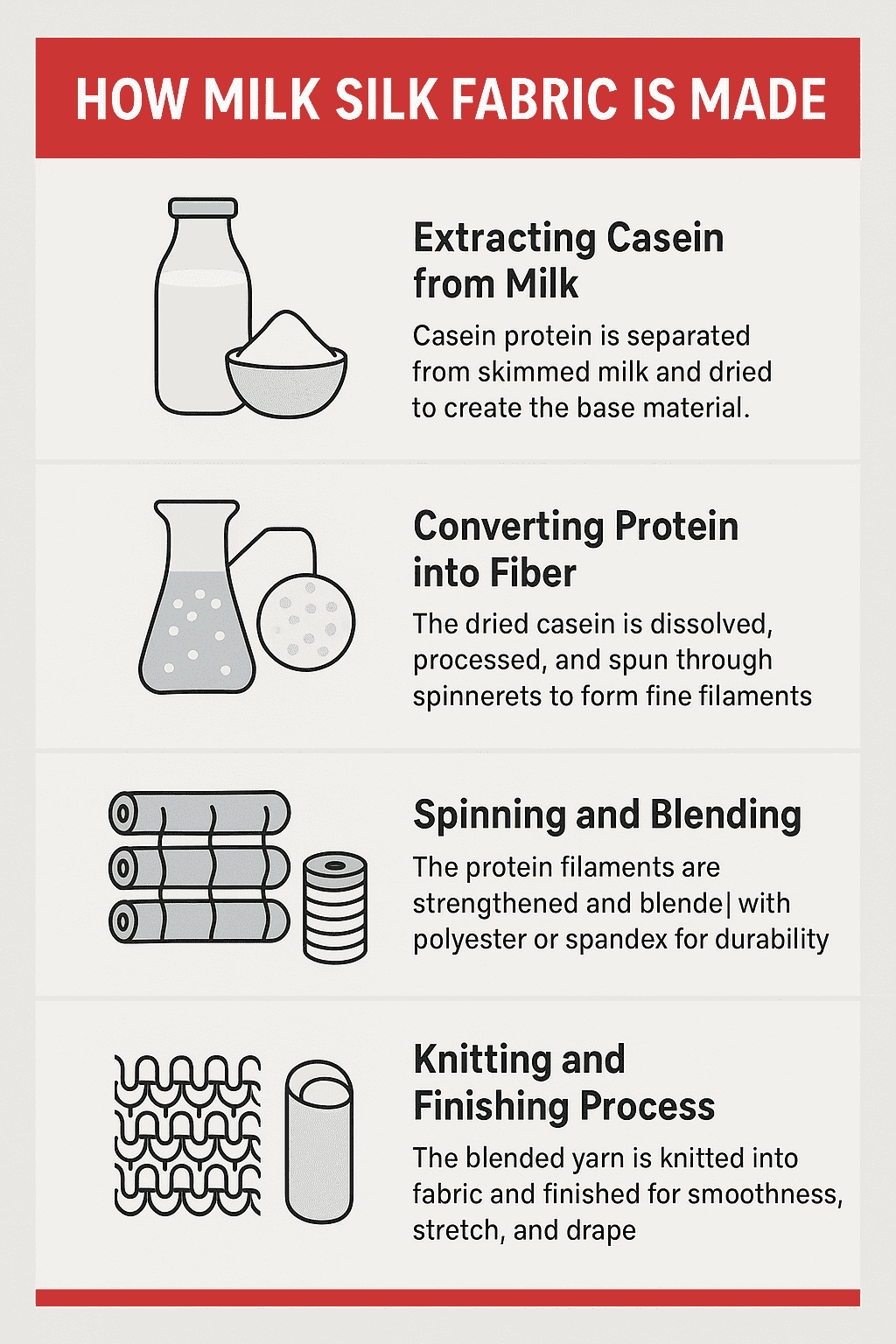
Extracting Casein from Milk
The process of production begins with skimmed milk that is separated to eliminate fats and impurities. Secondly, manufacturers introduce natural acids that assist in separating the casein protein in the liquid. Lastly, extracted casein dries up in form of a solid known to be the foundation of milk silk fiber.
Protein to Fiber Conversion
Following drying, the solid casein is combined with non-toxic chemical constituents in order to create a non-aggressive paste that is easy to handle. This paste is then pushed through fine spinnerets, which produce fine filaments like synthetic fibers. The silky nature of filaments is formed when they harden and resembles natural protein-based textiles.
Spinning and Blending
The new filaments of protein are transferred into spinning phase, where they are stretched and refined and reinforced. At this stage, they are combined with polyester or spandex to make it more durable and elastic. Consequently, the resulting yarn is appropriate to be used in everyday clothes and in any long-term use.
Knitting and Finishing Process
The yarn then is fed through knitting machines and a flexible and comfortable surface of fabric is formed. The material is then softened, dyed and finish treated to enhance feel and look. Once these have been done, the resultant milk silk garment acquires its trademark slenderness, tacit, and hue stability.
Key Characteristics of Milk Silk Fabric
Softness and Smooth Texture
The reason why milk silk is soft is due to its protein based structure. It has smooth surface even when worn over a long time. Hence, it is luxurious but does not require high cost.
Breathability
The fiber permits free air passage. This enhances comfort in hot environment. Consequently, the wearer gets the feeling of cooler and fresher air.
Stretch and Elasticity
Blended milk silk stretches naturally as a result of spandex. It easily goes back to its initial shape. This makes customized clothes that are supportive and comfortable.
Lightweight Feel
Milk silk is very lightweight on the body. Due to the lightness of its construction, it is not heavy in moving. As a result, it is effective in all-day use.
Moisture Absorption
The moisture is efficiently absorbed due to the protein content. This keeps the skin dry when in the day. Consequently, it can be used in hot and humid environments.
Wrinkle Resistance
Blended milk silk does not crease. The cloth requires little effort to retain its smooth appearance. This is perfect in terms of traveling and fast styling.
Is Milk Silk Fabric Real Silk?
No -milk silk does not qualify as natural silk. Milk silk is an artificial (regenerated) fiber, as the actual silk is made of silkworm cocoons. The two fabrics are different in their origin and structure as the silk is a protein fiber made by the silk moths and milk silk is made of the milk protein (casein) which is spun into the yarn. The structure of the fibers is also different: silk filaments are composed of continuous and pure protein, and the silk fibers made out of the milk are produced out of the dissolved casein (it is usually regenerated and sometimes mixed with plastics).
Is Milk Silk Fabric Breathable?
Yes. Milk silk is fabric that is naturally breathable. This enables air to move in and it cools the wearer. Textile Industry makes it clear that milk fabric is highly breathable hence it creates air circulation and stops accumulation of moisture. Practically a shirt of milk silk is cool to the touch and does not retain the heat.
Airflow Performance: The small holes in the milk fiber allow free circulation of air. This implies that heat and moisture are lost instead of being confined in the garment. This coolness in the air can make milk silk pleasurably cool in summer or on activity. Milk silk has breathability and moisture-wicking properties, which makes it efficient in absorbing sweat to avoid overheating.
Is Milk Silk Fabric Stretchy?
Milk silk is stretchy due to the fact that manufacturers tend to incorporate spandex. This enhances recovery hence retention of shape of the fabric. Stretch also helps in eliminating sagging when it is used in everyday life.
Activewear can take advantage of such elasticity since it is free to move. Clothing worn is also formative around the body. Consequently, the users experience comfort and flexibility.
Can Milk Silk Fabric Be Worn in Summer?
Milk silk is good at temperature regulation as it is breathable. It makes it less sticky through the efficient absorption of moisture. The garment also remains smooth on the skin even when worn over long periods.
It is lightweight and this enhances comfort during hot climates. There is consistent airflow even when one is outside. Thus, it is used as summer clothes by many people.
Is Milk Silk Fabric safe for skin?
Milk silk has hypoallergenic properties of protein fibers, as they are soft to touch. It has soft and non-irritable finish which is also advantageous to the sensitive skin. It can also be conveniently worn by babies in most situations.
Nevertheless, blended ones can have the ingredients of polyester or spandex. Such combinations can result in a reaction among extremely sensitive persons. Consequently, label checking turns out to be significant.
Common Uses of Milk Silk Fabric
The soft, breathable and stretchy milk silk have made it a favorite in the following types of garments:
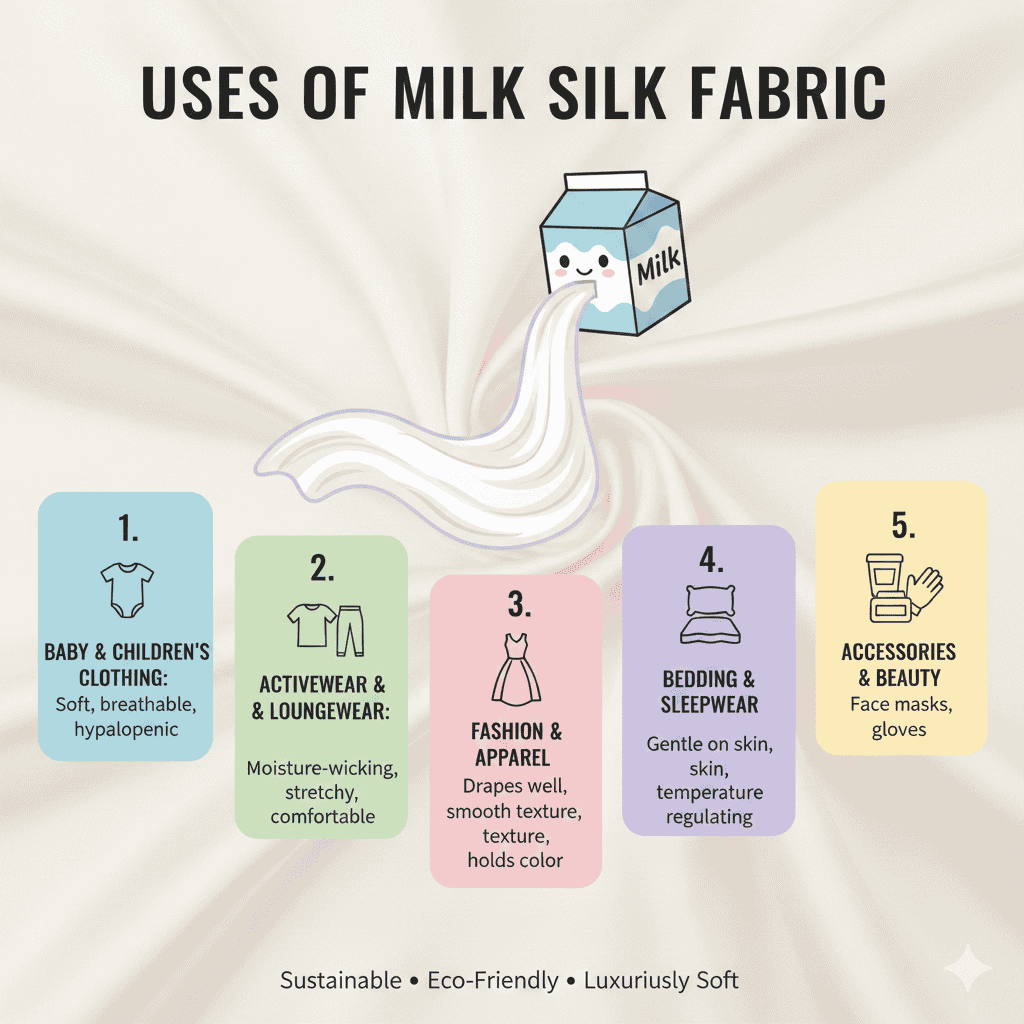
Dresses: the flow and sheen of milk silk is befitting to dresses and evening wear. It is applied in cocktail dresses and gowns by designers since it fits the curves very loosely and move freely.
T-shirts: Tees made of smooth milk silk are comfortable and cool. The moisture-wicking used in the fabric maintains the casual tops to be not wet and hence it is frequently employed in the expensive tee-shirts and blouses.
Sleepwear: Milk silk is soft and breathable; therefore, it is suitable in pajamas and nightgowns. It remains soft against the skin and it keeps people who are asleep very dry, which makes it a luxury nightwear.
Lingerie: Lingerie and intimate apparel are some of the most popular uses of milk silk due to its smooth texture. Natural luster and the comfort of the fabric avoiding itch under the arms are reasons of the comfortable bras and camisoles.
Activewear: Milk silk can be used as active wear, such as yoga pants and tops when combined with spandex. It absorbs sweat and stretches to reach without any difficulties, so it can be used by sportsmen.
Baby Clothing: Baby milk silk is also used in luxury baby clothes and blankets because it has a hypoallergenic property. Parents wear it on onesies and wraps to take care of tender skin of a baby.
All these applications leverage the traditional strengths of milk silk, which are its softness, breathability, and gentle elasticity.
Pros and Cons of Milk Silk Fabric
Pros:
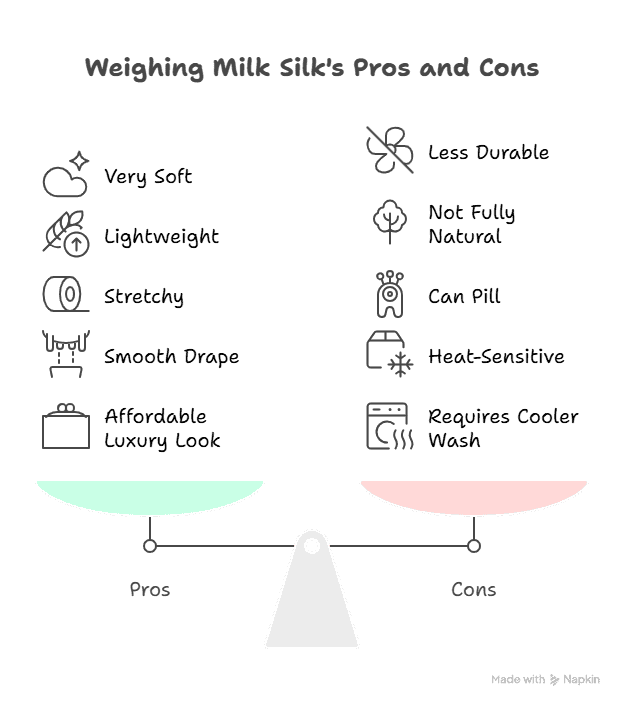
- Very Soft: This is extremely soft, and is luxurious and smooth against the skin.
- Lightweight: Feels light, airy, even the full garments will not be heavy or clingy.
- Stretchy: It is an elastic substance with good elasticity and recovery when mixed with elastane.
- Smooth Drape: Slippery and falls and feels like natural silk.
- Affordable Luxury Look: Appears to be representing silk or modal at a more affordable price.
Cons:
- Not Fully Natural: It is often a semi-synthetic textile (contaminated with polyester/acrylic) instead of organic.
- Can Pill: It can pill with time, particularly with acrylic, during repeated abrasion.
- Less Durable than Cotton: Milk silk is not as hardwearing as 100 percent cotton. It is durable in comparison with tough fabrics.
- Heat-Sensitive: It is to be treated as the silk or modal (cooler wash/iron). Acrylic fabric is not able to endure high temperatures.
Milk Silk vs Cotton vs Modal vs Polyester
Softness Comparison
Due to its protein structure, milk silk feels smoother than cotton. Modal is smoother but more weighty. Polyester is not as natural as the rest.
Breathability
Milk silk is a better breathable fabric, especially as compared to polyester because it has a porous structure. Cotton continues to be the leader in the natural airflow quality. Modal fabric is also breathable.
Stretch
Milk silk is an elongated fabric compared to cotton and polyester. Modal stretches a little with not as much as blended milk silk. Spandex blends enhance much better flexibility.
Durability
The cotton is resistant to wear over time as compared to protein blends. Polyester is also wear resistant. Milk silk is less strong but still softer.
Price
Milk silk is affordable in comparison with natural silk. The prices of cotton are different according to their quality. The modal is a little more expensive because it is highly fabricated.
Best Use Cases
Milk silk is to be used with loose and stretchy clothes. Cotton breathable casual clothing. Modal fits are a luxury lounge wear, whereas polyester is effective in durability.
Is Milk Silk Fabric Eco-Friendly or Sustainable?
The milk waste is used in making milk silk and this helps to cut down disposal issues. But there is a question of the chemical process involved in the regeneration of casein. There are manufacturers interested in lessening the influence of chemicals.
Polyester blends are still used in the fabric and they have an impact on sustainability. Thus, it is not entirely sustainable but only semi-eco friendly. There is a type of recycled milk silk but is not widespread.
How to Identify High-Quality Milk Silk Fabric
- Fabric Thickness
- Milk silk of high quality is medium thick with smooth texture and without weak spots.
- Stretch Recovery
- Good fabric is one that is easy to stretch and can get back in shape without sinking or becoming loose.
- Colorfastness
- Colors are supposed to appear smooth, stable and not leaking or changing color during mild washing.
- Label Reading
- An outer tag displays the specific mix, typically with a little spandex as performance.
- Feel and Drape Test
- The premium milk silk is soft, silky, fluid, and not stiff or plastic in touch.
How to Care for Milk Silk Fabric
- Washing: Milk silk is to be washed in a gentle manner using cold or lukewarm water. Wash with a light detergent developed to be used with delicate fabrics (or in a mild shampoo); do not use harsh detergents or bleach. Hand rinsing or laundry bags; one can either do laundry by hand or machine washing in a mesh bag. Basically, it should be treated as silk or delicate knit wear no high heat or aggressive agitation.
- Drying Instructions: Milk silk should be air-dried. Lay it flat or hang it to dry without the direct sunlight. Do not utilize a tumble dryer or high heat, because heat will make the fibers shorter and/or damaged. Gently remodel the garment when wet in order to keep it in shape.
- Ironing Temperature: When ironing is required, low temperature setting (such as silk or synthetic setting) should be used. A pressing cloth is another way of working hands-free. The milk silk does not wrinkle much in most instances and thus seldom needs ironing.
- Pilling Prevention: Pilling can be prevented by inside-out washing. Apply a soft cycle and do not overload the washer. When pills are present, carefully take them out with your fingers or using a cloth shaver that catches fine hair. Friction is to be avoided e.g. do not rub Milk silk on rough surfaces.
- Storage Directions: Store milk silk goods in a cool, dry location. Fold knits, and not hang (so that they do not stretch). Avoid exposing them to coarse substances that may get hooked up with the material. Since casein fiber is prone to pests, such as moths, others sprinkle cedar or lavender in the storage space as a natural pest repellant.
Read More>> How to care for Vintage Silk?
Conclusion-
Milk silk cloth fits individuals who like softness, stretchiness as well as comfort. It is particularly effective in summer wear, day clothes, and baby clothes. Nonetheless, those who desire completely natural fabric can use cotton or modal instead.
Generally, milk silk is a good performance fabric at the low cost. It is versatile, breathes well, and soft, which makes it a good choice. Thus, it is still a valuable cloth in the majority of wardrobes.
Read More>> What is Satin Silk fabric?
FAQs
Milk silk is semi-natural since casein is natural and needs to be processed. Blends incorporate artificial fibers to make them strong. Thus, it is one that is placed between the natural and synthetic textiles.
No, it does not have the smell of milk after processing. There is no natural odor left out by the chemicals. The last fabric has a neutral smell.
Milk silk is soft and stretchy compared to cotton. Cotton brings a fresh air and does not wear out. Both fabrics are used in various ways.
Blended milk silk is tough enough to be worn daily. Fine fibers of casein are weaker. Polyester mixtures enhance the general strength.
Fantastic post! Dietary fiber is so important, and I appreciate how you highlighted its benefits. Adding more fruits and veggies to everyday meals can really support gut health. Thanks for sharing!