
Breathability: this is the ability of a material to permit air and moisture to enter and exit a fabric. It is necessary to keep a person comfortable, avoid overheating, and decrease the number of sweat drops. Consumers are asking the question in the luxury fibers industry, -*is cashmere wool breathable? The question is not absurd, since cashmere is known to be very warm and soft. Nevertheless, the ultimate comfort also relies on the interaction that a material has with your skin and the surrounding.
Shoppers usually request this because they would also like to be elegant as well as stay practical. A fabric can be luxurious, but when it retains heat this fabrics will lose its daily functionality. However, cashmere balances a very uncommon activity of using the softness lavishly and allowing nature to move freely, which is also beautiful and useful.
Is Cashmere Wool Breathable?
In fact, cashmere is breathable, since it is a natural wool, which has a fine, airy structure. It has super fine fibers that trap but do not block air flowing. An example is cashmere goats in extreme Mongolian winters that develop coats to keep them warm in the freezing winter and cool them in summer. Concisely, natural thermoregulation of cashmere is the reason why it is a good insulator and it does not heat up.
What Makes Cashmere Breathable?
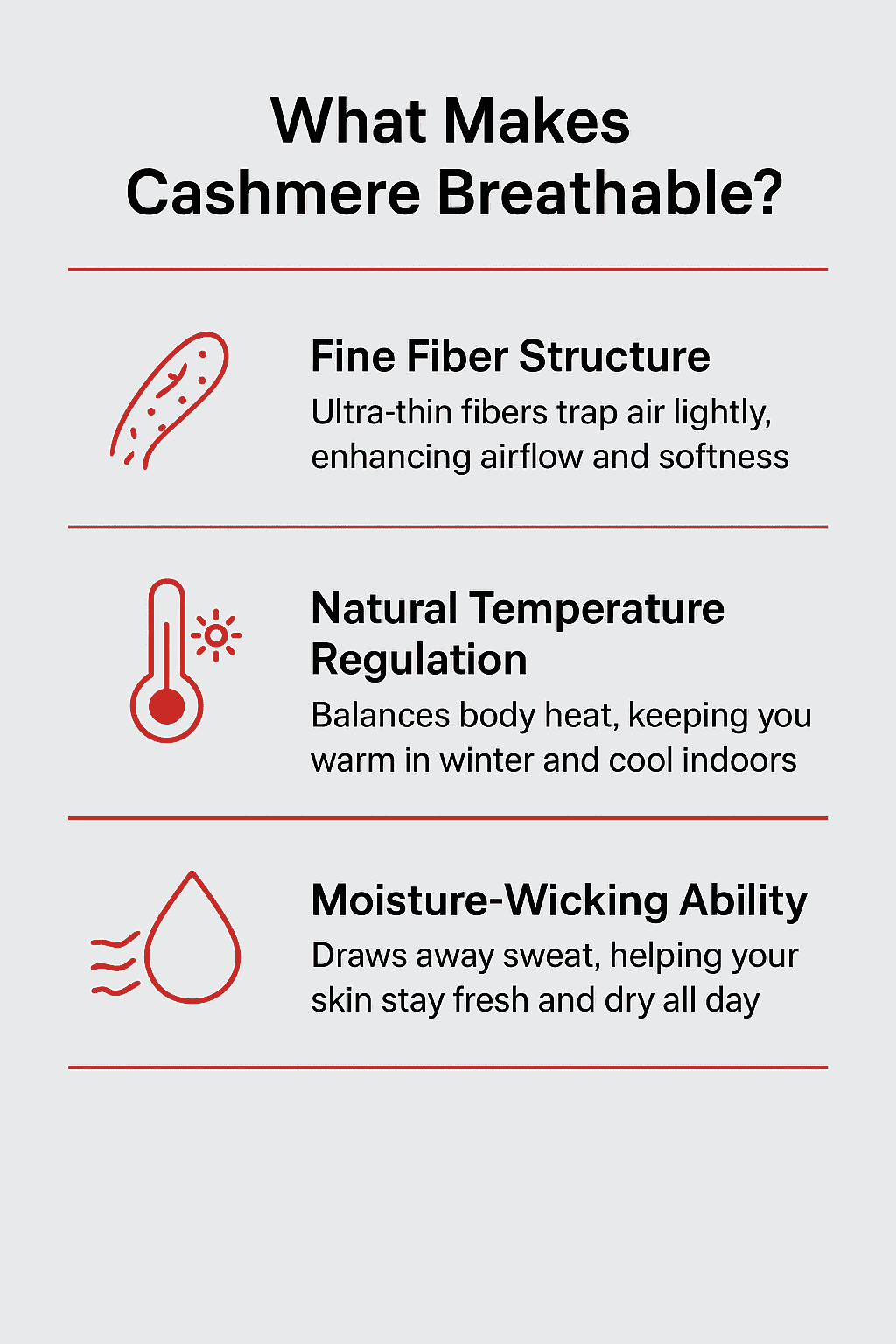
Fine, Hollow Fibers
In fact, the cashmere fibers are very fine- generally below 20 microns. The high fineness of cashmere makes the fabric lighter and loftier than ordinary wool. The small hollow fibers form air cavities which trap warm air but cool air passes through. Simply put, the cashmere breathability is based on the fine fiber structure.
Natural Temperature Regulation
Cashmere is very warm and at the same time breaths freely. Its material keeps up with your body temperature: it keeps you warm when it is cold with you, and releases the surplus heat when you become hot. This thermoregulation will eliminate overheating. To illustrate, the breathability of cashmere is to make sure that the surplus heat does not accumulate but dissipates. Consequently, cashmere is cool in the cold or in the warm, when you are traveling to a heated place.
Moisture-Wicking Fibers
Furthermore, cashmere fibers are also very good at moisture. They absorb the sweat and then automatically draw it off your skin. As an example, according to fabric directions, cashmere takes moisture off the skin. The moisture is then evaporated on the outer surface rather than hang around next to you. Practically, such a wicking process will keep you cool and dry without that dampness that synthetic materials tend to give.
Benefits of Breathable Cashmere
Comfort Across Seasons
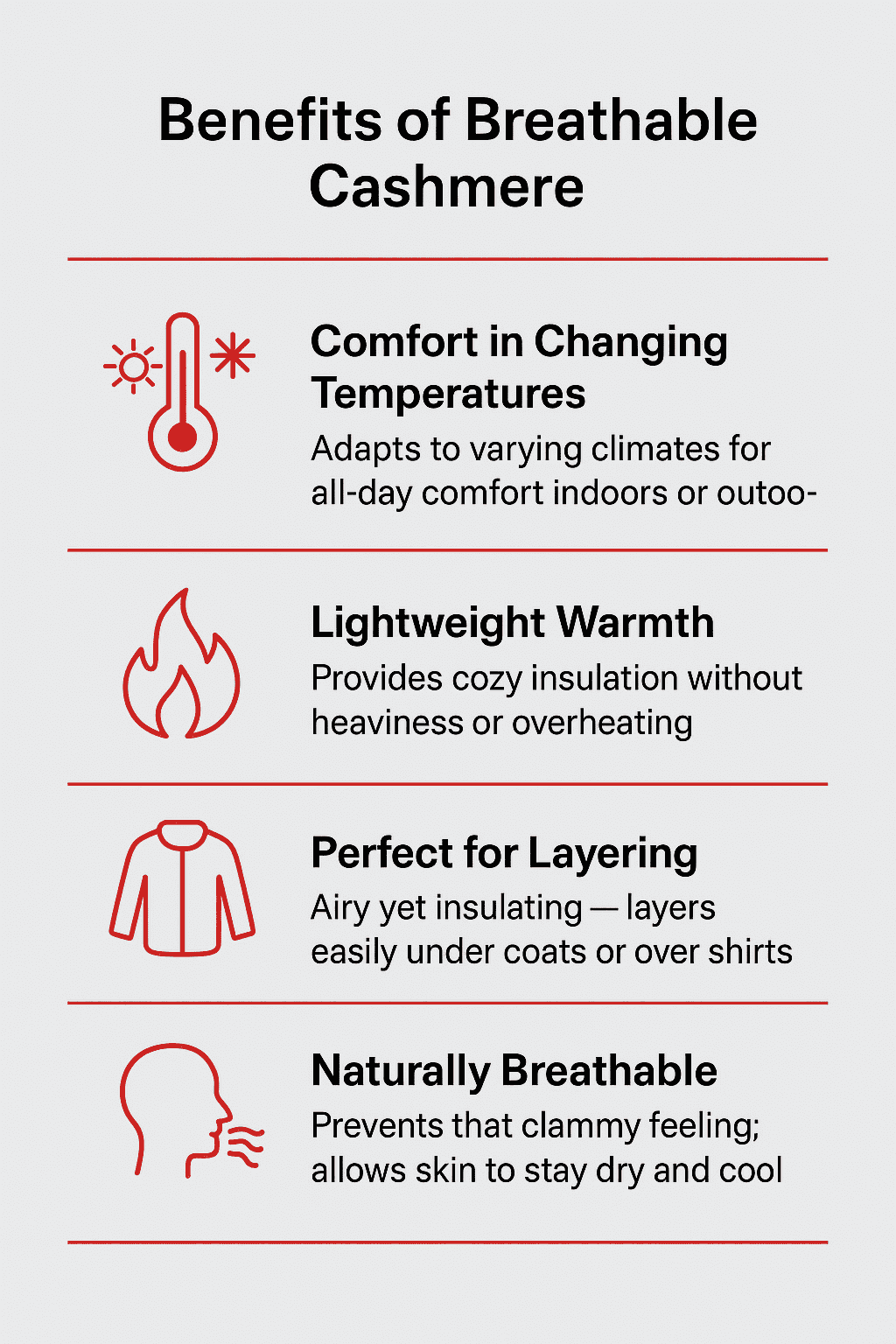
Cashmere is easy to adjust to the variable weather. It is a kind of natural insulator, which reacts to body heat, holds the warmth when one is cold and releases the heat when one is hot. That is, it can make you comfortable during the winter time and can also breathe well inside or during the warmer seasons. This thermostat quality results in the cashmere being relaxed in all seasons and activities.
Warmth Without Bulk
In addition, cashmere is very light as it gives great warmth due to its fine fibers. The garment stores the body heat in billions of micro air-pocket holes. As a matter of fact, the structure of cashmere is such that it entraps warm air and is breathable, thus avoiding overheating. Thus you are in earnest warmth without a fat jacket on. This non-bulky coziness is a prominent component of the high-end cashmere.
Ideal for Layering
Also, cashmere is light in weight and therefore ideal in layering. Thin cashmere sweaters, cardigans or tees under jackets or over shirts can easily be worn. It has pointed out that summer cashmere is light and breathable and can be worn in layers. Practically, a fine cashmere cover will keep you warm, but not too hot as you can adapt to the changing conditions. This is what makes cashmere a frequently used clothing item when traveling and in indoor to outdoor clothes.
Drier Than Synthetics
On the other hand, natural cashmere is usually less clammy compared to synthetic fabrics. Cashmere lets air pass through unlike polyester or acrylic which tend to trap heat and moisture and it lets sweat evaporate naturally. According to one of the sources, cashmere is breathable unlike synthetic fibers which trap heat, therefore making it a comfortable wear. This is to say that cashmere will tend to make you drier and cooler when you are on the move than most synthetic fabrics.
Cashmere vs Other Fabrics (Breathability Comparison)
| Fabric | Breathability | Moisture Handling | Warmth |
|---|---|---|---|
| Cashmere | Good (natural fine wool) | Absorbs moisture and wicks moderately | Very warm for its weight |
| Merino Wool | Excellent (high-performance wool) | Excellent moisture-wicking | High warmth; versatile |
| Cotton | Good (open weave) | Absorbs moisture (poor wicking) | Low to moderate warmth |
| Synthetic (Polyester/Acrylic) | Variable (often low) | Engineered to wick; can feel clammy | Varies (often low) |
| Linen | Excellent (very open weave) | Absorbs moisture but dries slowly | Low warmth (feels cool) |
Cashmere vs Merino Wool
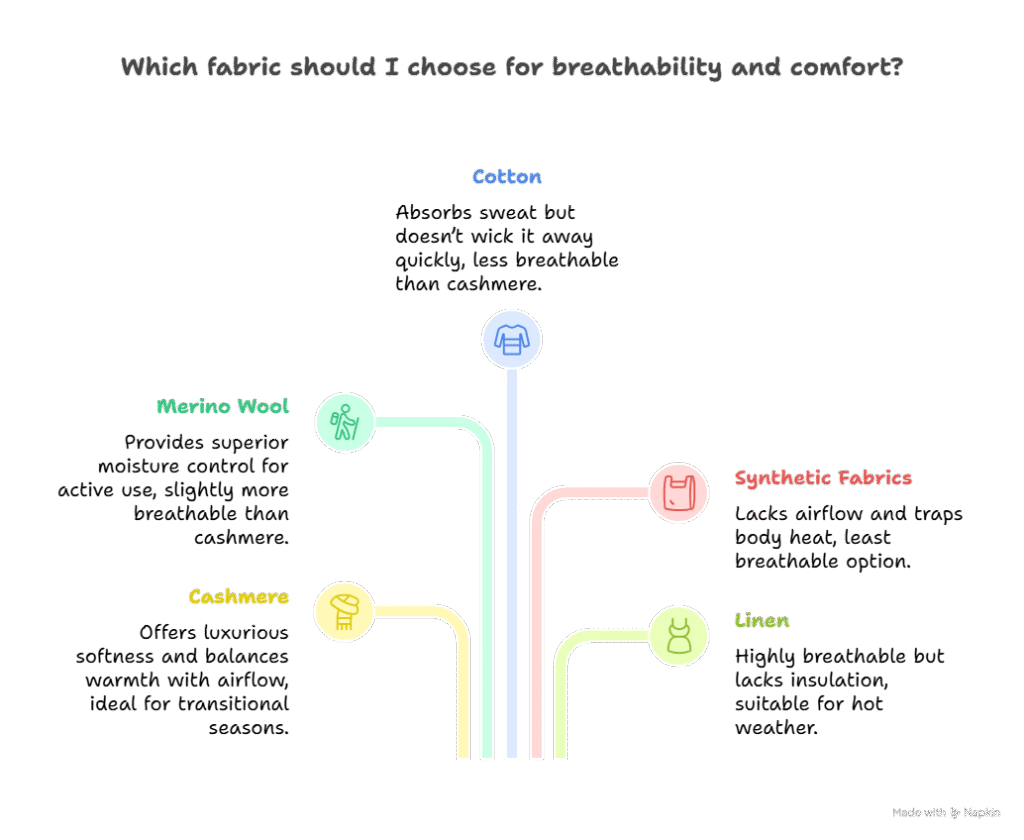
Also, cashmere and merino are natural wools that are valued because of their breathability. Merino fibers are a little more performance based as they are very breathable and sweat wicking. Cashmere is even smoother, therefore it continues to breathe, but merino tends to draw moisture and stench even quicker. Practically, the merino wool may dry faster in case of great activity, whereas cashmere provides additional warmth and luxury. Nevertheless, the two fabrics ensure you are dry and comfortable due to the moisture-wicking nature.
Cashmere vs Cotton
At the same time, cotton is breathable, cool but it can easily absorb moisture. According to one source, cotton does not wipe away moisture, but it absorbs it. This implies that cotton clothes are heavy when they are wet. Comparatively, cashmere breathes too but it does not deal with moisture in the same way. Its fibers will take in sweat and then transport it towards the outside so that it evaporates. When hot, cotton clothes might be light initially but get wet resulting to weight but in cashmere, the garments remain dry and warm.
Cashmere vs Synthetic Fabrics
In the meantime, artificial fabrics such as polyester fibers or acrylic fibers can move water rapidly when designed to do so, but artificial fibers tend to have no natural airflow. Active synthetics can be used to dry quickly, although their breathability depends on the size of the yarn and knit. Artificial fabrics are captive of heat and smell in most instances. Cashmere on the other hand is naturally breathable and smells odorless. As a matter of fact, as was mentioned above, cashmere is breathable, which makes it comfortable to wear in contrast with synthetics. Therefore, cashmere will normally make you drier and cooler than most synthetic fabrics used during activity.
Cashmere vs Linen
Besides, it is arguably the lightest of all fabrics since it is loosely woven. Linen is not very insulating, however, it does not feel warm but cool. Cashmere is not as breathable as linen, but it is much warmer in cold weather. On the other hand, linen is the most suitable in hot summer days, and cashmere is the one to cover you when the weather is cooler. In reality, linen suits extremely hot weather, whereas cashmere makes you feel warm on the chilly night or the place with air conditioning.
When Cashmere May Feel Less Breathable
- Heavy, Dense Knit: Cashmere which is thick knitted or tightly knitted will inherently be warmer and less breathable. A close or loose knitted 4-ply sweater holds a lot more heat and reduces airflow. Finer knits are a better choice in case breathability is a priority.
- Wrong Layer: Cashmere When used as a base under a non breathable shell (waterproof jacket) this can affect the comfort. In case cashmere is covered with plastic or rubber, the moisture may accumulate. Cashmere should always be worn in a layer with breathable materials in order to allow the elimination of sweat.
- Wet or High Humidity: Natural wool has some cooling effect which is lost in wet weather or even in rain. In case the cashmere gets moist due to rain or heavy sweat, the garment will weigh more and will be warmer until it dries. Any fabric may be less breathable under such circumstances.
Is Cashmere Good for Hot Sleepers or Summer Wear?
Lightweight Cashmere Layers
Yes – it can be, but you should choose the right one. Cashmere with a fine fineness and a high quality can surprisingly be breathable. As an illustration, a professional writes, “high-quality, lightweight cashmere is among the lightest and breathable fabric that you can ever wear during summer. Practically, thin cashmere T-shirts, tank tops or wraps can be of light weight and keep the body cool and the sweat away during cool summer nights or in the air conditioned indoors. Cashmere (which is frequently mixed with silk or linen) keeps your temperature controlled, and thus, in most warm weather conditions, it is comfortable.
Heavy Cashmere for Cooler Months
Thick cashmere clothes are however to be worn during cold weather. Heavy 4-ply sweaters are very serious in keeping you warm and will keep you sweaty in the heat. Thick cashmere is made to trap the body heat and therefore hot sleepers need to wear ultra light knits or blends rather than big sweaters. Imagine huge cashmere items to wear during a brisk fall or winter.
Cashmere Tees and Travel Wraps
To be more versatile in year-round, cashmere mixes and lighter clothes can be considered. T-shirts, polos, and wraps (such as shawls or pashminas) are made of cashmere, which is not overheating. Simply put, blended or ultra-thin cashmere can be used in summer provided that it is lightweight and heavyweight sweaters should be used in winter.
How to Choose the Right Cashmere for Breathability
Check the Ply
Look at the yarn ply count. A 2-ply cashmere sweater (two strands of yarns woven together) will be lighter and breathable. On the contrary, a 4-ply sweater is stronger and much warmer. Overall, 2-ply cashmere is referred to as a champion of lightweight – soft, light, and easy to wear. In case the breathability is a priority, select 2-, or 3-ply items instead of the thickest, 4-, or 6-ply ones.
Opt for Lightweight or Open Weave
There is also light weight fabric that breathes well even in a single ply. A heavy knit does not feel as airy as fine-knit cashmere. Select clothes with the tag of lightweight, fine gauge or summer weight. A lighter type of weave or lighter fabric will be more ventilated. Very tight jerseys should be avoided in case you want to be able to breathe. A light, loosely knit cashmere sweater will also cool down much better than a heavy cable knit, as a rule.
Consider Blends
Other fibers added to cashmere may enhance breathability. To be worn in warm weather, combinations, cashmere-silk or cashmere-linen, usually give supplementary airiness and coolness. Even silk and linen are very breathable, hence, their mixtures acquire some of this property. The slightest percentage of nylon or cotton is capable of saving cost and weight. Check garment labels: a cashmere garment combined with silk or linen should not be expected to feel heavy like a cashmere garment.
Caring for Cashmere to Maintain Breathability
- Hand Wash/Gentle Cycle: Cashmere should be washed by hand or on a light load machine cycle with cold water. Use light detergent or a wool detergent. The rough washing may cause the fibers to be rough and lower the natural loft.
- Skip Fabric Softeners: Cashmere should not be exposed to fabric softeners or bleach. These additives will be able to cover the fibers, preventing moisture wickings and rendering the fabric less breathable.
- No Heat, Dry Flat: Once it is washed, squeeze the water out of it (do not wring it) and put the garment back in place. Lay flat to dry in its natural form. Do not tumble-dry cashmere – it will be shrunk by heat and harmed.
- Store Well: Cashmere sweaters should be folded, rather than hung up, and stored in breathable containers (such as cotton bags). It should not be pressed as it can flatten the fabric and it may decrease the insulation and airflow of the fibers.
FAQs
Yes, cashmere can be worn but it is warmer than cotton or linen. It provides balance between airflow and insulation which is soft. This is why it is suitable both to cool and mild weather.
No, cashmere pushes out moisture and allows free air flowing. It allows it to keep your skin dry and prevents overheating.
Light cashmere or mixed materials are suitable when it is hot or under the air conditioner. They are light, but yet luxurious.
They are both naturally breathable but merino works a little better when used in active wear. Cashmere on the other hand is softer and luxurious.
Yes, lightweight cashmere knits or blends can be used during the summer evenings too. They are not stuffy and yet offer comfort.
Conclusion-
Cashmere is so far one of the few fabrics that assure the right balance between luxuriousness, comfort, and practicality. Its microscopic structure of fine fibers is what makes it breathable since air is transferred and moisture is regulated by the fibers. It is what makes it warm during winter and comfortable in transitional weather.
To those inquiring, does cashmere wool breathe? — the answer is yes, definitely yes. Depending on the ply and weight selected, cashmere is lightweight, soft, and cool. On cold winter days to sunny summer evenings, cashmere that breathes provides incomparable comfort in the form of style and glamour.
Read More>> About what is cashmere is made from?
Great breakdown of why cashmere feels both warm and breathable at the same time.Cashmere breathability comment One thing I’d add is that the weave really does make a difference—an open-knit cashmere sweater can feel surprisingly cool compared to a dense, multi-ply one. It’s helpful to understand that the fiber itself is breathable, but construction determines how it performs in different seasons.
I have been browsing online more than 3 hours nowadays, but I by no means found any attention-grabbing article like yours. It?s lovely worth enough for me. In my view, if all webmasters and bloggers made good content as you probably did, the net can be a lot more useful than ever before.