
Modal is not a complete synthetic plastic material. Rather, it is a semi synthetic (regenerated cellulose) substance and is prepared by treatment of beech wood pulp with chemicals. It is made of natural wood however it is transformed through a procedure such as rayon into soft textile fibers.
What Type of Fabric Is Modal?

Modal fiber is made of such trees as beech. Modal fabric is a chemically modified wood pulp in the form of textile fiber. Fabrics in the fiber terminology are classified into natural, synthetic, and semi-synthetic. Natural fibers are directly obtained out of plants or animals (cotton, wool, silk). Synthetic fibers are totally human generated polymers (as polyester or nylon) synthesized chemically. Semi-synthetic fibers are based on natural cellulose (wood or plant pulp) and are then chemically treated to regenerate it as fiber. Rayon and modal are examples.
Natural fibers: Right out of plants/animals (e.g. cotton a cotton plant, silk a silkworm cocoon).
Synthetic fibers: Artificial polymers (e.g. polyester, acrylic) made out of petrochemicals.
Semi-synthetic fibers: It is produced by chemically processing natural cellulose (e.g. wood or bamboo pulp) into fiber -like viscose, lyocell, and modal.
Modal is obviously in the semi-synthetic category. It is made by utilizing natural wood pulp and then it is chemically turned into fibers. That is, modal is not necessarily either pure natural cotton or pure plastic polyester, it is in between the two.
Why Modal Is NOT Fully Synthetic
Unlike actually synthetic fabrics (polyester, nylon) produced out of oil, modal is produced out of wood cellulose. Pulp of the beech wood is dissolved in chemicals (sodium hydroxide and carbon disulfide) and forced through spinnerets into fibers. The fact that the raw material used in modal is vegetable yet it undergoes these chemical processes makes it not exactly natural or completely synthetic. Sources in the industry categorize modal as a semi-synthetic (regenerated cellulose) fiber. Simply put, modal is natural but is produced – therefore not a 100% synthetic plastic.
Modal vs Synthetic Fabrics
| Feature | Modal | Synthetic (Polyester) |
|---|---|---|
| Source | Wood pulp from beech trees | Petroleum (oil-based polymer) |
| Breathability | Very high – highly breathable, wicks moisture | Low – tends to trap heat and moisture |
| Moisture Wicking | Excellent – absorbs sweat quickly and dries fast | Poor – usually retains moisture (unless specially treated) |
| Softness & Feel | Silky-smooth, similar to cotton/silk | Firmer texture, less “luxurious” feel |
| Durability | Good – resists pilling and stretching; can shrink if heated | Very high – strong, wrinkle-resistant, shape-retaining |
| Eco Impact | More eco-friendly: uses renewable wood, less energy/water; biodegradable conditions | Worse: uses non-renewable oil, higher carbon footprint; non-biodegradable |
Modal (out of trees) is naturally breathable and moisture-wicking, and polyester is a heat-trap. Polyester is an oil-based, incredibly tough plastic. Altogether, the wood source and eco-friendly properties of modal make it more environmentally friendly when compared to fully synthetic polyester.
Modal vs Natural Fabrics (Cotton, Silk)
Cotton vs Modal
Modal is produced out of beechwood (semi-synthetic) and cotton out of cotton plants (100% natural). The two fabrics are breathable and soft. Modal is most often smooth and silky compared to cotton. It is also more resistant in pilling and shrinking. Cotton is entirely natural and it is highly resistant to wear and tear, and it wrinkles and fades more easily. Overall, the modal is more luxurious, and cotton is a generic durable material.
Modal vs Silk
Silk is a natural protein fiber that is obtained as a cocoon of silkworms and has a luxurious, smooth look and feel. It automatically controls temperature (cold during summer, hot during winter). Modal, in its turn, is made of wood pulp and yet seems smooth and breathable. It is incredibly breathable as silk and even better wicks moisture – modal absorbs more moisture than cotton and dries rapidly. Silk is quite luxurious, and may be delicate; modal is robust, machine-washable and simpler to take care of. (Silk can be slightly shiny, where modal is softly matte.)
Is Modal Eco-Friendly or Toxic?
The eco-friendliness of Modal is based on its production:
Chemical Processing
Potent chemicals are used in modal productions. As an example, the pulp of wood is subjected to sodium hydroxide (caustic soda) and carbon disulfide. When poorly managed, these substances can be detrimental both to the workers of the factory and nature. Solvents of this nature are however captured and reused by reputable modal mills to achieve over 95% reuse of these solvents. This leaves the resulting modal fabric with an insignificant amount of chemical residue and is usually safe to wear.
Closed-Loop & Sustainability
The main mode manufacturers (such as TENCEL® of Lenzing) have very regulated operations. They reuse and reuse majority of chemicals. The wood is sourced in beech forests which are managed sustainably (FSC or PEFC certified). Notably, beech trees do not need as much water as cotton and grow faster, which also increases the sustainability of modal. Still, with low-cost manufacturers compromising, modal production may require deforestation or pollution. So modal can be environmentally friendly, but only when produced under strict conditions.
Read More>> What is Lenzing Modal Fabric?
Skin Safety
Modal is not very harsh on the skin. Research indicates that modal causes of fewer allergic reactions compared to synthetic fabrics such as polyester. The completed product is highly soft with practically no irritating residues. OEKO-TEX/GOTS certified many modal products are of high quality in terms of health and environmental aspects. Practically, modal is usually non-allergenic and does not cause irritation in the sensitive skin.
Advantages and Disadvantages of Modal Fabric
Advantages
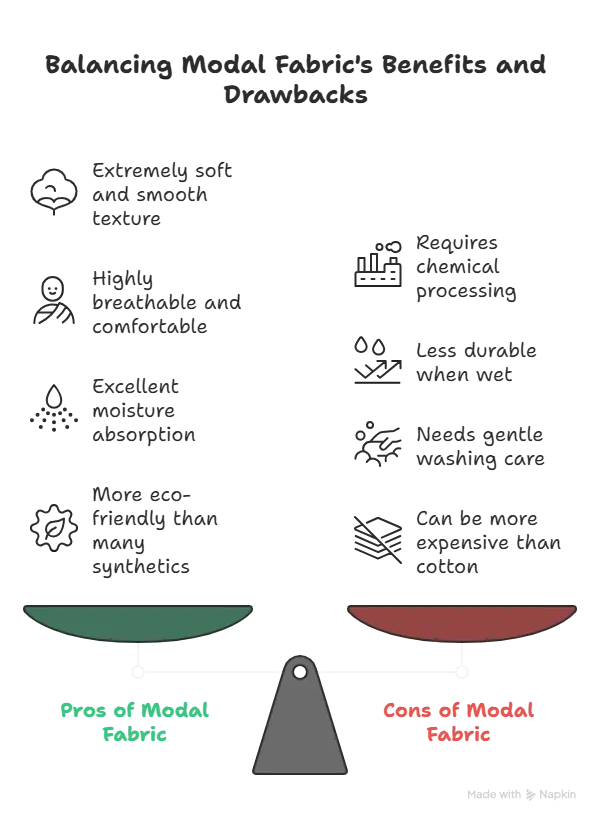
- Soft & Silky (Pro): Modal is extremely smooth and luxurious -softer even than cotton. Breathable & Moisture-Wicking (Pro): It is light and sweats off to keep you dry.
- Durable (Pro): Modal does not pill, shrink, or wrinkle as easily as most fabrics. Garments often last longer.
- Biodegradable (Pro): Modal can biodegrade under the correct environment because it is made of cellulose, unlike plastics.
Disadvantages
- Chemical Processing (Con): It is made by using chemicals that are toxic (carbon disulfide, etc.), which are dangerous when not contained completely.
- Care Required (Con): Modal will become smaller or become shape-less when washed or dried in excessively hot conditions. It usually requires soft laundering.
- Price (Con): Modal fabric is usually more expensive in comparison to cotton or polyester. Modal of high quality (e.g. TENCEL(R)) is more expensive to produce.
Common Myths
- ❌ Modal is completely synthetic – False: Modal is not made out of petroleum, it is made out of natural wood pulp. It is not a plastic, it is semi-synthetic.
- ❌ Modal is 100 percent natural – False: Despite being a plant based product, modal needs chemical processing. It isn’t purely organic fiber.
- ❌ Modal = Polyester -False: Polyester is manufactured using oil (plastic). Modal is made of wood and is like cotton or silk.
- ❌ Modal will not shrink -False: Modal may shrink under the influence of high temperature. Modal should always be washed in cold water.
- ❌ Modal is by default eco friendly – False: Sustainability is a matter of production. Modal (certified wood, closed-loop) is the only eco-friendly one made responsibly.
Conclusion-
Then modal is a synthetic fabric? The answer is clear. Modal is not fully synthetic. Rather it is a semi-synthetic textile composed of natural cellulose and treated with chemicals.
Thus, modal is the most suitable between the two worlds. It is soft like the natural fibers but then there is the performance of the synthetic fibers. Consequently, it has gained popularity in the modern textiles.
FAQs
No. Modal is not composed of plastic but of wood pulp (beech trees). It is a recycled cellulose fiber, thus it is not made of petroleum-based plastic.
Yes. Modal is extremely soft and hypoallergenic. Research identified fewer allergic reactions of modal than synthetic fabrics, and thus is generally soft against sensitive skin.
Generally yes. Modal is cellulose based (similar to cotton), therefore will biodegrade in the right environment. Please note that dyes or finishes may have an impact on it, however, the fiber itself is naturally degradable.
Yes. Modal is in fact a type of rayon (commonly referred to as high-wet-modulus rayon). Imagine it is a higher quality, firmer viscose rayon.