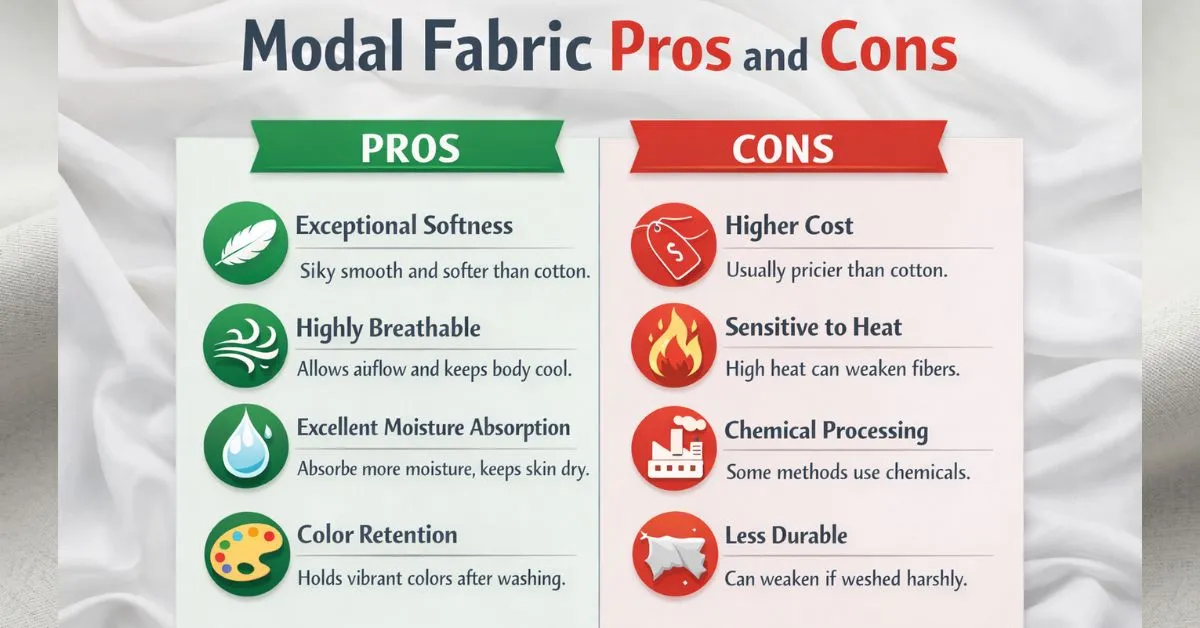

Modal is a semi synthetic cellulose fiber created out of beech wood pulp. It has been valued as a material that is very soft, has smooth hand feel and is very breathable. Compared to cotton, modal wicks moisture and resists wrinkling more effectively. The semi-synthetic features and the renewable characteristics provide it with a special combination of engineered performance and natural comfort. A brief overview of the main advantages and disadvantages of modal fabric can be displayed in the table below:
| Pros | Cons |
|---|---|
| Luxuriously soft and silky | Generally more expensive than cotton |
| Highly breathable and moisture-wicking | Can weaken or shrink with high heat |
| Excellent color retention (fade-resistant) | Some manufacturing processes can pollute |
| Stronger and smoother than viscose (rayon) | Slightly less durable if over-wet |
| Sustainable (from renewable beech trees) | Requires gentle care (cool wash/dry) |
What Makes Modal Fabric Unique?
Semi-Synthetic Cellulose Fiber
The name of the product is modal which is a regenerated cellulose fiber thus semi-synthetic. Plant cellulose is dissolved by manufacturers and then spun into fibers. In the case of modal, the fibers are primarily beech trees. Consequently, it has modal lies between a synthetic and natural fiber in origin. It is a blend of natural fiber breathability, synthetic strength and fabric softness.
Beech Tree Origin
The raw material at Modal is beech wood pulp. Beech trees are rapid, need minimal water or pesticides and are therefore a comparably sustainable source. Debarking and chemical pulping of wood are done in order to extract cellulose. Since modal is made of hardwood (as opposed to cotton or generic wood), the fibers are finer and more uniform. This special source distinguishes modal among other textile fibers.
Smooth Fiber Structure
Modal fibers are extremely smooth and fine. To achieve a uniform strand, the silky cellulose molecules are extruded and stretched during production, thereby creating a silky, uniform strand. This natural sheen and fluid drape are attributes of modal that result in a smooth fiber formation. Actually, modal can be compared to silk: it is smooth and can be said to be slippery against the skin causing less friction and pilling.
High Moisture Absorption
Modal is extremely absorbent. Kapsil can absorb about half the moisture that cotton fibers absorb. This in practice implies that modal wicks are highly effective in sweating away the body, and so skin remains dry and cool. Modal is also cool to touch and quick drying, because of high moisture absorption. As an illustration, modal textile is used in underwear and activewear as modal fabric draws moisture away and allows it to evaporate.
Soft Drape and Elasticity
Modal-clothing is soft flowing and draped. Fine homogenous fibers also enable the fabric to hang easily and also to mould to the body. Besides, modal fibers are somewhat stretchy, particularly when mixed with a small portion of elastane or cotton. This provides modal clothing a loose, stretchable fit that moves with you. In total the drape of modal is smooth and the feel of the same is extremely soft- features that render this fabric to be luxurious to the touch.
Modal Fabric Advantages
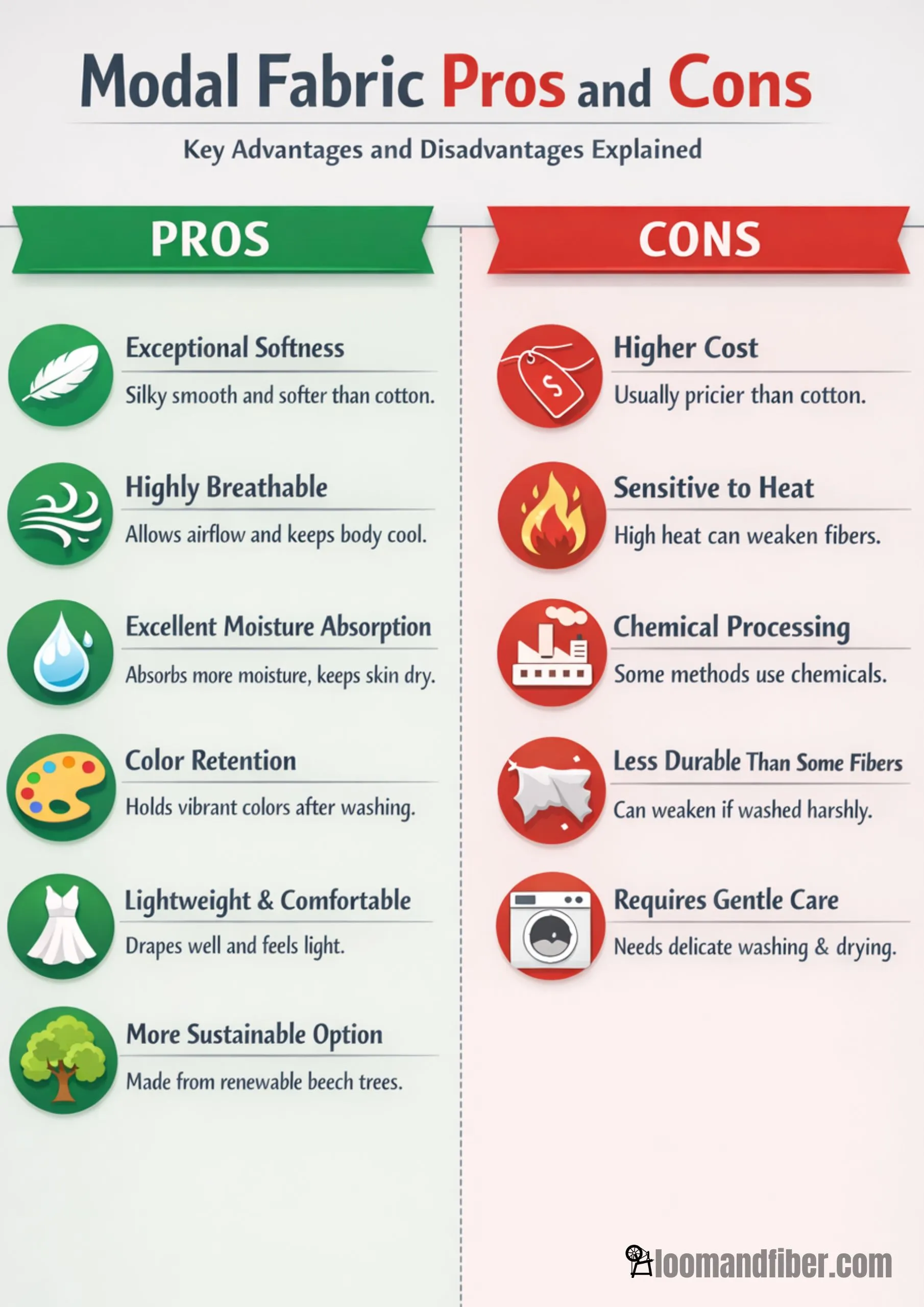
Exceptional Softness
The most outstanding characteristic of the modal is an incredible softness. It is soft and smooth unlike most cotton. It can be stated that people refer to modal garments as a second skin. Modal is used on underwear and loungewear because it contains fine, low-friction fibers and, therefore, is associated with comfort.
High Breathability
Modamuslin is highly breathable. It permits free circulation of air in the material hence heat and moisture is not trapped on the body. Such breathability makes you cold in hot weather or during exercise. Modal is a very comfortable garment worn by many wearers in summer since it wicks sweat and is airy thus a very good garment to wear in summer as a lightweight one.
High Absorption of Moisture
Modal absorbs water extremely well with a maximum of 50-percent more absorption capacity compared to cotton. It rapidly removes perspiration off the skin and traps it in the fibers. This is a property that makes your skin dry, as well as makes it less clammy. Due to its moisture-wicking capability, modal is a popular choice in clothing used in exercises, as well as sleepwear and other apparel where being dry increases comfort.
Shrink Proof and Pilling Proof
Modal maintains its form with the cycles of the wash. It does not shrink very easily as compared to normal viscose or untreated cotton. Similarly, it is difficult to make pills with its smooth fibers. That is, the modal clothing remains smooth and longer before appearing fuzzed-up. This would translate to your modal shirt/dress looking crisp and neat after every wash.
Retention of Color and Resistance to Fade.
The dyes attach or bond well onto modal fibers and the colors are vivid with time. Actually, modal garments do not yellow or fade during washing. According to the many users, modal is able to maintain its appearance of being in great condition even after being used multiple times. If you are fond of deep colors, you will be glad to find out that modal can be colored evenly and much longer than a regular cotton.
Lightweight and Drapes Well
Modal fabric is lightweight, and this is also a factor contributing to its comfort. It is gracefully suspended on the body and not heavy and hard. Due to this fact, modal suits dresses, blouses, and sportswear in which a liberal fit is desirable. It can be worn as modal tops or exercise clothes all day without weight so it is good as an everyday item and as well as an exercise article.
More Eco-Friendly than much of the synthetics
Modal is also made of renewable beech trees unlike petroleum-based synthetics. These trees reproduce fast and they grow under little irrigation. In the case of producing modal in a closed loop system, most of the chemicals and water are recycled. Consequently, high-quality modal (such as the TENCEL Modal developed by Lenzing) has a significantly smaller environmental impact compared to generic polyester. All in all, modal can be a more environmentally-friendly option, particularly in the comparison with petroleum-based fabrics.
Modal Fabric Disadvantages
Higher Cost Than Cotton
Due to this complexity of modal production, modal fabric tends to be more expensive than cotton. It is a high quality material because of Beechwood pulp and the specialized manufacturing process (solvents recovery). In the case of simple daily necessities, modal objects will cost more than plain cotton ones.
Can Weaken Under High Heat
Modal fibers are not resistant to high temperatures. When it is washed or dried in a high temperature, the fabric may lose its strength and may even shrink. Practically, modal clothes should be washed in cold water and not dried in a hot manner. The modal fibers may be damaged by excessive heat and hence most of the care labels advise against excessive machine washing or hand washing. Modal can be distorted or lose elasticity with time in a laundry set that is too hot.
Environmental Issues (in certain Processes)
All modal is not as eco-friendly. Toxic chemicals such as carbon disulfide (CS2 ) can be used in generic modal production. There is also a problem of unsustainable sourcing of wood by some manufacturers: modal pulp is reported to be sourced in endangered forests. When a factory fails to find a proper way of capturing its chemical solvents, it may contaminate water and air. Briefly, modal processing, which is conducted unscrupulously, can be detrimental to the environment. Buyers interested in sustainability would seek certified modal (as in the case of Lenzing, its TENCEL™ Modal) produced in closed-loop mills.
Not as Strong as some natural fibers
Even though modal is very strong, it is not as strong when wet as certain fibers such as rayon that are treated to be strong. Cheaper modal rapidly loses resilience when soaked many times or used under high stress. Extremes In severe instances, the modal may end up tearing or stretching in case it is frequently wet or roughly washed. Comparatively, thick cotton canvas or high-tenacity linen could last longer than modal when it gets hard to wear. Therefore, modal can not be the most suitable in highly rugged applications.
May Require Gentle Care
Generally, modal clothes are sensitive. Generally, laundry tips entail delicate wash, cold water, and boycotting fabric softeners. It is also not advisable to wring or tumble dry at high temperature. Practically, working with modal softly can assist in maintaining its shape and the softness. This additional care can be inconvenient to some people in their day-to-day life.
Modal Fabric vs Cotton: Which Is Better?
Softness
Modal is silky and smoother as compared to cotton fabrics. Cotton is soft and a bit coarse. Thus modal tends to be the winner in softness.
Breathability
The two fabrics are very comfortable and have good airflow. However, modal absorbs in a better way. It is therefore cooler than it usually is in hot weather.
Durability
Cotton is naturally resistant and robust. Modal is robust yet has to be washed mildly. Thus, cotton can be used in intensive service.
Price
The modal fabrics are usually more expensive than cotton. Production of modalities is very complicated. Consequently, modal garments are relatively costly.
Modal vs Rayon vs Viscose
Modal is part of the rayon fiber group that consists of viscose and rayon. Nevertheless, modal is subjected to further processing that enhances the strength and the softness of the fiber. Consequently, modal fabrics are smoother and breathier than the conventional viscose fabrics.
Modal vs Polyester
Polyester is a complete synthetic fiber which is made out of petroleum. It has a highly durable and wrinkle-resistant feature, but it is not as breathable. Instead, Modal is more comfortable and soft. Thus, modal is frequently selected by the people as the skin-contact attire.
When Should You Choose Modal Fabric?
- Underwear: Modal is ideal as an undergarment and lingerie due to its softness and ability to wick moisture. You will like the second-skin feel and comfort of modal.
- Sleeps: Modal will keep you cool and dry throughout the night, in pajamas or nightgowns. It is breathable and thus allows you to sleep without overheating.
- Activewear: In the case of yoga pants, workout tees, or gym shorts, modal does a good job. It is loose and manages sweat and therefore suits low to moderate intensity sports.
- Bedsheets: These are modal sheets that are smooth and flow like luxury fabrics. They are soft to touch and controlling the temperature and provide an alternative to cotton sheets which are softer.
Read More>> What does Modal Fabric Feel like on the skin?
When Should You Avoid Modal Fabric?
- Heavy-Duty Workwear: Do not use modal in jeans, overalls, or work uniform. It is not too hard to be used roughly. That is more suitable with cotton duck canvas or polyester blends.
- Hot Dry Cleaning Areas: Are you used to hot wash/dry cycles (such as using high heat to dry sheets or high heat dry) modal will be affected. In this case, use cotton or polyester that is heat-tolerant.
Is Modal Fabric Good for Sensitive Skin?
Yes. Modal is very tender to the skin. It has ultra-soft and silky fibers that are non-irritating and hypoallergenic. Due to sensitive skin, modal is far less irritating or scratching to a lot of individuals than the other fabrics. The dermatologists frequently prescribe modal (or modal blends) to delicate-skin apparel and underwear due to the smooth feel.
Is Modal Fabric Eco-Friendly?
Modal is green, however, it relies on manufacture. Even the fiber itself is a product of renewable beech trees, which require minimum water or pesticides. The most sustainable modal (e.g. the Lenzing TENCEL TM Modal) is produced in closed-loop mills which re-use solvents and produce less waste. Certified modal is biodegradable and is frequently accompanied by FSC/PEFC forest certifications. Nevertheless, there are dangerous chemicals involved in uncertified modal production. Concisely, select certified modal in case sustainability is crucial.
Does Modal Fabric Last Long?
Modal is durable but not indestructible. Its fibers are strong even in wet conditions and therefore modal items hold their shape longer as compared to traditional rayon. Modal garments were made to last a long time when well taken care of. Nonetheless, modal cannot withstand high temperatures and might stretch in case it is roughly handled. Among the tricks the wash modal should be in the cool water and dried at the low heat to maximize the lifespan.
Generally speaking, modal endures no shortcut than cotton in ordinary situations. Its ability to resist pilling and shrinkage in fact makes it appear younger. Gently made modal apparels as well as sheets will last long.
Conclusion-
Knowing the aspects of modal fabric advantages and disadvantages can enable customers to select the appropriate fabric to be used when they want to be comfortable and at the same time perform. Modal is extremely soft, breathable and absorbs moisture. It is also a gorgeous drapery and holds color. Nonetheless, modal clothes are more expensive than cotton and have to be treated gently. The fibers may also be weakened by high heat. Thus, master works underwear, sleepwear and light clothing. Modal is a comfortable and useful textile as it is produced responsibly and taken care of.
Read More>> Is Modal Fabric Toxic?
FAQs
Modal is more gentle and it is more moisturizing than cotton. Nevertheless, cotton tends to be more durable and cheaper.
Relative to most fabrics, modal resists to shrinking. But over heating in washing or drying can lead to some minimal shrinking.
Yes, modal fabric is such a good summer fabric. It is permeable, light and very moisture absorbing.
Modal fabrics are piling resistant. Nevertheless, bad modal can lead to the formation of small pills.
Modal can be a sustainable product that is made responsibly through certified wood and closed-loop production systems.