

Introduction-
Comparing sateen vs satin, one can be hardly wrong as confusing the two. Anyway, they sound alike and have the touch of luxury. Nevertheless, they are different. To understand the differences between these fabrics is key when purchasing a bedding or clothing or upholstery. To your surprise, none is a type of a fabric, but the type of a weave structure, applicable to various materials.
Sateen has soft and matte surface and is usually made using cotton fibers. Satin, on the contrary, is either silk or synthetic, and it has a silky shiny finish. This guide dissects the essential differences, advantages, disadvantages and preferred uses of the two as well as how to select among the two depending on your requirements.
Key Differences Between Sateen and Satin

Weave Structure (Sateen vs Satin)
Sateen and satin differ due to the fact that they both share a satin weave base but sateen and satin are different based upon the threads that float to the surface. In a sateen a weft (horizontal) thread floats over a number of warp (vertical) threads, normally one warp thread to every four weft threads. This produces a weft face fabric with gently shimmering face. In contrast to that, a satin weave most often has the warp threads floating over the weft (or vice versa) on a similar ratio of 4-over-1. In practice, the real satin tends to be warp-faced, very glossy on the face. The longer threads float on the satin making it smooth and a very shiny surface. Sateen has a weft float and is cotton-friendly; satin has a warp float and is filament-friendly. Such structural variations influence the manner in which the light reflects on the cloth and the draping of the cloth.
Read More>> Best GSM for every Fabric type.
Fiber Composition (Sateen vs Satin)
Another large contrast is the fiber content. Most sateen fabric nearly always consists of cotton, or blends. It is soft, breathable and has cotton yarns (usually Egyptian or long-staple). Sometimes to change the properties rayon or polyester can be used in sateen but the commonest is sateen that is pure cotton. Satin, on the other hand, tends to be made of long filament fibers such as silk or synthetics (polyester, nylon, or rayon). Originally satin referred to silk satin, nowadays most satin sheets or satin dresses are of shiny polyester satin or nylon satin. An example can be a bridal satin which is more often than not a silk to give it that rich feel whilst regular satin based garments can be made out of polyester in order to make it less expensive. In summary, the sateen is cotton fabric + satin weave and satin is filament yarns (silk or poly) + satin weave. This is not the only difference in fiber: cotton sateen is breathable, silk or poly satin might feel more slippery and cold.
Texture & Feel (Sateen vs Satin)
Sateen and satin both feel smooth, but the experience is distinct. Sateen has a soft, slightly lustrous surface that feels warm and cozy. Its cotton base gives it a matte-but-smooth texture. Many describe cotton sateen as velvety or like a lightweight flannel with sheen. It isn’t as shiny as satin; instead, it has a subdued glow. By contrast, satin is ultra-slick and glossy. The satin weave allows light to skim the surface, making it highly reflective and silky to the touch. Satin fabrics drape fluidly and feel nearly liquid against the skin. In practical terms, satin feels “slippery” and cool, while sateen feels “soft and a bit thicker.” For example, a satin pillowcase will have a mirror-like shine and feel very slick under your hand, whereas a sateen pillowcase will appear softly shiny and slightly more textured. Both are smooth, but satin’s gloss and slickness stand out.
Durability & Care (Sateen vs Satin)
Sateen lasts longer as it consists of cotton foundation and is normally able to be washed by machine.
Satin, particularly silk satin is fussy and is commonly hand washed or dry-cleaned.
Sateen is soft, but tough, able to hold up to constant wearing.
Satin clothes should be handled with more care in order to avoid snags.
Sateen can be used everyday, whereas satin is more special and will be worn only on special events.
Sateen vs Satin Sheets: Which Is Better for Everyday Sleep?
Concerning the bedding, the question of sateen vs satin sheets does not merely revolve around the shine anymore, but it literally depends upon the quality of sleep, comfort and the ultimate satisfaction. Both fabrics are smooth to the touch but their act in use at night is quite different.
Sateen Sheets
It is composed of cotton fibers in sateen sheets and is normally a product that is comfortable and breathable. The cotton bottom enables the free flow of air that aids in controlling body temperatures at night. This renders sateen a perfect choice to individuals who have much sleep or those who change their positions during the sleeping process. It is also a good fabric that absorbs moisture, therefore leaving you dry and comfortable.
Satin Sheets
Satin sheets, however, are normally woven of silk, polyester or rayon filaments. They are extremely smooth and luxurious yet they do not absorb water as well as cotton. Consequently, the satin sheets may become warmer, and particularly a bit clammy, particularly when the climate is humid or warm.
Best Fabric for Hot Sleepers: Staying Cool and Comfortable All Night
In the case that you usually wake up hot or sweaty, the right fabric to use among hot sleepers can significantly enhance your sleep. Breathability, Water management and warmth are some of these features which contribute to the coolness that you experience during the night.
Sateen Sheets for Hot Sleepers
Sateen is a type of cotton that can be ranked among the best materials when dealing with hot sleepers as it has the ability to move the air and remain smooth. The cotton fibres are natural and avoid trapping any heat and absorb any perspiration that helps keep the sleep temperature at a balanced rate. Sateen feels a bit heavier than percale however it still works well in the warm and moderately wet conditions.
Satin Sheets for Hot Sleepers
Hot sleepers should not be using satin fabrics, particularly polyester or nylon based ones. These artificial fabrics are not very good in dissipating heat and are not effective in absorbing moisture. It can make it a warm and slippery surface that would be uncomfortable during long sleep periods. Nevertheless, silk satin can be used as an alternative, because silk is naturally breathable and it regulates the temperature of the body however it is also very expensive and it needs attentive care.
Read More>> Which GSM Fabric is Good for sleeping Sheets?
Pros and Cons of Sateen
Pros of Sateen
- Really breathable and comfortable, hence suitable in all seasons bedding.
- Wrinkle-free and smooth in comparison to plain-weave cotton.
- Is warm and snug, very nice in cool weather.
- They may be of natural cotton which is skin-friendly.
- Less trouble to take care of – most of them are machine-washable and do not wear out so easily.
Cons of Sateen
- Sateen does not have the glossy shine that satin has.
- There is a likelihood of it pilling with time, particularly when it has been washed regularly.
- A little heavier, less airy than satin.
- Might become a little rough over time.
- Most likely to wrinkle than satin.
Pros and Cons of Satin
Pros of Satin
- Comes with the shiny high gloss finish in a luxurious and rich outlook.
- The surface is non abrasive as it is smooth on the body and hair, and this minimizes friction.
- Ideal in formal attires, lingerie, as well as accessories.
- Very light, flowy- ideal evening-wear.
- Obtainable in the forms of natural and synthetic ones.
Cons of Satin
- Slippery and can slide off body or off the bed.
- Less breathable, especially when they are composed of synthetic materials.
- Can be broken or easily caught and has to be handled with care.
- Requires special cleaning- must be hand washed or dry clean only.
- Satin might present the issue of watermarks and wrinkling when carelessly handled.
Best Uses for Sateen vs. Satin
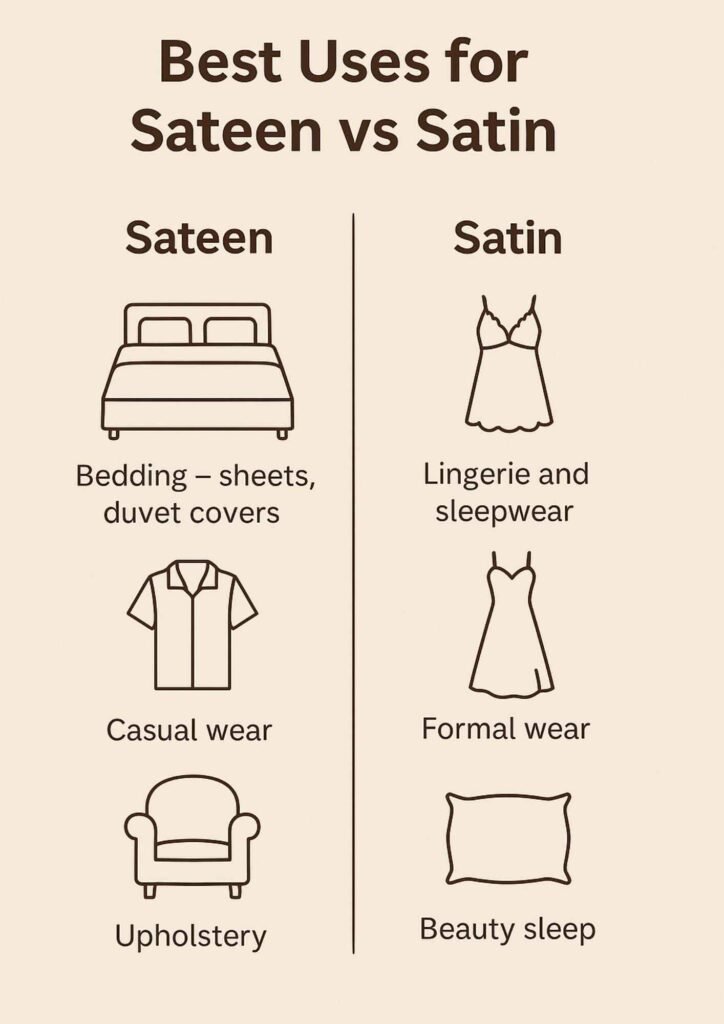
Sateen: Ideal for bedding (sheets, duvet covers, pillowcases) because of its softness, warmth, and easy care. It’s also great for casual apparel like summer dresses or lounge pants, and for upholstery/drapery where a soft sheen is desired. The cotton base makes it comfortable for everyday use.
Satin: Best used in lingerie, nightgowns, and lingerie thanks to its smooth feel. It shines in formal wear like evening gowns, blouses, and ties for that lustrous look. Satin is also common in pillowcases (for beauty benefits) and accessories. Outside of fashion, satin appears in luxury linings and upholstery for curtains or decorative pillows.
Which is Better for Bedding: Sateen or Satin?
Sateen vs Satin Sheets (Breathability, Comfort, Maintenance)
For everyday bedding, cotton sateen is usually the better choice. Cotton fibers allow air to circulate, making sateen sheets more breathable. They feel soft and cozy, especially in cool weather. Because sateen is machine-washable, maintenance is simple (cool wash, low dry). In contrast, satin sheets (often made of polyester or rayon) tend to trap heat and may make hot sleepers uncomfortable. They can also wrinkle easily and might need delicate washing. Sleep experts note that satin’s slippery feel does not wick away moisture as well as cotton. Therefore, for a good night’s sleep, choose sateen sheets (breathable, durable) and reserve satin sheeting for occasional or decorative use.
Satin Pillowcases for Hair & Skin
Although satin sheets are not the best option to use every night, satin pillow cases have become the popular trend of beauty purposes. The high gloss satin makes the friction on your hair and skin lesser. Researchers and scientists note that satin (and more precisely silk satin) can prevent hair breakage and frizziness due to allowing hair to slide over itself with ease. It also reduces creases in the face: satin holds less water as compared to cotton and therefore, keeps your skin oils and moisture intact. Concisely, satin or silk pillow-cases may give rise to the so-called good hair days and fewer wrinkles. To achieve the health as well as aesthetic benefits, our advice is to match your bedding with cotton sateen sheets to sleep on and satin pillowcase to enhance beauty.
Which is More Affordable: Sateen or Satin?
Sateen (Cotton-Based Fabrics)
- Compared to the silk satin, sateen is mostly cheaper.
- High quality sateen costs less than the majority of commercial satin. It is economical in terms of cost to people in need of softness and strong.
- Most suitable to purchase mid-way priced high-quality sheets.
Satin (Silk vs Polyester)
- The most costly silk satin is because it is made of luxurious origin.
- Polyester satin is affordable, however, it might not be breathable.
- Rayon satin is a product which has an intermediate range price.
- The price of satin varies a lot depending on fiber content and quality.
Common Misconceptions
Satin is never silk – Satin is a weave and not a fiber. It is either polyester, rayon or nylon.
Sateen and satin are the same – They are different in both texture and fabric (cotton or silk/synthetics).
The second distortion is that satin is more durable- the truth is that a sateen is almost always useful in everyday cases.
Anything glossy is satin – The gloss can be weave or finishes.
Sateen slickens” It is lightly sheeny, but not quite shiny like satin.
How to Choose Between Sateen and Satin
- Climate: During warm climates (or when using a hot sleeper), sateen (cotton) is the better fabric, which allows ventilation. A heavier cotton sateen can be warm at night especially when you assume it feels chilly. Satin (particularly synthetic satin) functions better in colder weather, or in evening wear.
- The bedding purpose: Cotton sateen is a good choice in bedding, being comfortable and easy-care. In garments or decor, satin can be applied where one requires a silky hang (formal dresses, ties, expensive curtains). In case you are conscious of hair and skin, satin pillow cases are a good idea.
- Budget: In the case where you are working on a small budget, then polyester satin or cotton sateen is both cheap. As a luxury, there is silk satin or fine Egyptian cotton sateen. Choose whether sheen (satin) or softness (sateen) is worth paying the additional price.
- Individual Preference: Take into consideration the feel and aesthetics you are fond of. Are you interested in something shiny and flashy (satin) or homey and comfortable (sateen)? Satin is considered by many people to be far more elegant and sateen more homely. It is also worth bearing in mind your care routine: hate special washing? Go robust sateen direction.
Care & Maintenance Tips
Sateen:
- Machine wash on cold or gentle cycle
- Avoid high heat to prevent weakening the fibers
- Use mild detergent—no bleach
- Tumble dry on low or air dry
- Iron on medium heat if needed
Satin:
- Hand wash or use a delicate machine cycle
- Always air dry—never tumble dry
- Use a mesh bag to protect the fabric
- Avoid twisting or wringing satin
- Store flat or hang to avoid creases and snags
Conclusion-
Knowledge of the difference between satin and sateen will enable you to select the type of fabric that will suit you. Overall, sateen (cotton weave) is breathable, soft, and comfortable to wash- nothing more fitting an everyday garment or bed sheets than this one. Satin (filament weave) is smooth and rich-looking, perfect to be used in formalwear, lingerie and beauty pillowcases. Usually, sateen is longer lasting and more merciful, and the satin has silkiness that cannot be matched. The most appropriate one should be picked according to the situation: sateen shines on cuddly bedclothes and casual stuff, whereas satin is great on fancy dresses and silk pillowcases. Look at climate, intent, and budget: most of the time cotton sateen runs ahead because it is comfortable and practical, whereas satin is luxurious and stylish.
FAQs
Generally, no. Cotton sateen breathes better and wicks moisture, so it tends to be cooler for sleepers. Satin (especially synthetic) can trap body heat. However, heavy winter sateen can feel quite warm.
Sateen is typically more durable for everyday use. It can be machine-washed regularly. Satin (especially silk satin) is less durable, prone to snags, and often requires gentle handling.
To the casual eye, yes – cotton sateen has a subtle sheen that can mimic satin at first glance. However, it is not as glossy. Under light, satin’s shine is much brighter, whereas sateen’s luster is more muted. Sateen will have a soft matte glow; satin will gleam.