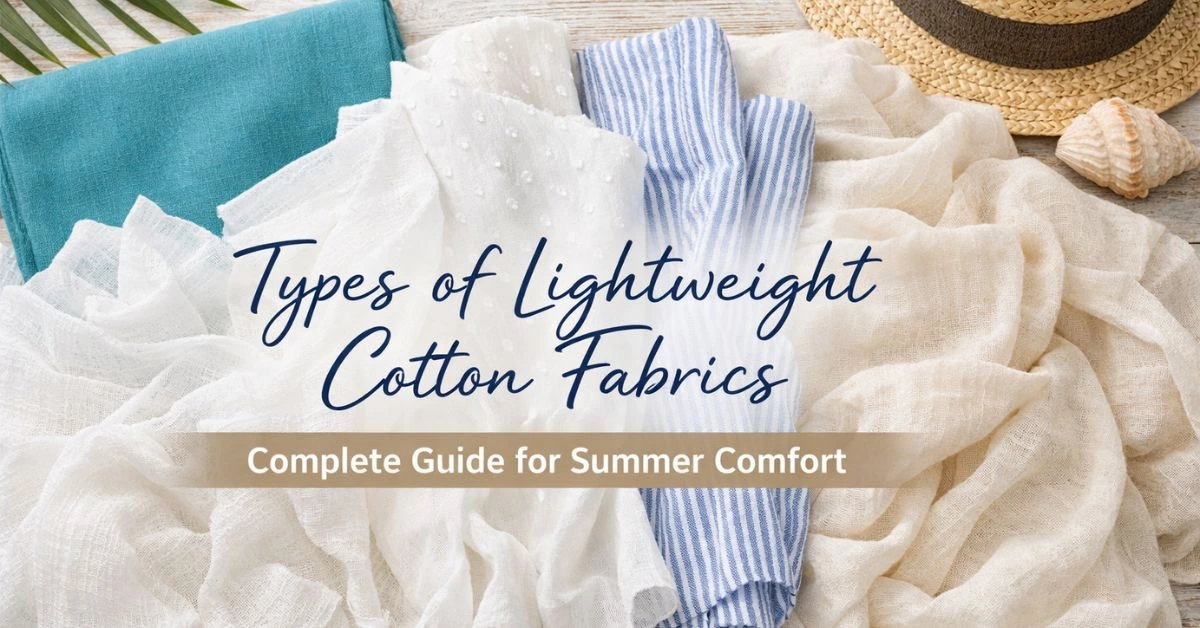

Lightweight cotton fabrics are thin, airy weaves designed for warm weather comfort. These fabrics are generally loosely woven with fine yarns, giving them excellent breathability, a soft hand, and often a semi-sheer look. Common types include cotton lawn, voile, muslin, cambric, poplin, seersucker, cotton gauze, batiste, and Swiss dot. Each has a unique texture and use: for example, cotton lawn is a finely woven, silky-smooth cloth, while cotton gauze is open-weave and ultra-soft. Together, these lightweight cotton fabrics keep you cool and comfortable in summer.
Common Types of Lightweight Cotton Fabrics:
- Cotton Lawn – Very fine, high-thread-count plain weave; smooth and cool.
- Voile – Semi-sheer, plain weave with high twist yarns; soft and flowing.
- Muslin – Loose, open weave with thicker yarns; coarse texture, very breathable.
- Cambric (Batiste) – Tightly woven, smooth plain weave; crisp and slightly opaque.
- Poplin – Crisp plain weave with ribbed texture; sturdy and lightweight.
- Seersucker – Puckered plain weave; creates air gaps, resists wrinkles.
- Cotton Gauze – Very open, loose weave; ultra-light, airy and gentle.
- Batiste – Fine, dense plain weave; extremely soft and semi-opaque.
- Swiss Dot (Dotted Swiss) – Lightweight cotton with raised dots; sheer and decorative.
| Fabric | Breathability | Softness | Transparency | Durability | Price (General) |
|---|---|---|---|---|---|
| Cotton Voile | Very high (airy weave) | Very soft, drapey | High (semi-sheer) | Moderate | Mid–premium |
| Cotton Gauze | Very high (open weave) | Very soft, plush (double-layer gauze) | High (sheer, single-layer) | Low–moderate | Affordable–mid |
| Cotton Batiste | High (fine yarns, open structure) | Extremely soft, crisp feel | Moderate (more opaque) | Moderate | Premium |
| Cotton Lawn | High (fine yarns, balanced weave) | Smooth, silky hand | Moderate (denser than voile) | High | Premium |
| Cotton Poplin | Moderate (tight weave, dense threads) | Crisp and smooth | Low (opaque) | High | Mid-range |
| Swiss Dot | High (light weave under dots) | Soft with raised texture | High (sheer base fabric) | Low–moderate | Mid–premium |
| Cambric | Moderate (tight weave) | Very smooth, crisp | Low (opaque) | Very high | Mid–high |
| Muslin | Very high (loose, open weave) | Coarser surface, soft feel | Moderate | Low–moderate | Affordable |
| Seersucker | Very high (puckered texture) | Soft but structured | Moderate | High (fabric tension) | Mid-range |
What Makes Cotton Fabric Lightweight?
There are multiple reasons for the lightweight airy feel of most cotton fabric.
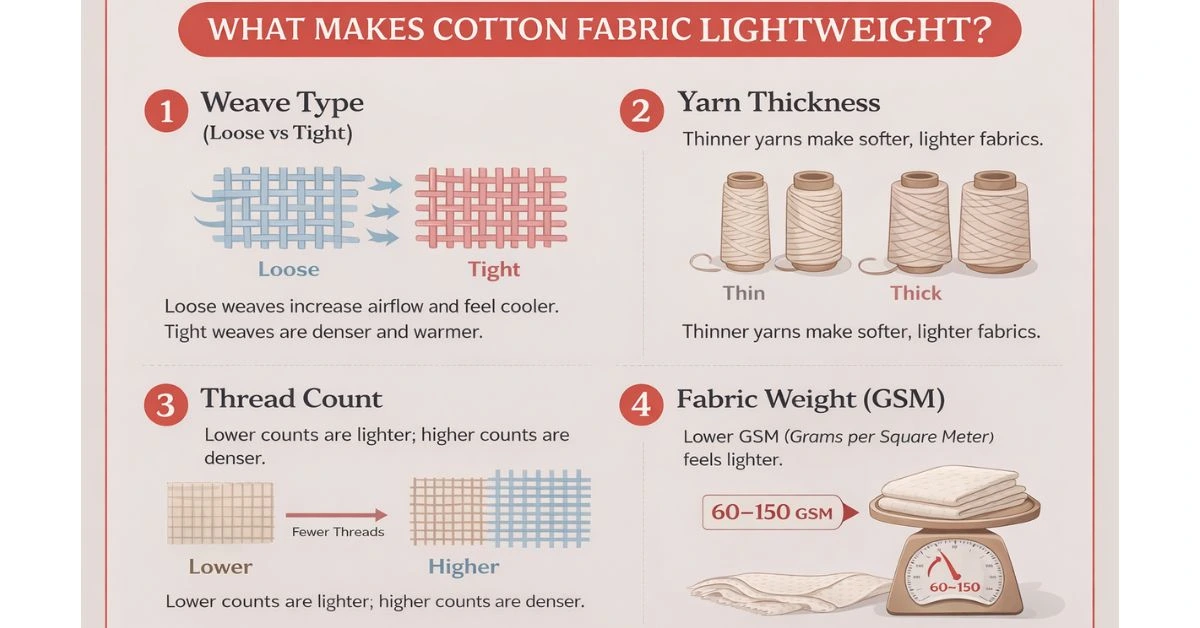
weave type
Open weave cotton fabrics allow more air through than their tighter woven cotton counterparts. Muslin and gauze both use thick yarns and an open weave to create the lightweight breathable feel of their fabric. Pack more threads per inch of fabric and create a heavier feel of fabrication, such as in the case of poplin or cambric.
yarn thickness
Yarn weave thickness and type influence the fabric. Voile and batiste use thin, fine yarns, while traditional muslin is made of thicker yarns. This is why traditional muslin has more fabric bulk, while thin, high-count yarns is made of lightweight and soft material than thicker, coarse yarns, is made of heavier and more textured fabric.
thread count
Increased thread count affects the fabric’s density. A high thread count fabric may feel soft, despite the added weight, while a low thread count fabric an open weave may lack the smooth finish of the fine fabric. As an example, cotton lawn is a lightweight fabric despite having a high thread count that gives it a smooth feel.
fabric weight (GSM)
Finally, GSM or Grams per Square Meter. A fabric’s weight or GSM is a direct correlation to the thickness of the fabric. As an example, Voile or gauze typically have a thickness of 60 to 100 GSM, while in bedding a cotton sheet may have a thickness of 100 to 150 GSM. The lightweight cotton fabrics have a GSM of less than 100.
Types of Lightweight Cotton Fabrics
Cotton Lawn
Lawn is a very fine and smooth plain weave with a high thread count. Lawn is softer and lighter than poplin (yet more opaque than voile). The silky texture makes it perfect for summer wear. The fabric drapes nicely which is more hot weather and summer season appropriate. The fabric maintains airflow and balances Durability wear (Hot Weather). Maintenance is very minimal.
Cotton Voile
Adding to a long list of possibly confusing fabrics, a true voile is not a weave, but a fine, semi-sheer plain weave. The term voile, which means “veil,” reflects its fabric texture. Voile is made with highly twisted fine yarns and is designed to have a soft, flowing feel. It is superb at, and ideal for, summer blouses, flowing drapes, and lightweight scarves & sheer curtains. Voile is lightweight, semi-transparent and is keeps the wearer feeling cool.
Cotton Muslin
Muslin is made with a plain weave and thicker yarns. It is inexpensive and it is very easy to sew and, historically, Muslin was used as a very low cost Mock Up fabric. Muslin is very coarse and has a slightly matte, and very Plain (with gaps in the weave) but it is somewhat sheer and highly Wrinkles . It is used for mock up dressmaking and summer tops. Muslin is also used for household items like tea towels and when used in layers it is ideal for baby swaddling.
Cotton Cambric
Cambric is a woven fabric that is light in weight, but is fine and smooth to the touch. While lighter and finer than lawn, it is opaque and is a little crisp to the touch, but soft and gentle against the skin. Cambric is very classy but is also one of the most absorbing and moisture wicking summer fabrics. It is a traditional classic fabric to use for dress shirts, light dresses, and lingerie. It is also very durable.
Cotton Poplin
A tight, plain weave with a subtle ribbed texture created by fine warp and thicker weft yarns. Poplin is smooth and medium-weight: crisp enough to look neat, yet still breathable. It’s widely used for button-down shirts, uniforms and summer dresses because of its clean drape and easy care. Poplin’s durability and opacity are high for a lightweight cotton, so it can be worn in both casual and semi-formal warm-weather garments.
Cotton Gauze
An ultra-light, soft cotton made with a very open plain weave. Gauze feels almost fluffy and feels gentle against the skin. It is highly translucent in a single layer, so double-layer (or “double gauze”) is common to give a soft, pillowy feel. Gauze’s exceptional airiness makes it ideal for summer blouses, scarves, baby swaddles and bandages. Its openness wicks moisture well and stays cool on a hot day, though it wrinkles easily.
Cotton Batiste
A very fine, dense plain-weave cotton. Batiste uses long-staple yarns and can reach about 90 threads per inch. The result is an extremely soft yet crisp fabric with a smooth surface. Batiste is as lightweight as voile, but more stable and less sheer. It has a subtle luster and holds its shape better. This makes batiste perfect for elegant summer dresses, lightweight trousers, scarves, and fine lingerie, where a silky feel is desired.
Cotton Swiss Dot (Dotted Swiss)
Cotton Swiss Dot is a fine cotton fabric (like voile or lawn) that has been embroidered or woven with small, raised dots. It has a smooth, light-weight base fabric with small transparent dots or tufts. It adds a touch of soft texture. It’s commonly used in blouses, dresses and curtains. Swiss Dot is a timeless and classic fabric with a polka dot look! Because of the small dots, the fabric is breathable and cool for hot summer days, allowing for airflow and taking a vintage feminine touch to every garment.
Cotton Seersucker
Cotton Seersucker is a regular plain weave cotton that is made with puckered stripes. Seersucker has a puckered look that is made through slack-tension weaving which creates alternating smooth and crinkled stripes. Because of this, the fabric creates built in air pockets. The fabric will never sit flat against the skin, which makes it easier for the body to cool down and moisture is dissipated greatly. It’s a light weight fabric that has a slightly bumpy feel. It is perfect for summer wear and is great for suits, shorts, dresses and kids clothing in hot climates. It offers a cooling effect of 2-3 degrees which helps it stays fresher longer through sweat.
Lightweight Cotton Fabrics Compared
Breathability:
Gauze and voile are top of the charts for airflow thanks to their open weave. Muslin and Swiss Dot are also top contenders for being super airy. Lawn, batiste, and seersucker have good breathability, while still having a little more body. Poplin and cambric are a little less airy as they are more tightly woven, but are still more breathable than synthetic materials.
Softness:
Batiste and gauze are the softest materials (especially when layered, gauze is the softest). Lawn and Swiss Dot feel smooth and lightweight. Voile is soft and has a flowy, soft drape. Muslin is coarser than the others while poplin and cambric are more firm and crisp than soft, and gauze is a little coarser than poplin.
Transparency:
Voile, gauze, and Swiss Dot are typically consider semi-sheer and if they are unlined, they are see-through. Lawn is less sheer than voile, but is lightly opaque. Muslin can be unlined and be sheer, but sheers are generally not a good idea for the better of it. Seersucker, poplin, cambric, and batiste are mostly opaque due to tighter weaves.
Durability:
With lightweight cotton, poplin and cambric are the most durable because they have a tighter weave than the others. Batiste and lawn are weak in comparison to their weight. Seersucker is good because she is durable and wrinkle-resistant. Muslin and gauze are the least durable as they can rip and wear out quicker and more often when handled with a little roughness of a single layer gauze.
Price:
Batiste and Liberty lawn are more finely woven and this are more expensive (more premium fabrics). With embroidery, Swiss Dot can be a little more expensive than the others. Muslin and cotton gauze are super cheap. Voile, poplin, and seersucker are at a price point which is very standard and very often produced.
Best Lightweight Cotton Fabrics for Hot & Humid Weather
Voile & Gauze
Cotton Voile and Gauze are amongst the most breathable cotton fabrics available. The construction of Cotton Voile is thin, twisted, and sheer, while Gauze has an open, loose weave allowing air circulation to pass freely. They are moisture-wicking and drape away from the body making them ideal for use in tropical and humid conditions.
Lawn & Poplin
Cotton Lawn and Poplin are both fabric types that offer coolness and structure. Cotton Lawn is constructed of a higher thread count and a lighter weight which makes it feel silky, cool, and holds its structural integrity in dresses and blouses. Poplin, being a tighter weave fabric, is constructed of fine yarns and is drapey, but, cool. These fabrics are suitable for garments that are intended to offer airflow whilst maintaining a polished look.
Seersucker
Seersucker properties are designed distinctly with hot and humid conditions in mind. The signature puckering design of Seersucker elevates the fabric away from the skin and allows airflow, making it cooler than its flat cloth cotton counterparts and never clinging. Wrinkles are part of the charm of Seersucker sewing. This is also why Seersucker is a popular choice for damp and humid conditions to remain dry and comfortable.
Best Light Weight Fabric by Use Case
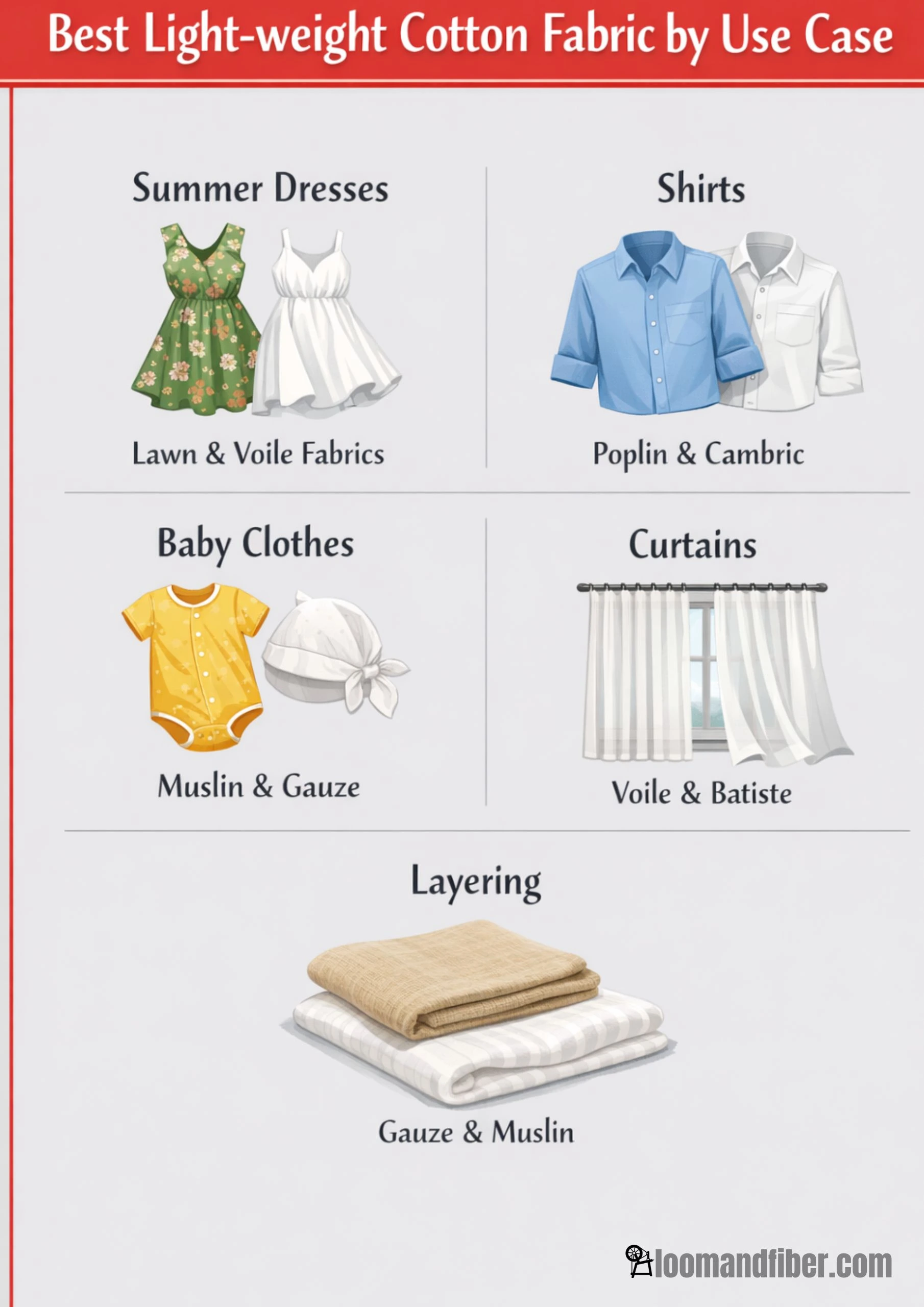
Summer Dresses
- Lawn for softness and structure
- Voile for airy and flowy styles
- Swiss dot for decorative appeal
Shirts
- Poplin for crisp and polished looks
- Cambric for durability and structure
Baby Clothes
- Muslin for softness and comfort
- Gauze for breathability and safety
Curtains
- Voile for light filtering
- Batiste for a premium look
Layering
Muslin for light inner garments
Gauze for breathable layers
Light Weight Fabric’s Price Guide
- Premium Fabrics: Liberty lawn and batiste are considered the best luxury cottons, along with high-end European or Japanese lawn that is silk-like. Embroideries or prints with Swiss dots are also considered premium since the extra weaving involved increases the cost.
- Budget-friendly Options: Muslin and cotton gauze are among the most economical. These are utility-based, simple weaves. Mid-quality lawn and voile are also priced somewhere in the middle. Poplin and seer-sucker are also similarly priced, with the basic (non-designer) versions being quite inexpensive.
- Middle Options: Plain poplin, basic cambric, and standard voile are mid-range, as they are not as inexpensive as muslin but also do not carry high fashion prices. Voiles and poplins with patterned or colorful designs are comparatively more expensive than those that are plain. Overall, Muslin and gauze should be the choices if there is a budget constraint. On the other hand, fashion prints on lawn or batiste would translate to a more expensive option.
Care & Maintenance
- Washing: For washing, always use cold water as warmer water will damage the garment faster. Use baby detergent as harsh detergent will damage the garment further. Wash separately as the dye from the colored items may damage the garments.
- Drying: For drying, it is better to use air drying method or tumble drying with low level temperature as high level temperature will damage the garment. For modern garments, they may be preshrunk but expect some shrinkage, especially when the garments are made of muslin or gauze.
- Ironing: For ironing, set the iron to low to medium level to avoid damage from heating. Seersucker is made to look wrinkled rather than neat and smooth so avoid ironing it. For gauze, even though it may look wrinkled, it may not be necessary to iron it and just use steam.
- Storage: For storage, FOLD the garments and avoid placing the garments on sharp areas. Keep the garments in a closed space to avoid snagging as environments with snagging will damage the garments. Avoid wrapping the garments in a plastic. Allow air to flow freely so fungus does not develop.
- Shrinkage and Wrinkles: Seersucker and poplin are the types of cloths that may be resistant to heavy wrinkling. Voile and gauze will wrinkle and they will look very neat when the cloth is hung. Seersucker and poplin are the types of cloths that may be resistant to heavy wrinkling.
Read More>> How much does cotton shrink?
Common Mistakes People Make
Selecting Sheer Fabrics Without Linings
- Asynthetic gauze and silk are often used
- Otherwise, garments may feel too see-through
Assuming All Cotton Is Breathable
- Some cotton fabrics are thick and warm
- Always check weave and weight
Ignoring Humidity
- Heavy cotton traps moisture in humid weather
- Choose breathable fabrics like voile or gauze
Conclusion-
With the variety of different lightweight cotton fabrics available, it is clear that choosing the right one is an important step that needs to be taken to guarantee comfort. Each fabric deals with different concerns and provide advantages that allow you to stay less stressed and more relaxed. As a result, it is imperative to consider and evaluate your needs based on the raw criteria of your fabric choice. The main three to consider first will be breathability, softness and the overall intended use of the fabric.
Now that the important criteria and the various types of fabrics have been covered, do you have another some more information that is critical to your next summer design?
Read More>> Best Cotton Fabrics for Summer.
FAQs
Voile and cotton gauze are the lightest cotton fabrics available. They feature a loose weave that allows maximum airflow and breathability. Therefore, they are perfect for hot and humid summer climates.
Voile is more breathable, smoother, and lighter than muslin, but muslin provides slightly more durability. Therefore, muslin is better for everyday use, but voile is better for more airy garments.
Voile, cotton gauze, and lawn are the best for the summer because they provide so much comfort to the user. These fabrics allow the circulation of air and prevention of the buildup of heat to the skin. Because of this, even in a very hot climate you will stay cool.
Some lightweight fabrics like cotton and voile gauze are sheer. Because of the thin structure, they allow light to easily pass through. Due to this, depending on the type of garment, you may need lining.