
Introduction to Ramie Fabric
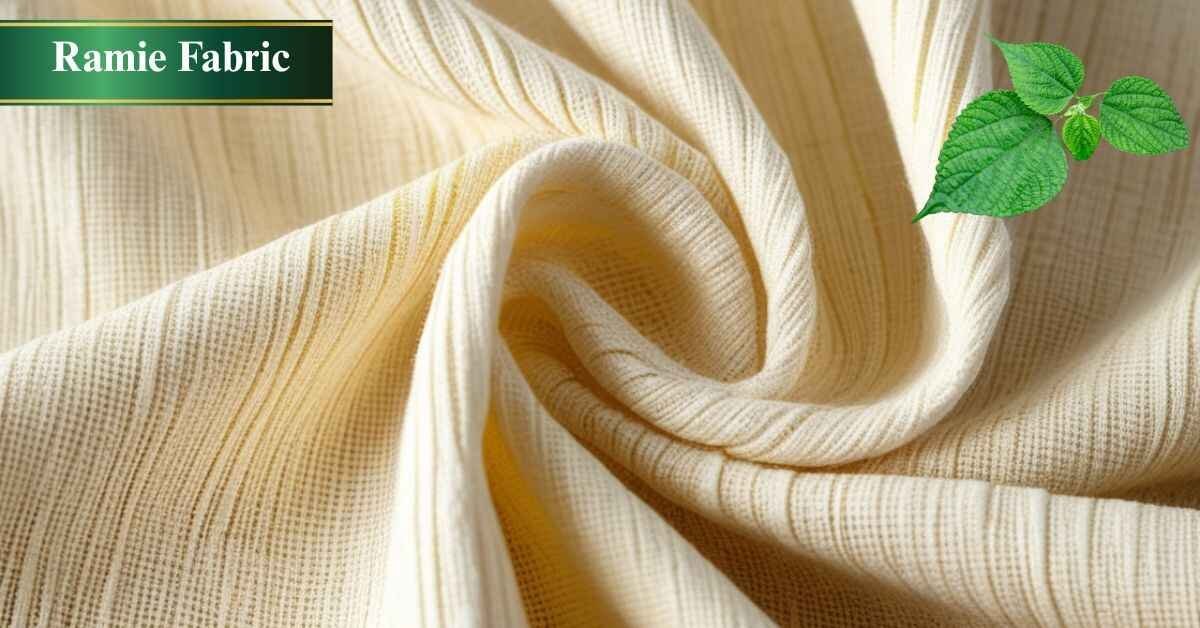
Ramie fabric is derived from natural fibers from the stalks of a ramie plant referred to as Boehmeria Nivea. This sustainable textile has been utilized for fabric production for thousands of years. Its soft and breathable qualities often contribute to comparisons with cotton and linen.
Because of its glossy and silky appearance, ramie is sometimes dubbed “vegetable silk.” The fibers are strong and can be spun into durable and versatile yarn textiles. With growing concerns about synthetic materials, many eco-conscious brands are turning to use ramie.
As the focus continues shifting globally towards sustainability, learning what ramie fabric is aids in making informed choices in fashion and other aspects of life.
Origins & History
The use of ramie dates back to over 6000 years, with ancient civilizations in China first using it during the Eastern Zhou dynasty. At the same time, the Egyptians also used ramie in their mummification process due to its preservation properties. Due to its ancient properties ramie has always been important for it’s durability. Chinese artisans perfected the techniques needed to process ramie fabric and this skill was passed down generations. Today ceremonial robes in Japan and Indonesia are sewn using ramie fabric.
Even though these styles are eastern, ramie fabric is still used today in the west, especially with the emergence of sustainable fashion.
Why It’s Called “China Grass” or “White Silk”
Ramie is frequently referred to as “China grass” for both it’s root and significance in agriculture and textiles within China. The name shows it’s origin, culture, and nature.
Another name bestowed upon ramie is “white silk,” demonstrating its amplifying look. Without undergoing any sort of treatment, ramie’s fibers shine naturally like silk. This enhances it’s luxurious feel along with the silken touch of the fabric.
Such solid names are a proof of ramie’s beauty which makes it stand out among natural textiles.
How Ramie Fabric is Made
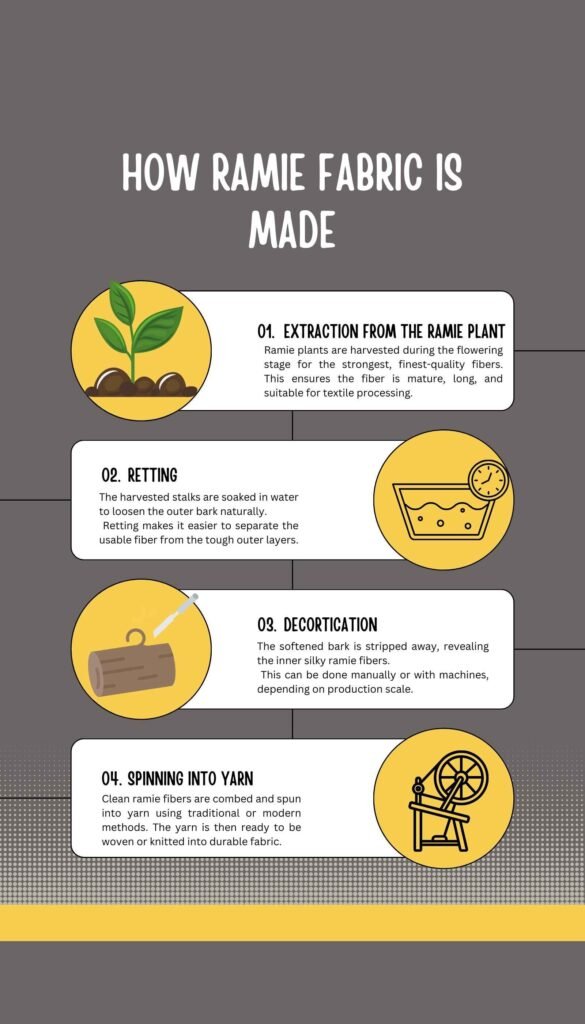
Extraction from the Ramie Plant (Boehmeria Nivea)
The ramie fabric is derived from the perennial plant Boehmeria nivea, which belongs to the nettle family. The stalks are cut in the flowering season as it yields the best quality fibers. The fiber is present in the outer bark of the stalk. It can be harvested multiple times a year because of its rapid growth which makes it an ideal renewable resource. Its farming also supports eco-friendly farming because it requires less pesticide.
Retting
The stalks undergo microbial processes after harvesting. This entails soaking the stalks to loosen the bark, which allows easy separation of useful fibers from the woody parts. Retting definitely makes fiber separation much more easier.
Taking the temperature during the retting process is very important. If the duration is too long, then the fibers become flimsy and frail; however if the duration is too short, then the fibers remain stiff, that means flexibility in retting temperature does affect the fabric’s softness and color.
Decortication
After retting has been completed, stalks undergo decortication, which is the mechanical stripping of the outer layers. This step removes bark, while extracting the fiber strands from within.
In order to maintain optimal quality, manual or machine decortication ought to ensure minimal damage to the fiber. Ideal decortication results in proper strength and texture, while yielding clean and long fibers, which are best for high-quality spinning.
Spinning into Yarn
The cleaned fibers are processed and turned into yarn with the use of sophisticated equipment. These yarns are subsequently woven or knitted into fabric. Spinning converts raw ramie into textile threads suitable for use.
At this stage, ramie can be combined with cotton or silk to provide additional softness and pliability. Once spun, the yarn is prepared for dyeing and finishing.
Differences Between Ramie and Other Natural Fibers
Ramie does not weaken when wet like cotton does, and it resists mildew. Its coarseness falls between that of hemp and cotton, while it is glossier and whiter than linen. Ramie’s water and chemical use are less than cotton’s. Its ability to resist bacteria, quick drying, and shining make ramie excel in these waters. This makes ramie one of the best contenders in the eco-fabric category.
Properties & Characteristics of Ramie
Strength & Durability
Ramie’s strength is unmatched among plant-derived fibers. It’s quite curious that it becomes even more potent when wet. This property makes it ideal for long-lasting and reusable clothing items. Ramie also outranks others when it comes to supporting shape retention because it does not stretch or lose structure easily. Ramie can endure routine cleaning without collapsing over time. This explains why ramie can also be found in industrial-grade textiles.
Breathability & Moisture-Wicking
Ramie’s properties make it a perfect match for summer clothing as it is highly breathable, just like linen. It allows air circulation which helps regulate cooling in the body.
Both ramie and cotton fabric possess high moisture retention which leads to a rapid rate of evaporation unlike other materials. Low levels of perspiration make it comfortable for long periods of time. These characteristics make ramie fabric excellent for warm and humid regions.
Natural Luster and Smooth Texture
Ramie looks silky and luxurious because it has a natural sheen. The fabric’s smooth finish makes the garment reflect light, thus making the wearer look opulent and enriched. Even untreated, ramie has a glow to it. Its texture is soft to the skin after a number of washes. This quality enhances the appeal both visually and in terms of comfort.
Resistance to Bacteria, Mold, and UV Rays
Ramie, by nature, resists mold, mildew, and bacteria, making it perfect for individuals suffering from allergies or those who have sensitive skin.
Moreover, ramie provides skin protection from the sun’s harmful UV rays better than many other fabrics. Ramie, therefore, provides protection as well as breathability. Together these qualities support hygiene and health.
Pros and Cons of Ramie Fabric
Advantages
- Eco-friendly and can decompose naturally
- Especially when wet, it is tougher than cotton
- Bacteria and mildew can not harm them easily
- Light and allows airflow
- Dyes are retained well and brilliant colors are produced
Disadvantages
- Can wrinkle easily
- Feels stiff at first (softens after several washes)
- Production process is expensive and labor-intensive
Ramie vs. Other Fabrics
Ramie vs. Linen
Both are breathable fabrics appropriate for summer weather. Ramie, however, naturally reflects light better than linen. Also, ramie does not get as bouncy while linen tends to have more stretch.
Ramie requires less maintenance for growth, making it more resistant to pests. Meanwhile, linen is softer to the touch and has been used in Western clothing for a comparatively longer time.
Ramie vs. Cotton
Cotton is softer at first, while ramie is stronger and more durable. Ramie dries faster than cotton which helps prevent odor and bacteria growth. Even though cotton is easier to find, it requires a lot of water and pesticides. Ramie is better in the long run.
Ramie vs. Hemp
Both can last long, are eco-friendly materials, and are easy to care for. Ramie is smooth and elegant while hemp is rougher and has a more durable feel. Hemp, like ramie, grows easily without the use of chemicals. However, ramie is more suitable for finer clothing because of its shinier textures.
Ramie vs. Silk
Silk has a soft and costly feel to it. Ramie is also shiny, but plant-based, making it a wonderful vegan substitute for silk. Silk can be soft and fragile, whereas ramie is much more durable and requires low maintenance. Even so, silk is softer to the touch.
Common Uses of Ramie Fabric
Clothing (Dresses, Shirts, Suits, Summer Wear)
Since ramie is breathable, it is popular in lightweight summer clothes. In hot weather, ramie shirts, blouses, and dresses help keep people cool. Blended with silk or cotton, ramie is also found in more formal clothing, such as suits and jackets. Ramie clothing is comfortable, yet sophisticated.

Home Textiles (Tablecloths, Napkins, Curtains)
Due to the strength the fabric offers, it is extremely useful for home items. Ramie tablecloths and napkins last for years and are resistant to stains. Ramie curtains hang elegantly, allowing light to filter gently into the room. They are also mold resistant in humid areas.
Industrial Uses (Rope, Fishing Nets, Paper)
Since ramie is such a strong fiber, it is utilized in making ropes and fishing nets. It is also a great material when producing high-quality paper. Ramie is good for rough use because of its resistance to moisture and decay. It performs superbly well in maritime and outdoor settings.
Blends (Ramie-Cotton, Ramie-Wool, Ramie-Silk)
Ramie blends mix strength with softness, and ramie-cotton blends are popular in casual clothing. Ramie-wool blends enhance the durability of winter clothing fabrics. Ramie-silk combines luster with lightness which makes it more luxurious. These blends provide optimal combinations.

How to Care for Ramie Fabric
- Washing & Drying Tips: It is preferable to use cold or lukewarm water. Hand wash or machine wash on a delicate cycle. Air dry if feasible.
- Ironing & Storage Recommendations: Iron while damp at medium heat. Store either folded or on hangers with padding to prevent marking.
- How to Soften Ramie Fabric: Washing several times will soften the fabric or adding natural fabric softener will help. This happens with every wash, resulting in smoother fabric.
Sustainability & Environmental Impact
Of course! Ramie is known as an eco-friendly fabric. It grows rapidly with little pesticide as well as water and irrigation. It is also fully biodegradable.
In contrast to polyester and nylon, ramie does not add pollution to the soil or water. It does not harm the planet while returning to nature. On the other hand, synthetic fabrics remain in landfills for centuries. However, ramie decomposes within months, given the right conditions. Its decomposition while being sustainable makes ramie unique. However, the processes required to produce ramie are labor intensive and lead to high production costs. This restricts its commercial application.
With new farming strategies automation, it might be more affordable. Until then, ramie stays as a premium eco-friendly fabric.
Conclusion-
What is ramie fabric you might ask? Ramie is beautiful, strong, and serves as an eco-friendly choice to cotton and linen. It has roots in ancient history while simultaneously having modern relevance–making it a bridge between tradition and sustainable fashion. From summer clothing to being used in industrial applications, ramie is versatile and responsible.
Among the sustainable fabrics, ramie is head and shoulders above the rest when it comes to greener lifestyles. Whether it is used in pure form or blended with other fabrics, ramie cloth is something that should be appreciated.
Read More>> Alpaca wool, Merino wool.
FAQs
Is Ramie Fabric Good for Summer?
Absolutely! We all know that ramie allows air to flow through and it does absorb moisture which is ideal for hot and humid conditions.
Does Ramie Shrink?
As long as you adhere to the washing instructions, the ramie will experience minimal shrinkage. Furthermore, pre-washed ramie goes through lesser shrinkage.
Is Ramie Expensive?
Ramie is more expensive on account of its complicated processing when compared to cotton. Regardless, having long-lasting value adds to its durability.
Can Ramie Be Blended with Other Fabrics?
Indeed, and very frequently indeed, the answer is yes! Blending materials makes the fabric more comfortable and less rigid, as well as more durable.
I visited several sites but the audio quality for audio songs current at this web site is actually fabulous.
Hello there, just became aware of your blog through Google, and found that
it’s truly informative. I’m going to watch out
for brussels. I’ll appreciate if you continue this
in future. A lot of people will be benefited from your writing.
Cheers!
Please let me know if you’re looking for a writer for your blog. You have some really good articles and I think I would be a good asset. If you ever want to take some of the load off, I’d absolutely love to write some material for your blog in exchange for a link back to mine. Please send me an email if interested. Thanks!
Virtually all of whatever you articulate happens to be astonishingly appropriate and that makes me wonder the reason why I had not looked at this in this light previously. This piece truly did turn the light on for me as far as this particular topic goes. However at this time there is 1 issue I am not too comfortable with and while I try to reconcile that with the actual core idea of the point, let me see what all the rest of your subscribers have to say.Nicely done.
Hey There. I found your blog the usage of msn. This is a really well written article. I’ll be sure to bookmark it and come back to read more of your helpful information. Thank you for the post. I’ll definitely comeback.
You are a very clever individual!
My brother suggested I would possibly like this website. He was totally right. This submit truly made my day. You cann’t believe just how so much time I had spent for this information! Thanks!
Hi my friend! I wish to say that this post is amazing, nice written and include almost all significant infos. I’d like to see more posts like this.
Thanks for another great post. The place else may anybody get that type of information in such a perfect way of writing? I’ve a presentation subsequent week, and I am on the search for such info.
Some truly grand work on behalf of the owner of this website , perfectly great content.
Enjoyed examining this, very good stuff, regards.
I’ve been absent for some time, but now I remember why I used to love this web site. Thanks , I will try and check back more frequently. How frequently you update your site?
An impressive share, I just given this onto a colleague who was doing a little analysis on this. And he in fact bought me breakfast because I found it for him.. smile. So let me reword that: Thnx for the treat! But yeah Thnkx for spending the time to discuss this, I feel strongly about it and love reading more on this topic. If possible, as you become expertise, would you mind updating your blog with more details? It is highly helpful for me. Big thumb up for this blog post!
I wanted to thank you for this great read!! I definitely enjoying every little bit of it I have you bookmarked to check out new stuff you post…
Thank you for sharing excellent informations. Your site is so cool. I am impressed by the details that you’ve on this site. It reveals how nicely you understand this subject. Bookmarked this web page, will come back for more articles. You, my pal, ROCK! I found just the info I already searched everywhere and just couldn’t come across. What a perfect website.
What i do not understood is actually how you are not actually much more well-liked than you may be right now. You’re so intelligent. You realize thus considerably relating to this subject, made me personally consider it from so many varied angles. Its like men and women aren’t fascinated unless it is one thing to accomplish with Lady gaga! Your own stuffs outstanding. Always maintain it up!
Thank you for another informative web site. Where else could I get that type of info written in such a perfect way? I have a project that I am just now working on, and I have been on the look out for such information.
You could certainly see your expertise within the paintings you write. The sector hopes for even more passionate writers like you who aren’t afraid to mention how they believe. At all times go after your heart. “A second wife is hateful to the children of the first a viper is not more hateful.” by Euripides.
This blog is definitely rather handy since I’m at the moment creating an internet floral website – although I am only starting out therefore it’s really fairly small, nothing like this site. Can link to a few of the posts here as they are quite. Thanks much. Zoey Olsen
This is the right blog for anyone who wants to find out about this topic. You realize so much its almost hard to argue with you (not that I actually would want…HaHa). You definitely put a new spin on a topic thats been written about for years. Great stuff, just great!
Very well written information. It will be helpful to anybody who employess it, including yours truly :). Keep up the good work – for sure i will check out more posts.
Absolutely pent subject matter, thank you for selective information. “No human thing is of serious importance.” by Plato.
I discovered your weblog website on google and test a number of of your early posts. Continue to keep up the superb operate. I simply extra up your RSS feed to my MSN News Reader. In search of ahead to studying extra from you in a while!…
Loving the info on this site, you have done outstanding job on the content.
Good info. Lucky me I reach on your website by accident, I bookmarked it.
I found it interesting how Ramie is not only sustainable but also incredibly strong and durable. It’s fascinating to think about how it’s used in everything from clothing to fishing nets. Definitely makes you appreciate the versatility of natural fibers.
It is really a great and useful piece of info. I am happy that you shared this useful info with us. Please stay us informed like this. Thanks for sharing.
Sweet website , super layout, very clean and use genial.
Really fantastic information can be found on web blog. “I can think of nothing less pleasurable than a life devoted to pleasure.” by John D. Rockefeller.