
Introduction-
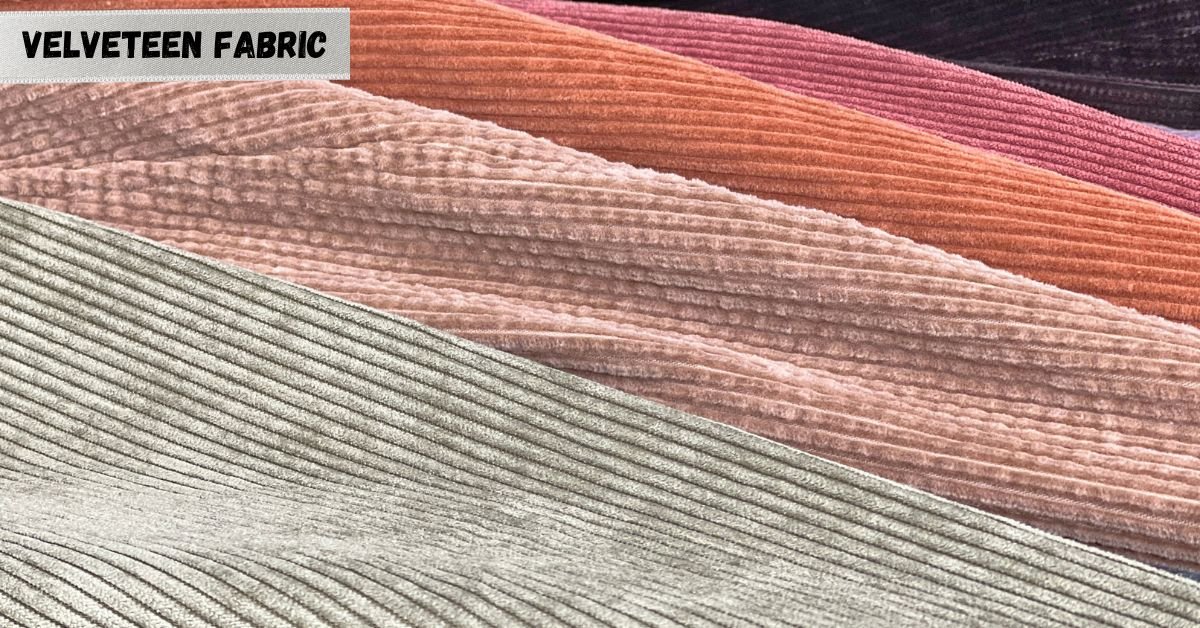
Velveteen fabric has been giving a lot of confusion to the buyers since it resembles velvet but acts differently. Thus, the question of what is velveteen fabric? will guide you in the selection of a suitable fabric to use as a garment or to use it as an interior decoration. Velveteen presents a comfortable floor, powerful foundation, and economical nature. Besides, it is more comfortable and more durable than most of the pile fabrics. Due to these attributes, velveteen is still popular in fashion as well as upholstry. This paper describes the meaning of velveteen fabric, the way it is made, its history, properties, and applications in real life.
What Is Velveteen Fabric?
Velveteen is a pile fabric made of woven material, which has a short and thick surface nap. It normally applies not silk or synthetics but cotton fibers. Consequently, velveteen is soft and firm at the same time. The material appears like some form of velvet, although it behaves differently on a daily use basis. Velveteen has an appearance similar to velvet but is stronger and heavier. It contains short standing fibers which are small enough to make soft without too much shine. Owing to this construction, velveteen retains its shape.
The Basic Differences between Velveteen and Velvet
Velvet is made of longer pile fibers and it may incorporate silk or polyester. Velveen incorporates shorter pile fibers which are normally cotton. Thus, velveteen seems to be more organized and smooth.
Why It’s Called Velveteen
The term velveteen is translated into English as velvet-like cloth. The name was given to it because it resembles the look of velvet given by the manufacturers. Nevertheless, it has a significant difference in terms of its fiber content and performance.
History of Velveteen Fabric
Origin in Europe
Velveteen was created in the industrial age of the 19th century Europe. Its invention came on as an alternative to costly silk velvet, but made of cotton. Historical accounts of textiles show that velveteen was created in the 19th century as a cheaper substitute to silk velvet. This is in line with fashion trends of that time (Victorian Era): machine looms were easily used to weave cotton velveteen to meet the demand of a velvet-like feel.
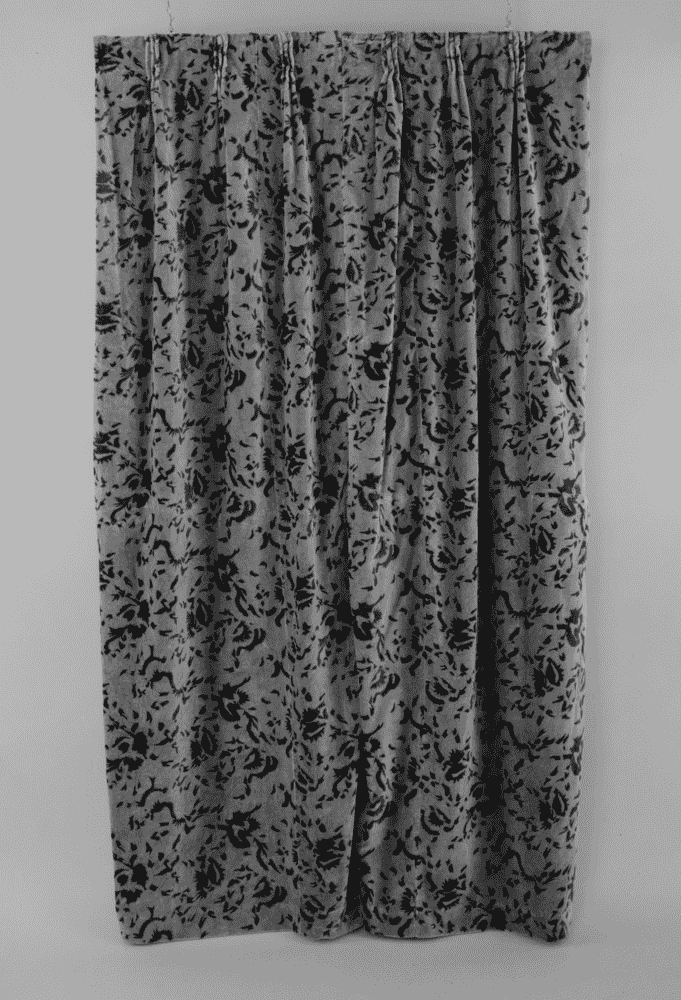
The top image depicts an American cotton velveteen curtain in 1883 as a depiction of how people utilized this material in the interior of their homes. Velveteen became indeed soon very popular in England and France, and it gave a full appearance to a cotton budget.
What Is Velveteen Fabric Made Of?
Cotton Velveteen:
This type of fabric is made of pure cotton, which is woven and the additional threads create the pile. Cotton is pure and therefore makes it strong and cozy. Cotton velveteen is very heavy and has a tender feel. It is commonly utilized in heavy garments and furniture since the pure cotton pile is raised up to be worn.
Cotton- Blend Velveteen:
Some are blended with cotton with silk or synthetic fibers. As an example, a cotton-silk velveteen is somewhat shiny and smooth with the help of silk, but still warm in cotton. It is also mixed with a small portion of polyester or rayon to minimize cost as well as to provide strength. These mixes render the material a little more shinier or wrinkle-proof than the certain cotton velveteen.
Modern Synthetic Versions:
In modern times, velveteen may be fabricated in all-synthetic versions (polyester) to fit the industrial requirements. Indicatively, on-demand printed velvety fabrics can be made with 100 percent polyester, providing a heavy-weight and plush feel. According to the source, these synthetic velveteen are machine washable as well as machine dryable, which is a significant benefit to mass-produced home decor. To conclude, although traditional velveteen is predominantly natural, today, polyester based velveteen is common.
How Velveteen Fabric Is Made
Weaving Process
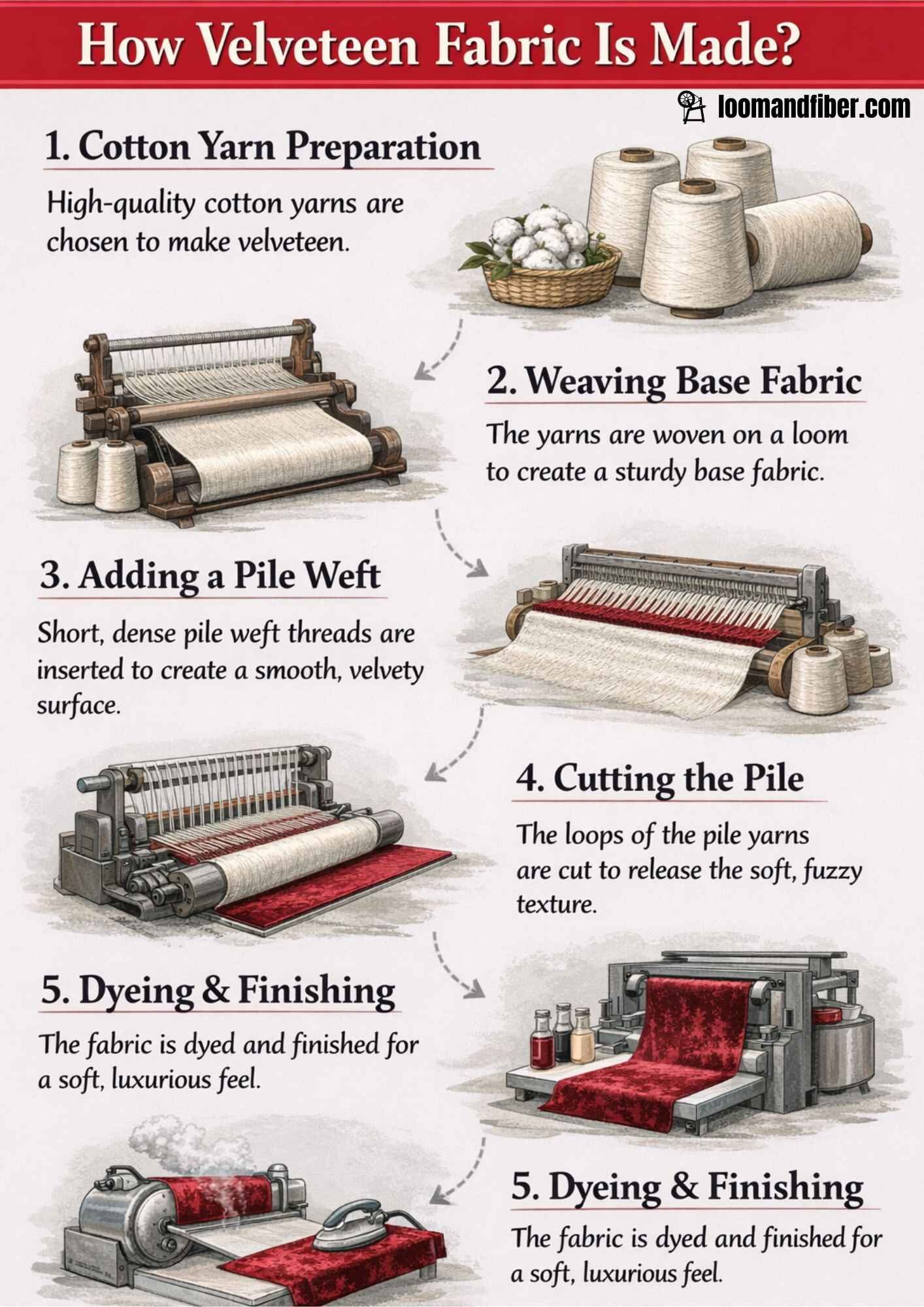
Velveteen is also woven on a loom like velvet but there is a major difference. We begin with a simple or twill ground weave. Weft threads are floated over the surface (pile threads) as they are weaved. These floats are removed and lifted after weaving in order to create the nap. Stated another way, the pile of velveteen is made by cutting loops of the additional threads.
Cut-Pile Structure
The peculiar heap of velveteen is short and thick. Once the loops are cut the ends are brushed up creating a velvety and smooth surface. Normally, the pile of velveteen is rather short, only 1/8 inch long, relative to most velvets. This is a cut-pile weave that makes velveteen very smooth. It is mentioned that the woven loops of velveteen are cut with a short nap, which form a thick texture. It is smooth, yet hard and rough on the surface. Practically, the pile is well packed and as such, the velveteen is heavier and appears more matte than long piled fabric.
Effects of Pile Length on Texture and Durability
The short pile of Velveteen makes a great impression on the character of the doll. A smaller nap, and there is not much fluff or gloss about it, so velveteen is solid, and nearly suede-like in its hand, instead of the rich, deep pile velvet. Due to the compactness and the low height of the pile, the fabric may be stronger: the long pile flattens and abrades easier than the short one.
Characteristics of Velveteen Fabric
Softness
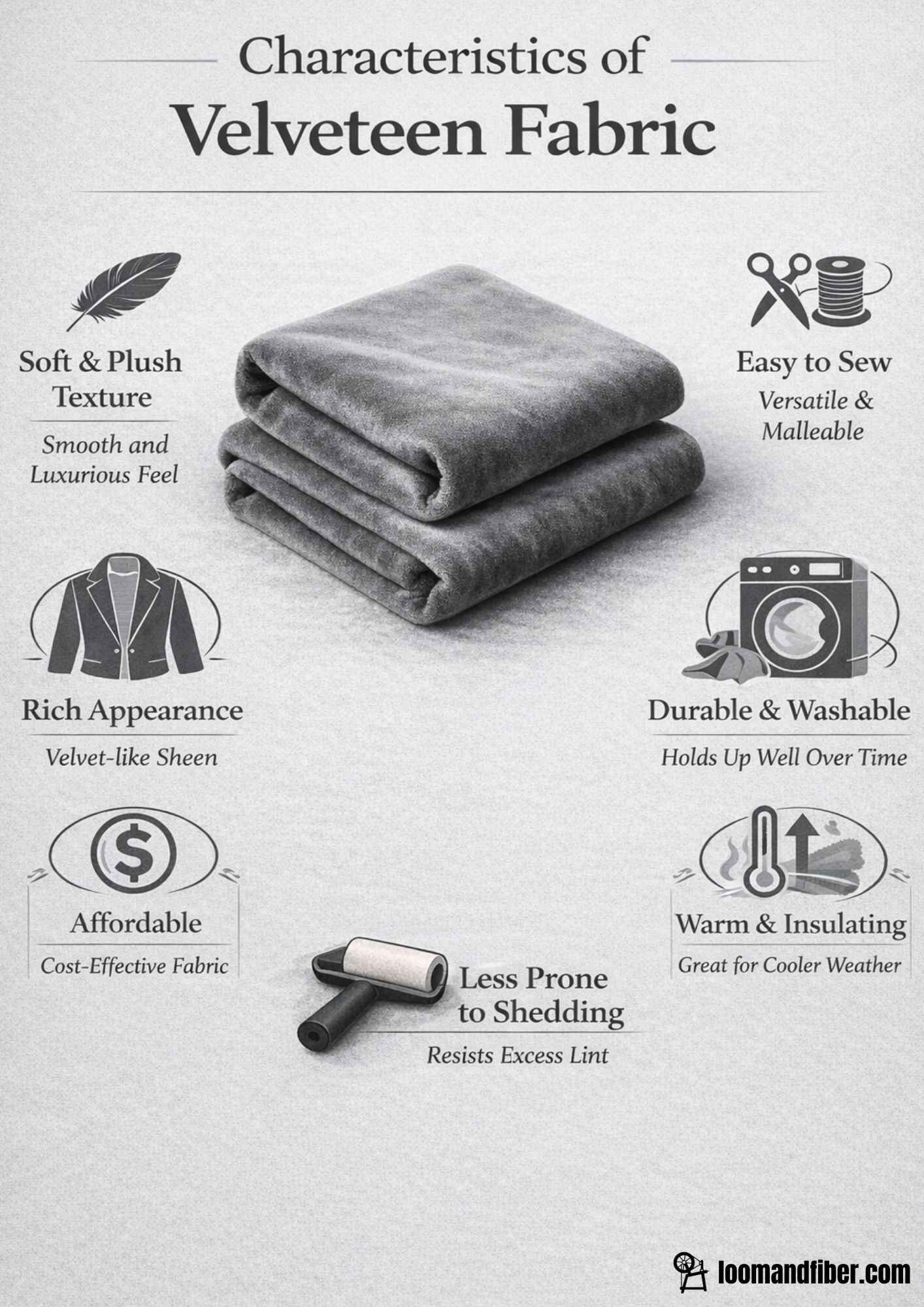
The velveteen fabric is soft to touch due to short dense pile that provides a smooth surface. Nevertheless, it is more solid than velvet, making it stronger and retaining better the structure and shape. Thus, it is not too delicate or slippery.
Weight
Velveteen is a medium to heavy fabric weight which gives weight to clothes and furniture. This weight is used to ensure that clothing does not collapse and it does not wrinkle too much. Consequently, velveteen is good with structured clothing and decor fabric.
Durability
Velveteen is a fabric that is very durable unlike regular velvet. The short pile lower the fibers breakage and minimizes wear of the surface as time progresses. Therefore, Velveteen is suitable in typical and average use.
Matte vs Sheen Finish
Velveteen has a matte texture as opposed to a polished texture. Its pile structure is made of cotton and thus reflects a small amount of light. As such, it develops a faint, fined, and conventional look.
Breathability
Cotton velveteen gives a chance to the natural air to flow into the fabric. This breathability enhances comfort on the long-term wearing and indoor usage. Synthetic blends however reduce the airflow a little bit in comparison to pure cotton blends.
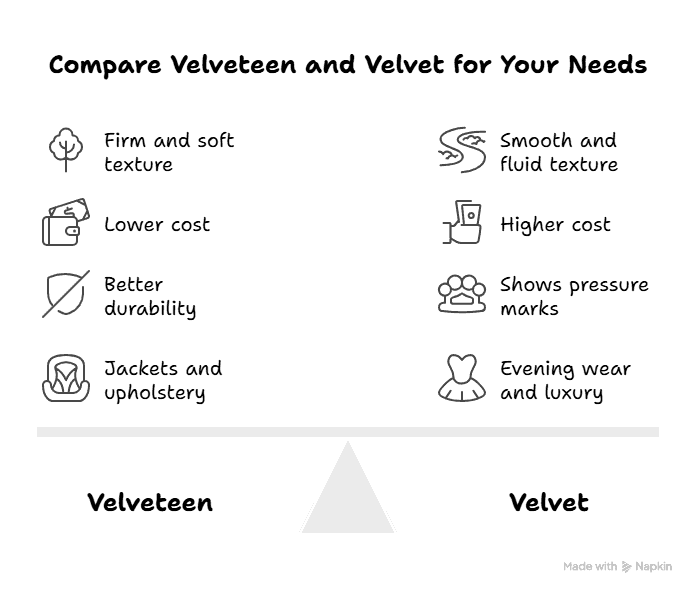
Velveteen vs Velvet
| Feature | Velveteen | Velvet |
|---|---|---|
| Texture | Short nap, dense pile; matte finish and heavy hand | Longer, lustrous pile; very soft and shiny, more flowing drape |
| Cost | Generally less expensive (especially cotton versions); affordable alternative to silk velvet | Traditionally pricier (silk or high-end polyester); considered luxury fabric |
| Durability | Thick and durable; holds up well to wear due to short, dense pile | Can be delicate (especially silk velvet); longer pile can flatten or snag more easily |
| Best uses | Structured casual garments, children’s wear, and durable upholstery | Formal evening wear, high-end gowns, luxury drapery and upholstery |
Texture Comparison
Velveteen is coarser and shorter piled than velvet. Its touch is solid and thick with a low lustre. On the contrary, the pile of velvet is long, soft and shiny. They explain that velveteen is far shorter pile and is not as shiny and draped as velvet. This gives velvet a more luxurious and fluid look and velveteen a more structured look.
Cost Difference
Velveteen, in the past, was a low-cost replacement of silk velvet. To this day, cotton velveteen tends to be less expensive than the posh velvet materials. Silk or special synthetics velvet is likely to be more expensive than simple cotton velveteen.
Durability
The saturated cotton pile of Velveteen makes it durable. It is quite wearable; it is resistant to many fine velvets. As mentioned above, velveteen is thick and tough. Velvet, particularly in silk, or very long-pile form, is more likely to be crushed and abraded with time. Therefore in the case of heavy wear (such as upholstery), velveteen has a longer lifespan than a fragile velvet.
Best Uses for Each
Velveteen glistens in domestic, commercial applications. Consider corduroy jackets, children dresses, and hard chairing. It is perfect in all that requires, warmth and form. Velvet is suitable to high-priced and formal products: the dresses of high fashion, the blouses of high fashion, and the luxurious curtains.
Velveteen vs Velour vs Corduroy
| Feature | Velveteen | Velour | Corduroy |
|---|---|---|---|
| Fabric Weight | Medium-heavy (cotton-based; adds warmth) | Varies (knitted cotton or blends; medium weight) | Medium to heavy (woven cotton or blends) |
| Stretch | Very little (woven, no stretch) | Stretchy (knit structure; often elastic in weft) | Little natural stretch (woven; some has elastane) |
| Appearance | Plush flat pile; matte finish (no ribs) | Smooth velvety pile; can be shiny if satin-backed | Ribbed texture (raised vertical “wales”) |
| Seasonal Use | Fall/Winter (warm fabric); midweight outerwear | Fall/Winter (cozy apparel, loungewear, drapes) | Fall/Winter (warm trousers, jackets, casual) |
Fabric Weight
Velveteen is medium to heavy. Velour is lighter because of knitting. Corduroy is heavier and stiff.
Stretch
Velour is elastic due to knitted fabric. Velveteen is not easy to stretch. Corduroy remains rigid.
Appearance
Velveteen appears to be smooth. Velour looks plush and shiny. Corduroy has ribbed texture.
Seasonal Usage
Velveteen suits winter suits and fall. Velour operates on a year round basis. Corduroy is more suitable in colder seasons.
Is Velveteen Stretchy Fabric?
Velveteen is also not a stretchy type of fabric since it is not knitted in a knit structure, but instead constructed through weaving. Cotton fibers and tight weave restrain natural elasticity in the fabric. Thus, velveteen maintenance is good and offers patterned look. A few contemporary velveteen is made with a small portion of synthetic fiber to provide some flexibility. Nevertheless, blended velveteen cannot be regarded as a stretch fabric.
Is Velveteen Fabric Warm?
Velveteen material is a good warm-up type of fabric because it is densely piled and is medium to heavyweight. Small fibers are short and they entrap air near the surface thus retaining body heat. Due to this aspect, velveteen works well in cool and cold weather. It is cozy in the fall and the winter and does not need extra lining. Nevertheless, velveteen can be exposed to hot or damp weather as it might be too warm.
Is Velveteen Fabric Durable?
Durability of velveteen fabric is unquestionable particularly with use of high quality cotton fibers. Its low pile minimizes crushing and it does not wear out its surface easily. Hence, velveteen is more resistant to frequent use as compared to traditional velvet. The weaved base material makes it stronger and resistant to tearing. Velveteen does not wear out in a few years when well taken care of.
Uses of Velveteen Fabric?
Clothing (Jackets, Pants, Dresses)
Velveteen is used by designers in structured garments. It holds shape beautifully. In addition, it is comfortable during chilly seasons.
Upholstery
Velveteen is suitable on chairs and sofas. It is harder to crush than velvet. Thus, it is suitable to medium traffic.
Home Decor
Vellveteen is used to give decorations texture. Cushions and throws are very classy. The mat style finish is ancient-classic.
Curtains & Cushions
Light is blocked by velveteen curtains. Cushions maintain shape. Consequently, interiors are homely.
Is Velveteen Good for Upholstery?
Velveteen is a good choice in upholstery. It is a balance of softness and structure. Nevertheless, it is suitable in moderate use.
Wear Resistance
Friction damage is minimized by short pile. Cotton fibers remain strong. As such, surfaces remain tidy.
Pet-Friendliness
Velveteen has average attraction of pet hair. Claws may mark the surface. Maintenance is due to brushing on a regular basis.
Maintenance Level
Velveteen needs light cleaning. Spot cleaning works best. Care by a professional increases life span.
How to Care for Velveteen Fabric
- Washing Directions: Wash velveteen as fine cotton. Wash 100% Cotton velveteen in pre-washing to prevent shrinkage. Wash using cold water in a gentle cycle. Machine washing of cotton velveteen is possible. Avoid hot water and bleach. Wash and do not twist or wring the cloth.
- Can Velveteen Be Ironed? Yes, but with caution. Apply iron on the smooth side of the ironing surface with a low heat setting. One of the methods is to put the pile under a towel or needle board which is clean so that it is not crushed. Always avoid pressing on the pile. Crushing can also be prevented using a pressing cloth or strip stick.
- Steam vs Iron: Steaming can be more safely used with velveteen. A handheld steamer has the ability to loosen the pile without making it lay flat as a hot iron does. In the case of ironing, protect the ironed area and do it on the other side (where the seam is to be ironed or a crease). Never leave the iron standing on the same spot; it will pile up and be permanent.
- Storage Advice: Store velveteen clothes and fabrics by hanging and not folding. The crease on the pile will appear as permanent. Dents can be avoided by using padded hangers or wide hangers. Store portions in a dry and cool environment not directly under sunlight (to avoid fading). When the longer term storage is required, wrap them with cotton cloth or breathable garment bags to take away dust but to allow air to pass through.
Velveteen Fabric Natural or Synthetic?
Velveteen is also natural (cotton or cotton/silk). It is “usually made of cotton”. Modern ones, however, may be synthetic blends. Polyester velveteen can be used as upholstery or printing. Summary: original velveteen Proper velveteen is the natural type; however, there are artificial versions nowadays.
Is Velveteen a Fabric that is Eco-Friendly?
It depends. Pure cotton velveteen is an all-natural product made of a renewable fiber, however, traditional cotton production is a costly environmental issue (water usage, pesticides). Velveteen made of organic cotton is more environmentally friendly. Synthetic velveteen (polyester) is also petroleum based and is not biodegradable. Velveteen dyeing (as with dyeing any fabric) may utilize both chemicals and water. The positive aspect is that due to its durability, the lifespan of the garments and furnishings is extended, and that may decrease waste in the long run. Sustainability can be enhanced by making certified organic or recycled options.
Advantages and Disadvantages of Velveteen Fabric
- Soft, Warm Texture: Velveteen is soft and warm, almost velvet. It gives a luxurious impression to clothes and items of the home.
- Very Strong Durability: Velveteen is strong because it has dense pile of cotton. It resists erosion and laundry as opposed to finer pile fabrics.
- Affordable Velvet Look: Velveteen has a less expensive way of achieving a velvet-like look. It allows you to wear velvet-style at a low cost.
- Matte Finish: This fabric is not shiny but has a dull finish. This may be an advantage as a bit of a peep is needed.
- Stiff Drape: Velveteen is denser and more of a solid. It is good, structure-wise (jackets, upholstery), but not flowing gowns.
How to Identify High-Quality Velveteen Fabric
- Pile Density: Premium velveteen is well-distributed and tight velveteen with no bald areas. The fabric must be soft and smooth throughout its surface.
- Fabric Weight: Denser velveteen (pile + thick bottom) is a typical sign of quality. It must be substantial to touch.
- Supporting the Quality: Find a stable and well-woven backing (no loose threads or holes). A good velveteen is one whose base is sturdy in a non-slippery cotton or twill that the pile is attached to.
- Color and Finish: The dye need not be uneven and the nap must be evenly reflected. High end velveteen tends to be rich in deep color.
- Edge Finish: You can be sure of a tight weave, not a floppy one, when you see the raw edge. It is a good sign to have a strong selvedge or finished edge.
Is Velveteen Fabric Costly?
Velveteen is normally priced averagely. It is nearly inexpensive compared to real silk velvet, but pricier than simple cotton knit or plain weaves. Velveteen used to be a cheap substitute of velvet, silk being a rarity in the past. In the modern day, cotton velveteen is more expensive than a simple cotton shirting and cheaper than upholstery velvets of medium quality. Velour (knit velvet) and cotton corduroy have a similar price point with velveteen. The point is: velveteen is luxe with a non-luxury price tag.
Conclusion-
Velveteen is a material that is very elegant, strong, and cost-efficient. What does velveteen fabric mean? is a question that assists the buyer to make informed decisions. It befits clothes, furniture and decorations in an adequate manner. In addition to this, its construction made of cotton is comfortable and warm. Despite the difference with velvet, velveteen is a strong one on its own. To achieve equal performance and eternal beauty, velveteen is still a good textile to rely on.
Read More>> What is Crushed Velvet fabric?
FAQs
Velveteen is an imitation of velvet but not true velvet. The fibers that compose velveteen are different.
Velveteen is moisture resistant but soaking it can damage the upper surface of the fabric. Careful handling will avoid moisture absorption issues.
Velveteen is ideal for winter because the dense fibers trap heat. It is suitable for cold environments.
Velveteen can fade, especially with sun exposure. Proper maintenance can help to reduce the loss of color.