
Introduction-
Have you ever wondered what makes Merino wool antimicrobial and it does not smell despite days of walk or travelling? This is its special feature because it is naturally antimicrobial – an aspect which makes Merino a popular choice of performance clothing, travel wear and outdoor apparel.
Compared to synthetic fabrics which trap moisture and sweat, merino wool has the ability to make you fresh, dry and odorless. When we learn what is behind the antimicrobial properties of the Merino wool we have the opportunity to know how the fiber structure combined with chemistry form a clean breathable and comfortable fabric.
You see, in this guide, you will understand why Merino wool does not smell, how the fiber is resistant to bacteria and why it is better than synthetic fabrics in terms of long-lasting freshness.
What “Antimicrobial” Means in Fabrics?
Antimicrobial is just a simple word that signifies the resistance to the growth of microbes (bacteria, fungi etc.) that bring about odor. As an illustration, the human sweat itself is odorless, body odor is a result of bacteria that decomposed the sweat and oils. A microbial resistant fabric inhibits that process. The merino wool is mostly referred to as naturally antimicrobial because it suppresses bacteria on the fibers. That is, Merino does not allow bacteria to multiply hence no odors are formed. This is particularly important on workout clothes or traveling equipment where you might have to use the such equipment several times in between laundry.
Why Merino Wool Is Antimicrobial?
- Natural Fiber Structure: The fiber of Merino wool is a protein strand in the form of keratin, which is then coated with microscopic scales (cuticles) which overlap. These minute layers of the cuticles serve as shingles that lose dirt and wetness. Practically, this natural scale structure makes it difficult to attach or make bacteria grow on the fiber surface. To the point, microbes are repelled by the very structure of fibers that Merino has.
- Moisture-Wicking Ability: Merino wool draws vapor into the interior (or core). It is capable of retaining moisture to the tune of 30% of its weight without becoming damp. Merino absorbs and traps the sweat inside and thus the surface of the outer remains relatively dry. As bacteria require a damp environment to multiply, a dry fiber surface causes Merino to prevent bacteria growth in nature.
- Natural Lanolin Wax: Lanolin is a waxy oil that is produced by sheep through the Merino wool. Lanolin, which is a natural antibacterial coating. It will keep the water away and will attack directly the odor-causing microbes. The lanolin that is present on the fibers of the Merino makes the fabric hostile to bacteria in effect. With the help of this wax and structure of fibers, Merino remains fresh without any chemical interventions.
Read More>> About the Water-Resistance of Merino Wool.
The Science Behind Merino’s Antimicrobial Properties
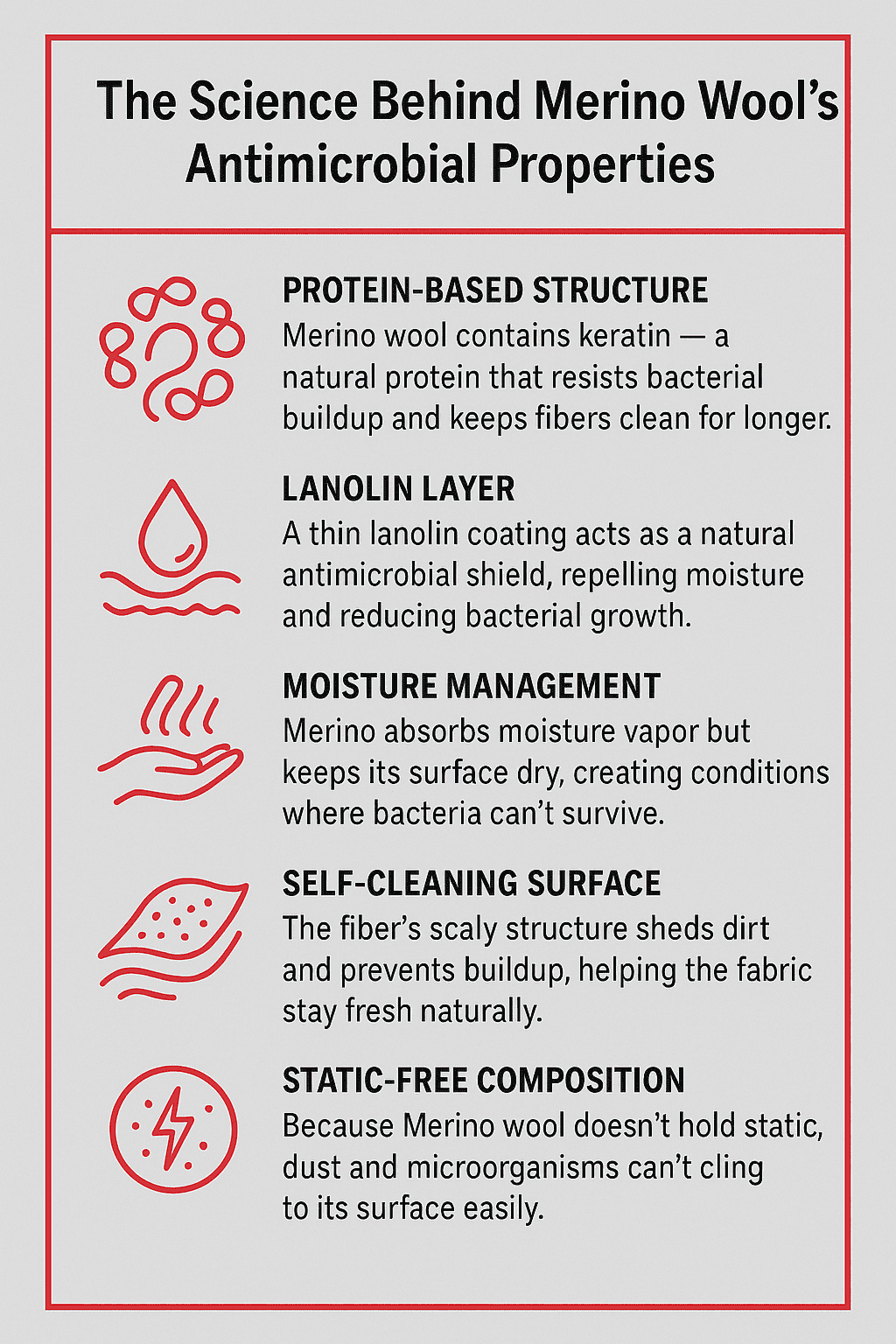
Protein-Based Structure:
Merino has a fiber core that consists of proteins and is organized into a helical structure as well. The outer cuticle is a scaly shell of superimposed plates (as small shingles). This shell offers physical shielding of microbes. Practically, the moisture and bacteria do not soak on the scales, but slide off. Consequently, the surface of the fiber remains rather dry and clean. This fiber structure is adequate to make Merino wool resistant to bacteria.
Lanolin Layer:
Lanolin is a natural grease that has antibacterial properties, and is present in every wool fiber. This is a waxy coating that not only repels liquid but also specifically deterrent of bacteria. Basically, the lanolin serves as a mild disinfectant, which is incorporated in the fiber. Keratin scales combined with lanolin implies that Merino wool is hostile in an environment to odor causing microbes.
Moisture Control:
Merino wool is the best at drawing moisture off the skin. It soaks up the vapor of the sweat into the fiber instead of it accumulating on the surface. The water present inside the fiber is absorbed by protein, thus making the fiber moist yet the outer part dry. Notably, Merino has the capacity of taking up approximately 30 percent of its weight in moisture without getting wet. Then it evaporates that moisture slowly to the air. This active humidity regulation makes Merino wool touch dry. Since bacteria require moisture in order to survive and reproduce, the dry surface implies that microbes are just unable to survive.
Self-Cleaning Surface:
Lastly, the scaly cuticle assists Merino to self-clean. When Merino clothing is shaken or aired, dirt and microorganisms caught on the fibers are likely to fall off. Indeed, aromatic substances are volatile. Wool fibers release odor molecules into the air when they are actually dried. Practically, all one has to do is to air dry a piece of clothing made of merino, and it will freshen without being heavily washed. That is why Merino is not a very sticky fabric to smells as opposed to other fabrics.
Why Merino Wool Doesn’t Smell — Even After Days of Wear
- Sweat Itself Isn’t Smelly: The sweat of human beings itself does not have any smell. Sweat is broken down by bacteria to provide body odor. Conversely, Merino wool prevents bacteria to multiply hence the smell does not build up.
- Keeps Dry and Fresh: The moisture control feature of Merino ensures that the fabric surface remains relatively dry and without the wet climate that bacteria require. This way; the wool material does not have any smell after strenuous work. Actually, trials and user feedback indicate that Merino can be put on days in end without any stench.
- Real-Life Evidence: Merino base-layers are frequently worn outdoors when on a multi-day trip. They consistently report the absence of bad smell even after days of usage. To illustrate this, an analysis indicates that wool clothing always smells less as compared to the same cotton or synthetic clothing of the same kind after a few days of use. The structure of lanolin and fiber of Merino forms an inhospitable environment to bacteria and thus it feels fresh despite the extended use.
Merino Wool vs Synthetic Fabrics: Odor Control Comparison
| Feature | Merino Wool | Synthetic Fabrics |
|---|---|---|
| Odor Resistance | Naturally odor-resistant – built-in lanolin and fiber scales inhibit bacteria. | Prone to trapping odors – no inherent antibacterial properties. |
| Moisture Handling | Absorbs and holds moisture vapor internally, keeping surface dry. | Wicks moisture to surface quickly, but tends to stay damp and can hold smells. |
| Antibacterial Aid | Contains lanolin (natural wool wax) with antimicrobial effect. | Lacks natural wax; often requires chemical finishes (e.g. silver or Polygiene) for odor control. |
| Washing Frequency | Washes less often – odor is released by airing out. | Washes more often – bacteria remain on fibers, causing persistent odors. |
| Environmental Impact | Renewable and biodegradable fiber. Reduces laundry (saves water/energy). | Petroleum-based (non-biodegradable) and sheds microplastics. |
Does Washing Remove Merino Wool’s Antimicrobial Properties?
No – Merino’s microbial defense is built into the fiber. Washing does not strip away the protein scales or all of the lanolin in one wash. The fiber will always regain its moisture-wicking and antibacterial abilities. While surface lanolin can be removed with exposure to harsh detergents or hot water over time, aggressive washing will soften the fabric and, in time, diminish the odor control. To preserve Merino’s natural benefits, always wash gently to protect the surface lanolin and thus the odor-resistance of the wool.
Environmental Benefits of Natural Antimicrobial Fabrics
No Added Chemicals: Because Merino wool naturally resists odors, extra antimicrobial chemicals do not need to be applied.
Less Washing and Less Waste: Since Merino wool can be worn multiple times without being washed, the amount of water and energy needed to wash it is significantly reduced. In fact, Merino wool allows you to simply air the garment and take odor-free washes.
Biodegradable, Renewable, and Eco-friendly: Merino wool comes from natural fibers as it is the covering of sheep after being shorn. At end-of-life, the fibers of wool will be biodegradable, return to the soil, and not release microplastics like synthetic fibers do. In conclusion, Merino wool is a natural and sustainable product that does not sacrifice quality.
Conclusion-
Nature is the operator behind the Merino wool. The wool’s natural features consisting of antimicrobial properties, odor prevention, and moisture regulation help wool keep the person dry, warm, and odor-free. These features make the wool perfect for attending outdoor activities like traveling, hiking, and for everyday usage. Merino wool not only prevents a person from overheating, it helps them stay odor free as well.
Read More>> Where does Merino wool come from?
FAQs
The combination of lanolin and Merino’s fiber structure means an environment where bacteria do not grow easily. The retention of moisture and lanolin’s waxy anti-bacterial wax means the wool is self-sterilizing. This means Merino wool is self-sterilizing.
It does not smell as Merino wool pulls sweat away from the skin and remains dry. That’s why bacteria cannot produce the odor of sweat, especially, because the wool does not provide moisture to the bacteria. Thus, the wool does not give those bacteria the means to do their work.
Not exactly. Merino wool does not obliterate microbes. Merino wool inhibits the growth of bacteria. Because the surface remains dry with the moisture-absorbing wool and lanolin, the bacteria do not multiply, and the odor does not form.
That is true. Although Merino wool is an exception to the rule, most synthetic materials provide odor protecting atmosphere. Merino wool’s intrinsic fibers and lanolin provide odor control as opposed to synthetic materials which provides odor control through chemical treatments. Synthetic materials trap moisture at the surface and do not provide odor control through moisture evaporation.
This breakdown of why Merino wool stays fresh for days is super helpful. The way its moisture control works is impressive, especially compared to synthetic options!