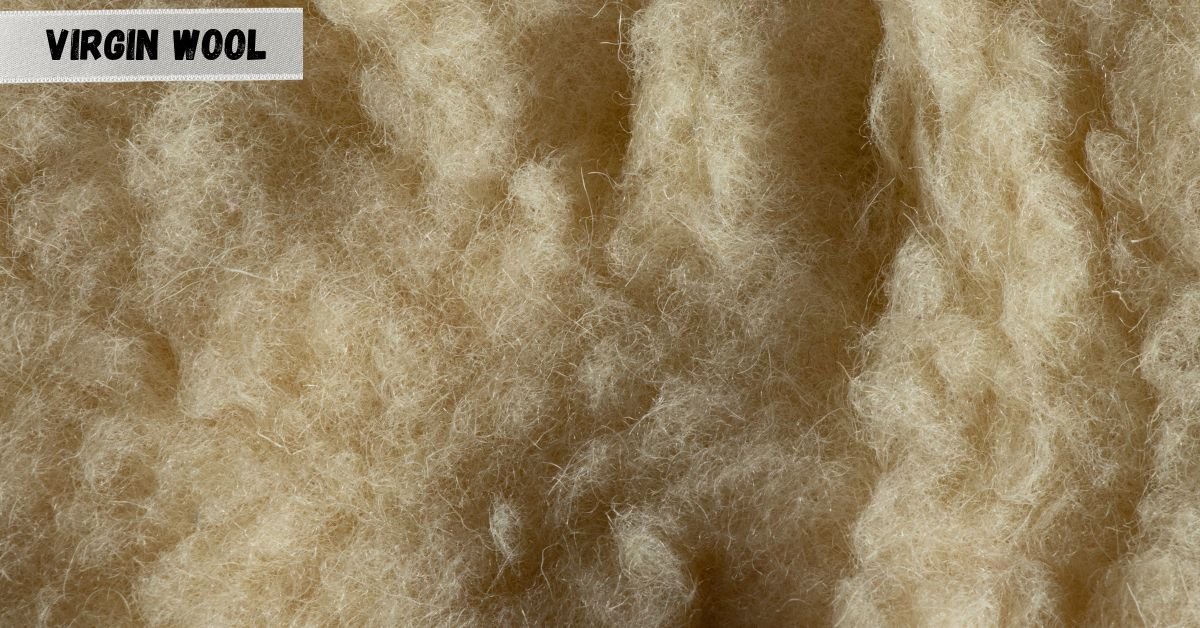

What Is Virgin Wool?
Virgin wool is wool produced as a result of the first shearing of a sheep (or any other shearing during which the fiber has never been utilized). The fibers are long, strong and naturally elastic since they have not been processed before. Consequently, virgin wool provides high quality as compared to used wool fibers.
Why It’s Called “Virgin”
Virgin can be defined as something that has not been touched or utilized, hence a perfect description of this type of wool. Virgin wool has never been used in clothes, carpets or textiles prior to processing. As such, it maintains its original form and works more efficiently in finished products.
Comparison between Virgin Wool and Recycled Wool
Both virgin and recycled wool use the same raw material (sheep fleece) but diverge very differently. Virgin wool is not used, more powerful, and with significant natural bounce, whereas recycled wool has been used in other products, and its fibers are shorter, worn-out. Re-processing of wool involves sorting, cleaning and shredding old garments or scrap into fiber. Shredding cuts and shortens the fibers, therefore, the new yarn becomes less strong. On the contrary, the fibers of virgin wool are not broken, and thus the fabrics are more elastic and durable. Since the fibers of virgin wool have never been strained, they do not pill and therefore the garments produced by it will maintain their shape far longer.
How Virgin Wool Is Made
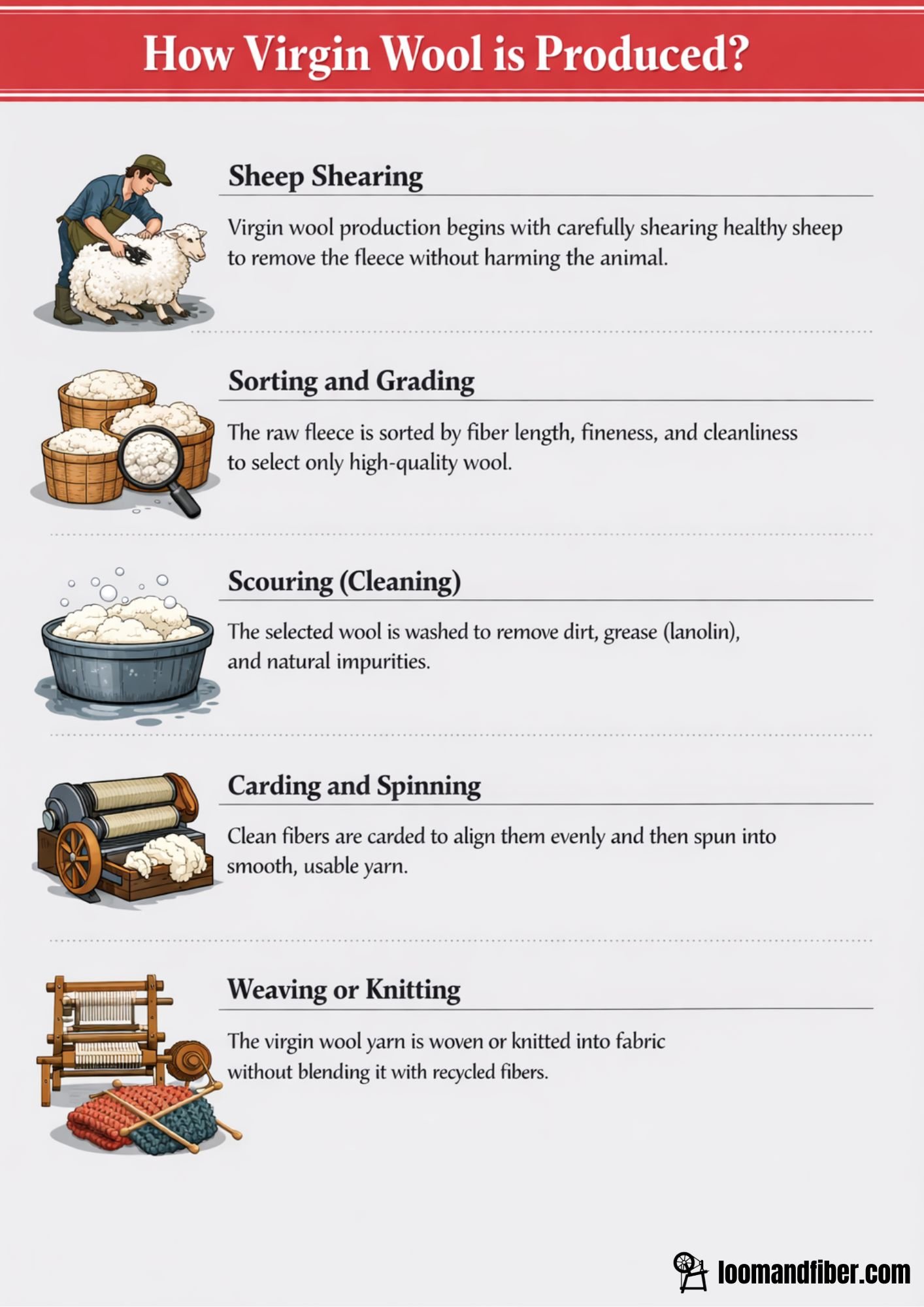
Virgin wool fabric production consists of the sheep-to-sweater stages. The path starts at the farm and finishes with spinning and weaving. In general, there are four key stages of the process.
Shearing Process
Shearing is the first step. Every year the sheep have to be sheared (they overheat and feel uncomfortable when they are not). Generally, a practitioner shearer removes the fleece with electric clippers to pull it off with caution. This is carried out in a soft manner such that the sheep do not suffer or experience any stress. You have a complete fleece of raw wool right out of the animal after shearing.
Cleaning and Sorting
Immediately after shearing the raw wool is dirty and contaminates with lanolin (the natural oil of the sheep) and grass and dirt. To remove dirt and grease the wool is washed (scoured) by warm water using slight detergents. The fiber is washed, and then it is carded and combed. The strands of wool are unstranded and laid out so that they get to form fluffy rolls known as rolags or batts, which are then created by Carding. The color and the quality of fiber is also sorted at this point: the high-quality soft fibers are separated and remaining impurities are separated.
Spinning and Weaving
The clean wool is then turned into yarn. During spinning, the fibers that are in alignment are pulled out and twisted. This could be either by spinning that could be done by the hand or by the machines. What is obtained is wool yarn which can be dyed or not. The yarn lastly is woven or knitted into a piece of fabric. A weaving mill has a lot of yarn which is interlocked on a mill in order to produce cloth. The yarn is converted into knitted textiles (like the sweater fabric) in a knitting mill. Since virgin wool is new, it can be spun into very thin yarns without losing its strength.
Why Virgin Wool Is not Previously Processed
Virgin wool by definition has never been made into cloth or clothing. It is wool fiber of the sheep. This in practice implies that mills do not utilize reclaimed material but just fresh sheared. Hence, all the steps mentioned above begin with the raw fleece. Consequently, virgin wool does not have a previously damaged structural form of the fiber, nor has undergone any chemical treatment. This ensures high quality of the fabric finished.
Virgin Wool vs Regular Wool
| Feature | Virgin Wool (New Wool) | Regular Wool |
|---|---|---|
| Origin | First shearing of sheep (often lambs) | Can be from any shearing (often older sheep) |
| Fiber Quality | Fibers are long, fine, uniform | Fibers may be coarser or more variable |
| Softness | Generally softer and smoother (especially lambswool) | Often coarser or slightly rougher if from older fleece |
| Durability | Very durable due to intact fibers; resists pilling | Less durable as fibers may be shorter or previously damaged |
| Strength | High tensile strength; garments last decades | Generally lower strength; more prone to wear |
| Elasticity | High elasticity and resilience | Lower elasticity; may stretch out of shape faster |
| Price | Usually more expensive per yard | More affordable (common wool) |
| Use | Luxury garments and fine fabrics | Everyday woolens and home textiles |
Is virgin wool superior to normal wool?
In most ways, yes. Virgin wool is the best of wool products. Virgin wool is finer and luxurious because it is new and is frequently brought by the softest lamb fleece. Fibers used in regular wool may take older shearing or less refined processing and as such, are generally coarser and less consistent. It implies that virgin wool pieces are much gentler to touch and wear and also fit much better in expensive clothes.
Quality Comparison
The quality of virgin wool is expressed in its uniformity and purity. It is generally produced through breeds and animal reared with special care of fine wool. Ordinary wool, in its turn, can be a blend of the types of sheep of different fiber thickness. In brief, virgin wool is designed to be soft whereas regular wool is soft, yet costly and suitable when used normally.
Durability and Softness
The virgin wool fibers have never been subjected to stresses by processing or wear, this means that they still maintain a high natural strength. This ensures that clothing made of virgin wool lasts a very long time when maintained. Simultaneously virgin wool may be softer since the youngest sheep give thinner fibers. Ordinary wool (particularly recycling wool) will pill or scratch more after a few wears and washes as the fibers are shorter and all have already lost some of their original properties.
Virgin Wool vs Recycled Wool
| Feature | Virgin Wool | Recycled Wool |
|---|---|---|
| Source | 100% new fleece from sheep | Made from used wool garments/fabric |
| Processing | Sheared, cleaned, carded, spun new | Collected, sorted, shredded, respun |
| Fiber Integrity | Fibers intact; longer staple | Fibers shortened by shredding |
| Strength & Durability | High; very durable | Lower; weaker yarn |
| Elasticity | Good elasticity | Less elastic, can sag |
| Softness | Smooth and soft (especially lamb wool) | Often rougher or coarser |
| Sustainability | Renewable natural fiber (see below) | Promotes waste reuse, less energy in regen |
| Typical Use | High-end apparel, suits, sweaters | Insulation, carpets, felt, budget clothing |
Key Differences
Virgin wool is obtained straight off the sheep. The old wool products are used to produce recycled wool. Thus, there are significant differences between fiber length and integrity.
Sustainability Impact
Recycled wool is a waste reduction in textile products as well as pressures in landfills. Nevertheless, virgin wool is renewable and biodegradable. Both choices are ecologically friendly.
Performance and Lifespan
Virgin wool is not affected by repeated wear and washing. Wool that has been recycled has a tendency to pill. Virgin wool is therefore durable.
Key Properties of Virgin Wool
Virgin wool has a row of natural qualities that make it stand out of the synthetic fibers:
Warmth & Insulation:
Virgin wool is good at capturing warmth. It has crimped fibers that create insulating air pockets that retain warmth of the body. This renders wool clothes and blankets to be perfect in the cold season. It is important to note that virgin wool will not leave you hot, as it can get rid of the surplus heat (see breathability). Actually, wool has a great ability to absorb moisture (up to 30 percent of its weight) without making it feel wet and this will stop the chill and thereby maintain a consistent body temperature during winter and cool climate.
Breathability:
Virgin wool is immensely breathable, in spite of the fact that it is warm. The moisture vapor can pass through the fiber structure hence perspiration gets out. This implies that the wool clothes are comfortable even when one is on a move or when the weather is hot. The air passes through the cloth, and it does not make one feel clammy. Simply, wool by nature balances between insulation and air circulation, and is thus usable throughout the seasons.
Moisture-Wicking:
The wool fibers are lined by a protein known as keratin that has the ability to wick moisture off of the skin. Wool has the ability to absorb close to 1/3 of its weight in water and remain dry to the touch. It then slowly evaporates water to the atmosphere. This aspect implies that clothing made of wool keeps warm even when you are perspiring or in humid weather.
Elasticity & Strength:
The Virgin wool fibers are springy. They are able to compress and back to shape again. This elasticity implies that wool clothing does not fall easily and bounces back to shape after being creased or pressed down. The wool natural crimp is what causes the bounce and also it provides the loft and fluff to woolen fabrics. The outcome is a long-lasting clothing that maintains its shape during the long-term use.
Odor Resistance:
The wool is self-resistant to odors. The surface of the fiber includes the natural wax known as Lanolin and is slightly acidic in pH and this prevents the growth of bacteria on the worn wool material. In reality, this implies that woolen clothes fail to absorb smells as fast as synthetic products. To illustrate a point, a wool sweater can be aired instead of washed to become fresh. Wool is also odorless even after repeated use except when it is extremely dirty.
Is Virgin Wool Soft or Itchy?
The feel of wool on human skin is mainly influenced by the fiber diameter. The more refined the fiber the more supple is the wool. Virgin wool may be of extremely fine (particularly merino lambswool) or coarse varieties. In most cases, the virgin wool of young sheep is very soft. A big fiber (>25 microns in diameter), on the other hand, will be hard or sharp. The reference point here is that human hair is approximately 50- 100 microns in thickness hence wool of 15-20 microns is extremely fine.
Merino Virgin Wool vs. Coarse Wool
Merino sheep breeds produce fine wool. The diameter of the merino wool usually ranges between 15-24 microns. Ultrafine Merino may be less than 18 microns creating a luxuriously smooth and silky touch. This is the reason why a lot of the virgin wool clothing employs Merino lambs wool. Conversely, other breeds (such as Shetland or generic mountain sheep) produce a 25 to 35 micron range of wool. Even virgin wool, though, is rougher and is apt to be scratchy. Thus, not every virgin wool is so soft, it depends on the breed of sheep and the age. One of the softest virgin wools is merino lambswool (first shearing) which is known as superfine.
Skin Sensitivity Concerns
Even the best wools may at times cause irritation to very sensitive skin, usually, because of lanolin or even of personal allergy. Nevertheless, virgin Merino or lambswool is comfortable to many individuals with mild sensitivities due to the thin fibers. An example is that lambswool (first shearing, young sheep of about 6-7 months old) is known to be hypoallergenic and soft. It has a smooth texture and low level of processing, so it hardly elicits a scratchy feeling. To conclude, virgin wool could be soft and itch free, particularly when of a fine-wool breeding but the determining element is woolen fiber diameter.
Is Virgin Wool Sustainable & Eco-Friendly?
Virgin wool can be regarded as a sustainable, environmentally friendly fabric. It is completely renewable: the production of wool is not exhaustive because sheep has a natural way of regenerating a fleece every year. There is no waste in the process of making the sheep wool: once sheared, the animal results in a new coat, and even in the case of animals that are well treated, a sheep can deliver meat without damaging the fleece supply chain.
Wool garments are biodegradable after they have been made. When wasted, wool will decompose in the soils, releasing nutrients back to the soil. In contrast to plastic fibers, wool is not sustained as microplastic pollution. And the only inputs required are sunlight, water, and grass which the sheep can consume the sheep do not require petrochemicals to grow or be processed. This provides the virgin wool with a significantly lower eco-footprint than petroleum-based garments.
Common Uses of Virgin Wool
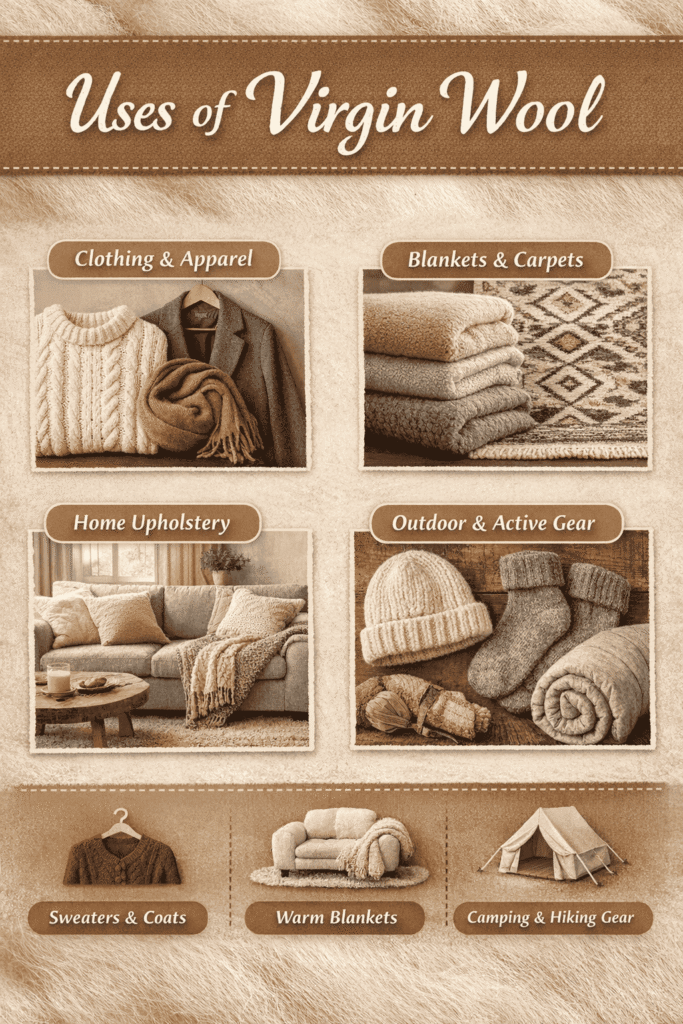
Apparel: Virgin wool is famous as the high-quality garments. Wool is used to make sweaters and jumpers, as well as knit wear, due to its warmness and softness. Virgin wool is frequently used in fine suits, jackets and trousers, because it has a smooth drape and it does not wrinkle. Oversized coats and blazers are also advantaged with the wind resistant and insulating property of virgin wool. Virgin wool is also used in accessories such as scarves, hats, and gloves to appeal to the greatest level of comfort and warmth.
Blankets and Carpets: Virgin wool is frequently used in woolen blankets and throws to insulate and remove moisture. With age, the wool blankets are softened and thickened and made more insulating. Likewise, virgin wool is sometimes used in high end carpets and rugs; a property of the fiber that adds to its durability and natural dirt-resistance is that the carpets will last longer and appear to be vibrant.
Upholstery and Home Textile: Virgin wool is applied in the upholstery of furniture and pillow fillings as well as bedding. Wool duvets and mattress toppers take advantage of the fact that wool regulates temperature all year round. Sleepers can remain warm without getting hot due to wool-sheets and pillows.
Virgin Wool vs Merino Wool
| Feature | Virgin Wool | Merino Wool |
|---|---|---|
| Definition | “Virgin” means first-use; can be from any sheep breed | Merino refers to wool from Merino sheep, a breed known for fine fiber |
| Origin | Any sheep, first shearing (could be Merino or others) | Exclusively Merino breed, various shearings |
| Softness | Depends on breed/age (lamb = very soft) | Typically very soft; superfine (15–18 μm) merino is ultra-soft |
| Fiber Diameter | Varies (coarse to fine) | Generally fine (15–24 μm) |
| Elasticity | High, since unused | Very high (Merino wool has natural stretch) |
| Use Cases | Luxury woolens, tailored clothes | Premium knitwear, activewear, base layers |
| Care/Processing | May or may not be treated for machine wash | Often treated (superwash) for easy care |
Are they the same?
No. The virgin wool is a processing label, but Merino speaks about a particular breed of sheep. Merino sheep have provided some of the best in the world, but merino wool may be utilized in virgin or non-virgin products. Virgin wool on the other hand may be of the initial shearing of any breed of sheep. That is to say, there are merino wool that can be virgin (first shearing), and there are virgin wool of non-merino breed. The words deal with various characteristics: merino = which sheep, virgin = first time use.
Can Merino Be Virgin Wool?
Yes. In the case of first shearing of Merino lambs, that wool is at the same time both Merino and virgin. Majority of high end merino clothes are fashioned using virgin merino wool to ensure the maximum form of softness. Nevertheless, non-virgin merino (e.g. recycled Merino fiber) and virgin wool of other breed (such as lambswool of Corriedale sheep) are also available.
Which is better?
It is a matter of your priorities. Merino wool (particularly virgin Merino) is widely reputed to be soft, fine-textured, and good at dissipating moisture. New virgin wool (of any breed) is valued due to freshness and strength. Virgin Merino or lambswool is the best choice in case softness and fine feel are critical factors. In case you just desire pure new wool, even a high grade wool (such as virgin Shetland or virgin Bluefaced Leicester) may be great. In brief, virgin Merino wool tends to be the best of both worlds, though pure virgin wool of other sources of the fine-wool sheep is also exemplary.
Does Virgin Wool Work in Winter and Summer?
The natural breathability of virgin wool and its ability to keep the wearer cool and dry make it surprisingly versatile to different temperatures. It is great in winter, its natural loft and crimp trap heat quite easily. The body is covered with thick virgin wool garments and blanket to keep it warm against cold air. Wool is moisture-wicking so that your sweat does not cool your body when you are inside a heated place.
Nevertheless, wool is also suitable in the warmer or mild weather. It is breathable and it handles the moisture so it can keep you cool in spring or autumn. Base layers or even summer shirts are made out of lightweight merino tops, which are worn by hikers. The reason is: wool adapts. During cooler weather it helps to retain heat and during hot weather it helps to take away extra heat and water. It is the temperature control that makes wool attractive all year round.
How to Care for Virgin Wool
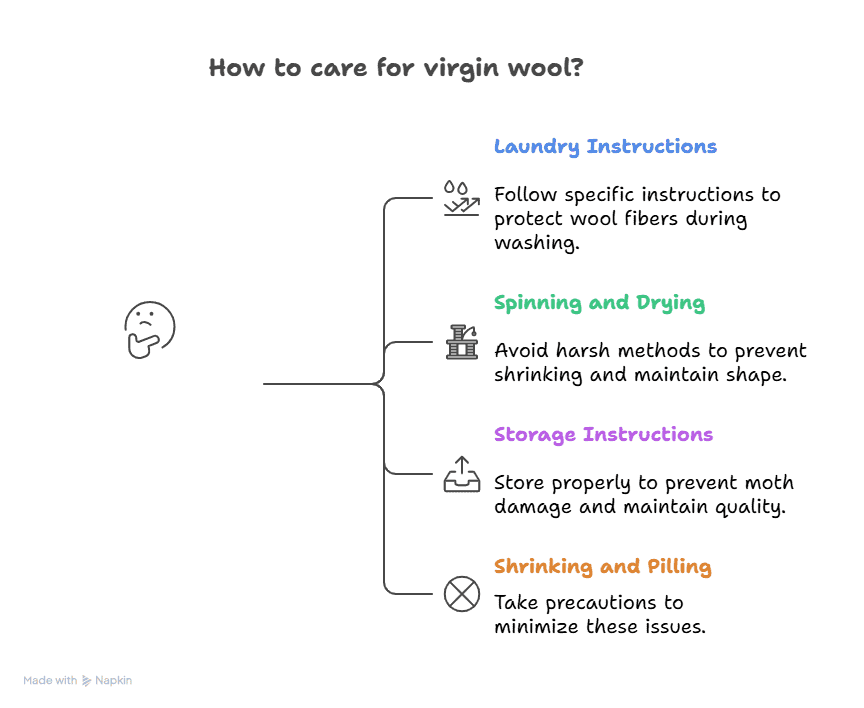
- Laundry Instructions: If hand washing, wash garments in cold or lukewarm water. If using a washing machine, use the gentle wool cycle. Wash garments with a wool specific detergent. Do not use bleach or fabric softener. To protect the outer fibers of the wool, wash garments turned inside-out.
- Spinning and Drying Instructions: Do not use the spin cycle. Do not wring or twist wool. To remove excess water, press the wool gently. To dry the wool, lay it on a towel and adjust the garment to its original dimensions. To complete the drying process, let it dry in a climate-controlled environment (room temperature with no direct heat or sunlight). Do not hang wool to dry. Wool will shrink if dried in a dryer.
- Storage Instructions: Wool garments need to be stored in a dry and cold environment. To avoid attracting moths, the wool needs to be clean since moth larvae are attracted to dirty wool. moths can be deterred while using storage bags with ventilation and with cedar blocks or lavender. To avoid damage, do not hang wool garments.
- To Avoid Shrinking and Pilling: Follow wash instructions and wash less; sometimes airing a wool garment is enough. Follow label instructions. To prevent pilling, wash with like fabrics, and wash inside out. Pilling can be removed with a fabric comb and should not be pulled off by hand.
How to Identify Virgin Wool
- When Label Says
- “Virgin wool”
- “New Wool”
- “100% Wool”
- Woolmark Certification
- Look for the Woolmark logo
- Confirms fiber authenticity
- Quality is verified
- Understanding the Difference Between Pure Wool and Virgin Wool
- Pure wool is a wool fiber that is unattached and is animal based. Virgin wool is high quality unattached wool fiber.
Is Virgin Wool Worth Buying?
Pros:
Virgin wool performs great and provides lots of benefits. Wool’s warmth, softness and durability often outlasts synthetic and other wool products and even used to subsitute the wool used in Virgin Wool products. A good wool product wool can last upwards of a decade. Virgin wool also provides a long time comfort and sustainable breathable. It is often worth the cost for many customers.
Cons:
The main concern is cost. Virgin wool is more expensive, and it requires more gentile care. The wool is often hand or machine washed on a delicate cycle. Some people may feel concerned with the wool’s origins collected from the animals. Wool producers follow a range of standards, from basic to RWS certified to ensure ethical practice.
Price vs Performance:
Virgin wool has a more expensive cost, but provides a great experience. If you require a fabric that is warm, breathable, and long-lasting you require Virgin Wool and it is wisely to pay more for it. If you are looking for a more functional product stick with regular wool or blend. For easier wool products that are cheap, blends or regular wool are a great option and are even more cost effective.
Conclusion-
What exactly is virgin wool? It is the first shearing of newly shorn sheep, and due to lack of prior use, experience, recycling, or processing, it possesses exceptional strength, softness, and durability that surpasses nearly all other types of sheep wool. Its unsurpassable elasticity and breathability provides the versatility of use in everyday and high-end luxury garments and textiles. The wool can deliver unparalleled comfort for a lifetime of use while retaining the same attributes it had during day one of usage.
From a purely logical point of view, the unparalleled wool virgin wool possesses is the sustainability and eco-friendliness of it. Sheep regrow their wool annually, meaning their wool is a perennial resource, and considering its biodegradability makes it eco responsible and virgin wool is a logical choice for performance and comfort for any season.
Read About >> What is Angora wool?
FAQs
Yes. Virgin wool only means that the wool is new and it has not been used or used up. It is 100% real sheep’s wool. Indeed, virgin wool is the highest quality of wool that can be obtained.
Virgin wool, like all wool, can be shrunk when it is not properly washed. But, being good wool, it can withstand temperatures or stirring more than coarse wool. Wool should always be washed in cold or lukewarm water (less than 30O C) in a soft wool detergent. Do not put in the dry clean, rather roll out the clothes and dry them flat so as not to stretch or shrink.
Fine virgin wool such as merino, lambswool is the favorite of many people with sensitive skin, and they feel soft, and many of them do not irritate. Some can have finer fibers and can be soothed by natural lanolin. Nevertheless, extreme wool allergic people still may be affected. In case you have sensitive skin, you should find clothes with the specification of 100% merino or lambswool, and how itchy the piece of clothing is to the skin before you decide to buy.
Most virgin wool clothes can only be hand-washed or have to be dry-cleaned. However, not all virgin wools are untreated (superwash) so that they can be machine-washed. When in the wash, use slow washing with cold water. Frequently, the garment can be aired between uses which is sufficient as the wool is resistant to odors. When machine washing is permitted on the label, then apply a wool-sensitive detergent and run on a gentle cycle.