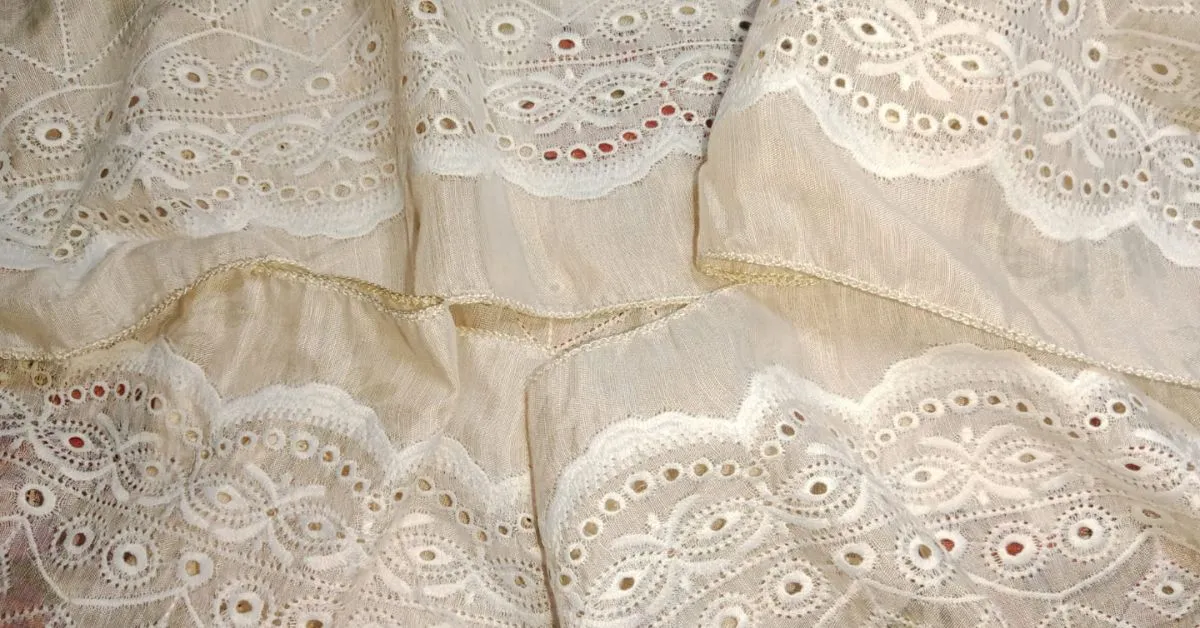

Broderie anglaise, also referred to as eyelet, is a lovely open-weave cotton fabric punctuated at intervals with small embroidered cut-out holes all around. The design of this fabric allows air to flow freely, making it perfect for hot weather. Broderie anglaise has been around for over four centuries, dating back to the 16th century European era. Modern summer fashions, like blouses and sundresses, rely on eyelet cotton for its comfort and aesthetic.
What Is Cotton Eyelet Fabric?
100% cotton (or cotton-blend) eyelet fabric contains woven cutouts. Eyelets are round or oval shaped holes that have been finished with buttonhole stitching. With these decorative holes, eyelet fabric creates a surface that is both lace-like and breathable. Designers love cotton as the base because it is soft, highly absorbent, and incredibly strong. This allows for a vivid appearance and gentle hand. Historically referred to as broderie anglaise, eyelet fabric became a prominent trend during the 19th century in England, and spread to the rest of the world. It was highly sought after for warm weather and children’s clothing.
History and Origin
Eyelet has origins in Eastern Europe, circa 16th century. It came to Victorian England, where it was named \”English embroidery\” (broderie anglaise). Cotton eyelet is popular because the fabric is soft, hypoallergenic, and breathable. Romantic modern eyelet is vintage in style with a modern pastel and white cotton. That’s the comfort of natural fibers.
How Cotton Eyelet Fabric Is Made
Base Cotton Fabric
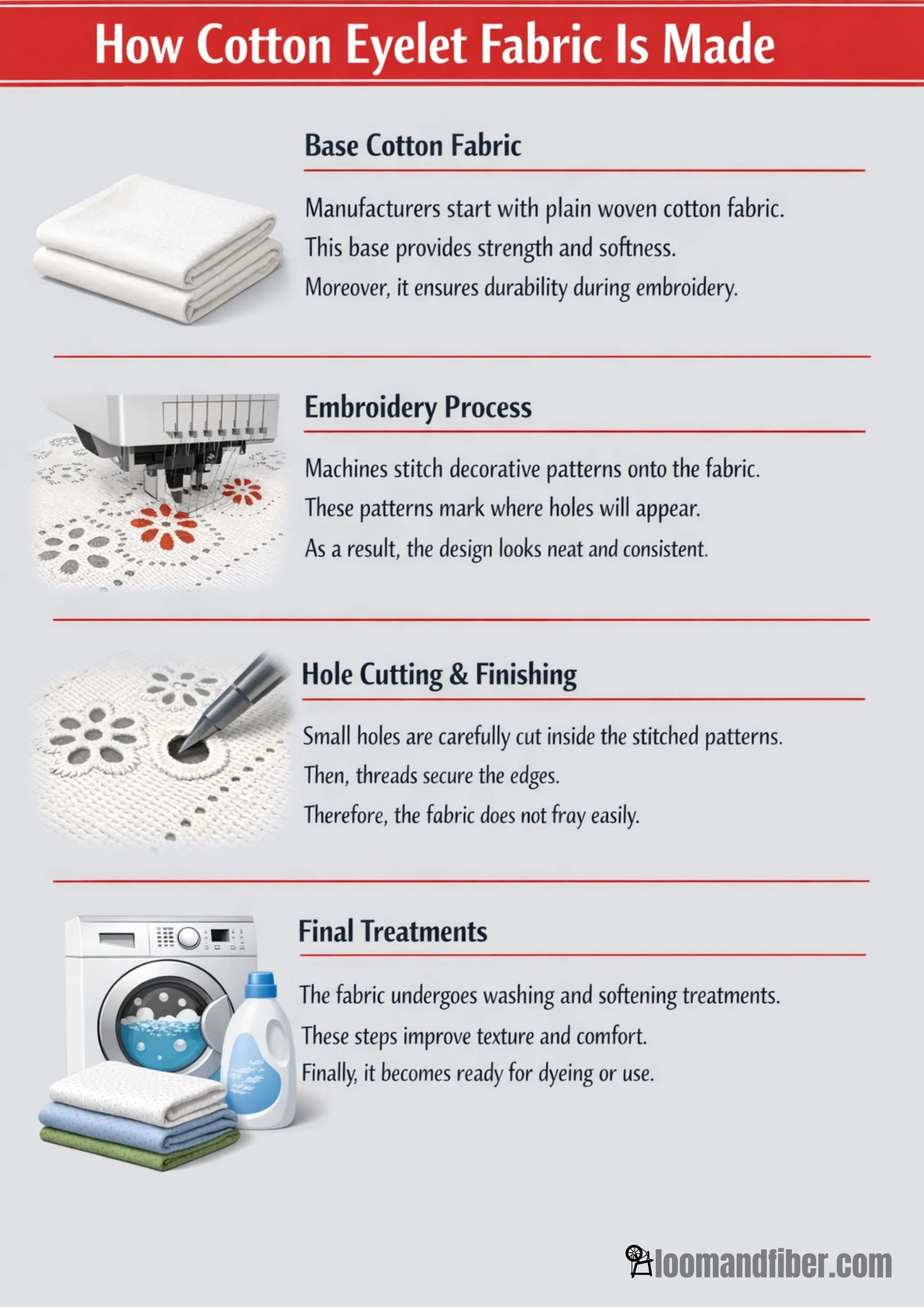
Eyelet starts with a fine cotton base such as voile, lawn, or batiste (lightweight weaves). Cotton is chosen for its softness and ability to hold embroidery. The plain weave provides enough stability for stitching the cutwork design. Sometimes poly-cotton blends or linen can be used, but 100% cotton ensures maximum breathability and dyeability.
Embroidery Process
The patterns are stitched next using Schiffli embroidery machines or digital embroidery. A multi-needle machine creates a dense buttonhole stitch outline around each hole. In the machine process, a tiny needle pierces the fabric to form each eyelet hole, then the surrounding edges are overcast with thread. This machine-based process replaced earlier hand-cut methods, allowing large-scale production with precise, even stitching.
Hole Cutting & Finishing
After the outline is stitched, the fabric shapes are cut or punched out to create the holes. The edges of each hole are already secured by the embroidery. This step may be done by hand with fine scissors or by machine tools. The result is neat eyelets with reinforced edges, preventing fraying.
Final Treatments
Finally, the fabric may be washed, starched, or dyed. Many eyelet fabrics are mercerized to increase luster and strength (improving dye uptake). Piece-dyeing (dyeing the entire fabric after weaving/embroidery) is common for solid colors. Print designs can be applied before or after embroidery. Pre-shrinking is often done; untreated cotton eyelet may shrink a few percent, so manufacturers sometimes pre-wash it. The finished fabric is then inspected for consistent embroidery and hole quality.
Dyeing, Printing & Customization Options
Yarn Dyeing vs. Piece Dyeing
Most commonly, cotton eyelet fabrics will be piece-dyed, which means that the woven fabric is uniformly solid in color. In contrast, yarn-dyeing is much less frequent because eyelet patterns typically focus on the embroidery design and less of the woven design. Piece dyeing ensures uniformity in fabric color for both the woven base as well as the embroidery.
Printed Eyelet Fabrics
Eyelet patterns and printed designs are often used in conjunction. A cotton base, for example, may have floral prints or digital prints followed by an embroidery. This technique adds visual depth as a printed design is juxtaposed with eyelet fabric that has a lace-like cutout. Especially during summertime, fashion brands are able to use eyelet fabrics with brightly colored floral, tropical, or abstract prints to add a graphic element to the breathability of the fabric.
Variations in Embroidery Colors
Of course, eyelet does not have to be white-on-white. Embroidery is done in a contrasting color to the base. Eyelet embroidery can be a solid color or involve multiple colors. There is a trend with pastel colored fabrics with embroidery of a more critical color. In seasons, manufacturers provide eyelet fabrics that have thread and embroidery in various colors.
Custom Patterns for Fashion Brands
Most often, wholesale suppliers of eyelet fabrics will work with particular fashion brands to coordinate custom-designed embroidery. Eyelet fabric is embroidered with exclusive patterns- whether it be a heart design or abstract shape- to differentiate collections. Logos or brand-related graphics can also be embroidered to fabricate custom designs. This is appealing to designers to provide custom eyelet fabric to create a unique look.
Key Features & Properties
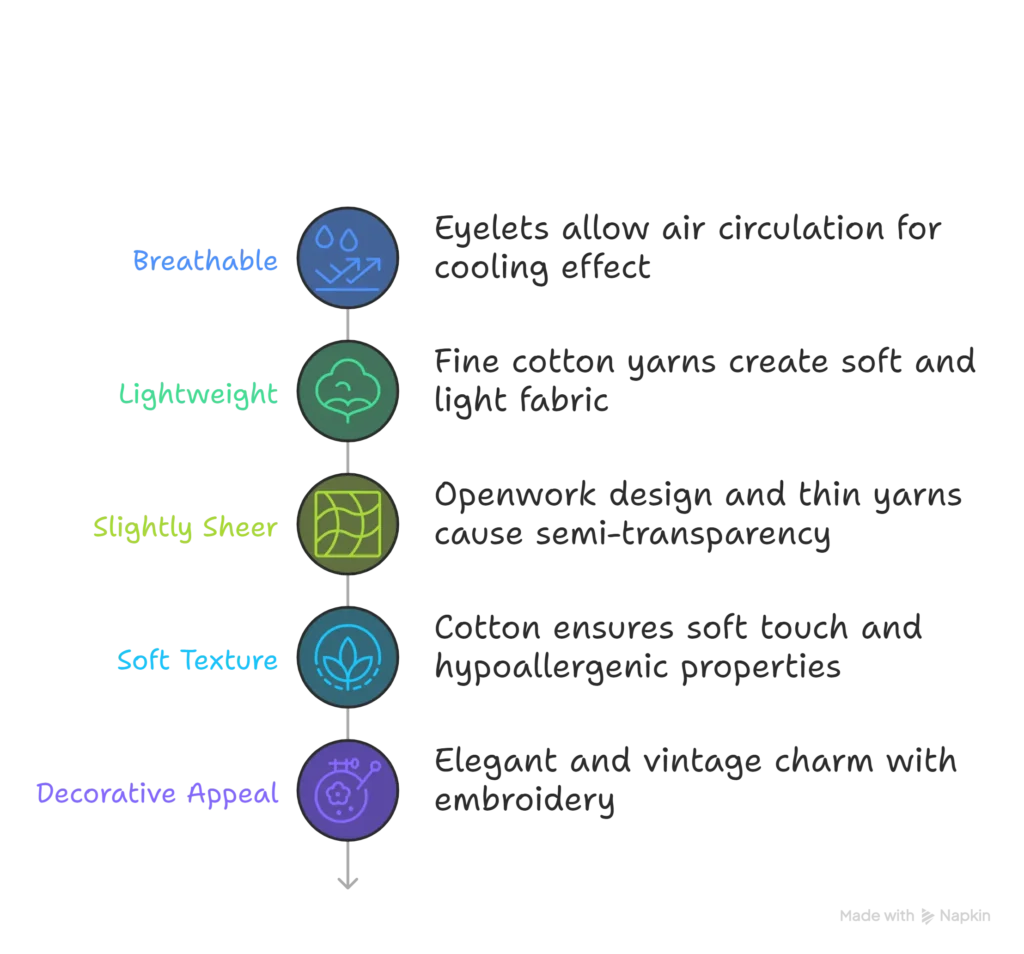
- Breathable: Because of its eyelets, this product is very well breathable. The eyelets allow air to circulate, giving a cooling effect to the user. (Perfect for hot weather.)
- Lightweight: The fine cotton yarns allow for a very light and soft fabric. Eyelet fabric is described as soft and light and is excellent for layered and summer clothing.
- Slightly Sheer: The openwork design as well as the thin yarns used in cotton eyelets cause it to be semi-sheer because even though there is some opacity because of the embroidery work, light can most definitely be seen. (Curtains and other garments will typically use a lining to avoid transparency.)
- Soft Texture: The use of cotton ensures that eyelet has a soft touch. The added embroidery creates a pattern that is soft, smooth, and very comfortable (and is hypoallergenic because of the cotton content).
- Decorative Appeal: The elegance and vintage charm of eyelet makes it a very desirable fabric. The embroideries of eyelets and designs use varying stitches which further creates romantic charm and character to the fabric. In particular, its fringe, embroidery, and threads designs are eye-catching for vintage children’s and women’s wear.
Types of Cotton Eyelet Fabric
Floral Eyelet
The embroidery of Floral Eyelet has flowers and leaves in the Eyelet pattern. Imagine Eyelet bouquets: the stitch work and the cutouts suggest petals. This romantic style looks very vintage and garden-like with the use of white and pastels in Eyelet.
Geometric Eyelet
Geometric Eyelet has circles, lines, and lattice work instead of floral theming. For example, within a grid, the fabric has rows of dots or circles cut out. The modern pattern maintains an organized style while maintaining an Eyelet’s usual breathability.
Border vs. All Over
Eyelet designs can be a border style or an entire all-over style. Border Eyelet only has open work designs in a single decorative strip, which is typically along one edge, like a skirt hem, or the edge of a tablecloth. Entirely All-over Eyelet has one pattern repeat throughout the whole fabric surface. Some Eyelet designs combine both, having a patterned exterior border and scattered Eyelet throughout on the inner section.
Scalloped Edge
Scalloped hems are very common in Eyelet fabric. Rounded or pointed arcs form into scallop shapes. The embroidered cutouts reach all the way to the edge. This is a decorative trim on hems of Eyelet garments. Scalloped trimming makes Eyelet designs have a dainty, lovely touch.
GSM / Weight Guidance for Eyelet Fabric
Eyelet fabric has various weights that impact their uses (GSM = grams per square meter). Use these guidelines:
- Lightweight (80–120 GSM): Highly airy and drapey. Best for summer dresses and blouses. Also makes for lightweight and breezy garments, veils, and linings.
- Medium (120–160 GSM): A bit sturdier and appropriate for making skirts, shirts, and tops. Possesses enough body to maintain shape in casual dresses and is appropriate for kid’s wear.
- Heavy (160+ GSM): More substantial eyelet better for making jackets and bags, and for use in home decor (e.g. curtain panels). When eyelet is required for firmness and shape, this is a better choice.
For warm weather, most industry sources suggest eyelet that drapes softly (80-120 GSM), and if structure is needed look to 120-160. Choose eyelet over 160 GSM when looking for a robust fabric that adds durability and form like upholstery accents. Always consider what is appropriate for your project.
Common Uses of Cotton Eyelet Fabric
Summer Dresses:
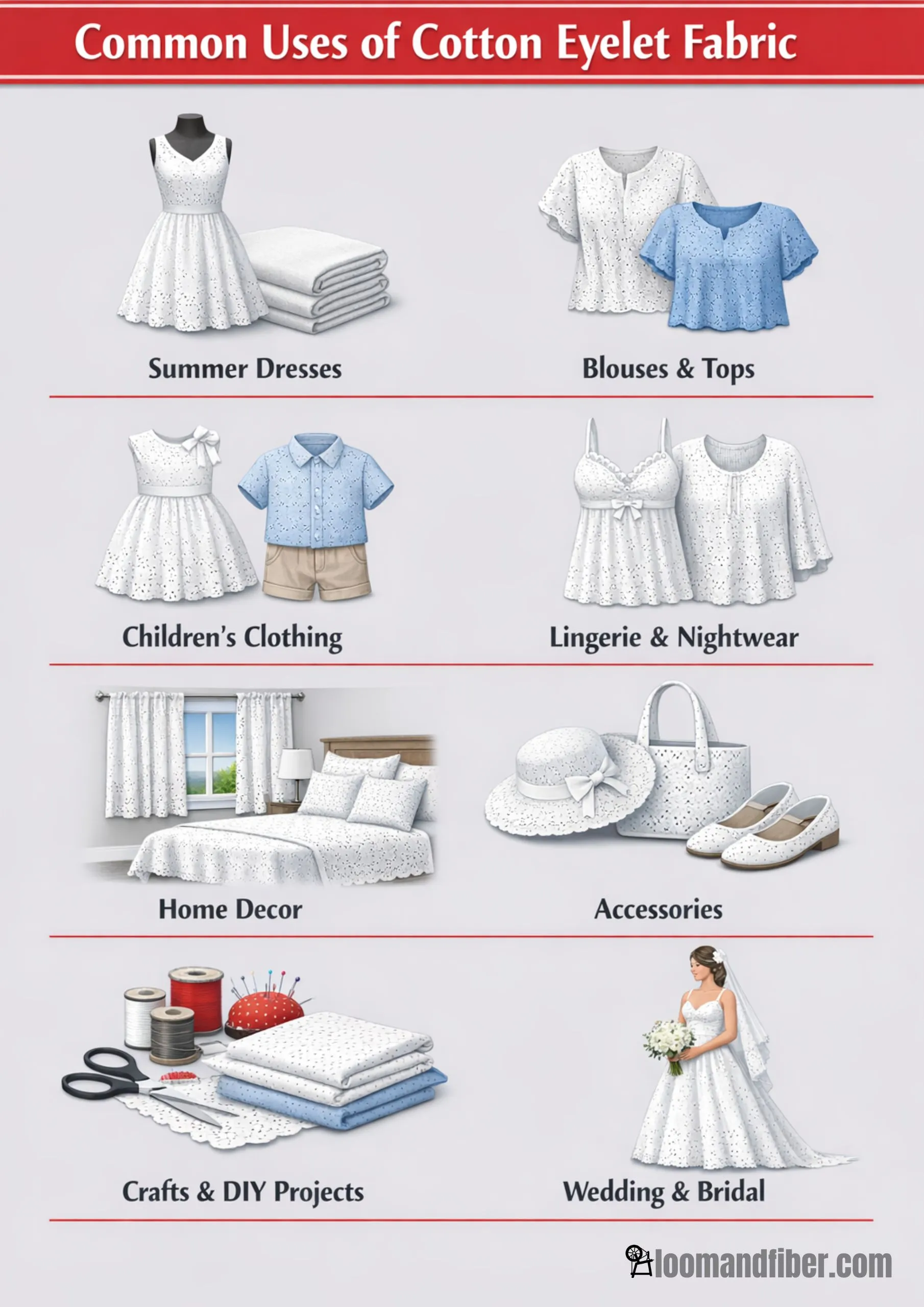
A timeless option is the sundress. They often come in varied colors and have patterns (checks, florals) that complement the slinky summer elements.
Read More>> Best Cotton Fabrics for Summer.
Blouses & Tops:
The fabric/eyelet part of these blouses is their distinct and fashionable aspect. They are quite breezy. Designers exhibit creativity by using light fabrics (eyelete is a light fabric) to contrast heavier materials (denim) in a top (see image below).
Baby & Children’s Clothing:
Eyelet is extremely suitable to make dresses and rompers (smocks are delicate, so smocks can be made also). Children’s clothing boast hypo-allergenicity (making them suitable clothes for allergy-prone children) and the fabric is also easy to clean.
Curtains & Sheers:
Cotton eyelet can also be made into light, vintage-style sheer curtains or cafe-style drapes. The fabric has semi-transparency, which is great to filter light that comes into the room. It also softens the harshness of bright light (as Mood Fabrics suggests).
Linens & Tablecloths:
Applying eyelet fabric to these items provides an elegant dining experience and an air of sophistication. It neatens the dining table and the materials are able to provide some solidity to the table that the eyelet fabric is covering/overlaying.
Pros and Cons
- Pros: Comfortable and airy – Eyelet fabric is designed with built-in ventilation. Breathable and light. Vintage-inspired – has embroidered cut-outs that add detail and charm. Eco-conscious – 100% Natural cotton is skin-friendly and better for the planet.
- Cons: Easily damaged – the smaller woven holes may snag and tears if not handled with care. Some transparency – because eyelet is not fully opaque, your eyelet garment may need a lining. More care is required to preserve the embroidery. Wash colder and gentler (hand wash or cold cycle). Avoid bleach and high heat to prevent distortion.
Cotton Eyelet vs Other Fabrics
| Fabric | Weave & Look | Sheerness | Common Uses | Care |
|---|---|---|---|---|
| Eyelet | Plain cotton base with embroidered cut-outs; decorative motifs | Semi-sheer (open holes) | Summer dresses, blouses, curtains | Machine wash cold, gentle (avoid bleach) |
| Lace | Openwork knit or woven (no base); delicate & ornate | Very sheer | Formal wear, trims, lingerie | Hand wash or delicate cycle (fragile) |
| Voile | Fine plain weave cotton, very smooth | Sheer | Blouses, light dresses, linings | Wash gentle (cotton) |
| Lawn | Plain weave cotton (crisper than voile) | Semi-sheer | Shirts, dresses, quilting | Wash gentle (cotton) |
Comparing Eyelet to Lace
Both fabrics have decorative openings, however, eyelet is a more specific term for cutwork embroideries on cotton. Lace is also decorative weaving and or knitting, but the weaving is done without a base fabric. Opacity and sturdiness also differs between the two. Lace is more sheer yet more brittle. From a fashion perspective, eyelet remains more affordable and still captures the the softness and romantic look of lace. Furthermore, eyelet is low maintenance and machine-washable, when lace is more complicated a delicate hand-wash.
Comparing Eyelet to Voile
Voile is a lightweight and smooth cotton. During weaving, a plain technique is used. Voile is also more uniformly textured and completely devoid of cutouts. Eyelet, although somewhat patterned, is also coted in a lightweight cotton for embroidery and hole details. Texture and weight become defining factors. In terms of fabric weight and texture, eyelet is heavier and more patterned. Fluidity is also a factor, both fabrics have a cotton base, however in this case, eyelet breathes better while also providing more structure and rigidity in embroidery.
Comparing Eyelet to Lawn
When eyelet has a lawn base, Lawn remains a contender for the base option. A lightweight cotton fabric is also used for Lawn, but it is more tightly woven, resulting in a smoother finishing. Lawn is also completely devoid of open weaving, ensuring perfect opacity. In this regard, lawn maintains a more plain and smooth aesthetic while eyelet captures a more patterned and airy essence.
Care & Maintenance
- Washing: You should hand wash these separates or machine wash in cold water on gentle cycle. Use soap that is gentle; do not use bleach or anything that is too strong as it can ruin the embroidery. For new eyelet fabric, wash before using it.
- Drying: If your washing machine has a tumble dry setting, use that on low. You can also dry these garments by laying them flat. Protect the threadwork by using low heat.
- Ironing: Use low or medium heat. You can iron them on the wrong side to be safe, or use a cloth to cover the eyelet. Steam or press on the eyelet. Always test on a scrap first.
Buying Guide
- Embroidery Quality: For eyelet fabrics, the art of the embroidery holds the greatest value. Take a look at the buttonhole stitches. They ought to be smooth and even, with no loose threads in sight.
- Hole Finishing: Each cut-out should be fully finished. Holes that have raw or frayed edges should not be present.
- Fabric Weight: Choose GSM that is appropriate for your project (see the GSM section). For dress that flow, 80-120 GSM is best. For skirts that are structured, 120+ GSM is best (Although this is not a hearty guideline, manufacturers often state the weight on the label).
- Best Use Case: Think about how you would like to use the eyelet fabric. Very light eyelet is best used for layering dresses and making veils. Medium to heavy eyelet is more appropriate for making blouses or for use in home decor projects. The eyelet fabric should be appropriate for your sewing skill, as denser embroidery can be difficult to contend with as you sew.
Trends in Cotton Eyelet Fabric for 2026
Sustainable Cotton Eyelet Fabrics
There is growing demand for sustainable and ethically produced fabrics.
Pastel & Neutral Tones
New designs featuring eyelet fabrics focus on soft and calming colors.
Oversized Eyelet Patterns
Eyelet fabrics feature large and bold designs. These big patterns are seen everywhere in today’s fashion.
Minimalist Embroidery Styles
Large and busy designs are being replaced with subtle and smaller ones. Fabrics are being designed with minimalistic approaches.
Use in Modern Fashion & Home Decor
Eyelet is being widely used across fashion and interior design. Modern eyelet fabrics showcase this versatility.
Conclusion-
The fabric of choice for summer activities has got to be cotton eyelet. It’s breathable, comfortable, and has decorative embroidery that keeps you cool. Vintage sundresses and modern blouses alike are going to be made from this fabric. Cotton eyelet even has eco-friendly options. This fabric isn’t just classic, it’s going to be in style for 2026. With summer just around the corner, it’s time to sew with this fabric.
Do you want to make the change for summer and sew with cotton eyelet?
Read More>> What is Cotton Jacquard Fabric?
FAQs
The fabric is cut so that it is semi-sheer. The cutouts allow for ventilation and light to pass through. There are denser designs, and some are even lined, but usually some sort of layering is needed for coverage.
Definitely. Eyelet is a great fabric for summer clothing. The openwork designs allow for ventilation, and keep the skin cool. Because it is makes of cotton, cotton eyelet is also great at wicking moisture. Eyelet is undoubtedly going to keep the user cool, making it great for hot weather.
Like most 100% cotton products, untreated eyelet fabric can shrink 3-8%. Pre-shrinking the eyelet fabric is a good way to set the size. The fabric can be treated to prevent it, but most people just choose to wash the fabric beforehand.
No. Eyelet is much more structured compared to lace. The embroidered holes that eyelet has, sits on a solid base of cotton fabric. All lace is made of threads, without a solid base. Because of this, eyelet fabric is much more structured than lace.
Yes! Cotton eyelet fabric can be used to make sheer curtains and drapes. It allows light to pass through, without totally leaving the window bare. Its most used in vintage and cottage decoration. It gives a romantic look to kitchens and living rooms.