
Introduction-
Another thing that is not to be ignored when selecting textile in clothing and interiors is fire safety. Thus, it will be crucial to learn how fabrics behave in the presence of heat and flames to both the consumers and the professionals. The most common question that is commonly posed is: Is wool flammable? Wool was used in clothes, blankets and furniture centuries ago. Nevertheless, its behavior when exposed to fire is still not understood by many people.
This paper describes the behavior of wool to heat in terms of science and practical examples. In addition, it makes a comparison between wool and other popular fabrics to show safety differences. The students, professional people in the textile industry and the general consumers will be in a position to acquire knowledge which will be clear and practical. At the end of it, you will find out whether wool really has any benefits in the area of fire safety.
Is Wool Flammable?
Yes, wool is flammable, but unless there is a circumstance that it is set ablaze, it does not readily catch. Wool does not catch fire, unlike other fabrics and it takes very high temperatures before it can catch fire. Wool burns gradual and does not burst into flame when it is put into flame.
Moreover, wool in most cases will not continue burning after the source of the flame is removed. Due to this behavior, it is believed by many experts that wool is fire resistant material that should be considered naturally. Therefore, even though wool burns in high temperatures, it is still much safer than cotton or synthetic fibers.
Why Wool Is Naturally Fire Resistant
The reason why wool is inherently fire resistant.
Large Nitrogen and Moisture Content
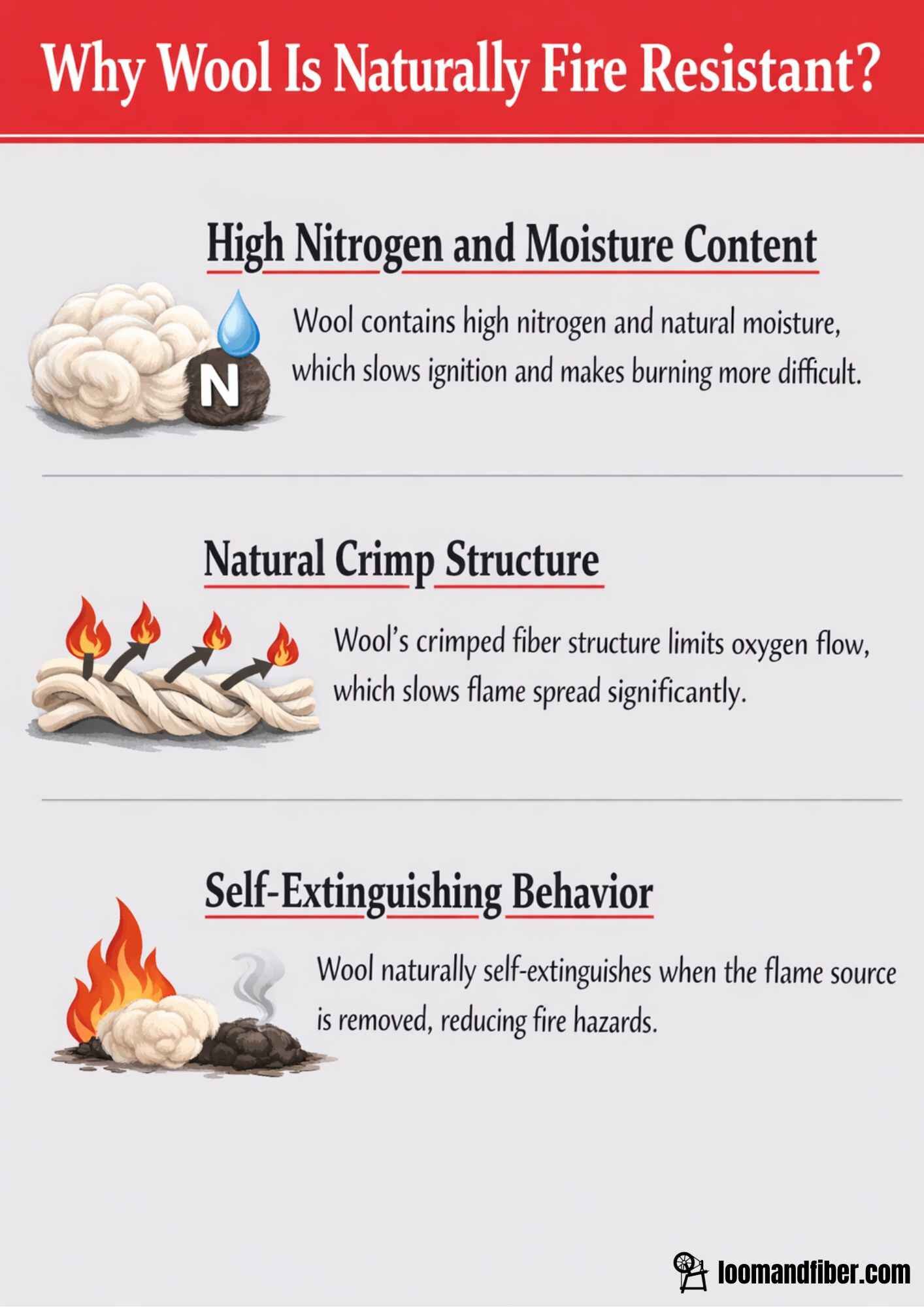
The flame resistance of wool is due to its chemical composition. It is approximately 14-16% nitrogen, and is capable of retaining approximately 14-18% water. Both nitrogen and water trap heat and dissolve inflammable gases, and the wool therefore requires considerably more energy to start burning than the dry, carbon-rich fibers. Actually, such a high percentage of nitrogen to water causes wool to require oxygen levels that are above the normal air to continue burning. Practically, normal air (containing 21% O 2) is insufficient; wool needs more than 25% O 2 to remain in combustion. Consequently, wool itself is highly un-combustible.
Natural Crimp Structure
Wool physical structure is also a fire deterrent. The fibers of wool are crimped (wavy), thereby enclosing air in small pockets. These airings offer insulation, which lowers the rate at which heat is transferred via the cloth. This crimp in a flame causes the heat to penetrate the wool gradually, therefore, fire does not propagate quickly compared to smooth fibers. Effectively, the bulk and crimps of wool serve to put off ignition and flame spread. This is the reason why a wool garment will warm up slowly and in most cases will not be burnt easily, which will buy valuable time to revert in the event of a fire.
Self-Extinguishing Behavior
Wool is a self-extinguishing material. In case a flame succeeds in catching the wool, the fiber chemistry will assume control. Wool fibers are a source of nitrogen (a natural flame retardant) and they become charred when heated. Removing the heating agent will normally cause the burning wool to self-put out. This burnt surface as well seals the remainder of the fiber with oxygen. When wool has caught fire, the wool will cease burning when flames are eliminated since the layer of char will stop the spread of the flames.
How Wool Reacts to Fire
Burns Slowly
Whenever wool comes into contact with flame, it catches fire and burns at a very slow pace as compared to other fabrics. Wool smolders as opposed to cotton which bursts into flames. IWTO studies have indicated that after wool ignites it tends to smolder as opposed to burning brightly. This slowness of burning allows wool to give out heat slowly and hence a wool jacket caught in fire has more time to put off the fire or escape. Essentially, the low burn rate of wool minimizes the chance of the sudden and spreading fire.
Curls and Charring Rather than melting
When wool is burnt, its fibers do not act like synthetics. The wool fibers twist and char with a brittle ash remaining. Wool does not melt or drip. Synthetic fabrics (polyester, nylon), on the contrary, melt in heat and may drip molten plastic, which may lead to serious burns. The complicated keratin filament of wool does not melt; it burns. The ash formed is normally soft and drip free. Actually, scientists have observed that wool leaves behind a soft ash that disperses and will not stick in any open wounds as compared to burning synthetics which yield hot and melted balls. This implies that wool blaze is not as dangerous as far as melting or dripping hot substances are concerned.
Self-Extinguishes on Removal of Flame
Wool will not support itself even in burning flame. When you take a burning bit of wool out of the fire the fire will soon be put out. This is based on the fact that wool needs a lot of oxygen to continue burning and ordinary air cannot be sustained indefinitely. The studies have verified that after the ignition source is lost, the high nitrogen concentration and char layer of wool makes the flame to go off. In real life, a woolen shirt or blanket will tend to cease burning once it is taken off the fire thus minimizing the possibility of further fire propagation.
Wool Ignition Temperature Explained
One of the reasons why wool does not catch fire is because the temperature of ignition is very high. The ignition point of wool is always estimated to be about 570-600 0 C. Comparatively, cotton burns at relatively low temperatures (approximately 255 o C), and most synthetics (polyester and nylon) begin to melt or burn at approximately 250290 o C. It implies that it requires twice or even more heat than cotton before even wool can begin to burn. Everyday heat sources are hardly more than a few hundred degrees; a kitchen oven may be around 250 o C and this would burn cotton and smolder wool. It will take a long time to ignite wool, and only the extreme heat (as in industrial fires or prolonged contact) will push it to ignition.
In brief, wool has a very high ignition temperature than the standard fire conditions and in this respect, wool fabrics will have a longer heat inertia time than standard fire conditions.
In comparison, when wool is lit on fire, it does not act the same: it does not melt, it forms charcoal. Wool has a limiting oxygen index (LOI) of approximately 2526 percent i.e. it requires an oxygen-rich environment to burn.
Is Wool Fireproof or Fire resistant?
Difference between Fireproof and Fire resistant
Fireproof materials are those materials that do not burn under any conditions. Fire-resistant materials on the other hand resist fire but can be burnt under extreme temperatures. Wool cannot be considered fireproof but fire resistant.
Why Wool Is Not Fireproof
Wool may also burn under extreme temperatures over a long period of time. Under extreme conditions its natural resistance can be overcome. Wool, therefore, cannot be termed as being entirely fireproof.
Why Wool Is Still Safer
Although not fireproof, wool does a much better job than the greater part of the fabrics. It burns slowly, self extinguishes, and little smoke is produced. Because of this, wool is considered to be one of the safest textile materials.
Wool vs Other Fabrics: Fire Safety Comparison
| Fabric | Ignition Temp | Flame Behavior |
|---|---|---|
| Wool | 570–600 °C | Burns very slowly, chars to ash, self-extinguishes; does not melt. |
| Cotton | ~255 °C | Ignites easily, burns rapidly to fluffy ash; will not melt. |
| Polyester | ~250–300 °C | Melts and drips molten plastic as it burns; ignites at relatively low heat. |
| Nylon | ~160–260 °C | Melts quickly under flame, often shrinks and drips hot liquid; ignites at lower heat than wool. |
| Silk | ~300–350 °C (approx) | Burns slowly, similar to wool; tends to smolder and leave a brittle ash. |
To give an example, the wool vs-cotton comparison is dramatic: cotton ignites after reaching only about 255 o C, but wool does not burn till around 570 o C. Polyester and nylon will melt much lower than that temperature and may result in serious burning by dripping away. Another such protein fiber is silk which acts more like wool; it curls off the inferno, burns slowly and in most cases extinguishes itself when the heat is taken away. Wool in any case demands much more heat and burns less fiercely or smokes less obnoxiously than the others.
Is Wool Clothing, Carpet and Upholstery Safe?
Wool Clothing
Wool fabrics are very safe to wear as a fire protection. It does not melt on the skin when the accident occurs. Hence, wool clothes prevent burns.
Wool Blankets
Wool blankets do not react to open fire and smolder. They do not explode into rage. Consequently, they are typically employed both at hospitals and homes.
Wool Curtains
Wool curtains reduce the spread of flames around the windows. They also limit the fire development in residential areas. Due to this fact, most hotels are fond of wool drapery.
Wool Carpets
Wool carpets comply with fire safety standards across the globe. They are low burning and produce minimal smoke. In this way, they improve the safety of fire indoors.
Furniture Upholstery
Wool upholstery does not ignite against sparks and cigarettes. It helps to avoid the spread of flames quickly over furniture. Hence, wool has extensive application on seating areas.
Does Treated Wool Burn Differently?
Fire-Retardant Treated Wool
The resistance of wool to fire is also enhanced by fire-resistant treatments. These solutions eliminate fire hazards and slow down the propagation of flames. Consequently, treated wool scores very highly in laboratory and real world fire safety tests.
Impact of Chemical Finishes(Is Wool Flammable)
Certain chemical finishes may in a subtle manner alter the reaction of wool to exposure to heat. Nonetheless, wool has excellent fire resistance that is maintained by high-quality finishes. Thus, even finished wool has been beating a lot of untreated natural and synthetic fabric.
Industrial vs Natural Wool
Fire-retardant regulated environment treatment is also usually added to industrial wool. Natural wool already fulfills numerous fire safety standards in the world without chemicals. Therefore, industrial as well as natural wool is extremely fire resistant.
Fire Safety Standards in the Real World with Wool
Protective Clothing of Firefighters
The firefighters are popularly wearing wool blends as protective layers of clothing. Wool is not affected by heat but is still breathable and flexible. This balance enhances comfort, shield and action when the fire is out of control.
Aircraft and Public Transport
Seats and carpets of aircrafts are often made with wools. Wool is subjected to tight rules on aviation fire, smoke, and toxicity all over the world. Hence, it is relied upon to be safe within closed forms of transport.
Constructing Fire Precautions
A significant number of building codes pass wool carpets and interior furnishing. Wool gets through flame spread, ignition and density smoke tests. Consequently, it contributes to a safer residential and commercial structure.
Pros & Cons of Wool from a Fire Safety Perspective
Pros:
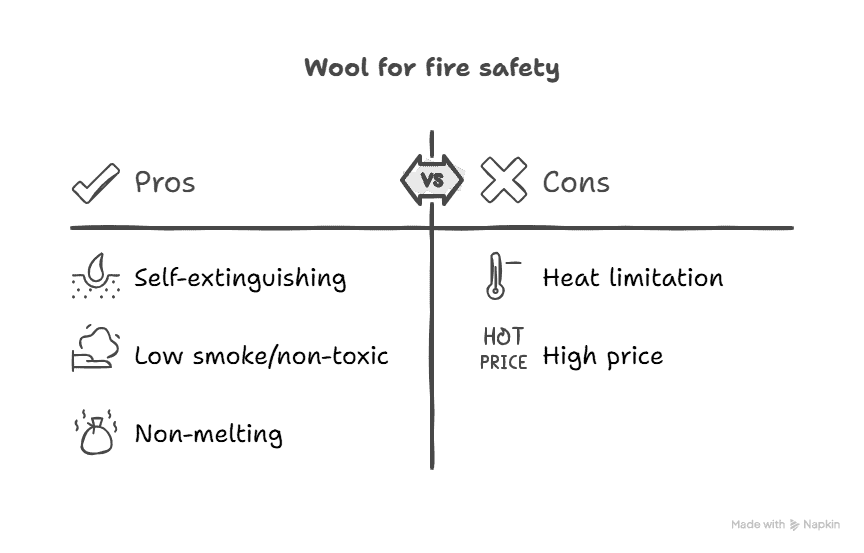
- Self-Extinguishing: Wool burns out when the source of ignition is removed because of its high level of nitrogen and charring layer.
- Low Smoke/Non-Toxic: Wool burns less and the smoke and toxic fumes generated are less than those of synthetic fibers.
- None Melting: Wool burns to ashes and will never fuse or spurt anything hot onto the flesh.
Cons:
- Heat Limitation: Wool can be burned under extreme heat (more than about 570 o C), it is not fire-proof.
- Price: Wool fashion garments are relatively costly compared to cotton or syntheses, which will restrict their application.
Conclusion-
Finally, wool is not readily flammable; its strands do not ignite readily and extinguish when burned. Wool can only be caught in fire when at much high temperatures when compared to other fabrics and will char and not melt. This would render wool a great product in clothing, home fabrics and in manufacturing industry where fire safety is a consideration. Wool is not actually fireproof, but its inherent characteristics provide it with a great degree of safety. On the whole, wool has a high ignition temperature, slow burning, self-extinguishing characteristics, which make it one of the safest fabrics in the presence of fire and flames.
Read More>> Fire Resistant Nomex Fabric.
FAQs
Generally no. Even a spark or ember of a few seconds will not normally ignite wool. Wool requires high temperature (hundreds of degrees) to light. Realistically, the energy and time that a fast spark has to heat wool to its ignition point are rare.
No – wool does not melt. It burns down rather, to ashes. Wool does not melt and run away unlike polyester or nylon. This implies that the burning of wool is of less danger of molten burns.
Yes. When compared to cotton, wool burns and ignites much slower. Cotton fabrics are easily caught by fire at moderate temperatures whereas wool will not be caught by fire in the same case. This makes wool to be the safer option to clothing and home fabrics.
Not truly. None of these natural fibers are fireproof. But wool may be treated to be still more fire-resistant. Fire-retardant finishes can increase the flame safety of untreated wool by very high levels, because untreated wool already self-extinguishes and it is flame resistant. Realistically, treated wool is much less susceptible to fire, though it is never 100 percent fireproof any type of wool will be burned under enough heat.
Yes, wool is safe in the case of children clothes. Natural flame resistance of wool suggests that it may readily comply with high standards concerning the safety of children sleepwear which demand products to be self-extinguishing.