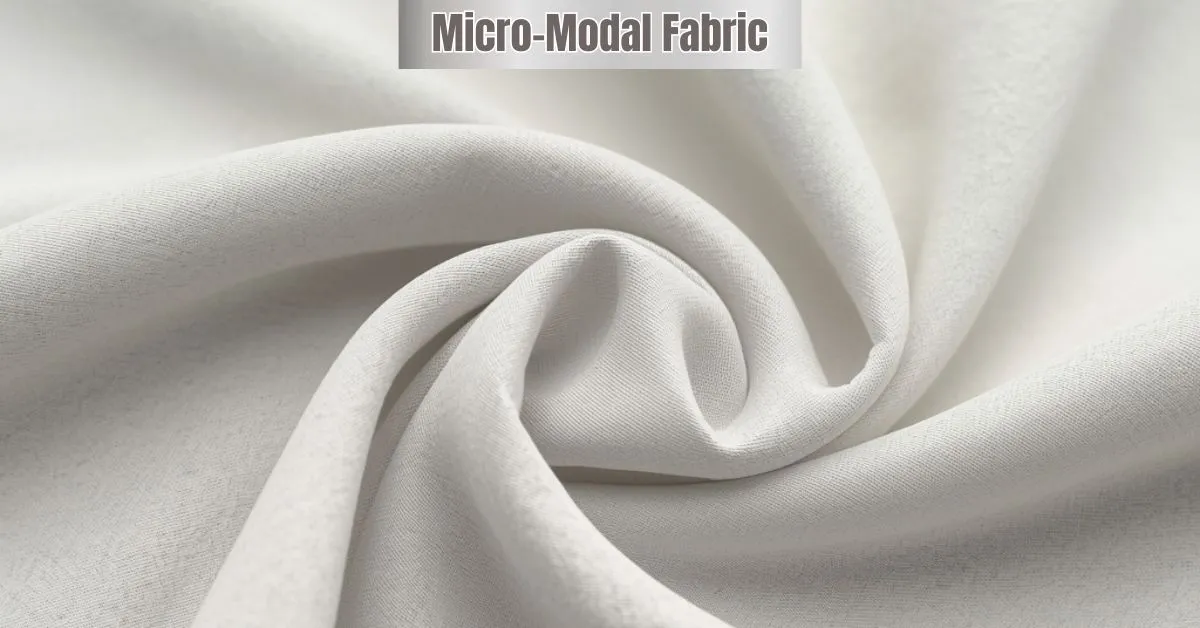

What Is Micromodal Fabric?
Micromodal fabric is an exceptionally soft, lightweight and breathable textile made from micro modal fibers, which have been spun from cellulose derived from beech tree wood. It is classified as regenerated cellulose fiber and is smoother, softer, and more durable than standard modal fabrics as a result of a micro filament structure. Micromodal is classified as a luxury fabric, as it is also stretchable and moisture-wicking, making it better suited for high-end apparel.
It is made of micro fibers, which are spun more finely than standard modal. These micro fibers result in a smoother surface, greater durability, and an improved silk-like drape.
What Is Micromodal Made From?
Pulp from beech trees
Micromodal similarly as Modal Fabric begins from beech tree pulp that is for beech trees that are sustainably harvested. The wood is chipped, then pulped into a purified cellulose pulp. The preferred wood is beech, as it grows with less water and pesticides. Using fast-regenerating beech wood forests (and often FSC certified) is more responsible than using non-regenerating sources.
Regenerated cellulose fiber
The beech pulp then undergoes a chemical process, so it can be spun into a continuous fiber called regenerated cellulose. In this method, a plant cellulose is transformed into a solution using non toxic solvents, then forced through miniature spinnerets to create very fine filaments. This is an artificial, plant-based fiber, that is, in essence, a variety of rayon. The Micromodal® patent holder is Lenzing AG located in Austria, and this company pioneered Micromodal® technology in the 1990s by patenting the ultra-fine fibers.
Sustainable production
The sustainable approach is readily apparent in the micromodal production from the beginning to the end. The majority of micromodal (MicroModal®) is manufactured in closed-loop systems with 95 to 99% of the chemical waste recovered and reused. The forests from which the wood pulp is obtained are not old growth, but are recognized as sustainably managed forests (FSC certified) in which Lenzing is actively involved and thus their supply chain is mostly FSC certified. This fiber has a considerably lesser ecological footprint than conventional synthetics or cotton fibers.
How Is Micromodal Fabric Made?
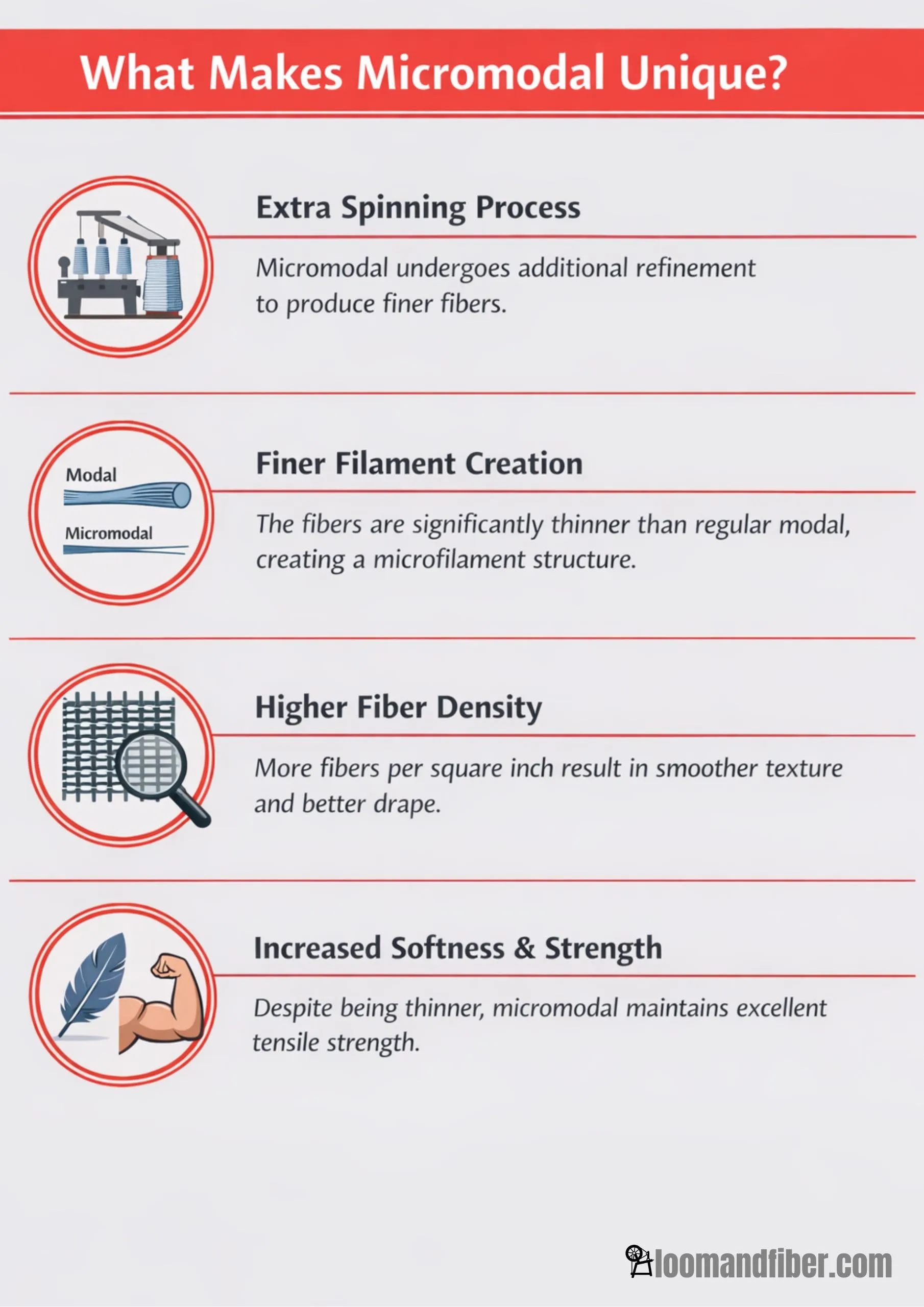
Additional Spinning Process
Micromodal has unique softness properties due to a special functioning spinning process. The beechwood cellulose is dissolved, and the solution is pressed through very tiny spinneret holes. These are smaller than the holes for standard modal. Because of the high precision temperature and pressure controls, an even spinning of uniform fibers are created for the process.
Ultrafine Spinning
Due to the ultrafine spinnerets, the modal fibers are substantially thinner than fibers of other modal types. A modal fiber of typical range is slightly over 1 denier, while a micromodal fiber is approximately 0.9 denier (40 times thinner than an individual human hair). These fibers are twisted together into yarn, resulting in an even fabric with a silky and smooth surface.
Ultimate Fiber Density
The use of exceptionally thin filaments means that the resulting fabric has a greater fiber density and thread count. The fabric’s weave becomes thicker because of the increasing number of filaments, which increases the opacity and strength of micromodal. The fabric is also lightweight and has a soft luxurious feel without the excess bulk.
Increased Smoothness & Strength
Micromodal technology uses extra fine structure for improvement in texture and durability. The uniform and smooth filaments provide the fabric the softest and silkiest feel. Also, Micromodal fabrics are produced with reinforced fiber, and due to this, it makes the fabric very strong. In fact, compared to regular viscose, micromodal has much higher wet tensile strength. This indicates micromodal can withstand many washes with little shrinkage (usually <3%) and is very difficult to tear. Smooth surface also contributes to the resistance to pilling. Overall, Micromodal exceeds the average standards in softness and durability.
Properties of Micromodal Fabric.
Micromodal has a reputation of a fine performance and luxury feel. The following are the major features that distinguish it:
Ultra-Soft Texture
The smoothness of Micromodal is made in such a way that it has ultra-fine microfibers which give it a smoothness of silk. It is a softer fabric than cotton is, and softer than regular modal. This is why it is suitable in the next-to-skin type of clothing such as loungewear and underwear.
Lightweight & Breathable
It has a fine fiber structure, which promotes increased circulation of air. The material is lightweight and comfortable particularly during hot seasons. This renders micromodal a trendy breathable underwear garment.
Excellent Moisture-Wicking
Micromodal absorbs water effectively and liberates it fast. It makes the skin cool and comfortable during the day. That is one of the reasons why it is applied in high end active wear.
Smooth Surface & High Drape
Its fabric is very fine microfiber making it elegant. It is naturally flowing and does not stiffen to fit the body. In high quality clothes, luxury brands tend to lean towards such flowing look.
Strong Yet Flexible
Micromodal fibers are tough though very fine. It stands its ground and does not get puffy with time. In combination with elastane, it has good stretch recovery.
Low Pilling Resistance
The friction on the surface is minimized by the smooth fiber structure. This is to keep away the fuzz and pilling. Consequently, clothes are smoother in appearance.
Color Retention
Micromodal has a good uptake of dyes. Colors are vivid and saturated. They also do not fade easily even after several washes.
Micromodal GSM Guide
GSM Basics: GSM stands for grams per square meter, which is a standard measurement for fabric weight. A high GSM indicates a heavier, denser fabric. A low GSM indicates a lighter, more sheer fabric. GSM is directly correlated with warmth, opacity, and overall fabric drape. With micromodal being a fabric that is naturally lighter in weight, GSM is a critical consideration when determining the appropriate weight for a garment.
| Garment Type | Recommended GSM |
|---|---|
| Underwear | 120–170 GSM |
| T-Shirts | 150–200 GSM |
| Activewear | 180–220 GSM |
| Loungewear | 160–200 GSM |
Low GSM vs High GSM: In practice, low-GSM micromodal is ultra lightweight and summer friendly, almost like a second skin. High-GSM micromodal is thicker and far more opaque; giving more durability and coverage (for example, thicker fabrics will not stretch out and become see through as easily). In general, the selection of GSM is for a specific purpose: lightweight fabrics for cooling and heavier fabrics for durability and coverage.
Micromodal vs Modal
| Feature | Modal | Micromodal |
|---|---|---|
| Fiber Thickness | Fine | Ultra-fine (microfibers) |
| Softness | Very soft | Extremely soft, silk-like |
| Durability | Good | Higher due to dense spinning |
| Stretch Recovery | Moderate | Better elasticity retention |
| Shrinkage | Low | Very low (when properly washed) |
| Price | Moderate | Higher |
| Best Uses | Everyday wear | Premium underwear & luxury apparel |
Fiber Thickness
Micromodal: It is much thinner than regular modal because of ultra-fine fibers (approximately 0.9 denier).
Modal: Thicker modal fibers make the feel somehow coarser (still soft, however, not so fine as micromodal).
Softness
Micromodal: Very soft and smooth – sometimes called as wearing a cloud. The smoother feel in its hands is attributed to the finer filament surface.
Modal: Soft (much softer than cotton) yet slightly less soft than micromodal. It is very soft, though micromodal puts it through the gears in terms of luxury.
Durability
Micromodal: Durable; the fine fiber structure and dense weave enhance strength, even in wet conditions. It does not shrink easily (<3%) and holds its shape even after being washed.
Modal: The material is stronger in dry form, but loses strength upon getting wet. Modal has high fiber length but micromodal is even more resilient to stress since they are strong.
Stretch Recovery
Micromodal: Superior retention of shape. The cloth is loose and stays on top of itself and it does not sag. When combined with elastane, it bends freely and returns to its shape excellently.
Modal: Excellent elasticity and softness. The modal fabrics are comfortable as they stretch, but might not recover as crisply as the more dense micromodal knit. In most applications, modal maintains its appearance, whereas micromodal tends to be more effective at storing a new appearance.
Price
Micromodal: Higher cost. Micromodal is a high end, niche fiber (usually branded), and clothing is approximately 30-50 more expensive than the comparable modal or cotton products. Nevertheless, additional softness and durability are valued by many and justify such an investment.
Modal: More affordable. Modal is produced on a large scale by such companies as Lenzing and it is not as costly as micromodal. It is luxurious and less expensive, that is why it is usually used in blends and mainstream eco-friendly lines.
Best Uses
Micromodal: Luxury use only – high-end underwear, high-end loungewear, silk-like sleepwear, and silky camisoles. Baby clothes and fine bedding (where hand and softness are important) are also desired.
Modal: The most common everyday soft necessities – quality T-shirts, pajamas, casual dresses, towels, sheets. It is glowing in the basics that can use the softness and absorbency without the ultra-fine need.
Micromodal vs Cotton
Breathability
Micromodal naturally forms small ventilatory openings in every fiber, due to its smoothness and roundness. This is to facilitate the movement of air and quick evaporation of sweat. Cotton, though, produces more moisture holding fibers that are more thick and keeps the heat. Hence, one can quickly observe that under micromodal clothes, an individual will be less sweaty and cooler than under cotton ones.
Moisture-wicking
Micromodal and cotton are different fabrics that respond to moisture differently. Whereas, (micromodal) dries 50 times faster than cotton and it absorbs moisture better, cotton entraps moisture and this makes garments damp and clung up. Micromodal can maintain the skin dry since it dries fast and can therefore be used in any garment such as underwear and active wear as opposed to cotton.
Comfort
Micromodal is usually said to be like a second skin. As comfortable as cotton may be, it cannot be compared to the silky feel of micromodal that is due to the smaller fibers that micromodal has. The almost plush feel of micromodal is much softer and more tender than the rough surface of cotton hence the reason why sensitive skin individuals choose micromodal.
Environmental Effects
Micromodal and cotton do not have the same impact on the environment even though they belong to the same group of the material. Micromodal is fashioned out of beechwood and cotton out of… you guessed it…cotton. The distinction is that beechwood is a closed-loop process that recycles approximately 95% of its chemicals, as well as consumes 10-20 times less water than even less irrigated beech trees that resemble its cotton counterparts. Also, cotton cultivation is water consuming and is cultivated using a lot of pesticides. Lenzing (micromodal producer), in its turn, utilizes the beech wood provided by FSC certified sources. Hence, Micromodal consumes less water and is manufactured in the better controlled conditions in comparison to cotton.
Durability
Garments made of cotton and Micromodal are worn on an everyday basis and this demonstrates that Micromodal garments will last significantly longer than cotton made garments. Micromodal Fibers resist pilling and is even stronger than acetate even after numerous washes. As a rule, it is assumed that the quality Micromodal underwear can pass through more than 100 washes and still be in almost new condition, whereas the clothes of cotton will fade and even become thin after 50 washes. At that, Micromodal clothes will be more expensive to buy at the beginning, but the Micromodal underwear will be economically more valuable in the future.
Read More>> What is Cotton-Modal Fabric?
Why Luxury Brands Prefer Micromodal
Micromodal is usually used in the high quality underwear, designer casual wear, and expensive basics. But why?
- Why Luxury Brands Selected It:
- Ultra-smooth hand feel
- Elegant drape
- Excellent color retention
- Retention of shape following washing.
- Minimal pilling
- Lightweight yet durable
Lenzing AG manufactures high-quality micromodal fibers that are characterized by the uniform fiber performance that is the reason why luxury brands frequently use it on high-end collections.
Micromodal enables brands to position their clothes as sustainable luxury fabrics with marvellous comfort.
Read More>> What is Lenzing Modal Fabric?
Is Micromodal Good for Gym Wear?
Yes – particularly when mixed with elastane or spandex.
Performance Benefits
- Moisture-wicking ability
- Breathable construction
- Lightweight comfort
- Stretch recovery
- Soft against sweaty skin
Workout Micromodal vs Polyester.
Polyester dry is quicker but has the disadvantage of capturing odor.
Micromodal is softer and more natural and is suitable in blended activewear.
Optimal combination: Micromodal + 5-10% elastane.
Micromodal works very well in the case of yoga, light training, or athleisure.
Pros and Cons of Micromodal Fabric
Pros:
- Incredibly Soft: These fibers are softer than cotton or standard modal.
- Light-Weight: It feels airy and smooth.
- Strong: The finer fiber structure and denser knit yield a higher strength and resilience than regular modal.
- Pilling Resistant: Smooth fibers combined with a tight knit keep pilling to a minimum.
- Hypoallergenic: Resistant to irritation it is smooth and plant based.
Cons:
- More Expensive: Being a premium, branded fiber, micromodal costs more than cotton, polyester, or standard modal.
- Heat Sensitivity: Like all rayon-type fibers, it can be damaged by heat (avoid hot water and hot dryers).
- Shrinkage: Care is needed to maintain fit. It can shrink by ≤3% if properly cared for.
What Is Micromodal Fabric Used For?
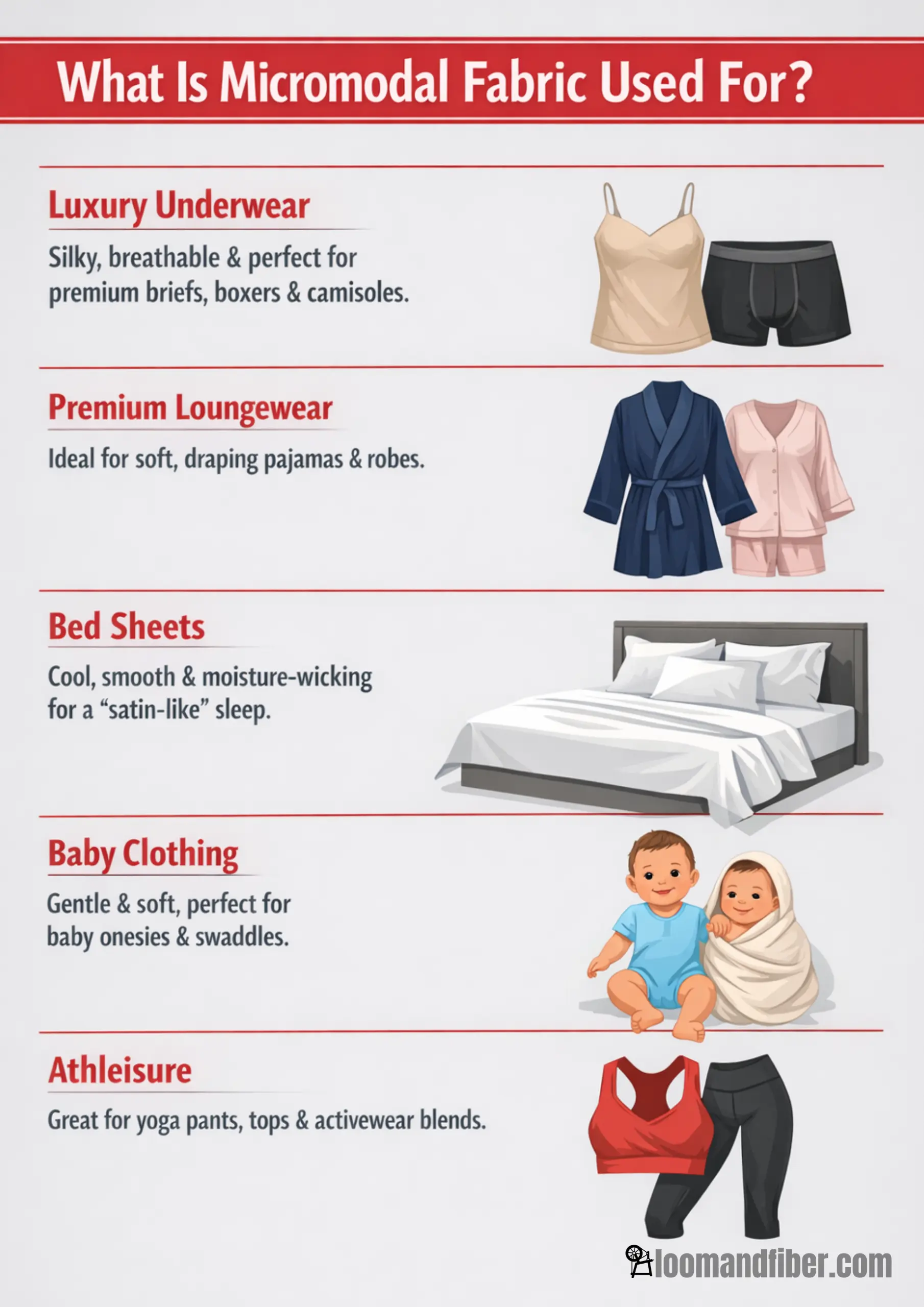
Luxury underwear: The #1 use. The soft and breathy nature of Micromodal make it the choice as premium briefs, boxers, panties and camisoles. It is smooth on the intimate skin.
Luxury loungewear: Wealthy pajamas, robes and lounge sets are made with micromodal as it is draped and feels like a second-skin.
Bed sheets: Micromodal sheets and pillow cases are fabricated with a cool and smooth sleeping surface. They absorb water and remain smooth. It is used in luxury bedding lines to create a cool satin feel.
Baby apparel: It is soft and smooth and has got moisture control, making it perfect in soft baby clothes and swaddles. It is usually combined with some organic cotton, to make baby necessities.
Athleisure: Starting with yoga pants, but extending to workout tops, micromodal blends (particularly in the presence of spandex) are thriving in athleisure collections because of the stretchiness and comfort of the fabric.
Is Micromodal Fabric Sustainable?
Yes, micromodal is considered a sustainable fabric, especially when made by reputable manufacturers. It is made from plant-based cellulose, which fully biodegrades after disposal. Regarding sustainability, micromodal’s production utilizes a closed-loop process to recover ~95-99% of the chemical solvent used, which reduces pollution from process chemical waste.
Micromodal’s water usage for production is also low because the beech trees from which it is sourced requires much less irrigation than cotton plants. In fact, micromodal production uses approximately 10-20 times less water than cotton production. Lenzing and similar companies ensure that the wood pulp used for micromodal production is sourced from sustainably managed, often FSC-certified, forests.
Does Micromodal Shrink?
Micromodal can shrink if exposed to high heat.
Causes of Shrinkage
- Hot water washing
- High dryer temperatures
- Aggressive agitation
Prevention Tips
- Wash in cold water
- Use gentle cycle
- Avoid high heat drying
- Air dry when possible
When properly cared for, shrinkage is minimal.
How to Care for Micromodal Fabric

- Cold Wash: Micromodal clothing is best washed with cold water (30°C or less). Hot water can weaken fibers. Using a gentle or mild liquid detergent is best. Avoid bleach and fabric softeners, as fabric softeners can clog the fiber’s moisture channels, and detergent can break down the fibers.
- Gentle Cycle: Choose your machine’s delicate or low agitation cycle. This most preserves the fine fiber structure. For added protection, you can wash micromodal in a laundry bag.
- Air Dry Preferred: For the most softness, micromodal should be dried flat or hung. Air drying is preferable, but if you dry in a machine, use low heat or “air fluff” only. High heat can damage fibers and cause shrinkage, so use as low a setting as possible.
- Avoid High Heat: Do not iron micromodal with a high temperature setting. If you must, use a cool setting or steam from a distance. In addition, this fabric will become wrinkly, so ironing should be a last resort.
Mindful treatment of micromodal clothing results in the garments retaining their softness and proper size wash after wash.
Conclusion-
Micromodal fabric is a modern textile innovation for 2026 and beyond. It is made from ultra-fine beechwood cellulose and combines unrivaled softness with eco-conscious and responsible production. It is also stronger than regular modal. We have seen the manufacturing process (with extra-spun filaments), the GSM weights appropriate for each use, and how micromodal compares to cotton and modal. In beddings, underwear, activewear, and loungewear, micromodal fabric offers a second skin sensation.
Micromodal also meets the requirement for eco-friendliness. Its use of a closed-loop system and the renewal of wood pulp mean that it is more environmentally responsible than other fabrics. It costs more to produce micromodal and it also requires more careful washing, but the overwhelming majority of users consider the trade-off worth it for the long-lasting and cloud-like comfort.
In conclusion, micromodal is a unique luxury fabric. It is also ultra-soft, and has a high level of breathability and durability. Regardless of whether it is called MicroModal® or “fine modal,” it is top of the range textile. It delivers the best comfort for the least amount of damage to the earth.
Read More>> About the Toxicity of Modal Fabric.
FAQs
It’s a semi-synthetic fiber. Micromodal is prepared using beechwood cellulose that is natural, but chemically transformed (similar to rayon) into an artificial yarn. Stated differently, it is plant-based but factory-made (closed-loop process).
Yes, in most aspects, yes for performance. Micromodal is much softer, breathable, and wicks water much better than cotton does. It also dries faster and it also resists odors. Cotton is strong and completely natural, whereas micromodal is cooler and more bowling in the summer or when wearing.
No, micromodal is pilled very well. Its fine, smooth fibres do not make fuzzballs, as wool does, or some artificial fabrics. With a proper care, a micromodal garment will remain smooth and not pill-ridden.
Absolutely. Micromodal performs well in the warm weather. Its breathable knit is lightweight and lets the air flow through and the sweat evaporate. It will capture half the amount of moisture that cotton is able to capture and therefore it does not feel hot on hot days but cool and dry. It is due to this that many prefer micromodal loungewear and shirts in summer.
Yes. Micromodal is skin-friendly due to its softness and smoothness. That is why it is commonly employed in underwear and baby clothes. It is non-irritating because it is hypoallergenic (no hard fibres) and breathable. Micromodal is normally a good option in case you have skin sensitivities.