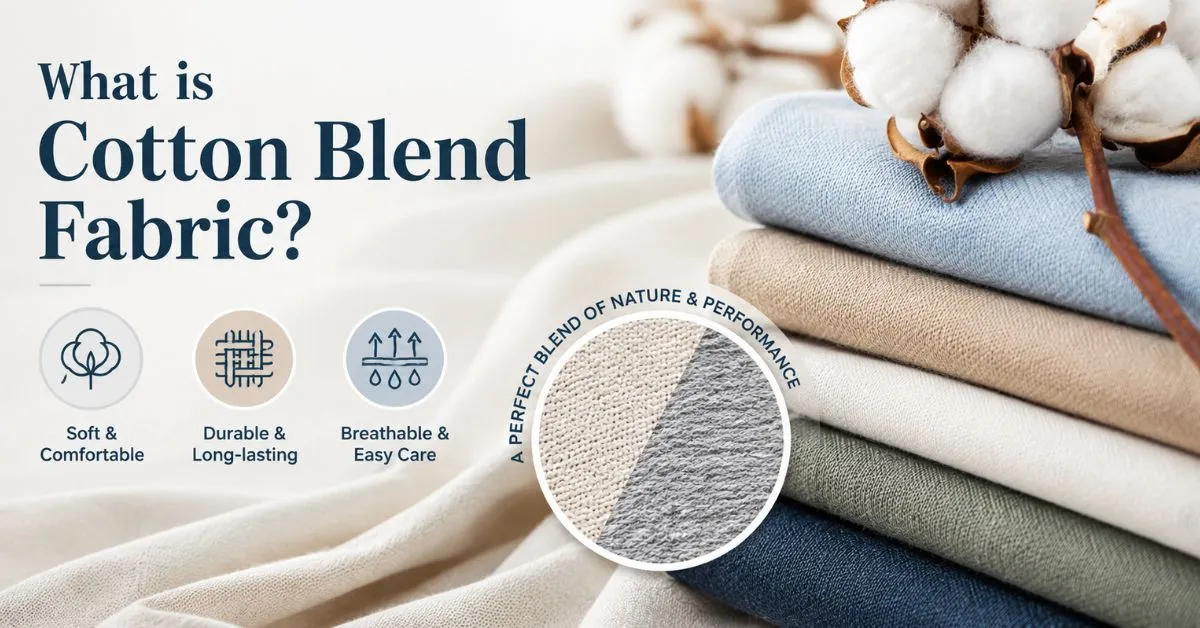

What Exactly Is Cotton Blend Fabric?
By blending cotton with other fibers, manufacturers create fabrics with enhanced properties. These fibers may be natural or synthetic. Cotton may be blended with polyester, linen, spandex, wool, or rayon.
In most cases, cotton is blended with other fibers to achieve either cost-effectiveness or an improvement in fabric function. For instance, the addition of other fibers may improve fabric functionality or reduce fabric costs.
Pure cotton fabrics have shortcomings such as excessive wrinkling, and easy shrinkage after washing. Cotton blend fabrics offer balance and functionality for modern-day clothing as well as home furnishings.
Common examples of cotton blend fabrics include:
60/40 cotton-polyester
95/5 cotton-spandex
50/50 cotton-poly blends
Cotton blend fabrics are also used in modern clothing. However, to address the question of whether cotton blend fabrics contain real cotton, the answer is yes. Cotton blend fabrics contain cotton combined with one or more additional fibers.
What Is Cotton Blend Fabric Composed Of?
In this section, we focus on the composition of cotton blend fabrics showing common cotton blends.
Cotton with Polyester
In the 60/40 and 50/50 cotton-polyester blends, cotton fabrics are combined with polyester to manufacture certain fabrics like T-shirts and uniforms. The 60/40 and 50/50 cotton-polyester blends used in T-shirts offer better functionality than 100% cotton T-shirts.
Cotton with Spandex
Cotton-spandex blend fabric provides better stretch and flexibility than many other cotton blends. 95/5 and 90/10 cotton spandex blends are common.
Fitness and activewear leggings made with spandex feel really comfortable. Spandex adds stretch and flexibility, while cotton maintains softness and comfort throughout the day.
Cotton + Rayon
Stay comfortable in warm weather with knit fabrics. The cotton-rayon blend is a light and breathable fabric. Using cotton-rayon blends helps garments drape more smoothly. Rayon and cotton blends work well with blouses, shirts, and dresses.
Cotton + Linen
Cotton-linen fabrics stay cool and comfortable in the summer. Linen fibers naturally create a slightly textured and crisp fabric. This fabric blend is more comfortable in the summer than many synthetic fabrics combined. Because of this, it is a common fabric choice with summer shirts and other casual clothing.
Cotton + Wool
Cotton-wool blends provide warmth and structure while feeling lighter and more comfortable than pure wool fabrics. This type of blend is perfect for winter tops, sweaters, and knit clothing. Wool helps insulate and keep warm during winter. With this blend, cotton reduces the rough texture of wool, adding to the comfort of the fabric.
Why Is Cotton Blended With Other Fibers?
Textile manufacturers blend cotton with other fibers to improve fabric performance. Cotton on its own feels comfortable but has many limitations.
Cotton fabrics shrink, especially in the wash. After incorporating fibers like polyester or regenerated fibers such as rayon, the structure of the fabric becomes more stable. Because of this, cotton fabrics maintain their structure for a longer time.
Pure cotton fabrics also wear out quickly when exposed to heavy friction or repeated washing. Spandex improves stretch and flexibility, which is why cotton-spandex blends are commonly used in sportswear and fitted garments.
Blending also improves moisture management in many performance fabrics. Some fibers dry faster, significantly reducing sweat retention.
Another important reason is cost. Polyester fibers cost less than premium cotton fibers. For this reason, cotton-poly blends become more relevant due to their affordability during mass production.
Many blends also resist wrinkles better than pure cotton. This also helps reduce the frequency of ironing.
Mini Summary:
Cotton blends combine the comfort of cotton with the advantages of synthetic or specialty fibers.
Types of Cotton Blend Fabrics
| Blend Type | Feel | Benefits | Common Uses |
|---|
| Cotton Polyester | Smooth | Durable and wrinkle-resistant | T-shirts |
| Cotton Spandex | Stretchy | Flexible and comfortable | Leggings |
| Cotton Rayon | Soft | Drapes beautifully | Dresses |
| Cotton Linen | Crisp | Breathable and airy | Summer wear |
| Cotton Wool | Warm | Insulating and cozy | Sweaters |
Cotton Polyester Blend
Cotton-poly blends combine softness with long-lasting durability. These fabrics consistently resist wrinkles better than pure cotton garments. They are commonly used in affordable everyday clothing products. Additionally, they dry quickly after being washed or after sweating in them.
Cotton Spandex Blend
Cotton-spandex blends stretch comfortably during movement and exercise. These fabrics fit closely without being restrictive or uncomfortable. These cotton spandex blends are used in large volumes in activewear and athletic clothing. They hold their shape well after being used many times.
Cotton Rayon Blend
Cotton-rayon textiles are soft and lightweight. Rayon drapes beautifully in dresses and other fashion apparel. This fabric blend helps airflow in warm weather. As a result, many higher-end casual apparel brands use this blend.
Cotton Linen Blend
Cotton-linen blends feel breathable, textured, and naturally airy in summer. Linen enhances cooling and evaporating moisture even more. The blend usually wrinkles less than pure linen. Thus, it is appropriate to use in clothing made for hot climates.
Cotton Wool Blend
Cotton-wool fabrics feel more comfortable and warm than pure wool. This blend is great for making sweaters and garments made for winter. Cotton also reduces the itch of wool for people who have sensitive skin. The blend accomplishes insulation and breathability well.
How Cotton Blend Fabric Is Made
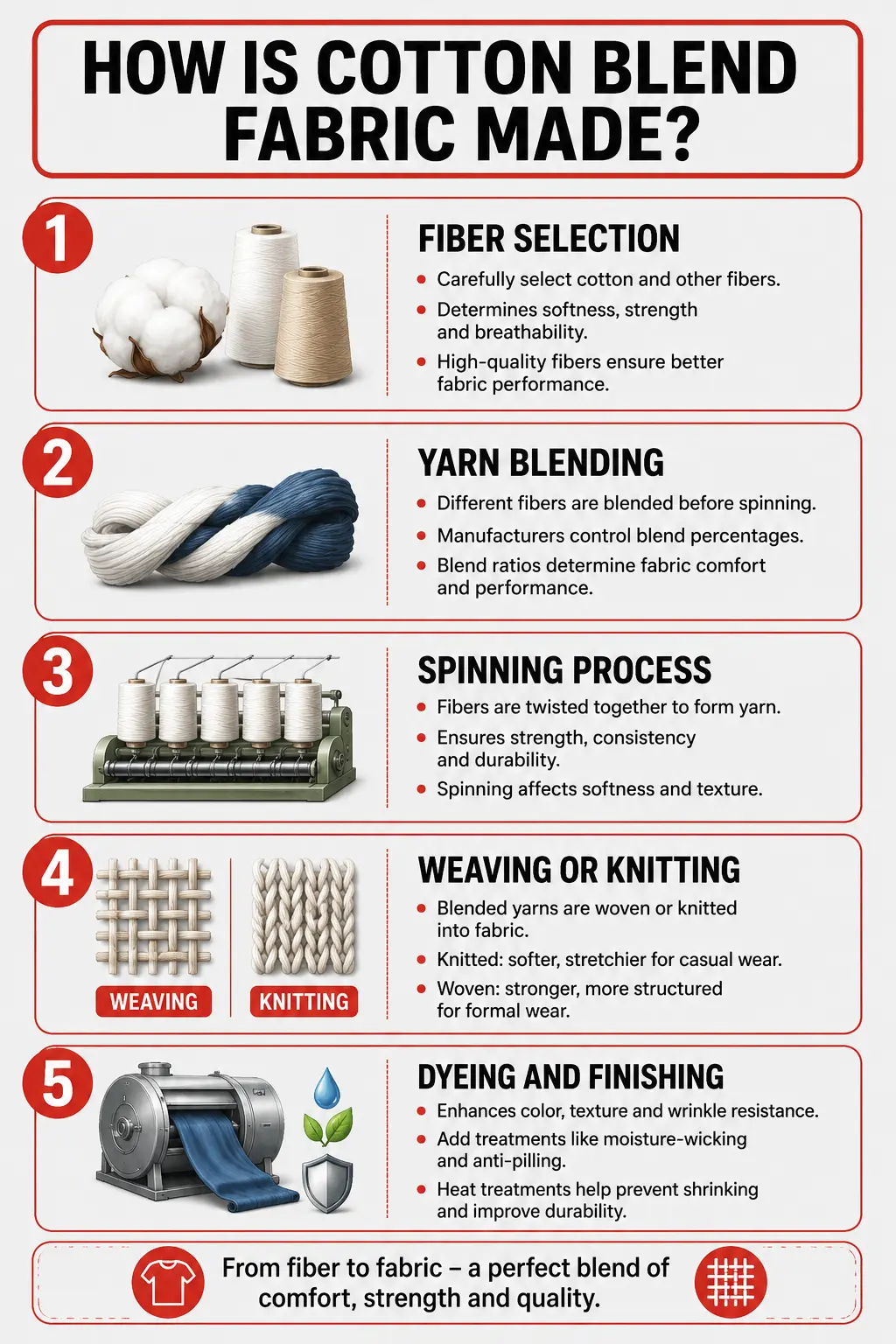
Fiber Selection
When mixing, manufacturers first select fibers to partner with cotton. The selected fibers are the basis for softness, strength, stretch, and breathability. High-quality fibers help produce fabrics that are durable, smooth, and long-lasting.This is why fiber selection is crucial to fabric performance.
Yarn Blending
Yarn blending involves mixing fibers before the spinning process begins. The manufacturers closely monitor the percentages during this phase of production, as the ratios determine the performance and comfort of the fabric. This is why blend percentages are fundamental to the behavior of the fabric.
Spinning Process
The fibers are twisted during the spinning stage which forms the yarn. This step of the process increases the durability and consistency of the yarn. Modern spinning machines help achieve more even fiber blending and yarn consistency. Spinning also influences the texture and softness of the yarn and fabric.
Weaving or Knitting
Manufacturers either weave or knit the combined yarns to make the finished fabric structures. Knitted fabrics tend to feel stretchier and softer and are generally used for casual garments. Woven fabrics, on the other hand, provide greater structure and durability for the more formal applications. Thus, construction methods greatly impact the functionality of the final fabric.
Dyeing and Finishing
Finishing improves the color, the texture, and the resistance to wrinkles of fabrics. Manufacturers may also add treatments to fabrics that help control moisture or to prevent pilling. Also, heat treatments can help stabilize the fabric to prevent it from shrinking in the future. Therefore, finishing improves the fabric’s aesthetics and enhances its performance over time.
Intimate Blending vs Yarn Blending
Intimate blending occurs when fibers are mixed before the complete formation of yarns. Yarn blending occurs when the separate yarns are combined during the construction of fabric. Generally, intimate blends provide more uniform performance characteristics when compared to yarn blending, yet, yarn blending has the potential to create texture differences that are noticeable.
Does Higher Cotton Percentage Matter?
Yes, higher cotton percentages make fabrics noticeably softer and more breathable. However, lower cotton ratios may also improve durability and decrease the wrinkles in the fabric. A 95% cotton blend generally feels softer and more breathable than a 50/50 blend. Therefore, the percentages that are utilized depend on the intended use of the fabric.
General Characteristics of Cotton Blend Fabric
Softness
- Cotton blend fabrics usually feel softer than many synthetic-only fabrics.
- Blends of rayon and modal fabrics also add significant softness.
- Blends with polyester may feel smoother, but less naturally.
- Higher cotton percentages lead to a more comfortable feel against the skin.
Breathability
- Cotton allows air circulation more effectively when worn.
- Blends with linen and rayon may circulate air better.
- Blends with a heavy polyester content may reduce breathability.
- The ratio of fibers in the composite and the thickness of the fabric play a large role in influencing breathability.
Stretchability
- Cotton by itself has very limited stretching ability.
- The flexibility of a fabric is dramatically increased by the addition of spandex or elastane.
- A cotton-spandex fabric blend has better shape retention after stretching.
- The percentage of stretch of a fabric is closely related to the comfort of the fabric and the fit of the garment.
Moisture Absorption
- Cotton has the ability to absorb moisture, which is beneficial in warm weather.
- Polyester has limited moisture absorption but is fast drying.
- Effective moisture management can be achieved through well-designed blended fabrics.
- Most athletic fabrics have the combination of moisture absorption and drying.
Durability
- Blended cotton fabrics have better resistance to wear and tear.
- The use of stronger fibers helps to ease the problems of tearing and thinning.
- The use of these fibers helps to improve the durability of a fabric for use in workwear.
Wrinkle Resistance
- A product made of 100% cotton wrinkles often after washing and daily use.
- The use of polyester helps to reduce the wrinkling of a fabric and greatly improves the smoothness of the fabric.
- A cotton blend fabric wrinkles less than pure cotton fabric and requires less frequent ironing.
- The use of wrinkle-resistant fabrics increases the convenience for users who have little time.
Shrink Resistance
- Fabric made from 100% cotton tends to shrink when exposed to high temperatures.
- Polyester gives a degree of fabric stabilization.
- A cotton composite fabric shrinks less than a cotton fabric after many laundering cycles.
- Care of the fabric also helps to reduce the risks of shrinkage.
Color Retention
- Polyester improves the retention of dyes and improves the fade resistance of the fabric.
- Fabric made of 100% cotton can fade quickly due to multiple washings.
- Composite fabrics have color brightness that lasts for a longer period of time.
- Color stability is very important in uniforms and in activewear.
Lightweight vs Heavyweight Feel
- A cotton-rayon blend tends to have a lightweight, airy feel.
- Cotton-wool blends feel heavier and warmer.
- The thickness of a fabric depends on the fiber and the way it’s woven.
- Different weights are appropriate for different climates and purposes.
Variability in Texture
- The cotton-linen mix has a textured and naturally crisp hand.
- Cotton-rayon blends are smoother and silkier.
- Wool mixes produce the warmest and fuzziest textures of all blends.
- Texture impacts the look and feel of the garment.
Advantages and Disadvantages of Cotton Blend Fabric
Advantages
Feel: Blended cotton is soft and more comfortable than many synthetic fabrics.
Strength: The addition of polyester and advanced fibers increases strength. Blended fabrics are less likely to tear or be worn away by friction.
Wrinkle Resistance: When compared to 100% cotton, cotton blends wrinkle less. Therefore, the need to iron them is also reduced.
Convenience: Many blends are easy to wash and to dry at home. They take even less time to dry than 100% cotton fabric.
Cost: Adding polyester helps reduce fabric production costs. This means blended fabrics cost less than quality cotton fabric.
Versatility: Many blends can be made to accomplish many different things. Fabrics can be designed for varying needs from comfort to stretch.
Disadvantages
Overheating: Fabrics with a lot of polyester feel hotter. This means some high-polyester blends may not breathe well.
Pilling: Some of the cotton-poly blends form little balls of fiber. Lower-quality fabrics pill more frequently.
Environmental Impact: They are less biodegradable because there are synthetic fibers in them. Unlike cotton, polyester does not break down naturally and can persist in the environment for a long time.
Less Natural Feel: Some blends are less breathable than fabric made from pure cotton.Users with sensitivities may choose to use 100% naturally made materials instead.
Is Cotton Blend Fabric Good or Bad?
Cotton blend fabric is good for everyday clothing and home textiles. But, what blend is used depends on the purpose, the climate, and what is most comfortable for the person.
Cotton Blend vs 100% Cotton
| Feature | Cotton Blend | 100% Cotton |
|---|---|---|
| Softness | Moderate to high | Very soft |
| Durability | Higher | Moderate |
| Wrinkles | Fewer | More |
| Breathability | Depends on blend | Excellent |
| Stretch | Better | Limited |
| Shrinkage | Lower | Higher |
Cotton blends win on durability and require less maintenance. But cotton has the edge in breathability.
Questions are often asked about:
- cotton vs. cotton blend? Which is better?
- Are blends of cotton breathable?
These all depend on the purpose of the fabric and the weather.
Is Cotton Blend Fabric Breathable?
Yes, many fabrics blended with cotton are breathable. Breathability is dependent on the ratio of fibers and how the fibers are blended.
Blends of cotton and linen or blends of cotton and rayon have excellent air flow and breathability for hot weather. These fabrics feel cooler and lighter during the summer months.
Blends with higher polyester content are usually less breathable because polyester traps more heat. However, light cotton-poly that is blended breathes well.
Spandex in small percentages also affects the fabric’s breathability. This usually does not go over 5%.
Best Cotton Blends for Hot Weather
- Cotton-linen
- Cotton-rayon
- Lightweight cotton-poly blends
Is Cotton Blend Fabric Good for Summer?
Many cotton blends work well for summer clothing. Lightweight blends improve airflow and sweat management.
During humid weather, cotton-linen blends stay cool. Linen improves evaporation and airflow.
Another blend that feels cool during hot weather is cotton-rayon. It is lightweight, and rayon provides a soft cooling effect against skin.
Lightweight cotton-poly blends dry quickly after sweating. So, they work well for active summer wear.
Worst Blends for Humidity
- Heavy polyester blends
- Thick brushed cotton-poly fabrics
Is Cotton Blend Stretchy?
Cotton itself has very limited natural stretch. However, adding spandex or elastane improves elasticity significantly.
Most stretchy cotton blends contain 3% to 10% spandex. A 95/5 cotton-spandex blend feels flexible and comfortable during movement.
Cotton-poly blends stretch slightly, yet they remain less elastic than cotton-spandex fabrics.
Does Cotton Blend Shrink?
Yes, cotton blend fabric can shrink slightly after washing. However, blends usually shrink less than pure cotton fabrics.
Cotton fibers naturally contract under heat and moisture. The polyester helps stabilize the structure.
Heat drying makes fabric shrink more, so it is best to air dry.
Many manufacturers also pre-shrink cotton blends before selling garments.
How to Avoid Fabric Shrinkage
- Use lukewarm or cold water for washing
- Avoid placing fabric in a high setting for drying.
- Read the care and wash instructions and follow them.
Applications of Cotton Blend Fabric
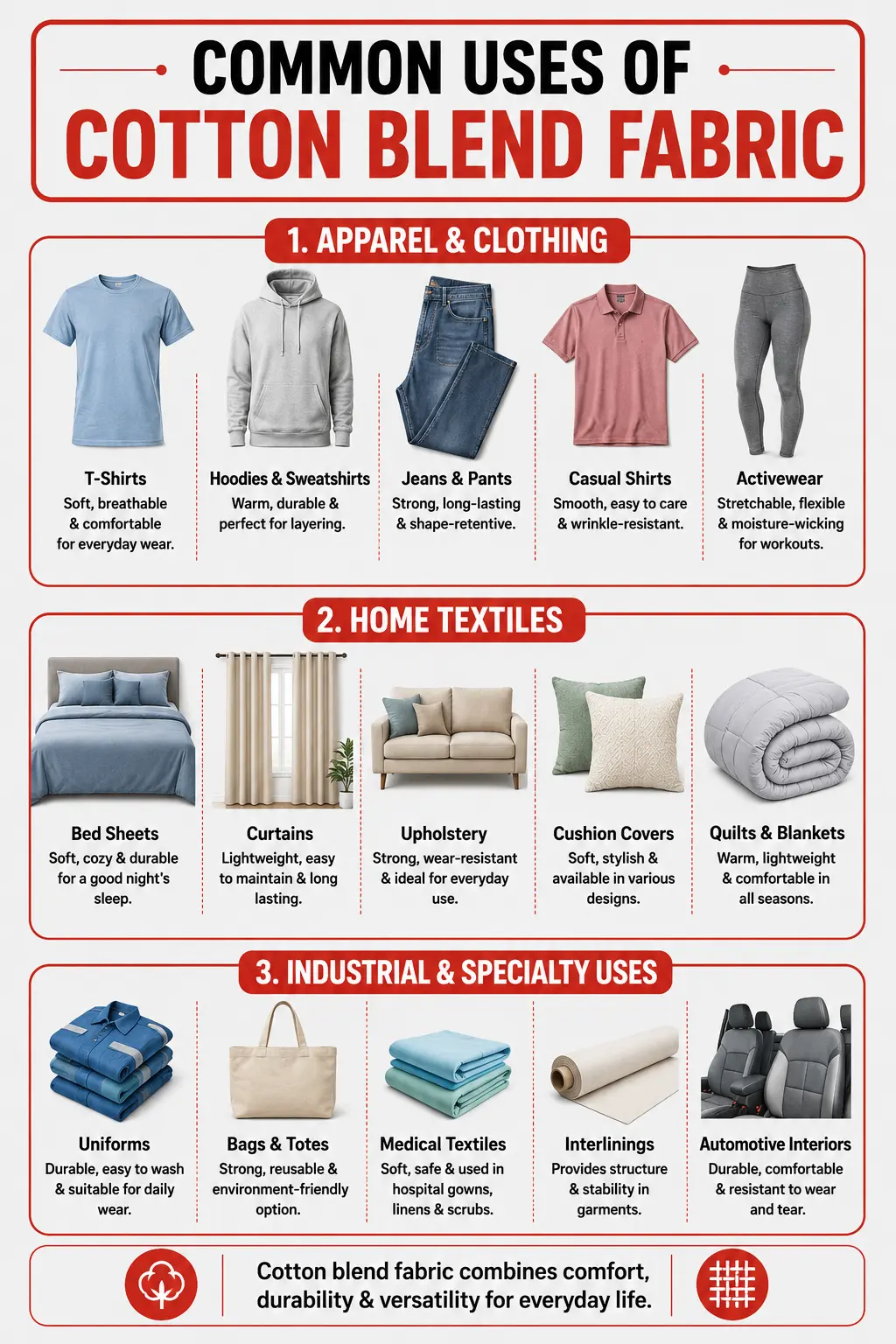
Clothing
T-Shirts
- T-shirts are made from a cotton-poly blend.
- This combination allows for softness and durability with affordability.
Hoodies
- Cotton-poly fleece hoodies retain their shape and warmth.
- This blend reduces shrinking in cotton hoodies.
Jeans
- Cotton-spandex denim is both comfortable and flexible.
- Both denim blends allow ease of movement in daily activities.
Sportswear
- Cotton-spandex allows for flexible and comfortable clothing, although moisture-wicking performance depends on the fabric construction and fiber composition.
- This blend becomes the new staple for sports leggings and clothing.
- Underwear
- Cotton blends feel soft and absorb moisture effectively.
- The comfort in the spandex blend is easily achieved.
Home Textiles
Bedsheets
- Cotton-poly bedsheets resist wrinkles better and dry faster after washing.
- This blend is cheaper than 100% cotton bedsheets.
Curtains
- The durability of cotton blends prevents fabrics from fading.
- Polyester also helps curtains retain their shape.
Upholstery
- Cotton-poly upholstery fabrics become timeless due to their resistance to wear and tear.
Industrial Uses
Medical Textiles
- Cotton blends are commonly used in medical clothing and reusable textile products.
- The durability of cotton blends withstand repeated sanitization procedures.
Uniforms
- Cotton-poly fabrics dominate workwear and school uniforms worldwide.
- These materials are widely used in school uniforms because they resist wrinkles and maintain their appearance.
Top Cotton Blend Fabrics for Different Uses
Gym Wear
Blends of cotton and spandex offer excellent comfort and flexibility.
These blended fabrics have good stretch, retain their shape, and bounce back after a workout.
Summer Shirts
For hot weather, cotton-linen blends improve airflow and breathability.
These fabrics feel light, are naturally cool, and become highly breathable.
Hence, they are well-suited for those who live in tropical areas.
Budget T-Shirts
Production costs are saved while keeping comfort thanks to the cotton-and-polyester blend.
These fabrics resist both shrinkage and wrinkles.
So, they are the preferred choice for mass-market clothing.
Luxury Dresses
Cotton-rayon blends are valued for their softness and elegant drape.
Rayon gives premium garments an elegant drape and fluid movement.
Hence, this blend is the frequent choice among designers.
Winter Wear
Cotton-wool blends provide warmth while often feeling lighter and softer than pure wool fabrics.
They create a blend of fabrics that stay warm but are good at preventing cold air from entering.
Plus, cotton helps in softening the texture of wool.
Caring for Cotton Blend Fabric
Washing Instructions
- Use warm or cold water to wash cotton blends.
- Using a gentle wash cycle helps retain the fabric’s texture and elasticity.
Drying Instructions
- Air drying helps prevent fabric damage and reduces shrinkage.
- A low heat setting in the dryer can also be a good option, depending on the blend.
Ironing Tips
- While ironing cotton blends, a medium heat setting can be appropriate.
- As for blends that are heavier on polyester, lower settings are typically recommended.
Preventing Pilling
- Washing them inside out is a way to reduce the friction that damages the surface of the fabric.
- A rougher wash or an overstuffed washing machine should be avoided.
Preventing Shrinkage
- High dryer temperatures should be avoided because excessive heat can shrink cotton-rich fabrics.
- Always pay close attention to garment care instructions.
Can Cotton Blends Go in the Dryer?
Most cotton blends are dryer safe. However, low or medium heat settings are recommended for dryer use to avoid potential shrinkage or damage to these fabrics.
Is Cotton Blend Fabric Sustainable?
The sustainability of cotton blends largely depends on the types of fibers used and how they are produced. Cotton uses a lot of water, and the cultivation doesn’t come without some environmental costs.
Polyester is problematic from an environmental standpoint for a few reasons, primarily due to petrochemicals and microplastics that it releases when it is laundered.
However, blends that use recycled polyester help to close the loop, and many brands are successfully blending recycled fibers with organic cotton.
Organic cotton blends can improve sustainability by reducing pesticide use and supporting more environmentally responsible farming practices, and the sustainability of the blends is furthered by the introduction of biodegradable regenerated fibers.
Environmental Trade-Offs
- Cotton uses more water resources.
- Polyester reduces biodegradability.
- Recycled fibers balance sustainability.
Sustainable Textile Innovations
- Organic cotton blends
- Recycled polyester fabrics
- Closed-loop rayon production
How to Identify Cotton Blend Fabric
Read Fabric Labels
You can usually find the exact percentages of fibers listed on clothing labels. For example, you may find a label stating that the fabric is made of 60% cotton and 40% polyester.
Check Texture
Cotton blends can feel soft and smooth, although the texture depends on the fiber composition and fabric construction. In cotton-polyester blends, the fabric may feel smoother or slicker than pure cotton.
Observe Stretch Behavior
A fabric blended with spandex will usually have noticeable stretch. Pure cotton has very little stretching capability.
Wrinkle Test
Pure cotton will wrinkle easily and lose its shape after being squeezed tightly. A cotton blend will hold its shape better after being squeezed tightly.
Burn Test
When testing fabric blends, cotton will smell like burning paper. Polyester will melt and form a blob of a hard plastic residue.
It is very important to perform burn tests in a safe manner.
FAQs
Cotton blend fabric is great for making clothing, home textiles, and bedding. They provide the same comfort as cotton, but add stretch, decrease wrinkling, provide durability, and are more affordable compared to pure cotton. However, the best blend depends on the intended use and the environment.
Some cotton blends are warmer compared to pure cotton; the polyester-heavy ones can be very warm. However, cotton-linen or cotton-rayon blends may feel cooler and provide more comfort during hot weather.
Cotton blend fabric can shrink, but usually less than pure cotton because polyester fibers have low shrinkage. Washing at a low temperature and air drying will help retain the size of the garment and minimize shrinkage.
Yes, some cotton blends will provide comfortable breathability, even for extended periods of time. Breathability depends on the type of fiber added and the percentage of the blend. Cotton-linen and cotton-rayon blends in particular have the best air permeability.
Cotton blends feel soft and comfortable against skin. Rayon and modal add extra softness. However, polyester-heavy blends can feel smoother but less natural than cotton.
Nothing is better than the other in all cases. Pure cotton is natural, soft, and breathable. On the other hand, cotton blends are more durable and do not wrinkle with use.
Yes, cotton blends are more durable than pure cotton. Blends with polyester add sturdiness and improve resistance to wear and tear. Thus, blended garments are more durable.
The best percentage depends on comfort and use. Higher cotton percentages improve softness and breathability, while lower cotton percentages may improve durability and reduce wrinkling.
Conclusion-
Balanced comfort, durability, affordability, and performance make cotton blend fabrics among the most popular textiles in the world.
- For most comfort and softness, cotton-rayon blends excel.
- For ease of care and durability, cotton-poly blends are often the best choice.
- Cotton-linen is best for breathability when it is hot.
- In today’s sportswear, cotton-spandex blends are widely used in activewear and stretch garments.
Generally, cotton blends are worth your money if used for a specific purpose and chosen carefully.
Read More>> What is Poly-Cotton Fabric?