
Introduction-
Cotton twill is all around us nowadays, whether it is the old fashion blue jeans on your knees or heavy-duty chino pants or utility workwear. The diagonal weaving pattern of this fabric makes it a favorite fabric in many garments since it has a special feel that is extremely strong. Twill, rather than a plain checkerboard weave, presents a diagonally angled wale, or rib on the surface, which attracts the eye and provides the fabric with its durability. The cotton twill is something that fashion lovers, people who sew themselves, and those who purchase items of long-term usefulness need to pay attention to: it is a material that silently offers comfort and style to people and their clothing.
What Is Cotton Twill Fabric?
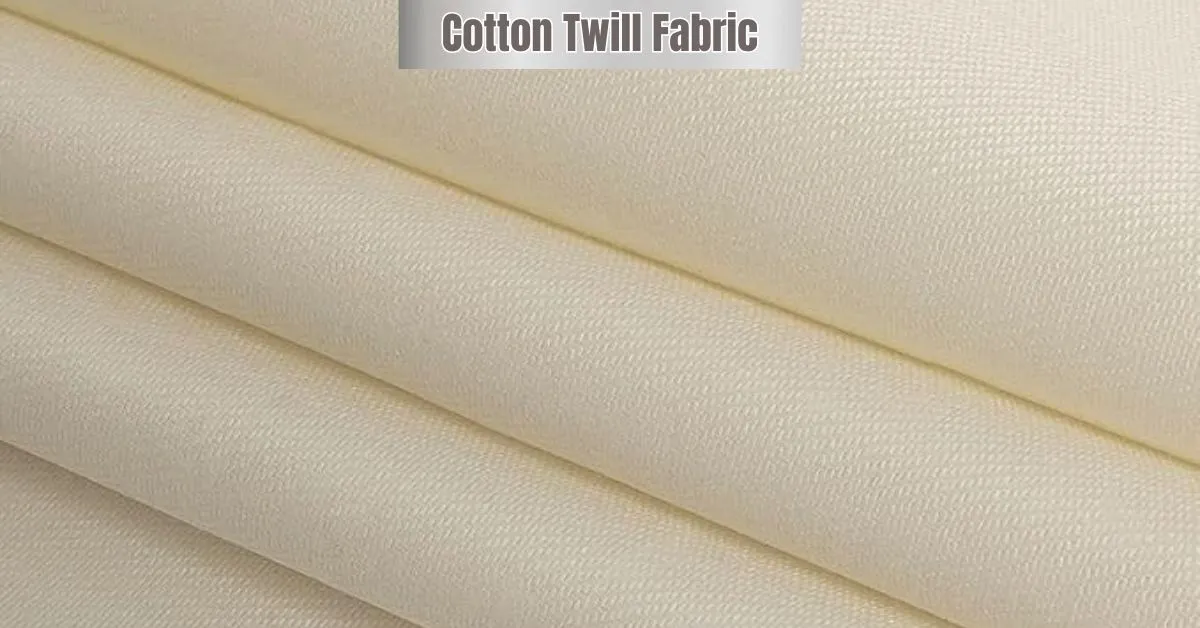
Cotton twill is merely, cotton fiber that has been woven in twill. In this diagonal, a weft (crosswise) thread is carried around one or several of the warp (lengthwise) threads and under two or several warp threads and vice versa with an offset. What has been produced is a muslin that has a trademark slanted rib or wale on one side. Simply put, cotton twill is 100% cotton fibers in this diagonal pattern that produces a strong, opaque clothing that can be worn.
How Cotton Twill Is Made
Twill Weave Structure (Diagonal Ribs)
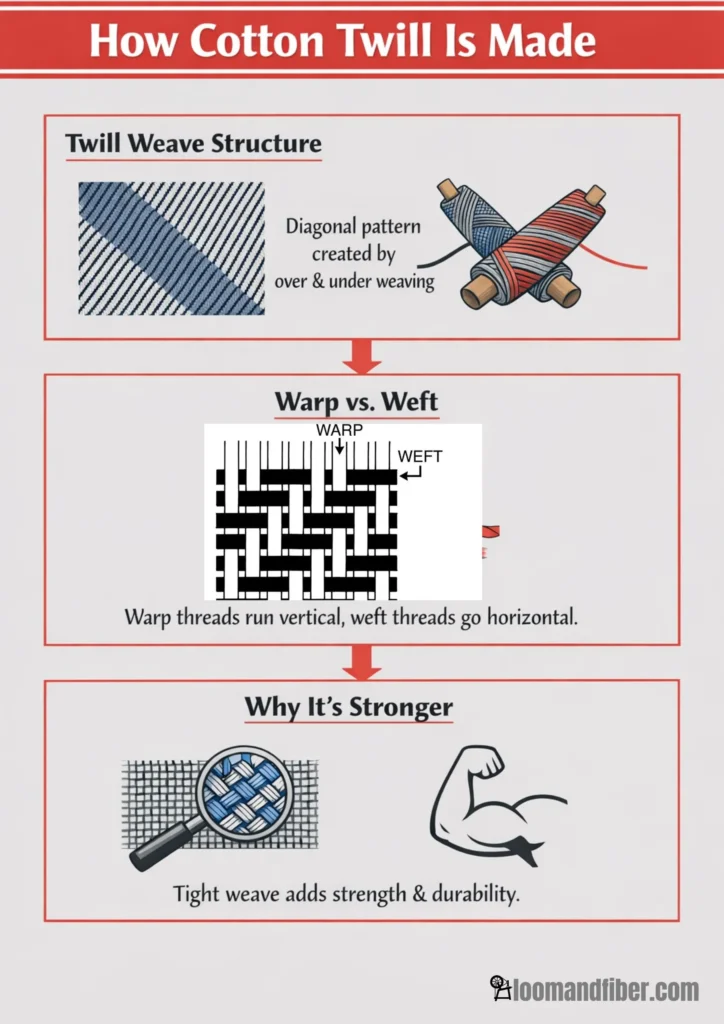
Twill is made with a distinct effect of diagonal clothing on the fabric face. In order to make a plain twill, the loom crosses one weft yarn over two (or more) warp yarns, then under one, in each row, by stepping it off sideways. This over-1, under-2 (e.g.) offset gives the angled ribs so well-known as wales. The staggered rows of the twill make straight diagonal lines, unlike the checkerboard appearance of a plain weave. These diagonal ribs make the fabric stronger and make its surface smooth and textured.
Warp vs. Weft Threads
To know twill is to know warp and weft. The strands of warp are placed longitudinarily on the loom (fixed in place), and weft strands placed transversely. In cotton twill the warp yarns are generally the stronger lengthwise threads and the weft yarns cross and under cross the warp in the twill pattern. A 2/1 twill, or to be more precise, a 2/1 twill is an illustration of a weft passing over 2 warp threads followed by one. This twill the order of floating over a number of threads is the main strength of twill. More floats increase the thread count and a tight and hard fabric.
What Makes It Stronger than Plain Weave
The diagonal weave of cotton twill gives it greater strength compared to plain weave cotton. Since the yarns are suspended across a variety of threads, twill is able to fit more threads per square inch and is tear resistant. Indeed, cloth experiments indicate that a 10-ounce cotton twill has a 15 per cent. greater diagonal tear strength than an equal weight plain weave. Twilll its extreme interlacing and the dense floats provide it with high durability. Plain weave (1 over, 1 under) is more exposed, by comparison, hence is not as likely to be heavy-duty. All in all, the twill fabric has a durable and strong cloth.
Key Characteristics of Cotton Twill
Durability
The cotton twill is known to be tough. It is very resistant to tearing and abrasion as it has a tight diagonal weave. With everyday applications (jeans, uniforms etc.), this implies that twill will wear much longer than a corresponding weight plain weave. The diagonal ribs also assist in concealing minor stains or dirt as the soil sticks to the rough surface rather than to smooth cotton.
Wrinkle Resistance
Cotton twill has better resistance against wrinkles than other cotton fabrics due to the pattern and medium weight. The diagonal rib enhances the fabric system in such a way that it does not easily crease. You will see that twill shirt or pant will be neater in appearance than the lightweight poplin shirt after sitting or packing. That is why workwear and traveling clothes use twill frequently – it does not look crumpled when packed.
Softness Over Time
Cotton twill is hard when fresh, however, and it feels beautiful after washing and use. A lot of users report that a stiff twill softens with time, yet remains pliable and retains form. With the relaxation of the fabric, the fabric covers the body more easily. Twill (using combed or long-staple cotton yarn) of high quality will just feel softer at the beginning and will get even better.
Breathability
Because twill is 100% cotton, it remains reasonably breathable. The cotton fibers can carry on the circulation of air as opposed to plastic. Nevertheless, the woven texture of twill is heavier and denser, which makes it not as airy as light cotton voile. It is in between: you will be cooler in a cotton twill shirt than wool, but more comfortable than a thin linen. Most users would consider twill as an all-year-round garment (at least, in summer, the lighter twills are better), because it can withstand wind without keeping the user overheated.
Drape
The cotton twill is less stiff than a denim or a canvas. Being so pliable, with a diagonal weave, it can be shaped to conform to anatomy, particularly when it has been broken in, and twill is much smoother than a plain weave of the same weight and feels less boxy. This is observable in custom made twill pants or jackets: they do not move loose.
Cotton Twill vs Other Fabrics
Cotton Twill vs Denim
Denim is in fact a form of cotton twill thus in most ways they belong to the same family. The distinction is more in style and weight. Denim is a warp-faced indigo-dyed indigo warp cotton twill, and white weft, yarn. This is the way of making classic jeans (blue on the outside, white inside). Common cotton twill may either be light or dark on either side (such as chinos or jackets). By comparison, denim (the heavy 10-14 oz cloth) is more rigid and stronger, and other lighter cotton twill (5-7 oz) is smoother and lighter. They are both long lasting, though denim will tend to be more sturdy and popular when it comes to jeans that are rugged.
Cotton Twill vs Canvas
Canvas is heavy plain-weave cotton and twill is diagonal. The simplicity of the weave counts a lot: canvas (an 1/1 over/under weave) is extremely rigid, and it looks cross-hated. it is usually compressed and hard ( boat sails or tents). Twill on the other hand is softer and more flexible. As an illustration, the two fabrics are extremely strong, yet the canvas can withstand brute forces (and even water) even better. Twill is more comfortable with improved drape. It is not that one fabric is better than the other; a bag or a jacket that is rugged should be made of canvas, whereas comfortable apparel should be made of twill.
Cotton Twill vs Plain Cotton
Plain cotton is usually cotton of a plain (1-over-1-under) weave such as poplin or Oxford. In comparison to that, cotton twill is slightly superior in its steadiness and feel. Twill weaves are made in very tight packs and this makes them tear resistant and soil resistant as compared to plain weave. A twill shirt is normally heavier and sturdier, whereas a plain-cotton shirt is lighter and flatter. To a practical, twill will be more durable and conceal wrinkles and dirt than a similar plain-weave cotton.
Cotton Twill vs Polyester Blends.
Some of the qualities are changed by a polyester blend (sometimes referred to as poly-cotton twill). Poly-cotton twill is stiffer and more rigid to form, as polyester fibers do not make wrinkles easily. It also becomes smaller when rinsed. However, cotton twill 100 percent is softer, gets even comfier with time, and is more breathable. The cotton twill is also usually warmer and more natural to touch. The combination is selected due to additional strength and the lack of care: polyester gives the ability to resist tears. Therefore, a mixture of poly-cotton could be the best choice in case durability and shrink-resistance are the most important factors (such as uniforms). However, in case you like softness and natural touch, pure cotton twill is the choice.
Common Uses of Cotton Twill
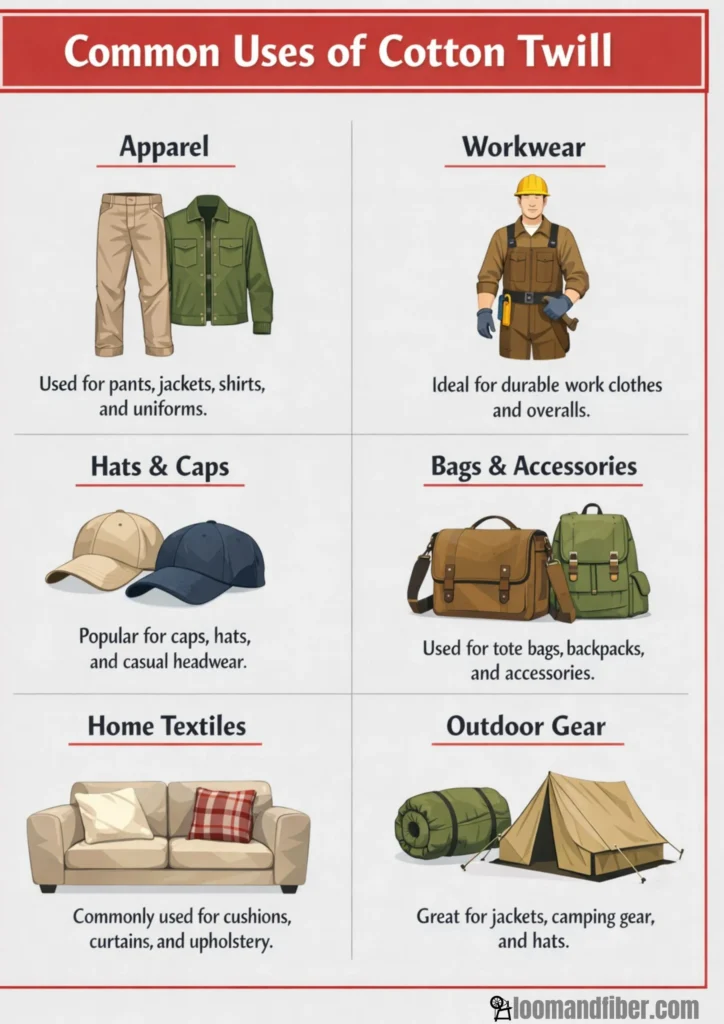
- Chinos: Cotton twill light weight or midweight chinos and casual trousers are the traditional materials used. It has a robust and cozy quality which makes it ideal as everyday pants.
- Work clothing: Pants, coveralls and jackets worn by the mechanic, laborer; these are made of heavy drill (or canvas-weight) cotton twill. The hardiness and resistance to stains are befitting tough jobs.
- Uniforms: Cotton twill is commonly used as a school uniform as well as a military uniform. It is durable enough to wear on a daily basis, as well as easy to dye. It is cool but not too warm to suit neat uniforms.
- Upholstery: Cotton twill is frequently used as furniture material and other types of draperies due to the fact that it is resistant to wear and conceals stains. Its diagonal weave is textured, which provides home textiles with a faint pattern and easy-care.
- Jackets: Overshirts, field coats and chore jackets (as well as other casual jackets) are often made of cotton twill. The fabric has a strike of coziness, construction, and trendy that suits outer garments.
- Best Use Cases: Cotton twill is most useful in areas that require durability and some degree of polish such as work and jackets as well as durable pants where comfort is required. It is great with garments that need to last, and those that need to look good without extensive ironing.
- Worst Use Cases: Do not use heavy cotton twill on ultra-light summer dress or active sportswear or underwear. Its weave is quite thick and therefore can be warm during hot seasons and it is not as stretchy as knits or as light as voile.
Pros and Cons
Pros:
- Very Durable: Cotton twill is tight-woven in diagonal form, which makes it tear-resistant and heavy-duty. It is a lot harder than ordinary cotton cloth.
- Durable and Smooth: The material retains its shape and it does not wrinkle easily. It’s low-maintenance.
- Ease with age: With time and washing twill is made very comfortable without disintegrating. It is a nice-looking drape after it has been worn.
- Breathable Natural Fiber: It is all-cotton and thus is comfortable and allows skins to breathe as compared to synthetics.
Cons:
- Cotton twill is heavier and thicker compared to light fabrics. It may be warm to summer and thick to fine cuts.
- Shrinkage: Pure cotton twill is a fabric that is likely to shrink 3-5 percent unless it is washed previously, particularly in hot water. It requires proper care (cold wash, etc.).
- Less Stretchy: twill does not stretch at all, unlike knits; therefore, it can become tight and uncomfortable in the tight clothes.
- Color May Fade: Strong dye (such as indigo denim) can decrease in strength with repeated washing, thus dark colors can become lighter with wear.
Is Cotton Twill Good Quality?
Yes, twill cotton may be good. Quality is however dependent on a number of factors.
To begin with, the high quality of cotton fibers enhances softness and durability. Long-staple cotton produces smoother and stronger garments. Thus, fiber quality should be always checked. Then there is the density of the weave. Tighter weave implies higher strength and longer life. Twilly is thin and wears out more easily. Also, the thread count is significant, although not overly. A medium thread count and a good weave is preferable. The number of threads is not enough to ensure quality.
Lastly, quality is affected by brands. Famous brands have superior finishing. But less expensive ones can afford to lose in durability and comfort.
How to Care for Cotton Twill
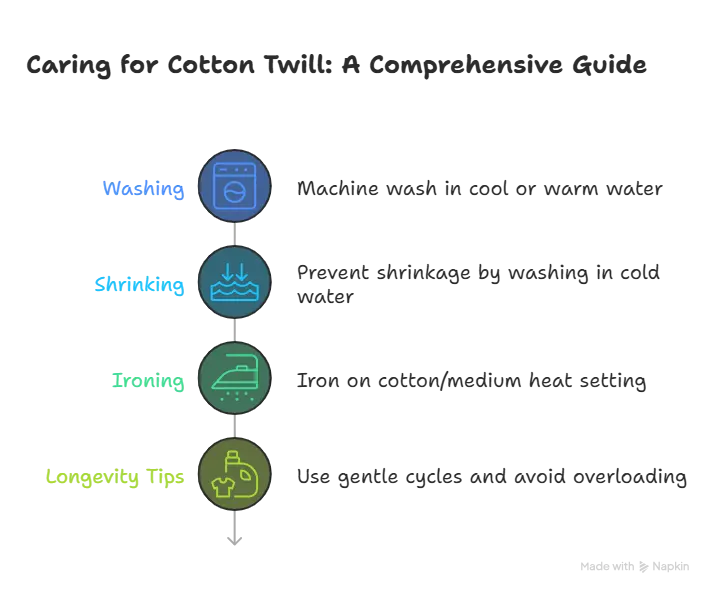
- Washing: Wash cotton twill in cool or warm water using the machine. Hot water can result in shrinkage. Invert clothes and wash them with a very weak detergent to maintain fibers. Wash with like colors. Bleach is a detergent to be avoided as it weakens the cotton threads.
- Shrinking: Shrinkage may be up to 5% unless the fabric has been pre-shrunk. To avoid this, cold water will be used when washing twill materials, and they will either be air-dried or dry on a low-heat level. Surprises also can be avoided by pre-washing new twill fabric before cutting or stitching.
- Ironing: Cotton twill does not wrinkle as much, but should be ironed where necessary on the cotton/medium heat. Iron when the fabric is a bit damp to achieve optimum results. Steam ironing is used in order to relax the weave and remove all creases in a short period of time.
- Longevity Tips: Wash using a soft machine cycle to minimize abrasion. Avoid putting too much in the washer, the cotton must have space to move and rinse. Take twill clothes off the dryer as soon as possible to avoid wrinkles. Fold and hang clothing in the stores to prevent the crease. Stain early, because the twilled surface of the fabric gives it some ability to conceal dirt, but a deeper set stain is difficult to be removed later. These practices help cotton twill items to last years after years.
Is Cotton Twill Fabric Right for You?
Cotton twill is an excellent choice in case you want it durable. It is suitable to daily wear as compared to most fabrics. That is why buyers who want to find out long-lasting clothes should pay attention to it. Twill that has cotton is simple to work with, should you be a home sewer. It is stiff, and it does not slide when sewing. Thus, it will be easy to use among DIY users.
They are versatile, and in case you are a fashion lover, cotton twill is the choice. It is used in casual, semi-formal and even work wear styles. Nevertheless, it might not be extreme climatic.
Conclusion-
You can now clearly see what is cotton twill fabric and why you need to know. It is unique due to the diagonal weave, strength and versatility. In addition, it is comfortable and durable as compared to most fabrics.
Therefore, you should think of your needs when making purchases. When you need long and breathable yet fashionable fabric, then you can choose cotton twill. Nevertheless, quality, weight and care directions are always a good idea to check.
Read More>> What is Percale Cotton?
FAQs
Yes. Cotton twill is a breathable substance as it is a mixture of cotton fibers. The weave is tighter than others cottons and therefore it is firmer but still air can pass through the material. The twills that are made of lighter wefts are easily cooled and the heavier twills are moderately warm.
Cotton twill may also shrink, particularly when it is 100 per cent cotton and was not pre-shrunk. Warm water or dryer heat will cause a reduction of about 3–5%. The best way to reduce this is to wash with cold water and either air dry or use low tumble dry. Twill that has been pre-washed or pre-shrunk will not shrink by much.
It is the confusion: twill is a pattern or weaving style, and cotton is a fiber. Numerous cotton fabrics have a plain weave. Twill cotton is typically stronger, more resistant to stains, and looser than the plain-weave cotton. It would be nicer to wear strong pants and jackets.
Cotton twill could also work during summer in case it is a lighter-weight twill. Even cotton breathes and a light twill shirt or shorts can be very comfortable to wear in hot weather. But a thick 1214 oz twill could be hot on a hot day. In very hot climates, a more open-weave cotton or linen would be cooler.
No. Waterproofing Standard cotton twill is not waterproof. It will absorb water since the cotton fibers absorb water. Part of the canvas (plain-weave cotton) is made waterproof, whereas plain cotton twill is not. To keep the water off you would require some coating (or a mixture, such as cotton duck and wax).