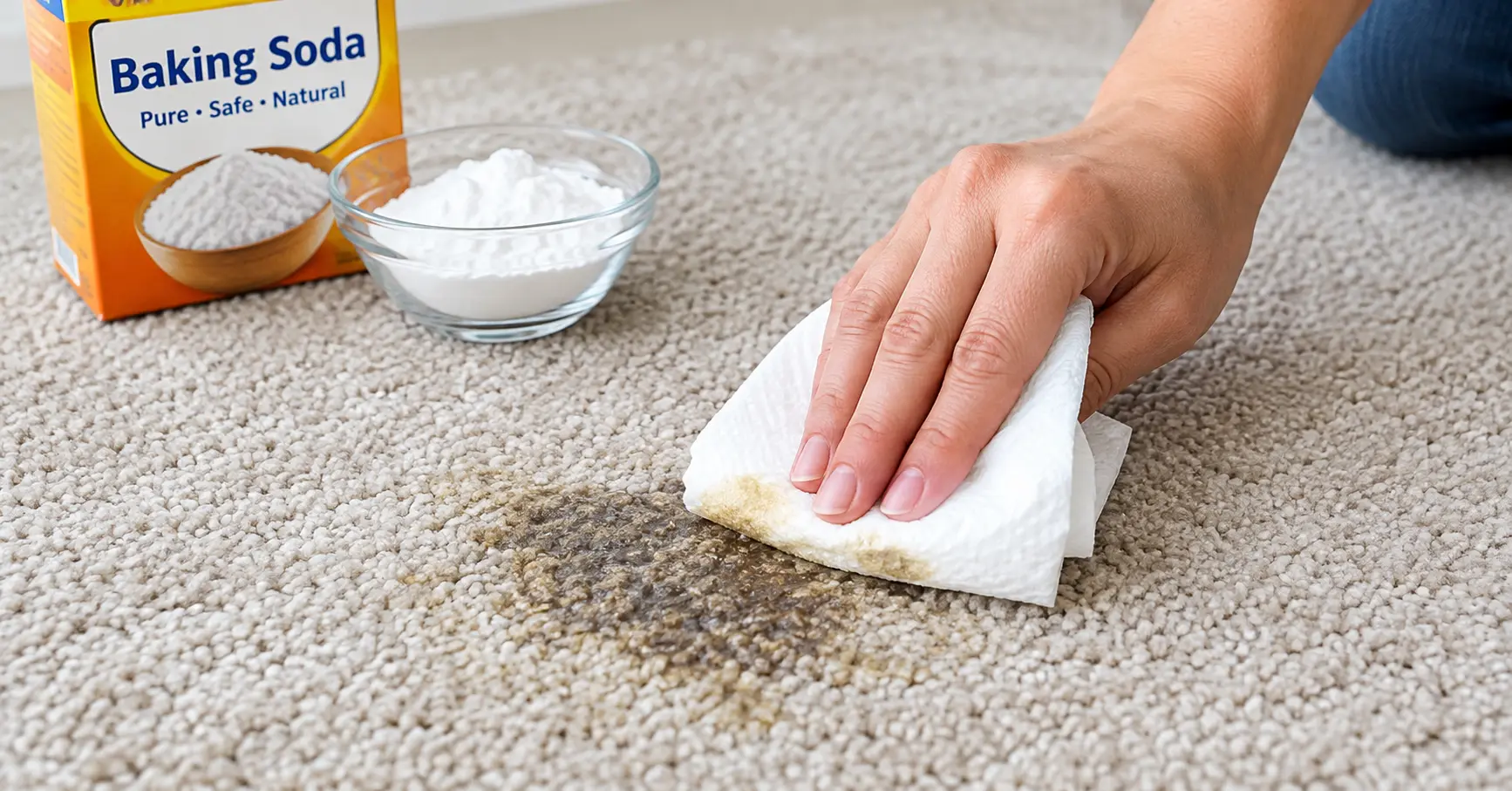

To remove grease from carpet you need to first remove the excess with a spoon, blot the spot, then cover it with baking soda or cornstarch to draw out the oil. After vacuuming the powder away, you need to treat the spot with a dish soap solution and rinse and dry the area.
1. How to Take Grease Out of Carpet
This is the correct procedure for fresh grease stains: To start, scrape away any excess grease with a spoon. Next, blot the spot (do not rub!) and then sprinkle baking soda or cornstarch generously over the stain. Allow the powder to draw out the oil and then once it has dried, vacuum it up. Finally, dab the spot with a mild dish soap solution, and then rinse and blot it dry.
Current cleaning resources consistently emphasize this procedure: you should absorb the grease first, and then treat the spot with a dish soap solution.
2. What You’ll Need to Remove Grease From Carpet
Here is what you are going to need to gather if you want to remove grease from your carpet. You should be able to have all the materials ready in advance so that you are prepared for this home emergency. Gather:
- Paper towels or a clean white cloth
- A spoon or dull knife
- Baking soda
- Cornstarch
- Mild dish soap
- Warm water
- A clean spray bottle
- A vacuum cleaner
- Clean, dry towels
Most of these materials are very common in the kitchen so you can have everything ready in no time.
3. How to Remove Fresh Grease From Carpet — Step by Step
To remove fresh grease from your carpet you should follow the following steps precisely in order to achieve the best results:
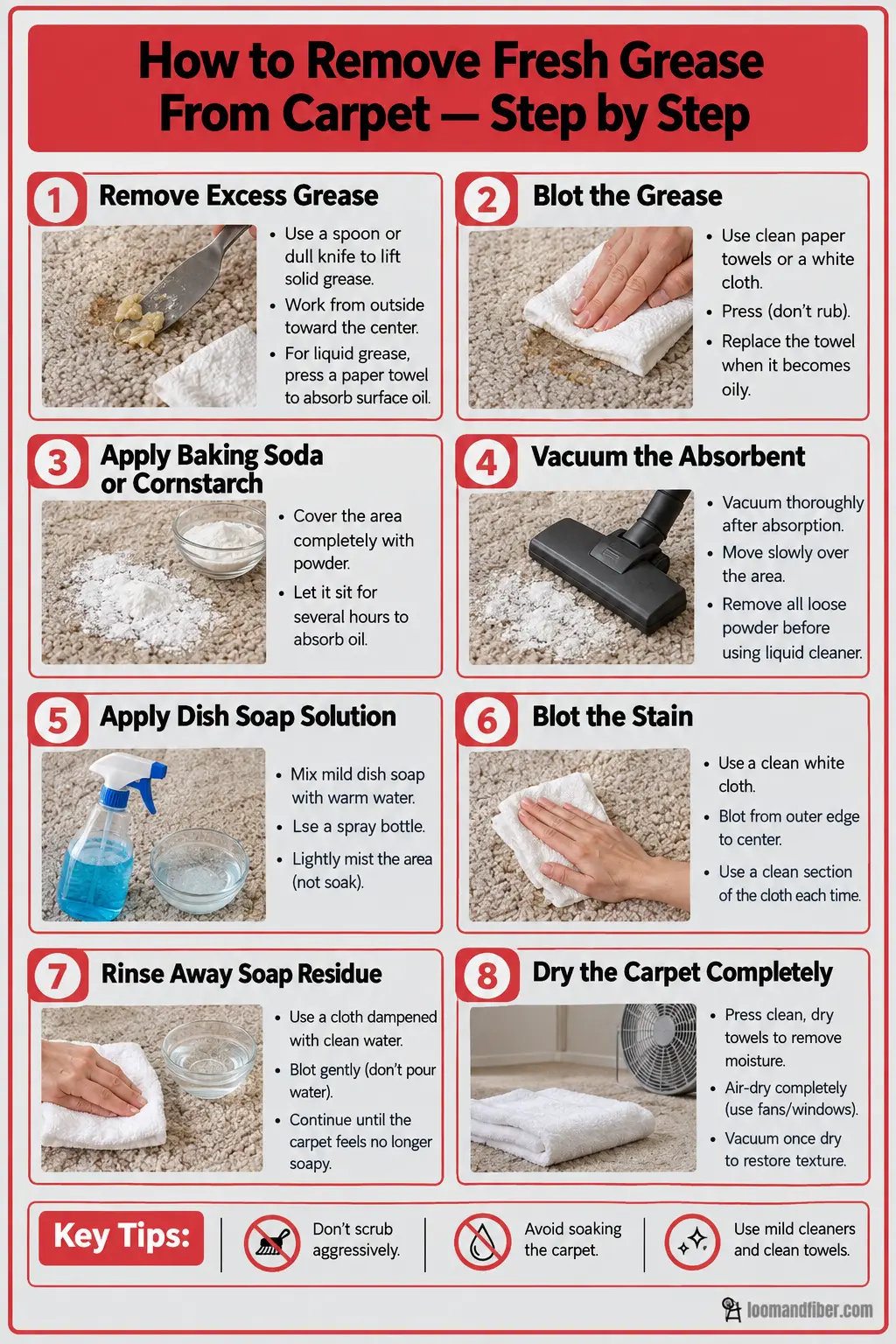
Step 1: Remove Excess Grease
You can remove excess grease using a spoon or dull knife. Simply, scrape away any excess and do not spread the grease around.
Step 2: Blot the Grease
Blot the spot using a clean white cloth (not paper towels!). Again, do not rub. Just continue blotting until the cloth does not pick up any more grease.
Step 3: Apply Baking Soda or Cornstarch
Apply baking soda or cornstarch generously over the spot. These powders are excellent at absorbing the oil from the fabric. Allow the powder to absorb the oil for at least fifteen minutes, or even hours for stubborn stains.
Step 4: Vacuum the Absorbent
Once the powder has absorbed as much grease as possible, vacuum it all up. Be sure to check the spot and see if there is still some residue left. If so, repeat this step.
Step 5: Apply Dish Soap Solution
You can apply a dish soap solution by mixing a few drops of dish soap with warm water. Again, you should lightly mist the spot, not soak it. Dish soap helps emulsify any remaining oil.
Step 6: Blot the Stain
You should blot the stain using a clean white cloth, and always start from the outside working your way in.
Step 7: Rinse Away Soap Residue
You need to rinse away the soap residue so that it does not attract more dirt. To do that, simply dampen a cloth with water and blot the area once more.
Step 8: Dry the Carpet Completely
Press dry towels onto the spot to absorb any moisture, and then allow the area to air dry completely. If you like you can also use a fan or open window to speed up the process.
The order of these steps is important because oil is hydrophobic (water-repelling), and thus cannot be easily removed by water. This is why you should always try to absorb the grease first, and then rinse away the soap once you are done.
4. How to Remove Old or Dried Grease From Carpet
Old or dried on grease tends to be more difficult to remove because it is more set in the fibers. As such, the process will take slightly longer than for fresh stains.
How to loosen the residue: you should first gently scrape the surface with a dull knife.
Using an absorbent powder: Apply baking soda or cornstarch generously. Let it rest for a few hours or overnight if possible, as old stains tend to need more time to absorb the oil.
Dish-soap treatment: After vacuuming the powder, you can treat the spot once more with a dish soap and warm water solution. Be sure to blot thoroughly as the old, dried on grease may need more work. In fact, you might need to repeat this treatment two or three times.
If the stain remains: If the stain is still visible after multiple treatments, you may need to get a professional cleaner to remove the remaining residue.
This method will also help if you are looking for how to get old grease out of carpet, how to remove dried grease from carpet, how to get dried oil out of carpet, or how to remove set-in grease stains from carpet. Also learn how to deal with dried blood stain.
5. How to Remove Cooking Grease From Carpet
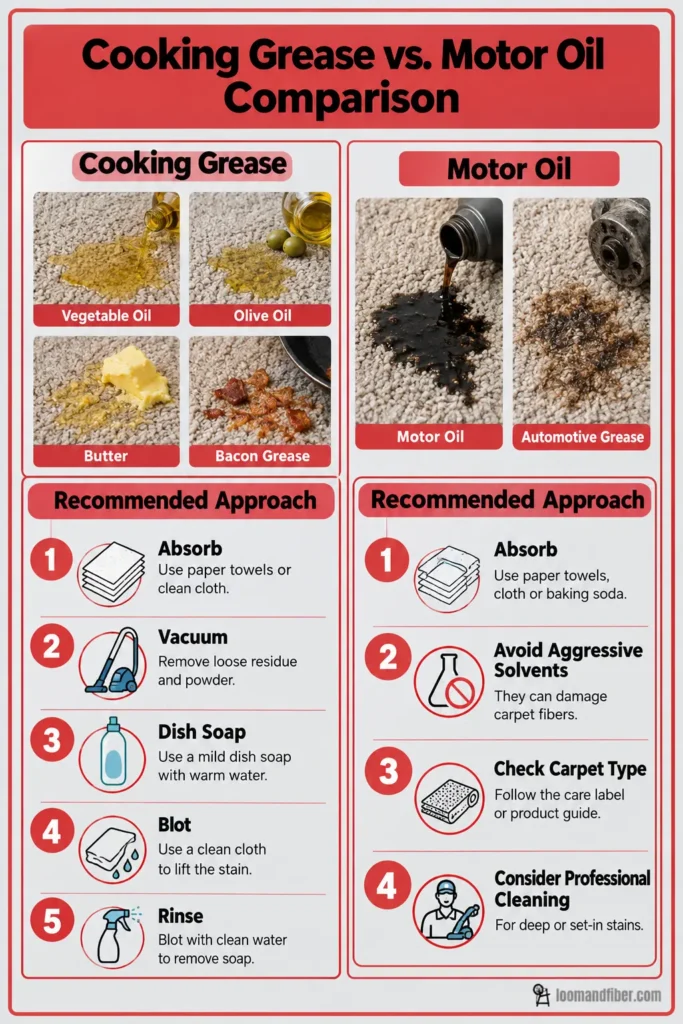
Cooking grease is one of the most common types of stains you may encounter, and fortunately this method is effective for most cooking oil types:
- Vegetable oil: Simply blot the spot, and then apply baking soda to absorb the liquid oil.
- Olive oil: Treat this grease in the same manner as vegetable oil stain.
- Butter: You should scrape off any solid butter, and then proceed to treat the spot as above.
- Bacon grease: Blot any excess grease to remove as much of the oil as you can.
- Fried-food grease: Apply cornstarch generously over the spot as this type of food tends to leave heavier oil deposits.
- Pizza grease: Blot the spot while it is still fresh since pizza grease can be especially damaging to thinner carpets.
- Gravy or greasy-food spills: You should first remove any solid food particles, and then treat the spot as though it were an oil stain.
Notably, current resources specify that cooking oil and food grease are separated from petroleum-based products, and require less caution. If you are dealing with milk stain then read our guide on how to remove milk stains from carpet.
6. How to Remove Motor Oil and Automotive Grease From Carpet
Motor oil and automotive grease are much more stubborn than cooking oils, and thus require a slightly different method. Always remember:
- Motor oil: Blot the spot and apply a thick layer of an absorbent powder.
- Automotive grease: Scrape away any excess grease and treat the spot with dish soap in small amounts.
- Garage grease: Test any cleaning solution on a hidden spot first.
- Lubricating oil: Do not scrub as this type of oil tends to spread more easily when agitated.
Note, that you should not use the same treatment for cooking grease and motor oil. Petroleum-based products tend to be made up of different chemical compounds. As such, stronger solvents may end up damaging the carpet fibers or even the backing of the carpet. However, a DIY approach is adequate for smaller spots or fresh spills, but a professional cleaner may be a better option for more severe cases.
7. How to Remove Grease From Different Types of Carpet
Since different types of carpet have different fiber makeups, it is important to choose the right cleaning method for your specific type. In general, it is a good idea to spot test any cleaner on a small, inconspicuous section.
Synthetic Carpet
Synthetic carpets typically respond well to dish soap and baking soda treatments, but always test first.
Nylon Carpet
Nylon is a strong and durable material, and should respond well to most methods.
Polyester Carpet
Polyester fibers tend to hold up to mild dish soap treatments. However, be careful not to use harsh solvents as they can damage the fibers.
Olefin Carpet
Olefin carpets tend to be surprisingly resistant to oil stains, but always blot any excess grease to prevent staining.
Wool Carpet
Wool fibers tend to require extra caution during any cleaning process. Avoid using harsh solvents or detergents, as they can permanently damage the fibers.
Shag Carpet
Shag carpets have extra long fibers, that can hold oil deep within the pile. As such, work the powder down into the fibers carefully.
Berber Carpet
Berber carpets have tightly-looped fibers that can hold grease at the surface. Blotting and using an absorbent powder should help lift the oil away.
The section on wool carpet fibers needs extra consideration. Readers should understand that not every DIY cleaner is suitable for all fibers. Professional resources specifically advise against using stronger solvents for wool carpets.
8. Can You Use Baking Soda to Remove Grease From Carpet?
Yes, baking soda is an excellent way to remove grease from your carpet as it effectively absorbs the oil. People tend to use baking soda because it is safe and affordable. To apply baking soda, you should simply sprinkle a thick layer over the stain, and allow it to sit for fifteen minutes to several hours depending on the severity. Once it has absorbed as much oil as possible, vacuum it up ensuring you remove any excess powder.
However, keep in mind that baking soda may not always be enough, and should be followed by a dish soap treatment for best results. Professional resources, such as HGTV, recommend using baking soda as part of their grease-removal procedure.
9. Can You Use Dish Soap to Remove Grease From Carpet?
Dish soap can help remove grease from carpet because it emulsifies, or breaks up, grease.
Do not use a lot at once, because it leaves behind residue that can attract dirt. Mix a few drops with some warm water in a spray bottle. Spray it lightly on the stain and blot it rather than soaking the carpet.
Too much soap leads to another issue: leftover residue attracting dirt. In addition, do not soak the carpet in an attempt to remove oil because it can push the stain deeper into the backing or ruin the padding.
Several modern carpet cleaning guides specifically recommend dish detergents after the dry absorption step as one of the best ways to get rid of oil. This is still considered among the best options today.
10. Can Vinegar Remove Grease From Carpet?
The short answer is no, vinegar is not a good option to remove grease from carpet.
It is true that vinegar can help dissolve mineral deposits, as well as some odors and oils. However, it does not break up or emulsify oil like dish soap does. Therefore, it is not considered a good option for tackling a heavy stain.
Therefore, it should not be relied on to simply because it is a popular DIY ingredient. Baking soda and dish soap are significantly better options for dealing with an oil-based mess.
11. Can Rubbing Alcohol Remove Grease From Carpet?
Rubbing alcohol can help remove heavy or old grease stains as a last resort.
It is best to try some of the less aggressive methods first, and save alcohol for when those have failed. Always test it first on a small, hidden spot to see how your carpet reacts. Do not use more than necessary, and never pour it directly on the stain.
In addition, always ventilate the room well, because alcohol can be quite pungent. Check the care instructions for your carpet before using any solvent, because some backing and fibers are sensitive to harsh chemicals.
Many carpet cleaning guides online do not agree on whether stronger solvents are generally safe. Therefore, this article will advise caution in case there is an underlying issue with your carpet.
12. How to Remove Grease From a Carpet Without Making It Worse
Avoiding these carpet cleaning mistakes will keep your carpet from getting worse while you attempt to clean it.
- Do not scrub the stain.
- Avoid rubbing, since that can push the oil deeper.
- Do not pour water directly on the stain.
- Avoid soaking the carpet.
- Do not apply excessive heat to the area.
- Do not apply too much detergent at once.
- Do not pour solvent directly on the carpet.
- Do not mix different cleaning products.
Most carpet cleaning guides will warn you about these carpet cleaning mistakes. Rubbing, over-wetting, and uncontrolled solvent use all contribute to the difficulty in stain removal.
13. Why Does My Grease Stain Keep Coming Back?
One reason why a grease stain will keep coming back is because of wicking, leftover soap, or because it was not cleaned properly.
Wicking: If oil has gotten deep into the carpet, it may “wick” up the fibers as it dries, creating a new dark spot.
Leftover soap: Too much detergent can cause the carpet to look dirty again, since the extra soap attracts new dirt to the area.
Not enough grease removal: Sometimes the surface looks fine, but the oil remains inside the fibers. Therefore, the stain will return when the carpet is dry.
Modern carpet cleaning guides identify wicking and excess detergent as the main reasons why a dark spot will recur. Understanding the cause will help you address the real issue.
14. How to Remove a Grease stain that has already been cleaned
If a stain keeps coming back after you’ve tried to clean it, follow this procedure.
Let it dry first before doing anything else. Then, check if the dark spot is due to old oil, or if it is new dirt. Once you’ve identified the cause, you can repeat the proper cleaning procedure. Next, work on removing leftover detergent from the fibers. Then, you can consider professional extraction if the oil has gotten deep into the carpet.
It addresses the root cause, rather than just the visible effects. Therefore, it is more likely to prevent the dark spot from reappearing.
15. How to Remove grease smell from carpet
Sometimes, an oil-based mess will not only leave a dark spot, but will also smell unpleasant.
Old food oil can smell worse, as it breaks down over time. In such cases, removing the cause of the smell is the best option. Clean the residue with a mixture of baking soda and dish soap. Then, you should dry the carpet to remove the moisture, as it can intensify the odor.
If the smell persists, you would need to have the carpet professionally extracted. It will get rid of the deeply embedded oil that regular carpet cleaning methods cannot remove.
16. How to Remove large grease spills from carpet
A large spill usually requires more caution than a small one.
With larger spills, it is best to start with containment and absorption. Cover the area generously with baking soda. You should avoid getting the area too wet with soap and water, since large areas of carpet are affected.
In addition, large oil spills are sometimes a good reason to call for professional carpet cleaning. DIY methods work best with smaller spots.
17. When Should You call a professional carpet cleaner?
There are some situations when a professional cleaner should be called instead of trying to DIY.
- There has been a large oil spill.
- The stain contains motor oil.
- The carpet has been heavily soaked in oil.
- The oil has reached the padding.
- The carpet is made of wool.
- A dark spot keeps recurring after cleaning.
- There is a persistent bad smell.
- Multiple DIY attempts have failed.
Most guides for dealing with oil on carpet agree that these are some of the best times to call for professional help. Deep extraction machines can get rid of the oil deep within, unlike household tools.
18. How to prevent grease stains on carpet
Prevention is usually much better than trying to remove a tough stain later.
These are some effective measures that will keep your carpet from getting stained with food oil or other greasy substances:
- Keep cooking oil and other fatty liquids away from carpet.
- Use a mat near the kitchen to prevent tracking oil spills.
- Make sure greasy shoes are cleaned before walking on carpet.
- Always clean up a spill as soon as possible, rather than leaving it.
- Avoid getting garage oil on carpets.
- Keep food-making areas covered or on mats.
It will reduce the chances of future staining dramatically.
FAQs
Yes, you can get grease out of carpet using baking soda and dish soap. Fresh stains respond well to prompt cleaning.
Blot the oil, and sprinkle baking soda on it to absorb the excess. Vacuum it up, and treat the residue with dish soap if needed.
Yes, baking soda can absorb oil from carpet when it is left to sit on the fibers. It can be used in tandem with a follow-up dish soap treatment.
Yes, dish soap can help remove oil from carpet by breaking it up. Do not use it in great quantities, because it can leave behind residue.
No, vinegar is not a good option to remove grease from carpet because it does not effectively emulsify oil.
Yes, you can use cornstarch to remove oil from carpet the same way you would use baking soda. Put plenty of it on the affected area, and vacuum it up once it has absorbed the grease.