
Introduction-
When you frequently purchase fabric, you might notice GSM on the labels. Nonetheless, this remains to be confusing to many buyers. This is the reason why you can learn what GSM in fabric is to know the type of materials to use.
GSM has significant contribution with regard to comfort, durability and seasonal usage. In addition, it directs manufacturers, designers and exporters in quality choices. Consequently, the knowledge of GSM assists the professionals and the common customers.
Within this guide, you will get to know the definition, significance and examples in the real life. You will also learn the influence of the GSM on the warmth and the breathability, as well as the life span. Most significantly, you will learn useful suggestions when selecting the appropriate weight of the fabric.
What Is GSM for Fabric?
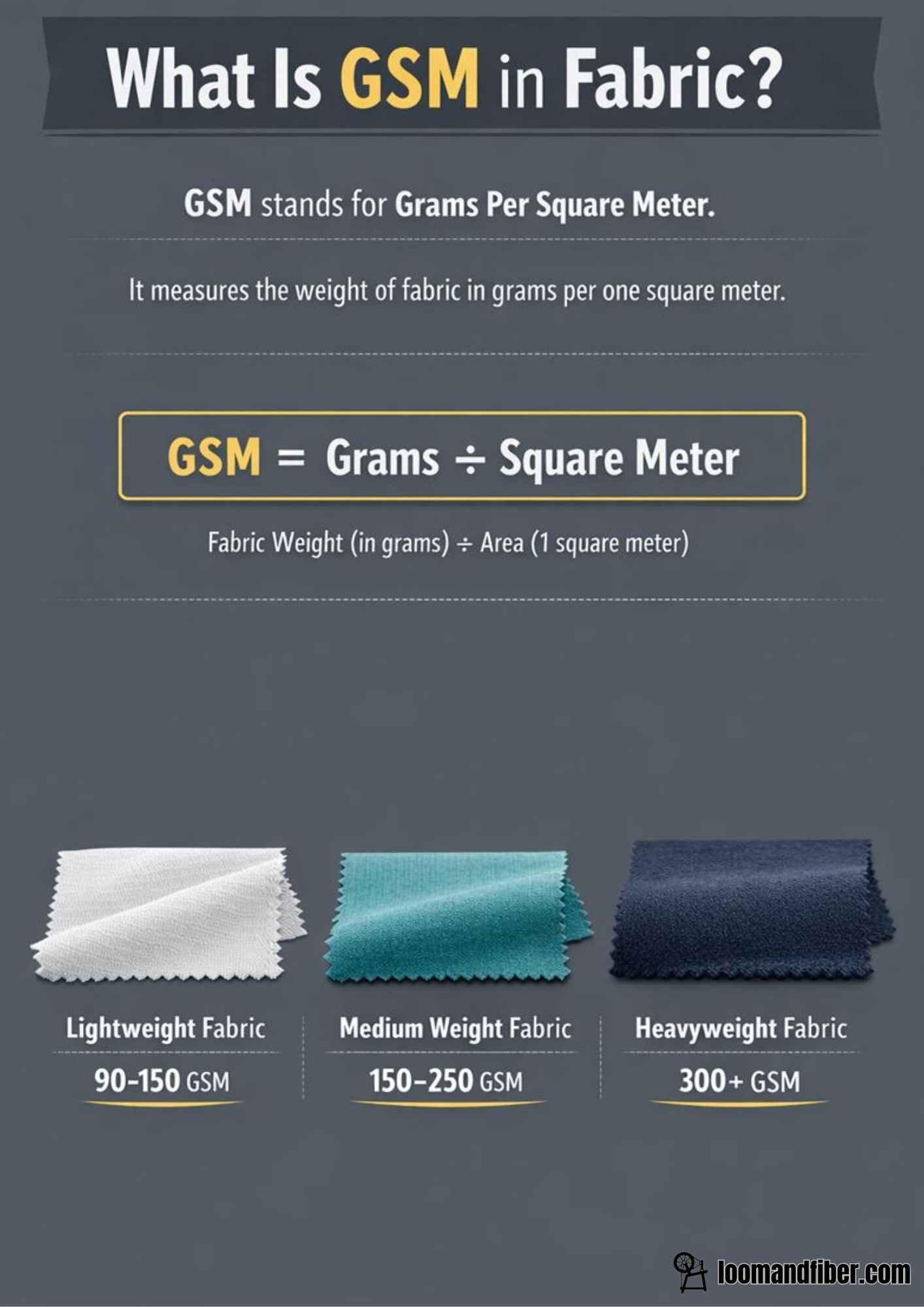
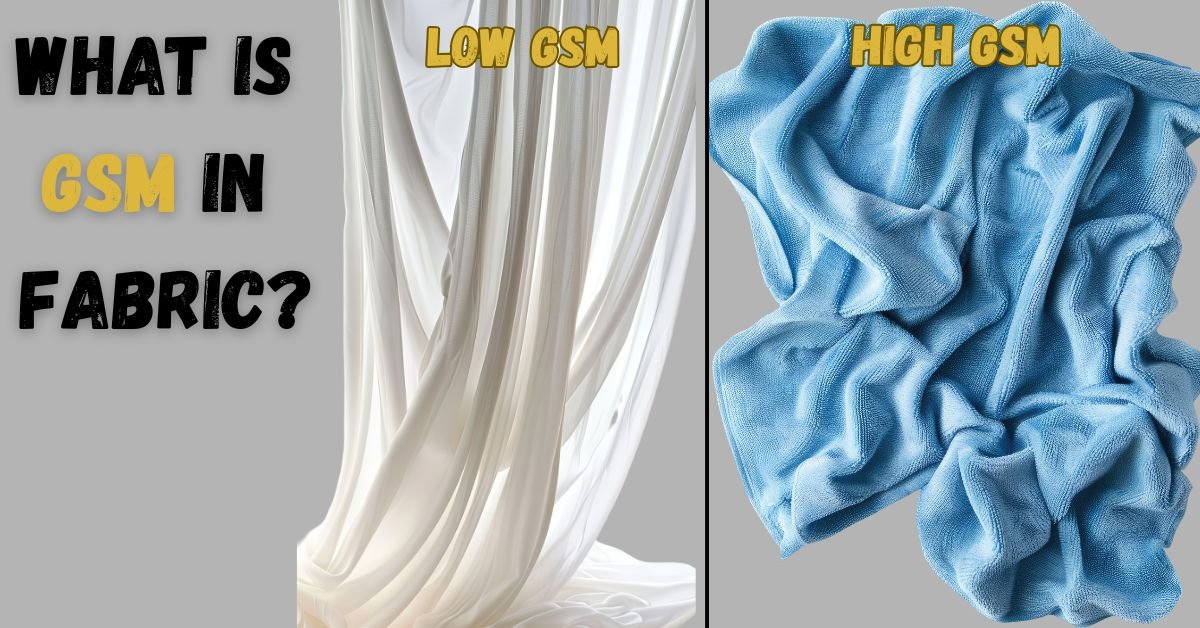
GSM(grams per square meter) is the acronym of the weight of the fabric per unit area and it means the weight of the fabric in grams per square meter. It refers to the weight per one square meter of fabric. The bigger the number of GSM, the heavier and thicker the fabric, the smaller the number of GSM, the lighter and airy the material. Just to put it in a simple manner, GSM is the secret behind fabric thickness and feel. Since the weight tends to be associated with the strength and insulation, the knowledge of the GSM can make you judge the comfort, durability and use.
An example would be that a 150 GSM cotton shirt would be light as compared to a 300 GSM denim jacket. Manufacturers determine the required amount and the costs of fabric with the help of GSM: the more raw material is used in manufacturing of the fabric, the higher can be the cost. To put it briefly, GSM is a fast way of determining the weight of a fabric and its probable performance in clothing or domestic textiles.
| Fabric Type | Low GSM (Lightweight) | Medium GSM | High GSM (Heavyweight) | Common Uses |
|---|---|---|---|---|
| Cotton | 90–150 GSM | 150–250 GSM | 250–400 GSM | Shirts, dresses, bedsheets, towels |
| Jersey / T-Shirt Fabric | 120–160 GSM | 160–200 GSM | 200–240 GSM | T-shirts, tops, casual wear |
| Denim | 200–300 GSM | 300–400 GSM | 400–500+ GSM | Jeans, jackets, workwear |
| Fleece | 180–220 GSM | 220–300 GSM | 300–400+ GSM | Hoodies, sweatshirts, blankets |
| Linen | 120–160 GSM | 160–230 GSM | 230–300 GSM | Summer clothing, home textiles |
| Wool | 180–250 GSM | 250–350 GSM | 350–500+ GSM | Sweaters, coats, suits |
| Polyester | 80–140 GSM | 140–220 GSM | 220–350 GSM | Sportswear, uniforms, upholstery |
| Rayon / Viscose | 90–140 GSM | 140–200 GSM | 200–280 GSM | Dresses, blouses, linings |
| Silk | 30–60 GSM | 60–100 GSM | 100–150 GSM | Scarves, luxury garments |
| Poplin | 90–120 GSM | 120–150 GSM | 150–180 GSM | Shirts, uniforms |
| Flannel (Cotton/Wool) | 160–220 GSM | 220–300 GSM | 300–400 GSM | Winter shirts, bedding |
| Towel Fabric (Terry) | 400–500 GSM | 500–600 GSM | 600–800 GSM | Bath towels, hotel linens |
What Does GSM Measure in Fabric?
Weight Density vs Thickness
GSM is not directly a measure of thickness or density of mass, but it is a measure of mass per area. It informs you of the weight of the fabric per gram per square meter. Fabric thickness is a physical dimension (usually millimeters) that is independent of weight. Similarly, weight/volume is referred to as density; the weight/area is GSM. In reality, the higher the GSM usually is the thicker the cloth is since more material is crammed into a square meter. But weight does not entirely display thickness. This implies that two fabrics with identical GSM level may be different in terms of thickness when they are made of dissimilar fibers or weave.
The effect of GSM on Feel, Durability and Drape
GSM has a great impact on the hand and performance of a fabric. Enhanced fabrics are heavier (high GSM). They are more fashioned and do not wear easily thus are durable. As an illustration, 300 GSM cotton fleece will be dense and shape-giving, whilst 150 GSM cotton jersey will be soft and flowing. By contrast, light (low GSM) materials are airy and light in weight, which means that they can move more and be ventilated more easily.
Nevertheless, low GSM clothes may be less durable and may stretch or tear easily in case the threads are of a poor quality. More to the point, GSM can be used with fiber type: a tightly woven polyester GSM 200 can potentially last longer than a loosely knitted cotton of the same weight. Generally, the greater the GSM = the heavier, the warmer, the more durable and the lower the GSM = the lighter, the cooler and the more fluid drape.
Why GSM Is Important When Choosing Fabric
Comfort & Breathability
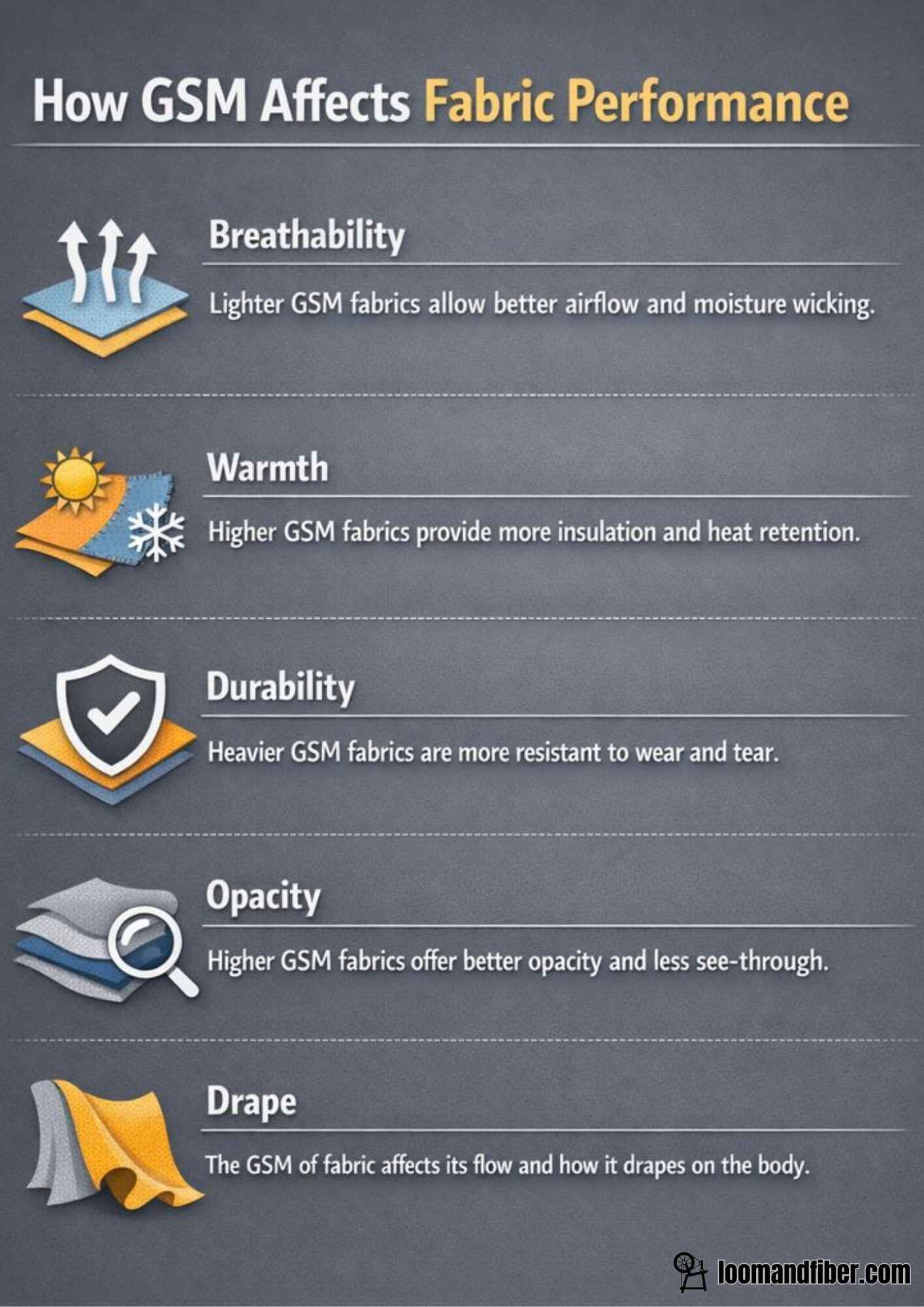
GSM has a direct impact on the movement of air through cloth. Smoother GSM fabric is more air-permeable. Hence, they are cooler during hot days.
The heavier GSM materials capture more heat. Consequently, they offer warmth in the cold seasons.
Durability & Lifespan
Increased GSM fabrics tend to have longer life. They are less prone to tearing and pilling. Thus, they are appropriate in heavy-wear and household fabric.
Creasy GSM fabric can be worn out quicker. They are however good in light and seasonal use.
Opacity & Coverage
Thin GSM materials may be transparent. As such, they might require layering.
GSM fabrics are high and provide better coverage. Consequently they feel less insecure and secret.
Seasonal Suitability
Light GSM is an appropriate suit in summer and humid weather. Heavy GSM would be used in winter and during cold weather. Hence, GSM aids in the alignment of fabric to climatic requirements.
GSM vs Thread Count vs Fabric Thickness
| Aspect | GSM (Weight) | Thread Count (Fineness) | Thickness (Depth) |
|---|---|---|---|
| What it measures | Mass per unit area (g/m²) | Number of threads per sq. inch | Physical height or bulk of fabric |
| Units | grams per square meter (g/m²) | Threads per inch | Millimeters or mils |
| Influence | Heavier GSM = heavier cloth, more warmth/durability | Higher count = finer, smoother weave | Thicker fabric insulates better |
| Example | 150 GSM cotton T-shirt | 200 TC cotton sheet | ~0.5 mm thick fleece |
How to Measure GSM of Fabric (Step-by-Step)
GSM Cutter (Standard Lab) Method
In the laboratory, a GSM cutter and a scale are employed. The fabric is first conditioned (at standard humidity and temperature). A cutter is then used to punch a sample of the identical size (commonly 100 cm², which is 0.01 m²). Weighing of that sample is done on a digital scale. Given that the sample size is 1/100th of a square meter, when one multiplies its weight (in grams) by 100 they get the GSM. This approach is based on such standards as ISO 3801 or ASTM D3776.
DIY Home Method
How to estimate GSM at home with no cutter. Prepare a measure area of cloth (e.g. 10 cm × 10 cm = 0.01 m²). Weigh this piece on a specific kitchen or a postal scale in grams. Then multiply by full square meter: GSM = weight of fabric (g)/area ( m²). Divide the gram-weight by 100 in the case of a square of 10×10 cm. As an example, a 0.5 g 10x10cm cotton swatch contains GSM ≈50 g/m². Do not forget to flatten the sample and eliminate wrinkles.
Industry-Standard Testing
The protocols of the fabric suppliers are strict in relation to their profession. Tests are conducted according to the standard procedures ( ISO 3801 / ASTM D3776) that define how to prepare the sample and to condition it. A sample is often cut after hours of acclimation of the fabric at a fixed temperature and humidity. Mass is then measured very precisely using calibrated scales. These controls assure the repeatability and comparability of GSM results in mills. To control quality, several factories provide GSM values in technical datasheets to buyers on what to expect.
Fabric GSM Chart (By Fabric Type)
- Cotton (woven) – 100–400 GSM. 100-200 GSM is lightweight cotton (shirts, dresses), whereas 200-300 GSM is a typical covering of clothing and quilts. Durability Light heavy (e.g. canvas, denim base) may be up to 300+ GSM.
- Jersey / T-shirt Knit – 120–220 GSM. T-shirts T-shirts made of single jersey cotton tend to be 120-180 GSM. A nice summer jersey can be about 120 GSM, and a heavier so-called luxury tee can be about 180-200.
- Denim (Twill) – 180–500 GSM. Light shirting denim 180–250 GSM; regular denim jeans 300-450 GSM; heavy denim or canvas jackets 400-500+ GSM. The shirting is plain weave cotton (typically light) compared to plain weave cotton.
- Fleece / Sweatshirt Fabric – 200–350 GSM. Polyester fleece/brushed cotton (sweatshirts, hoodies) usually include a range of 240-350 GSM (lighter and heavier fleece respectively). Midweight fleece 280 to 350 GSM is quite an ordinary winter/summer casual wear.
- Linen (woven) – 100–200 GSM. Light linen fabric or summer clothing is approximately 100 -150 GSM, providing the comfort of coolness. Midweight linen (to make pants or upholstery) is about 150-200 GSM. Quite thick linen (e.g. jackets) may be up to 200 + GSM.
- Wool (various weaves) – 200–500 GSM. Merino or worsted Light suits can begin at or below 200300 GSM. Sweaters and coats are heavier: 300 -500 GSM. Aran or blanket woolen knits could be more than 500 GSM. (Wool is warm even in moderate GSM due to the loft of the fiber.)
- Polyester & Blends – 100–250 GSM (varies). Activewear Polyester knits may fall between 120-200 GSM, like cotton jersey. Polyesters are available in woven forms (satin -100 GSM and twill -250 GSM). Blends (cotton/poly) Blends are variations of the cotton range above, with alteration of fiber ratio.
What Is a Good GSM for Different Uses?
T-Shirts
An excellent GSM of T-shirts is between 140 and 180. This line is comfortable and breathable. It offers proper durability as well.
Hoodies & Sweatshirts
Older Hoodies Finest between 280 and 350 GSM. This weight is not too heavy but it is warm.
Bed Sheets
Sheets can measure between 120 and 160 GSM. This mixture is soft and chilly. It also lets air move in so that one can sleep better.
Towels
Towels normally measure between 400 and 600 GSM. Greater GSM towels have increased water uptake. They are also plush and thick.
Activewear
Active wear is used between 120 and 180 GSM. This runway is permeable to moisture. It is also light during exercising.
Winter vs Summer Clothing
Lower GSM fabrics are used in summer clothing. Higher GSM is used in winter clothing. Thus, GSM assists in the alignment of clothes with temperature requirements.
Low GSM vs High GSM Fabric: What’s the Difference?
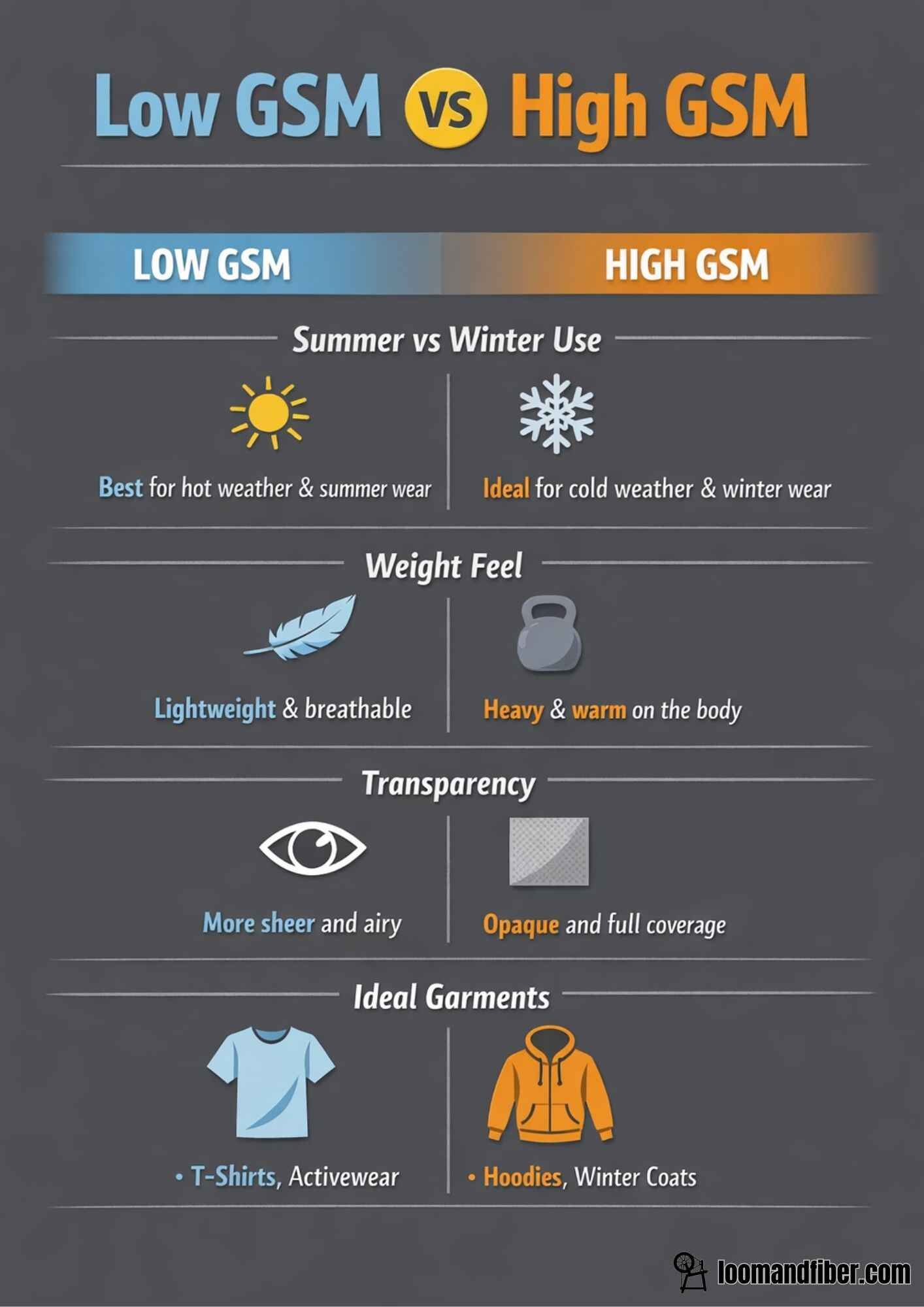
Lightweight (Low GSM):
Pros
- Light and very breathable.
- These are cool (good in summer or layers) soft fabrics that flow freely.
- They are normally less expensive in material.
Cons
- They are not so tough and can easily wrinkle or stretch.
- They are often semi-sheer.
- When GSM is very low, they may become flimsy.
High GSM (Heavyweight):
Pros
- Thick and strong.
- High GSM fabrics are strong, can be opaque, and insulate and support.
- They do not fall and they stand strong to use.
- They express a premium touch (consider heavyweight hoodies or denim).
Cons
- They may be stiff or bulky, initially.
- High GSM fabrics are heavier and thus garments may be hot during the warm weather.
- They are pricier to produce.
Does Higher GSM Mean Better Quality?
Myths vs Reality
- Myth: Increased GSM is equal to quality.
- Fact: Quality will be based on type of fiber and weaving technique.
- Myth: That low GSM is poor fabric.
- Fact: Low GSM is used in many high quality fabrics to make them comfortable.
- Myth: Heavy fabric is associated with high GSM.
- Fact: Thickness and GSM may vary.
When High GSM Is Bad
High GSM may be too dense to use in summer. It may also trap moisture. Hence, it can be uncomfortable.
Fabric Type Dependency
The same GSM behaves differently with Cotton, wool and Polyester. Thus, never forget about the fiber type, as well as weight.
GSM Standards in the Textile Industry
Fashion Manufacturing Standards
GSM ranges are used by the factories with each type of clothing. The practice will guarantee uniform sizing and comfort. It is also a way of maintaining brand quality.
Relevance of Export and Quality Control
GSM is tested by exporters so that it can match the buyer specifications. This measure minimizes returns and conflicts. It also establishes confidence with the customers.
Why Brands Specify GSM
GSM is used to regulate fabric performance at the brand level. They have a regular product feel as well. Hence, GSM safeguards the brand image.
Common GSM Mistakes Buyers Make
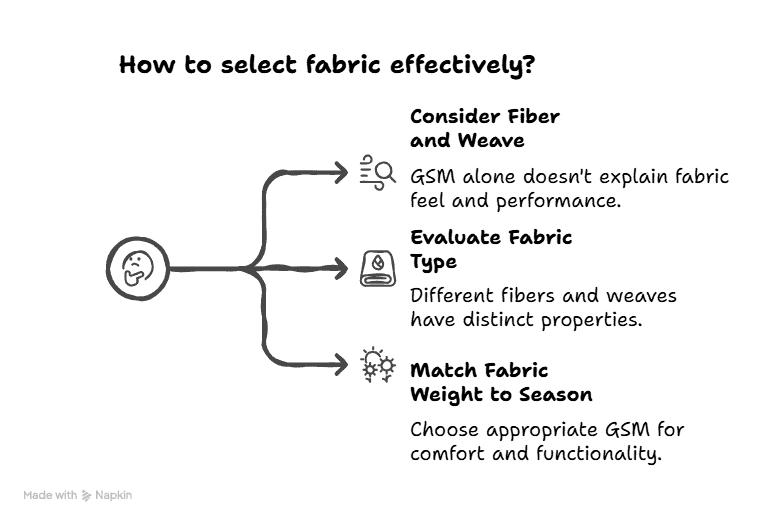
- Selecting based on GSM Only: One of the most frequent errors in selecting fabrics is to select a fabric based on its GSM number. This ignores fiber and weave. There is a 200 GSM sweater that may be rough acrylic or soft wool – it is the same but the experience is completely different. GSM cannot explain everything.
- Neglecting Fabric Type: Sometimes buyers think that a high GSM cotton is similar to a high GSM polyester. As a matter of fact, cotton and synthetics of the same GSM do not act similarly (breathability, shrinkage, etc.). The question to always ask yourself is whether the fiber and knit/weave suits you.
- Seasonal Mismatches: Choosing fabric weight without considering season is a mistake. To illustrate, it will not be comfortable to take a 300 GSM T-shirt cloth in summer. On the other hand, a winter coat would reveal holes when made of a 120 GSM. Examine check circulation and clothing when choosing GSM.
Buyers can avoid such pitfalls by remembering that GSM is merely weight, not quality in order to make more wiser fabric choices.
The impact of GSM on Breathability and Warmth
Summer vs Winter Fabrics
GSM creates fiber thermal comfort. Summer fabrics: Low GSM (Less than 150) fabrics are breathable and are able to evaporate moisture which leaves you cool. The best examples are lightweight cotton and rayon. Winter clothes: High GSM (250 +) clothes trap air to keep one warm. An example is that of a 400 GSM wool knit or a fleece coat, which is used to provide insulation. But it is not only GSM, fleece loft or wool nap is also warming without reference to weight.
Moisture Management Impact
Reduced GSM cloth is quicker to dry. Due to reduced material, the sweat is likely to be evaporation-cooled more easily through the weave. That is why athletic shirts of 120-160 GSM are quick-drying. Conversely, high GSM knits or fleeces have the capability to hold water longer and become wet when one has been sweating heavily. To manage moisture best, select a light to medium GSM with moisture-wicking fabrics (such as polyester) in active wear and use high GSM fabrics to be warm and not to be sweat-controlled.
Conclusion-
Knowing what is GSM in fabric? is one thing that will make you make smarter and more certain choices in fabric to serve all purposes.
Comfort can be enhanced by taking into account the weight of the fabric, the type of fiber, and the seasonal requirements.
GSM labels should always be checked before purchasing to prevent the usual errors and fabric choices.
Using this bare knowledge, you will be able to choose materials that are indeed suitable to your lifestyle and performance requirements.
FAQs
No. GSM is area per weight rather than a direct dimension of thickness of fabric. A cloth may be light and heavy (when thick) or may be heavy and light (when fluffy). Never forget to take the weight and the thickness separately.
The material with a low GSM of less than 150 GSM is normally used in summer. These are lightweight materials (e.g. 120 GSM linen or cotton) which breathe and make you cool.
Greater GSM is better in order to get warm. Clothing of about 250-350+ GSM (such as heavy knits or lined wool) is winter-appropriate. Most winter clothes in cold climates are more than 300 GSM.
Yes. GSM may rise marginally following the process of washing particularly in natural fibers. Most of the fabrics (cotton, linen, wool) become slightly smaller in size after being washed, which results in more grams being absorbed per square meter. Therefore a garment that has been washed can turn out to have an increased GSM than what it was initially issued.
Not necessarily. Warmth relies on fiber and construction just as much as it relies on weight. An example is that low-density wool can be used to insulate even when it is mid-range GSM. On the other hand, a cool fiber (such as a few linens) high GSM fabric will not be very warm.