
Introduction-
The modal fabric is immensely popular in the contemporary textile. The question that many individuals present is, what is modal fabric made of? The solution is easy and intriguing.
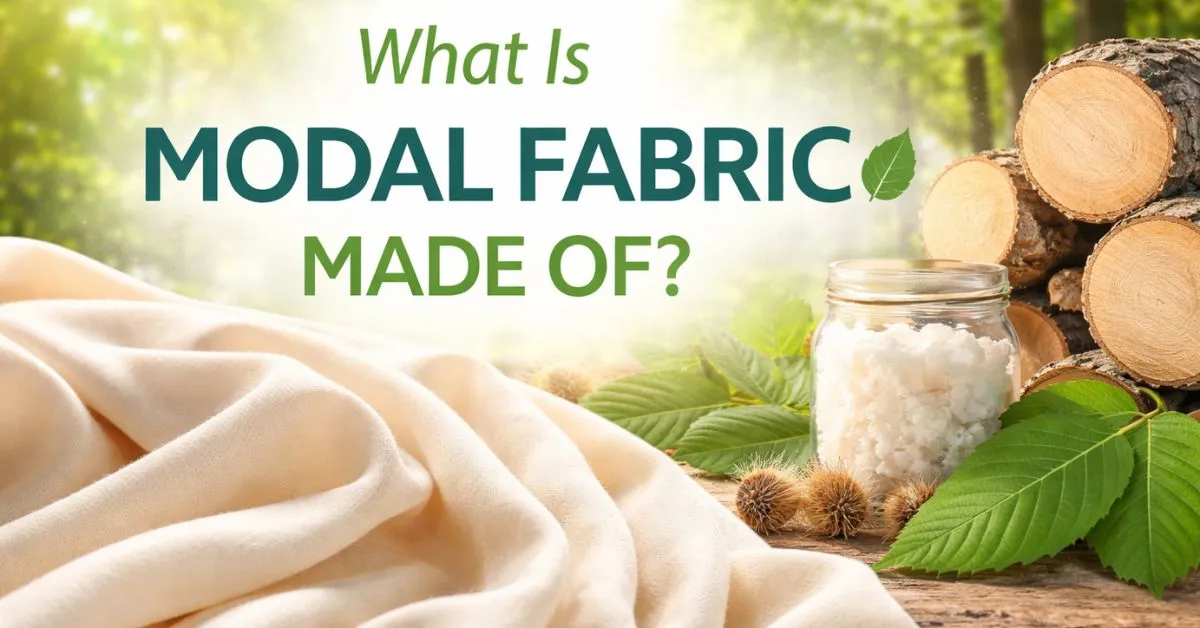
Beech tree pulp is used to manufacture modal fabric and it has natural cellulose. The manufacturers take out this cellulose and convert it into soft fibers of textiles. Thus, modal is vegan, however, processed to a semi-synthetic fiber.
In addition, modal is wearable, soft and dry to the touch and highly breathable. It is therefore commonly applied in apparel and domestic textiles.
What Is Modal Fabric Made Of?
Modal fabric is mainly composed of cellulose of beech trees. The beech logs are chipped and treated to separate the cellulose fibers of the wood. This is then dissolved and re-distilled into fibre filaments. Briefly, modal is not cotton or silk it is produced out of the pulp of wood. It is a rayon based product, but uses beechwood pulp. Due to this fact, modal is regarded as a regenerated cellulose fiber: a plant-based one, but processed with chemicals to create a fabric.
The Main Raw Material: Beech Tree Pulp
Modal’s source is beech trees. The fiber begins with wood of the European beech (genus Fagus) or some species related to it. These are hardwood trees that grow to their heights taking decades before they die. Beech trees are normally very slow in growth (approximately 1 to 2 feet every year) and are able to survive 200 years and 300 years. Beech wood has been used historically to make furniture and paper and is the best to use in the manufacture of fibers because it contains a lot of cellulose.
What Are Beech Trees
Beech trees are European and Asian hardwood trees. They are thick bushy forests and their bark is smooth and gray. When the trees are pulped, the fibers obtained are very long in nature thus resulting in a very soft modal cloth. Some countries (such as Austria) have beech pulp plantations. Due to its successful growth in mixed forests, beeches can be harvested in a sustainable way under the controlled environment.
The reason why Beech Trees are used in modal
Beechwood unlike other trees contain a high cellulose content and it grows in relatively cool climates. The cotton plants also require more irrigation compared to beech trees. They are deep-rooted making them drought-resistant. The above elements imply that beech pulp is useful in the production of robust fibers. The International Bureau for Synthetic Fibers observes that modal (a kind of viscose) is produced using beech pulp only. Such consistency enhances quality over other rayons.
Beech Wood Sustainability Harvesting
Beech forests are capable of regrowth after being cut when handled. The most popular one is the practice of coppicing, during which trees are cut almost at the base and they grow once more at the stump. This brings about new growth without planting. A lot of modal manufacturers get beech at FSC/PEFC certified forests which means that trees can be replenished or be replenished to grow naturally. Sustainable forestry is a priority in certain parts of the world such as in Austria and Germany that restrict the deforestation.
Modal Raw Material Producers
The beech wood used in modal is predominantly European. As an illustration, Lenzing AG (Austria) obtains a majority of the beech pulp locally. Nevertheless, modal production takes place globally also. Large-scale manufacturers are in China, Indonesia, India, Pakistan and other areas in Europe. Due to the fluctuating cost of labor and energy, in Asia, numerous of the modal mills are established. Nonetheless, there are brands that demand beech (that is of European origin) because of certifications. The raw cellulose in any case has to be obtained in plantations or beech or other hardwood plantations.
How Cellulose Becomes Modal Fiber
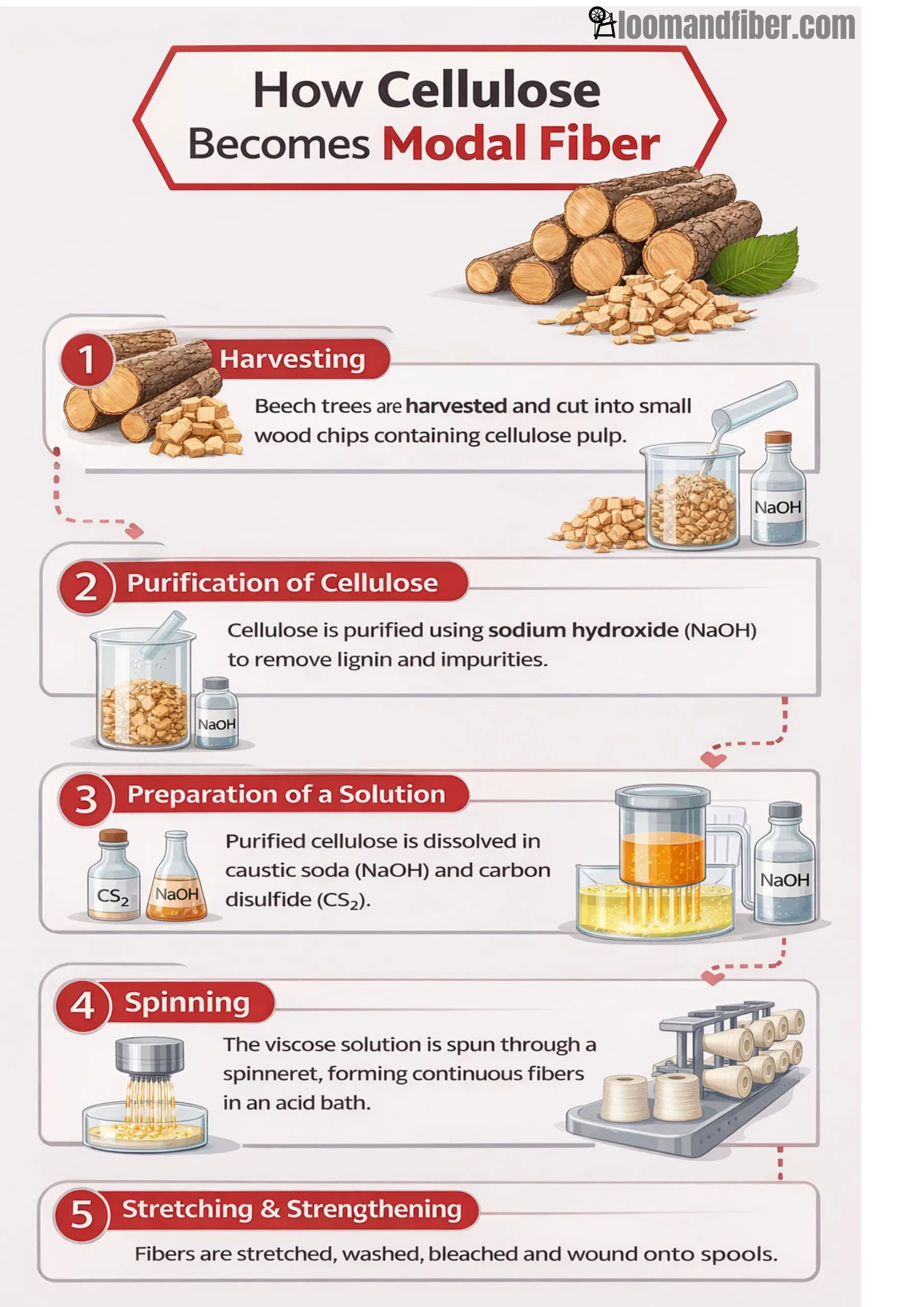
- Harvesting: The beech trees are harvested and cut into small wood chips by the producers. The initial pulp is these chips.
- Purification of Cellulose: The chips of the wood are washed to eliminate lignin and other substances. The wood is broken down to cellulose fibers using chemicals such as sodium hydroxide.
- Preparation of a Solution: Using caustic soda (NaOH) and carbon disulfide (CS 2 ) in the purified cellulose, viscose is prepared. The procedure transforms the pulp into orange-colored xanthate solution.
- Spinning: This cellulose solution is forced into a spinneret (a plate with small holes), and continuous filaments of fiber are formed. The filaments are made in the form of fiber strands by taking them through an acid bath.
- Stretching and Strengthening: It is the process of stretching (drawing) and washing of the newly formed wet fibers. This aligns the molecules of cellulose and thus the fiber becomes strong. The fibers are then finally bleached or finished and put on spools.
These processes convert natural tree pulp into long and silky fibers that are prepared into yarns. It is worth noting that spinning is followed by blending or dyeing of the fibers before being woven into a fabric.
Is Modal Fabric Natural or Synthetic?
Modal may also be referred to as semi-synthetic. It begins with a natural substance (plant cellulose) and involves the use of human-created chemicals. In that regard, modal is a natural fiber (such as cotton) and synthetic fiber (such as polyester). The wood is a renewable resource which is harvested and then chemically transformed by the manufacturers into fiber. This is why some individuals refer to modal as man-made/regenerated cellulose as opposed to natural fabric.
By comparison, cotton is a natural fiber that is picked off of cotton plants- no significant chemical treatment is required (only cleaning and spinning). Viscose rayon (also wood based fiber) is semi-synthetic, yet it has the ability to use a variety of woods or even bamboo. Actually, there are bamboo fabrics in the market that are not modal but viscose. Modal particularly refers to beech-derived. In the meantime, polyester is a 100 percent synthetic, and consists of petroleum chemicals and no plant content. The semi-synthetic character of modal implies that it is not a plastic fiber, but it is not an all-organic one as well.
Chemicals Used to Make Modal Fabric
Sodium Hydroxide
Sodium hydroxide (NaOH) which is also known as caustic soda is used to dissolve wood pulp in the modal process. It splits the chips into a slurry containing a high content of cellulose. NaOH is used in wet-spinning in the formation of cellulose xanthate. The process is often recycled to produce NaOH which is a strong base that should be handled with care by modern plants.
Carbon Disulfide
The other important chemical is the carbon disulfide (CS₂). This reagent transforms the alkali-cellulose into cellulose xanthate, which is a liquid that may be spun to fiber. Carbon disulfide is a neurotoxin in conventional rayon and modal production. Its application has brought about health risks in the past and thus, plants utilize controls. It is worth noting that these more modern processes (such as Lenzing Lyocell) do not use CS₂ at all, but standard modal invariably does at some point.
Closed-Loop Production (Less Waste)
Luckily, a large number of contemporary modal mills employ closed loop to alleviate chemical wastage. To take an example, the TENCEL Modal of Lenzing reuses more than 95% of the solvents (NaOH and CS₂). This implies that there is minimal emission of effluent. Closure production has a great impact on the environment. Besides, Lenzing also bleaches pulp using oxygen-based techniques (as opposed to chlorine) as a way to reduce toxicity. Consequently, TENCEL Modal has been promoted as greener than generic modal in general, as majority of chemicals are recycled.
Read More>> Is Modal Fabric Toxic?
What Makes Modal Different From Other Fibers?
Modal vs. Viscose Rayon
Modal is technically the kind of viscose rayon, although it varies in raw material and strength. Any cellulosic pulp can be used to make traditional viscose (bamboo, pine, etc.), and only beech wood is used to make modal. Consequently, the structure of modal fibers is more uniform. Modal is stronger, less likely to be destroyed when it is wet, and feels smoother as compared to generic viscose. Practically, modal clothes wear more easily and can be torn less easily compared to regular pieces made of viscose.
Modal vs. Lyocell (TENCEL)
Lyocell (TENCEL™) and modal are both made of wood pulp, however, their procedure is different. Lyocell dissolves cellulose using a non-toxic solvent (NMMO) in an almost closed loop recovering 99.8% of the solvent. NaOH and CS₂, which are more dangerous, are used in modal (viscose-type). Regarding materials, lyocell may be made of beech or eucalyptus pulp, with modal made traditionally of beech only. Both fibers are soft, although lyocell is sometimes mentioned as being slightly greener as it has a cleaner process.
Modal vs. Cotton
Cotton is a natural plant fiber and modal is a regenerated wood cellulose. Mode is most commonly softer and more absorbent than cotton. As a matter of fact, modal can hold up to 50% more moisture as compared to cotton. Modal also shrinks and pills less than pure cotton. The other large difference is the consumption of resources: cotton crops need huge irrigation and land. The beechwood source offered by Modal requires a lot less water to grow. Cotton, however, is less expensive to produce, and modal fabric is therefore more likely to have higher prices in the shops.
Modal vs. Polyester
Unlike plant-based modal, polyester is completely synthetic (derived out of petroleum). This makes polyester extremely strong in tensile and very cheap, however, it is less breathable and non-biodegradable. On the contrary, modal is breathable and biodegradable. The modal fabrics are more natural and cool to the touch when compared to polyester, which is able to trap moisture and heat. Eventually the environment will decompose modal (similar to cotton), but polyester will survive and be able to release microplastics.
What Products Are Made From Modal Fabric?
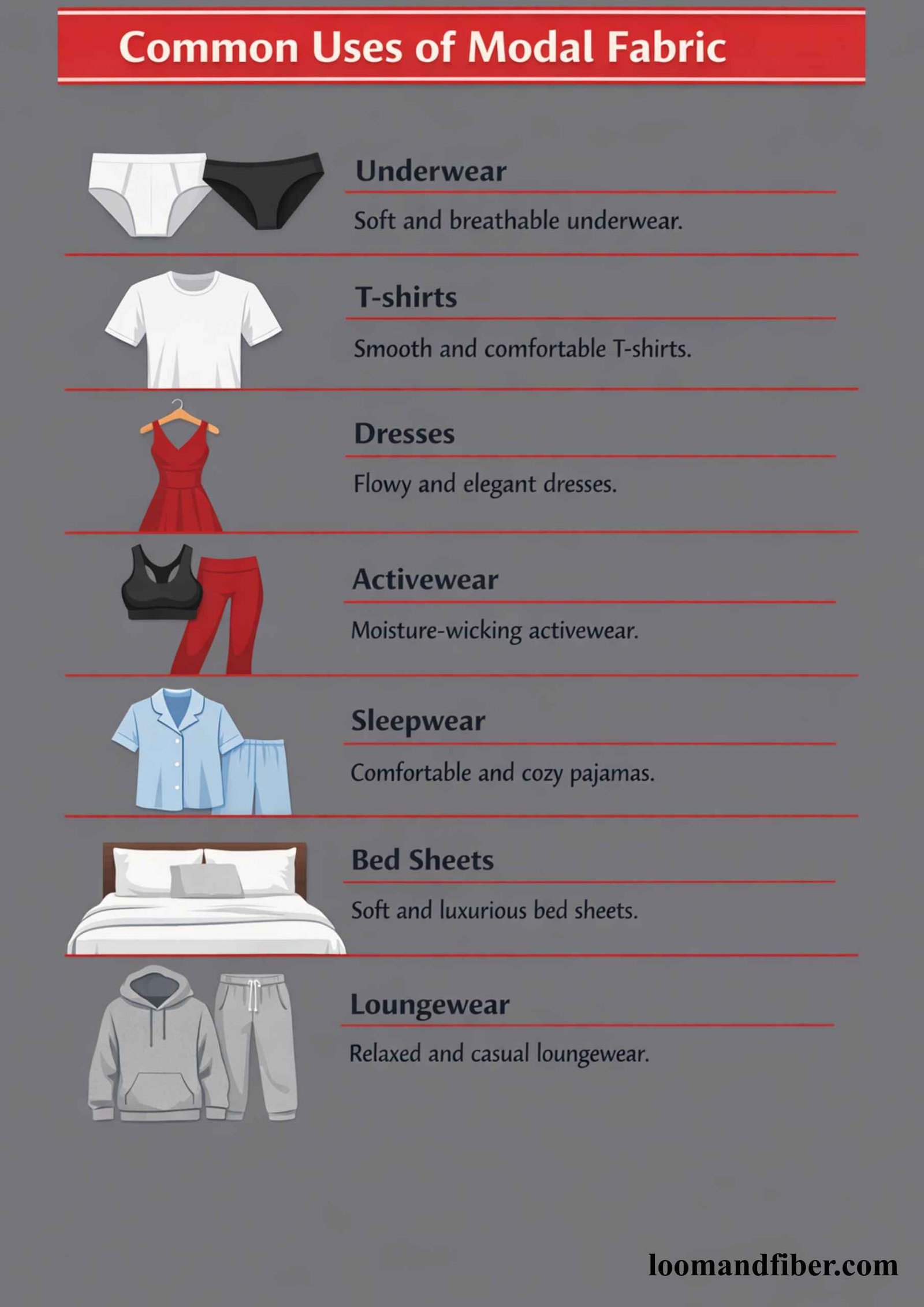
Underwear
Modal is soft and breathable. Thus it is ideal on a day-to-day basis.
Bed Sheets
Modal sheets are soft and chilled. They consequently enhance the quality of sleep.
Pajamas
Modal pajamas are comfortable and easy. Hence, they can be worn as night garments.
Sportswear
Modal is a good absorber of moisture. Hence, it is appropriate to active lifestyles.
Dresses
Modal drapes beautifully. Consequently, it adds fashion attractiveness.
Socks
Modal socks allow feet to stay dry and comfortable. They are thus very useful in day to day activities.
Advantages of the Material Composition of Modal
- Exceptionally Soft: Modal fabrics are extremely soft and nearly silky. Clothes are soft on the skin.
Very porous: The cellulose structure permits breathing. Modal clothes are cool and dry; this is perfect in hot weather or even exercise.
What Does Modal Fabric Feel Like On Skin?
- Moisture- Wicking: Modal absorbs water and evaporates fast. It is capable of retaining half the amount of water in comparison with cotton, drawing the sweat off the skin, which is much more comfortable.
- Powerful and Strong: Due to the long wood fibers and tight spinning, modal is rather powerful. It is tear resistant and it can withstand washing. Actually, modal tends to become even stronger when it is wet as compared to cotton.
- Shrink-Resistant: Modal is less prone to shrinkage in comparison with most rayons. It is resistant to shrinking and swelling during the wash. Colors are also not faded away, as modal takes dyes well.
Practically, the mixture of softness and strength of modal makes it look like a premium cotton. It is better than average cotton in such properties as colorfastness and pilling resistance. These advantages are related to its beech-pulp source and production method directly.
Possible disadvantages of Modal Fabric.
- Chemical Processing: It involves the use of powerful chemicals such as NaOH and carbon disulfide in order to make modal. Unless these are well controlled, they can be detrimental to the workers in the factories and the environment. The consumers ought to be informed about the mode of production.
- Increased Cost: Simple cotton is usually cheaper than modal fibers and fabrics. The modal clothing is more costly at the retail level due to the special processing and quality control.
- Environmental Risks: If it is not sourced in a responsible way, beech pulp may lead to deforestation. There are modal mills which utilize mixed forest pulp, which threatens habitat loss. In addition, the toxins could be discharged in older mills that do not have closed-loop systems. Conclusively, the sustainability of modal is pegged on the practices of the maker.
Nevertheless, there are more brands which today produce modal under stringent eco-conditions (e.g. Lenzing Modal™). Regarding consumers, seeking certifications (FSC, OEKO-TEX, etc.) can help to reduce the environmental and health issues.
Conclusion-
But what is modal fabric composed of? The answer is clear. Beech tree cellulose is the source of modal, which is converted to soft fibers by manufacturers.
Even though modal is semi-synthetic, it possesses a powerful natural origin. In addition, it has good softness, breathability and durability.
Moreover, it is more sustainable with the modern production methods. As such, modal is a cool and cozy textile.
The modal fabric is nature and technology in general. Consequently, it fulfills the demands of contemporary customers who appreciate comfort and sustainability.
Read More>>Modal Fabric Pros & Cons.
FAQs
No. Modal is not made of cotton, it is made of wood pulp. Cotton is natural fiber that comes as a result of cotton bolls whereas modal is a semi-synthetic fiber that is regenerated using beechwood cellulose.
Not usually. Beech trees are nearly all that are used in true modal. Rayon fabrics can be produced using bamboo, however, when a label includes the words bamboo modal, it is probably merely bamboo viscose, not modal.
Beech tree (either European beech or related Zelkova species) is used to make modal fabric. Every constituent component of the fiber begins with beechwood chips or pulp. Classic modal production does not involve the use of any other trees.
No. Modal is not plastic. It is a wood fiber cellulosic hence significantly different to plastic fibers (such as polyester). Since it is composed of cellulose, modal is biodegradable just as other natural fibers are. It is not right to call modal as plastic, it is not petroleum, it is plant.
Yes. Modal is 100% cellulose and therefore it is completely biodegradable. As time goes by, modal will naturally break down without the presence of microplastics. This is unlike synthetic fabrics. Modal is a more eco-friendly end-of-life material because it is biodegradable.
Modal is made out of natural substances. It begins with the natural cellulose of the beech trees and the treatment by a chemical process and the re-spinning into fiber is necessary. In classification of fibers, modal can be classified as a regenerated cellulose fiber (type of rayon).