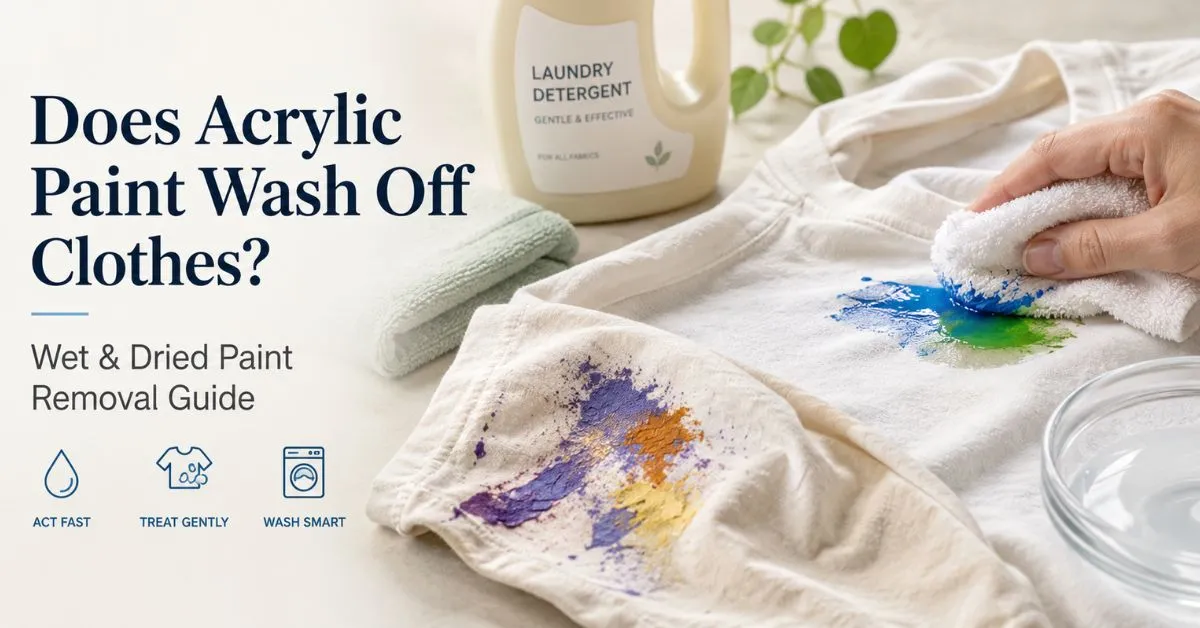

Acrylic paint can wash off clothes when it is still wet, but it becomes much harder—and sometimes impossible—to remove after it dries. Most artist acrylic paints are water-based in their liquid state, so prompt rinsing and pretreatment can prevent the paint from bonding deeply with the fabric. As the water evaporates, however, the acrylic binder forms a flexible, durable film that resists ordinary washing.
The chance of successful removal depends on the paint’s condition, thickness, formulation, fabric type, stain age, and exposure to dryer heat. Wet paint on washable cotton may come out completely, while thick, dried, heat-exposed paint on delicate or color-sensitive fabric may remain permanent. Liquitex describes acrylic paint as water-cleanable while wet and permanent when dry.
When Does Acrylic Paint Wash Out?
Acrylic paint is most likely to wash out when it is fresh, thin, and still water-soluble. Once it dries, regular washing may remove loose pigment but leave the hardened acrylic binder attached to the fibers.
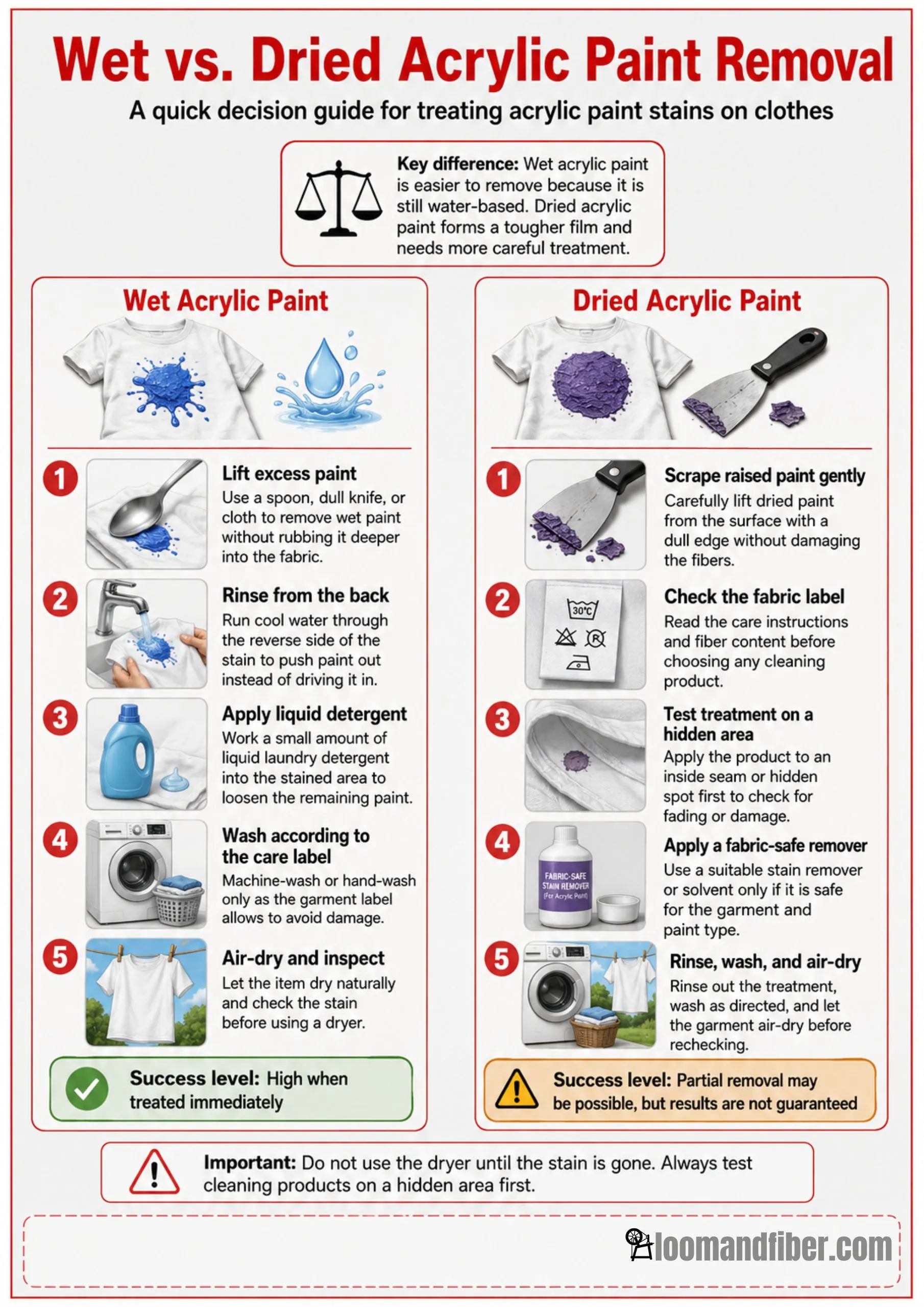
| Paint condition | Chance of removal | Best first action | Main concern |
|---|---|---|---|
| Fresh and wet | High | Flush immediately and pretreat | Spreading paint deeper |
| Tacky or partly dry | Moderate | Lift excess paint and apply detergent | Smearing softened paint |
| Fully dried | Low to moderate | Scrape gently and test a suitable treatment | Fiber or dye damage |
| Machine-dried | Low | Repeat careful treatment or seek professional help | Heat-exposed residue |
| Mixed with fabric medium | Very low after drying | Follow the paint manufacturer’s directions | Designed fabric adhesion |
| Purpose-made fabric paint | Very low after curing | Treat cautiously as permanent decoration | Damage from aggressive solvents |
The American Cleaning Institute recommends rinsing water-based paint while it is wet and then laundering the garment. It also gives the conservative warning that dried water-based paint may not be removable.
Why Does Acrylic Paint Become Harder to Remove After Drying?
Direct answer
Acrylic paint becomes difficult to remove because its liquid carrier evaporates and leaves a solid acrylic polymer film around the fabric fibers.
Fresh acrylic paint contains pigment suspended in a water-based acrylic medium. While the paint remains wet, water, detergent, and mechanical rinsing can dilute and carry away much of that mixture. After drying, the binder no longer behaves like a normal water-soluble stain.
Water alone may remove loose surface color from a dry stain, but it usually cannot dissolve the hardened paint film. This is why timing affects removal more than almost any other factor.
Pigment and binder are not the same thing
Pigment creates the visible color, while the acrylic binder holds the pigment together and attaches it to a surface.
A garment may look cleaner after some pigment has been removed, yet a transparent, stiff, or slightly discolored binder film may remain. Therefore, removing the color does not always mean the entire paint deposit has disappeared.
Thick acrylic paint is harder to remove
A thin splash may stay close to the surface of a tightly woven fabric. A thick drop can settle between yarns and create a solid mass around several fibers.
Heavy-body acrylics, textured paints, metallic paints, and paint containing fillers may leave a raised deposit that requires gentle mechanical removal before any liquid treatment can reach the lower layers.
Fabric construction affects penetration
Open knits, fleece, brushed textiles, ribbed fabrics, seams, and loosely woven materials may allow wet paint to penetrate deeply.
Tightly woven fabrics can sometimes keep more of the spill near the surface, but aggressive scraping may still damage their yarns or finish.
Identify the Paint Before Treating the Stain
Not every product labeled “acrylic” behaves in the same way. Identifying the exact paint helps determine whether the stain is likely to respond to water, detergent, or a stronger treatment.
Check the bottle, tube, marker, product label, or purchase record before beginning.
Regular artist acrylic paint
Most artist acrylic paint is water-cleanable before drying. Once dry, it becomes durable and increasingly resistant to water.
Thin artist acrylic may penetrate fabric quickly because of its fluid consistency. Heavy-body paint may remain raised on the surface but form a thicker film.
Acrylic craft paint
Craft acrylics are often water-based, but formulations vary between brands. Some contain additional fillers, binders, gloss agents, metallic particles, or additives intended to improve adhesion to different surfaces.
Do not assume that every craft paint will react to the same stain-removal product.
Acrylic paint mixed with fabric medium
Fabric medium makes ordinary acrylic paint more suitable for textiles. It can improve adhesion, penetration, flexibility, and wash durability while reducing the stiffness of dried paint.
Liquitex states that its fabric medium makes acrylic paint more adhesive and flexible on textiles and allows the finished fabric to be hand- or machine-washed once dry. Accidental stains containing fabric medium may therefore be more difficult to remove after curing.
Purpose-made fabric paint
Fabric paint is designed to remain attached to cloth through handling and washing. Some products require heat-setting, while others cure without heat.
Once properly cured, fabric paint should generally be treated as a permanent textile decoration rather than an ordinary washable stain.
Acrylic paint markers
Acrylic markers can deposit concentrated paint in a controlled line. Liquitex advises cleaning its acrylic markers with soap and water while wet and describes them as permanent and durable after drying.
Oil-based paint mistaken for acrylic
Oil paint, enamel, and some industrial coatings require different cleaning methods. Water may have little effect on them.
Read the product label before using a solvent. A method suitable for ordinary water-based acrylic paint may be ineffective or unsafe for another paint formulation.
What Should You Do Immediately After Spilling Acrylic Paint?
Remove excess paint, flush the stain from the reverse side, apply liquid detergent, rinse thoroughly, and keep the garment out of the dryer until the stain is gone.
Speed matters. A wet stain can begin forming a film within minutes, especially when the paint layer is thin and the environment is warm or dry.
Do not rub the wet paint
Rubbing pushes paint through the fabric and enlarges the stained area. It can also force pigment into yarn intersections, seams, and textured surfaces.
Instead, lift thick excess paint with a spoon, plastic card, or dull-edged tool. Work from the outside of the spill toward the center.
Keep the stain wet during initial treatment
Do not allow fresh paint to dry while gathering cleaning supplies. Rinse it promptly when the care label permits water treatment.
Avoid placing the garment on a radiator, near a heater, or in direct hot airflow.
Flush from the back of the fabric
Turn the stained area face down and run water through the reverse side. This helps push loose paint back through the path by which it entered.
Flushing from the front can drive diluted paint farther into the textile. The reverse-flushing approach is also recommended in stain guidance for washable fabrics because it helps force contamination outward rather than deeper into the material.
How to Remove Wet Acrylic Paint from Washable Clothes
Use this method only when the care label allows washing and the paint is still wet.
Step 1: Read the garment care label
Identify the fiber content, permitted water temperature, washing instructions, and restrictions on bleach or solvents.
Do not use a home wet-cleaning method on a garment labeled “dry clean only” unless the manufacturer specifically permits it.
Step 2: Remove excess paint
Use a spoon, dull knife, spatula, or plastic card to lift thick paint from the surface.
Do not scrape hard enough to stretch, cut, fuzz, or thin the fabric.
Step 3: Rinse from the reverse side
Hold the back of the stain under running water. Continue until the water carries away less visible color.
Use a temperature allowed by the garment care label. Although some general guidance recommends warm water for water-based paint, the care label should take priority.
Step 4: Apply liquid laundry detergent
Work a small amount of liquid laundry detergent gently into the wet stain using clean fingers or a soft cloth.
Detergent helps suspend loosened pigment and other paint ingredients so that they can be carried away during rinsing.
Step 5: Let the detergent work briefly
Allow the detergent to remain on the stain for several minutes without letting the area dry.
Follow the detergent manufacturer’s contact-time instructions. Longer soaking is not automatically better, especially on unstable dyes or delicate fibers.
Step 6: Blot or work gently
Use a clean white cloth to blot from the stain’s edge toward its center.
A white cloth makes it easier to see whether paint or garment dye is transferring. Stop if the original fabric color begins lifting.
Step 7: Rinse and repeat
Rinse thoroughly. Repeat the detergent treatment when visible paint continues to loosen.
Several mild treatments are generally safer than one aggressive scrubbing session.
Step 8: Wash according to the care label
Launder the garment after most of the paint has been removed.
Consider washing it separately if loose pigment could transfer to other clothing.
Step 9: Air-dry and inspect
Do not tumble-dry the garment until you have examined it in good light.
If a stain remains, repeat a care-label-safe treatment. Dryer heat can make remaining contamination more difficult to address; ACI similarly recommends confirming that stains are gone before placing garments in the dryer.
How to Remove Partly Dried or Tacky Acrylic Paint
Partly dried paint requires a different approach because it may smear when rubbed but resist simple rinsing.
Lift the raised paint first
Use a dull edge to remove paint that sits above the fabric. Do not press the sticky deposit into the garment.
Wipe the tool after each pass so that lifted paint is not transferred to a clean section.
Apply detergent around and beneath the residue
Place a clean absorbent cloth beneath the stain. Apply a small amount of liquid detergent to the affected area and work it gently from the edges inward.
The goal is to loosen the remaining wet portion without spreading the tacky material.
Blot instead of scrubbing
Scrubbing can turn a small sticky deposit into a wide, thin stain.
Blot with a clean white cloth, changing to a fresh section as color transfers.
Rinse and reassess
After the loose paint has been removed, rinse from the back. If the remaining material feels hard rather than tacky, move to the dried-paint method.
How to Remove Dried Acrylic Paint from Clothes
Dried acrylic paint may sometimes be reduced, but complete removal cannot be guaranteed because the paint has already formed a durable film around or between the fibers.
The American Cleaning Institute states that dried water-based paint may not be removable. Any dried-paint method should therefore be understood as a careful recovery attempt rather than a guaranteed cure.
Step 1: Let any soft residue become stable
Do not scrape paint that is partly sticky and likely to smear. Wait until the raised surface can be lifted without spreading it, but do not intentionally use heat to speed drying.
Step 2: Scrape off the surface film
Lay the garment on a firm surface and use a dull-edged tool to lift brittle or raised paint.
Work slowly. Stop if fibers begin pulling, thinning, breaking, or becoming fuzzy.
Step 3: Brush away loose particles
Use a soft brush or clean cloth to remove loosened flakes.
Do not shake paint particles into the air or onto nearby textiles.
Step 4: Read the fiber label
Determine whether the garment contains cotton, polyester, wool, silk, acetate, acrylic, modacrylic, elastane, or a blend.
This information matters because a chemical that softens dried paint may also damage a fiber, dye, print, coating, or elastic component.
Step 5: Test the mildest treatment first
Begin with liquid laundry detergent or a fabric-approved prewash stain remover.
Test the product on an inside seam. University of Georgia textile-care guidance recommends reading the care label and testing cleaning agents in an inconspicuous area to evaluate colorfastness.
Step 6: Place an absorbent cloth beneath the stain
A white cloth or paper towel can collect loosened pigment and binder.
Replace the absorbent material as it becomes stained. Otherwise, dissolved paint can transfer back into the garment.
Step 7: Blot in controlled amounts
Apply only enough product to contact the stain. Flooding the area can spread pigment and increase the risk of rings, dye migration, or finish damage.
Blot toward the center rather than rubbing outward.
Step 8: Rinse and pretreat again
Rinse out the treatment completely before applying a different product.
Do not combine chemicals. Mixing stain removers, solvents, ammonia, acids, or bleach can produce dangerous reactions or damage the textile.
Step 9: Wash and air-dry
Launder only after loose paint and cleaning-product residue have been removed.
Air-dry the garment and inspect the result. Repeat only when the fabric remains stable and colorfast.
Can Rubbing Alcohol Remove Dried Acrylic Paint?
Rubbing alcohol may soften some dried acrylic residues, but it is not safe for every fabric, dye, print, or finish.
Isopropyl alcohol is frequently suggested because it may affect certain acrylic binders. Its effectiveness varies by paint formulation, curing time, thickness, and fabric construction.
More importantly, alcohol can damage some textiles. University of Georgia guidance warns that alcohol can harm acetate, triacetetate, modacrylic, and acrylic fibers.
How to test rubbing alcohol safely
- Read the garment’s care label.
- Confirm that the fiber is not listed as alcohol-sensitive.
- Test one drop on a hidden seam.
- Blot with a white cloth.
- Allow the test area to dry.
- Check for fading, stiffness, shine, distortion, or surface damage.
Do not continue if the garment’s dye transfers or its appearance changes.
Can Acetone or Nail Polish Remover Remove Acrylic Paint?
Acetone may soften some paint residues, but it carries a high risk of discoloring, weakening, dissolving, or permanently altering fabrics and garment components.
Acetone should not be treated as a universal acrylic-paint remover. Nail polish remover may also contain fragrances, oils, colorants, conditioners, or alternative solvents that leave additional marks.
Never use acetone on acetate or triacetate
University of Georgia textile-care guidance warns against using acetone or lacquer thinner on acetate and triacetate because these fibers can be severely damaged.
Other garment components may also be vulnerable
Acetone can affect:
- Printed logos
- Heat-transfer graphics
- Plastic buttons
- Synthetic coatings
- Faux leather
- Reflective trim
- Adhesives
- Elastic finishes
- Surface laminations
- Some garment dyes
Even when the base fabric appears stable, a decorative or structural component may not be.
When professional cleaning is safer
Take the garment to a professional when it is valuable, delicate, lined, structured, embellished, vintage, or labeled dry-clean-only. Tell the cleaner which paint was used and which home treatments have already been attempted.
Which Acrylic Paint Removal Products Actually Help?
No single treatment is appropriate for every stain. Use the mildest product capable of addressing the paint without damaging the garment.
| Treatment | Most appropriate use | Main limitation |
|---|---|---|
| Water | Fresh water-based acrylic paint | Limited effect after drying |
| Liquid laundry detergent | Fresh paint and remaining pigment | May not dissolve cured binder |
| Fabric-safe dishwashing liquid | Fresh greasy or additive-rich residue | Not a guaranteed dried-paint remover |
| Prewash stain remover | Washable and colorfast clothing | Product must suit the fabric |
| Rubbing alcohol | Selected dried residues on compatible textiles | May fade dyes or damage certain fibers |
| Acetone | Rare, carefully tested last-resort situations | High fabric and finish risk |
| Commercial paint remover | Only when specifically approved for textiles | Formulas vary widely |
| Professional cleaning | Delicate, valuable, large, or dry-clean-only items | Complete removal is not guaranteed |
The best product is not necessarily the strongest chemical. It is the product that removes the greatest amount of paint while causing the least change to the textile.
Does Acrylic Paint Come Out in the Washing Machine?
A washing machine may remove fresh, properly pretreated acrylic paint, but a normal wash cycle alone is unlikely to remove a fully dried paint film.
A washing machine provides water, detergent, movement, and rinsing. These actions can remove diluted wet paint and loose pigment, but they cannot reliably dissolve cured acrylic binder.
Before machine washing:
- Remove excess paint.
- Flush the stain from the back.
- Pretreat the affected area.
- Rinse out loosened pigment.
- Confirm that the garment is machine-washable.
- Wash separately when color transfer is possible.
Do not place a thick paint deposit directly into the washer. Paint flakes and pigment may spread to other garments or collect in parts of the machine.
What If the Clothes Have Already Been Washed?
The next step depends on whether the garment was air-dried or exposed to dryer heat.
Washed but air-dried
A stain that was washed and air-dried may still respond to pretreatment, especially if the paint was not fully cured before washing.
Examine the stain closely. Remove any raised residue, test the fabric, apply a suitable pretreatment, rinse, and wash again.
Washed and tumble-dried
Acrylic paint that has passed through a dryer is generally more difficult to treat. Heat can increase the practical difficulty of removing many remaining stains and may also change the fabric’s surface around the paint.
Do not compensate by immediately using an aggressive solvent. Begin with the same care-label and colorfastness checks required for any dried stain.
Washed several times
Repeated washing may gradually remove loose pigment without eliminating the binder. The remaining area may appear:
- Stiff
- Shiny
- Slightly raised
- Rough
- Discolored
- Darker when wet
- Lighter because the garment dye has faded
When repeated treatments produce no improvement, further cleaning may damage the clothing more than the remaining stain.
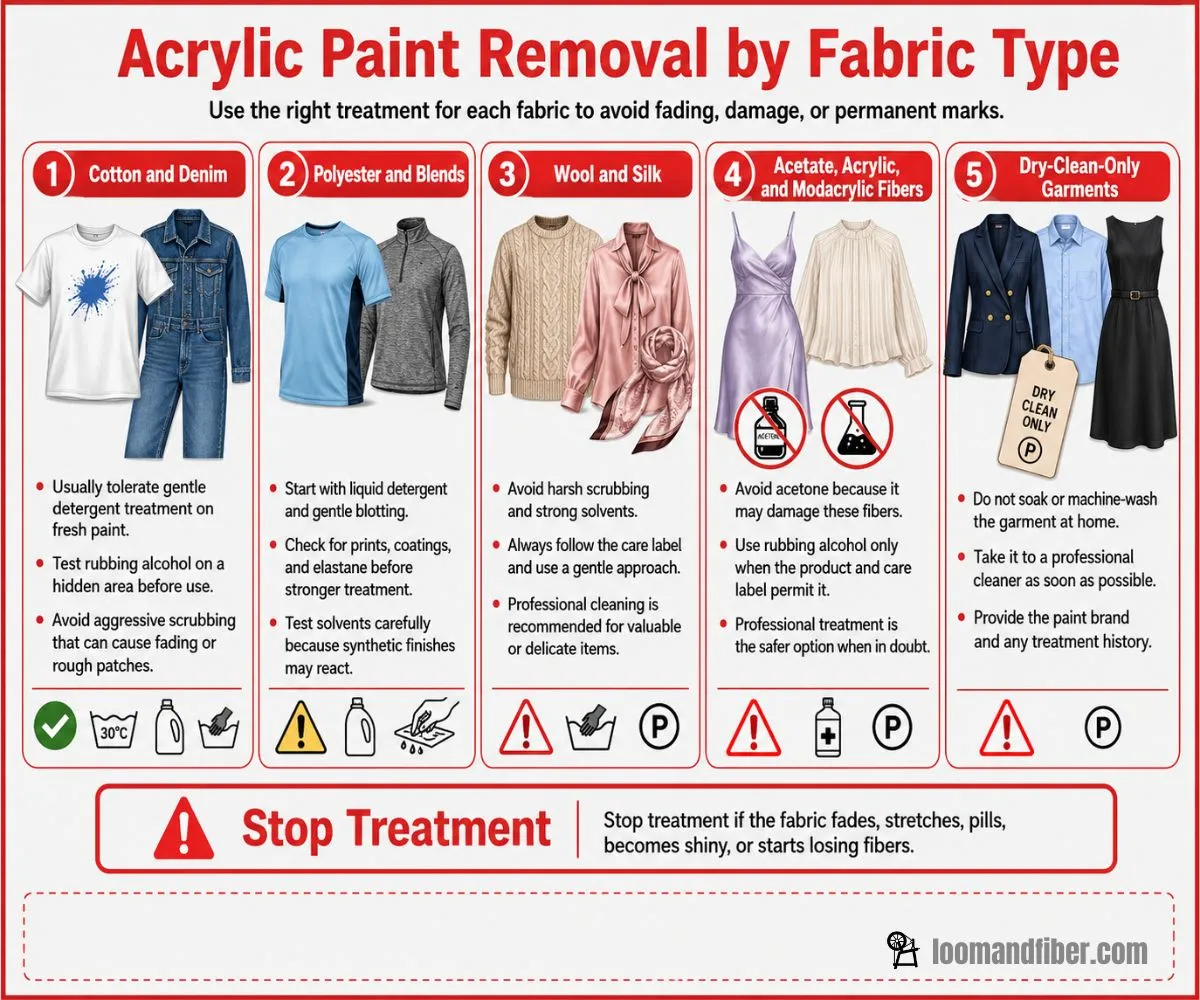
How Does Fabric Type Affect Acrylic Paint Removal?
Fabric type influences absorbency, chemical resistance, colorfastness, surface damage, and the depth to which paint can travel.
Cotton
Cotton is usually washable and can tolerate gentle pretreatment, but it is absorbent. Diluted paint may penetrate deeply into cotton yarns. White cotton may permit additional stain-removal options when the care label allows them, but chlorine bleach is not automatically safe for every white garment.
Polyester
It absorbs less water than cotton, but acrylic paint can still surround individual fibers and settle in the fabric structure. Polyester garments may also include heat-sensitive prints, coatings, dyes, or elastane that limit solvent use.
Cotton-polyester blends
A treatment must be safe for every fiber in the blend. The cotton portion may absorb pigment, while polyester, elastane, finishes, and sewing threads may respond differently to heat or chemicals.
Denim
Denim is durable, but its dense yarn structure can hold paint between intersections. Hard scrubbing may produce a faded or worn patch that remains visible even after the paint improves. Dark indigo denim requires careful colorfastness testing.
Nylon
Nylon can be affected by strong chemicals, heat, and dye instability. Use a hidden-area test and avoid assuming that a solvent-safe cotton method will also be suitable for nylon.
Stretch fabrics
Garments containing elastane or spandex require gentle treatment. Strong solvents, repeated soaking, high heat, and vigorous brushing may affect elasticity, bonded details, finishes, or recovery.
Wool and silk
Wool and silk can change texture, color, shape, and surface appearance when exposed to friction, unsuitable water temperatures, alkaline cleaners, or solvents. Professional cleaning is generally safer for valuable wool or silk garments, especially when the paint has dried.
Acetate, triacetate, acrylic, and modacrylic fibers
These fibers require particular caution around solvents. Do not confuse acrylic paint with acrylic fiber. The paint is a coating material; acrylic fiber is a textile material. A solvent that affects acrylic paint may also damage acrylic-based fabric.
Dry-clean-only garments
Do not rinse or soak a dry-clean-only garment unless its manufacturer permits water treatment. Take it to a cleaner promptly, identify the paint product, and describe all previous treatment attempts.
How to Remove Acrylic Paint from White Clothes
White fabric eliminates the risk of removing a colored garment dye, but it still requires fiber-safe treatment.
Remove the paint film before treating discoloration
Bleaching a garment will not necessarily dissolve a hardened acrylic film. First remove as much surface paint and binder as possible. Only then assess whether a pigment shadow remains.
Consider oxygen bleach only when permitted
A care-label-approved oxygen bleach may help with certain remaining color traces on washable white fabrics. Follow the product dosage and contact time. Do not assume that a longer soak is safer or more effective.
Use chlorine bleach cautiously
Chlorine bleach can weaken, yellow, or damage some fabrics, finishes, sewing threads, prints, and elastane. Use it only when both the garment label and bleach instructions confirm compatibility.
Avoid creating a bright patch
Repeated spot bleaching may make the treated area whiter than the rest of the garment. When whitening is appropriate, treating the whole garment according to its care instructions may create a more even result than repeatedly bleaching one small area.
How to Remove Acrylic Paint from Colored or Printed Clothes
Colored and printed clothing requires greater attention to dye stability.
Test for color transfer
Apply the intended treatment to an inside seam and blot it with a white cloth. Do not continue if the garment’s original color transfers, becomes dull, or develops a ring.
Protect printed graphics
Solvents may damage screen prints, vinyl transfers, logos, reflective elements, and decorative coatings. Keep treatments confined to the paint stain and away from intentional garment decoration.
Be cautious with garment-dyed clothing
Garment-dyed pieces may have intentional variations and surface color that changes through washing and friction. Aggressive spot treatment can create a permanently lighter patch even when the acrylic paint is removed.
What Acrylic Paint Removal Methods Should You Avoid?
Do not rub fresh paint
Rubbing enlarges the stain and pushes paint deeper into the textile.
Do not use a sharp blade
A razor or sharp knife may cut yarns, weaken the material, or create a hole.
Do not start with the strongest solvent
A powerful solvent may remove the garment’s dye, finish, logo, coating, or fiber before it removes the entire paint stain.
Do not mix cleaning chemicals
Never combine bleach with ammonia, acids, vinegar, alcohol, solvents, or other household cleaners.
Rinse one product out completely before considering another.
Do not ignore the care label
The garment manufacturer’s instructions should override a general online stain-removal method.
Do not put the garment in the dryer too soon
Air-dry the garment until the stain has been assessed. Dryer heat reduces opportunities for further treatment and may make remaining contamination harder to address.
Do not soak blindly for hours
Long soaking can cause dye migration, shrinking, distortion, finish loss, or damage to trims and adhesives.
Do not assume vinegar is a universal remover
Vinegar may affect some mineral or odor-related problems, but it is not a reliable solvent for cured acrylic polymer.
Acidic treatments can also affect certain dyes and fibers.
Do not rely on hairspray without checking the ingredients
Older stain-removal advice often relied on alcohol-rich hairspray. Modern formulas vary and may contain oils, fragrances, conditioners, resins, or only small amounts of alcohol.
A controlled application of a known product is safer than using an unpredictable cosmetic spray.
Do not use the dryer to “test” whether the stain is gone
Inspect the garment while it is air-dried. Once the item enters a hot dryer, the remaining treatment options may become more limited.
When Is an Acrylic Paint Stain Permanent?
An acrylic paint stain is more likely to be permanent when the paint is fully cured, thick, deeply embedded, heat-exposed, mixed with fabric medium, or impossible to treat without damaging the garment.
Use the following recovery scale:
Good chance of removal
- The paint is still wet.
- The spill is small and thin.
- The garment is washable.
- The fabric is colorfast.
- Treatment begins immediately.
Possible partial recovery
- The paint is dry but remains mostly on the surface.
- The garment is made from a sturdy, washable fabric.
- The stain has not entered a dryer.
- A hidden-area test shows good chemical resistance.
Low chance of complete removal
- The paint layer is thick.
- The stain is several days or weeks old.
- The garment has been tumble-dried.
- The paint contains fabric medium.
- The paint has penetrated seams, fleece, or an open knit.
Stop treating the stain when
- The garment’s dye begins transferring.
- Fibers become fuzzy or thin.
- The area stretches or distorts.
- The surface becomes shiny.
- A print or coating begins dissolving.
- Elasticity decreases.
- No additional paint transfers during repeated treatments.
A faint stain is often preferable to a hole, faded patch, weakened fabric, or damaged logo.
Why Is the Acrylic Paint Stain Not Coming Out?
The paint has fully cured
Once the acrylic binder has formed a durable film, water and ordinary detergent may remove loose pigment without dissolving the entire deposit.
The garment entered the dryer
Dryer exposure can make the remaining stain more difficult to treat and may reduce the benefit of repeated washing.
The paint contains fabric medium
Fabric medium is intended to improve the paint’s connection with textile fibers. A properly dried application may resist ordinary laundering by design.
The stain passed through both sides
A surface treatment may be reaching only the upper layer. Place an absorbent cloth beneath the stain and work from both the reverse and front when the fabric permits.
The paint is trapped in a textured fabric
Fleece, ribbing, knits, terry cloth, seams, and brushed surfaces can hold particles below the visible surface.
Hard brushing may damage the texture before it removes all of the paint.
The wrong product is being used
Detergent can help remove fresh paint and loose pigment but may not dissolve cured binder. A solvent may soften one paint formulation while having little effect on another.
The garment cannot tolerate stronger treatment
Sometimes the remaining stain could only be removed with a chemical or amount of friction that would also damage the garment.
In that situation, partial improvement is the safest realistic result.
Conclusion-
Acrylic paint usually washes off clothes most successfully while it is still wet. Remove excess paint, flush the stain from the reverse side, apply liquid detergent, rinse, wash according to the care label, and air-dry the garment before evaluating the result.
Dried acrylic paint is much less predictable because its binder has formed a durable film. Gentle scraping and carefully tested treatments may reduce some dried stains, but complete restoration is not guaranteed. Strong solvents should never be used without checking the fabric, dye, print, finish, and care instructions.
The safest stain-removal method is not the most aggressive one. It is the method that improves the stain without causing fading, thinning, distortion, stiffness, or permanent damage to the garment.
Read More>> Oil Stains on Clothes after Washing: How to fix?
FAQs
Fresh acrylic paint may come out in a normal wash when it has first been rinsed and pretreated. Washing an untreated stain can spread pigment or leave dried binder behind. Fully dried acrylic paint is unlikely to disappear through an ordinary wash cycle alone.
Sometimes, but complete removal is not guaranteed. Success depends on the paint formulation, thickness, age, fabric type, dye stability, and whether the garment entered a dryer. Dried water-based paint may remain permanent, particularly when it has penetrated deeply or bonded with the fibers.
Rubbing alcohol can fade dyes, affect prints, and damage certain synthetic fibers. University of Georgia textile guidance warns that alcohol can harm acetate, triacetate, modacrylic, and acrylic fibers. Always read the care label and perform a hidden-area test first.
Acetone may soften certain acrylic residues, but it can also damage fibers, dyes, prints, coatings, plastics, and adhesives. It should never be used on acetate or triacetate. Valuable or delicate garments should be assessed by a professional instead.