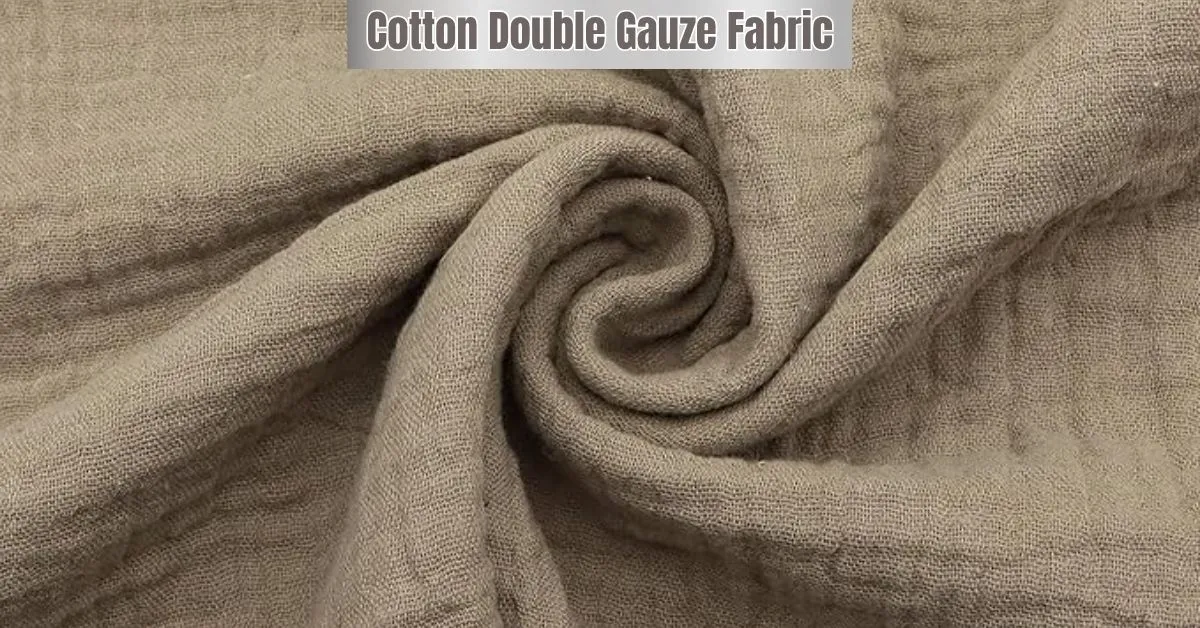

Cotton double gauze is a lightweight, breathable cotton fabric, composed of two thin layers of loosely woven gauze fabric sewn (tacked) together invisibly. It is soft and snug and has a slight crinkled (bubbled) touch. The two-layered structure renders it curiously opaque with its weight, and its open weave allows air to pass freely. To put it mildly, it is a cozy, fluffy material that is ideal to use in warm-weather and baby items.
How Cotton Double Gauze Fabric Is Made
Weaving Process
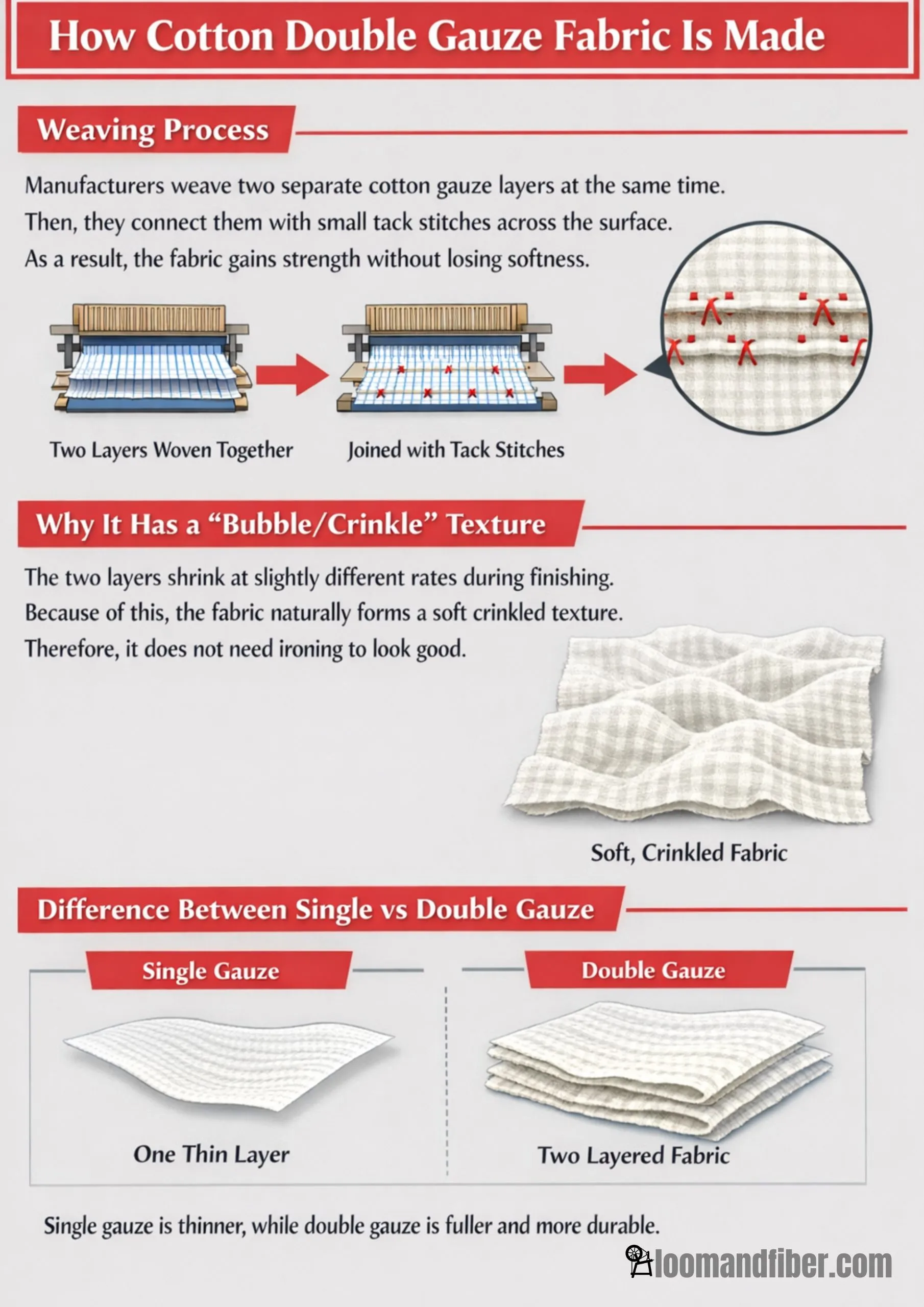
Cotton double gauze starts as two pieces of fine, open-weave cotton gauze. The layers are plain-woven, and loosely woven on fine yarns. The two layers are then face to face and tacked or stitched in regular intervals together. Small stitches are used to sew the layers without flattening the weave and entrap small air pockets. The outcome is a soft, airy cloth, yet easy to breathe since the weave is open.
Why It Feels Like a Bubble/Crinkle
This crinkled appearance is a result of the production process as well as the reaction of the fabric to washing. When the two loose layers are tacked, the two layers form small wrinkles and bubbles. Indeed, some little wrinkles are built-in when the cloth is made, which give the cloth character. The layers become flatter and the puckers become sharper when you wash it, which means that the cloth becomes softer and crinklier with every wash. This translates to an iron free naturally textured finish.
Single vs. Double Gauze
The main difference between single and double gauze is that single is one layer of loosely-woven cotton, as opposed to double which is two layers of fabric stacked into one. Single-layer gauze is even more light and thin, but it lays flat and may be quite transparent. In comparison, the two layers of the fabric make double gauze slightly thick and plush. It still feels light, but it isn’t completely see-through. Practically, clothing and baby wear are made of double gauze, with single-layer muslin (and particularly the thin variety) being frequently utilized as backing or draping. It is also more insulating and absorbent than single gauze due to the double layer.
Cotton Double Gauze vs Other Fabrics
| Feature | Double Gauze | Muslin | Voile | Lawn | Linen |
|---|---|---|---|---|---|
| Layers | Two | One | One | One | One |
| Texture | Crinkled | Slightly rough | Smooth | Crisp | Textured |
| Breathability | High | High | Medium | Medium | High |
| Softness | Very soft | Medium | Soft | Smooth | Moderate |
| Best Use | Babywear, summer clothes | Swaddles | Blouses | Dresses | Pants, shirts |
Double Gauze vs Muslin
Although the words muslin and gauze sound like each other, muslin is generally a single-layered cotton in tight or loose weave (depending on the region), commonly used as backdrops or cloths. In comparison, double gauze is stitched in two layers thus, it is softer. Gauze is light and airy, perfect to wear in a boho style. Muslin is more durable and more rigorous, featuring a greater number of threads per piece, and is used in a table cloth or pattern-making.
Voile vs Double Gauze
Cotton voile is a plain-weave single layer fabric that is produced using very fine yarns. It is soft and silky, like a cotton chiffon, with a floating flow. On the contrary, double gauze is twice as thick, which provides it with more body and transparency. Voile is very lightweight (usually 50-70 GSM) and semi-transparent, whereas double gauze (100-150 GSM) is more substantial. They both breathe easily, but voile is more fragile and transparent, so it generally requires lining. Gauze is a unique matte, puckered fabric, which can be worn as a single layer in most instances.
Lawn vs Double Gauze
Another light weave of cotton is cotton lawn, which is, however, much tighter, and crisper than gauze. Lawn has a thread count of very fine, combed cotton which provides the lawn with a smooth, near satin finish. It is light (~70 GSM) but with a firmer hand and fits shape (collars or custom clothes). The softness and fluffiness of double gauze (two 115-130 GSM layers) are softer. Gauze, in contrast to the lawn, is textured and billows. The lawn is typically opaque enough to be worn in the case of one-layer clothes (generally in darker color), but the layer of the garment is quite opaque due to its layering. Concisely, lawn = smooth crisp and gauze, soft draping.
Double Gauze vs Linen
Linen is a natural fabric that is made of flax; it is crisp and cold. Both fabrics are breathable and great for summer, but linen fibers are thicker and make a heavier, textured cloth. Cotton double gauze is far softer and plush, and linen is crisp and stiff (softens with wear). Linen absorbs water quickly and it has a somewhat structured drape. The multilayered weave of gauze captures air to insulate and is soft against skin. But linen is much tougher and sturdier. Practically, both gauze and linen provide a light, informal appearance, but linen has a natural, textural appearance. They are both worn in hot weather and gauze is preferred in cases when the utmost softness and drapiness is required.
Why Cotton Double Gauze Fabric Is So Popular
Ultra-breathable: Cotton double gauze is very light and airy. It has an open-weave construction (two times) that allows maximum amounts of airflow, thereby keeping the skin cool. Actually, wearers will say they feel significantly less overheated in gauze than heavier fabrics.
Softens after washing: Right out of the wash, double gauze feels delightfully soft. Moreover, it gets even softer and cozier with each laundering. You do not have to break in gauze as many fabrics do, but rather it is comfortable when you first put it on and only gets softer as time goes by.
Lightweight but not sheer: It is airy, but its two layers render it not as transparent as single-layered voiles or muslins. Majority of the double gauze garments are conveniently opaque to wear. You can also usually skip lining, as two-ply construction provides cover but still feels featherlight.
Natural crinkle (no ironing required): The soft wrinkles and crinkles are an attribute, not a blemish. Gauze inherently appears somewhat wrinkly, thus you save ironing time. Its rugged surface conceals small lines, which is why it is suitable in the hectic lifestyle. The cloth maintains a casual, worn appearance which most people find appealing.
Hypoallergenic & safe: Being 100% cotton, gauze is soft on sensitive skin. It is commonly applied to baby products and bedding as it is soft and breathable. This is perfect to those who have allergies or babies with sensitive skin.
Easy and lightweight: Gauze is lightweight and easy to use. It is popular in dresses and tops, light-weight scarves, blankets etc. Designers enjoy the fact that it can be easily dyed or printed and that it mixes with other fabrics in quilts and layers.
Read More>> Best Cotton Fabrics for Summer.
Disadvantages of Cotton Double Gauze Fabric
Snags easily: The loose weave that makes gauze soft, also makes it delicate. Its threads can be snagged on sharp objects or rough surfaces. Examples of this would be pet claws or Velcro that can snag the gauze when compared to tight weaving cotton.
Less structured: Gauze is unstructured and flowy. It will not have crisp edges or sharp pleats such as poplin, or denim. Gauze can be a disadvantage in tailored or formal clothes where a body is needed.
Not ideal for formal wear: With its casual, crinkled look, double gauze is best for laid-back styles. It is not commonly worn in business suits, evening dresses or other highly fashioned clothing. In a formal setting, starchier or more shinier fabrics (such as satin, wool, or fine linen) are worn instead.
Shrinkage: Gauze is made of loose, natural fibers, and therefore can shrink during the wash. This is not a weakness but a reality: anticipate a few percent (even to about 10 percent) first-laundering shrink. Always wash gauze prior to sewing to fix size.
Wrinkles readily: Gauze wrinkles as part of its charm, but it does wrinkle further if you iron it hard. The material should be handled delicately. When you press it hard it loses some crinkle (which may be regained by re-washing).
What Is Cotton Double Gauze Fabric Used For?
Clothing
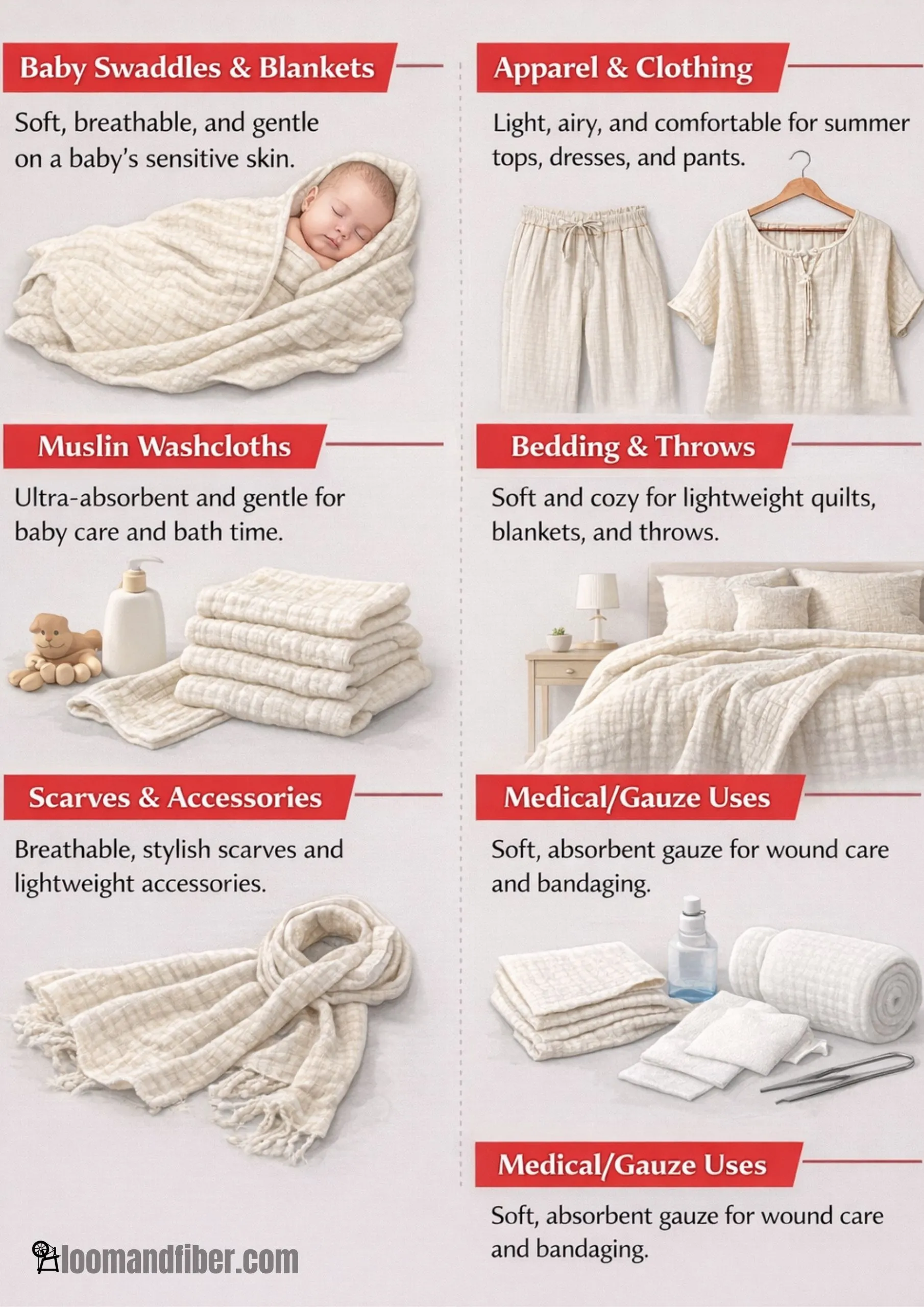
In clothes, cotton double gauze gleams. It has a loose summer dress, tunic and blouse because of its breezy drape that designers use. It is also a favorite baby fabric, whether in onesies or rompers, as it is extremely soft and hypoallergenic. Actually, several sewing blogs refer to double gauze as one of the most suitable fabrics to make baby clothes. The softness and breathability of it keep the infants cool and comfortable. Furthermore, parents adore the fact that it is simple to take care of and gentle with sensitive skin.
Bedding
Gauze’s softness extends into the bedroom. You will be able to find it in swaddle blankets, crib sheets, and light throws. To illustrate, most muslin baby blankets are in fact made of two-layered gauze, which is warm, yet not heavy. Its moisture-wicking cotton makes sleepers feel comfortable, and thus, the gauze sheets or quilt backs are usually popular among people during summer. The airy air-pocket of a fabric gives a comforting cloud-like touch to blankets, so it is perfect in anything that requires to be soft, absorbent and breathable (like burp cloths or lightweight quilts).
Accessories
Scarfs, shawls and wraps are also popular in double gauze. A gauze scarf is lightweight enough to wear during warm weather, and warm enough to use on cold nights. It is worn as an uncomplicated, textured accessory as it is a drape. Other makers also apply gauze to reusable face masks or lightweight blankets and dust covers, using its softness and lightness.
How to Choose the Best Cotton Double Gauze Fabric
GSM / weight guide:
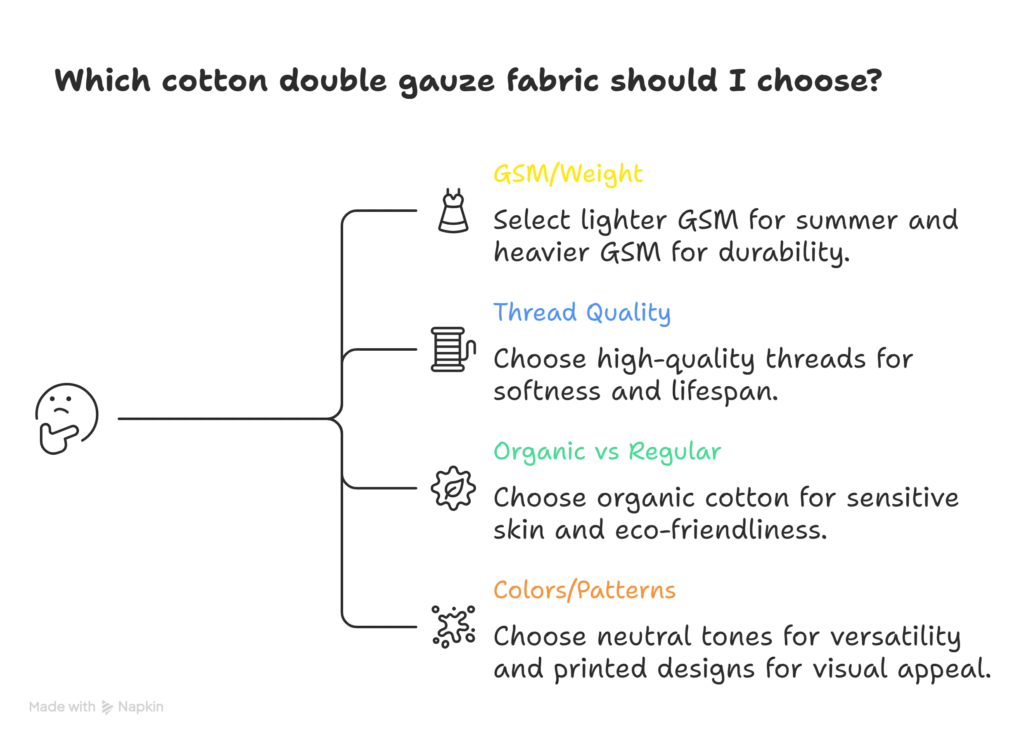
See the GSM (grams per square meter) of the fabric. Light gauze (~100-130 GSM) is extremely light and ideal in airy clothes or baby clothes. The medium gauze (approximately 130-160 GSM) is a bit more substantial in order to use with everyday tops or children garments. Gauze with heavier weights (160 or more GSM) is uncommon, and can even feel like soft flannel. Standard double gauze is indicated by one guide at 100-150 GSM. Find the right GSM in relation to your project: a lighter one to wear on a breezy day, a heavier one in case you have to wear it a bit more or warmer.
Thread quality:
High quality double gauze is made of fine and long-staple cotton. Search between layers, tightly spun yarn and even stitching. Nicer gauze usually is more smooth and tough. An instance of this is the use of cotton gauze fabric produced using organic or combed cotton which will be smoother and silkier. (One of the sources mentions that double gauze is made up of two layers of fine cotton that are sewn together.) The lower quality gauze may drop lint or break easily, thus look closely at a swatch.
Organic vs Regular Cotton:
Decide if you want organic. Organic cotton gauze is cultivated without the use of pesticides or fertilizers and is processed in a less harsh manner. It is targeted at environmentally friendly consumers, and baby products seem to be the most demanded as there are no chemicals. Ordinary cotton gauze may be equally breathable and soft, but organic provides a sense of security over sustainability and can be a natural white or unbleached appearance. In any case, both types are easy-care like gauze.
Best colors/patterns:
Gauze is available in solid colors or in whimsical patterns. The airy texture is emphasized with light or pastel colors, and bold prints are a statement. Just in case you want the crinkle to be natural, then use light or medium colors. In such projects as baby clothes, subdued earth colors or plain geometrical patterns are in fashion. Cute all-over motifs are available in gauze in some suppliers (primarily with Japanese design) – ideal with playful dresses. Note that darker dyes can be a little heavier; check a swatch to be transparent.
Sewing with Cotton Double Gauze Fabric
Needle type: Use a fine, sharp needle (e.g. size 70/10 or 80/12). Lightweight gauze is best with a Microtex (sharp) or high-quality universal needle. Fine needles produce clean stitches with no snagging. Do not use thick denim or ballpoints because they may produce holes or missing stitches.
Cutting tips: Due to the shift of the double gauze layers, weigh down your pattern pieces and cut with a sharp rotary cutter where possible. Pinning and spray stabilizer (such as diluted starch or a spray product, like Flatter) can be used to stabilize the fabric. Put your top layer on the bottom and trim or cut layers one at a time when it is important you have everything accurate. Sewists may prefer to cut individual layers or cut the two layers together to match patterns.
Pre-washing: You should always wash and dry your gauze then cut. The cotton gauze will shrink, therefore prewashing will help to prevent surprise shrinkage following sewing. A gentle spin in warm or cool water then low-heat tumble or air-dry is best. The pre-softening of the fabric is also achieved with this initial wash. Wash, then squeeze out the water and lay flat or drape to dry; you see it fluffs up so well.
Seam finishes: Due to the loose weave, the unhemmed edges may fray. Consider French seams or double-turned hems to encase edges. To avoid perforation, use a longer stitch length (approximately 2.5 3.0 mm). When using a machine to sew, a walking foot may assist in feeding the layers evenly. A serger is good with knits or delicate work, but clips off.
Dyeing, Printing & Customization Options
Reactive Dyeing
Cotton double gauze is easy to work with fiber-reactive dyes, the same as T-shirts and quilting cottons. Gauze, being 100 per cent cotton bonds with these dyes. Bleached double gauze could be dyed using fiber-reactive dyes, providing rich permanent color. You may tie-dye, batik or hand-paint gauze. The open weave of the fabric allows the dye to spread easily and thus one can expect a soft watercolor look. Always wash gauze, that has been exposed to dye.
Digital Printing
Contemporary digital print textile printing is done on gauze as on other cottons. On the loose weave of gauze, fine details might appear well, particularly when the ground color is light. Big bold prints or big all-over patterns are both good. Actually, the open structure implies that dyes are adhesive. To be mass produced, there are numerous suppliers with digitally printed cotton double gauze – imagine whimsical patterns or botanicals on gauze on clothes. (The Double gauze is easy to dye, print, and sew, observes one of the industry summaries.) When printing at home, textile inkjet printing or heat-transfer printing can be used with cotton.
Embroidery Compatibility
Embroidery on gauze is possible, although additional support is required. The loose weave implies that the thread can be stretched by the stitches over the adjacent threads. Embroider using a stabilizer (tear-away or wash-away) underneath to avoid puckering of the fabric. A water-soluble topper was used to enable neat work: I sewed his name on the gauze… I used wash-away topper to make the stitches more permanent. This displays that subtle monograms or patterns can be made. In the case of machine embroidery, thread should be light and the designs are to be not too dense (satin stitches stretched the fabric). In the case of hand embroidery the longer stitch length (e.g. chain stitch) is very pleasant without shaping up the gauze.
GSM / Weight Guide for Double Gauze Fabric
Light (100 130 GSM): This is a very lightweight. This range of fabrics hangs loose and is almost paper-thin. Wear it with light blouses, scarves, or baby muslin. This gauze allows maximum airflow at an approximate of 115 GSM. It is best when you would like to feel ultra-summery, but beware of wrinkling, the finer the gauze, the more it will fly about.
Medium (130-160 GSM): This is the most widely used type of apparel gauze. Still light (suppose a light T-shirt), though it has a little more shape. Numerous craft gauges are in this category. The medium gauze is strong enough to use with casual dresses, pajamas, or light quilts. It is well balanced in terms of the drape and coverage. The fabric may not necessarily need lining at these weights.
Heavy (160 or more GSM): Gauze heavier than about 160 GSM (approximately 2.5 or 3.0 oz/yd²) is very heavy; and some manufacturers offer gauze in the style of a gauze-flannel in this weight. It is warm and insulating, almost as soft flannel. Wear heavy gauze in colder weather (cozy lounge pants or quilt backing). It still has the feel of gauze but it is more draped. There are not many designs that demand it in particular, but light flannel may be substituted with heavy gauze to give a distinct loft.
Trends in Cotton Double Gauze Fabric for 2026
Sustainable/Organic Fabrics
Green consumers use organic cotton.
Thus, the demand is increasing worldwide.
Eco-friendly Tones and Understated Prints.
Fashion trends prevail with natural hues.
Consequently, brands are oriented at subtle aesthetics.
Baby & Comfort Wear Boom
Parents are concerned with comfort clothes of children.
Hence, demand of double gauze increases at a very high rate.
How to Care for Cotton Double Gauze Fabric
Washing instructions: Laundering of gauze: Use gentle cycle and mild detergent. To preserve color and texture, cold water or lukewarm is preferred. Since gauze is not tightly woven, a mesh bag is necessary to prevent twisting when using on small projects. Do not use bleach or other harsh chemicals as they can weaken the fibers. To achieve the maximum softness and any finish, most manufacturers advise that one should wash before the first use.
Drying techniques: Gauze can be dried either in the tumble-dryer at low heat or dried by air. Flat dries best when air-dried. In case of dryer, low heat is important-high heat may either over-shrink or harden the cotton. Take gauze off as soon as it is dry to avoid over wrinkling. Others sewists also promote hand reshaping: slightly pulling the fabric into place (or scrunching) when wet can increase the airy feel of the fabric.
Does it shrink? Yes. All-cotton double gauze is going to shrink, about 5-10 percent on the first wash. Such is normal cotton conduct. To prevent a shock, it is always advisable to pre-wash before cutting. Further washings result in little further shrinkage. You can pre-wash gauze and then have it ready to sew, and not worry much about changes in fit. Any slight shrinkage is also a plus to the snugly soft feel of the fabric.
Conclusion-
You know what cotton double gauze fabric is now and why it is so popular in comfort textiles. The fabric is soft, breathable, and versatile in its many uses. It is also becoming more popular for 2026 trends. If the most important thing is comfort, why not use it on your next project?
Read More>> What is Cotton Eyelet Fabric?
Frequently Asked Questions
Indeed. Summer is a great season to use double gauze cotton because it is light and airy which contributes to its breathability. Being a loosely woven gauze fabric, it allows air circulation and keeps the fabric light.
It is true. Yes, double gauze does shrink quite a bit after first washing. Some say it is a good idea to prewash gauze fabric to control the expected destructive shrinkage. If washed warm, shrinkage is usually around 5-10%. If you use the cold gentle cycle for washing, it will minimize shrinkage, but expect some change and prewash for sewing to get the most accurate measurements.
True. Double gauze, due to its fabric and texture, is soft and breathable and highly recommended as baby fabric. It is comforting and very absorbent. Double gauze is a hypoallergenic baby fabric and gentle on the skin, making it perfect for baby clothes and swaddles. It is natural and easy to care for baby clothes. Wash the baby clothes and double gauze will get softer.
Generally no. One of double gauze fabrics advantages is opacity due to its double layers. These layers provide coverage, so double gauze garments may be used without a lining. You may care less about underlayers with solid colored double gauze, and it’s really less sheer than expected from a cotton. Very light pastel double gauze may show some faint shadowing, but overall even the thinner cotton double gauze is less sheer than expected.