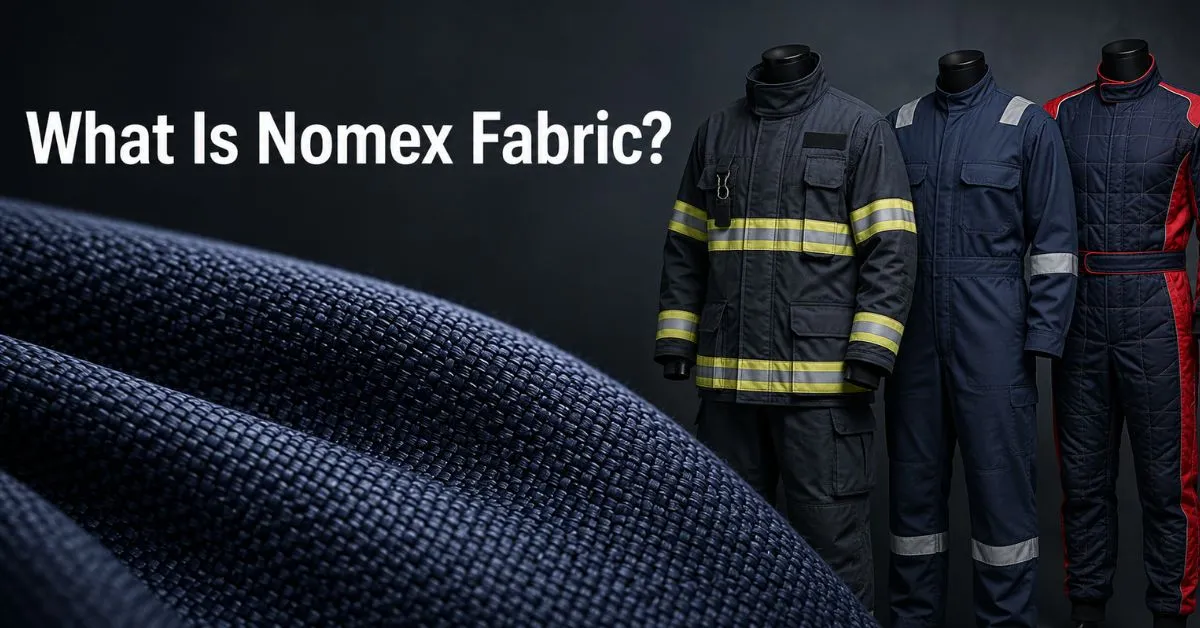

Nomex fabric is a flame-resistant textile made from heat-resistant meta-aramid polymers. This fiber provides inherent protection from heat, flame, and fire. Unlike some flame retardant materials, Nomex clothing and apparel does not lose its protective qualities when exposed to extreme temperatures, and its properties are not affected by regular washing and wearing. Nomex fabric tends to char instead of melting or dripping when exposed to an open flame. It is used to make fireman clothing, racing suits, military aviation flightwear, electrical arc flash protection apparel, and other gear. Nomex is not completely fireproof, and the selection of the right material and clothing construction is vitally important.
What Is Nomex Fabric Made From?
Nomex is a registered trademark of a flame-resistant and heat-resistant fabric made from a polymer known as a meta-aramid. Aramid is a type of synthetic fiber with an excellent resistance to heat, mechanical damage, and other environmental factors. Nomex fabric is made from a special type of aramid with even better performance characteristics.
The generic name for this type of fiber is simply aramid, and many manufacturers sell similar types of fabric. Nomex aramid is a type of fiber that can be turned into staple fibers, yarn, weaving and knitting fabrics, nonwoven sheets and webs, high-temperature papers, composites, and electrical insulating materials.
Nomex clothing is typically made from a blend of NOMEX aramid and other fibers or is made from pure NOMEX. Therefore, it is vitally important to pay attention to the fiber content when purchasing NOMEX items.
What Are the Fire Resistance Properties of Nomex Fabric?
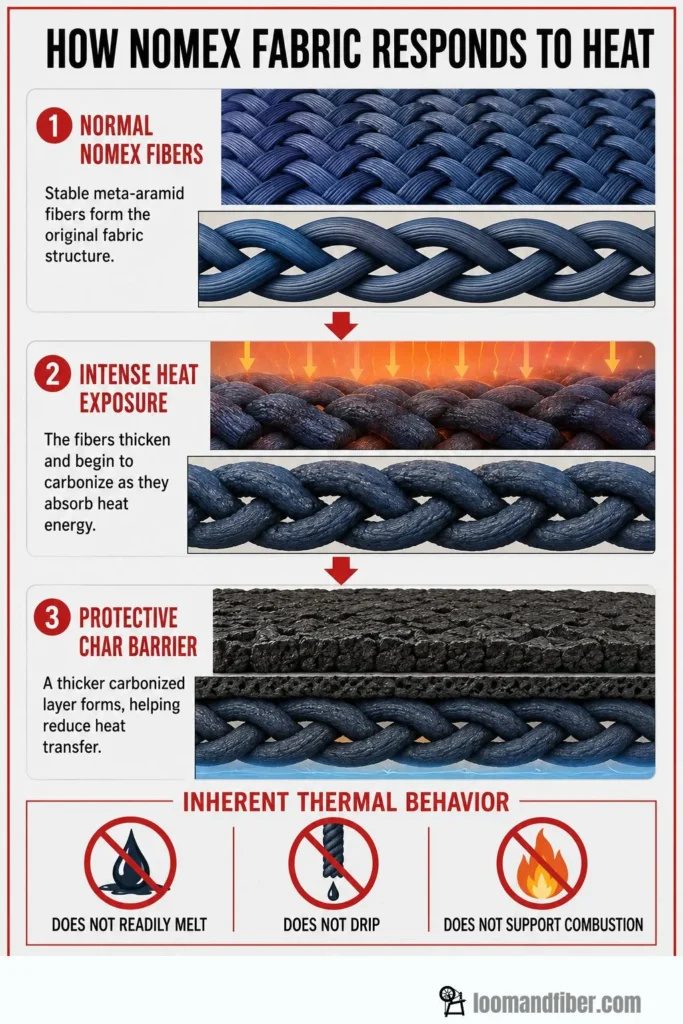
Nomex fabric is inherently flame-resistant. The fiber’s fire retardant properties are provided by its chemical composition and are not lost during washing or regular wear. When exposed to an open flame, NOMEX tends to form a charred layer that protects the wearer from high temperatures.
NOMEX does not drip, melt, or stick to the skin when exposed to an open flame, unlike many other synthetic fibers. This is one reason why NOMEX is often used to make protective clothing for firefighters and other personnel who are likely to be exposed to high temperatures. It is vitally important to understand that NOMEX is not completely fireproof, and it will burn when exposed to an open flame for a long time. However, it protects the wearer from burns by not sticking to the skin and forming a thick charred layer that insulates against the heat.
What Are the Main Properties of Nomex Fabric?
- Inherently flame-resistant fiber
- Fibers do not drip, stick, or melt when exposed to an open flame
- Retains most physical properties at high temperatures
- Fibers form a charred layer when exposed to an open flame
- Low weight
- Can be worn as clothing
- Some blends are highly resistant to many chemicals
- Electrical insulation papers are made from NOMEX
- The protective properties of NOMEX fabric can be reduced when exposed to certain acids and alkalis
- Can be laundered and worn multiple times
- Can be made into woven and knitted fabrics
- Can be used to make coveralls, workwear, and even balaclavas
- Not completely waterproof, but can protect against water splashes
- Nomex fibers and fabrics are subject to abrasion and may fail due to mechanical damage
- Cannot be relied upon when exposed to high pressure, radiation, or other extreme physical conditions
- Cannot be used against all types of fires, including gas fires or fires caused by oil
Is Nomex the Same as Flame-Retardant Fabric?
No, NOMEX is not the same as flame-retardant fabric. NOMEX is a type of inherently flame-retardant fiber, while flame retardant fabric can be any type of fabric treated with a flame retardant chemical.
| Feature | Inherent Nomex fabric | FR-treated fabric |
|---|---|---|
| Source of protection | Fiber structure | Applied chemical treatment |
| Can protection wash out? | Not under normal use | Depends on treatment and care |
| Melting behavior | Does not readily melt or drip | Depends on base fiber |
| Typical cost | Higher | Often lower |
| Fabric options | Specialized aramid constructions | Cotton, blends and other treated textiles |
| Service life | Depends on wear, contamination and damage | Depends on wear and treatment durability |
It is vitally important to understand the difference between the two terms. Flame-retardant fabric typically refers to a type of fabric that has been treated with a special chemical to make it more resistant to catching fire. This type of treatment usually lasts for a limited amount of time before it needs to be reapplied. In contrast, NOMEX is an inherently flame-retardant fiber, which means that it naturally resists catching fire and does not require any special treatment.
Therefore, NOMEX is usually more reliable than typical flame retardant fabric. However, it is not always completely superior in every situation. It ultimately depends on the specific requirements and conditions. A properly treated flame-retardant garment can be better than NOMEX clothing in some circumstances.
Read More>> Is wool Flammable?
Common Types of Nomex Fabric
Woven Nomex fabric
Woven constructions are used in making shirts, coveralls, pants, jackets, and racing suits. Variations of this type involve using plain or twill weave and other patterns to achieve the desired balance between pliability, durability, weight, breathability, and resistance to abrasion.
Knitted Nomex fabric
The yarns of this type of fabric allow for a greater degree of flexibility and stretch as compared to woven variants. Such construction is used for making balaclavas, hoods, underwear, cuffs, and other garments and accessories that require close fitting to the body surface.
Nomex felt and nonwoven fabric
Variants of this type are used for insulation, filtration, padding, and heat barrier applications. The range of options is divided according to density and thickness.
Nomex paper
This type of paper is made from Nomex fibers, and it is an engineered electrical insulation material used in the production of transformers, electric motors, batteries, and aircraft components. It is not suitable for making clothing articles, due to its specific nature, despite being made from the same fibers as fabrics.
Antistatic Nomex blends
Some blends involve adding fibers that make the resulting fabric safe in terms of being able to dissipate static electricity. Such properties are necessary for specific applications in particular environments.
Nomex and Kevlar blends
Nomex can be blended with other para-aramid materials to enhance certain characteristics, such as strength and resistance to tears. Kevlar is another para-aramid fiber, and blends with it improve the properties of Nomex.
Solution-dyed Nomex
Solution-dyed variants involve adding coloring agents during the manufacturing process, as opposed to finishing yarns or fabrics. As a result, garment constructions made from such materials resist fading due to washing or exposure, making them suitable for industrial applications.
What Is Nomex Fabric Used For?
Nomex fabric is used to make:
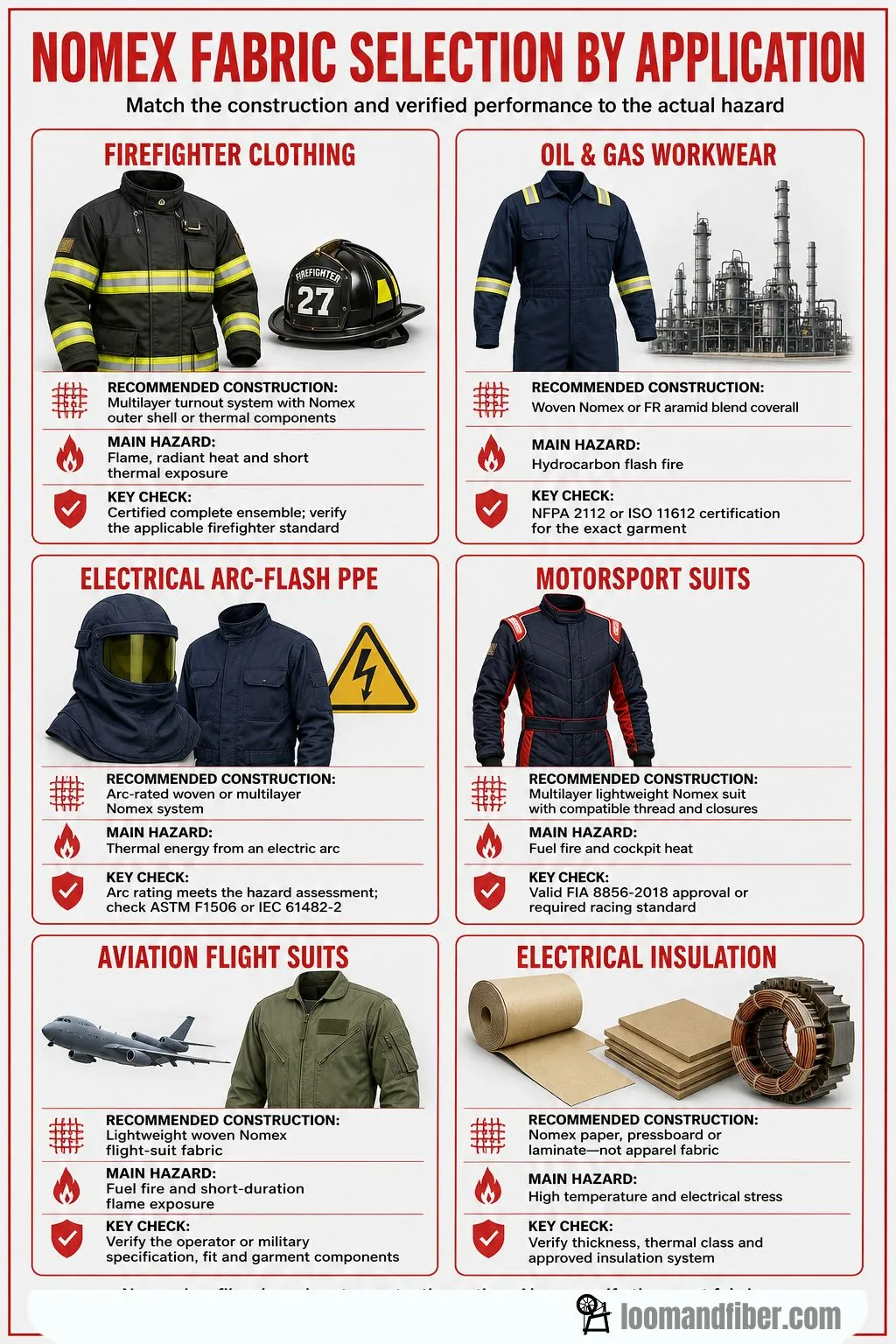
- Firefighter clothing
- Protective clothing for workers in hazardous industries
- Motorsports racing suits
- Aviation and military flightwear
- Electrical arc flash protection apparel
- Industrial heat protection clothing
- Electrical insulation paper for high-voltage equipment
- Aerospace and transportation components
Advantages and Disadvantages of Nomex Fabric
Advantages:
- Inherently flame-resistant
- Does not drip, stick, or melt when exposed to an open flame
- Can be worn as clothing
- Has good resistance to high temperatures
- Has a low weight
- Can be machine-washed and worn multiple times
- Can be used to make a variety of garments
- Can be made from blends that are resistant to chemicals and abrasion
- Some Nomex materials are certified to meet various international safety standards
Disadvantages:
- Higher cost compared to many other fabrics
- Does not allow the skin to breathe
- Nomex fabrics tend to degrade faster than cotton and other natural fibers
- Limited color options
- Cannot be used in all situations
- Cannot be relied upon when exposed to extreme physical conditions
- Cannot be worn in all weather conditions
- Cannot be used as a substitute for all types of protective clothing
- Cannot be used for all types of fires
- Contamination can greatly reduce its effectiveness
- The fabric is inherently flame-resistant but has limited resistance to abrasion, tearing, and other forms of wear
- Cannot be used against high-intensity radiation, extreme pressure, or other extreme physical conditions
- The protective properties of this fabric depend on the type of garment, its weight, and other factors
- It should be noted that the use of this clothing does not eliminate the need for safety precautions and proper training
Nomex vs Kevlar
As mentioned above, NOMEX is a type of aramid fiber that is mainly used for its excellent resistance to heat and flame. Kevlar is another type of aramid fiber that is mainly used for its high tensile strength and resistance to impact.
| Characteristic | Nomex | Kevlar |
|---|---|---|
| Aramid type | Meta-aramid | Para-aramid |
| Main strength | Heat and flame resistance | High tensile and cut strength |
| Typical form | Protective fabric and insulation paper | Reinforcement, armor and cut-resistant material |
| Common uses | Firefighter clothing, flight suits, electrical insulation | Body armor, ropes, tires and cut-resistant equipment |
| Thermal behavior | Chars without readily melting | Also heat resistant but optimized for strength |
| Apparel role | Often the main FR textile | Often blended in for reinforcement |
These two fibers have similar properties, but they are usually used for different purposes. NOMEX is usually used to make flame-resistant clothing, while Kevlar is usually used to make bulletproof vests and other forms of body armor.
Nomex vs Cotton FR Fabric
Cotton flame-resistant fabric is made from cotton that has been treated with a special chemical solution to make it more resistant to catching fire. As a rule, cotton fabric has good moisture-wicking properties and can be worn in warm weather. This type of fabric is usually cheaper than NOMEX and is sometimes preferred for its softness, but it is not as strong or durable.
NOMEX fabric has a number of advantages over cotton flame-resistant fabric. For example, NOMEX has a much lower weight, is more comfortable to wear, is more resistant to heat, and its protective properties are not affected by washing. However, it is important to remember that each fabric has its own advantages and disadvantages. When selecting the right fabric, it is important to consider many factors, including the working conditions, the required level of protection, and personal preference.
Nomex vs Polyester Fabric
Nomex is a type of aramid fiber that is mainly used for its excellent resistance to heat and flame. Polyethylene terephthalate (PET), or simply polyester, is a type of synthetic fiber that is mainly used to make clothing and other everyday items. Polyester fabric is usually much cheaper than NOMEX and can be used to make a wide variety of garments. However, it does not have the same resistance to heat and flame as NOMEX.
PET fabrics are usually quite comfortable to wear and are available in a wide range of colors and styles. They are also relatively easy to care for and can be machine-washed and dried without damaging the fabric. However, they are not typically recommended for use in high-heat environments because they can easily catch fire and melt.
It is important to note that polyester is not a suitable substitute for NOMEX in situations where the fabric is likely to come into contact with an open flame. In such cases, NOMEX should always be used instead of polyester. However, when it comes to everyday clothing, PET fabrics are usually the preferred choice over NOMEX.
Is Nomex Fabric Waterproof?
Nomex fabric is not inherently waterproof, but it is often treated to make it more water-resistant. Water-resistant fabrics can be beneficial in many situations, including hot weather, heavy rains, and snowstorms.
There are several types of water-resistant fabrics, including water-repellent, water-resistant, and waterproof fabrics. Water-repellent fabrics are typically the most water-resistant, but they can be difficult to clean and may require special care to maintain their protective properties. Water-resistant fabrics are usually more durable and can withstand repeated use without losing their protective qualities.
It is important to keep in mind that water-repellent finishes may decrease the flame resistance of Nomex fabric. Therefore, it is important to carefully select the right type of water-repellent fabric based on the intended use and the required level of protection.
Read More>> Is polyester waterproof or water-resistant?
Is Nomex Fabric Breathable?
Nomex fabric can be breathable, depending on the construction and weight of the fabric. A breathable fabric is one that allows air to pass through it. This is usually an important consideration for clothing, as it affects how comfortable the item is to wear.
In general, Nomex fabric is usually breathable, but it has a different level of breathability depending on the desired level of protection. For example, light-weight Nomex shirts are usually more breathable than heavy-weight Nomex coveralls. It is important to choose the right type of Nomex fabric based on the desired level of protection, the weather, and the comfort level.
Is Nomex Safe to Wear?
Nomex clothing and other personal protective equipment (PPE) are designed to protect the wearer from flash fires, arc flashes, and other sources of extreme heat. However, it is important to follow specific safety guidelines when selecting and using Nomex clothing to ensure that it provides the required level of protection.
Some important safety considerations when wearing Nomex clothing include:
- Using the appropriate type of Nomex clothing for the hazard
- Following all care and maintenance instructions
- Making sure that the clothing covers all exposed areas of the body
- Making sure that Nomex clothing is always worn as part of a complete PPE system
- Making sure that the clothing fits properly in order to provide the best possible protection
- Making sure that contaminated clothing is cleaned or replaced as needed
- Making sure that damaged clothing is not worn and is properly repaired or replaced
It is also important to understand that NOMEX is not completely fireproof, and it should not be worn in conditions where it could be exposed to an open flame for a prolonged period of time. In addition, NOMEX clothing should always be worn as part of a complete PPE system, and it should never be worn alone. A fabric certificate does not mean the garment itself is certified; clothing needs to meet the specific requirements for the task and the threat.
NFPA 2112 is an important standard for flame-resistant apparel that protects against occupational hazards. This standard ensures that the garment has been tested and certified to provide the necessary level of protection against flash fires. The standard outlines specific requirements for fabric, stitching, design, and testing to ensure that the garment meets the minimum safety requirements.
How to Wash and Care for Nomex Fabric
Nomex fabric is used to make protective clothing and other garments that are designed to protect the wearer from extreme heat and fire. Proper washing and care are vitally important in order to maintain the protective properties of Nomex clothing. The following are some important guidelines for washing and caring for Nomex clothing:
- Always follow the care instructions provided by the clothing manufacturer
- Always separate contaminated clothing from other laundry
- Always use a mild detergent
- Avoid using chlorine bleach or other chemicals that can destroy the protective properties of Nomex clothing
- Always close all openings and snaps before washing
- Always look at the condition of the clothing after washing and make sure it has not been damaged
- Avoid wearing clothes with holes or other defects
- Always follow the manufacturer’s recommendations for repairing damaged clothing
- Always use an approved cleaning method
- Always inspect the clothing before wearing it and make sure it is in good condition
- Always make sure that the clothing is repaired properly if it has been damaged
OSHA states that the responsibility of maintaining flame-resistant (FR) and arc-rated clothing lies with the employer. If employees are allowed to wash the clothing at home, they must be trained in the proper care and cleaning techniques. In addition, the employer must regularly inspect the clothing to make sure it is in good condition.
How Long Does Nomex Fabric Last?
The useful life of a piece of clothing made from Nomex depends on a number of factors, including the fiber content, the construction of the garment, the type of hazard it is exposed to, the frequency of use, the type of maintenance, and other factors.
Nomex inherently flame-resistant fabric is permanently protected, but the useful life of a particular piece of clothing depends only on its maintenance and use conditions. The end of service life can be determined by the following factors:
- Damaged surface, broken stitches, torn openings
- Reduced thickness due to severe abrasion
- Broken closures or reflective elements
- Contamination with combustible liquids or chemicals that affect the protective properties
- Mechanical damage due to improper storage or use
- Unauthorized repairs or the use of inappropriate repair materials
- Excessive shrinkage or changes in size or shape that adversely affect the characteristics of the garment
How to Choose the Right Nomex Fabric
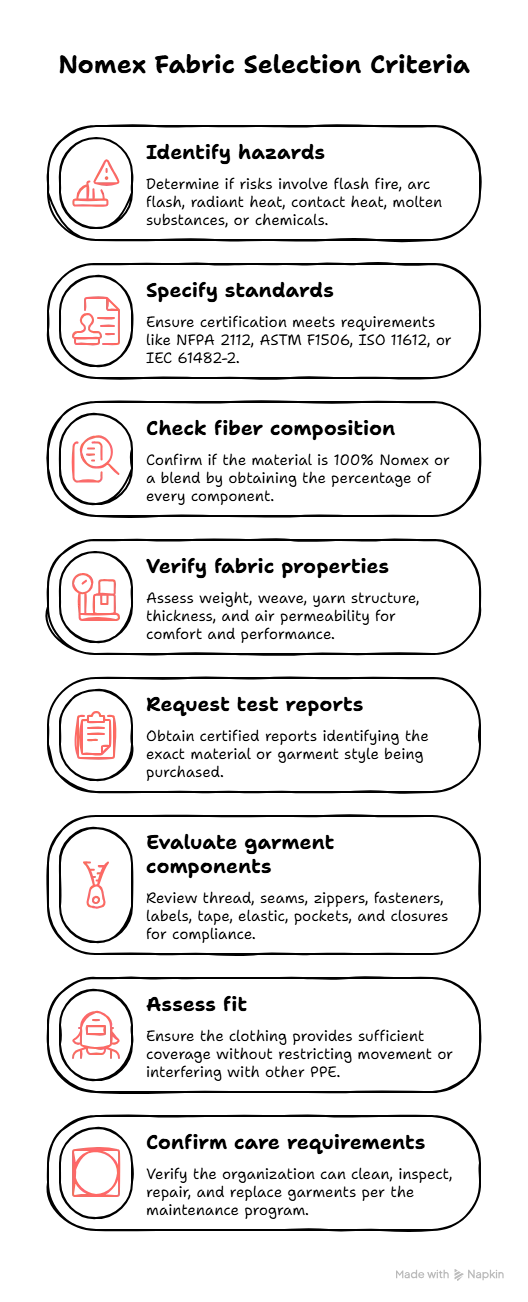
Identify the hazard
Flash fire, arc flash, radiant heat, contact heat, molten substances, chemicals, or a combination of hazards may be present.
Specify the applicable standard
Depending on the country, industry, and type of work, a garment may need to be certified to one or more of the following: NFPA 2112, ASTM F1506, ISO 11612, and IEC 61482-2.
Check the complete fiber content
Ask for the percentage of each fiber, not just a branded description. Nomex clothing can be made from a blend of fibers, not just Nomex.
Check the fabric weight and construction
The fabric weight in grams per square meter (gsm) has a direct impact on comfort, durability, and thermal performance. Ask for the fabric construction, including weave, yarn, thickness, and air permeability.
Request certified test reports
Test reports should be specific to the material or garment style purchased. A report on a similar product is not sufficient.
Evaluate the garment as a whole
Consider the threads, seams, zippers, hook-and-loop fasteners, labels, reflective tape, elastic, pockets, and closures. Incomplete protection can compromise the garment’s overall performance.
Assess fit and coverage
The garment must allow for a full range of motion while providing maximum protection. A poor fit can cause exposure or impede other personal protective equipment.
Confirm care and maintenance
The organization must be able to clean, inspect, repair, and replace the garment according to the care instructions in the certified maintenance program.
Common Buying Mistakes
- All types of aramid fabrics are considered Nomex
- Assuming that ‘FR’ and ‘Arc rated’ fabrics are always interchangeable
- Choosing a fabric based only on GSM
- Basing the choice only on the test report, ignoring the details
- Ignoring the trims, closures, and other details
- Choosing the cheapest option without considering the service life
- Assuming that inherent flame resistance fabrics are not affected by any damage
- Assuming that Nomex is completely fireproof
- Buying fabric without determining the threat level
- Testing fabric rather than the complete garment
Conclusion
Nomex fabric is a type of meta-aramid material that inherently resists flames and is used to make protective clothing, including electrical insulating equipment. The fibers have superior heat resistance and are difficult to drip or melt. In addition, the unique protective properties of Nomex fabric are not lost during washing and other care methods. However, a product made from this fiber does not automatically provide the desired level of protection because the term Nomex refers to specific fiber content and treatment. It is important to look at fiber composition, construction, certification, testing, and garment components when selecting protective clothing.
FAQs
Nomex is a type of inherently fire-resistant fabric made from a special type of aramid polymer. This material is used to make various types of flame-resistant clothing, such as protective suits and workwear. One of the main advantages of this type of clothing is that it does not lose its protective properties when exposed to an open flame, and it protects against heat, fire, and other hazards.
Nomex does not burn, and it typically chars when exposed to an open flame.
Nomex does not typically melt or drip when exposed to an open flame, but it will char.
No fabric is completely fireproof, and Nomex is no exception. This type of clothing protects against fires, but it still burns when exposed to an open flame.
Nomex tends to be more expensive than average clothing fabrics and many flame-resistant materials. The final price is determined by the fiber content, weight, certification, dyeing method, clothing construction, and order size.
It depends on the fabric weight, weave, and other factors. Light-weight Nomex is generally comfortable to wear, while heavy-weight Nomex can be uncomfortable.
Its flame resistance is inherent to the manufactured fiber. It does not rely on a topical treatment, which must be applied to the surface of the garment.
Many Nomex garments are washable, but it is important to follow the manufacturer’s care instructions. Contamination, physical damage and inappropriate cleaning products can affect the performance of Nomex.