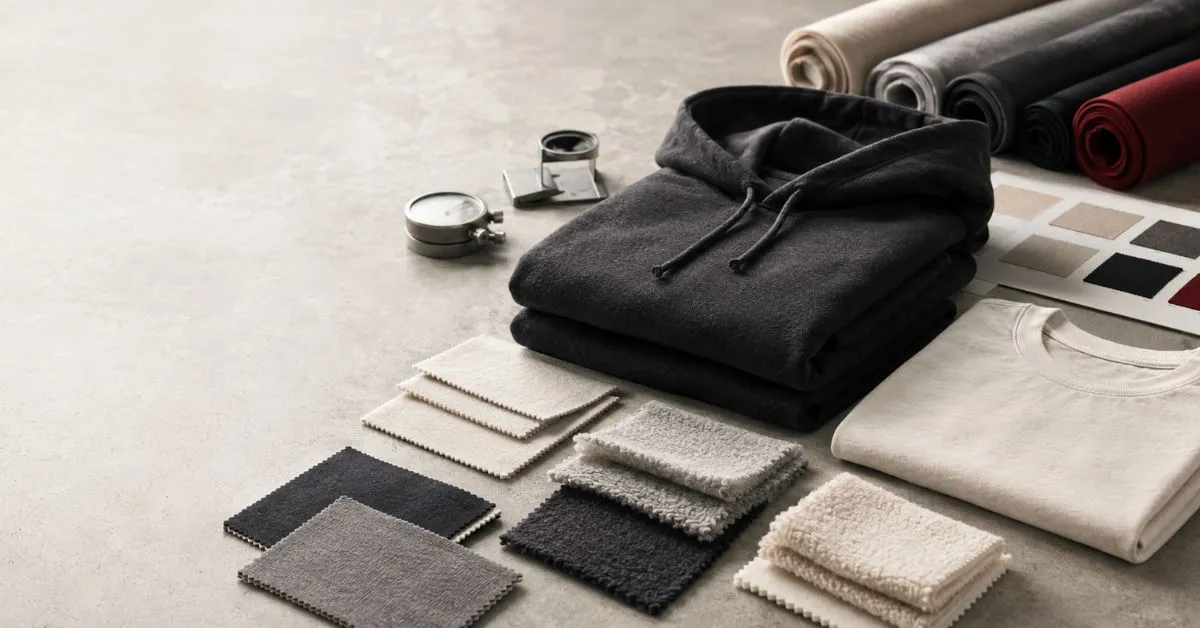

Most new private label brands spend weeks picking a logo placement and almost no time on fabric weight. Then the first bulk shipment arrives, the hoodies feel thinner than the sample, and nobody can explain why. The answer is almost always the same: fabric was treated as an afterthought instead of the first real decision in the process.
Working on the manufacturing side of private label apparel, we see this pattern constantly. A founder comes in with a design, a color palette, and a target price point, but no real fabric spec. That gap gets filled by whoever is cheapest to fill it, and cheap fabric choices have a way of showing up months later as returns and one-star reviews.
Fabric Weight Is Not a Detail, It’s the Product
Ask ten shoppers what makes a t-shirt feel “premium” and almost none of them will say GSM (grams per square meter). But that number is doing most of the work. A 160gsm tee reads as a summer basic, thin and breathable. Push past 200gsm and it starts to feel like something you’d pay $30 for instead of $12. Hoodies and fleece live in a different range entirely, usually 280 to 380gsm, and the difference between the low and high end of that range is the difference between a hoodie that holds its shape after ten washes and one that doesn’t.
None of this is visible in a flat sketch or a mockup. It only becomes real once fabric is chosen, and by then a lot of brands have already locked in a retail price that assumes a fabric quality they never actually specified.
Natural, Synthetic, or Blend Isn’t a Style Choice, It’s a Cost and Compliance Choice
Cotton feels premium and breathes well, but it shrinks more, wrinkles more, and costs more at scale. Polyester and poly blends hold shape and color better and cost less, which is why so much fast fashion leans on them, but they don’t carry the same sustainability story a lot of new brands want to tell. Blends are a compromise, and a reasonable one, but “reasonable compromise” needs to be a decision someone actually makes, not a default that happens because nobody asked.
Certification adds another layer. If a brand wants to say “organic cotton” on a swing tag, that claim needs GOTS certification backing it, not just a supplier’s word. If the target market cares about harmful substance testing, OEKO-TEX Standard 100 certification is the credential buyers actually check for, and it needs to travel with the shipment, not live in a PDF nobody can find during a customs inspection. We build this into paperwork from the start now, because the alternative is a brand finding out their “eco-friendly” line has no documentation to back the claim right when a retail buyer asks for it.
The Sample Isn’t the Problem. The Second Batch Is.
Here’s the part that catches people off guard: the sample almost always looks right. Sampling is small-batch, closely watched, and everyone is paying attention. The real test is bulk production, and specifically, the second bulk order six months later. Fabric comes in dye lots, and dye lots vary. Without a locked spec sheet (GSM, fiber content, shrinkage tolerance, colorfastness) a second production run can come out visibly different from the first, and a brand’s regular customers notice fabric inconsistency faster than almost anything else.
The fix isn’t complicated, it’s just unglamorous: get the fabric spec written down before the first order, not derived after a problem shows up. On our end, that means MOQ gets set per color, usually around 100 pieces per color once a spec is locked, so a brand can test a small range of colorways without the fabric or construction quality drifting between them.
What This Actually Costs You
Being upfront about the tradeoff: locking a real fabric spec and requesting certification documentation adds time and a bit of cost upfront compared to just picking “whatever the factory has in stock.” A brand chasing the absolute lowest landed cost on a first order will find a cheaper, faster path by skipping this step. But that’s exactly the shortcut that shows up later as inconsistent hand-feel, failed compliance checks at customs, or a fabric that pills after three washes. For a brand trying to build repeat customers rather than run one-off drops, the upfront cost is the cheaper option long term, not the expensive one.
Where This Leaves a New Brand
If you’re building a private label line right now, the practical takeaway is small: before you finalize pricing or place a bulk order, get an actual fabric spec sheet, not just a swatch you liked the feel of. Ask what GSM it is. Ask what happens to that number after a wash. Ask whether the certification you want to claim on the label has paperwork behind it or just a verbal assurance.
We work with startup brands on exactly this step, getting private label production right from the start instead of fixing it after a bad batch. It’s a smaller, less exciting decision than picking a logo. It also matters more.