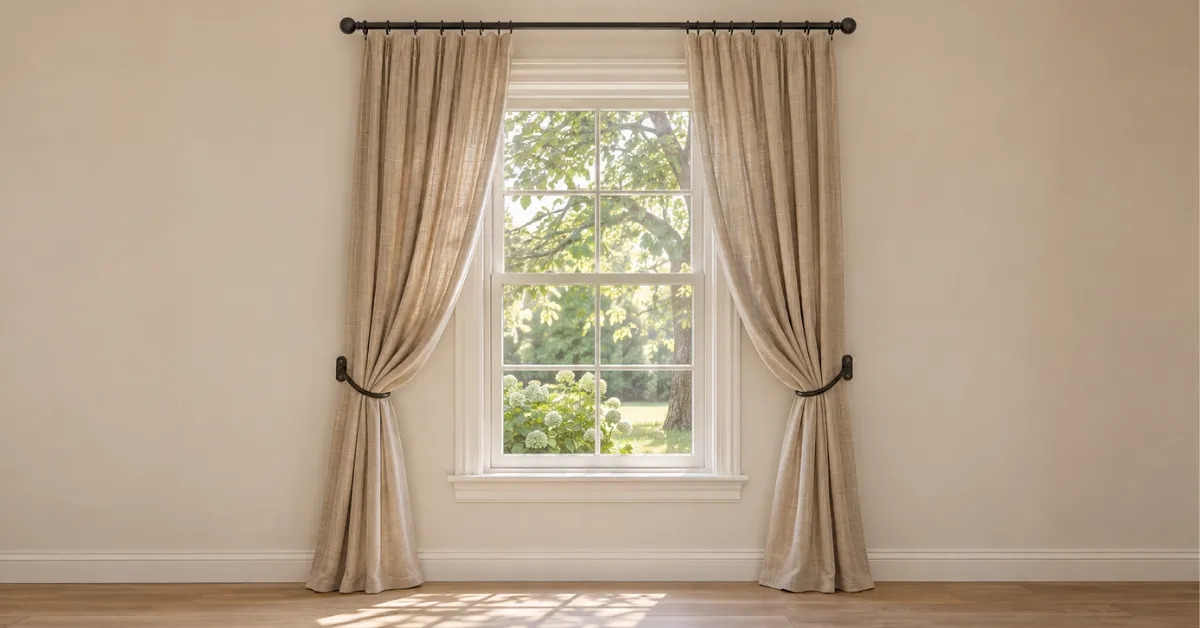

Where to Place Curtain Holdbacks?
Place your holdbacks about a third of the way up your curtain. For example if you have an 84″ floor-length curtain it should be placed 28″ from the floor. Also place them 2–4″ outside the window frame. Ensure they are symmetrical. Don’t place them in the centre.
Although they seem simple, placing your holdbacks incorrectly can make your window look shorter, make the fabric bunch and leave your curtain hanging over the glass. This article will give you the exact measurements but also shows how to adjust for your window, fabric and room.
The ‘one-third’ Rule
Most will reference placing them at one third. However some say two thirds. This is actually the same:
It’s one third up from the bottom of your curtain. This means the holdback is low on your curtain and will create a long, flowing curve.
Two thirds down from the top of your curtain.
The confusion comes when people measure down from the top but use a number meant for the bottom. Just pick one method and stick with it. In this article all holdback heights will be measured up from the bottom of the curtain, or from the floor if the hem touches it.
Work out by:
- Measuring the finished length of your curtain from the top of the curtain to the bottom of the hem.
- Divide by three.
- Measure this distance up from the bottom of the curtain and mark on your wall.

Holdbacks By Curtain Length
| Curtain length | Standard placement (one-third up) | Formal, lower look |
|---|---|---|
| 63 in (sill length) | 21 in | 16–20 in |
| 84 in (most common) | 28 in | 24–28 in |
| 96 in | 32 in | 28–32 in |
| 108 in | 36 in | 30–36 in |
| 120 in | 40 in | 34–38 in |
As a guide use these measurements. It’s a personal preference to place them slightly higher or lower. The biggest mistake to avoid is placing them in the centre.
Some articles will suggest placing them 40–48″ or 30–36″ from the floor. These measurements will depend on your curtain length and style. As they aren’t related to your curtain length they aren’t as reliable.
How to Place Curtain Holdbacks: High Or Low?
| Placement | Effect | Best for |
|---|---|---|
| Higher (closer to halfway, never exactly there) | Exposes more glass, window looks taller, more light | Casual rooms, tall windows, curtains you open daily |
| One-third (standard) | Balanced curve, works for most rooms | Living rooms, bedrooms, general use |
| Lower | Longer, more dramatic sweep, more formal | Dining rooms, formal living rooms |

You’ll be tempted to place them higher or lower depending on:
Ceiling/window height. If you have tall windows and high ceilings you can place them slightly higher.
Heavy fabric. If your curtain is heavy you’ll want to place the holdback slightly higher to provide support.
Accessibility. The lower you place them the easier they are to reach. This is important if you have children in the room, or if you sit to open the curtains.
How Far From The Window Frame?
Whilst the height of your holdbacks is important, how far out they are will create a deliberate look.
Place them 2–4″ outside the window frame. Typically 3″. Never place them flush with the trim. You need space for your curtain to gather. If you go too close the curtain will spill over.
Ensure they’re not past the end of your curtain rod. If they are your curtain will pull diagonally and create a gap.
If you have full/heavy curtains you’ll need more space.
Stack Back
How much space your curtain takes up on your wall when open. As a rough guide:
Grommets/Eyelets will take up around 15% of the width of the panel.
Pinch pleat/Rod pocket/Tab Top will take up around 20%.
| Panel width | Approximate stack-back | Holdback distance from frame |
|---|---|---|
| 50 in | 8–10 in | 3–5 in |
| 75 in | 11–15 in | 6–8 in |
| 100 in | 15–20 in | 8–10 in |
These are just a rough guide. Tuck your curtain by hand against the wall and see where it naturally falls.
Holdbacks, Tiebacks & Curtain Bosses
Often these terms are used interchangeably. But they work differently which will affect where you place them.
| Holdback | Tieback | Curtain boss | |
|---|---|---|---|
| What it is | Rigid metal or wood arm fixed to the wall | Soft loop of fabric, rope or cord that wraps the curtain | Decorative disc or “mushroom” fixed to the wall |
| How it holds | Curtain drapes over and behind the arm | Wraps around the gathered curtain, hooks to the wall | Holds back the leading edge only |
| Look | Crisp, fixed, tailored | Softer, easy to restyle | Decorative accent |
| Best for | Heavy drapes, formal or modern rooms | Lighter fabrics, traditional or relaxed rooms | Eyelet curtains and rope tiebacks |
| Height | One-third rule | One-third rule | Near the front edge of the curtain |
With a holdback you lift the curtain off the arm to close. With a tieback you unclip. They’re placed at the same height.
Specific Window/Curtains
Eyelets/Grommets
Eyelet curtains create nice deep columns and rarely need dressing. Using a tieback will cause the pleats to bunch and create creases. For a softer look tuck just the front pleat behind the holdback/boss.
Short curtains will place the holdback very low. Stick to the guide and ensure they’re proportionate. For example if you have a 63″ curtain place the holdback 21″ above the hem. The side positioning will be close to the frame as short curtains won’t take up as much space.
Puddled
Only measure how long your curtain is hanging. Don’t include the extra fabric on the floor as this will place the holdback too high.
Tall Windows/High Ceilings
Longer curtains (108″/120″) will mean your holdback is placed 36″–40″ above the hem. You can place them slightly higher to provide support. If you have a very tall window using two holdbacks around 6″ apart will create a more balanced look.
Bay/Corner Windows
There’s often not much wall space so the side positioning will depend on how much wall you have. Use the stack back guide and test with painter’s tape.
Sliding Glass Doors/French Doors
Make sure the holdback isn’t in the path of the door. Place them at a height that’s easy to reach as these curtains will be opened regularly.
Place the holdback for the heavy drape at one third. If there are sheers behind make sure your arm will clear both layers.
Windows With Furniture/Radiator Below
Place the holdbacks as normal but ensure they won’t interfere with the heat source or furniture below.
Fabric
Your fabric will affect how your curtain falls which will affect how high you place your holdbacks.
Velvet, blackout and lined drapes are heavy and bulky. Use a rigid holdback with a deep arm. Place them at the high end of your range to provide support. Small hooks can cause your drapes to bunch and put pressure on the wall.
Linen/Cotton will create a soft pleat. Use a holdback or soft tieback at the standard height.
Sheers/Voile are light so a fabric tieback or small hook will work. Place slightly higher to stop the gathered fabric creating a dark lump when back lit.
Thick, wide tiebacks/fringe will often look best slightly lower.
How To Install
Tape measure, pencil, spirit level, painter’s tape, drill, wall anchors, screwdriver and your holdbacks.
- Hang your curtains. Mark whilst the curtains are hanging in their final position.
- Measure the finished length and divide by three.
- Mark the height on one side.
- Work out how far out you should place them. Gather your curtain loosely and mark where the fabric falls naturally. Start 2–4″ outside the frame.
- Repeat on the other side ensuring they’re even. Use a spirit level or long ruler. Uneven holdbacks are the first thing people will notice.
- Test with painter’s tape. Apply a strip of tape and gather your curtain against it. Make any adjustments.
- Drill pilot holes and insert wall anchors where there isn’t a stud.
- Attach your holdbacks. Ensure your arm is sticking straight out. Any bends should face away from the window.
- Dress your curtain. Close your curtains and gather into the holdback. Ensure the pleats are even throughout. Step back and make any adjustments.
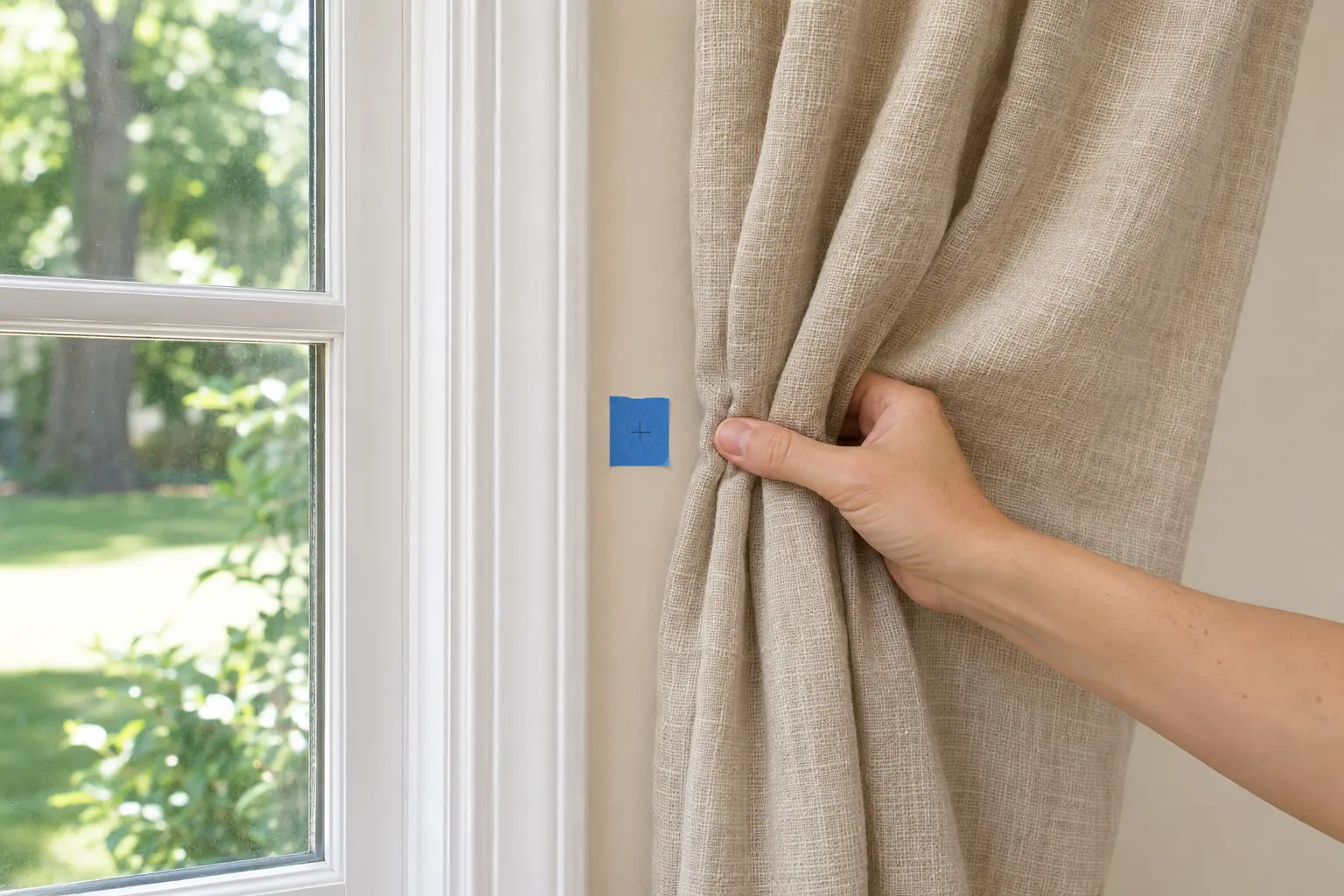
If you have multiple windows in the room keep them the same height.
Fixing
Fix into a stud for the strongest option.
Fix into drywall but use the correct anchor. Light tieback hooks will work fine with a basic anchor. However for heavy drapes use a strong anchor such as a toggle or molly bolt. The anchor should be rated higher than the weight of your panel.
If you’re renting use an adhesive hook for light tiebacks on smooth walls. Or use non-drilling holdbacks attaching to the wooden window trim. Adhesive hooks won’t work with heavy fabric.
Common Mistakes
- Placing in the centre. This will make your window look shorter and the fabric look bulky.
- Measuring your window. If your rod is high up it will add extra length which won’t be accounted for.
- Too close to the trim. There won’t be anywhere for the fabric to go and it will fall over the glass.
- Past the end of your rod. This will pull your curtain diagonally.
- Uneven. Even a slight difference will be noticeable.
- Small hardware. Heavy drapes will cause the pleats to bunch and put pressure on the anchor.
- No testing with tape. It’s easy to adjust a pencil mark. However once you’ve drilled you’ll have to fill the hole if you move the holdback.
Safety
Curtain holdbacks are fixed to your wall. However tiebacks/cords can be a hazard in children’s rooms. Keep cords short and out of reach. Use rigid holdbacks where possible.
Quick Checks
- String Test. Tie a piece of string around your curtain at various heights and step back. See how it affects the curve.
- Gut Feeling. If you can see the bottom of the holdback clearly from across the room without looking down it may be too low.
- End of rod. Ensure the holdback is inside the end of your rod.
- Finish. It’s safest to use a holdback that matches your rod. However you can use contrasting ones. For example metal rod and glass holdbacks.
Final Checklist: How to Place Curtain Holdbacks?
- Measure your finished curtain.
- Divide by three and measure this distance up from the bottom.
- Place 2–4″ outside the frame. Inside the end of your rod.
- Ensure they’re even on both sides using a spirit level.
- Test with painter’s tape.
- Use an anchor suitable for the weight of your fabric.
- Dress your curtain. Adjust by eye.
- Once you’ve got the height, distance and evenness right they’ll look like a finishing touch.
FAQs
Around one third from the bottom of your curtain. If you have an 84″ floor-length curtain place them 28″ from the floor. For a more formal look place them slightly lower. For more light and a taller looking window place them slightly higher. Don’t place them in the centre.
Place them 2–4″ outside the window frame. Typically 3″. If you have full/heavy curtains you’ll need more space. Ensure they’re inside the end of your curtain rod.
No. Placing them in the centre will halve your window and make it look shorter. Try to keep them to one third.
Yes. They both follow the one third guideline. The difference is the fixings. Holdbacks are rigid arms and tiebacks are soft loops.
Not necessarily. Light hooks can be fixed with a drywall anchor. If you have heavy velvet/blackout curtains use a stud or heavy duty anchor such as a toggle or molly bolt.