
Introduction-
In this particular post, we will review fabric options that help you keep your body temperature at a comfortable level when it is hot outside. What are the best cotton fabrics to keep you cool? This guide breaks down the different cotton options by level of comfort, with the best cotton fabrics for daytime use listed below:
Most Breathable: Cotton Voile, for its lightweight, airy feel, and exceptional breathability.
Crossed Air Flow: Cotton Gauze Muslin, because its open-weave and very lightweight construction allow for maximum air flow and circulation, making cotton gauze a good fabric for summer.
Gauze Cotton: Cotton Jersey is a soft knit that absorbs and holds moisture and then dries quickly.
Budget pick: Cotton Poplin, a type of fabric that is made of plain weave cotton and is commonly found in shirts and uniforms.
What Makes Cotton Good for Summer?
Why does cotton breath?
The fibers of cotton are naturally porous, which allows for air flow to occur. This air flow carries heat away from the body. Cotton has the ability to “breath” and is soft against the body. It is for this reason that cotton is a fabric of choice for summer wardrobe.
Absorbent vs. Wicking
The absorption capacity of cotton is exceptional. It can absorb up to 27 times its weight. When you sweat and touch cotton, the moisture is drawn away from your body. Because cotton absorbs moisture, it will hold that moisture. Unlike the high-tech fabrics that claim to be “wicking” or pull moisture away from your body, cotton does slow evaporation which in turn keeps you feeling moist.
Air Flow vs. Heat
When a high enough level of heat is reached, summertime cotton fabrics allow it to escape. In other words, these summer lightweight fabrics allow heat to escape. On the other hand, a tightly woven fabric, like denim or flannel, would keep the heat inside.
Read More>> What is Cotton Sateen Fabric?
Key Factors That Decide the Best Fabric for Summer
Loose vs Tight Weave
Unlike closely woven fabrics, loose plain weaves, as in gauze or voile, have many gaps through which air can flow. In the case of cotton voile and cotton muslin, fine yarns are used in a very open weave. In contrast, dense packing and weaving of fibers in twill and sateen weave fabrics weave limit airflow and ventilation. To maximize ventilation in summer, choose cottons with a visible structure or with a woven pucker such as, but not limited to, seersucker and lawn.
GSM
GSM or gram per square meter is the unit of measurement of fabric weight. Thus, a lower GSM fabric is a lighter fabric. Summer calls for lighter cotton levels of 80 to 130 GSM. Heavy cotton levels are 200 or more GSM which trap heat while lightweight cotton levels, which are often seen with cotton voile, are 80 to 120. Light and breezy feel is with cottons under 120 GSM. Warm is anything over 200 GSM.
Thread count
The common belief or myth is that the more thread count, the more breathable and comfortable the fabric is, which is not true. In fact, very tightly woven fabrics with 600 or more threads in a certain length lose their breathability to the point of becoming a barrier. This is the reason why experts recommend a moderate count around 300 to 500 thread count, weave the flow of air with the fibers of the fabric. Thus, percale sheets are often summer sheets of choice as they have a moderate thread count while providing a crisp, breathable fabric.
Air Permeability
This is the measure of the amount of air that can pass through a certain area of fabric. Open-weave cotton, such as gauze or seersucker, has high air permeability and is, therefore, very cooling as the more air that can flow through the fabric, the more heat the fabric can remove.
Read More>> What is Cotton Eyelet Fabric?
Moisture handling
Cotton absorbs sweat so that it can manage moisture by drying for evaporation. The behavior of moisture control varies by weaving styles. While thick jerseys hold more moisture and dry more slowly, jerseys dry faster and absorb moisture more. Overall, cotton’s moisture handling comes from absorption and evaporation. It does not do the wicking and cooling that synthetics do, but by absorbing sweat into the fibers and allowing for evaporation, cooling is aided.
Types of Cotton Fabrics for Summer
Cotton Lawn
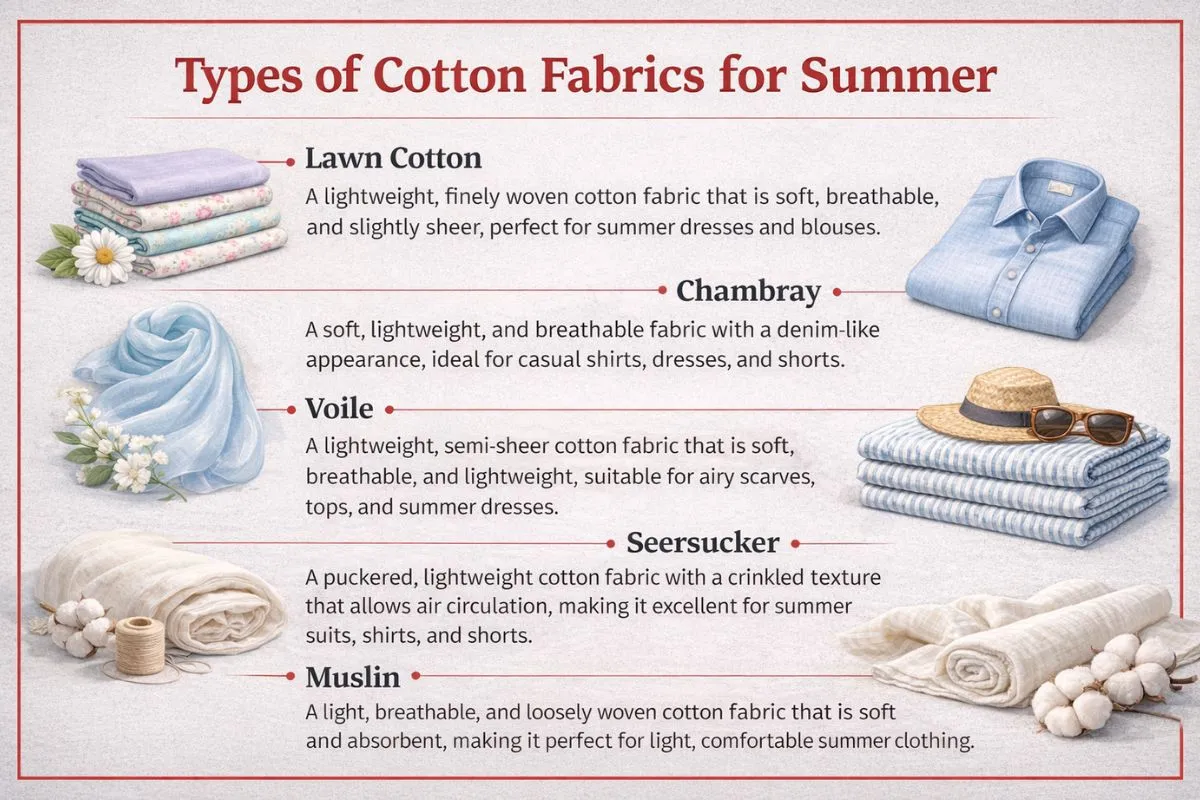
Resembling lightweight, crisp sheets, cotton lawn most often scores a 4/5 in breathability and a 3/5 in softness. They are perfect for lightweight summer dresses, shirts, and even light sheets. Pros: Lightweight, and polished drape, Cons: Somewhat stiff, and easy to wrinkle. They are best for hot and dry weather.
Cotton Voile
With an exceptionally fine, crisp face and an open weave, cotton voile is incredibly lightweight. They are perfect for lightweight summer dresses, and scarves. Pros Extremely lightweight, and polished drape, Cons: Somewhat stiff, and easy to wrinkle. They are best for hot and dry weather.
Cotton Cambric
Cotton Cambric is a fine cotton plain weave, and somewhat smoother than lawn cotton. They are perfect for summer casual shirts or pajamas. Pros: Lightweight, and polished drape, Cons: Somewhat stiff, and easy to wrinkle. They are best for hot and dry weather.
Cotton Chambray
Chambray is a plain weave cotton that resembles light denim. It breathes very well, and is a good choice for fear of overheating in dry weather. It is used in casual shirts, dresses, or shorts. Pros: Airy denim look, Cons: Wrinkles easily. They are great for moderately hot climates.
Seersucker
Seersucker is a textured woven cotton. It is great for summer suits, dresses, and tops. Pros: Very breathable because air is trapped between the puckers, and is wrinkle-resistant. Cons: Rough to the touch. It is best for hot and humid weather.
Muslin
Muslin is a lightly woven cotton fabric that is open in weave. It is very soft, breathable, and great for summer baby attire, and light summer tops. Pros: Ultra breathable, incredibly absorbent, very quick to dry. It is very sheer and easy to damage. It is perfect for hot and humid weather.
Poplin
It is made of fine yarns made of cotton and is slightly more breathable and more durable. Poplin is also used in dresses and uniforms. Poplin has less flow compared to gauze and also compared to other fabrics. It also is very durable and performs well in mild heat summer heat.
Read More>> What is Cotton Plaid Fabric?
Knitted Cotton jersey
Knitted cotton jersey has a breathability of around 3 out of 5. Whereas for softness it has a maximum rating of 5. Moisture absorbing is also done well by cotton jersey. Evreyday wear is also ideal for warm climates.
| Fabric | Breathability | Softness | Best Use | Climate Suitability |
|---|---|---|---|---|
| Cotton Lawn | ⭐⭐⭐⭐⭐ | High | Dresses, shirts | Extreme heat |
| Voile | ⭐⭐⭐⭐⭐ | High | Blouses | Humid climates |
| Muslin | ⭐⭐⭐⭐⭐ | High | Towels, babywear | Sweaty weather |
| Seersucker | ⭐⭐⭐⭐⭐ | Medium | Shirts | Humid climates |
| Cambric | ⭐⭐⭐⭐ | Medium | Shirts | Warm climates |
| Chambray | ⭐⭐⭐⭐ | Medium | Casual wear | Mild heat |
| Poplin | ⭐⭐⭐ | Medium | Shirts | Moderate heat |
| Jersey | ⭐⭐⭐ | High | T-shirts | Casual use |
Best Cotton Fabric by Use Case
Best Cotton Fabric to Wear in Hot Weather
The lighter you go during the blazing heat the better. Opt for the lightest cottons. Cotton fabrics like gauze, voile, and muslin are excellent. Offering the maximum airflow and the fastest drying to sweat. Also, in extreme heat, they let you stay cool while under the sun.
Read More>> Cotton Lawn vs Voile.
Best Cotton Fabric for Sweating
If you like to perspire, you should choose the cottons that breathe the most and absorb the best. A fine cotton jersey or slub jersey would work best, as it has good absorbance, and airflow. Gauze and jersey knits move sweat as well as dry quickly. Stick to the light knits and avoid the heavy knits.
Best Cotton Fabric for Shirts
More structure is needed for shirts. They need airflow too. Classic summer shirts like poplin, oxfords, and chambray are excellent. They are crisp and have ample airflow. For a more elegant shirt, fine chambray and 100% cotton poplin are great selections that will keep you neat and under control while cool.
Best Cotton Fabric for Summer Dresses
Wear flowy and breathable cottons for your dresses. Lightweight gingham, cotton lawn, voile, muslin and the likes will keep you and your skin cool. These materials drape freely so they won’t cling or trap heat. Casual layered summer dresses and skirts are perfect for them.
Best Cotton Fabric for Bedding
Bedding and sheet as well as hot sleepers best sheets are percale. Particularly Egyptian or Pima cotton is more breathable and cooler than percale. They allow air to circulate freely as the finish that feels crisp to the skin.
Read More>> Cotton Jacquard Fabric.
Best Cotton Fabric for Different Climates
Hot and humid areas
Consider wearing cottons designed specifically for hot and humid climates which allow moisture to pass through them and dry quickly. Muslin and gauze cottons remain dry to touch and actually help keep you cooler during extremely humid conditions. These cottons do not stick to your body in extremely humid and sticky conditions.
Read More>> Is cotton breathable in humidity?
Dry heat climates
When it comes to dry heat, sufficient airflow plus lightweight moisture-wicking fabrics are extremely important. Fabrics such as cotton chambray, lightweight cotton lawn, or lightly woven poplin works well. They’re lightweight, yet provide UV protection. For example, chambray is frequently mentioned to keep you cool in dry heat. These cottons won’t cling to your body underneath intense sunlight.
Coastal summers with sea breezes
Coastal summers (warm with sea breezes) call for fabrics that dry quickly such as seersucker and chambray. They allow airflow to and without collecting moisture, so salt spray or even humidity is not a concern at all. Simply put, lightweight woven cottons perform exceptionally at the shore.
Cotton vs Other Summer Fabrics
Cotton vs Linen
Linens breathe better and dries faster than cotton. Its extra breathability in extreme heat can make it cooler while cotton will feel warmer. Linens are also more difficult to do laundry with. Linen is more easy to do laundry with but doesn’t feel as nice initially but after few washes it feels good.
Cotton vs Rayon
Rayon is cellulose based and also very breathable. Furthermore, it drapes smoothly and feels cool to the skin. Some people say that in humid environments, rayon is even more breathable than cotton. However, rayon is more likely to wrinkle, and stick to skin if it is wet. Cotton is more absorbent than rayon, and that is why it is preferred in most cases.
Cotton vs Modal
Modal is a type of rayon that is more soft and dries faster. Because it dries faster and wicks moisture better, it can make people feel cooler when it is really hot and is better to wear during those days. Even though most people prefer wearing modal, 100% cotton is better at wicking moisture, making it good to wear in the summer.
What not to buy:
Cotton that is too heavy: They trap heat (think denim/canvas).
Too much twill or Flannel: They can be too tightly woven resulting in too little airflow which can feel hot and heavy in summer
Blended fabrics of poor quality: Poor quality blends can trap heat and reduce breathability (they are too synthetic).
How to Choose the Right Cotton Fabric
- If you’re going to be sweating a lot: Choose ultra-light and moisture-wicking fabrics like muslin, gauze, or cotton jersey as they will absorb and evaporate sweat quickly.
- If you want the softest: Choose cotton jersey or premium long-staple cottons (Pima/Egyptian) as they are the softest.
- If you want the most durable: Go for tightly woven and heavier cottons like poplin or oxford as they breathe better than most synthetics while also standing up to a lot of wear.
Read More>> Types of Lightweight Cotton Fabric.
Care Tips for Summer Cotton

Washing: Use gentle machine wash in cold or lukewarm water. Choose a mild detergent and skip fabric softener (they reduce absorbency).
Drying: Air-dry whenever possible. If using a dryer, tumble on low heat and remove while slightly damp. High heat can shrink cotton and harm its airy structure.
Maintenance: Store cotton garments in cool dry places. Do not use airtight plastic bags to store cotton, it needs to breath. Maintaining proper care helps cotton keep its natural cooling properties over time.
Conclusion-
Your needs determine what cotton fabric to choose for summer, but cotton lawn would be the top pick as it is the most breathable, softest, and most comfortable.
Voile and muslin are also great for hot weather because they perform well in the most extreme temperatures. Poplin and chambray are more durable for everyday use. Consider the climate, weight, and weave of the fabric to help you choose what to buy.
The best cotton fabric will keep you cool, fresh, and comfy for the all summer long.
Read More>> What is Hygro Cotton?
FAQs
Yes, the ideal fabric for hot weather is cotton because it is breathable and absorbs moisture, and it allows your skin to breathe more than most synthetic fibers. Voile and muslin are the most breathable cottons and therefore the coolest, as they have the most open and free weave
The coolest are the lightest, most open-weave cottons (cotton voile or muslin/gauze). They allow maximum airflow and feel the most breathable.
Linen also beats cotton in extreme heat as it wicks moisture away faster and breathes better. Cotton is softer, but retains moisture longer. Either fabric is good, but linen is cooler under direct sun more often than cotton is.
Summer clothing is best made of low GSM (80- 120) cotton. Fabrics that are lighter, allow more air to pass through them and therefore, they also provide more breathability. For optimal coolness, target around 100 GSM for shirts and dresses and for 100 GSM you would need to use cool fabric.