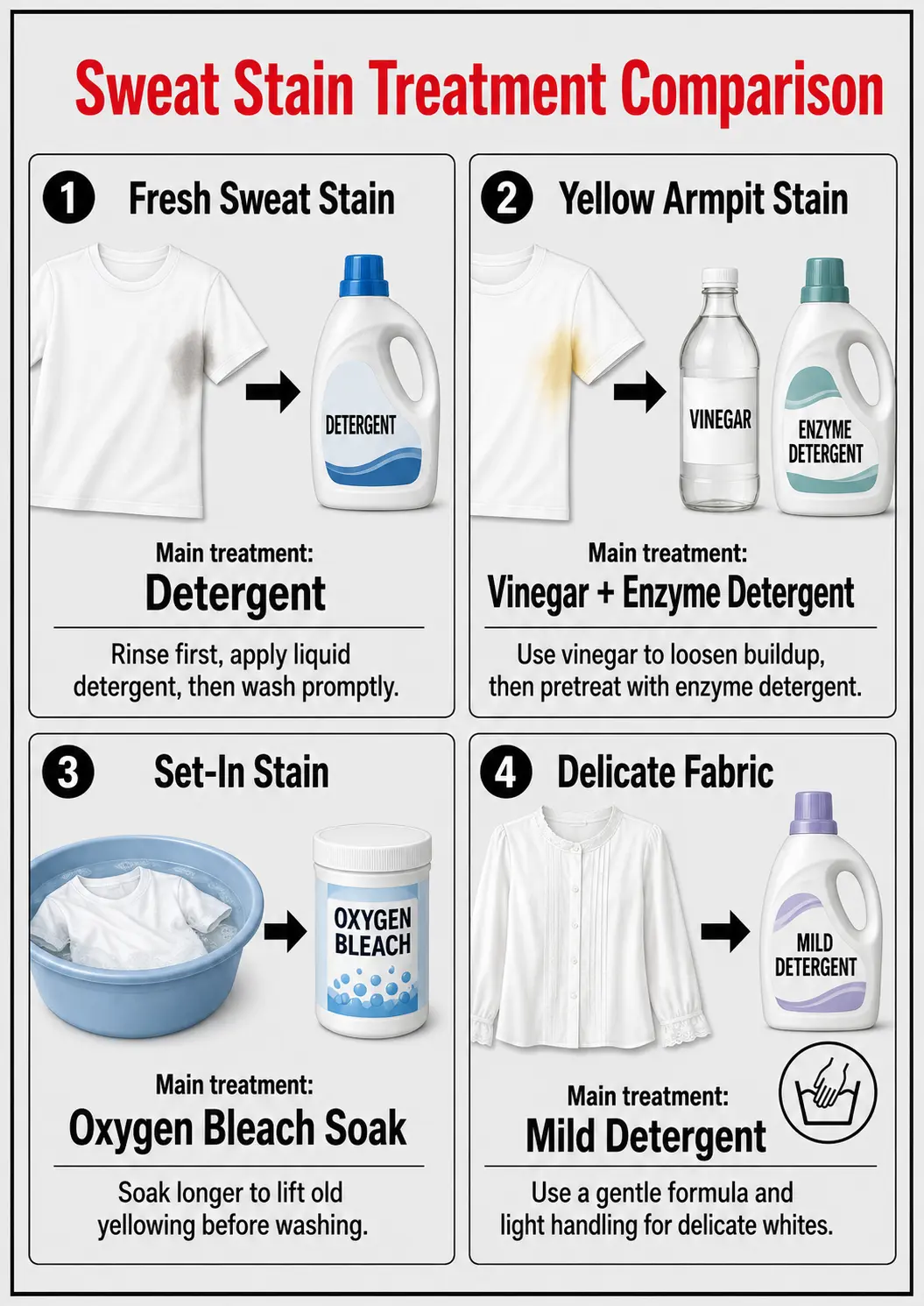
You should pretreat a stained area before washing. For fresh stain removal, fabrics should first be rinsed with cool water. Rinsing should be followed up by rubbing in liquid detergent, enzyme detergent, or a prewash stain remover. For more set-in yellowing, first apply white vinegar. The fabric should be rinsed and then, enzyme detergent or bleach should be used to wash. If using oxygen bleach, dissolve it in warm-to-hot water as directed by the product label. If using chlorine bleach, use it only when the care label and product label allow.
Take special care with drying the garment. Stains can be set by the heat of the dryer. Recommended prewash treatments for perspiration stains include liquid laundry detergent, enzyme-based stain removers, and oxygen bleach when the care label allows. Stubborn stains respond best to the recommended treatments which are prewash stain removers, enzyme-based stain removers, or oxygen bleaches.
How Do You Remove Sweat Stains from White Clothes?
Use detergent for fresh stains, vinegar for old yellow stains, and oxygen bleach for stubborn white clothes.
The care label should be the best starting point. Liquid laundry detergent or enzyme stain removers should be applied after rinsing the stain in cool or lukewarm water for the removal process. The stain should be allowed to set for 5-15 minutes before being washed. Be sure to wash in the hottest water the fabric can withstand.
Why Do Sweat Stains Turn Yellow on White Clothes?
Accumulation of sweat, oils, and deodorant within the fabric.
Although sweat does not actually stain fabric, the combination of sweat with the oils, bacteria, or even deodorant residues does. Over time, this combination can cause white clothing to develop yellow stains.
The combination of sweat, oils, and deodorant results in yellowing of the fabric. They also state that an enzyme-based detergent can help break down sweat, body oils, and deodorant residue. So, yellow stains often require more than a normal wash cycle.
Cause
Explanation
Sweat
Sweat contains water, salts, and body residue.
Body oils
Oils collect in underarms, collars, and cuffs.
Deodorant residue
Deodorant can stick to fabric fibers.
Antiperspirant buildup
Aluminum-based ingredients can contribute to yellowing.
Heat drying
Dryer heat can make stains harder to remove.
Delayed washing
Old residue oxidizes and darkens over time.
Quick Method: How to Remove Sweat Stains from White Clothes
The steps are: rinse, treat, wash, dry, and repeat.
Follow this simple method for most washable white clothes.
Step
What to Do
Why It Works
1
Check the care label.
It prevents fabric damage.
2
Rinse with cool water.
It removes fresh sweat residue.
3
Apply detergent or stain remover.
It breaks down body soil.
4
Let it sit for 5–15 minutes.
Contact time improves stain removal.
5
Wash in the hottest safe water.
Warm water helps loosen oily buildup.
6
Air dry first.
It prevents heat-setting.
7
Repeat if needed.
Set-in stains often need more treatment.
This process is generally safe for many washable white cotton and cotton-blend garments, but the care label and fabric type should always control the method.
Fresh Sweat Stains vs Old Yellow Sweat Stains
Fast treatment is best for new stains, while old yellow stains require the use of vinegar, enzymes, or bleach. Old yellow stains require more treatment time than new stains. New stains also lack the buildup that old stains contain.
Best treatments for different sweat stains
Stain Type
Best Treatment
Why
Fresh sweat stain
Rinse, pretreat, wash quickly
Fresh residue has not bonded deeply.
White salt marks
Vinegar rinse or detergent pretreat
It loosens mineral residue.
Old yellow armpit stain
Vinegar plus enzyme detergent
It targets old body soil.
Set-in stain
Longer soak plus repeat treatment
Older stains need more contact time.
Heat-set stain
Pretreat again before drying
Dryer heat can lock residue.
You can respond to fresh perspiration discoloration with ammonia. They also indicate that old perspiration discoloration might respond to white vinegar. Both require rinsing afterwards.
How to Remove Fresh Sweat Stains from White Clothes
To get fresh sweat stains out, quickly use cool water and liquid detergent.
Since the residue has not yet hardened, fresh stains are the easiest to remove. Start by turning the clothing item inside out. Then, from the back side, rinse out the underarm area.
Then, rub the stain with liquid detergent. You can use either your fingers or a soft brush. Once you have done that, let it sit for 5-15 minutes and then wash the item as you usually do.
After washing the item, let it air dry. You should then examine the stain in natural light. Repeat the process if there are any remaining marks.
How to Remove Old Yellow Sweat Stains from White Clothes
Old yellow sweat stains require vinegar, enzyme detergent, and possibly oxygen bleach.
Old yellow stains require a more advanced method. Start by soaking the stain with white vinegar. Let that sit for 15-30 minutes. After that, rinse it out.
Then, apply the enzyme detergent directly to the stain and work it into the fabric. After that, wash the item in the hottest water the fabric can handle.
For particularly stubborn yellowing, soaking the item in oxygen bleach may be your best option. The product label should be followed. The ACI suggests that oxygen bleach should be dissolved in water that is warm to hot.
How to Remove Set-In Sweat Stains from White Clothes
Set-in sweat stains require soaking, repeated pretreatment, and air drying in between each step.
Set-in stains will typically survive just one normal wash, and will therefore require a more lengthy process. As a start, you should apply white vinegar to the stain and rinse the fabric completely.
After this, the item should be soaked in warm water and enzyme laundry detergent and left to soak for 30 minutes, or longer. It should then be washed with oxygen bleach, or soaked in an oxygen-bleach solution, if the care label permits.
Scrubbing should be avoided, as this can more easily damage fabrics. Instead, you should aim to increase the contact time.
Best Ingredients for Removing Sweat Stains from White Clothes
Enzyme laundry detergent, white vinegar, and oxygen bleach are all great options. Not all stain removers are effective for every stain. The age of the stain, the type of fabric, and safety should all dictate which ingredient is chosen.
Ingredient
Best For
Notes
Liquid laundry detergent
Fresh sweat stains
Good first treatment.
Enzyme detergent
Sweat, body oil, odor
Best everyday choice.
White vinegar
Old sweat marks
Rinse before washing.
Baking soda
Mild odor and light stains
Gentle but limited.
Hydrogen peroxide
White cotton stains
Test first on a hidden area.
Oxygen bleach
Yellowing and dull whites
Safer than chlorine for many whites.
Chlorine bleach
Bleach-safe white cotton
Check the care label first.
Bar soap
Basic sweat pretreatment
ACI recommends it for perspiration.
White clothing is not inherently safe for chlorine bleach. The fiber content, finishes, trims, and the inclusion of wool, silk,mohair, or spandex can all impact the bleach safety.
Best Methods Ranked for White Sweat Stains
Enzyme laundry detergent is the best for everyday methods. Oxygen bleach should be used for extra whitening support when the care label allows.
Rank
Method
Best For
Safety Level
1
Enzyme detergent pretreatment
Sweat, body oil, odor
Safe for most washable whites
2
White vinegar pretreatment
Old yellow sweat stains
Safe for many washable fabrics
3
Oxygen bleach soak
Yellowing and dull whites
Good for washable whites
4
Baking soda paste
Mild stains and odor
Gentle but weaker
5
Hydrogen peroxide paste
White cotton stains
Test first
6
Chlorine bleach
Bleach-safe white cotton
Use carefully
Choose the stain-removal method according to the severity of the stain, as enzyme laundry detergent and oxygen bleach will tend to perform much better than any random DIY methods which may be used.
How to Remove Sweat Stains from Various White Fabrics
Consider the fabric when treating the stain. Cotton can withstand more treatment than silk, wool, and spandex.
When it comes to treatment of sweat stains, the fabric care label is more important than the color. Different white fabrics will respond to different treatment methods of heat, bleach, enzymes, and scrubbing.
Fabric
Recommended Approach
Avoid
White cotton
Enzyme detergent, oxygen bleach, careful chlorine bleach if allowed
Over-bleaching
White linen
Gentle detergent and oxygen bleach if allowed
Harsh scrubbing
White polyester
Enzyme detergent and oxygen bleach
High heat drying
White spandex blends
Mild pretreatment and cool wash
Chlorine bleach
White silk
Professional cleaning or delicate hand treatment
Bleach, peroxide, enzymes
White wool
Wool-safe detergent or professional cleaning
Enzymes, bleach, hot water
As noted by the ACI, chlorine bleach is not suitable for silk, wool, mohair, spandex, certain trims, or special finishes. Oxygen bleach is usually gentler on many washable whites, but the care label should still be checked.
How to Remove Yellow Armpit Stains from White Shirts
First, apply vinegar. Then treat with enzyme detergent, followed by oxygen bleach if needed.
The buildup of sweat and deodorant is primarily responsible for the yellow armpit stains. Because of this, standard washing may not fully remove built-up yellow underarm stains. Start by thoroughly soaking the entire underarm area of the fabric with white vinegar and allow it to sit for 15–30 minutes.
After the time is up, rinse the entire underarm area to remove the vinegar. Rub the detergent into the stain, and wash the shirt in the hottest water safe for the fabric, without overloading the washer. For more stubborn yellow stains, follow the label directions on the shirt and soak in oxygen bleach. Air drying the shirt is essential to ensure that the stains are not set by heat. Be sure to check the shirt for stains before placing it in the dryer.
How to Remove Sweat Stains from White T-Shirts
The combination of oxygen bleach and enzyme detergent works best on most white T-shirts.
In most cases, T-shirts are made from cotton or a cotton-polyester blend. Pretreat the underarms with liquid enzyme detergent. After applying, let the detergent sit for 10–15 minutes.
Wash the shirt in warm water if the label permits. For yellowing, use oxygen bleach in the wash or in a soak. Avoid using a highly heated dryer until the stains lift.
Cotton can usually tolerate stronger washing than spandex-rich blends; however, the care label should always dictate the procedure.
Removing Sweat Stains from White Dress Shirts
Approach washing the collar, cuffs, and underarms carefully.
White dress shirts commonly develop sweat and body-oil stains around the collar, cuffs, and underarms. Treat those areas first by applying detergent and working it in gently with your fingers.
For yellowing underarms, vinegar should be used and then the area should be rinsed before washing according to the care label. Avoid vigorous brushing or scrubbing on fine cotton, linen, or blends.
Air dry the shirt on a hanger. After drying, check the collar and underarms for stains before ironing. Irons also set residue and potentially make it more difficult to remove.
How to Remove Sweat Odor from White Clothes
Use enzyme detergent, soak if needed, and dry the garment completely.
Body-oil residue can remain in the fabric and contribute to sweat odor. Fragrance can’t solve this and may mask the odor, but will not remove residue.
First, treat underarms with enzyme detergent. If odor is still present, soak the garment for 30 minutes. Wash in the warmest water permitted for the fabric.
Air dry the garment entirely, as damp garments can still hold odors. Also, avoid overloading the washer so detergent and water can circulate properly.
Vinegar vs Baking Soda vs Oxygen Bleach for Sweat Stains
As a pre-treatment, vinegar works well. Baking soda may help reduce mild odor. Oxygen bleach provides stronger whitening support.
Treatment
Best Use
Strength
Vinegar
Old sweat marks and stiffness
Good pretreatment
Baking soda
Mild stains and odor
Gentle but limited
Oxygen bleach
Yellowing and dull white clothes
Stronger whitening support
Enzyme detergent
Sweat, oil, and odor
Best everyday option
Chlorine bleach
Bleach-safe white cotton only
Strong but risky
Can You Use Bleach on Sweat Stains in White Clothes?
Use bleach only when the care label and product label allow it. Chlorine bleach may assist in whitening some white cotton garments. However, it may also ruin wool, silk, spandex, trims, and any special finishes. Thus, white does not equal bleach safe.
According to the ACI, chlorine bleach is effective on many whites and colorfast washables, but it also cautions that fabric content and care labels are important
What Not to Mix When Removing Sweat Stains
Never mix bleach with vinegar, ammonia, and other random cleaners.
Some products may help remove stains when used separately, but mixing cleaners can create dangerous gases. For this reason, only one treatment should be used at a time. When switching products be sure to rinse the fabric first.
Do Not Mix
Why
Bleach + vinegar
It can release chlorine gas.
Bleach + ammonia
It can produce toxic chloramine gases.
Bleach + hydrogen peroxide products
It creates unsafe reaction risk.
Bleach + random cleaners
Labels may contain incompatible chemicals.
The CDC says mixing some cleaners can cause bleach to give off chlorine gas. It says not to mix cleaners.
The Washington State Department of Health says not to mix bleach and ammonia, acids, and other cleaners. Vinegar, which is an acid, should not be mixed with bleach.
Common Mistakes That Make Sweat Stains Worse
Dryer heat, the wrong bleach, delayed washing, and aggressive scrubbing can all make sweat stains worse.
Avoid all of these common mistakes:
Mistake
Why It Hurts
Drying too early
Heat can lock stains deeper.
Using chlorine bleach on unsafe fabric
It can weaken or yellow fabric.
Scrubbing delicate fabric
It can damage fibers.
Treating all whites the same
Cotton, silk, wool, and spandex differ.
Ignoring deodorant buildup
Residue grows after each wear.
Using too much detergent
Extra detergent can leave residue.
Washing too cold every time
Oil buildup may remain.
Waiting too long
Old stains oxidize and darken.
Mixing vinegar and bleach
It can create dangerous fumes.
Overloading the washer
Detergent cannot reach stains well.
How to Avoid Sweat Stains on White Clothing
Avoid sweat stains by washing clothes quickly, using deodorant with less build up, and pretreating your underarms regularly.
It is easier to prevent sweat stains than to remove old yellowing after it has built up. White shirts should be treated before the stains are allowed to build up.
Prevention Tip
Why It Helps
Wash white clothes soon after sweating
It prevents residue from setting.
Let deodorant dry before dressing
It reduces transfer to fabric.
Use less antiperspirant
It lowers underarm buildup.
Wear undershirts
They protect white shirts.
Pretreat underarms before washing
It stops gradual yellowing.
Avoid overloading the washer
Detergent reaches stains better.
Air dry when unsure
It prevents heat-setting.
Rotate white shirts
It reduces repeated buildup.
You should also wash your workout clothes right away. They become harder to clean and more likely to smell when sweat residue sits too long, especially in damp clothing.
Best Method to Keep White Shirts Free from Regular Sweat Stains
Always pretreat your underarms, even if the stains are light.
Use this method on white shirts that are worn in hot and sweaty weather:
Turn the shirt inside out.
Pretreat the underarms with liquid enzyme detergent.
Let the detergent sit for 10 minutes.
Wash the shirt using warm water, if safe.
For dingy or yellowed white shirts, add oxygen bleach if the care label and product label allow.
Inspect the shirt and air dry.
Following this method stops the remnants that become yellow from showing up on the shirts. It also stops the yellowing buildup on white shirts.
Safe Method for Delicate White Clothes
Mild detergent and cool water are usually the safest starting method for washable delicate white clothes.
Silk, wool, lace, and fabrics with embellishment are all delicate fabrics that need special care. You can first look at the care label. If the care label states dry clean only, then you need to take that garment to a dry cleaner.
For washable delicates, you can use cool water and mild detergent. After that, you will need to gently blot the stain. Avoid scrubbing, twisting, bleach, hydrogen peroxide, and harsh stain treatments on delicate fabrics unless the care label specifically allows them.
Avoid enzyme detergents on wool and silk unless the product is specifically labeled safe for those fibers. Enzyme based detergents can affect protein based fabric. If a garment is expensive and needs special care, then definitely take it to a dry cleaner.
Pros and Cons of Common Sweat Stain Methods
Each method has a different purpose: enzyme detergent is best for body oils and odor, vinegar helps loosen old residue, oxygen bleach supports whitening, and chlorine bleach should be used only on bleach-safe fabrics.
Therefore, choose methods by stain type and fabric type. Do not choose based only on fabric color.
Conclusion-
The most effective method to remove fresh sweat stains is to pre-treat and wash. For fresh stains after rinsing, use liquid detergent. Older yellow stains require vinegar and enzyme detergent, and oxygen bleach may be necessary. For older stains, soaking and multiple treatments are necessary.
Always read care instructions to see if bleach and other strong cleaners can be used. Never use vinegar and bleach together. Stained white clothes should be air dried until the stains are gone. A treatment method that is repeated over time works better than a harsh cleaning.
Be sure to pre-treat the stains, wash using the correct method, and avoid buildup on the underarms to prevent yellow stains.
FAQs
Can vinegar remove sweat stains?
Yes, vinegar is great at removing old sweat stains, stiffness, and old deodorant marks. However, it is best used as a pretreatment. Apply it before it is washed, and then make sure to rinse it out. Do NOT mix vinegar and bleach, as it creates a dangerous gas.
Can baking soda remove yellow sweat stains?
Baking soda may help reduce mild odor and loosen light residue, but it is usually not strong enough for old yellow sweat stains. However, baking soda alone is usually not enough for yellow underarm stains. Use an enzyme detergent to remove the majority of the stain, and then use oxygen bleach on the item to get the best results.
Can hydrogen peroxide remove sweat stains from white clothes?
Hydrogen peroxide may be tested on sweat stains on white cotton. Just make sure to test it out on a hidden part of the fabric. Do NOT mix hydrogen peroxide with bleach or other products and cleansers.
Why do white shirts get yellow underarm stains?
It is a combination of sweat, oils from your body, deodorant and antiperspirant along with body salts. The longer it sits, the more the combination sets into the fabric. Heat and extended time between washes can make the stains set in darker.
Are sweat stains impossible to remove?
Removing sweat stains can be difficult. Old stains are more difficult to remove than new stains, especially if the old stains have been heat set. Repeat treatment before giving up, and don’t use the dryer until the stain is removed.