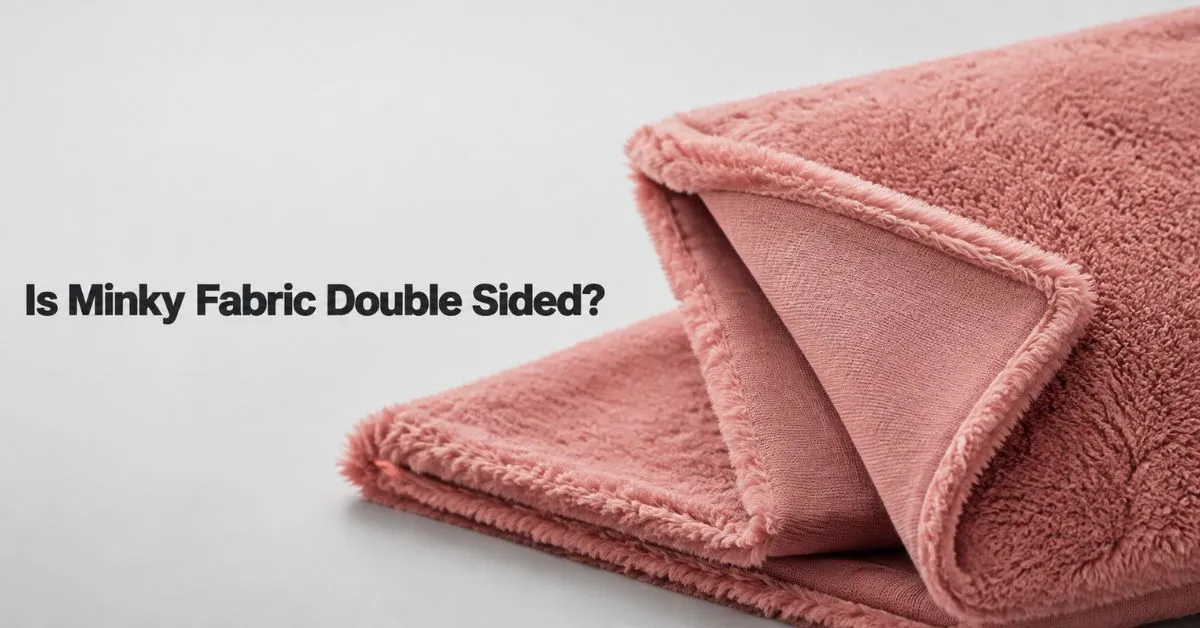

Minky fabric can be single- or double-sided, depending on the manufacturer. Most common minky has a plush pile on one side and a flatter knitted or woven surface on the back. Double-sided minky fabrics have a pile on both sides, though they are usually labeled differently. Many minky blankets, which might look similar to a double-sided fabric, are made from two layers of single-sided fabric. It is important to know what kind of fabric you are buying to get the necessary material for your blankets, clothes, or other projects.
What Is Minky Fabric?
Minky is a type of plush knitted fabric made from polyester microfibers with a smooth surface, a short or long pile, stretch, and a warm touch. The material is often used for blankets, baby clothes, and toys due to its softness, durability, and mild stretchiness.
Minky blankets are popular for their cozier feel and are used for:
- baby blankets
- throw blankets
- quilt backings
- stuffed toys
- dressing gowns
- slippers
- cushion covers
- pet beds
- children’s clothing
The term minky refers to the general category of plush fabrics, as there are variations in the pile height, weight, texture, stretchiness, and the look of the back of the fabric.
Is Minky Fabric Double Sided
The short answer is that some minky fabrics are double-sided, while others are not. The double-sided type usually has pile on both sides, while the single-sided version only has a plush side. The best way to differentiate is to look for mentions of double-sided, two-sided, or double-plush fabrics in the product description or on the packaging.
For example, Shannon Fabrics has a Cloud Cuddle collection of specialty minky with a printed front and plain back, which are about the same pile height on both sides, but are made from different materials. The company notes in the product description the difference in pile height on the face and the back of the fabric, which confirms that some minky fabrics are indeed double-sided but are not treated as universal, standard materials applicable to all minky products.
What Does the Back of Standard Minky Fabric Look Like?
The back of standard minky fabric usually has a knit or woven texture, making it less fluffy or even rougher than the pile of the face of the fabric. Here are some of the differences between the face and the back:
- pile
- less vibrant colors
- less consistency
- less softness
- patterned designs that might lose their detail
- different look when the fabric is being brushed
It is important to note that the back of most minky is not necessarily rough; it can vary. However, it is generally meant to be hidden when making garments, blankets, and other items.
Single-Sided vs Double-Sided Minky
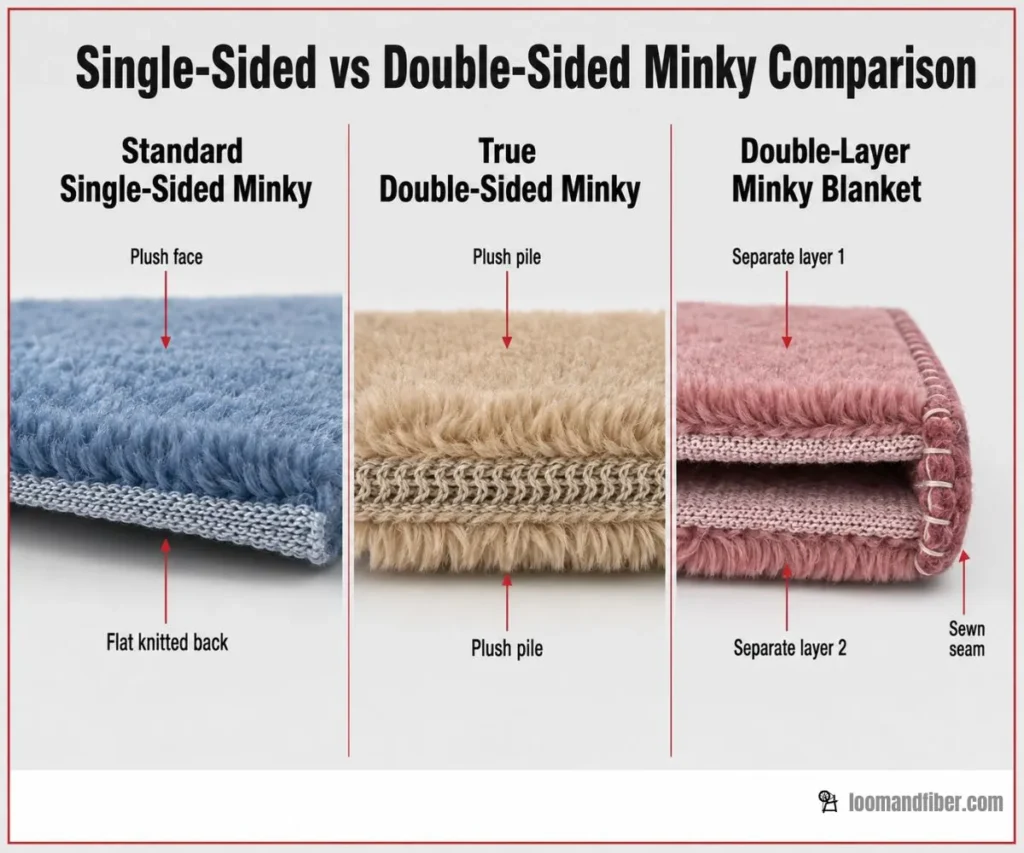
| Feature | Single-sided minky | Double-sided minky |
|---|---|---|
| Plush surfaces | One | Two |
| Reverse appearance | Flat knitted backing | Finished plush surface |
| Typical weight | Light to medium | Usually medium to heavy |
| Warmth | Moderate to high | Generally higher |
| Need for a lining | Often needed | May not be needed |
| Sewing difficulty | Easier to control | Bulkier at seams |
| Common use | Quilt backing and lined projects | Throws, scarves and robes |
| Typical price | Lower | Higher |
What Is True Double sided Minky?
True double-sided minky has a pile on both sides of the fabric, making it suitable for any projects where both sides of the textile are going to be seen.
The two sides can look different from each other in terms of pattern, color, or pile height. Double-sided minky fabric can be:
- the same color or pattern
- a printed design on one side and a solid color on the other
- a shorter pile on one side and a longer pile on the other
- a smooth side and a rough side
- with other variations
For example, some clouds cuddle minky fabrics have a 3 mm pile on one side and a 4 mm pile on the other. Since the back of the fabric also has a pile, not a knit or woven surface, this is a true double-sided fabric.
Double-sided Fabric vs a Double-layer Minky Blanket
Double-layer minky blankets and double-sided minky fabrics are not the same, and there is a reason to differentiate between the two. The former refers to a product made from two pieces of fabric, usually sewn together around the edges, where the back of the fabric is usually hidden on the inside. A double-sided fabric, on the other hand, refers to a fabric that has been specially treated or manufactured to have a pile on both sides and does not necessarily require any additional materials for making blankets.
It is important to remember this difference when buying material for blankets since some sellers incorrectly refer to double-laid blankets as being made from double-sided minky fabric. In reality, one fabric layer is usually minky while the other is a cotton or flannel lining or a different type of material, like sherpa. Before buying a finished double-sided blanket, make sure to ask the seller whether the blanket has been made from:
- one piece of fabric with a pile on both sides
- two single-sided minky materials
- one minky side and one cotton, flannel, or sherpa side
- how much material is in a finished blanket
- what the other side of the material looks like
How can you tell whether minky is double sided?
The best way to find out if minky is double sided is to look at the fabric yourself or read the product description carefully. Here are a few tips that will help you identify a double-sided fabric:
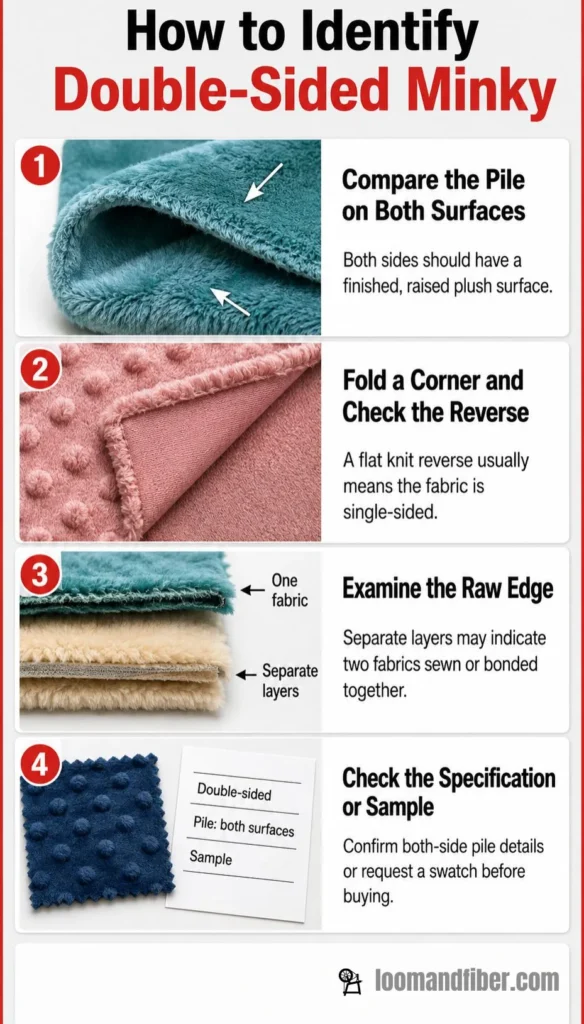
Compare the pile
Touch both sides of the material and see if there is a clearly defined fluffy pile on both sides. Most standard minky fabrics will have a plush side and a rougher side with the knit texture.
Fold back a corner
It can help to get a closer look at the fabric. If there is a clear contrast between the two sides, then the fabric is not double-sided.
Look at the raw edges
The raw edges can indicate if you are looking at a double-sided fabric or at two layers of fabric that have been stitched or laminated together. For example, if you see two pieces of fabric on the edge, then you may be looking at a minky blanket made from two layers of standard minky.
Check the product details
If the product says double-sided or double-plush minky or mentions something about the face pile and the backing pile, then you should pay close attention to what the product description actually says. The terms double-sided, two-sided, and double-plush minky usually refer to the fact that both sides of the fabric have a pile. It is important to remember that a minky blanket or fabric that states double-sided may just be a double-layer blanket.
In some cases, minky products may mention that the fabric is reversible, which means that it has been specially treated to be used on both sides. In this case, you would not need any additional materials for making blankets or other projects.
Ask for a swatch
Sometimes, pictures can be misleading, and pictures of swatches may not necessarily show the texture or softness of the material’s raw edges. The best way to determine if a minky fabric is double-sided is to buy a swatch and examine it closely for softness, density, color, and other features. It may also help to compare swatches if you are trying to choose between two minky fabrics.
Are printed and embossed minky double sided?
Printed minky is not double sided, as the print is on the face of the fabric. The print on the face can take some of the softness away from the fabric, and it is not uncommon for the back of such material to be flat as well. The same goes for embossed, dimpled, or other minky fabrics with designs, like stars, waves, diamonds, or dots. The pattern is mostly on the front, while the back may have a few details left from the embossing process, but it is not double sided.
Sparkle, metallic, digital-printed minky, and other types of special print minky should also be considered as printed materials, and, therefore, are not double sided. Exceptions to this rule apply if a fabric is specially treated, but the best way to identify a double-sided fabric is to study the product description carefully.
Does Minky Need a Backing?
Single-sided minky is not necessarily supposed to have a backing, but it is recommended to have the back of the fabric face a finished surface if both sides are visible. Minky fabric can be finished with:
- an additional layer of minky
- cotton quilting fabric
- flannel
- fleece
- sherpa
- a woven light polyester fabric
- any of the mentioned fabric, provided that the colors match
Having a backing will provide additional warmth and insulation, making it easier to create a warm blanket without having to add more layers. It can also conceal the less soft back of the minky fabric and hide any visible seams.
True double-sided fabrics do not necessarily require a separate backing, as both sides of the material are fluffy. Shannon Fabrics specifically recommends that its Cloud Cuddles prepared for printing fabric does not need an additional backing.
Which type of minky is best for blankets?
What is the best type of minky fabric for blankets? It depends on the desired weight, pattern, and the ease of making the intended project.
Single sided minky with a cotton front
A single-sided fabric can create a lighter throw, particularly if the cotton will not be too thick. A single-sided minky fabric with a cotton front can be used to create baby blankets as well as patchwork and quilting projects due to the versatility of cotton.
Two layers of single-sided minky
Two layers of single-sided minky can also create a warm and thick blanket with a fluffy texture on both sides. Using two layers of the material is also a good option to create a blanket with a pattern on one side and a solid color on the other. However, using two layers of the fabric will make the blanket heavier.
True double-sided minky fabric
A fabric with a pile on both sides can be used to create a simple reversible blanket without any additional materials. It is easier to sew such a blanket due to the presence of one layer of fabric, and a double-sided minky fabric can also help create a lighter blanket compared to those made from two layers. However, the fabric can be more expensive than single-sided options.
Minky with batting
Some blankets made from minky may include an additional layer of batting to give the fabric more volume and create a warmer and fluffier feel. However, it is not necessary since minky itself can be warm enough, particularly in combination with additional materials.
Is Double-Sided Minky Better for Clothing?
The double-sided minky provides softness on exterior and interior which might be beneficial for unlined robes , scarves, ponchos or jackets made without an additional layer.
It can also help to simplify the process of construction since there will be no need for another fabric to serve as lining.
Nevertheless, the increased weight and pile can interfere with the creation of desired garments:
- thick seam allowances,
- warmth,
- poor breathability,
- bulky hems ,
- difficulty when attaching zippers,
- fabric sliping during seams
Single-sided minky is better for lined items, small accessories, and projects when reduced weight is crucial.
Is Double-Sided Minky Warmer?
The double-sided minky is definitely warmer than the same fabric with a single layer due to the presence of pile on both sides and a higher fiber density. The thickness of the fiber pile alone is not always indicative of warmth, however. The weight, air circulation, cutting pattern, other layers, and fit should also be taken into account when trying to maximize the retention of heat. When comparing the qualities of different manufacturers, it is essential to pay attention to the amount of grams per square meter or linear yard in addition to the height of the pile.
Is Double-Sided Minky Harder to Sew?
Working with double-sided minky can be challenging due to its increased weight, stretchiness, tendency to shift during work, and pile that can hide reference points.
Below are some helpful ideas for sewing with this type of fabric:
- Determine the direction of the pile.
- Cut all pieces in the same direction.
- Use clips or close pins
- Make long basting stitches
- Use walking foot
- Try a polyester or stretch needle on scraps
- Increase the size of the stitch
- Reduce pressure on the machine foot (if possible)
- Trim the bulk of the seam allowance
- Remove loose fibers from the machine
Minky tends to shed loose filaments from the cut pile at the edges of the seams, but fabrics with a knitted foundation do not fray like woven cotton.
What Should You Check Before Buying Minky?
A reputable seller should be able to provide more information than just the word “minky”. Below is a list of features to consider:
Surface construction
It is essential to determine whether one or both sides of the fabric have a pile.
Fibers
The vast majority of minky fabrics are made of polyester, but this detail should be specified when purchasing.
Weight
Heavy fabric usually means a higher pile or a dense knit, which in turn means more significant seams.
Pile height
Short pile is easier to sew and clean, while a longer one looks luxurious and hides the seams. Nevertheless, long piles tend to shed more noticeably when cutting.
Width
The width of the fabric indicates how much material is needed to make a particular project, such as a blanket. Extra-wide minky allows you to sew large items without leaving visible seams.
Stretch
Minky is usually knitted, which means that it stretches more across the width of the grain. This feature should be considered when choosing patterns.
Pattern and nap direction
Some minky fabrics have prints that are applied to one side of the fabric, as well as a directional pile. When working with such materials, it is essential to follow the specified directions to ensure that the printed images on different pieces match.
Care
Most minky fabrics are machine washable, but high water temperatures or the use of softeners may damage the fibers of the fabric. It is always necessary to follow the care instructions that are provided by the manufacturer.
Common Buying Mistakes
The most common mistake is thinking that a softly shagged appearance on a product photo means that fabric is double sided, but in reality lighting and photo editing can make an ordinary knit backing look fluffy.
Other common mistakes are:
- Thinking that two layer blanket is double sided
- Assuming that all solid minky have two usable surface
- Not taking into account total weight of fabric
- Buying by color and not checking pile height
- Thinking that embossed patterns on the reverse side are a finished design
- Not ordering enough fabric to allow for shifting nap
- Using long pile minky for intricate patterns
- Thinking that reversible fabrics are always double sided
Double-sided minky is a special case, as most minky fabrics are single-sided, with one side being a fluffy pile and the other being a knit or woven surface.
Conclusion-
is minky double sided? It depends on the fabric, as most minky is single-sided with only one fluffy surface. Double-sided minky is a special case, which should be stated as such in the product description.
Minky buyers should take a close inspection at two sides of the fabric and check other specifications such as pile height, weight, fiber content, and the type of backing. For blankets, which require a soft fluffy surface on both sides, double-sided minky or two layers of single-sided minky stitched together can be used.
Read More>> What is Challis Fabric?
FAQs
Both sides of minky tend to be somewhat soft because of the fine fibers, but most of the fabric has a single plush side and a thinner backing. The reverse side is rarely as smooth and fluffy as the front surface. If the back of the minky seems too soft, it may be a sign that the fabric is double-sided.
It is not, in most cases. Minky with a dimpled surface has a pile on one side and a rougher surface on the other. However, it is always necessary to study the specifications of the product carefully.
If you want a plush surface on both sides of the blanket, you will need to use either two pieces of minky or opt for a double-sided version of the fabric. If you only want one fluffy side, a single piece of minky will be sufficient.
No, minky and fleece are different fabrics. They are often made of similar materials, such as polyester, but the structure of their surface differs. Minky is typically smoother and denser, while the surface of fleece tends to be more fluffy and stretchy.
Minky fabric can certainly be used to sew baby clothes, accessories, or toys. However, it is crucial to pay attention to the age of the child and consider potential hazards: long strands, additional ornaments, or overheating. In addition, specific standards must be followed when selecting supplies.