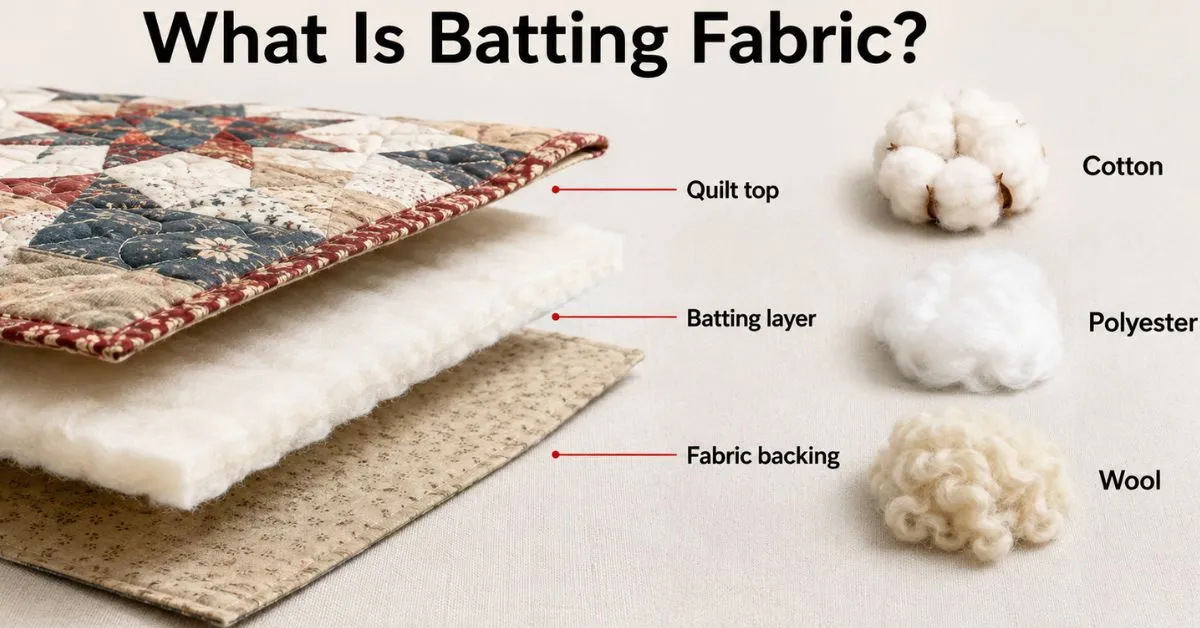

Batting fabric refers to fiber batting placed between a quilt top and backing. This includes warmth, thickness, shape, cushion, stitch definition, and stitch definition, as well as other properties. However, “batting fabric” refers primarily to a category of purchase. Unlike woven or knitted fabric, batting is formed by blending fibers into a sheet with needling, thermal bonding, or resin bonding. Common fibers include cotton, polyester, wool, silk, and cotton-polyester. Recycled polyester or rayon from bamboo are other possibilities. Warmth, weight, drape, texture, and washability are all determined by the fibers. As a result, the choice of batting depends on the project, its intended use, desired loft, quilting distance, care, and final appearance.
What Is Batting Fabric?
Batting refers to a layer of fibrous insulating material used in quilts and other sewing projects. The top layer of the quilt is the batting, while the backing is the lower layer.
Batting provides warmth by enclosing air within and between fibers, as well as cushioning, thickness, shape, and texture. In addition, it adds to the weight, drapiness, warmth, stiffness, and surface irregularities. Finally, the batting influences the clarity of the quilting stitches.
Batting is available in precut, folded, and full-width rolls in a variety of sizes. The most common size is the crib, twin, queen, and king sizes.
Manufacturers may create batting by needle punching, thermal bonding, resin bonding, and/or attaching a scrim for stability. As a result, two different battings may have dramatically different characteristics despite being constructed of the same fibers. Wadding is also the term for batting in the United Kingdom, Australia, and other regions. However, suppliers frequently employ differing conventions.
Batting refers to the inner fibrous layer of a quilt, with the top and bottom layers of fabric.
Is Batting Actually a Fabric?
Most batting is not woven or knitted. Instead, it is constructed of fibers that have been consolidated into a sheet by mechanical means. As a result, it is referred to as nonwoven fabric. There is a distinction between woven, knitted, and nonwoven materials. Woven fabric is formed by weaving together warp and weft yarns. The weft threads run horizontally in the fabric, while the warp threads run vertically. Knitted fabric is formed by knitting interlocking loops of yarn. The loops in a knitted fabric might be large or small, depending on the knitting style. However, nonwoven fabric does not possess loops or interlacing of the yarns. Instead, it is formed by entangling fibers into a sheet, which is then stabilized by mechanical means, such as needling or thermal bonding. Manufacturers create sheets of nonwoven fabric by blending fibers together.
Although batting is made up of fibers, it is typically not considered to be a woven or knitted fabric as the term suggests. Furthermore, nonwoven fabric is not inherently unstable or low quality. On the contrary, it’s the same fibers that manufacturers use to make woven or knitted garments.
As a result, most companies sell sheets of nonwoven fabric in widths that allow cutting to a particular width. As a result, the word batting fabric is accurate when referring to nonwoven sheets.
What Is Batting Used For?
Batting is utilized in a wide range of sewn projects that require warmth, padding, shape, and/or dimension. Some examples include the following:
- Bed, lap, cot, and baby quilts
- Wall hangings and art quilts
- Table runners and placemats
- Quilted handbags and totes
- Padded jackets and quilted apparel
- Lightweight upholstery and furniture pads
- Seasonal ornaments and decorations
- Machine embroidery and trapunto
- Protective covers and equipment cases
- Sound-absorbing craft panels
- Pot holders and oven mitts
- Microwave bowl covers
However, each of these items is concerned with construction and performance. Ordinary quilt batting, for instance, is frequently not flame resistant or microwave safe.
Similarly, most forms of batting are not recommended for use in safety coverings or protective equipment. In such circumstances, a different type of technical material may be necessary.
When working with microwave items, the instructions specify which type of batting should be used. For instance, Pellon recommends that its Wrap-N-Zap projects constructed with cotton batting, thread, and fabric only utilize cotton batting. It advises against using scrim or layers of batting. It is crucial to note, however, that Pellon’s products are neither flame nor heat resistant. As a result, the manufacturer recommends following the care instructions when using its microwavable goods.
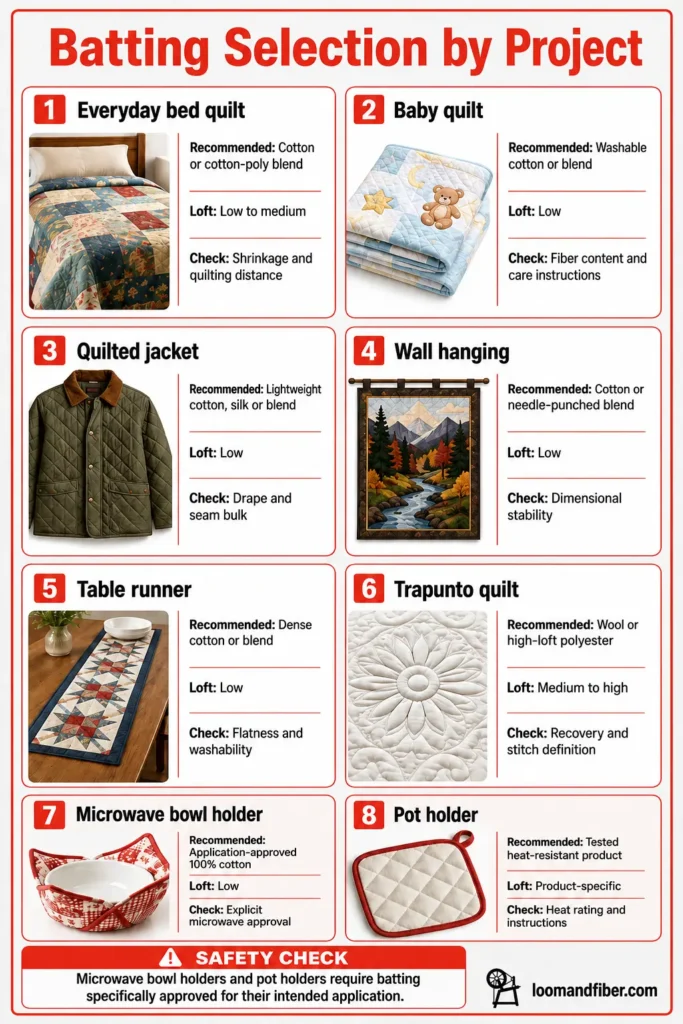
Batting Selection Chart by Project
| Project | Recommended starting option | Preferred loft | Main buying check |
|---|---|---|---|
| Everyday bed quilt | Cotton or cotton-poly blend | Low to medium | Shrinkage and quilting distance |
| Baby quilt | Washable cotton or blend | Low | Care instructions and fiber disclosure |
| Wall hanging | Cotton or needle-punched blend | Low | Dimensional stability |
| Quilted jacket | Lightweight cotton, silk, or blend | Low | Drape and bulk at seams |
| Trapunto | Wool or high-loft polyester | Medium to high | Recovery and stitch definition |
| Table runner | Dense cotton or blend | Low | Flatness and washability |
| Microwave bowl holder | Application-approved all-cotton batting | Low | Explicit microwave instructions |
| Pot holder | Tested heat-resistant product | Product-specific | Heat rating and construction |
| Dark quilt | Black or dark batting | Low to medium | Fiber migration and color show-through |
How Is Batting Fabric Made?
Manufacturing processes have an effect on batting’s stability, softness, density, loft, and quilting features. As a result, it is critical to pay attention to the construction. The primary types include the following:
Carding and cross-lapping
Carding is the process of opening up compressed fiber and separating bits of it for textile production. First, carding machines break up long strands of fiber during the carding process, resulting in short fibers. Then, cross-lapping machines produce a web with more weight, thickness, and stability. The weight and thickness of the web are achieved by repeatedly cross-lapping the web. However, the web still needs to be stabilized.
Needle-punched
Barbed needles punch through the web to tangle and twist the fibers in mechanical needling. Manufacturers utilize thousands of barbed needles in this process, which helps to stabilize the web. The barbed needles pass through the web, entangling the fibers. This process results in a stiff, lofty batting, which is denser and has minimal drape. Although it is constructed of fine fibers, it is not recommended for intricate stitching.
Thermal-bonded
Heat is used to bond the fiber in thermal bonding. Low-melt polymer is blended with fibers during the manufacturing process. When the web is heated, the low-melt polymer bonds the fibers together. This procedure is frequently utilized in polyester or wool batting. It is crucial, however, to understand that it does not render the material heat safe. Thermal bonding is also less common in the United States than in other countries.
Resin-bonded
Resin-bonded batting is constructed by connecting fibers with a binder solution. In this process, a binder is sprayed, coated, or brushed onto the web. It might also be utilized in a fiber-spinning machine. However, when compared to other types of batting, this one may not be as soft or durable. In addition, resin adhesion can affect the needle’s ability to penetrate and the fabric’s ability to withstand washing.
When selecting such products, it is essential to look at more than just the fiber. The resin itself is equally important.
Scrim-supported
A scrim is a woven mesh that reinforces batting. Manufacturers reinforce the fibers by sewing them to or through the scrim. This procedure is typically used when a product is prone to stretching during the manufacturing process. In addition, it allows for greater spacing between stitches. However, it may interfere with hand quilting and have variable heat properties. In addition, the Pellon company does not recommend using scrim with their microwave items.
Bonded batting refers to bonded fibers using heat, resin, or a combination of both. Mechanical needling is the process of entangling fibers by punching them with barbed needles. On the other hand, scrim refers to a thin, woven mesh that reinforces certain types of batting.
Types of Batting Fabric by Fiber
The fibers influence the warmth, weight, drape, shrinkage, moisture, and stitch definition of batting, among other characteristics. However, the construction process might modify some of these features.
Cotton
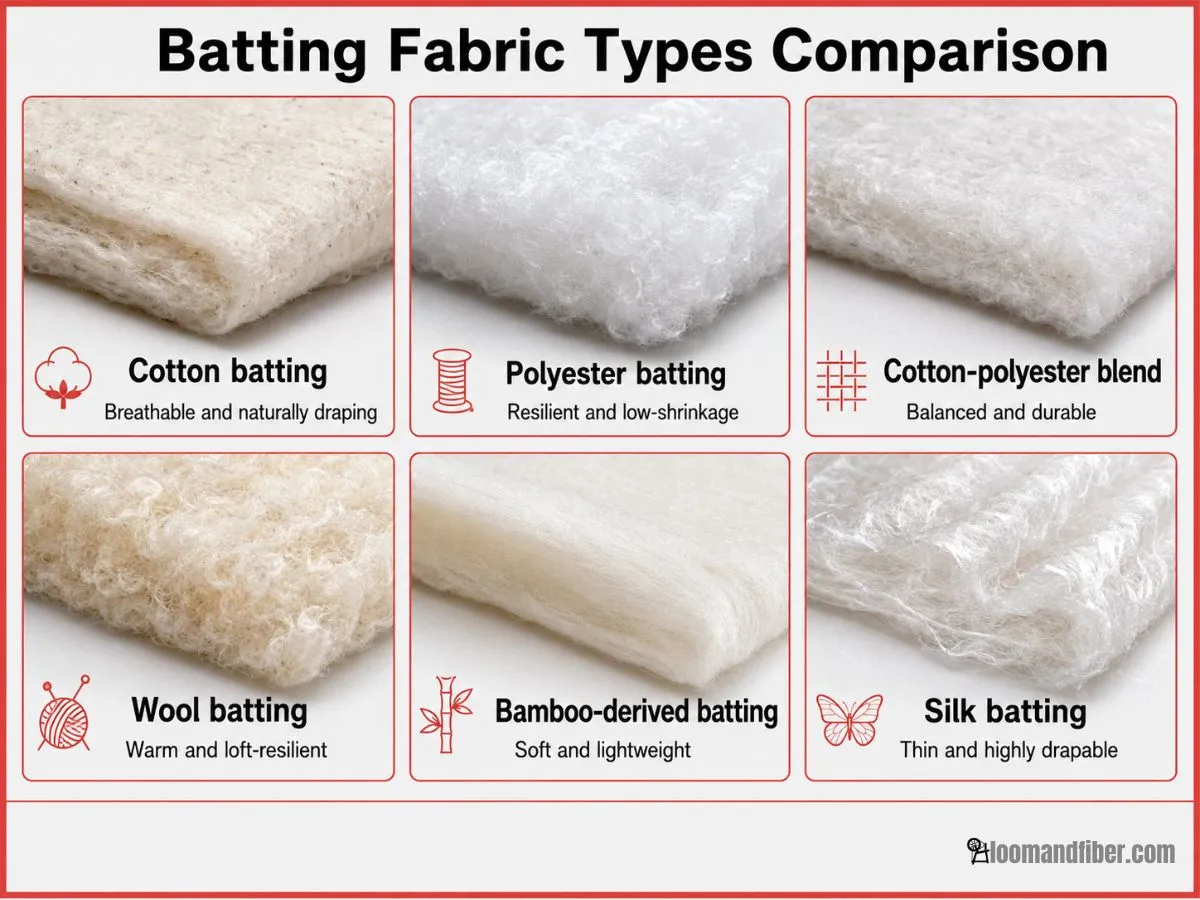
Cotton batting tends to provide good warmth with minimal weight while allowing excellent drape and a traditional look. Low-loft cotton batting is ideal for high-stitch-density quilting. Shrinkage after washing makes cotton batting a popular choice for traditional quilts. Shrinkage typically results in a nice crinkly surface, while cotton batting rarely pills. Low-density cotton batting allows good stitch definition while maintaining a degree of softness. In addition, most cotton batting is suitable for hand quilting because it lacks scrim (a stabilizing mesh). Furthermore, this type of batting is typically used in the following items:
- Everyday bed quilts
- Baby quilts
- Traditional patchwork
- Wall hangings
- Table linens
- Natural fiber projects
The ability to shrink varies depending on the manufacturer and the design. Therefore, two cotton battings may have dramatically distinct shrinkage characteristics. Another disadvantage of this type of batting is the risk of weight gain when working with large or high-density projects.
Polyester
Polyester batting tends to shrink less and has excellent washability and loft retention. This fiber allows the maker to choose between extremely flat and lofty batting. Polyester batting’s high-loft variants allow for excellent stitch definition with deep quilting relief. Low-loft polyester batting, on the other hand, has minimal weight and little stitch definition. Polyester batting typically has the following advantages and drawbacks:
Pros
- Superior washability and reduced shrinkage
- Poorer drape compared to natural fibers
- Good resilience when wet
Cons
- May emit unpleasant odors when wet
- Exceptional stitch definition options
- May feel stiff when worked with
- Better than cotton in high-loft variations
- Not inherently heat resistant
- Greater choice of fiber weights
- May be slippery when working with
Cotton-polyester blend
When comparing cotton-polyester blend to cotton, a cotton-polyester blend tends to have less shrinkage and improved resilience after washing. Similar to polyester, it has excellent washability and resilience. Cotton-polyester blend is typically used when a maker needs the softness and drape of cotton but requires additional resilience, particularly in high-use items.
Wool
Wool batting provides excellent warmth without significant weight. It also tends to have outstanding stitch definition while providing the maker with ample quilting space. In comparison to other fiber types, wool batting tends to be the most elastic. This batting typically has the following benefits and drawbacks:
Bamboo-derived
Rayon or viscose from bamboo frequently serves as a fiber for this type of batting. It can also be blended with cotton, silk, or polyester to enhance its characteristics. Generally, this fiber has excellent drape and tends to be quite slippery. It also has good warmth to weight ratio and therefore can be used in a variety of items. This batting typically has the following benefits and drawbacks:
Silk
Silk fiber allows the maker to create exceptionally lightweight and flexible quilted items. It typically has superb draping characteristics while providing decent warmth without adding much weight.
Pros
- Excellent drape
- Can be slippery when working with
- Good warmth to weight ratio
Cons
- Higher price point
- Lightweight items
- Lower availability compared to cotton
Specialty Batting
Specialty batting refers to batting that possesses unique characteristics or was produced utilizing a unique process. Therefore, it’s critical to examine the specifics before purchasing such items. The primary examples include the following:
- Soy-blend batting
- Black batting for dark quilts
- Fusible batting
- Adhesive-backed batting
- Reflective insulated batting
- Flame-resistant batting
- Microwave-approved batting
- Heat-resistant products
Black batting refers to black-colored batting that typically allows the maker to conceal white fibers from the fabric layers. In turn, fusible batting allows the maker to adhere it to another surface with the use of pressure. Similar characteristics are possessed by adhesive-backed items, although some of them require the use of an iron. Reflective batting can help reduce the impact of radiant heat, but it’s not suitable when direct heat is involved. In addition, flame-resistant batting is different from ordinary quilt batting. Thus, it’s critical to follow specific instructions when working with specialty items.
What Does Loft Mean in Batting?
Note: Loft typically refers to a batting’s thickness or height, not its warmth rating. Loft is the vertical measurement of batting, which indicates the potential thickness of the finished project. In addition, it has a significant impact on the texture of the surface and the visibility of quilting stitches. However, the loft does not necessarily correlate with the insulation properties of a batting. The reason for this is that fibers, density, air pockets, and quilting patterns also affect warmth. The following are the characteristics and applications of different types of batting:
Low-loft
- Creates a flat, flexible, and lightweight finished project
- Reduces the bulk around stitching and seams
- Ideal for lightweight items, such as placemats and table runners
- Also suitable for close quilting patterns, bag-making, dense quilting, and baby quilts
- Great choice for domestic quilting machines and/or light quilting tasks
Medium-loft
- Creates average thickness and texture
- Allows the maker to achieve good stitch definition without extreme bulk
- Suitable choice for general-purpose items, such as bed linens, everyday quilts, throws, and machine quilting projects
- Ideal for medium-density items and general quilting projects
High-loft
- Results in lofty and puffy surface texture
- Increases the stitch definition and provides the quilting with exaggerated texture
- Suitable for trapunto techniques and/or items with bold quilting patterns
- Also appropriate for comforters, dimensional work, and decorative display items
What Are Scrim, Bearding and Quilting Distance?
The batting characteristics listed below play an essential role in the quilting process:
What is scrim?
Scrim refers to a mesh that some manufacturers use to stabilize the batting. The mesh can be on one or two sides of the web, depending on the manufacturer. Scrim allows the maker to accomplish the following:
Increase the stability of the finished project
Reduce the possibility of the fabric stretching unnaturally
Allow for greater quilting space
However, working with scrim can be difficult because it affects the drape and/or resistance to needles. In certain cases, it can also be inappropriate for microwave projects.
What is bearding?
Bearding refers to a condition where the fibers from the batting protrude from the edges of the top fabric. This issue is more common in low-density batting, especially when the quilting project lacks sufficient density or uses the wrong needle size. In addition, the fibers tend to migrate more actively when the fibers of the top fabric and batting do not match. Other influencing factors include abrasion, static, and density. To reduce this problem, it is essential to choose high-density batting and pay close attention to the fiber type. In addition, choosing a darker shade of batting might conceal the fibers if they do stick out.
What is maximum quilting distance?
It is the distance between stitches that keeps the batting from shifting. The manufacturers determine it, and it’s essential to look for this characteristic when buying batting. The reason for this is that a greater quilting space allows the batting to slip more freely, which will eventually result in undesirable wrinkles and thin spots in the fabric. Therefore, it is critical to adhere to the specified distance when quilting a particular project. In addition, never extrapolate this measurement based on the fiber type, since these specifications are unique to each product, depending on their density and construction.
Can You Piece Batting Scraps Together?
Yes, but only use compatible scraps and a joining method that prevents ridges. For example, wide zigzag sewing, batting tape, and hand stitching can all bind straight edges with little thickness added.
Wide zigzag stitching
Join straight edges without overlapping them. Then, sew a wide zigzag stitch along both pieces to bind them together. Avoid making the channel by pulling either side while stitching.
Batting-joining tape
Batting tape bridges abutted edges and holds them together. However, always follow the manufacturer’s instructions for fiber and heat compatibility. You might test how fusible tape interacts with wool, polyester, or other specialty batting.
Hand joining
Hand stitches can hold batting together without high heat and pressure. Simply use a wide stitch pattern that binds both sheets evenly. In addition to joining methods, always match fibers, loft, density, color, and care. For example, batting scraps can have different shrinkage rates. Moreover, never overlap edges since they’ll create noticeable ridges. This is especially true for joins near folds and stress points.
Should Batting Be Prewashed?
Prewashing is not recommended for most modern batting. Many manufacturers even suggest a controlled soaking process instead of laundering.
Loose batting can stretch, tear, felt, or separate during home washing. Some products require special soaking to reduce shrinkage and minimize agitation.
However, soaking can affect the fiber and change the loft. Therefore, always follow the manufacturer’s recommendations instead of general guidelines.
In other words, never assume that every unfinished batting needs or benefits from prewashing.
Washing and Caring for Batting Inside a Quilt
The entire quilt determines care requirements rather than batting on its own. Every component must have compatible washing and drying instructions.
Check the following factors before laundering:
- Water temperature requirements
- Gentle vs. standard cycles
- Detergent types
- Dryer temperature
- Air-drying requirements
- Wool-specific instructions
- Shrinkage potential
- Fabric colorfastness
- Decorative trim care requirements
- Compression risks
A color catcher sheet is not a substitute for testing all potentially unstable dyes. Use it as an extra precaution when washing mixed quilts.
Large wet quilts can be exceptionally heavy. Therefore, avoid lifting them by a single narrow edge.
Dry the quilt before storing it. Leftover moisture encourages mold and fiber breakdown.
Store quilts in a cool, dry, well-ventilated location. Do not compress them by stacking heavy items on top.
Furthermore, always refold stored quilts occasionally. This minimizes permanent creases and unwanted thickness variations.
Finally, save the manufacturer’s label or take a photo for future reference. It will help with washing instructions, troubleshooting, and identifying the product.
Common Batting Problems and Their Causes
Batting shifts or bunches
- Fibers migrate through the fabric
- The quilt becomes stiff
- Thickness becomes uneven
- Unexpected shrinkage appears
Batting loses loft
Reasons;
- Quilting spacing too far, poor basting, and multiple launderings.
- Loose facings, abrasion, static, and an inappropriate needle size.
- Too much quilting density, heavy scrim, resin, or adhesives.
- Stretching, joined piece overlaps, or compressed batting.
- Unsuitable washing, differing fiber care, or general assumptions about shrinkage.
- Heavy quilting, heat exposure, long-term pressure, and low-quality materials.
Batting Versus Related Materials
Batting Versus Wadding
Both terms describe the same product, but “wadding” is more common in British and Australian markets. However, individual sellers might differentiate between the terms. Therefore, compare the fiber content and construction.
Batting Versus Interfacing
Batting adds bulk while interfacing usually adds stability. Interfacings are typically used for small parts like collars, cuffs, waistbands, or bags. Batting can also be used to produce stable, thick sections.
Batting Versus Interlining
Interlining is an additional layer that adds warmth, opacity, or structure. Therefore, interlining and batting have overlapping properties. Make sure to review the manufacturer’s recommendations for interlining materials.
Batting Versus Fleece
Fleece is a finished fabric designed to be worn or used as a surface. It can be found in garments, blankets, bags, and other items. On the other hand, batting is usually placed between layers. However, some projects utilize stable batting as a surface.
Batting Versus Stuffing
Batting comes in different forms but is designed to be cut and enclosed within a project. On the other hand, stuffing is a bulk material used for filling.
Batting Versus Upholstery Foam
Foam provides bulk and structural support. Upholstery foam is specifically designed to be wrapped in batting for furniture. Polyester batting is a good choice for most upholstery foam projects.
Batting Versus Thermal Insulation
Some batting materials have undergone testing to be used as insulation. Thermal, reflective, or protective insulation is not generally suitable for traditional quilting projects. Thermal insulation materials should only be used in appropriate applications.
Is Batting Safe?
Batting safety depends on the fiber content, construction, finishing, and intended use. No single fiber is safe for every application.
Skin-contact Products
Remember that most batting stays enclosed within a project. However, finishes, odors, and fibers can nonetheless affect sensitive skin. Wash completed items according to the manufacturer’s instructions when appropriate. In addition, stop using a product if it causes an adverse reaction.
Baby Quilts
Choose washable fibers whenever possible. In addition, make sure to keep all fibers secured within the batting’s maximum quilting distance. Look out for unsafe materials such as loose fibers, damaged seams, and questionable trim. Always prioritize a good overall construction when creating items for sensitive groups.
Allergies and Sensitivities
Do not label any batting as hypoallergenic. Individual reactions can be unpredictable and depend on fibers, finishes, dyes, dust, or other factors. Therefore, always review relevant product disclosures and conduct personal testing when possible. Consult medical professionals if necessary.
Microwave and Oven Projects
Only use batting that is explicitly designed for the intended application or heat resistance class. Microwave-safe batting is not necessarily oven-safe and vice versa. Additionally, follow all fiber, layer, threading, and supervision recommendations.
Flame Exposure
Most natural fibers tend to burn while synthetic fibers can shrink or melt when exposed to an open flame. Wool performance depends on the specific product and construction. Flame resistance should never be assumed based on fiber type alone. Always look for products with verified claims and performance specifications.
Certification and Environmental Claims
Always review the certification’s name, scope, issuing organization, and relevant product claims. Claims about raw fiber content might not apply to the final product.
Recycled content does not necessarily mean reduced environmental impact.
Remember that durability, manufacturing, logistics, and end-of-life disposal contribute to a product’s sustainability. Individual factors vary between batting products.
Fiber-Label Accuracy
For U.S.-made textile items, labels should specify fiber content, manufacturer, and country of origin. Therefore, use the textile disclosure rather than marketing language. This is especially important for blends or bamboo-based products.
FAQs
Yes, batting and wadding generally refer to the same thing; the fibers running through the inside of the fabric. “Wadding” appears be preferred in a few English-speaking markets.
Wool batting can provide excellent warmth without too much weight, while still retaining its shape. High loft polyester can also provide great insulation and texture to the finished project.
A low loft cotton-polyester blend tends to have a good amount of give and hold its shape well when being machine quilted. It also has a nice drape and does not add too much bulk.
Most batting should be sandwiched between layers of fabric, as it will pill, snag, stretch, and generally wear out faster if left exposed.
Yes, multiple layers can allow for extra loft and stitch definition. Some quilter’s even mix and match different btings, usually cotton with either wool or polyester.