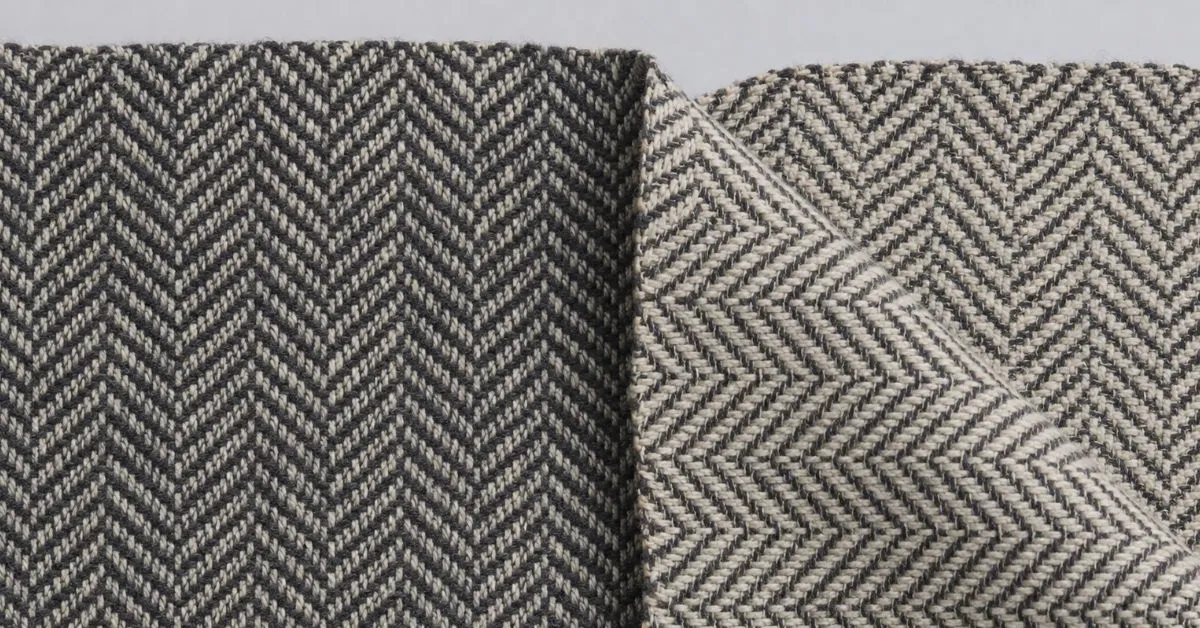

Traditional woven herringbone consists of diagonal twill ribs that reverse direction at regular intervals and form an offset zigzag resembling the bones of a herring. Herringbone may refer to a woven construction or a similar visual pattern, and it can be produced from various fibers. Wool, cotton, linen, silk, and synthetic fibers can all be used. Wool herringbone is commonly used for coats and tailored garments, while cotton and linen herringbones can provide lighter options for shirts, dresses, trousers, and warm-weather clothing. The fiber type, yarn structure, fabric construction, weight, density, and finish determine the fabric’s performance and handling characteristics.
Is Herringbone a Fabric, Weave or Pattern?
Herringbone is a twill variation in which the diagonal direction reverses at regular intervals and the opposing twill lines are offset to create a broken zigzag. The staggered, V-shaped formations that characterize herringbone result from the repeated, alternating direction of the twill.
Sellers will also market textiles that feature a broken zigzag as herringbone.
Because of this, the term herringbone may describe the appearance of a textile rather than its woven construction.
Herringbone is a construction and design style; it is not a fiber like wool, cotton, linen, silk or polyester.
Due to this characteristic of herringbone, textiles that feature this design style and construction can be made from a range of natural and synthetic fibers.
The herringbone design style can also be manufactured through knitting, printing, and digital reproduction.
A printed herringbone design may appear convincing, but a pattern printed on the fabric’s surface does not create a twill structure.
Because of this, printed herringbone lacks the structural characteristics produced by the reversing and offsetting of twill lines in woven herringbone.
A printed herringbone design does not necessarily indicate poor construction or low fabric quality.
Lastly, the design style of herringbone that is featured in textiles is different from the herringbone stitch that is used in embroidery or the herringbone pattern that is seen in flooring and brick arrangements.
Although they may exhibit a similar visual rhythm or design style, they employ different methods of construction.
How Is Herringbone Fabric Woven?
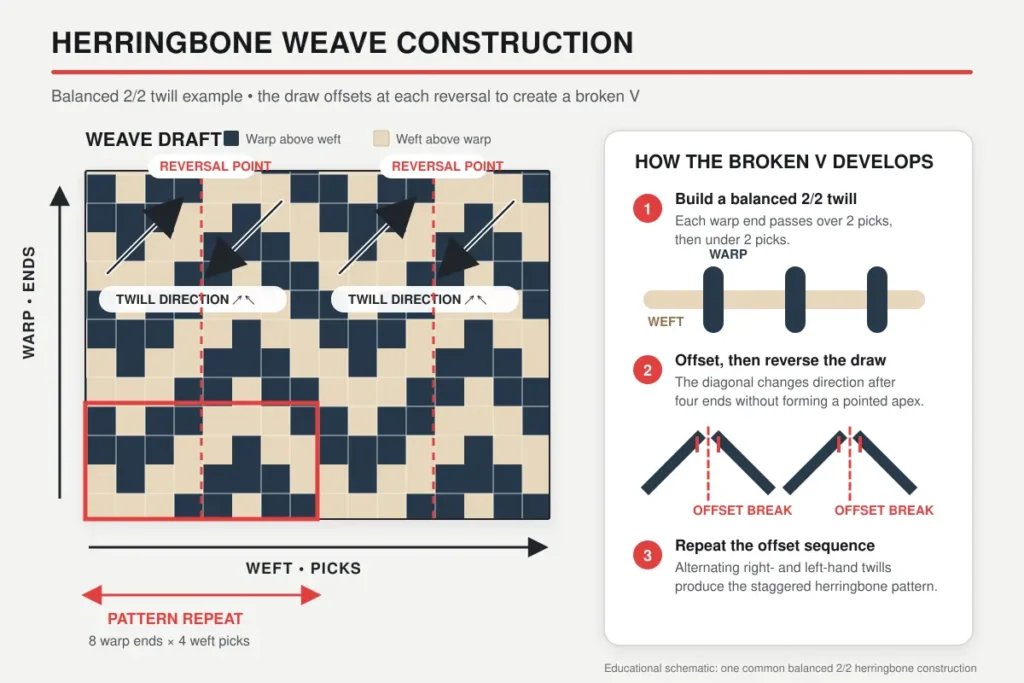
Herringbone is a variation of twill weave. In weaving, the lengthwise warp yarns interlace with the crosswise weft yarns according to a planned weave structure. This interlacing sequence forms diagonal features known as twill lines or wales.
For example, in a balanced 2/2 twill, each warp yarn typically passes over two weft yarns and then under the next two, with the sequence offset in adjacent warp yarns to form a diagonal line.
At predetermined intervals, the weave draft reverses the direction of the twill line.
This reversal occurs after a specified number of warp ends, according to the intended pattern repeat.
The Characteristic Break
Herringbone displaces the twill lines at each reversal.
Instead of converging, the staggered lines shift the opposing diagonals.
In chevron, the opposing diagonals meet at aligned points; in herringbone, they are offset to produce a visible break.
How Color Affects the Overall Look
If the yarns are the same or similar in color, they create a subtle texture.
If contrasting yarns are used, the diagonals or sections become more pronounced.
Fine, low-contrast repeats may appear nearly solid from a distance, while large or high-contrast repeats remain more visually pronounced.
Herringbone Weave-Construction Diagram
The diagram below separates the basic twill interlacing from the repeated directional reversals.
Furthermore, herringbone and pointed chevron differ visually because of the central break.
3. What are the Signs of Authentic Woven Herringbone?
A limited number of simple checks are available, and most rely on close observation because color contrast can alter the appearance of the underlying structure.
- Look at the ribs: Herringbone shows regularly alternating diagonal ribs.
- Examine the break: Woven herringbone normally shows offset or staggered reversals rather than the aligned points associated with chevron.
- Look at the reverse side: The weave pattern is usually visible on the reverse side of a woven herringbone item, although its appearance may differ from the face.
- Use a magnifying glass: Look for interlacing yarns that form the pattern rather than pigment applied only to the surface.
- Look at the cut edges: The exposed yarns can help show whether the colors and pattern are woven into the structure.
- Inspect the selvage: When visible, it may help identify the warp direction and provide additional information about the fabric’s construction.
- Change the lighting. Subtle twill ribs can be revealed by angled lighting that may be concealed by yarns of similar color.
- Read the product information. Compare the seller’s construction description with the required fiber-content label.
- Order a swatch. Online photos usually depict surface relief, drape, thickness, and reverse construction poorly.
Printed herringbone should not automatically be associated with poor quality.
It is a surface design rather than a structural herringbone weave.
What is Herringbone Fabric Made From?
| Herringbone type | Typical character | Suitable applications | Main point to check |
|---|---|---|---|
| Woolen or tweed herringbone | Warm, textured and usually fuller-bodied | Coats, jackets, caps and winter furnishings | Softness, fabric weight and pilling |
| Worsted-wool herringbone | Smoother and more refined | Suits, trousers and tailored jackets | Drape, crease recovery and finish |
| Cotton herringbone | Firm, practical and potentially washable | Shirts, trousers, uniforms and workwear | Shrinkage, colorfastness and weight |
| Linen herringbone | Crisp, breathable and naturally irregular | Summer tailoring, dresses and furnishings | Wrinkling, transparency and shrinkage |
| Silk herringbone | Lightweight with subtle sheen | Scarves, ties and luxury garments | Snagging, seam stability and care |
| Polyester or nylon herringbone | Performance varies by yarn and finish | Uniforms, bags, décor and blended apparel | Heat sensitivity, pilling and breathability |
| Blended herringbone | Combines characteristics of several fibers | Tailoring, upholstery and everyday clothing | Exact blend ratio and care instructions |
| Stretch herringbone | Contains elastane or uses another stretch construction | Fitted trousers, jackets and uniforms | Stretch recovery and seam compatibility |
Is herringbone fabric made from wool?
No. Herringbone fabric can be made from many different fibers and blends. When evaluating the performance of herringbone fabric, its fiber content is more informative than the pattern name alone. Wool herringbone is not automatically tweed, because tweed is a broader class of typically woolen fabrics defined by more than its pattern. Herringbone can be made from smooth or non-wool fabrics, while tweed may feature herringbone or several other weave structures and patterns.
What Properties does Herringbone Fabric Have?
Is Herringbone Warm or Suitable for Summer?
Patterns themselves do not provide insulation, therefore Herringbone is not warm by itself.
Heavy wool herringbone is generally better suited to cool weather, while lightweight linen or cotton herringbone can be suitable for warm conditions.
Breathability depends mainly on fiber type, fabric density, weight, construction, and applied finishes rather than on the herringbone pattern itself.
Breathability should be assessed in the complete garment, not only in the outer fabric.
Often, the inner linings may restrict airflow.
Is Herringbone Fabric Durable?
Woven herringbone may be durable, but its performance depends on fiber strength, yarn quality, fabric density, weave construction, finishes, and intended use.
As a result, the herringbone pattern alone is not sufficient to predict tear strength, abrasion resistance, or service life.
Is Herringbone Fabric Stretchy?
Traditionally woven herringbone provides little scope for stretch in the warp and weft.
Stretch may come from elastic fibers, engineered mechanical stretch, movement on the bias, or a knitted herringbone construction.
Therefore, measure stretch and recovery before making close-fitting or stretch-fitted garments.
Does Herringbone Fabric Crease?
Linen and cotton herringbones generally crease more readily than comparable wool or synthetic herringbones.
Also, finishing changes wrinkle recovery but does not affect the herringbone pattern.
So, crush a sample for a short time and check recovery before buying.
How Soft is Herringbone Fabric?
Softness depends on fiber fineness and length, yarn size and twist, fabric construction, surface brushing, and finishing.
For example, fine worsted wool is generally smoother than coarse woolen tweed.
Therefore, softness must be evaluated from the specific fabric rather than inferred from the herringbone pattern.
Is Herringbone Fabric Reversible?
In woven herringbone, the interlacing structure is usually visible on both sides, although the two sides may not look identical.
But, sides can vary in balance, texture, finishing, and surface quality.
Thus, a manufacturer can consider one side the intended face.
Does Herringbone Fabric Have Good Drape?
Drape can range from fluid in lightweight silk herringbone to firm or stiff in upholstery and coating fabrics.
The weave structure can influence movement, but fiber, yarn, weight, density, and finishing usually have a greater effect on drape.
Therefore, assess the actual fabric while it is hanging or draped rather than judging it by the herringbone name.
Herringbone Fabric – Advantages and Limitations
Practical Advantages
- Subtle texture: Fine herringbone provides depth and does not need a large decorative print.
- Perceived solidity: Small repeats may even look solid from a few steps away.
- Formal or casual: The design may equally be employed in casual or formal items.
- Marks camouflage: Directional textures may mask minor imperfections better than a flat solid.
- Material variety: Many different materials, weights, colors, finishes, and repeat sizes are readily available.
- Wool and cotton clothing: These fabrics can be made into durable and tailored clothing.
- Diagonal balance: Diagonals can create a sense of order and balance.
- Practicality: Herringbone continues to be a sensible design choice for clothing and interiors.
Limitations
- Increased Cutting Time: Matching visible lines can increase cutting time, planning, and the amount of fabric required.
- Clearly Visible Errors: Large repeats quickly show mismatches in pockets, seams, lapels, or center fronts.
- Possible Coarseness: Some wool versions may be coarse and irritating to sensitive skin.
- Loose constructions may fray: Bulky or loosely woven fabrics may fray easily at cut edges.
- Moiré in images: Fine repeats may produce rippled moiré distortion on screens or in photographs.
- Pattern and design conflict: Bold repeats may overwhelm small garment pieces or compete with detailed design elements.
- Inconsistent Fabric Care: Various materials and finishes require different care.
- No Guarantees of Durability: The term “herringbone” does not ensure the durability of clothing and upholstery.
What Is Herringbone Fabric Used For?
Tailored and Everyday Clothing
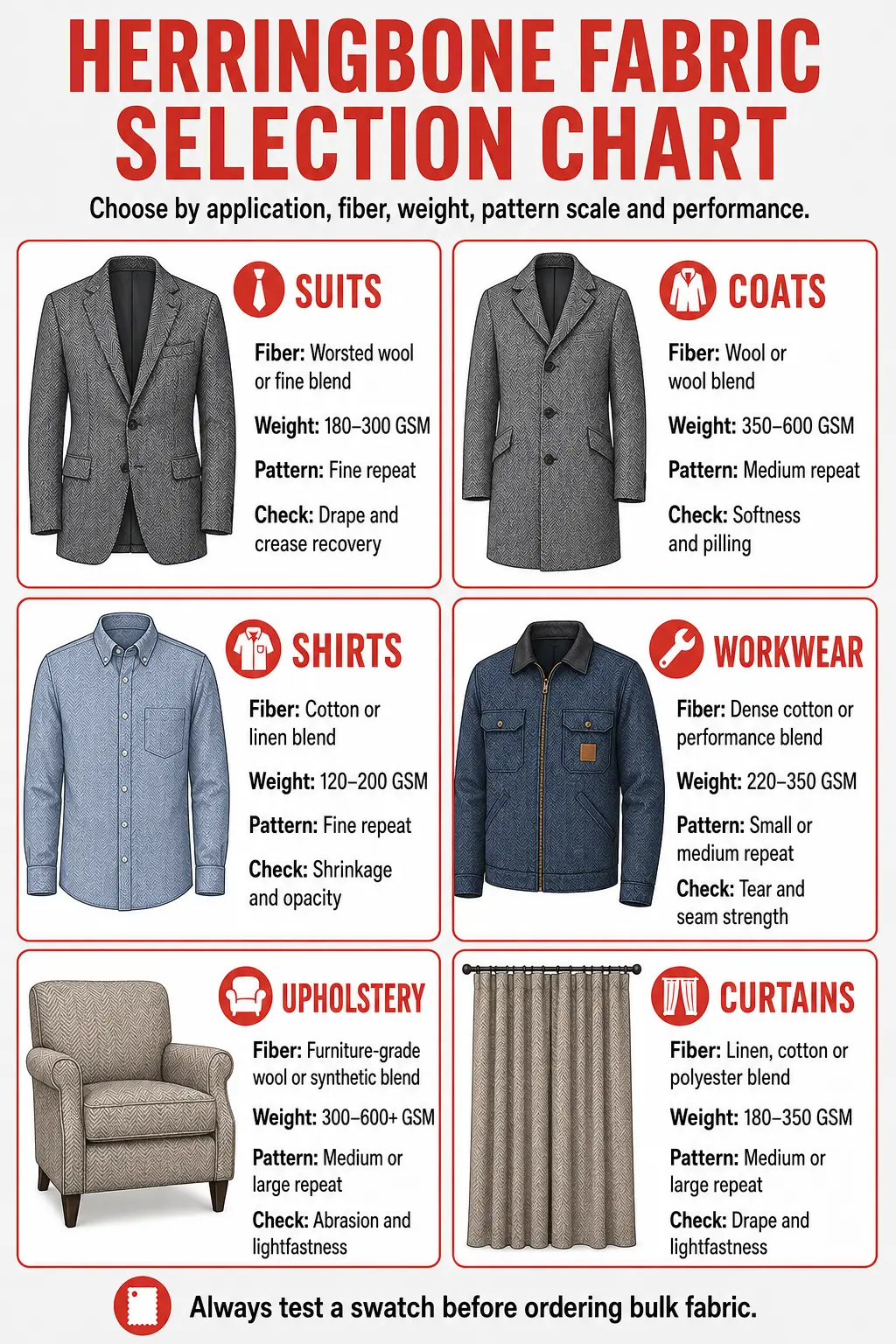
- Suits and blazers: Look for fine repeats, controlled drape, a smooth surface, good wrinkle recovery, and compatibility with the intended lining.
- Coats: Look for medium- or heavyweight wool and check its softness, pilling resistance, warmth, and wind resistance.
- Trousers and skirts: Check abrasion resistance in high-contact areas, suitable stretch and recovery, construction stability, and opacity.
- Shirts and dresses: Select lightweight, breathable, sufficiently opaque cotton, linen, or suitable blends.
Workwear and Accessories
- Workwear: Look for dense cotton or performance blends and check tear strength, seam strength, shrinkage, and colorfastness.
- Bags: Look for compact constructions and check for seam slippage, abrasion, interfacing, and closure support.
- Small accessories: For caps, ties, wallets, and similar items, check whether the pattern scale suits the product’s small components.
Interiors and Furnishings
- Upholstery: Look for furniture-rated fabric and check abrasion resistance, pilling resistance, lightfastness, cleanability, and the specified care instructions.
- Curtains & Drapes Check all stated characteristics for drape, weight, and lining as well as dimensional stability and anticipated exposure to sunlight.
- Throws and cushions: Review the care instructions and check pilling, comfort against the skin, color transfer, and shedding.
However, it should not be assumed that apparel-grade herringbone will meet the requirements for covering furniture.
Depending on their intended application and market, upholstery textiles may require test data for abrasion, flammability, seam slippage, physical properties, and colorfastness.
This means that one figure for abrasion will not capture the full range of durability required for upholstery.
Herringbone vs. Similar Fabrics and Patterns
| Comparison | Main difference |
|---|---|
| Herringbone vs chevron | Herringbone has staggered or broken direction changes; chevron normally forms continuous aligned points. |
| Herringbone vs standard twill | Standard twill continues in one diagonal direction, while herringbone periodically reverses direction. |
| Herringbone vs tweed | Herringbone describes a weave or pattern; tweed describes a broader class of textured fabric, commonly made from wool. |
| Herringbone vs houndstooth | Herringbone forms alternating diagonal ribs, while houndstooth creates a broken check with pointed shapes. |
| Woven vs printed herringbone | Woven herringbone is formed by yarn interlacing; printed herringbone places the appearance on the surface. |
| Herringbone vs zigzag | “Zigzag” is a broad visual description and does not confirm a particular textile construction. |
Most notably, herringbone has offset breaks at its reversals, while chevron has aligned points. Because sellers may use these terms loosely, checking a swatch is important.
How to select Herringbone Fabric?
Always follow this selection process before pricing or placing a bulk order.
- Define the application. What will the fabric be exposed to and what movement and contact will it experience?
- Choose the fiber. How does the fiber need to behave to satisfy needs for comfort and durability?
- Compare the weight. What is the fabric’s weight in GSM or ounces per square yard? Visual appearance alone can give a misleading impression of weight.
- Check the repeat scale. What will the size of the repeat be in relation to panels, pieces, and/or accessories?
- Assess handling. How does the fabric drape? What is the surface texture? Is it comfortable for skin? Opaque? How does it look in various directions?
- Inspect construction. Look at the inner and outer surfaces, the edges, and the overall quality and look for defects.
- Check total width and usable width: Compare the total fabric width with the usable width after excluding selvages and any defective edge areas.
- Collect stability data: Collect data on shrinkage, relaxation, skew, and other forms of dimensional change.
- Analyze deterioration: Examine pilling, abrasion, tearing, seam strength, and colorfastness.
- Evaluate stretch: Confirm stretch and recovery in each direction for products that are close fitting.
- Check care information: Available cleaning methods need to meet the requirements of the product and the customer.
- Perform practical tests: Wash, press, sew, stretch, and rub the swatch, and examine it under different lighting conditions.
- Verify dye lots: Source the required quantity from one verified dye lot when consistent color is important, and retain an approved reference sample.
- Prepare for matching: Use the actual fabric repeat and cutting plan to calculate additional fabric needs.
Compact Herringbone Selection Flow
Application → fiber → weight → repeat scale → performance requirements → care method → swatch test.
Also, compare the product’s fiber-content label with the seller’s description.
For example, certain textile products sold in the United States must disclose the generic fiber names and their percentages by weight under the U.S. Textile Fiber Rule.
How to Cut and Sew Herringbone Fabric
Woven herringbone should be treated as directional since some pieces placed in reverse may reflect light differently.
- Prepare the fabric: Pretreat or preshrink the fabric according to its intended care method before cutting.
- Pick a direction: All visible pieces should be placed in the same direction.
- Put down a guide: Use the grainline and a prominent herringbone line as references when positioning pattern pieces.
- Consider the focal point: Align center fronts, major seam lines, lapels, collars, and pockets consistently with the chosen pattern direction.
- Cut single layers: For accurate matching, control improves with cutting fabric in single layers.
- Mark the face: Mark the intended right side of every piece immediately after cutting.
- Stabilize bias edges: Before manipulating the edges, staystitch or stabilize bias edges.
- Select tools: Consider the weight of fabric to choose the size, point, and type of needle, as well as the type of thread and length of stitch.
- Test seams: Loosely woven or knitted structures may require seam testing to reduce fraying, seam slippage, or breakage.
- Choose interfacing: Provide support to areas as needed, while avoiding altering the drape or making the area too stiff.
- Sample pressing: Test temp, steam, pressure, and recovery on a sample.
- Use protection: Use a press cloth to prevent damage.
- Check synthetics: For synthetic fabrics, use a temperature within the care-label limit and test it on a sample first.
- Calculate matching waste: Be as precise as possible in determining matching waste with repeats, along the actual layout, and avoid arbitrary percentages.
How to Care for Herringbone Fabric
Use the care label as a guide. The herringbone pattern alone does not determine cleaning requirements; fiber content, dyes, finishes, fabric construction, trims, and garment structure must also be considered.
- Tailored wool: Brush, air, and spot-treat the item if needed. Follow the care label for professional cleaning.
- Washable cotton: To minimize fading or shrinking, follow the care label for washing at a low or medium temperature.
- Linen: Follow the care label when washing and drying linen because the chosen method can affect its softness, crispness, shrinkage, and wrinkles.
- Silk: Handle silk gently to reduce abrasion and snagging, treat perspiration promptly, and avoid harsh chemicals that may damage the fibers or dyes.
- Polyester or nylon: Excessive heat from dryers or irons can warp synthetic fibers.
- Blended fabrics: Identify the fiber, trim, lining, or finish with the most restrictive care requirement and follow that method.
- Upholstery: Follow the manufacturer’s cleaning code and do not use unapproved water- or solvent-based cleaning methods.
- Tailored storage: Use hangers that fit the item and preserve the shape of the shoulders.
- Heavy knits: Fold to prevent distortion.
- Stain treatment: Test the stain-treatment product on a concealed or inconspicuous area first.
Is Herringbone Fabric Sustainable?
Herringbone describes a method or pattern of weaving and therefore is neither sustainable nor unsustainable.
Consider the following when assessing sustainability:
- Fiber source: Consider the effects of farming, forestry, petrochemical extraction, land use, and animal welfare, as applicable.
- Recycled content: Check the percentage of recycled material, feedstock traceability, and relevant certifications.
- Processing: Consider the spinning, weaving, knitting, dyeing, and finishing along with water, energy, and chemicals.
- Durability and service life: Determine whether the fabric will meet its intended use and how frequently it may need replacement.
- Care: Consider washing frequency, water use, drying energy, cleaning chemicals, and the required care temperature.
- Repairability: Will it support easy repairs?
- End of life: Can it be composted, fiber recycled, or reused?
- Certifications: Assess certificate validity, product scope, transaction certificates or chain-of-custody records, and the credibility of the certification body.
Consequently, no single fiber name can substantiate total sustainability.
Wool, cotton, linen, and recycled polyester present different environmental impacts that are supply-specific.
A Short History of Herringbone Cloth
The name comes from the pattern’s resemblance to the repeating V-shaped arrangement of bones in a herring skeleton. However, reversed-twill structures existed long before the modern name became established.
Herringbone twill has been identified in ancient and medieval textiles from multiple European locations, demonstrating that early weavers could produce reversing twill structures. Wool was widely used for warm patterned cloth, and skilled weavers produced herringbone structures in wool and other available fibers. Herringbone later became strongly associated with menswear through regional tweeds and tailored cloths. Herringbone’s broken diagonals added visual depth to menswear fabrics without requiring large pictorial or floral motifs.
During the 20th century, herringbone twill was widely used in utility and military clothing, specifically military cotton herringbone twill. Herringbone twill became commonly known by the abbreviation HBT. For example, the U.S. Army issued herringbone-twill uniforms during World War II. Designers continued to use herringbone in bags, workwear, upholstery, and curtains in addition to fashion. Advances in textile production made herringbone fabrics available in a wider range of fibers, weights, finishes, and price points. Modern herringbone appears in woven, knitted, and printed textiles, while traditional herringbone generally referred to a woven reversing-twill structure.
Conclusion-
Herringbone typically refers to a fabric with a woven structure of broken twill ribs that reverse direction to create staggered V-shapes. However, a similar appearance may be produced through printing or knitting without using a woven herringbone structure. Therefore, select herringbone fabric according to its fiber content, weight, construction, repeat size, performance requirements, care method, and validated test data.
Ultimately, test a representative swatch before cutting, sewing, cleaning, upholstering, or placing a bulk fabric order.
Read More>> What is Damask Fabric?
FAQs
No, herringbone describes a reversing-twill construction or a similar visual pattern; it does not refer to a specific fiber. Herringbone fabric can be made from wool, cotton, linen, silk, polyester, or blends of different fibers.
The warmth of herringbone fabric depends mainly on its fiber content, weight, density, construction, and finish. In general, heavyweight wool herringbone suits are more suitable for cool weather, while lightweight linen herringbone suits are more suitable for warm weather.
Herringbone fabric can be breathable, but its visual pattern alone does not determine airflow; fiber type, yarn structure, fabric density, weight, finishing, and garment construction are more important. Cotton and linen herringbones are often breathable, but wool and synthetic herringbones can also manage airflow and moisture effectively depending on their weight, density, construction, and finish.
Traditional woven herringbone usually has little natural stretch along the warp and weft, although it may provide some movement on the bias. Stretch herringbone may be knitted, woven with elastane, or engineered to provide mechanical stretch without elastic fibers.
Linen and cotton herringbone fabrics generally crease more readily than comparable wool or polyester-blend herringbones, although yarn structure, fabric construction, and finishing can significantly affect wrinkle recovery.