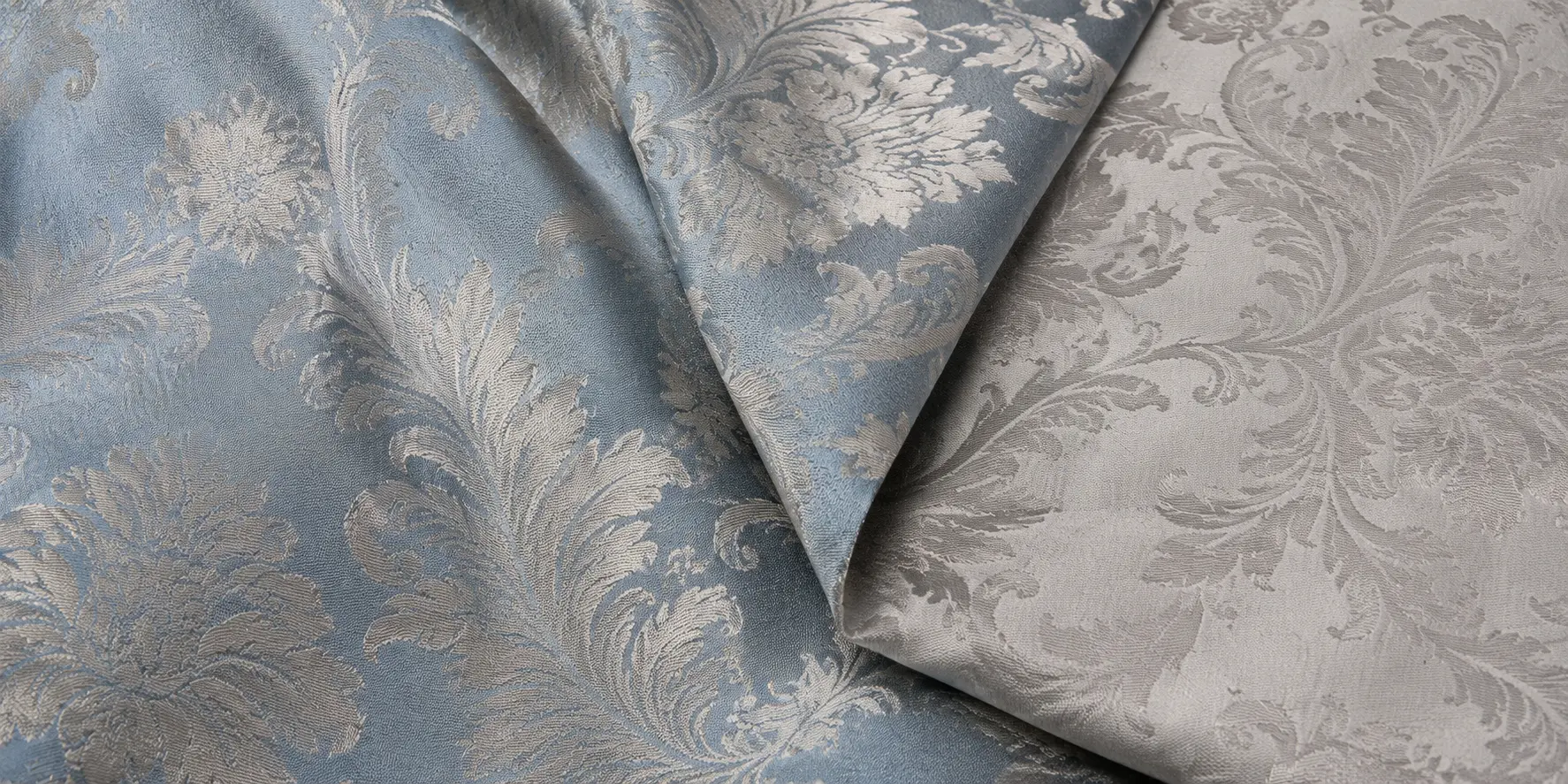

Damask is a woven fabric with patterns created during weaving, making printing, coating, or embroidery unnecessary. The fabric displays a pattern with a combination of reflective and matte areas.
While traditional damask fabrics display designs on both sides, the reverse usually shows the design with an inverted arrangement of light and dark areas. Today, damask fabric can be made using silk, cotton, linen, wool, viscose, polyester, or blended yarn.
| Question | Direct answer |
|---|---|
| What is damask? | A woven fabric with an integrated decorative pattern. |
| Is it printed? | Authentic damask is woven, not printed. |
| Is it reversible? | Technical damask normally has a reversible positive-and-negative pattern. |
| What is it made from? | Silk, cotton, linen, wool, rayon, polyester, or blends. |
| What is it best used for? | Table linen, curtains, upholstery, formalwear and structured accessories. |
| What is its main limitation? | Performance and care vary greatly according to fiber, weight and finish. |
What Is Damask Fabric?
Damask fabric is a figured textile with patterns built into its woven structure. The fabric contains areas that reflect light differently, creating tonal contrast between the motif and the ground.
Because of the structural arrangement of the weave, a traditional damask fabric can display a design on both sides of the fabric. Damask fabrics may be woven with multiple yarn colors or produced as monochromatic textiles.
Is Damask a Fabric, Weave, or Pattern?
Damask as a Woven Textile
Textile damask refers to a category of woven fabrics. The design is created through the interlacing of the warp and weft threads in a specific arrangement. Damask can be woven from a wide range of natural, regenerated, and synthetic fibers.
Damask as a Decorative Pattern
In surface design, “damask” commonly describes an ornate repeating motif inspired by woven damask, often featuring floral, scrolling, medallion, geometric, or heraldic elements. Damask style patterns may be present in fabrics, rugs, wallpapers, and other printed designs. They cannot be classified as woven damask unless the design is created through the process of weaving.
Printed damask can only replicate the look of woven designs. Historical flock wallpapers imitated the appearance of woven silk and linen damasks. Because of this, pattern style and structure in textiles must be considered as separate classifications.
Damask as a Jacquard Fabric
Jacquard refers to a patterned-weaving control system that allows individual warp ends, or selected groups of warp ends, to be raised according to the design. Damask, however, refers to a specific figured or reversible woven textile structure. For this reason, many modern damasks will fit into the broader jacquard fabric category.
Modern Jacquard systems can control individual warp yarns and reproduce complex pattern repeats accurately. However, damask existed well before Joseph-Marie Jacquard and his mechanized systems. Many historic examples of damask fabric predate Jacquard’s designs of the nineteenth century.
As a result, all damask fabrics can be described as patterned weaves; however, not all patterned weaves are damask. Jacquard-woven fabrics can include damask, brocade, matelassé, and fabrics designed to imitate a tapestry-like appearance, all of which can be complex constructions, but damask fabrics must maintain specific structural and visual elements.
How Is Damask Fabric Made?
Warp and Weft Yarns
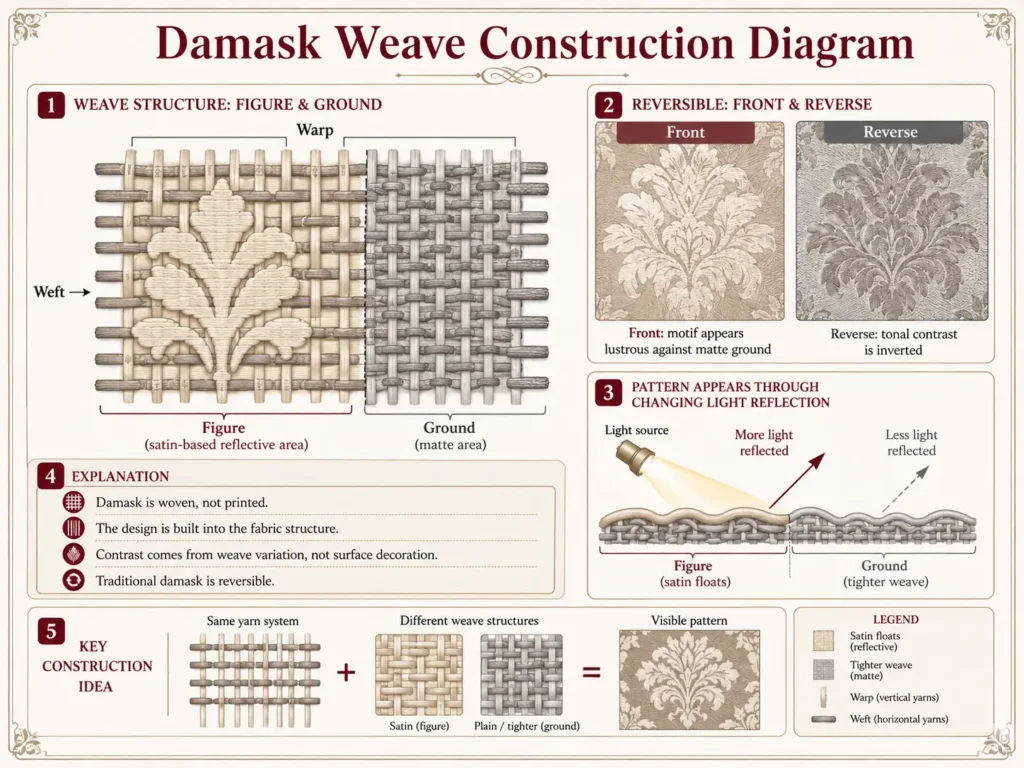
Warp yarns run the length of the fabric and remain under tension throughout weaving. Weft yarns run across the width of the fabric. Their planned interlacing with the warp yarns creates the fabric structure, ground, motifs, and selvedges.
Contrasting Weave Structures
Traditional damask typically contrasts lustrous warp-faced satin areas with duller weft-faced satin or sateen areas. Longer yarn floats with fewer interlacing points generally create a smoother, more lustrous surface that reflects light more strongly. Therefore, yarns that are utilized in damask can create a tonal pattern with a fairly high contrast, with one yarn color producing the pattern.
Damask structures may combine warp-faced satin, weft-faced satin or sateen, plain-weave, or twill areas to create differences in sheen and texture. These weave structures can influence the effects of light, contrast, and texture, as well as the reversibility of the fabric.
Reversible Patterns
On the front, a reflective motif may appear against a matte ground. On the reverse, the motif usually appears matte against a more reflective ground. The pattern may be inverted in a tonal relationship, but still be identifiable.
The reverse may not look similar to the front in all cases. A damask may also contain multiple colors or possess a compound structure, which can reduce visual symmetry between its two sides. Although the two sides may look different, a related structural reversal remains an important identifying characteristic.
Traditional Looms Vs. Modern Jacquard Looms
A conventional drawloom typically required a weaver and an assistant, known as a drawboy, who operated the pattern cords. Weaving highly detailed patterns was time-consuming and required considerable coordination. The consistency of each pattern repeat depended heavily on the skill and coordination of the operators.
The Jacquard mechanism refined and popularized earlier punched-card systems for automatically controlling complex woven patterns. Many modern industrial Jacquard looms use electronic or computerized pattern-control systems. This has led to significant improvements in the production of patterns that contain a high level of complexity and require a high degree of precision.
Key Characteristics of Damask
Two key aspects are used to identify a damask: the weave which controls pattern behavior and the fibers that make up the damask which control comfort and care.
Pattern Integration
Because the design is woven into the structure, it does not peel away like an applied print, although abrasion and yarn damage can still affect its appearance.
Reversibility
Traditional damask usually displays its woven pattern on both sides of the fabric, with the reverse showing an inverted tonal relationship.
Shifting Patterns
With slight changes in light or changes in the angle of viewing damask, the design may shift from bright and prominent to subtle and shadow-like as the light or viewing angle changes.
Texture
Damask is generally more even in appearance compared to heavily textured brocade, though longer floats may cause slight texture variations.
Weight and Drape
Damask may be lightweight, crisp, and fluid or heavy, dense, and structured. These characteristics are influenced by yarn size, fiber content, weave density, and finishing and should be selected according to the intended end use.
Breathability
Damask cannot be classified as breathable or non-breathable without considering the fiber content, density, thickness, finishes, and garment construction.
Cotton, for example, can produce a soft, breathable, and absorbent damask. A thick, densely woven polyester damask may feel warmer because its construction can restrict airflow.
Stretch
Traditionally woven damask has very little mechanical stretch. That being said, the use of textured yarns, elastane, or specialized construction can improve damask flexibility.
Durability
A dense damask construction can produce a strong, serviceable fabric, though durability will also be influenced by the seams, finishing, fibers, floats, and abrasion.
Decorative damask may not satisfy upholstery or commercial performance standards because longer exposed floats are susceptible to snagging when used in a high abrasion environment.
Types of Damask Fabric
With damask, fiber choice strongly influences comfort, appearance, durability, cost, care requirements, and overall fabric quality. Therefore, it should be prioritized over motif and color.
| Damask type | Typical character | Suitable applications | Main consideration |
|---|---|---|---|
| Silk damask | Lustrous, refined and light-responsive | Formalwear and luxury décor | Delicate care and higher cost |
| Cotton damask | Softer, absorbent and practical | Table linen, bedding and light furnishings | May wrinkle or shrink |
| Linen damask | Crisp, breathable and naturally textured | Premium table linen and curtains | Wrinkles easily |
| Wool damask | Warm and structured | Historic clothing and decorative interiors | Specialized cleaning |
| Rayon or viscose damask | Fluid with pronounced sheen | Apparel and decorative accents | Can weaken or distort when wet |
| Polyester damask | Wrinkle-resistant and economical | Events, curtains and commercial décor | Lower breathability in dense constructions |
| Blended damask | Performance depends on blend ratio | General apparel and interiors | Fiber percentages must be checked |
Silk damask can be structured and highly lustrous. Standard viscose rayon, by contrast, can lose substantial strength when wet. The behavior of damask crafted with polyester can vary a lot, depending on the yarn, construction, finishing, and the type of polymer used.
Technical Damask Structures
Single damask usually contains one set of warp yarns and one set of weft yarns and may be woven in one or two colors.
Compound damask allows more complex layering and color arrangements, which may create greater visual differences between the front and reverse.
Twill damask incorporates twill in the background and/or pattern and thus can have textures that are diagonal in addition to reflective contrast.
Damask vs Jacquard vs Brocade vs Satin
These terms describe different aspects or categories of textile construction and should not be treated as synonyms.
| Textile term | What it describes | Pattern construction | Reversible? | Surface |
|---|---|---|---|---|
| Damask | A specific patterned woven fabric | Contrasting weave structures | Normally yes | Relatively flat with tonal sheen |
| Jacquard | A broad patterned-weaving category or control method | Individually controlled yarn arrangement | Sometimes | Varies |
| Brocade | Decorative figured fabric | Often uses supplementary pattern yarns | Usually no | More raised or elaborate |
| Satin | A weave structure | Long yarn floats produce smoothness and sheen | Not inherently | Smooth and reflective |
| Printed damask | A damask-style motif | Ink or pigment applied to the surface | No structural reversal | Usually visually flat |
| Embroidered fabric | Surface decoration | Threads stitched onto completed fabric | Usually no | Raised stitching |
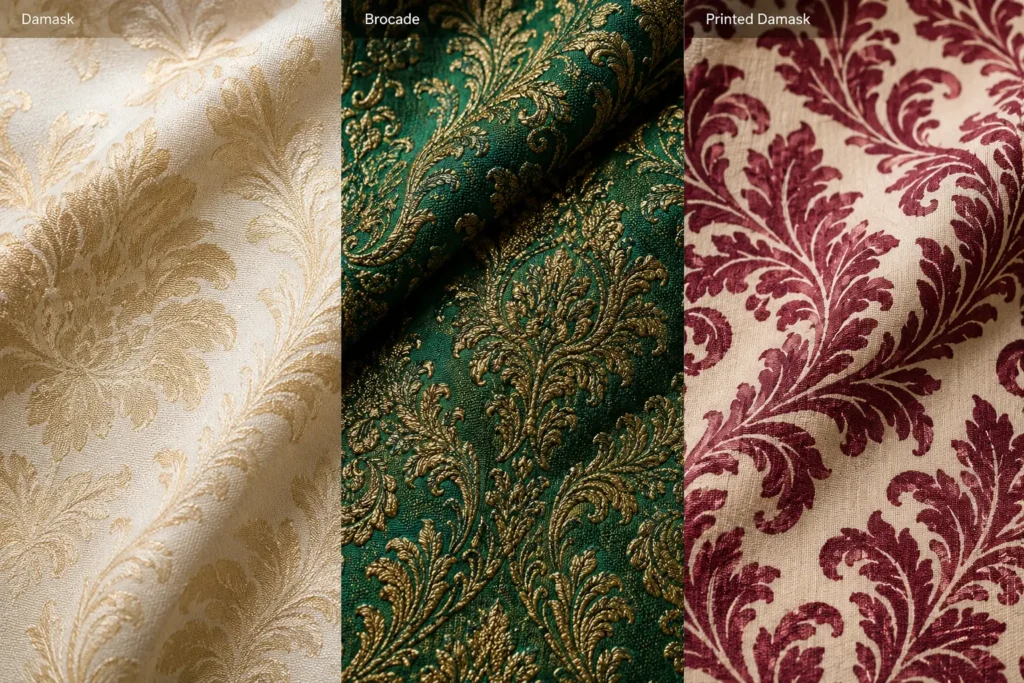
Today, damask and brocade are commonly produced on Jacquard looms, although both textile structures existed long before the Jacquard mechanism. Damask has a flatter and more structurally reversible appearance. Brocade is generally less reversible and often has visible supplementary-yarn floats on the reverse.
Satin can be a weave and is not a fiber. Moreover, it can be present in a damask configuration. Damask uses contrasting or reversed weave faces to distinguish the motif from the ground.
How Can You Identify Genuine Damask Fabric?
- Reverse-side test. Observe the entire motif on the reverse side. Authentic damask not only retains its motif, but will typically have inverted sections of reflective and matte finishes.
- Do an intersection check. Examine a few crossings of the yarns. Woven motifs will be aligned with the structure of the yarns, whereas printed motifs will sit over the yarn intersections.
- Look for printing problems. A printed damask-style fabric may have clean, precise motifs, so identification should focus on whether the yarn structure changes within the design and whether a related motif appears on the reverse.
- Light and shade. Genuine damask usually changes in appearance as the lighting or viewing angle changes. The contrast is bright in reflective float areas and subdued in matte areas.
- Examine a clean cut edge. The design should flow seamlessly with intertwined arrangements of yarn. Printed color may sit mainly on the surface or penetrate the fibers, but it does not create the structural weave reversal found in traditional damask.
- Compare front and reverse colors. Reversibility does not mean identical front and back colors. Either side may visually dominate, and the two sides may display different colors, tonal relationships, or levels of sheen.
- Check the fiber-content label separately. The word “damask” does not describe its fiber. You must check whether the fabric contains silk, cotton, polyester, viscose, wool, or another fiber.
In the United States, most covered textile products must carry a label stating the generic fiber names and their percentages by weight, the country of origin, and the identity of the manufacturer or another responsible business.
Advantages and Disadvantages of Damask Fabric
Advantages of Damask
- The design is woven into the fabric, so it does not peel away like an applied print, although the yarns can still wear or become damaged.
- Damask can create visual depth without requiring applied embroidery, coating, or printed surface decoration.
- Many damask fabrics provide reversible visual effects.
- Manufacturers can use several different fibers. Damask can be seen at many levels in the marketplace from luxury to budget.
- Dense furnishing damask can support decorative interior applications. Buyers should ensure the damask meets the intended use.
- Tone-on-tone designs add controlled pattern. Damask construction can integrate detail without a lot of colors.
- Damask works with both traditional and modern motifs. Designs may be geometric, abstract, floral, traditional, or minimalist.
Disadvantages of Damask
- Waste due to pattern matching. Large motifs or long pattern repeats may require additional fabric for accurate alignment at seams, corners, and adjoining panels.
- Snagging due to long floats. Damask that is loosely woven will likely snag around rough surfaces and may have limited durability in areas exposed to frequent abrasion or contact with rough surfaces.
- Fragile fibers and specialty cleaning. Some silk, wool, metallic, or specially finished damasks may require more careful handling or professional cleaning, depending on their construction and end use.
- Rigid and heavyweight fabrics. Dense furnishing damask may be too heavy or rigid for comfortable apparel, so its weight and drape should be matched to the intended end use.
- Reflective surfaces and shoddy work. Mistakes with construction such as puckered seams and creases show with surfaces that reflect light.
- Quality is not guaranteed. Just because fabric is labeled as damask does not mean that it is quality. It will depend on the fibers, finishing, density, and the workmanship.
What Is Damask Fabric Used For?
Table Linen
Cotton and linen damasks are commonly used for tablecloths, runners, napkins, and coordinated formal dining sets. They are absorbent and help keep the set neat, while the woven design helps with decoration. It is best to test the fabric for shrinkage, colorfastness, and stain-release performance before production.
A white damask tablecloth may make slight tonal variations less noticeable because the woven surface reflects light differently across the pattern. In contrast, a dark tablecloth may show water marks, lint, and detergent residue more readily and should be considered when thinking about maintenance.
Curtains and Drapery
Damask can be used as drapery and curtains fabrics as they can create many patterns designed to interact and respond to different intensities of light. However, fabrics can have a decorative pattern and still not block all light. It will depend on the construction of the fabric, the yarns used, and the density of the damask.
It is good to know the total usable width of the damask and the vertical pattern repeat because it will determine how the damask can be cut and used. Directional patterns can have different effects or serve various purposes when used with damask that has a directional sheen. A lining can improve the drapery’s privacy, insulation, light control, and protection from sunlight.
Upholstery
Upholstery damask can be used for covering chairs, headboards, benches, and other types of furniture. However, just by looking at a damask, you cannot tell if that damask will be resistant to abrasion, pilling, staining, or seam slippage. It is suggested that customers request performance evidence for these attributes.
Since long floats will snag with intensive usage, and loosely constructed damasks may experience seam slippage or yarn separation at heavily stressed seams, commercial environments will need more rigorous evidence than decorative residential damasks.
Clothing
Light and medium damask can be used to make dresses, skirts, jackets, waistcoats, and ceremonial wear. Damask intended for clothing should have a weight, drape, flexibility, and seam stability appropriate for the garment design. In comparison, heavy furnishing damask may restrict movement and provide less comfort when used for clothing.
When selecting damask for clothing, consider skin contact, climate, lining, motif scale, and the fabric’s weight and stiffness. In addition, the consistency of your panels can be affected by the direction of the fabric’s sheen. Therefore, all parts of the garment should have the same visual direction.
Accessories and Decorative Pieces
Damask can be used to make bags, cushions, runners, wall panels, boxes, and costume accessories. Small-scale projects can be great ways to showcase large or dramatic motifs. However, the scale of your motif should be appropriate for the final product.
For small-scale accessories, large repeated motifs may be lost, whereas a small medallion motif can be the focal point of your design. It is best to preview the cut area before purchasing to see how the fabric will look when constructed.
How to Choose Damask for a Specific Project
First, determine the project’s required performance. Afterward, consider the fiber content, weave construction, weight, care requirements, pattern repeat, and motif scale.
Natural fibers such as cotton and linen can be comfortable in hot weather, but actual performance also depends on weave density, thickness, finishing, moisture management, and garment construction. Because of this, consumers need to sample fabrics and not just read fiber names.
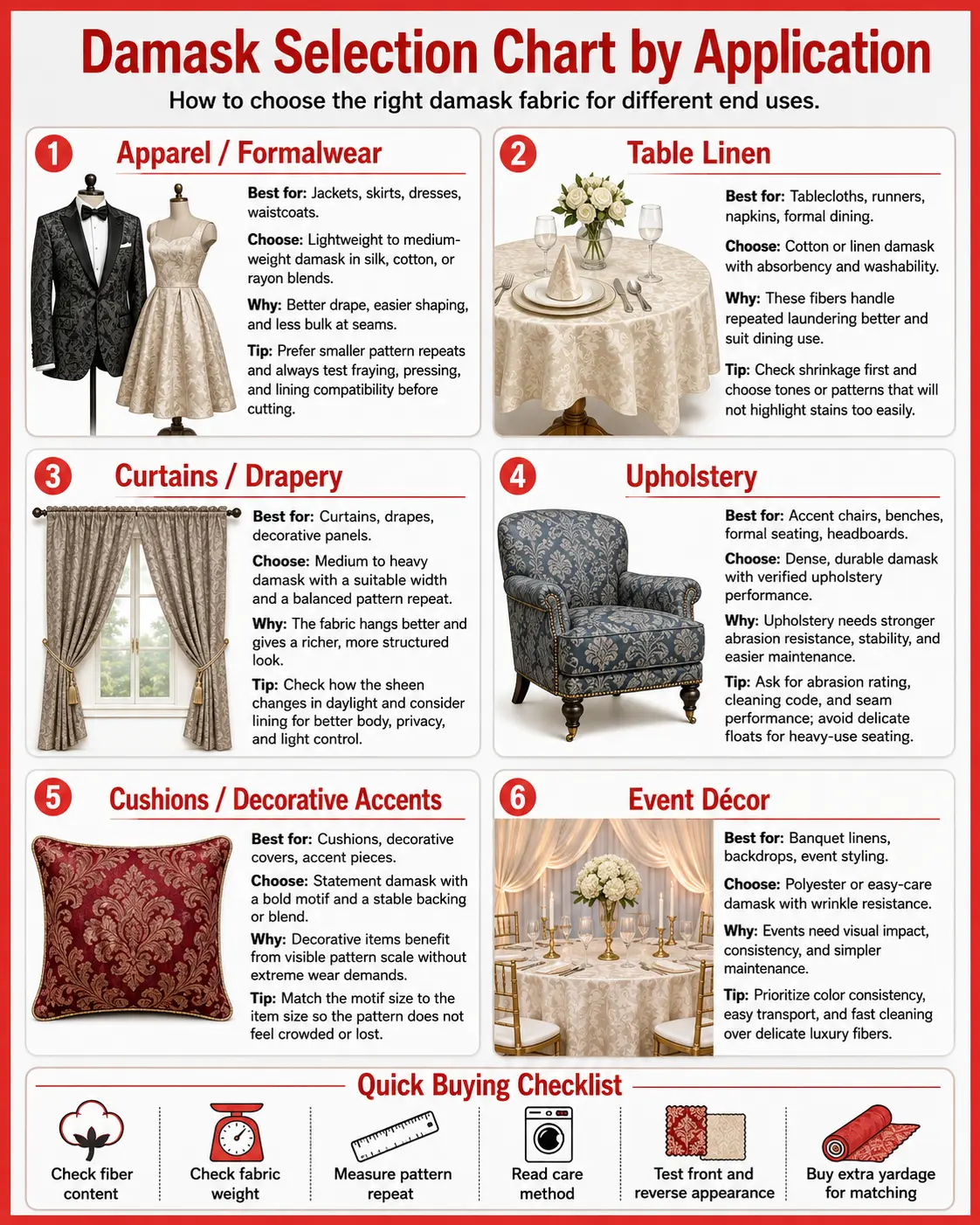
| Project | Prioritize | Avoid |
|---|---|---|
| Summer clothing | Cotton, linen or lighter rayon construction | Dense polyester upholstery damask |
| Structured jacket | Stable medium-weight damask with suitable lining | Very loose or snag-prone weave |
| Dining tablecloth | Washability, absorbency and colorfastness | Dry-clean-only silk |
| Curtains | Appropriate width, repeat size and lightfastness | Small remnants with mismatched repeats |
| Everyday upholstery | Verified abrasion, seam and cleaning performance | Choosing by appearance alone |
| Decorative cushions | Pattern scale and sheen | Oversized motif on a small cushion |
| Event decor | Wrinkle resistance and cleaning economy | Delicate fiber requiring specialist care |
Damask Buyer Checklist
- Get full fiber percentages. Don’t let imprecise descriptions like “silk feel” and “linen look” suffice.
- Ask for the fabric weight. Before judging a fabric, get the weight in either GSM or ounces per square yard.
- Confirm the usable fabric width. Considerations like decorative borders or damaged selvedges can reduce usable fabric width.
- Measure horizontal pattern repeat. This repeat impacts the alignment of individual panels, the placement of upholstery, and the amount of fabric required.
- Measure vertical pattern repeat. A larger vertical pattern repeat may require additional fabric so adjoining curtain panels can be matched while maintaining the intended finished length.
- Request shrinkage information. Ask how much the fabric may change in length and width after the recommended cleaning or finishing process.
- Request colorfastness info. Evaluate all factors including laundering, rubbing, light, and all cleaning chemicals.
- Test the final sample fabric using the care method intended for the finished product. Consider the final product and not just the sample fabric.
- Test the actual sample fabric. Refer to the AATCC for methods on fabric sample testing related to laundering and colorfastness.
How to Sew Damask Successfully
- Prewash or steam the fabric as appropriate. Follow testing and care recommendations for the fabric before cutting.
- Identify the fabric’s visual direction. Even without a raised nap, damask may have a directional sheen that changes with the cutting orientation.
- Cut all panels in the same direction. Cutting in opposite directions can result in panels appearing different shades under normal lighting.
During cutting, align dominant motifs across adjoining seams, panel centers, cushion faces, and other visually important areas. Additional fabric is usually needed when working with large pattern repeats. If your patterns have smaller repeats, less fabric is required. Test the needle, thread, seam construction, pressing temperature, and edge finish on a fabric offcut before sewing. Lightweight silk damask and dense furnishing damask may require different needle sizes, stitch lengths, seam finishes, and pressing methods. Overlocking, binding, or using enclosed seams can control fraying and protect the cut edges.
Pressing
Use a clean press cloth when ironing fabrics. Direct heat on fabrics can damage or change the finish. Use a press cloth on fabrics that may scorch, develop shine, or flatten under direct heat.
Washing and Care
There are different types of damask, especially considering the fibers. Also, there are different types of finishes and dyes. Because of all these possibilities, there is no one-size-fits-all washing method for damask.
- Silk damask has to be treated with care. Valuable or structured silk damask items are better off with professional cleaning.
- Many cotton damasks can be laundered more regularly, however, it is a good idea to test a sample before washing to confirm that the fabric will not shrink, bleed, distort, or lose its finish.
- Avoid over-drying linen damask because excessive drying can make later pressing more difficult.
- Standard viscose rayon damask can lose substantial strength when wet.
- While polyester damask can melt, glaze, shrink, or develop permanent shine when exposed to excessive heat.
Is Damask Fabric Pricey?
Damask can be a reasonably priced event fabric or a very expensive high-end textile. Because of this, there is no absolute price range for damask.
- Silk damask generally costs more than comparable polyester or cotton damask.
- Fine yarns, high thread counts, precise pattern definition, and specialized finishing can increase the price of damask.
- A denser damask may cost more to produce, but price alone does not determine whether it is suitable for a particular project.
- Complex motifs, numerous weave changes, additional colors, and demanding loom setups can increase production costs.
- More colors in a design can mean more control and complexity in manufacturing.
- A specialized finish can add to the fabric’s cost while providing benefits such as softness, stain resistance, or flame resistance.
- Smaller manufacturing runs usually mean higher costs.
- Damask fabrics can require more tests to meet commercial upholstery standards.
Damask that costs more isn’t automatically better. For repeated event use, washable polyester damask may be more practical than silk, while silk may be preferable for a luxury gown.
Is Damask Fabric Eco-Friendly?
Damask can be made in a way that is eco-friendly or produced in a way that is harmful. Damask cannot be classified as inherently sustainable or unsustainable solely by its weave structure.
It is critical that sustainability assessment covers the entire fabric and manufacturing system. A long-lasting damask could even mean fewer replacements, but highly intensive processing and low recyclability could negate that.
Investigate the Source of the Fiber
Does the fiber come from plants, animals, regenerated cellulose, virgin polymers, or recycled feedstock? Environmental claims should be substantiated and documented.
Assess the Balance of Recycled vs. Virgin Synthetic
Recycled polyester may contain either 100% recycled polyester or a documented blend of recycled and virgin polyester, depending on the product specification. Recycled content does not resolve all environmental issues. Consider product durability, shedding, the dyeing process, and end-of-life.
Assess Chemical Processing and Finishes
Environmental performance should be assessed for treatments such as dyes, optical brighteners, stain treatments, surface coatings, softeners, and flame treatments. Buyers should ask for chemical compliance if the project requirements demand it.
Conclusion-
Damask is more than just a pretty design. It is a woven textile with patterns. The clever construction allows for changes patterns with varied responses to light. Also, damask shows an inverted image of its pattern on the other side.
Damask also differs on the content of the fabric, like silk and polyester, and their blends. Buyers have to consider the weight, repeat, care, performance, and the purpose of the fabric separately.
Purchasing can be done successfully by the following. First, check the design is created by the yarns. Second, compare the technical properties to the requirements of your project. Test the material before doing any bulk order.
Read More>> Is Modal Fabric Breathable?
FAQs
Traditional damask is usually reversible because the warp-faced and weft-faced areas exchange visual roles on the reverse. However, some modern fabrics sold as damask are only partly reversible or use the term decoratively. Therefore, inspect both sides before purchasing.
No. Damask can be woven from silk, cotton, linen, wool, viscose, polyester, and blended fibers. It is defined mainly by its woven structure rather than by any particular fiber.
Damask breathability depends on fiber content, thickness, weave density, and finishing. Lightweight cotton or linen damask may feel cooler, while dense polyester damask may restrict airflow. The fabric’s construction matters more than the name “damask.”
Lightweight cotton or linen damask can be suitable for summer clothing. Natural, synthetic, and blended damasks should still be evaluated for airflow, weight, moisture management, and density. Also consider drape, opacity, and comfort against the skin.
Some cotton, linen, polyester, and certain rayon damasks may be machine-washable. Silk, wool, upholstery, and structured damask items may require specialized care. Always follow the care label and test uncertain fabric on a separate swatch.