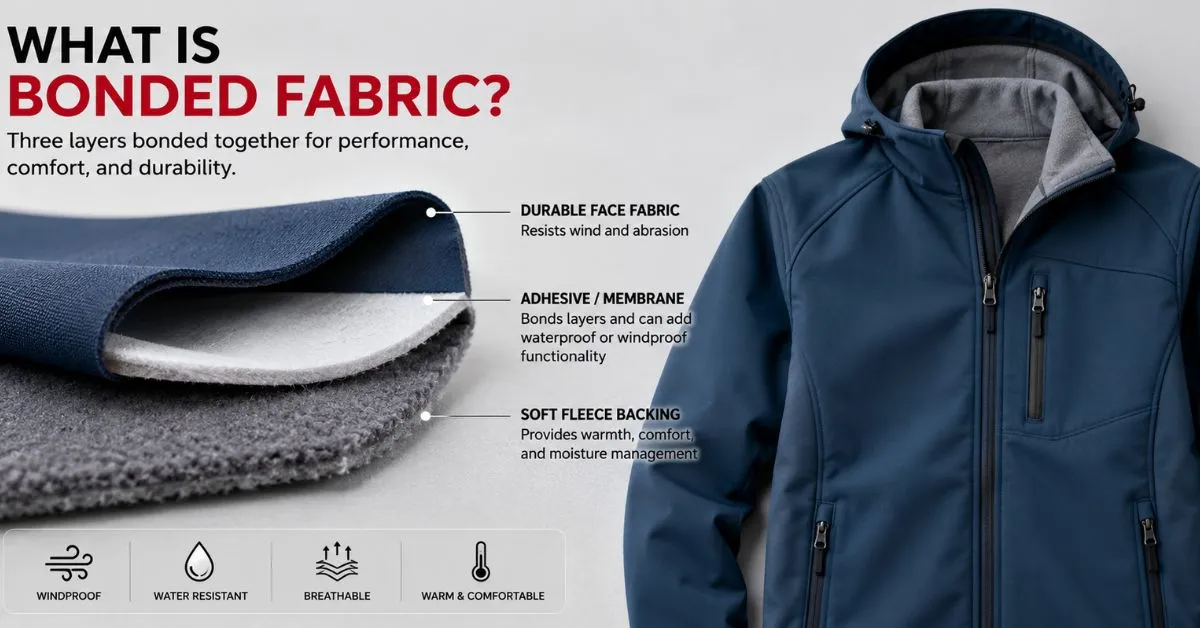

What is Bonded Fabric?
Bonded fabric refers to a textile produced by bonding two or more layers of fabric or a fabric and another material. The bonding could be done using adhesives, heat, pressure, flame, or ultrasonic energy. The resulting material is a composite fabric that has improved features such as insulation, structure, water resistance, cushioning, and durability. An example of bonded fabric is a fleece layer bonded to a water-resistant material for jackets.
The term bonded fabric can also refer to a nonwoven fabric made by bonding staple fibers. Therefore, bonded fabric can either be a layered composite fabric or a nonwoven sheet, depending on the manufacturer’s intention. It is essential to highlight the difference between bonded composite and nonwoven fabrics.
What Does Bonded Mean in Fabric?
The word bonded means that two or more layers of fabric or fibers have been adhered or attached to each other to create a new textile with enhanced properties. In most cases, bonded fabric is a composite fabric formed by bonding two or more textile layers.
A fabric manufacturer can bond:
- Two woven fabrics
- Two knitted fabrics
- One woven and one knitted fabric
- Fabric and foam
- Fabric and fleece
- Fabric and membrane
- Fabric and synthetic leather
- Face fabric and nonwoven
The face fabric provides the design, color, and abrasion resistance, whereas the other layer adds softness, insulation, weight, and stability. It is worth noting that bonded fabric does not refer to a specific fiber type. Therefore, cotton, polyester, nylon, viscose, wool, elastane, and other fibers can be used to make bonded fabric.
Is Bonded Fabric Woven, Knitted or Nonwoven?
A bonded fabric can be woven, nonwoven, or knitted because the term bonded refers to attaching two or more materials together to create a textile with improved properties. The term bonded fabric can have two meanings:
Bonded Layered Fabric
Bonded layered fabric refers to a textile made by laminating two or more layers of fabric or other materials. It is also called composite fabric or laminated fabric.
Examples of bonded layered fabric include:
- Polyester bonded to microfleece
- Nylon bonded to a waterproof membrane
- Jersey bonded to foam
- Faux leather bonded to woven fabric
- Fashion fabric bonded to an interlining
Bonded Nonwoven Fabric
A bonded nonwoven fabric refers to a textile made by entangling fibers using mechanical, thermal, or chemical methods. The fibers are not first spun into yarn and then woven or knitted into a fabric. Instead, they are formed into a web and then bonded together.
The process of making nonwoven fabric involves the following steps:
- Web formation
- Bonding
- Finishing
The bonding step can be done by needling, thermal bonding, chemical bonding, hydroentangling, or using spunbond or meltblown technology.
Nonwoven fabric is used to produce filters, wipes, medical apparel, insulation, interlinings, and geotextiles. According to the FTC Textile Products Identification Act, the term textile fiber includes fibers formed into fabric by entanglement or bonding. [FTC Textile Products Identification Act]
How Is Bonded Fabric Made?
Several bonding techniques can be used to make bonded fabric. A bonded fabric manufacturer usually follows specific production steps, depending on the intended use and materials.
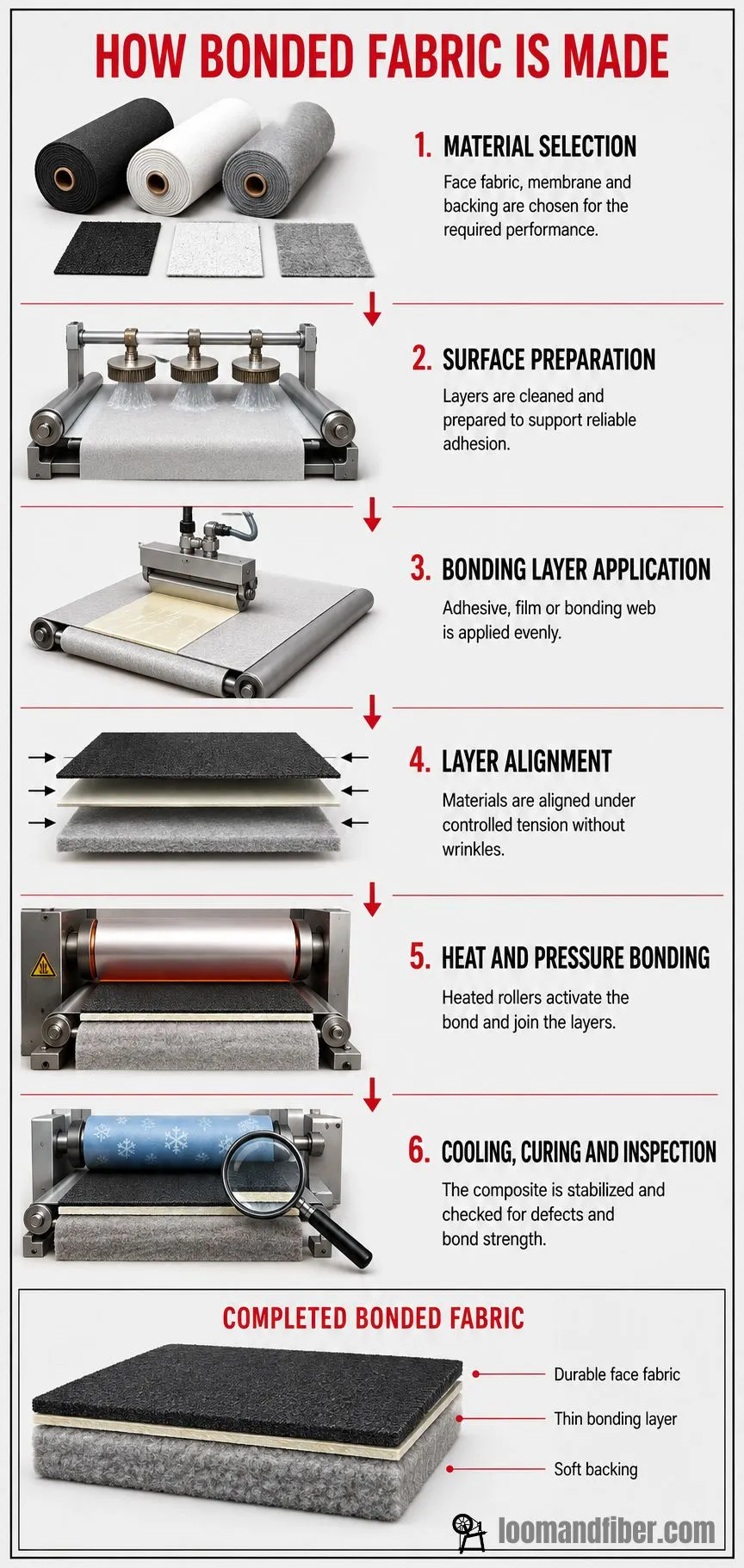
Material Selection
The fabric manufacturer selects the face fabric, backing, and any other layers that will be bonded together to form the desired composite fabric. The face fabric and backing should have good bonding properties.
For instance, a manufacturer can produce a bonded softshell jacket fabric by bonding a tightly knitted polyester face fabric, a breathable membrane, and a brushed fleece layer.
Surface Preparation
The manufacturer prepares the fabric surfaces by cleaning and/or treating them to ensure they bond well. Dirt, moisture, oil, and finishing chemicals can hinder the bonding process. Some fabric layers may need corona, plasma, or chemical treatment to activate bonding.
Adhesive or Bonding Agent
The manufacturer applies an adhesive agent as a film, powder, web, liquid, or printed pattern. A continuous adhesive layer may provide a strong bond, but it can also make the fabric stiff and less breathable. On the other hand, a dot pattern allows the fabric to breathe and have a better drape.
Layer Assembly
The manufacturer assembles the fabric layers by placing them on rollers in the desired order. Rollers ensure that the fabric layers are aligned correctly and do not develop wrinkles. In some cases, the rollers apply pressure to remove air pockets and unwanted wrinkles.
The assembly step is crucial because it determines the final fabric quality. Therefore, it is essential to ensure that the fabric layers adhere to each other evenly without forming folds, creases, or irregularities.
Heat and Pressure
The assembled layers pass through heated rollers, a press, or another bonding machine that applies pressure to adhere the fabric layers together. The heat activates the bonding agent and ensures that the layers fuse together. However, excessive heat can damage the membrane, flatten the fleece, bleach the fabric, or weaken the elastic.
Cooling and Curing
The fabric manufacturer cools the bonded fabric under controlled conditions. Some bonding agents may require extra curing time to achieve the desired properties.
Finishing and Inspection
The fabric manufacturer finishes and inspects the bonded fabric for quality. The finishing process may involve trimming, dyeing, printing, brushing, or applying a water-repellent finish to the fabric. The manufacturer can also cut the fabric into the desired size and shape.
The fabric manufacturer inspects the bonded fabric for delamination, bubbles, wrinkles, unevenness, color variation, and width inconsistencies. The manufacturer can also perform a fabric bond strength test to ensure the fabric meets the quality standards. For instance, the AATCC developed TM136 standard for testing the bond strength of bonded and laminated fabrics. [AATCC history and test-method information]
Main Bonding Methods
Adhesive Bonding
Adhesive bonding uses an adhesive agent to stick two fabric layers together. The bonding agent can be in the form of a film, powder, web, liquid, or printed pattern.
Adhesive bonding is a preferred method because it is versatile and can be used to adhere most fabric layers, foams, and membranes. However, the adhesive agent should be selected based on the washing temperature, elasticity, and chemical resistance of the bonded fabric.
Thermal Bonding
Thermal bonding uses heat to fuse two fabric layers together. The heat usually comes from a heated roller that applies pressure to adhere the fabric layers. This bonding method usually utilizes a thermoplastic fiber, film, or web to bond the fabric layers.
For instance, polyester, polypropylene, and polyamide bonding webs can be used to bond woven and nonwoven fabrics.
Flame Bonding
Flame bonding is a technique that uses an open flame to adhere fabric to polyurethane foam. It works by briefly exposing the foam to an open flame, thereby heating and softening its surface. The softened foam then adheres to the fabric layer.
Flame bonding is commonly used in the automotive industry to attach foam to upholstery and other surfaces. However, the process can generate undesirable odors and weaken the foam if not done correctly.
Hot-Melt Bonding
Hot-melt bonding uses a hot-melt adhesive agent to adhere fabric layers, foam, or other materials. The adhesive agent is usually in the form of a film or web that is applied to one fabric layer and then pressed against the other layer.
Hot-melt bonding agents do not use solvents and offer excellent flexibility, elasticity, and resistance to washing. The adhesive agent should have an appropriate melting point, flexibility, and washing resistance.
Ultrasonic Bonding
Ultrasonic bonding uses high-frequency mechanical vibrations to generate heat and fuse thermoplastic materials. The process does not involve using adhesives, and it is ideal for bonding materials that have been processed to contain thermoplastic components.
This bonding technique is used in the medical, protective clothing, and technical textile industries.
Mechanical Bonding
Mechanical bonding refers to physically entangling fibers using needles, water jets, or other mechanical methods to form a fabric. This bonding method is mainly used to produce nonwoven fabrics.
Needle-punched nonwoven fabric is an example of a mechanically bonded fabric.
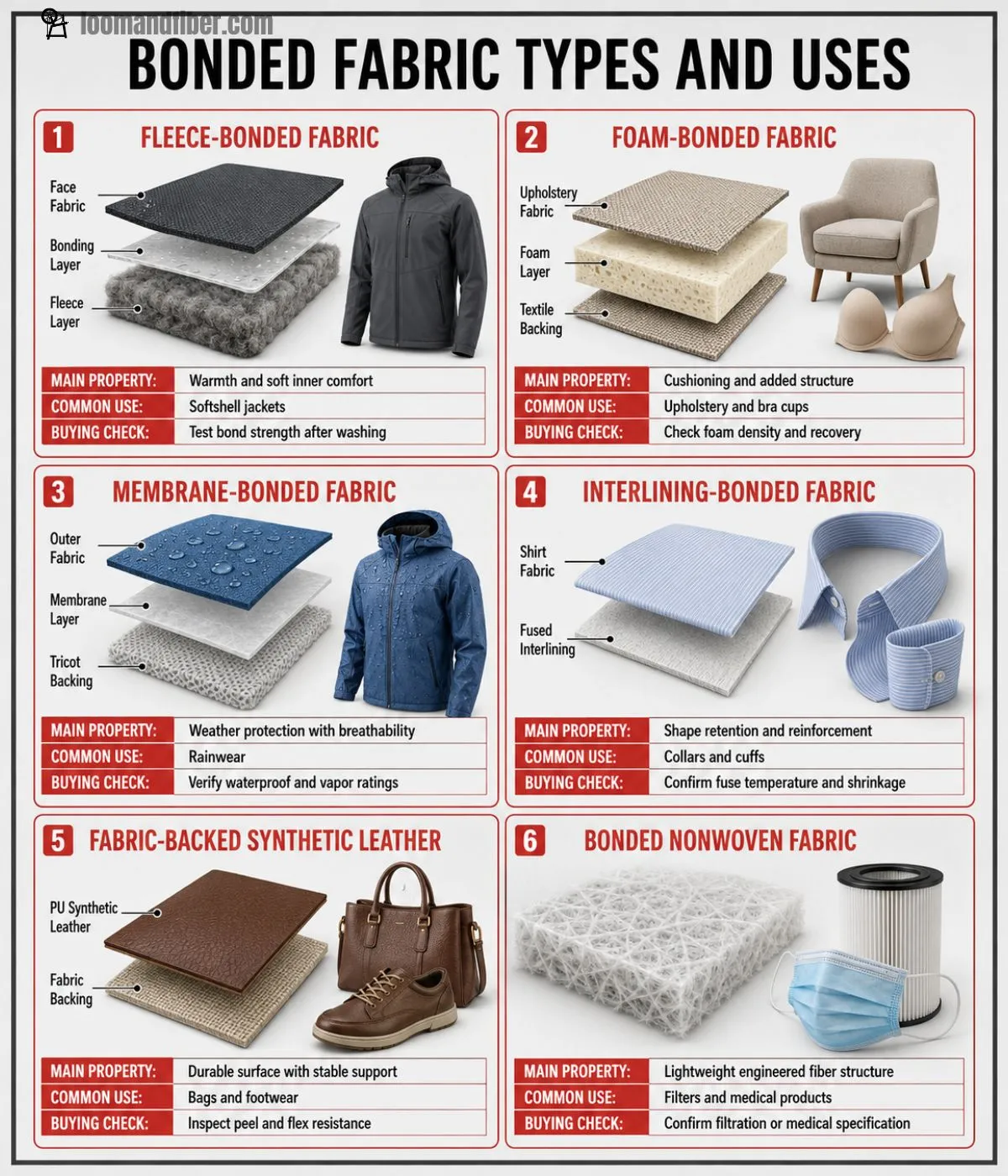
Common Types of Bonded Fabric
Fleece-Bonded Fabric
Fleece-bonded fabric is a type of composite fabric that consists of an outer fabric layer bonded to a brushed inner layer. The fabric is used to make garments and accessories that require extra insulation without the need for a separate lining.
Fleece-bonded fabric is ideal for making softshell jackets, outdoor pants, gloves, and cold-weather workwear.
Foam-Bonded Fabric
Foam-bonded fabric refers to a textile material that consists of a foam layer laminated to one or two fabric layers. The foam layer adds bulkiness, cushioning, resilience, and sound insulation to the fabric. Foam-bonded fabric is used to produce garments, accessories, and other products such as bra cups, vehicle seats, headliners, shoes, and upholstery.
Membrane-Bonded Fabric
Membrane bonded fabric refers to a textile material that consists of a membrane layer laminated between a face fabric and a backing. The membrane layer determines the membrane fabric’s end-use, and it can be hydrophilic or hydrophobic.
Membrane bonded fabric is used to make raincoats, outdoor clothing, and workwear. Waterproof membrane fabric is not entirely waterproof because the seams and other weak points need to be sealed.
Interlining-Bonded Fabric
An interlining is a fabric layer that is laminated to the wrong side of a garment or fabric to add fullness, shape, and stiffness. Fusible interlining is commonly used in clothing to give it a crisp finish. Interlining bonded fabric is used to produce collars, cuffs, waistbands, and other garment parts that require extra structure.
Faux Leather with Bonded Backing
Faux leather or synthetic leather usually consists of a polyurethane or PVC layer bonded to a woven or nonwoven fabric. The bonded backing adds durability, dimensional stability, and ease of cutting and sewing to the synthetic leather.
Bonded Lace or Delicate Fabric
Delicate fabric such as lace can be laminated to another fabric to add weight, reduce transparency, and enhance durability. It can also be used to make patterns that are easy to cut.
What Is Bonded Fabric Used For?
Outdoor Clothing
Bonded materials are used in softshell jackets, hiking pants, gloves, and cycling clothes as a single construction can provide weather resistance, stretch, warmth, and comfort.
Rainwear
Face fabrics can be bonded to waterproof or water-repellent membranes to provide protection from the weather while allowing moisture to escape.
The performance of rainwear depends on the properties of the membrane, any face treatments, seams, closures, and the design of the garment.
Sportswear
Stretch knit fabrics can be bonded to provide compression, support, and shape in sports bras, compression garments, and supportive athletic wear.
The manufacturer needs to ensure that the bond can withstand repeated stretching without cracking or delamination.
Automotive Interior
Automotive interior materials often involve foam laminates and bonded fabrics that must withstand temperature extremes, vibration, abrasion, and aging.
Upholstery
A bond can add body, cushioning, and shape to upholstery fabric. A backing can also help prevent fraying or provide a decorative surface that endures frequent use.
Footwear and Bags
Shoes, bags, and handbags often use bonded composites to add structure, padding, moisture resistance, and protection from abrasion.
Protective Clothing
Protective clothing can involve multiple bonded layers to add insulation, chemical resistance, reflectivity, and/or protection from the elements.
A bonded fabric should not be relied upon to provide protection against any hazardous material unless the complete construction has been tested and certified according to the relevant standards.
Medical and Hygiene
Nonwoven bonded materials can be found in masks, medical gowns, wipes, hygiene products, and packaging. The key performance considerations include fluid resistance, barrier properties, filtration, and comfort.
Home Textiles
Home textiles include bonded materials in blackout lining, mattress covers, tablecloths, carpet backing, and insulating window treatments.
Advantages of Bonded Fabric
Bonding allows multiple performances within a single textile construction.
Key benefits include
- greater warmth without a separate lining,
- more body and cushioning,
- increased dimensional stability,
- resistance to stretching or distortion,
- a smart appearance,
- faster garment assembly,
- potential weather resistance,
- enhanced surface durability,
- contrasting tactile sensations for different layers,
- and reduced slipping of layers
- The composite can also be easier to cut and sew due to the bond’s cohesion.
Disadvantages of Bonded Fabric
Bonded constructions also have some disadvantages.
Some of the common ones include
- delamination after washing,
- reduced breathability,
- increased stiffness,
- higher cost,
- recycling challenges,
- potential sensitivity to heat or solvents,
- unpleasant odor from poor-quality adhesive,
- bubbling,
- reduced stretch,
- and
- repairability issues.
The performance of the composite is only as good as the weakest component or the bond itself.
Bonded Fabric vs Laminated Fabric
Laminated fabric and bonded fabric are sometimes used interchangeably, but suppliers may make a distinction between the two.
Bonded fabric typically refers to materials that are adhered, heat-sealed, or otherwise attached together, whereas laminated fabric refers to a laminating process.
The best way to identify the difference is to ask the supplier to specify the construction.
A fabric made of two layers of woven polyester and a layer of nonwoven polypropylene bonded together with a hot press would be considered a bonded fabric.
When asking about a fabric’s construction, it is helpful to inquire about the number of layers, the fibers in each layer, and whether any membrane, foam, or laminate has been added.
It is also helpful to ask what bonding or laminating method has been used to attach the layers and whether the bond is suitable for washing, dry cleaning, or exposure to weather.
Bonded Fabric vs Coated Fabric
A bonded fabric refers to a composite material that is made by attaching two or more layers together.
Coated fabric refers to a textile that has been covered with a polymer, rubber, or other coating.
For example, a fabric made by bonding two layers of woven polyester is a bonded fabric.
A woven polyester fabric that is coated on one side with polyurethane is a coated fabric.
A fabric made of woven polyester bonded to a polyurethane membrane would be a laminated or bonded composite.
Both constructions can offer improved weather resistance, but the feel, weight, breathability, and durability can be noticeably different.
Bonded Fabric vs Fusible Interfacing
Fusible interfacing is a type of bonded fabric that is typically used to add shaping, firmness, or durability to specific areas of a garment. It usually has an adhesive coating on one side that is activated by heat and bonded to another layer of fabric. A bonded fabric is a wider category that includes fusible interfacings, as well as other constructions that involve attaching two or more layers with an adhesive, heat, or pressure.
Is Bonded Fabric Waterproof?
Bonded fabric is not waterproof by default. A continuous waterproof or water-resistant barrier, such as a membrane or coating, needs to be incorporated into the construction for it to repel water. It is also necessary to ensure that the waterproof barrier is continuous across all seams, and openings such as zippers, are adequately sealed. Some fleece bonded composite outerwear shells are water-resistant and do not repel large volumes of water, so they are only suited to light rains.
Buyers should ask for quantitative information, such as hydrostatic pressure or water-column resistance, and test results if moisture resistance is a priority.
Read More>> Is polyester Waterproof or just Water-resistant?
Is Bonded Fabric Breathable?
A bonded fabric’s breathability depends on the construction, laminates, and finishes used. A breathable membrane or a loosely woven face fabric allows moisture to pass through, while a plastic coating or adhesive may prevent it. A bonded fabric should not be relied upon to keep the wearer comfortable in warm conditions without testing or specific design features.
The term ‘breathable’ should be treated cautiously, as it refers to a broad range of performance levels unless quantified by a standardized test.
Is Bonded Fabric Stretchy?
A bonded fabric can be stretchy if the weave, knit, or composite structure allows it. The bonded fabric’s elasticity can also depend on the adhesive, so a stretchy face fabric may lose much of its stretch when bonded to a stiff layer. or activewear, the stretch, percentage of extension, and recovery should be considered. All components must be able to withstand the stresses of stretching without delamination.
How to Choose Bonded Fabric
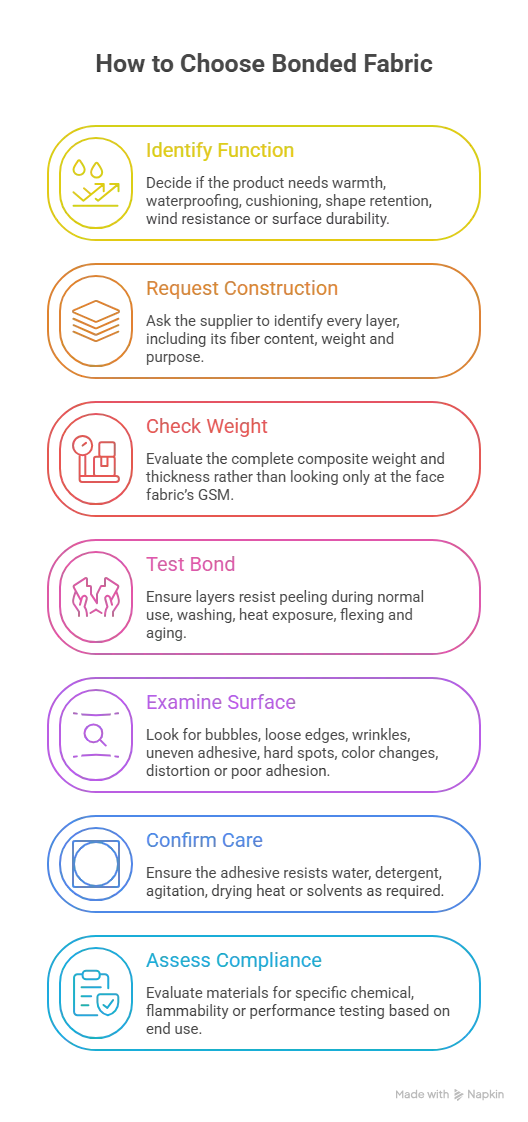
Determine the Required Performance
Identify whether warmth, abrasion resistance, cushioning, breathability, waterproofing, or other attributes are needed.
Avoid paying for features that are not required, such as waterproofing for a lightweight summer garment.
Specify the Complete Construction
Request a detailed description of the material, including the fibers in each layer and their weights.
“100% polyester” usually refers to textile fibers, but a composite may have a nonwoven bonding layer that is made from another type of polymer. In the United States, textile fiber content labeling laws only apply to textile fibers, and do not cover membranes or coatings. [Thread the Needle: Your Guide to Textile and Wool Acts]
Consider the Weight and Thickness
Bonding adds weight and thickness, so specifications should take this into account.
Evaluate the Bond Strength
Peel strength is an essential characteristic that must be adequate for the fabric’s end-use. It may be necessary to physically test how the materials hold up to bending, washing, and aging.
Examine the Surface
Look for imperfections such as bubbles, holes, rough or uneven edges, wrinkles, stiff spots, and color variations.
Check whether any areas have failed to adhere to the other layers or exhibit distortion.
Confirm Care Instructions
A fabric that is intended for washable garments must have a bond that is compatible with laundering.
Dry-clean-only constructions need appropriate resistance to solvents. Delamination is a common weakness in bonded materials, so it is important to match the fabric to the care method.
Evaluate Safety and Compliance
Materials suitable for children’s clothing, medical devices, protective equipment, or automotive seating may require additional performance and safety testing. The end-use of the fabric influences its compliance requirements.
How to Wash and Care for Bonded Fabric
Always follow the care instructions for the bonded fabric item, as the membranes and adhesive may behave differently from the face fabric. In general, bonded materials may require special handling and gentle treatment. Washing in warm or cooler water is preferable, where possible.
Additional guidelines may include the following:
- Use a liquid detergent that is suitable for delicate garments and avoid bleach.
- Choose a gentle washing cycle and minimize high-speed agitation.
- Air- or tumble-dry on a low heat setting.
- Do not iron directly over membranes or foam inserts.
- Avoid fabric softener, if the care instructions do not recommend it.
- Avoid high heat when washing, drying, or ironing, if the materials begin to bubble or peel.
Manufacturers and importers of clothing made in the United States must provide consumer care instructions that are permanently attached to or on the product and are legible during the product’s useful life. [FTC Care Labeling Rule]
How Long Does Bonded Fabric Last?
The bonded material’s longevity depends on its composition, bonding technology, and exposure to stress, moisture, heat, and ultraviolet light. A high-quality composite that has been properly maintained can last for the lifetime of the garment. Lower-quality bonded fabrics can begin to peel or bubble after just a few washes.
Accelerated aging and laundering tests can provide more information about the bonded material’s potential lifespan than testing an unworn sample.
Can Bonded Fabric Be Recycled?
Bonded fabric can be challenging to recycle due to the combination of fibers, polymers, and adhesives that make up the composite. A bonded fabric with a polyester face, polyurethane membrane, and a fleece lining would need to be separated before being recycled, but the individual layers might not be separable in practice.
Recycling single-polymer composites is relatively easier. For instance, using polyester for the face, lining, and bonding material instead of combining different fibers and materials can make recycling easier. Nevertheless, practical recycling opportunities still depend on the local waste management infrastructure.
Conclusion-
Bonded fabric is a composite material that is made from different fabrics, membranes, foams, and other materials that are permanently joined together by an adhesive, heat, pressure, flame, or other bonding techniques. It can also refer to a process of making nonwoven fabrics by entangling fibers.
The primary benefit of a bonded fabric is that it combines multiple desirable qualities, such as warmth, structure, insulation, and weather-resistance, within a single material. However, its performance depends on the characteristics of the materials used and the bond between them.
FAQs
Woven, knitted, or nonwoven fabrics made from polyester, nylon, cotton, viscose, wool, elastane, and other fibers can be used in bonded constructions. Foam, adhesive, membrane, and other materials can also be part of a composite.
Fleece-bonded and insulated constructions are good for creating warm winter wear, as they combine an outer shell and an insulating lining.
A bonded fabric can be warm and fluffy if it includes a brushed or lofty fleece layer or has an insulating backing. Thin laminates often provide weather protection but little insulation.
A bonded fabric can delaminate if the wrong adhesive has been used, manufacturing conditions have not been correctly observed, or the material has been exposed to extreme heat, moisture, or solvents.
Some bonded materials can be safely pressed at a low temperature. High heat should be avoided, as it can damage the membrane or cause the fabric to delaminate.
Some neoprene sheets are made by laminating fabric to a foam core, but not all bonded materials are neoprene, and not all neoprene products are laminated.
A bonded fabric is made from two or more layers or fibers that are permanently joined together by an adhesive or another bonding method. A non-bonded woven or knitted fabric is made by interlacing fibers without additional bonding.