

Curtains don’t have to touch the floor, but full-length curtains always look well-proportioned in a living room or bedroom when they either kiss or lightly float above the floor. A small gap makes it easier for curtains that you open during the day, but extra fabric resting on the floor creates a more decorative effect.
To select the most appropriate finish, consider how the curtains move and the surface below them. Decide what appearance you want to create before measuring from your curtain hardware.
Float, Kiss, Break or Puddle: What Is the Difference?
Floor-length curtains always require a little extra fabric at the bottom to create either a pool or a gap between the hem and floor. These variations are often described using the terms float, kiss, break and puddle, although retailers and designers use the terms interchangeably.
| Style | Appearance | Ease of opening and closing | Cleaning | Suitable uses |
|---|---|---|---|---|
| Float | Clean, tailored; floor visible beneath the hem | Easiest; hem does not catch on carpet or rugs | Least dust and dirt contact | Everyday living rooms, bedrooms, kitchens, homes with pets or children |
| Kiss | Neat and fitted when exact | Easy on smooth floors; can drag over thick carpet | Light contact with the floor | Formal rooms, curtains that are mostly kept closed |
| Break | Soft, relaxed, slightly generous | Moderate; the bend can catch if pulled often | Collects more dust at the hem | Bedrooms and traditional rooms where curtains stay put |
| Puddle | Dramatic, luxurious, formal | Hardest; fabric must be rearranged after each use | Most dirt contact; needs regular care | Rarely moved decorative drapes, formal or period-style rooms |
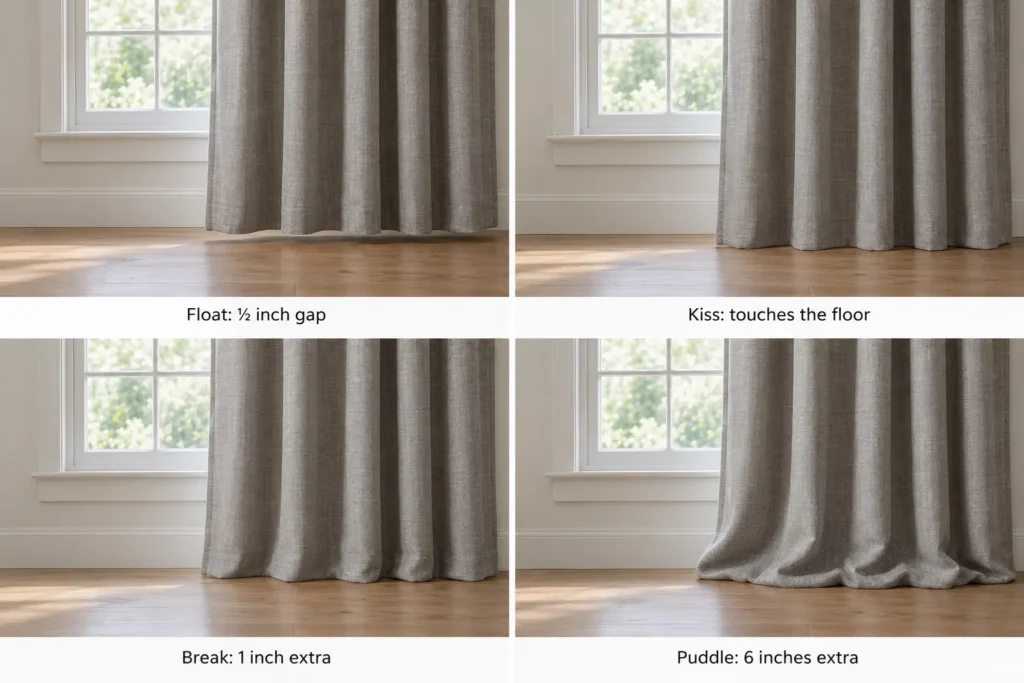
Floating Curtains
A floating curtain always has a small gap between the hem and floor, but ½ inch clearance is a personal preference rather than a rule for full-length curtains. An approximate 1.3 cm (1/2 inch) clearance is suggested by some interior designers, who consider it ideal for operational curtains in a high-traffic area. Always allow for flooring and clearance as your curtain moves when calculating your own desired gap.
Curtains That Kiss the Floor
A kissing finish creates a line of curtain that flows down to exactly meet the floor, but requires a perfectly even surface to avoid a section of fabric lifting or falling. This is the most decorative option, but small inconsistencies will mean one side of a curtain is always hovering above the floor while the other rests on it.
Curtains With a Break
A curtain with a break finish extends sufficiently below the hook so that the hem sags slightly instead of lying flat against the floor. Although this is another option for shortening the appearance of a window, a break leaves the hem touching the floor. Assess whether extra length will make it difficult to move the curtains or keep them clean.
Puddled Curtains
Puddled curtains are designed to create a pool of fabric at the floor. This style always requires extra fabric that is carefully weighed to avoid a large mound of curtain at the front. Puddling is recommended only in conjunction with curtains that generally remain stationary. Varying the fabric weight and construction also means that there is not a standard extra length for creating the same puddle effect in all types of material. Some retailers suggest measuring their samples as well as providing written instructions for a pooled curtain finish.
How Far Above the Floor Should Curtains Hang?
For regular full-length curtains, first measure for a small gap of approximately ½ inch before reassessing whether the curtains can move freely throughout their intended range of motion.
Adjusting this measurement may be necessary in the presence of:
- Thick carpeting underneath the curtain panels or
- A non-uniform floor surface that includes floorboards, tile or any object along the base of your window
- A rug running alongside or under your window
- A raised doorway threshold if the curtain also moves within this area
Aesthetically, your choice of finish is likely to dictate the size of any gap if you want to keep your options open when dealing with furnishings that require a larger clearance such as large drapes at a doorway.
Is a 1-Inch Gap Too Short?
A 1-inch gap isn’t intrinsically too short, but can create a strange effect of the curtains not reaching the floor.
Examine the overall proportions of your window and decide whether the curtain panels will still appear to reach to the floor or if the extra clearance will create issues with the way they move.
Are Curtains 2 Inches Above the Floor Too Short?
A 2-inch gap may appear too short above the floor, but remains a style choice regardless of the type of fabric or the pattern of the curtain. You will almost always be able to reposition this type of curtain by examining the existing hardware and the amount of hem that you can allow on either floor surface before encountering an obstruction.
Which Curtain Length Works Best in Your Room?
A consideration of the room itself may be more useful than the name or function given to a piece of furniture, but bear in mind that the practical aspects of use should ultimately dictate the choice of floor finish. A living room with double patio doors is not comparable to a formal sitting room that only requires curtains that remain mostly still.
| Room | Recommended length | Why |
|---|---|---|
| Living room | Float or kiss | Opened and closed often; a clean hem looks tailored and stays tidy |
| Bedroom | Float, kiss or light break | Often kept closed at night; a fuller hem helps with a cosier look and light control |
| Formal dining room | Kiss, break or light puddle | Rarely moved and meant to look elegant; guard against food splashes and chair movement |
| Kitchen | Shorter, sill length, or a clear float | Splashes, counters and heat make long fabric impractical |
| Patio or sliding door | Float | Used as a walkway, so the hem must clear the track, threshold and daily traffic |
For curtains that you open during daylight hours and close again in the evening, the float is generally the easiest option. If you mostly want your curtains to appear decorative, a break or a puddle of curtain will give you greater latitude in terms of design.
Should Curtains Touch Carpet, Wood or Tile?
The surface that your curtains hang above can affect both the measurement and the overall way that the curtain moves.
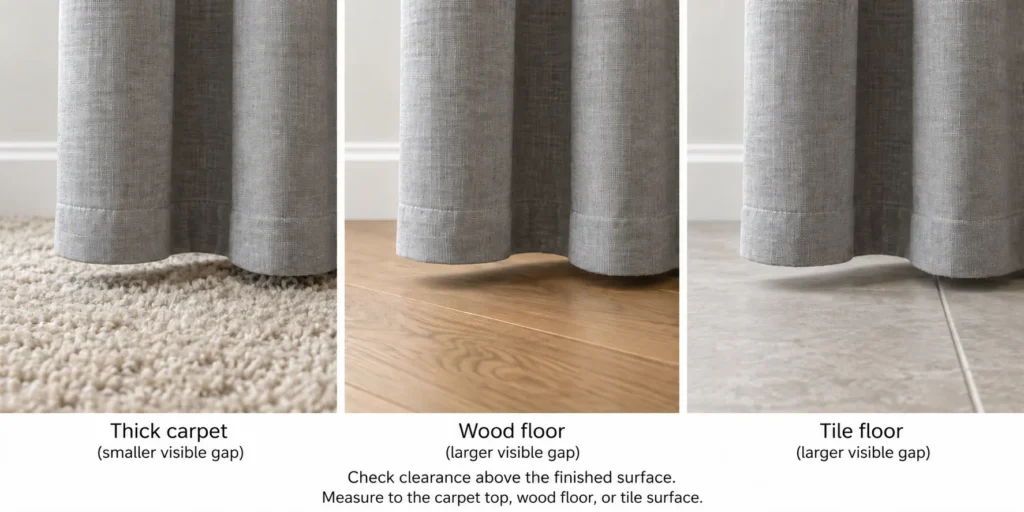
Curtains Over Carpet
When considering full-length curtains over thick carpet, your initial measurement is taken to the height of the carpet itself rather than the solid floor underneath it.
A curtain that hangs heavily onto thick pile can actually become trapped, bunched or difficult to move. A slight float will reduce this adhesion, but the final measurement should always reflect practical movement rather than theory.
If you are planning to replace your carpet, always bear in mind that the thickness of pile will influence the way that the curtains hang.
Curtains Over Wood or Tile
Either floating your curtains or simply allowing the bottom of the curtain to meet the surface works well on reasonably smooth hard floors such as wood or tile. Always take multiple measurements at the base of the window, because floorboards, grout lines and lumps in tiles can mean that a seemingly uniform depth of curtain will not actually meet the entire surface in this scenario.
What If There Is a Rug Near the Window?
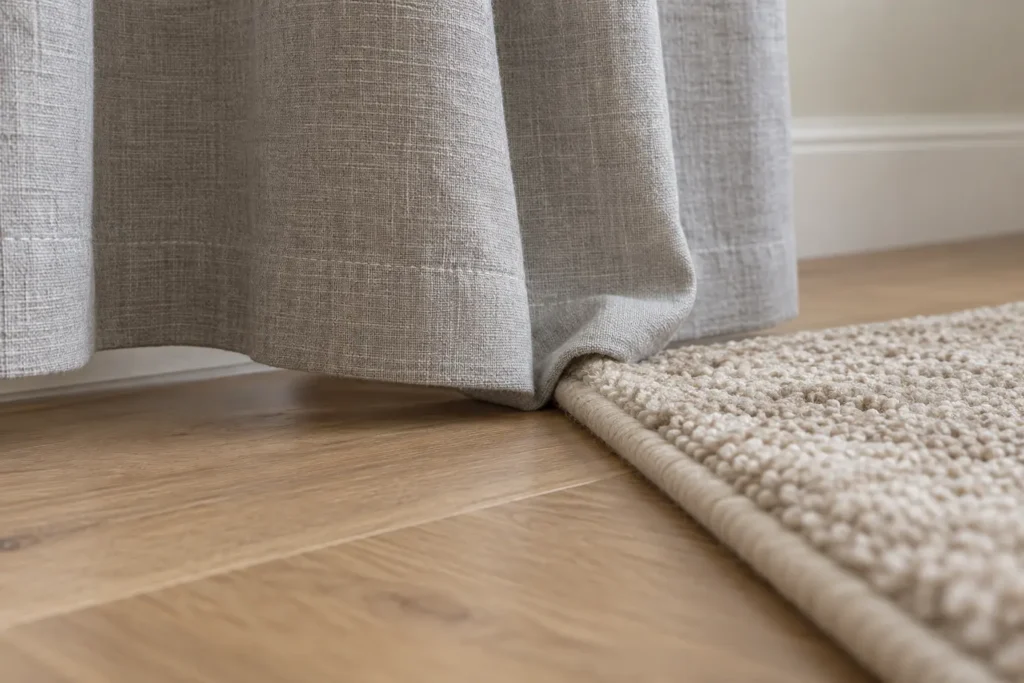
If you have an area of carpeting near your window, always examine the way that the curtains will fall around this rather than just on the bare floor. Your overall clearance is calculated based on the floor, but this clearance can mean that the fabric catches on the edge of your rug. Always take into account the entire space that the curtains occupy as they open or close.
Should Blackout and Sheer Curtains Touch the Floor?
Blackout and sheer curtains can both finish at floor level but do not need to have the same finish.
Blackout Curtains
While blackout curtains can float just above the floor, merely resting on the floor does not guarantee darkness, because light can still penetrate around the edges as well as at the top of the curtain. Consider the fabric, panel width and type of installation as factors that can all influence the way that blackout curtains meet the floor. If you are trying to achieve darkness, always examine curtains during daylight after installation to establish the problem.
Sheer Curtains
A sheer curtain can float, kiss or puddle the floor in various finishes according to the effect that you desire, but using a small amount of float is useful if you intend sheer curtains to float above hard floor that is subject to a lot of activity.
Testing practical positioning before committing to a finish is always useful if you intend the sheer curtains to become a pool of fabric on the floor, because the weight of the fabric will influence this pooling effect.
Layered Curtains
Sheer curtains and other forms of window dressings do not necessarily need to use the same floor finish, because the inner panel may float just as the outer decorative drapes kiss or break the floor surface. Measure each of the sections of your layered curtain individually, because the different systems used to hang them can influence the way that they finish relative to the floor.
Each curtain layer will have its own specific hardware system for supporting and guiding the curtain, which can influence the final depth of the curtain as it hangs from rods, tracks, hooks or headings.
When Are Shorter Curtains the Better Choice?
Floor-length curtains are an option, not a requirement, for every window.
Shorter curtains or an alternative treatment could be a better choice where:
- There is a counter, sink or built in cabinet beneath the window;
- furniture prevents the panels from hanging freely;
- the fabric would contact wet or frequently dirty surfaces;
- a heater or radiator occupies the space below the window;
- or the use of full-length panels prevents access or the movement of a door.
Sill-length curtains end around the windowsill whilst apron-length curtains extend below it, both of which can create the intended effect if their proportions are appropriate to the window and the room.
Near a heater, the instructions for the specific appliance should be followed, and a recommended decorative gap above the floor cannot be used in place of the requirements from the manufacturer.
How to Measure Your Chosen Floor Length for Curtains
Decide whether you would like a float, kiss, break or puddle before taking the final measurement.
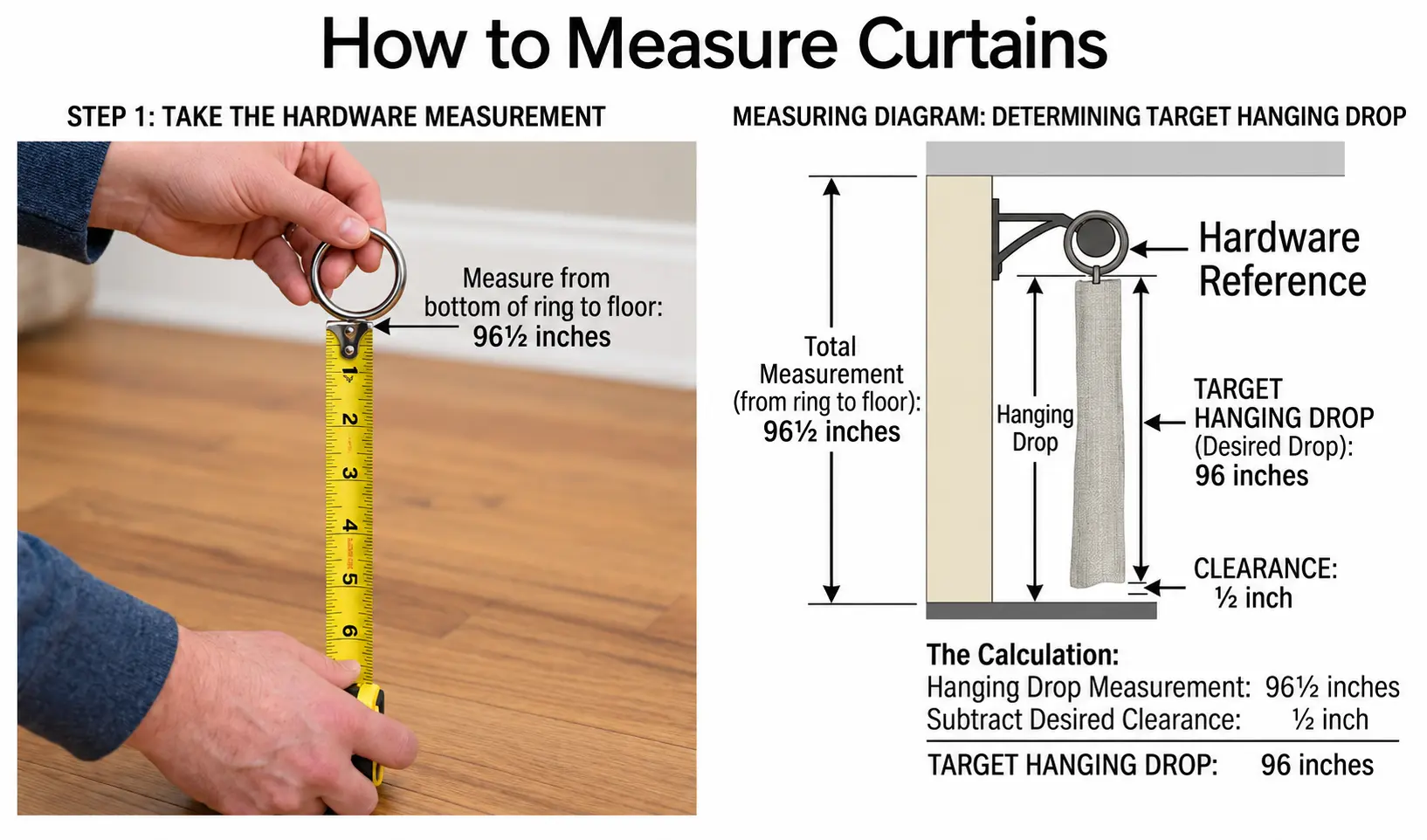
1. Confirm Your Hardware and Curtain Heading
Check the measuring instructions from the supplier for the curtain system you have chosen.
Curtains hung using rings, grommets, rod pockets or track hooks do not all use the measuring reference from the top of the window frame, which will not necessarily be the required curtain length.
2. Measure From the Correct Reference to the Floor
Use a metal tape measure and record the hanging distance at the left, centre and right of the installation.
For wider treatments, check additional points along the curtain’s travel and record the differences, rather than assuming the floor is level.
3. Adjust for Your Chosen Finish
Now you have established the correct hanging reference:
- Float: subtract the desired clearance;
- Kiss: target light floor contact without gathering;
- Break: add a small amount for the intended fold;
- Puddle: add the chosen decorative allowance.
For curtains that have to clear the floor throughout their movement, you should account for the highest surface they pass over.
4. Translate the Drop Into the Required Panel Length
The measured hanging drop and the curtain’s finished panel length are not always interchangeable.
Fabric above a grommet, the position of an adjustable hook or ring geometry can affect where the hem lands, so confirm how the supplier defines its finished length before ordering.
Worked Example: A Floating Curtain
Suppose the distance from the supplier’s specified hanging reference to the floor is 96½ inches and you want a ½ inch clearance.
96½ inches − ½ inch = 96 inches
Your target hanging drop is therefore 96 inches.
Before choosing a panel labelled “96 inches”, confirm that its heading and hardware produce that drop, a ring-hung panel and a grommet panel may land differently.
5. Check the Curtains Before Permanent Hemming
Hang the panels, arrange the folds and test their movement.
Check the hem when the curtains are both open and closed and follow the fabric and supplier’s instructions before making permanent alterations.
How Fabric and Washing Can Change Curtain Length
Curtain length can change with care, hanging and fabric behaviour, the amount of which depends on the product, so do not assume that every cotton, linen or polyester curtain behave alike.
Potential factors include:
- Shrinkage after washing;
- Relaxation while hanging;
- Stretch caused by fabric or lining weight;
- Different behaviour between the outer fabric and lining;
- Changes caused by an unsuitable washing or drying method.
Check the care label before laundering or steaming.
For washable curtains you intend to hem yourself, ask whether they should be washed in accordance with their care instructions before alteration, and for expensive custom curtains, confirm the finishing process with the supplier or workroom.
How to Fix Curtains That Are Too Short or Too Long
First, identify the cause, which could be the panel length, the installed hardware, the heading or an uneven floor.
| Fix | Works for | Limits |
|---|---|---|
| Hemming | Curtains that are too long | Permanent; leaves less fabric to let down later, so measure twice |
| Adjustable hooks or gliders | Small length changes either way | Only moves the hanging point by a limited amount and can change how the heading looks |
| Changing rings or clips | Small changes, when the new ones sit lower or higher | Changes the look of the hardware and the header, and the clips must still fit the pole |
| Letting down an existing hem | Curtains that are too short | Only works if there is spare hem; old fold lines and fading may show |
| Adding a border or band | Curtains that are too short | Changes the look, and the fabric must match or contrast on purpose |
| Replacing the panels | Curtains that are far too short or too long | Costs the most, but gives the cleanest result |
Moving the rod can sometimes change the drop, but consider the consequences for window coverage, proportions and mounting before doing so.
If you like puddled curtains, the extra length may be useful, but first, check whether the fabric gathers attractively and whether you are comfortable moving it during cleaning.
Common Curtain-Length Mistakes
Measuring From the Window Instead of the Hardware
The window frame does not determine where the curtain begins hanging, so use the reference specified for the actual heading and hardware.
Assuming “Floor Length” Means Dragging
A small float can still provide a full-length appearance and dragging fabric is only one possible finish.
Ignoring Carpet, Rugs and Thresholds
Measure the surfaces the curtains actually pass over, including when drawn aside.
Choosing a Puddle for Frequently Moved Curtains
Extra fabric may need rearranging after opening and closing, so consider whether that suits your daily routine.
Hemming Before Checking Care Instructions
An alteration made before product-specific washing or finishing requirements are understood may leave the curtains shorter than intended.
Treating a Style Preference as a Universal Rule
A precise floor touch is attractive in some rooms and a small float or shorter window treatment may work better elsewhere.
FAQs
They can, floor-length curtains can frame a short window and create a continuous vertical line, check that the wall below the window is clear and that the panels can hang and move freely.
For similar windows along one wall, a consistent visual finish usually looks cohesive, but different floor levels or obstructions may require different measurements to achieve that appearance.
If easy daily operation is the priority, they should generally move without catching, a deliberate break or puddle involves floor contact which brings additional maintenance.
Yes, curtains ending slightly above the floor can still look full length, the distinction is between their overall proportion and whether the hem physically contacts the surface.
They can kiss, break or puddle as they move less often than operational curtains, choose the finish around the available space, fabric behaviour and cleaning routine.
Before ordering or altering your curtains, choose the finish, measure the actual installation and test the complete opening and closing movement, a well-chosen length should look intentional and work comfortably every day.