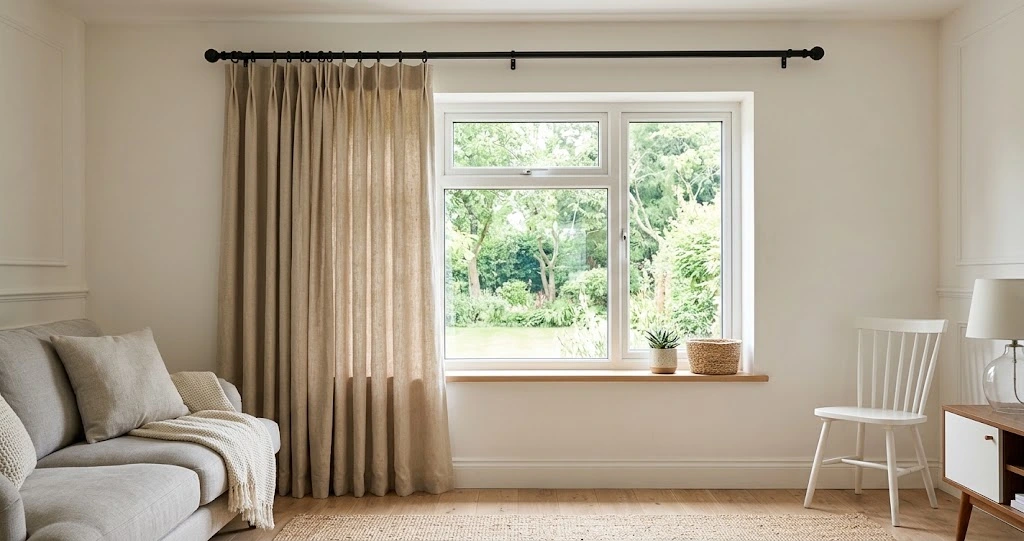

For most ready-made curtains, aim for a total flat panel width of 1.5 to 2 times the width of the usable part of your curtain rod or track. Two times is a good guide to creating fullness (especially for traditional styles). Measure the usable length of your curtain rod or track (excluding the decorative finials) and remember that if your curtains are pre-pleated, wave- or made-to-order styles, you should check the supplier’s instructions.
The most important thing to note is the phrase “than the window.” The most guides advise you to make curtains wider than the window, but the width of the curtains should be wider rather than the width of the rod or track on which they will be hung. This guide describes how to calculate each of these widths, shows the calculations that must be made, and checks that the curtains you are about to buy are wide enough.
Curtain Width vs. Window Width vs. Rod Width
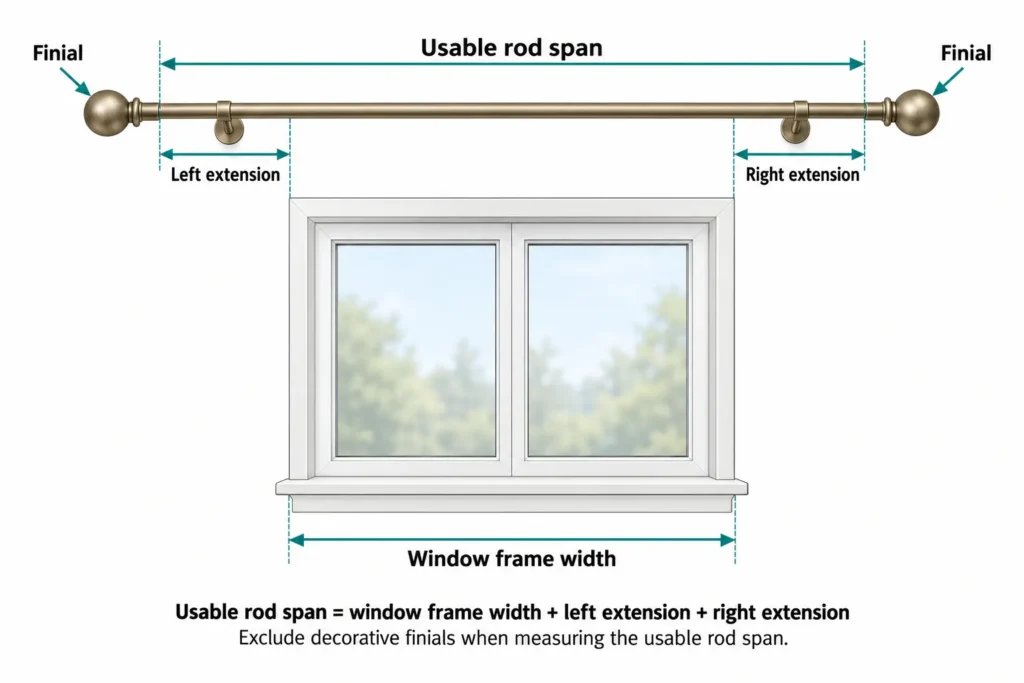
Several different measurements are often called “curtain width,” and mixing them up is the most common cause of curtains that look skimpy.
| Term | What it measures | Why it matters |
|---|---|---|
| Window-frame width | The glass and frame, edge to edge | A starting point for planning, but not the number you multiply |
| Usable rod or track span | The length the curtains can actually slide across, excluding finials | The number you multiply by your chosen fullness |
| Combined flat fabric width | The total width of all panels laid flat, added together | Determines how full the curtains look |
| Width per panel | The width of one panel, laid flat | The number printed on most product labels |
| Finished pleated width | The coverage width after fixed pleats have been formed | Already includes fullness, so do not multiply it again |
Example: a 48-inch window with a 64-inch usable rod span needs about 128 inches of combined flat fabric at 2× fullness. With two panels, each panel is 64 inches wide. The extra fabric forms folds; it does not mean the curtains cover a 128-inch-wide window.
Should You Measure the Window or the Curtain Rod?
Measure the rod (or track) if it is already installed. If not, measure the window (you will need to decide where the track will go).
- Existing hardware: measure the amount of curtain that can run along the track (excluding the finials, as curtains cannot be attached to these). For a track, follow the supplier’s instructions for installation (particularly in relation to systems with overlaps or returns).
- New installation: measure the outer width of your window, and add in the desired amount of extension for either side (see below, in the rod-extension section). This will give you your desired rod width.
- Custom orders: note that some suppliers ask for the track or install width and calculate the fabric amount for you. For example, some suppliers ask you to separate the different measurements and remind you to check the track width before ordering.
Always calculate from the rod or track width, and not the glass width. If you have a 48 inch window and a 64 inch rod, you will need curtains to fit a 64 inch rod, not 48. Make sure you also work in the same unit of measurement (inches or centimetres) from beginning to end.
How to Calculate Curtain Width in Four Steps
Combined flat curtain width = usable coverage span × fullness ratio
Width per equal panel = combined flat curtain width ÷ number of panels
- Measure the coverage span. This is the usable rod or track width, with finials excluded.
- Choose your fullness. Use 1.5× for a lighter, flatter look, 2× for a full standard look, or 2.5× for a very full, luxurious look.
- Calculate the combined flat width. Multiply the coverage span by the fullness.
- Divide between panels. Split the combined width by the number of panels (usually two).
Here is one complete worked example. The 8-inch extension is an example assumption, not a rule for every window.
| Measurement | Example |
|---|---|
| Window-frame width | 48 inches |
| Planned rod extension | 8 inches on each side |
| Usable rod span | 48 + 8 + 8 = 64 inches |
| Chosen fullness | 2× |
| Combined flat curtain width | 64 × 2 = 128 inches |
| Width of each of two equal panels | 128 ÷ 2 = 64 inches |
For a metric example, a 160 cm track at 2× fullness needs 320 cm of combined flat fabric, or two equal panels of 160 cm each.
If you cannot find panels that wide, check the actual fullness of the nearest available sizes before buying. When the choice is close, slightly too wide is easier to live with than slightly too narrow, which shows up as flat, stretched fabric when the curtains are closed.
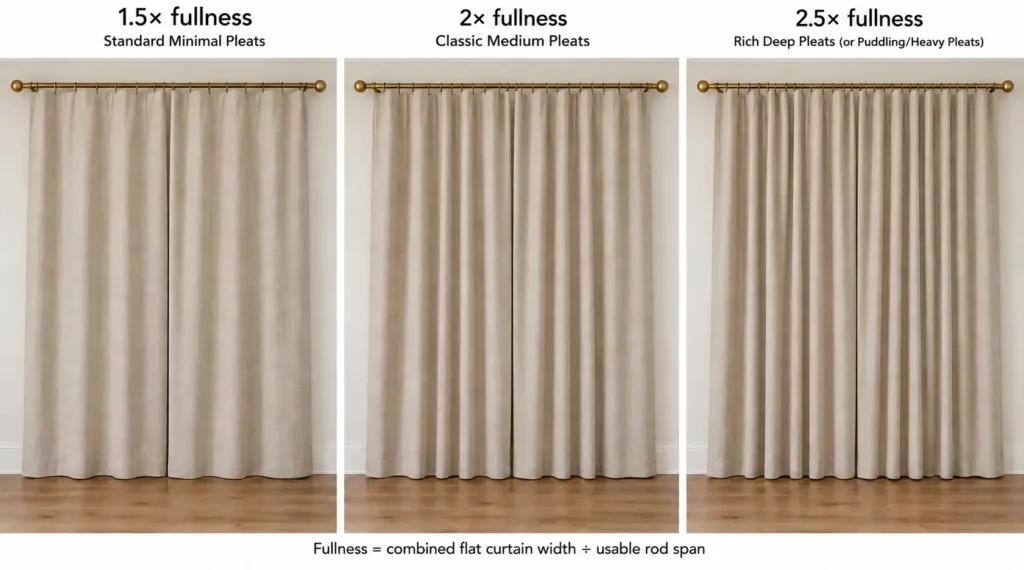
Should Curtains Be 1.5, 2 or 2.5 Times as Wide?
Choose 2× if you want a safe default. Choose 1.5× when budget or space is tight, and 2.5× when you want a richer, more gathered look.
| Fullness | How it looks closed | Practical trade-offs |
|---|---|---|
| 1.5× | Gentle, relaxed folds; fabric looks slightly flatter | Lower cost and a smaller stack when open; suits heavier fabrics and modern styles |
| 2× | Even, full folds across the whole width | The most common starting point; balances appearance, cost and stack size |
| 2.5× | Deep, plush folds, especially on light fabrics | Higher fabric cost, a larger stack when open, more weight on the rod |
| 3× | Very full | Used for some lightweight sheers and designs that specify it |
These ranges are general guidance. Heading style and supplier instructions can override them: a pinch-pleat or wave heading may already include its fullness, and some made-to-measure suppliers calculate the fabric for you. You do not need to hit exactly 2.00×. What matters is that the curtains close fully, show the folds you want and move easily.
Curtain Width Chart for Common Window Sizes
Assumptions: the rod extends 8 inches beyond each side of the window frame, you are hanging two equal panels, and fullness is measured on flat fabric. These are calculated examples for panels sold by flat width, not universal installation or custom-order sizes. If your hardware is already installed, use its actual usable span instead.
| Window width (in) | Rod width (in) | Total fabric at 1.5× (in) | Total fabric at 2× (in) | Width per panel at 2× (in) |
|---|---|---|---|---|
| 24 | 40 | 60 | 80 | 40 |
| 30 | 46 | 69 | 92 | 46 |
| 36 | 52 | 78 | 104 | 52 |
| 48 | 64 | 96 | 128 | 64 |
| 60 | 76 | 114 | 152 | 76 |
| 72 | 88 | 132 | 176 | 88 |
For a 1.5× result with two panels, divide the 1.5× total by two. For example, a 48-inch window needs about 48 inches per panel at 1.5×, or 64 inches per panel at 2×.
Does the Listed Width Mean One Panel or a Pair?
It can vary from retailer to retailer, so it’s important to check the product description. Some ready-made curtains will note the width per panel, and the package can include one or two panels; some indicate the width of the pair. Here are some factors to consider:
- The package size: how many panels does the set include?
- The width per panel: is it given for a single panel or for the whole set?
- Flat or finished width: You need to know how much material you need to cover your window. A finished width of 52 “, for example, means that before the pleats were sewn, about 2 x this number of inches of fabric was used. It is not necessary to calculate this number again.
- The width can be given in two ways: total or per panel.
Make sure which one is indicated. If, for example, the description says that the width is 52 “x 96”, and the set includes two panels, then in total, you get 52 × 2 = 104 “of curtain surface. If one panel is indicated, the width is 52”. In case of a mismatch in the description, calculate the required number yourself: multiply the width per panel by the number of panels and compare the result with the desired value.total. If the listing is unclear, multiply the per-panel width by the number of panels yourself and compare the result with your target.
Are Two 52-Inch Curtain Panels Wide Enough?
It depends on your rod width. Two 52-inch panels give 104 inches of combined flat width. Divide that by your usable rod span to find the fullness you will actually get:
Actual fullness = combined flat panel width ÷ usable coverage span
| Usable rod width (in) | Fullness with 104 in of fabric | Verdict |
|---|---|---|
| 48 | 2.17× | Very full |
| 52 | 2.0× | Full, standard look |
| 60 | 1.73× | Comfortably within range |
| 64 | 1.63× | Acceptable, but not a full 2× |
| 72 | 1.44× | Slightly under 1.5×; likely to look flat |
| 80 | 1.30× | Too narrow for a gathered look |
On a 64-inch rod, for instance, 104 ÷ 64 = 1.625×. That sits inside the 1.5–2× range but does not reach 2×. If your rod is wider than about 70 inches, consider a third panel or wider panels. Always calculate from the rod’s usable span: a 48-inch window can have a much wider rod.
How Curtain Heading Style Changes the Calculation
The heading (the top of the curtain) decides whether fullness is something you calculate or something already built in. The ranges below are typical starting points; the supplier’s instructions always take priority.
| Heading style | How fullness works | What to check |
|---|---|---|
| Eyelet / grommet | Fullness comes from how the fabric folds on the rod; often about 1.5–2× | Whether the listed width is per panel; too few panels can look flat |
| Rod pocket | Fabric gathers directly on the rod; about 2× is common, sheers often more | Gathering shortens the finished width, so size the flat fabric accordingly |
| Pencil pleat | Tape pulls the fabric into even gathers; made-to-order versions commonly need about 2–2.5× | Whether the stated width is flat fabric or the finished, pulled-in width |
| Fixed pinch pleat | Pleats are stitched in, so fullness may already be built into the ordered width | Confirm whether the stated width is the finished pleated coverage |
| Wave / S-fold | Curves are set by the track carriers, and fabric requirements are set by the system | Order to the track length and follow the supplier’s measuring method |
Do not automatically double a finished pleated width. If a custom supplier asks for a 160 cm track measurement, it may calculate the extra fabric needed to produce the heading you chose. Ordering 320 cm instead could create a substantial sizing error. Supplier guidance notes that fixed pinch pleats and S-fold systems need different calculations from headings gathered after installation.
How Wide Should Sheer and Blackout Curtains Be?
Sheer curtains
Sheers often require more width as the light, fine fabric has less volume, so extra fabric is needed to create the desired folds without the effect of a single sheet. A fullness of around 2-2.5 times is a good average to start with, and some patterns suggest up to 3. Designer recommendations vary, so this should be treated as a design choice based on the heading and supplier rather than an absolute.
Blackout curtains
Heavy lined out fabric creates fullness sooner, making 1.5 – 2 x the usable rod span a good average for ready-made panels, unless the manufacturer recommends something different. As lined fabric is much heavier and less pliable, panels will stack more thickness on opening, so allow more room on either side.
Fullness and blackout are unrelated issues. Light leakage at the sides and top is usually down to the distance between the curtain and the wall, and not due to insufficient fabric. To reduce the amount of light, extend the rod beyond the frame on either side, allowing the curtains to sit closer to the wall. Alternatively, create a return at either end or use a wrap-around rod. Extra fabric will make the curtains look fuller but will not bridge gaps at the sides or top, which need to be addressed differently.
How Far Should the Rod Extend Beyond the Window?
A practical starting point is 6 to 10inch on each side of the frame where space allows. Published advice varies: some guidance recommends roughly 8in per side on a planned pole free of an installed pole, while other guidance talks of extensions from around 4 to 12in. These are planning ranges; not a guarantee that all your curtains will clear the glass.
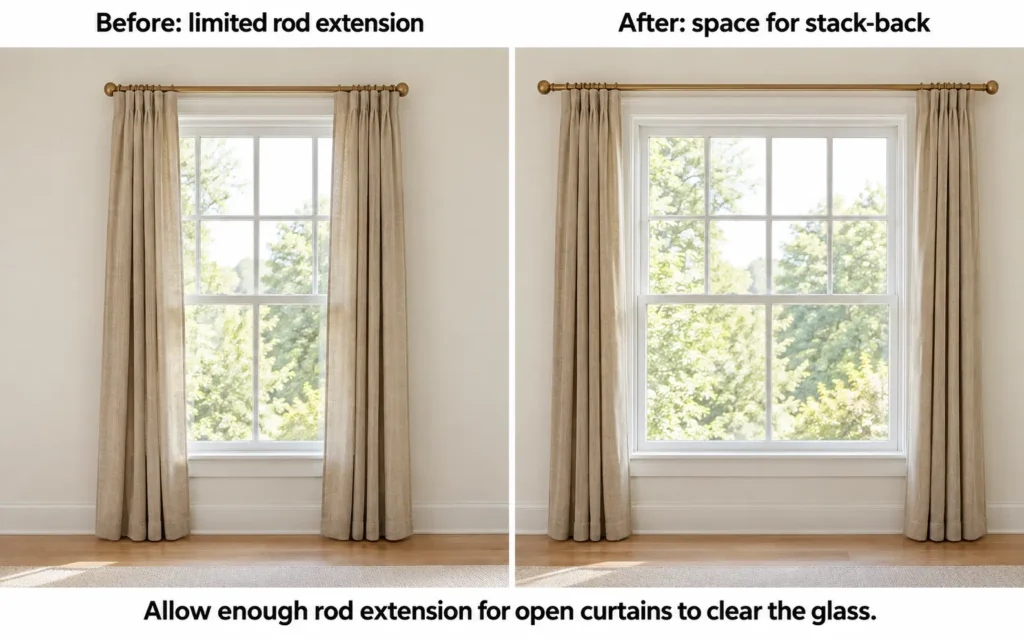
The space your open curtains take up is known as stack-back. The more extension you choose the more of the stack will be alongside the window, keeping the glass clear and making the window look bigger. Then adjust for your room:
- Wall space: if a wall, corner or piece of furniture limits one side, shorten the extension on that side.
- Stack size: Bulky lined or very gathered curtains need more room when open. Add several inches if you want the glass to be completely clear.
- Appearance: A very wide extension can make a small window look disconnected from its curtains.
- Obstacles: Check nearby switches, doors and furniture, and leave room for the hardware and finials.
Remember that the extension changes your curtain width. Every extra inch on each side adds two inches to the rod and, at 2× fullness, four inches to the fabric you need..
Can Curtains Be Too Wide?
Yes. Extra fabric increases fullness up to a point, but beyond that it often produces more drawbacks than benefits. Curtains risk being impractically wide if they:
- Create stacks that block some part of the window even when open.
- Block a corner or doorway.
- Pile up on the rod and be difficult to slide.
- Add weight that a lightweight rod or weak brackets can’t support.
- Cost more and fail to produce the look you want.
If you find yourself looking for more than about 2.5× fullness to achieve the effect you want, a different fabric, style of headings, or length of rod is often a better choice. Ask the supplier about expected stack-back and hardware for custom-made curtains.
What If the Window Is Near a Corner or Sliding Door?
Plan each side separately if one side has little space available, you might not be able to extend the rod equally at each end.
- Unequal side space: Extend the rod up to the full length of the wall on the more spacious side but only as far as is necessary on the other. Measure the fabric from the overall width of the track as before.
- Curtains that open to one side only: This usually means using a one-way track or a pair of very wide panels, allowing for the extra space needed on the side where they open. Check that your chosen heading and hardware will accommodate this.
- Sliding doors: Make sure the open curtains clear the door and handle, and that the width allows for easy access.
- Widow groups, wide windows or clusters: You may need to incorporate more than one track. Some styles make it fairly easy to use more than one panel, some require a special construction. Check that centre supports will allow the curtains to reach the end of the run.
Bay and bow windows have their own measuring rules, because bends, joins and returns affect the track length. They are better covered in a separate guide.
Common Curtain Width Mistakes
- Doubling only the glass width. Apply fullness to the rod width which is usually wider than the glass
- Confusing panel width with pair width. A listing that says 52 inches may be a single panel or the whole pack.
- Multiplying pre-pleated widths again. Pinch-pleat and wave curtains often include your fullness already
- Rounding down without checking. A slightly smaller size may be okay, but calculate its actual fullness first
- Including finials in the rod width. Curtain can’t slide onto decorative ends, so leave them out
- Ignoring stack space. Check how the curtains look closed and where they sit when open.
Questions to Check Before Ordering
- What heading style is it, and does it already include fullness?
- How many panels come in the pack?
- Is the listed width per panel or for the pair?
- Is the width measured flat or finished?
- Which way do the curtains open: both ways, left only or right only?
- Is there enough space for the open fabric, and can the hardware support the weight?
- What is the actual combined width, and what fullness does it give on my rod?
Measure curtain length separately. Width determines coverage and fullness; length determines where the hem finishes.
FAQs
No. The fullness multiplier applies to the combined flat width of all panels, measured against the rod. With two panels at 2× fullness, each panel is roughly the rod width, not twice the window width.
It depends on the product. Most ready-made panels list flat width, measured with the fabric laid out. Fixed pleated curtains may list finished coverage width instead. Check the seller’s measurement description.
First establish the usable rod span. With an 8-inch extension on each side, the rod is 64 inches. At 2× fullness you need about 128 inches of total flat fabric, or two 64-inch panels.
They give 104 inches of flat width. That is a full 2× on a rod of about 52 inches, and still at least 1.5× on a rod up to roughly 69 inches. Beyond that, add panels or choose wider ones.
Yes. Add all four panel widths together to calculate fullness. Two panels per side is a common way to reach the width you need on a wide rod, as long as the hardware can support the weight and centre supports do not block movement.
Often, yes. Sheers commonly use more fullness to look full, while lined blackout fabric often looks good at lower ratios. The heading and the supplier’s guidance matter more than fabric type alone.
Often yes. Fixed pinch pleats are stitched to a set fullness, so confirm whether the listed width is finished or flat before multiplying.