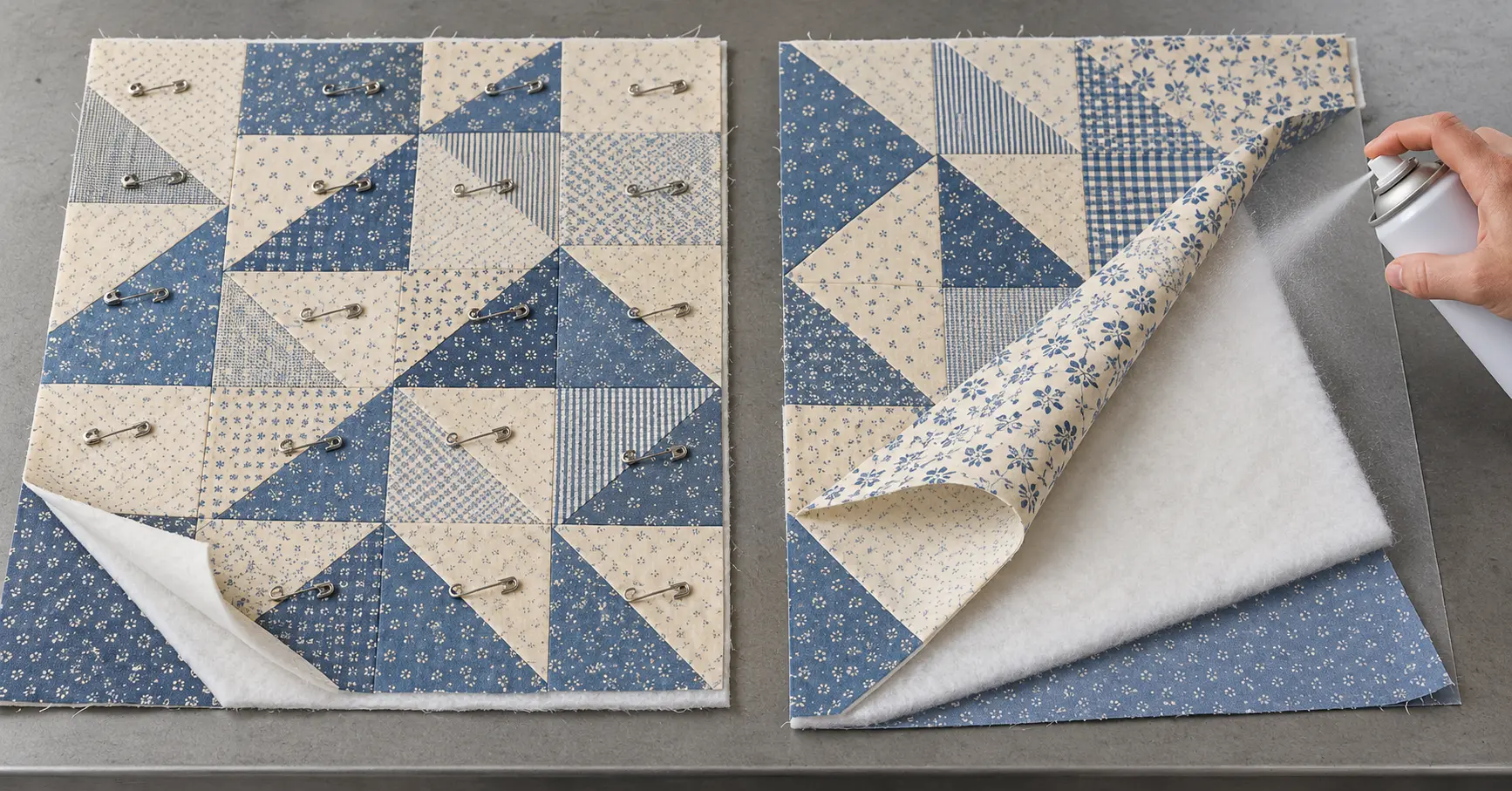

Ask a home quilter and you get a craft answer. Ask a line supervisor and you get a different question: which method keeps the panel moving through the cell without a stop for re-alignment, a needle strike, or a re-lay at the end of the shift?
Spray basting and pin basting are both temporary holding methods. They differ in where the labour sits, how evenly the hold is distributed, and what happens when the hold is removed. The comparisons below cover four measurable points — station time, fabric shift, removal damage, rework rate — plus the fabric types that belong on a spray line and the two that do not.
Ranges quoted are typical figures from panel-quilting and bag-lining cells running 2.4–3.2 m panels. Planning benchmarks, not laboratory data.
1. Station time: the cost is front-loaded, not eliminated
Pin basting looks cheap because pins cost almost nothing. The cost sits in the station.
At one pin every 75–100 mm, a queen panel needs 300–450 pins. At 2.5–3 seconds each — pick up, place, close — that is 15–22 minutes of handling before the panel reaches the needle. On a 30-minute takt, basting eats half the cycle.
Spray moves that time into a short step that overlaps with handling. Two operators lay the backing, fold it back, apply adhesive in overlapping passes at 200–250 mm, and press the batting down: 4–6 minutes for the same panel, with the carrier flashing off in 1–3 minutes while the next layer is prepped.
| Operation | Pin basting | Spray basting |
| Lay-up and alignment | 5–8 min | 5–8 min |
| Hold application | 15–22 min | 4–6 min |
| Cure / settle | — | 1–3 min (overlapped) |
| Removal after quilting | 4–7 min | 0 |
| Touch time per panel | 24–37 min | 9–14 min |
The saving is not the pin cost. It is 15–20 minutes of operator time per panel plus the removal pass after quilting. A quilting spray adhesive with a controlled tack window is what makes that compression possible; if the adhesive stays wet too long, the press step becomes a smear step and the advantage disappears.
2. Fabric shift: distributed hold versus point hold
A pin holds one point. Between two pins there is slack, and the slack redistributes every time the panel is lifted, rolled, or pulled against the feed.
Measured at the panel edge after a 1.8 m quilt-through pass, pinned three-layer stacks typically show 2–4 mm of relative movement between backing and top, worst in the centre of large open areas. That is enough to produce a visible backing tuck on a 50 mm grid, and enough to throw off a pattern matched across a seam.
Spray converts the hold into a continuous bond across the full surface. Displacement measured the same way usually stays under 1 mm, and it stays there through repeated lifts. On tight geometric patterns, cross-hatch, or registered prints, this argument matters more than speed — shift is the root cause of most of the rework below.
3. Pin removal: the damage happens before removal
Two costs sit here, and the smaller one is the 4–7 minutes of pulling pins.
The larger cost is what pins do to the machine. A missed pin becomes a needle strike: broken needle, a jump in the stitch field, 20–40 minutes of re-threading, re-timing, and inspecting the panel for fragments. On multi-needle panel quilters one strike can take out several needles. Plants running metal-detection before packing scrap the panel at the end of the line instead of at the machine.
Then there is the fabric. Pin holes do not close on tightly woven, coated, or high-twist fabrics, and they close slowly on batting with high recycled content. On dark solids they read as a line of light dots under raking light — a defect that surfaces only in final inspection.
Spray has no removal step and no metal in the panel. The equivalent risk is residue, not perforation, and residue is controllable through application distance and a clean nozzle: a process variable instead of a hard object.
4. Rework rate: where the difference compounds
Rework in quilting traces back to three causes: a tuck or pleat in the backing, a pattern distorted by layer shift, or a puckered field from uneven tension.
Pinned panels generate all three at a higher rate because the hold is discontinuous — operators pin what they can reach, and the middle of the panel is held by tension rather than adhesion. Plants running pinned lay-ups commonly report 6–10% of panels returning for re-lay or spot repair. Spray-basted panels, with even application and a full cure, typically land at 2–4%, mostly from technique rather than method.
At 200 panels a week that gap is 8–16 panels — roughly a shift of rework labour, plus the fabric.
Three fabrics that suit spray basting
- Quilting-weight cotton and cotton-linen wovens. Tight, stable, low-lint. The adhesive grips evenly, there is no pile to bridge, and residue lifts with a normal wash. The baseline case, and where spray shows its cleanest time advantage.
- Cotton-polyester blends and polyester wovens, including microfibre. Smooth filament surfaces take a light, uniform tack and release cleanly after quilting. Useful on lining and bag panels where pins leave permanent marks.
- Flannel, brushed cotton, and other napped fabrics. The nap gives mechanical key rather than relying on surface energy, so a lighter coat holds. These are also the slowest fabrics to pin, because pins disappear into the pile and are easy to miss at removal.
Two fabrics that do not
- High-pile plush — minky, faux fur, cuddle fleece. The adhesive only reaches the tips of the pile, so the hold is weak and uneven, and overspray mats the pile into patches that cannot be brushed out. Pins are slow here, but spray is worse: residue without the bond.
- Coated, laminated, and water-repellent finished fabrics. PU coatings, TPU laminates, and silicone-softened shells resist the adhesive outright, and the carrier can dull or cloud the coating. The same applies to heavy silicone or fluorocarbon softeners — the finish is doing its job, which is why nothing sticks.
Getting the line ready
Confirm four things before switching a cell: extraction at the station, nozzle and distance set for a 200–250 mm fan, a cure window matched to your takt, and a written rule for how long a basted panel may sit before quilting. Use a Sprayidea tempo rary spray adhesive graded for repositionable hold if operators need to lift and re-lay — a permanent grade turns a correctable mistake into a scrapped panel.
The short version
Pins cost almost nothing per unit and a great deal per panel: 15–20 minutes of station time, 2–4 mm of shift, metal-contamination risk at both the needle and the packing gate, and roughly double the rework rate of a well-run spray line. Spray front-loads a short, overlappable step and removes the removal pass entirely.
It is not universal — high-pile and coated fabrics stay on pins. But for cotton, blends, and napped wovens at production volume, the saving is not in the consumable. It is in cycle time and the panels you do not have to run twice.