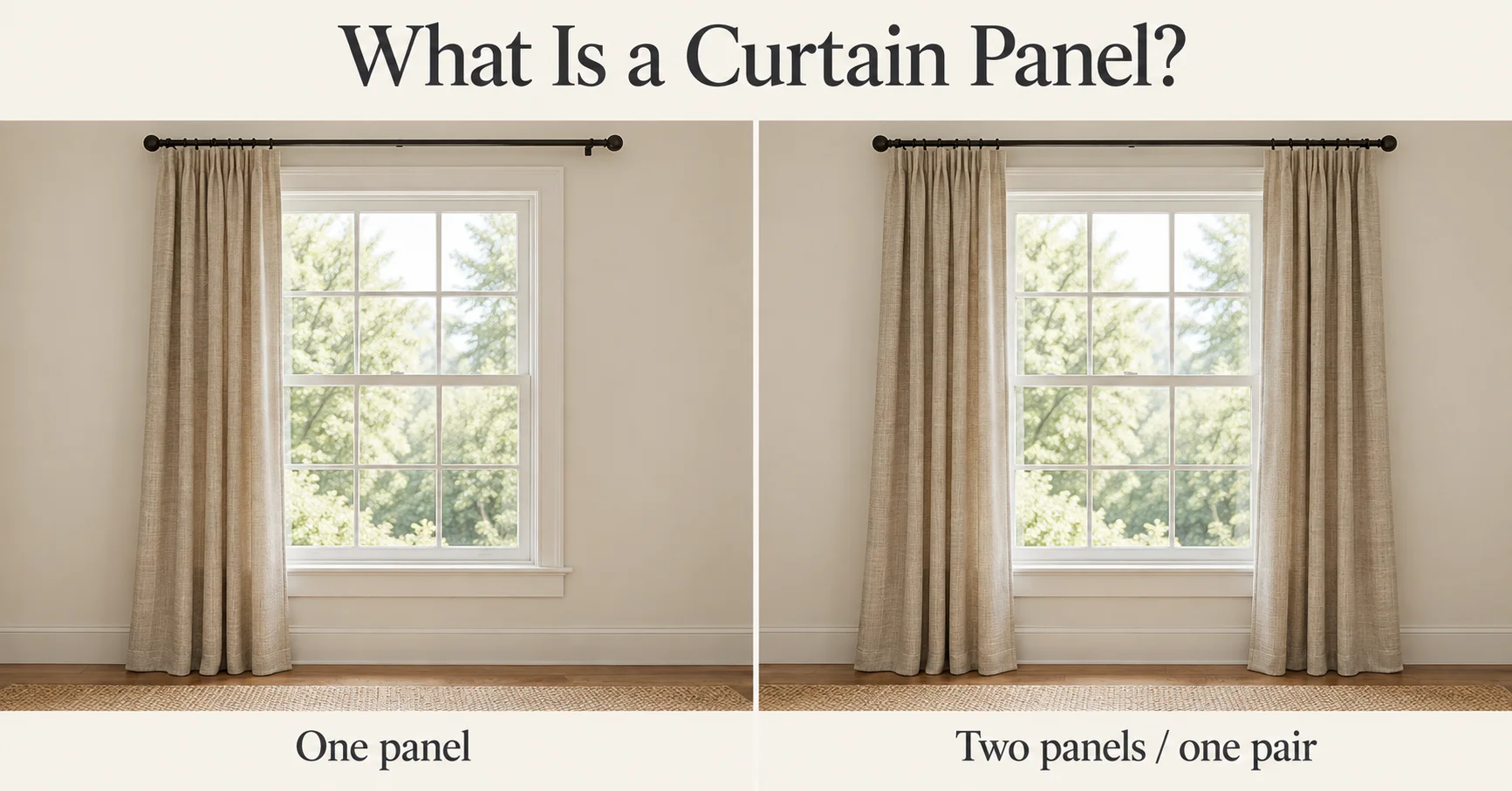

A curtain panel is a single finished section of curtain fabric that is hung on a rod or track. It may be used singly or in combination with other panels to cover a window. Two panels are a pair, but a product listing may offer one panel, a pair or a larger set.
That could be a vital distinction if you want two identical curtains on either side of a window. A listing may feature an image of two curtains, but the price may well buy you only one. If two panels are provided, their combined width may give less fullness than you want.
Here is a guide to thinking about the number of panels, their width and size.
Does One Mean One Curtain or a Pair?
A curtain panel is a single finished section of curtain fabric. A pair comprises two panels.
The word panel refers to one individual curtain section rather than a particular fabric or finish. A sheer, a lined linen, and a blackout panel can all be single curtain panels.
| Product wording | What it means |
|---|---|
| One panel | One individual curtain section |
| Two panels | Two individual curtain sections |
| Pair of curtains | Two curtain panels |
| Curtain set | Contents vary; check the itemized description |
| Sold individually | Each ordered unit contains one panel, unless otherwise specified |
A panel may have a lining and/or seams where joined fabric widths are brought together to create the panel. Notation and terminology can vary greatly depending on the supplier, but the word panel most often refers to one finished curtain section.
Check the listing for ‘includes’, ‘number of panels’ and ‘per panel’. Do not rely on the image to indicate how many panels you are receiving.
What Does “52 × 84 Inches, Two Panels” Mean?
Curtain panel dimensions are typically given as width by length, but always check that the listing actually specifies that.
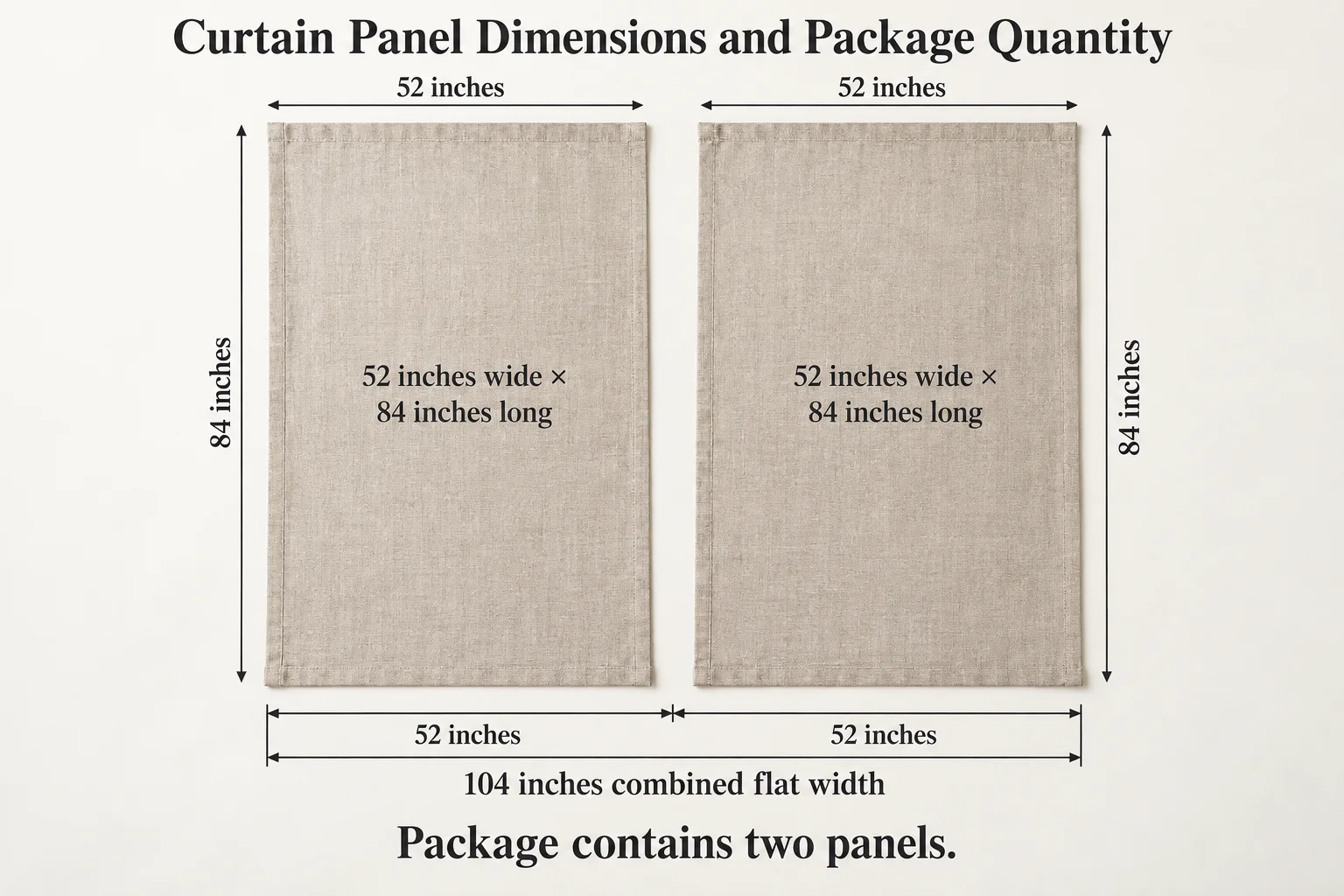
If the listing provides two panels, each measuring 52 inches wide by 84 inches long, that means:
- You receive two individual panels.
- Each has a 52-inch flat width.
- Together, the pair will provide you with 104 inches of flat width.
- Your length will be 84 inches for each.
The lengths remain the same when the panels hang side by side, rather than adding up. A listing providing 52 inches as the combined width for a pair of panels would mean that each equal panel is 26 inches wide.
The key question is whether the listed width applies to each panel or to a pair.
As a reference, 52 × 84 inches equals approximately 132 × 213 cm.
Flat Width Is Not Full Coverage
Two panels providing 104 inches of flat width will not necessarily dress a 104-inch rod opening with sufficient folds. There would be little or no fullness. Exactly how much of the fabric you need to allow for folds will depend on the heading, the type of fabric and the fullness you wish to achieve.
Can One Curtain Panel Cover a Whole Window?
Yes, if the width allows and you can provide the necessary hardware.
A single panel will typically open towards one side. Two panels are often used to provide a centre-opening arrangement.
| Arrangement | How it works |
|---|---|
| One panel | Usually opens towards one side, if the width and layout allow |
| Two panels | Usually open from the centre |
| Four panels | Can provide extra fabric width, with two panels on each side |
| Stationary side panels | Frame the opening without necessarily providing full coverage |
A single panel is not inherently half a window, but a very wide panel could be used to cover a whole opening, while a narrow one would be suitable for a small decorative section. It is a matter of choice depending on the opening direction, space and coverage.
How Many Panels Do You Need?
For mass-produced curtains sold by their flat width, work from your intended coverage on the rod or track. You can calculate required panel count using the formula below.
Panels required = rod or track coverage width × target fullness ÷ flat width per panel
Round the result up to the next whole panel. To allow for a balanced centre-opening arrangement, you may prefer to round up to an even number.
Fullness is a ratio between the combined flat width of the panels and the width they need to cover. At 2× fullness, you will need 2 units of width for every 1 unit of coverage.
A good starting point for many panel curtains is 1.5×–2× the width needed to cover, but it will also depend on the type of fabric and heading. Sheers, some types of headings and dramatic fullness may benefit from higher ratios. Always follow the manufacturer’s advice for specialist treatments.
Worked Example for a 64-inch Rod
If the rod coverage width is 64 inches, your target fullness is 2×, and the flat width per panel is 52 inches:
Required flat width = 64 × 2 = 128 inches
Panel count = 128 ÷ 52 = 2.46
Three panels will suffice and will give you more fullness than you asked for, but four would enable you to spread two panels on each side for a centre-opening arrangement.
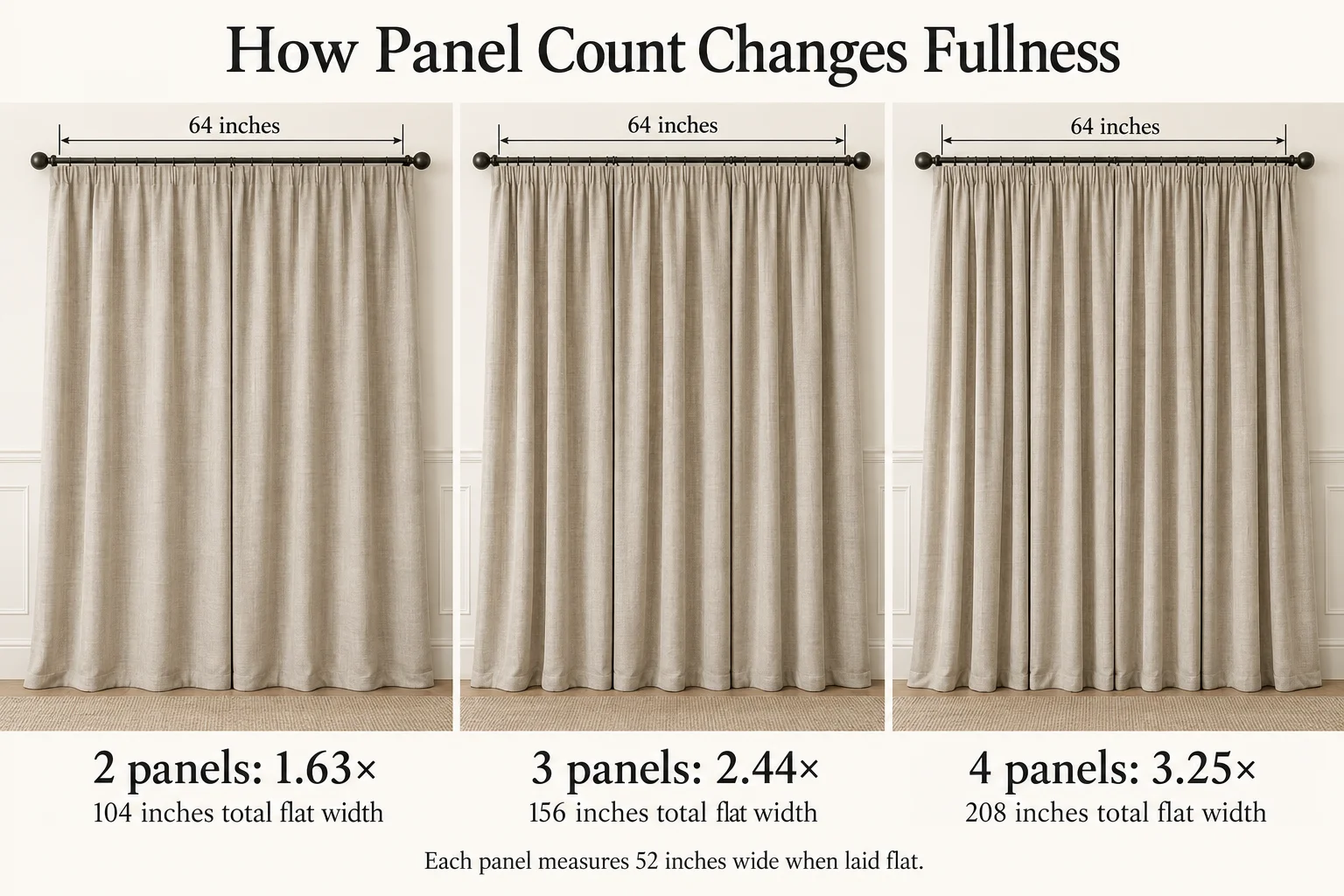
| Panels | Combined flat width | Fullness over 64 inches |
|---|---|---|
| Two | 104 inches | 1.63× |
| Three | 156 inches | 2.44× |
| Four | 208 inches | 3.25× |
Two panels may be sufficient for a lighter gathered look, but they would provide insufficient fullness for the 2× target. With four panels, the larger stack of fabric may be too bulky for some fabrics or hardware. Panels wider than 52 inches are another option.
Remember to allow for side returns, centre overlap in case of a centre-opening system, stack-back clearance and any other recommendations by the supplier. A centre support bracket for conventional curtain rods may also restrict movement.
For help comparing widths, use the Curtain Width & Fullness Calculator.
Flat Width versus Finished Pleated Width
Always double-check the definitions with the supplier before any purchase.
Flat Panel Width
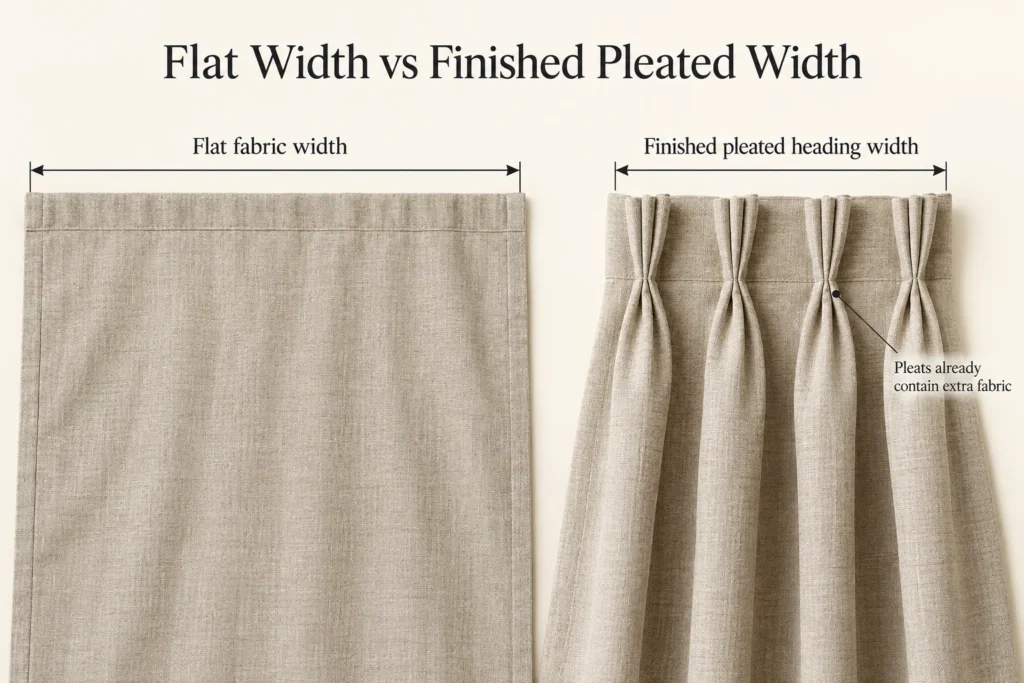
The width of the fabric before any gathering is the flat panel width. For many mass-produced products including rod pocket, eyelet and back tab curtains, it is the relevant figure.
Flat width is required to calculate fullness.
Finished Pleated Width
Some pinch pleat curtains are sold by the finished heading width. The additional fabric required for pleating is already incorporated in the panel.
A panel measuring 30 inches at its finished pleated heading already has extra fabric to allow for the pleats. Do not try to apply a fullness multiplier to this measurement. Always ask whether the width is flat or finished pleated, or whether the recommendation is based on track coverage.
The same considerations apply to wave or ripple fold curtains: follow the manufacturer’s advice in relation to pleats, wave or ripple folds, and track systems.
Curtain Panel vs Curtain, Drapery Panel and Valance
These terms sometimes overlap with the word panel, and usage varies between retailers and countries.
| Term | Usual meaning |
|---|---|
| Curtain panel | One individual finished curtain section |
| Curtain | A general term for a fabric window covering; also used for an individual panel |
| Pair of curtains | Two curtain panels |
| Drapery panel | An individual drapery section, often associated with tailored or lined treatments |
| Valance | A short decorative treatment across the top of a window |
The word drape generally refers to a heavier curtain, but terminology is not standardised.
Look out for fabric, lining, headings and measurements. Curtain panels can be made of a variety of materials and constructions, including lined or unlined, lightweight or heavyweight, and designed for free movement or stationary use.
Types of Curtain Panels: Fabric, Light Control and Heading
Three factors usually combine to define a curtain panel’s appearance and performance.
Fabric
Most commonly, curtain panels are made from cotton, linen, polyester, blends and velvet. Textured cotton or linen can create a different impression from smooth polyester or plush velvet, although finishes vary. Heavier fabrics tend to create a larger pile of fabric when opened.
Fabric choice can affect the curtain’s ability to control light, reduce heat transfer, provide privacy and withstand washing, but these qualities also depend on the lining, finishing and construction.
Light Control
| Type | Main purpose | What to check |
|---|---|---|
| Sheer | Softens daylight while maintaining a translucent appearance | Limited privacy, especially when the room is lit at night |
| Light-filtering | Diffuses daylight | Privacy depends on fabric density and lighting |
| Room-darkening | Reduces incoming light | Performance varies between products |
| Blackout | Designed to block light through the fabric | Light can still enter around edges and hardware |
A blackout panel is not necessarily a guarantee of absolute darkness. Fit, overlap, and installation are also important.
Heading
The heading is the top part of the curtain panel, which allows it to be hung. Headings affect the way the curtain will open and close.
- Eyelet/grommet: Metal or plastic rings reinforce openings in the fabric through which a compatible rod passes.
- Rod pocket: A channel at the top of the curtain is slipped over a rod.
- Back tab: Curtain loops are attached along the back of the panel’s top edge.
- Pinch pleat: The fabric is sewn into pleats and usually hung using hooks attached to compatible rings or track carriers.
- Wave or ripple-fold: A compatible track and carrier system is required to create the folds.
For regular use, make sure the heading allows the easiest opening on your intended hardware. Rod pockets can often create more friction than rings or carriers.
How to Measure Curtain Panel Width and Length
Choose the heading and hardware before taking any measurements.
Width
Take the width measurement across the intended coverage. For outside-mount curtains, this will be the usable coverage span of the rod or track. Avoid measuring across the decorative finials at the ends of the rod.
If you have not yet selected the hardware, take into account the extension of the rod or track beyond each side of the window opening, and the space needed for the curtains to stack when open.
Then, determine whether the product is sold by flat or finished pleated width. Use the relevant information provided by the supplier.
Length
Always measure the length from the relevant hanging point to the desired hem position. The point will vary depending on the heading: hook-hung panels are measured from the specified hook attachment point, while eyelet curtains extend above the rod and may require an allowance above a rod-to-hem measurement.
The length of the fabric may also differ from the drop of the mounted curtain, depending on the heading and the manufacturer’s measuring convention. Always follow the measuring instructions provided by the supplier, particularly when buying custom-made products.
Hem Position
Choose the position of the curtain hem based on the available space. Options typically include sill length, below-sill length, a little distance from the floor, floor-length curtains or puddling. Leave some clearance from the floor for frequent use.
Do not forget radiators, vents or other potential obstacles. In many retail settings, an 84-inch panel is a popular choice, but it is not necessarily a good fit for an eight-foot ceiling.
Use the Curtain Length Calculator to compare your measurements.
Most Common Curtain Panel Buying Mistakes
Wrong Assumptions about the Image
An image showing two curtains may feature more panels than the package contains. Always check the written description.
Individual Width versus Pair Width
‘Two panels, 104 inches wide’ can be ambiguous. Always check whether the listed width applies to each panel or to a pair. Ask the supplier to clarify if in doubt.
Assuming Two Panels Always Provide Enough Fullness
Two panels may well be a pair, but they may also be insufficient to provide the fullness you want.
Fullness Applied Twice
You should not apply a fullness multiplier to a finished pleated width. Check that the width actually refers to flat panel width before using a flat-width fullness calculation.
Assuming Decorative Side Panels Can Provide Full Coverage
Decorative side panels may be stationary and may not be designed to close across the window. Always check whether the given width and hardware will provide the coverage you need.
Measuring the Length from the Wrong Hanging Point
You may well need to measure from the hook attachment point at the rings or carriers. Take into account the drop created by the heading and the intended position of the hem.
Not Checking Care and Hardware Requirements
Make sure to check the care instructions, rod diameters, curtain weight, bracket ratings and track compatibility. Not every panel can be machine-washed, and not every curtain will be compatible with your existing track system.
FAQs
Yes, usually. A curtain panel is a single finished curtain section that can be hung at a window. Two panels are a pair, but there may also be listings stating that a single panel is provided.
It depends on the seller. Always check whether the listing describes individual panels or sets of two or more panels.
It depends on the listing. Always look out for ‘per panel’, ‘each curtain’, ‘combined width’, or ‘pair width’. Contact the seller if it is not clear.
Yes, if the width allows and you can provide the appropriate hardware. A single panel is usually opened towards one side.
Yes, if the rod and brackets can support their weight and the space allows. Make sure that the centre brackets do not restrict the movement you need. Separately hung panels will also have separate vertical edges, unless joined.
It depends on the width, the heading, the hardware and the installation. Some panels are intended to be used as fixed side panels.
Not necessarily. Check the listing to see whether these items are provided. Some panels may have eyelets or hooks, but rods, rings and carriers often need to be purchased separately.