
What Are Grommet Curtains?
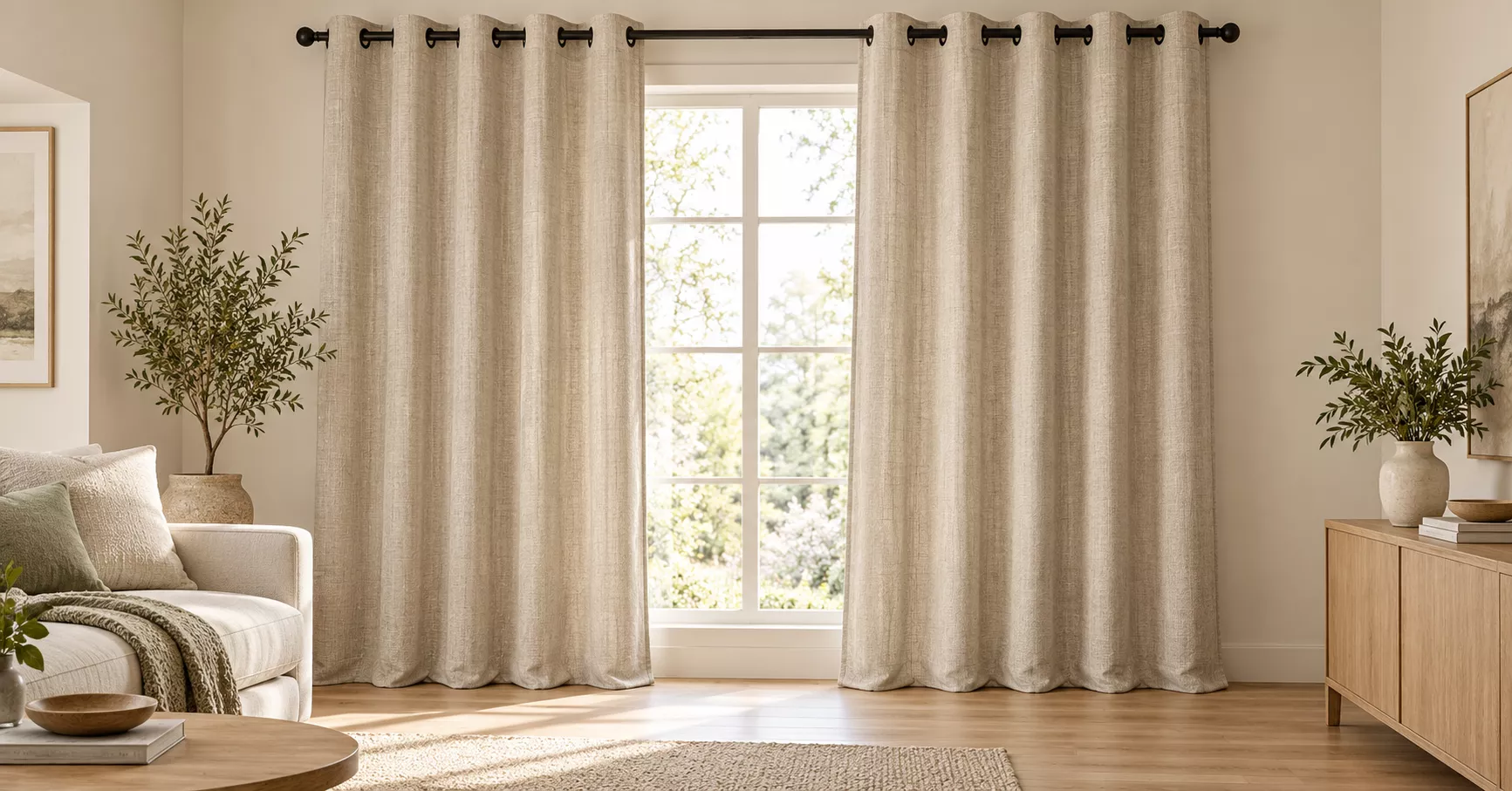
Grommet curtains are a type of curtain panel with reinforced metal or plastic rings set into the top hem. The rod passes through the rings, without requiring any additional hooks, clips or hardware. The rings prevent the panel from tearing, allow the panel to glide on the rod, and draw the fabric into deep, even folds. Eyelet curtains are the same type of curtain under a different name.
Quick facts
- Also called: eyelet curtains, ring-top curtains
- Hung from: a round rod threaded through the rings, without any hooks or track
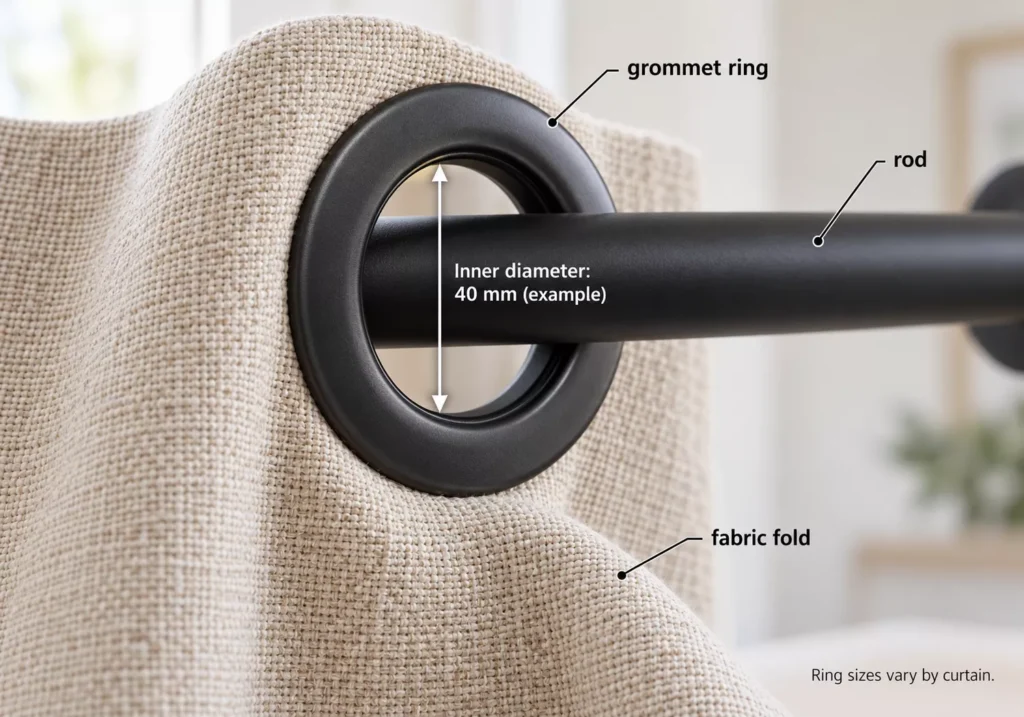
- Typical ring size: 1.5 to 2 inches inner diameter
- Fullness needed: 2 to 2.5 times the rod width
- Best for: windows and doors you open every day, in modern or transitional rooms
This guide explains how grommet curtains work, their pros and cons, how they compare with other header styles, which fabrics suit them, and how to measure, hang, style and care for them.
How Do Grommet Curtains Work?
A grommet is a ring set into a punched hole near the top of the panel, and serves two functions: to reinforce the hole, preventing the fabric from fraying or tearing under the panel’s weight, and to provide a smooth, hard surface for the rod to slide against, instead of raw cloth.
The rings are spaced at even intervals across the top. When the panel is drawn open, the fabric folds front to back into regular S-shaped waves, forming pleats. Closed, these folds create a tailored surface.
Most ready-made panels use an even number of rings, often eight on a 50-inch-wide panel. An even count means that both edges fold toward the wall, giving neatly ended panels.
Metal vs. plastic grommets
Metal rings are stronger and better for heavy fabrics or windows you open daily. Plastic rings are cheaper and quieter, but molded plastic rings can crack under heavy daily use.
Grommet finishes
Rings come in brushed nickel, polished chrome, antique brass, oil-rubbed bronze, matte black and more. Match the finish to your rod and other room hardware, such as light fixtures and drawer pulls, for a cohesive look. Ready-made panels come with fixed rings. Custom curtains usually allow for a choice of finish, and sometimes the ring size.
Pros and Cons of Grommet Curtains
Grommet curtains are best for windows you open and close often, in modern rooms. Their main drawbacks are a visible rod, a fixed wave pattern, and some light leakage and noise, and each has a simple fix.
Benefits
- They slide easily. Rings ride on the rod with little friction, and a panel moves with one pull. This is most beneficial on sliding doors and wide windows with heavy fabric.
- They form even waves. Panels self-pleat and do not need folds arranged by hand.
- They are simple to hang. Simply thread the rod through the rings. No need for hooks, pins or clips.
- They suit many fabrics and budgets. Grommet is a header style, not a fabric, so it is available in sheer, linen-look, blackout and velvet.
- They protect the fabric. Only the ring touches the rod, so the top of the panel wears less than a rod-pocket panel that drags across the rod.
- They suit bold prints. Closed, the panel hangs almost flat, so a large pattern is readable.
Drawbacks and how to fix them
| Drawback | Why it happens | Fix |
|---|---|---|
| Light leaks at the top | Gaps between rings and above the rod | Mount the rod higher and wider, use a blackout lining, and buy panels that overlap the frame |
| Rings clink on the rod | Metal rings touch a metal rod | Choose plastic or silicone-lined rings, use a wooden rod, and open the panels slowly |
| The rod stays visible | The panel hangs below the rod | Pick a decorative rod you like, or choose a back-tab or rod-pocket header |
| The waves are fixed | The rings force a regular fold | Choose another header if you want a flat, crisp panel |
| Not for tracks | Grommet panels are made for round rods | Use a rod, or pick a pleated header for a traverse track |
| Casual look | The style is clean and modern | For a formal room, consider pinch pleats |
Are grommet curtains out of style?
No. Grommet curtains continue to be a mainstream modern header for living rooms and busy windows. The idea that they are out of style comes from design cycles, not any flaw in the style. Their even, rolling waves also echo the popular ripple-fold look, without the cost of a track. What matters is the fabric and fullness: thin, skimpy panels look cheap with any header. Use a full panel width in a fabric with some body, and hang it to the floor.
Do grommet curtains look like shower curtains?
Only if the fabric is thin and the panels are too narrow. Buy at least 2 times the rod width, choose linen-look, cotton blend, blackout or velvet, and let the panels reach the floor. The result reads as tailored drapery.
Grommet vs. Eyelet vs. Other Curtain Header Styles
Grommet and eyelet curtains are the same type of curtain. The header is the top of the curtain, and it determines how the panel hangs, how easily it moves and how formal it looks. Here is how grommets compare with the other common headers.
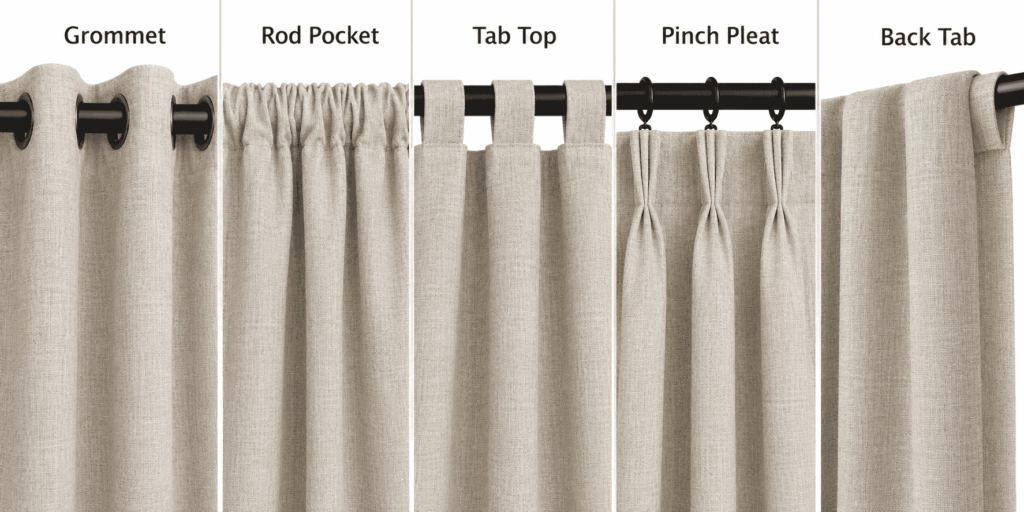
| Header style | How it hangs | Look | Ease of opening | Rod visible? | Best for |
|---|---|---|---|---|---|
| Grommet (eyelet) | Rod passes through rings | Clean, even waves | Very easy | Yes | Modern rooms, doors, daily-use windows |
| Rod pocket | Rod passes through a sewn channel | Soft, gathered | Harder, bunches | Mostly hidden | Casual and cottage rooms, fixed panels |
| Back tab | Hidden loops on the back | Flat, tailored, soft pleats | Moderate | Mostly hidden | Panels you rarely move |
| Tab top | Fabric loops over the rod | Relaxed, casual | Moderate, can snag | Yes | Casual, rustic, boho rooms |
| Pinch pleat | Hooks and rings on a pleated header | Formal, tailored | Easy on a rod or track | Often | Formal living and dining rooms |
| Ripple fold | Snaps onto a track | Continuous, precise waves | Very easy | No | Contemporary rooms with a track |
| Rings with clips | Clips attach to separate rings | Flexible, adjustable | Easy | Yes | Changing panel heights, any style |
Grommet vs. rod pocket
Rod-pocket panels cost less and hide the rod, but the fabric drags along it, so they are hard to open and close. Grommets glide, and they are a good choice for curtains you move every day.
Grommet vs. tab top
Tab-top loops are soft and casual, but can snag and do not slide as smoothly. Grommets give a more structured, tailored look and move more smoothly.
Grommet vs. pinch pleat
Pinch pleats look formal and give softer, fuller folds, but they need hooks and rings and usually cost more. Grommets are a more casual choice.
Grommet vs. back tab
Back-tab panels hide the rod and hang flat. They are a good choice for panels that stay in place. Choose grommets if you open the curtains daily and do not mind seeing the rod.
Best Fabrics and Linings for Grommet Curtains
Any fabric can take a grommet header, but weight matters most of all. A heavier fabric makes deeper, more even waves and hangs straighter. A very light fabric makes shallow waves that can look flat unless you add fullness.
| Fabric | Weight | Wave depth | Light control | Care | Best rooms |
|---|---|---|---|---|---|
| Linen and linen-look | Light to medium | Soft, relaxed | Filters light | Often machine washable, wrinkles easily | Living rooms, kitchens, dining rooms |
| Cotton and cotton blends | Medium | Even, structured | Filters or darkens, depending on weave | Usually machine washable | Bedrooms, family rooms |
| Polyester and blends | Light to heavy | Even, holds shape | Wide range, including blackout | Easy care, resists wrinkles and fading | Kids’ rooms, offices, busy homes |
| Velvet | Heavy | Deep, rich | Dense, good for darkening and insulation | Often dry-clean only | Bedrooms, formal dining rooms, media rooms |
| Voile, organza and other sheers | Very light | Shallow, airy | Soft, diffused light with privacy by day | Gentle wash | Living rooms, layered with heavier panels |
Check the care label on your fabric. Washing rules vary by fiber, weave and lining.
Sheer grommet curtains
Sheers diffuse harsh sun while keeping daytime privacy. Buy extra fullness, about 2.5 times the rod width, so the waves look full and not see-through and skimpy. Layering sheers behind heavier panels on a double rod is a classic setup.
Blackout and thermal grommet curtains
The grommet does not block light. The fabric and lining do. A blackout or room-darkening grommet panel works as well as any other header, if you size it wide and long enough to overlap the window frame. Thermal linings add insulation and can reduce drafts and noise.
Heavy fabrics and grommet strength
Velvet and lined blackout panels are heavy. Choose metal grommets that are professionally set, a sturdy rod, and strong brackets. Wide rods usually need a center support bracket, so check the rod maker’s span limit.
Lining options
- Standard lining: adds body, helps the waves fall evenly, and protects the face fabric from sun.
- Blackout lining: blocks most outside light for bedrooms and media rooms.
- Thermal or interlining: adds weight and insulation, and deepens the folds.
How to Measure and Buy Grommet Curtains
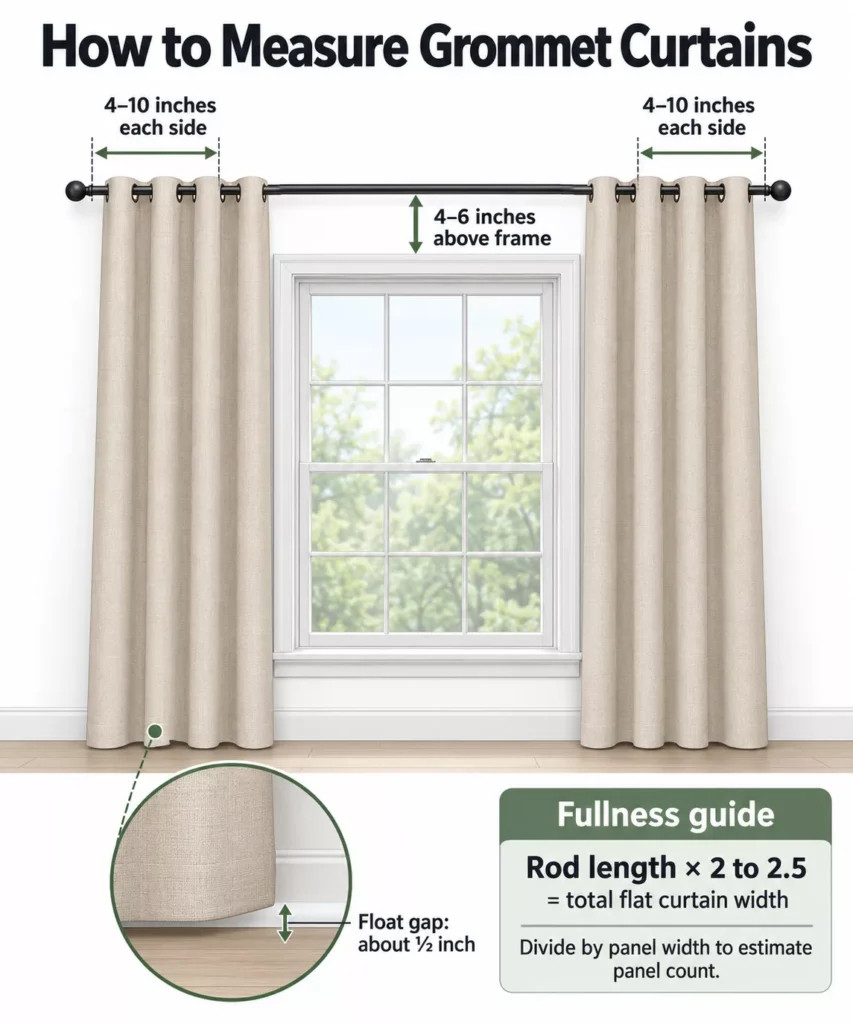
Buy panels whose combined width is 2 to 2.5 times the length of your rod. This fullness gives deep, even waves. Below 2 times, the waves flatten and the panels look thin.
The fullness formula
Total panel width = rod length × (2 to 2.5)
Fullness is measured against the rod, not the window. Use the rod length between the brackets, or the full length if you are fitting finials outside the brackets.
Worked example. Your window is 60 inches wide, and you place brackets 8 inches beyond each side. The rod is 76 inches long.
- At 2 times fullness: 76 × 2 = 152 inches of total panel width.
- At 2.5 times fullness: 76 × 2.5 = 190 inches of total panel width.
- Ready-made panels are often about 50 to 54 inches wide, so three or four panels would cover this window, or buy two wider custom panels.
Rod height and width
- Height: mount the rod 4 to 6 inches above the window frame. This makes the window look taller and gives the rings room to move.
- Width: extend the rod 4 to 10 inches past each side of the frame, so open panels stack beside the glass and do not cover it.
- Placement for light control: for bedrooms, go higher and wider to cut light leaks at the edges.
Choosing the length
| Length | How it looks | Best for |
|---|---|---|
| Float | About 1/2 inch above the floor | Daily-use windows, easy to keep clean |
| Kiss | Just touches the floor | The classic, safe choice |
| Puddle | Several inches of fabric on the floor | Formal rooms with little traffic |
Measure from where the rod will sit to the floor, then subtract your float gap. Check whether the maker’s listed length includes the fabric above the rings, as the ring position varies by an inch or two.
Rod and grommet size chart
The rod must be thinner than the inside of the grommet so the panel slides freely. As a rule of thumb, choose a rod at least 1/4 to 1/2 inch smaller than the grommet’s inner diameter.
| Grommet inner diameter | Rod diameter that works smoothly | Notes |
|---|---|---|
| 1.5 inches | Up to about 1 inch | Tighter, more structured folds |
| 1.6 inches | Up to about 1.25 inches | The most common ready-made size |
| 1.75 inches | Up to about 1.25 to 1.5 inches | A good middle size |
| 2 inches | Up to about 1.5 inches | Looser, more flowing folds |
Measure the opening inside the ring, not the outside edge. If your rod is thick, such as a 2-inch decorative rod, confirm the ring clears it before you buy. Finials and brackets must also let the rings pass.
How to Hang Grommet Curtains
To hang grommet curtains, mount a round rod, thread the rod through the rings on each panel, then set the rod on its brackets and train the folds. It takes about 15 to 30 minutes for one window.
You will need: a curtain rod with brackets and finials, a tape measure, a pencil, a level, a drill with a bit and screws or wall anchors, and a step ladder.
- Measure and mark the brackets. Mark the rod height 4 to 6 inches above the frame and the outer bracket positions 4 to 10 inches past each side.
- Check the level. Use a level to ensure the rod hangs straight.
- Mount the brackets. Screw the end brackets into studs where possible, or use wall anchors rated for the curtain’s weight. Add a center bracket on wide rods.
- Match the rod to the rings. Confirm the rod is thinner than the grommets’ inner diameter, as in the size chart above.
- Thread the panels. Feed the rod through the rings on each panel, starting at the edge that will sit against the wall.
- Fit the finials. Screw on the finials, or refit the one you removed, so the panels cannot slide off.
- Set the rod on the brackets. Lift it into place and secure any bracket locks.
- Train the waves. Spread the panel evenly along the rod. Fold each wave front to back, pushing one fold toward the wall and the next toward the room, then run your hand down the folds. They will hold the shape when set.
- Check the length. The panel should float about 1/2 inch above the floor, or just kiss it. Adjust the rod height if needed.
Tips for a clean result
- Ensure the panel ends fold toward the wall, for a neat, finished edge.
- Steam or press the panels before hanging, so creases do not set into the folds.
- Use a drop of silicone-based lubricant on a metal rod if rings stick. Test it on a hidden spot first, as some lubricants can stain fabric.
- For a high, wide window, ask a second person to help lift a long, heavy rod.
Grommet Curtain Ideas by Room
Grommet curtains suit almost any room. The difference comes in the fabric, the lining and the rod. Use this guide to match them to the room.
| Room | Fabric and lining | Rod and finish | Tip |
|---|---|---|---|
| Living room | Linen-look, cotton blend or velvet, lined | Decorative rod in brushed brass or matte black | Mount high and wide so the window looks larger |
| Bedroom | Blackout or thermal-lined, heavy weave | Rod above the frame with a wide overlap | Layer sheers on a double rod for day and night control |
| Sliding doors and patio doors | Medium-weight, lined, easy-care | Sturdy rod with a center support | Choose float length so panels do not drag on the track |
| Dining room | Textured linen or velvet | Matching metal finish to light fixtures | Use floor-length panels for a polished look |
| Home office | Polyester blend in a calm solid color | Slim, simple rod | Pick a light-filtering fabric to reduce screen glare |
| Nursery and kids’ room | Washable cotton or polyester, blackout lining | Sturdy rod, rings that stay put | Skip puddled lengths that collect dust and trip hazards |
| Outdoor patio or pergola | Weather-rated, fade-resistant outdoor fabric | Rust-resistant rod and rings | Check that the grommets are rated for outdoor use |
Layering and color
Hang sheer grommet panels behind heavier ones on a double rod. You get soft daylight and privacy in the day, and darkness at night. For a calm look, choose a color close to the wall so the window blends in. For drama, pick a deeper shade, such as navy velvet on a brushed brass rod.
Treat the grommets as a design detail
The rings are visible, so match their finish to other metal in the room, such as light fixtures, door handles and furniture hardware. A matte black ring and rod suit industrial and minimalist spaces. Brushed brass or antique bronze warms up traditional and transitional rooms.
How to Care for and Repair Grommet Curtains
Always follow the care label. Many cotton and polyester grommet curtains can be machine washed on a gentle cycle in cold water, while velvet, silk and lined panels often need dry cleaning.
Washing and drying
- Remove the panels from the rod and shake out dust.
- Wash on a gentle cycle in cold water, with the panel loosely folded or in a large mesh bag, so the rings do not scratch the drum.
- Tumble dry on low or hang to dry. Remove the panel while slightly damp to limit wrinkles.
- Rehang and retrain the folds while the fabric is still a little damp.
Ironing and steaming
Steam the panel while it hangs, or press it on the wrong side at the fabric’s recommended heat. Keep the iron away from plastic rings, which can melt.
Dust and light cleaning
Vacuum with a soft brush attachment every few weeks. This keeps dust from settling in the folds.
Rust and sticking rings
Rust is a risk in damp rooms and with low-grade metal rings. Dry the panels fully before rehanging. If a rust mark appears, treat it with a fabric-safe rust remover and test on a hidden spot first. If rings stick on the rod, wipe the rod clean and check that the ring is not too small for it.
Fixing a loose or torn grommet
- A ring that pops out: reset it with a grommet kit or pliers, and ensure both halves of the ring lock together.
- A torn hole: sew a patch or iron on interfacing behind the hole, cut a clean new opening, and set a new ring.
- A bent ring: replace it. A damaged ring can snag fabric.
Adding grommets to curtains you already own
You can add grommets to a flat-top panel with a DIY grommet kit. Heavier fabrics take more care.
- Fold and press a 3-inch header and stitch it, then add interfacing for strength.
- Mark the ring positions evenly, about 6 inches apart on center, with matching margins at both ends.
- Cut the holes using the kit’s cutter, following its diameter.
- Set each ring with the setter and a mallet or pliers, until both halves lock flat.
- Hang the panel and test the fit on your rod.
For heavy velvet or custom drapery, a professional workroom will give a more durable result.
Conclusion
Grommet curtains are a practical modern choice for windows you move every day. They slide easily, fold into even waves and come in almost every fabric. Match the ring size to your rod, buy 2 to 2.5 times the rod width, choose a fabric with body, and hang the rod high and wide. Do that, and grommet curtains will look tailored and last for years.
FAQs
There is none. Eyelet is the British term for the same metal-ringed header.
No. They remain a mainstream modern header, especially for windows and doors you open often. The fabric weight and fullness decide whether they look polished.
They work on standard round rods that are thinner than the rings. They are not made for traverse tracks, and a very thick rod may not fit through the rings.
Metal rings can make a soft clink against a metal rod. Plastic rings, a wooden rod, or slower movement reduce the sound.
The fabric blocks light, not the header. A blackout or room-darkening grommet panel works well if it is wide enough and hung high and wide so it overlaps the frame.
The rod must be thinner than the inside of the grommet. Most ready-made grommets are about 1.5 to 1.6 inches wide inside, and suit rods up to about 1.25 inches.
A standard-width panel, about 50 inches wide, usually has eight rings. An even count makes both edges fold toward the wall.