

Is Modal Fabric Breathable?
Yes, modal fabric is generally breathable because its cellulose fibers absorb and release moisture efficiently. Lightweight modal also allows useful airflow and feels cool against the skin. Therefore, modal suits summer clothing, underwear, pajamas, bedding, and gentle exercise. However, thick or tightly knitted modal can retain warmth. Linen ventilates better, while performance synthetics usually dry faster.
Modal offers good breathability, strong moisture absorption, and a smooth skin-friendly surface. However, its final performance depends heavily on weight, construction, fit, and added fibers. Therefore, consumers should examine the complete fabric instead of trusting the fiber name alone.
Who Should Choose Modal?
Choose modal for everyday clothing, breathable underwear, summer dresses, pajamas, and soft bedding. Moreover, modal suits office workers, travelers, hot sleepers, and people with sensitive skin. Lightweight modal works especially well during moderate heat and low-intensity movement.
Who Should Avoid Modal?
Avoid standard modal during endurance sports, mountaineering, heavy rain, or prolonged outdoor exposure. Additionally, modal may feel wet during intense sweating because it absorbs considerable moisture. Technical polyester, nylon, or wool systems often perform better during demanding activities.
What Makes Modal Fabric Breathable?
Modal is a regenerated cellulose fiber commonly produced from wood-derived cellulose. Its smooth structure can absorb moisture and release it into the surrounding environment. However, the finished fabric controls actual ventilation more than the raw fiber alone. Modal’s Fiber Structure Improve Comfort?
Modal contains hydrophilic cellulose, which attracts and absorbs water molecules from sweat. Consequently, moisture moves away from concentrated wet areas near the skin. This process can create a drier and more comfortable clothing microclimate. Cellulose Fibers Increase Breathability?
Smooth modal fibers reduce surface roughness and feel gentle against bare skin. However, smoothness does not automatically create greater airflow through the fabric. Instead, yarn spacing, fabric pores, thickness, and construction determine air movement.
How Does Modal Transport Moisture?
Modal absorbs moisture within its fiber structure instead of leaving everything on the surface. Therefore, it can reduce the sticky feeling associated with trapped surface sweat. However, absorbed moisture still requires airflow and evaporation before the fabric feels completely dry.
Modal can provide good air circulation when manufacturers use open, lightweight fabric structures. Conversely, compact knits can restrict airflow despite containing breathable cellulose fibers. Research consistently connects fabric structure and porosity with measurable air permeability. Yarn Construction Affect Modal Fabric Airflow?
Fine yarns can create lightweight modal fabrics with a soft and flexible drape. However, tightly packed fine yarns may still create a compact surface. Therefore, yarn diameter, twist, spacing, and stitch length all influence ventilation.
Does Fabric Weave Affect Modal Breathability?
Yes, weave density strongly affects how easily air passes through modal fabric. Loose woven structures usually ventilate better than tightly woven sateen structures. Similarly, open jersey knits usually breathe better than compact interlock fabrics. Does GSM Influence Modal Breathability?
GSM means grams per square metre and indicates fabric weight. Generally, lightweight modal feels cooler because it contains less material and lower insulation. However, structure and thickness can matter more than weight alone. wo Modal Fabrics Feel Completely Different?
One modal shirt may use lightweight jersey, while another uses thick brushed fleece. Moreover, one garment may contain pure modal, while another contains polyester and elastane. Therefore, fiber percentage alone cannot predict breathability, drying speed, or heat retention.
Breathability Versus Moisture-Wicking: What Is the Difference?
Breathability describes airflow and water-vapor movement through a fabric. Meanwhile, moisture-wicking describes liquid sweat movement across or away from the skin. Although these properties interact, they measure different parts of thermal comfort.
| Factor | Breathability | Moisture-Wicking |
|---|---|---|
| Primary movement | Air and water vapour move through fabric. | Liquid sweat moves across the fabric. |
| Main benefit | Ventilation supports heat release. | Moisture spreads beyond one wet area. |
| Cooling role | Airflow supports sweat evaporation. | Wider moisture distribution may accelerate evaporation. |
| Main structure | Fabric pores strongly influence performance. | Fiber chemistry and finishes influence performance. |
| Skin feeling | Better airflow can reduce overheating. | Better transport can reduce local dampness. |
Does Modal Perform Well in Both Areas?
Modal usually manages absorbed moisture effectively because cellulose attracts water. Additionally, lightweight modal structures can provide comfortable ventilation during normal daily use. However, engineered polyester often transports and dries sweat faster during vigorous exercise. ency the Same as Wicking?
No, absorbency measures how much moisture a fiber can hold. Conversely, wicking describes moisture movement through capillary pathways within yarns and fabrics. Therefore, highly absorbent fabric can still dry slowly after becoming saturated.
How Breathable Is Modal Compared With Other Fabrics?
Modal ranks among the better breathable fabrics for daily clothing and sleepwear. However, linen often provides greater ventilation, while performance polyester offers faster sweat drying. The following ratings assume lightweight fabrics with suitable construction and no heavy surface coating.
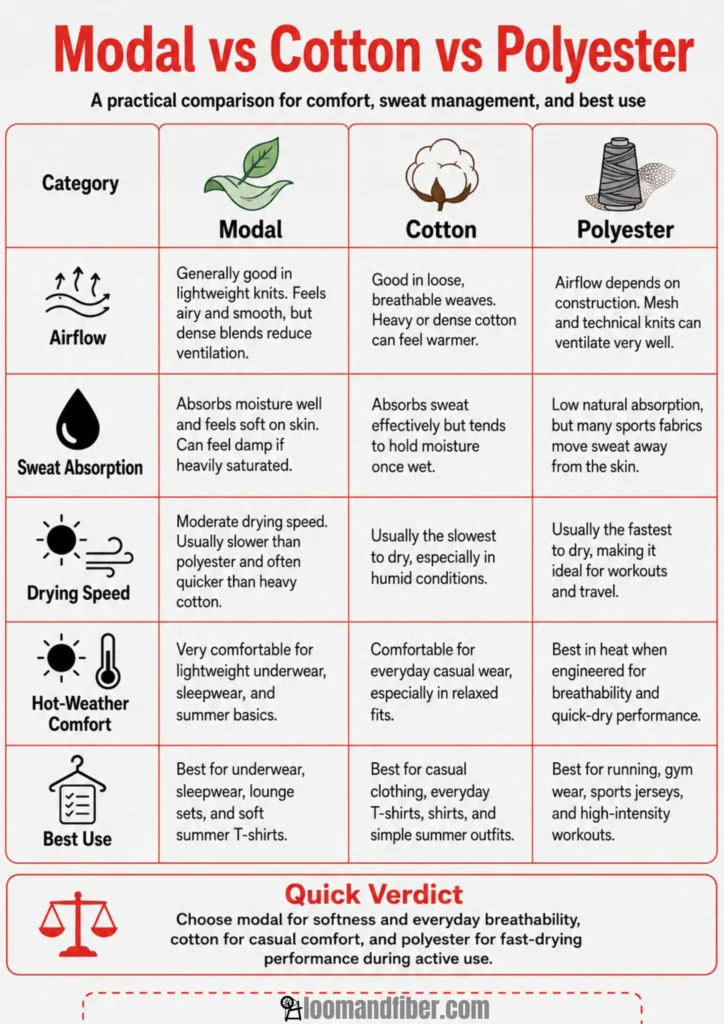
| Fabric | Breathability | Moisture Management | Drying Speed | Hot-Weather Comfort | Natural Odor Control |
|---|---|---|---|---|---|
| Modal | Good | Very good | Moderate | Very good | Moderate |
| Cotton | Good | Good | Slow | Good | Moderate |
| Linen | Excellent | Good | Moderate | Excellent | Moderate |
| Bamboo viscose | Good | Very good | Moderate | Very good | Unproven without treatment |
| Lyocell | Very good | Very good | Moderate-fast | Very good | Good |
| Standard rayon | Good | Good | Slow-moderate | Good | Moderate |
| Polyester | Variable | Excellent when engineered | Very fast | Good during exercise | Low without treatment |
| Nylon | Variable | Good when engineered | Fast | Moderate-good | Low without treatment |
| Merino wool | Good | Excellent | Moderate | Good across temperatures | Very good |
Where Does Modal Perform Best?
Modal performs strongly in softness, moisture absorption, drape, and next-to-skin comfort. Therefore, manufacturers frequently use it for underwear, T-shirts, pajamas, dresses, and sheets. It offers a strong balance rather than dominating every performance category.
Where Does Modal Lose?
Modal usually dries slower than lightweight polyester and many engineered nylon fabrics. Additionally, wet modal may feel heavier during demanding exercise or extended travel. Linen may also feel airier in extremely hot and dry conditions.
Is Modal One of the Best Breathable Fabrics?
Modal belongs among the best breathable fabrics for daily comfort and sensitive skin. However, no fabric performs best across every climate and activity. Construction, moisture volume, garment design, and drying conditions always influence performance.
Is Modal Good for Hot Weather?
Yes, lightweight modal works well in hot weather because it handles moisture and feels smooth. Moreover, its soft drape prevents the stiff or rough feeling found in some fabrics. However, choose an open construction and relaxed fit for better summer ventilation.
Is Modal Good for Summer Clothing?
Modal suits summer T-shirts, loose dresses, underwear, skirts, pajamas, and lightweight loungewear. Additionally, modal clothing for summer feels soft during prolonged skin contact. However, dark colors and tight fits can still increase perceived warmth.
How Does Modal Perform in Dry Heat?
Modal feels comfortable in dry heat when the fabric remains lightweight and ventilated. Because sweat evaporates quickly, moisture absorption rarely overwhelms the material. Nevertheless, linen often feels cooler because its structure supports greater air movement.
How Does Modal Perform in Humid Heat?
Modal absorbs sweat efficiently, which can initially reduce surface dampness. However, high humidity slows evaporation and keeps absorbed moisture inside the fabric longer. Therefore, loose clothing and thinner modal become especially important in humid climates.
Does Modal Create a Cooling Effect?
Modal does not actively lower body temperature like powered cooling technology. Instead, it supports comfort through moisture regulation, softness, and potential ventilation. Therefore, cooling depends on sweat evaporation and surrounding air movement.
When Does Linen Outperform Modal?
Linen often outperforms modal during extremely hot, dry, or poorly ventilated conditions. Its typical fabric structure provides strong airflow and limited skin cling. However, modal usually feels softer, smoother, and less crisp than linen.
Does Modal Make You Sweat?
No, modal itself does not make the body produce more sweat. Human sweating responds mainly to temperature, humidity, activity, health, and individual physiology. However, unsuitable modal construction can make existing sweat feel warmer or wetter.
Which Factors Increase Sweating in Modal Clothing?
Several garment and environmental factors can increase discomfort:
- High humidity slows evaporation. Therefore, sweat remains on skin and clothing longer.
- Heavy fabric increases insulation. Consequently, thick modal may feel warmer during summer.
- Tight clothing restricts ventilation. Moreover, close contact can increase dampness and skin cling.
- Polyester-rich blends may retain odors. However, engineered polyester can still dry very quickly.
- Intense activity produces more moisture. Eventually, modal may absorb more sweat than evaporation removes.
Can Modal Feel Clammy?
Modal can feel clammy after absorbing substantial sweat in humid conditions. Furthermore, compact clothing can hold wet fabric directly against the skin. Therefore, choose loose, lightweight modal when humidity and sweating remain high.
Does Modal Keep You Cool While Sleeping?
Modal can support cooler sleeping because it absorbs moisture and feels smooth against skin. Moreover, lightweight modal bedding drapes softly without feeling stiff. However, mattress materials, room temperature, weave, and blanket weight also control sleep comfort.
Are Modal Bed Sheets Breathable?
Lightweight modal sheets can provide breathable, moisture-regulating comfort for warm sleepers. However, tightly woven or heavy sheets may ventilate less effectively. Therefore, shoppers should examine fabric weight and weave alongside fiber content.
Are Modal Pajamas Good for Hot Sleepers?
Modal pajamas work well because their smooth fabric reduces friction and handles moderate perspiration. Additionally, loose modal sleepwear allows more ventilation than fitted designs. However, heavy brushed pajamas may suit winter better than summer.
Are Modal Blankets Breathable?
Modal blankets vary greatly because manufacturers use different thicknesses, fillings, and fabric constructions. A lightweight woven blanket can release heat more easily. Conversely, multilayered or brushed modal blankets can provide noticeable insulation.
Are Modal Mattress Covers Cooling?
Modal mattress covers can improve surface softness and moisture handling. However, they cannot overcome heat-retaining foam or waterproof backing materials. Therefore, evaluate the complete mattress system instead of the cover alone.
Modal Versus Cotton Percale for Sleeping
Cotton percale often feels crisp, dry, and highly ventilated because of its simple weave. Meanwhile, modal usually feels softer, smoother, and more draped. Therefore, choose percale for crisp airflow and modal for silky moisture comfort.
Modal Versus Linen Bedding
Linen generally offers stronger airflow and a drier textured feel during extreme heat. However, modal offers greater smoothness and causes less initial roughness. Consequently, personal texture preferences may determine the better bedding choice.
Is Modal Breathable Enough for Exercise?
Modal works for yoga, walking, stretching, mobility training, and light gym sessions. However, it becomes less suitable as sweat volume and exercise intensity increase. Technical fabrics often dry faster and maintain lower wet weight during demanding workouts.
Which Exercises Suit Modal Clothing?
Modal works well for activities producing low or moderate perspiration:
- Yoga benefits from modal’s softness and flexibility. However, elastane usually provides the required stretch.
- Walking suits lightweight modal clothing. Moreover, relaxed fits support airflow during casual movement.
- Pilates benefits from smooth, low-friction fabric. Nevertheless, fitted garments require suitable stretch recovery.
- Casual gym sessions can use modal blends. However, users should avoid heavy modal during intense circuits.
- Recovery clothing benefits from modal’s softness. Therefore, modal suits post-training tops and lounge trousers.
Which Workouts Require Better Performance Fabrics?
Marathons, HIIT, cycling, football, and heavy lifting can produce substantial sweat. Therefore, engineered polyester and nylon may transport and dry moisture more efficiently. Channeled synthetic structures can provide high permeability and strong sweat-drying performance. chnical Synthetics Sometimes Outperform Modal?
Technical synthetics absorb little water within their fiber interiors. Instead, engineered yarns spread moisture across larger surfaces for faster evaporation. However, untreated synthetics may develop stronger odors after repeated sweating.
Does a Fabric Blend Affect Modal Breathability?
Yes, every added fiber changes modal’s airflow, stretch, drying speed, and moisture behaviour. However, fabric structure may create larger changes than blend percentages alone. Therefore, shoppers should examine both composition and construction.
| Modal Blend | Expected Breathability | Main Strength | Main Limitation |
|---|---|---|---|
| 100% modal | Good to very good | Maximum softness and moisture absorption | Moderate drying speed |
| Cotton-modal | Good to very good | Balanced softness and familiar cotton feel | May dry slowly |
| Modal-spandex | Good | Better stretch and body fit | Tight fit may restrict ventilation |
| Modal-polyester | Moderate to good | Faster drying and improved durability | Less absorbent and potentially odor-prone |
| Modal-wool | Good | Temperature regulation and winter comfort | Greater warmth and higher care needs |
| Modal-nylon | Moderate to good | Strength, stretch, and quicker drying | May feel less natural |
| Modal-linen | Very good | Improved airflow and reduced cling | Less smooth than pure modal |
Is 100% Modal the Most Breathable Option?
Pure modal removes the airflow limitations associated with dense synthetic additions. However, pure fiber content does not guarantee an open or lightweight structure. A thick modal interlock may breathe less than a loose modal blend.
Does Elastane Reduce Breathability?
Small elastane percentages rarely block airflow by themselves. However, elastane often creates tighter garments that remain closer to the skin. Consequently, the garment fit may reduce ventilation more than the fiber percentage.
Does Polyester Reduce Modal Fabric Ventilation?
Polyester can reduce absorbency and change the fabric’s skin feel. However, engineered polyester may improve wicking and shorten drying time. Therefore, modal-polyester blends can perform well when manufacturers design them correctly.
Is a Cotton-Modal Blend Breathable?
Cotton-modal blends usually provide strong everyday breathability and excellent softness. Moreover, cotton adds familiar texture while modal improves drape and moisture regulation. However, these blends may remain wet longer than performance synthetics.
Which Factors Affect How Breathable Modal Feels?
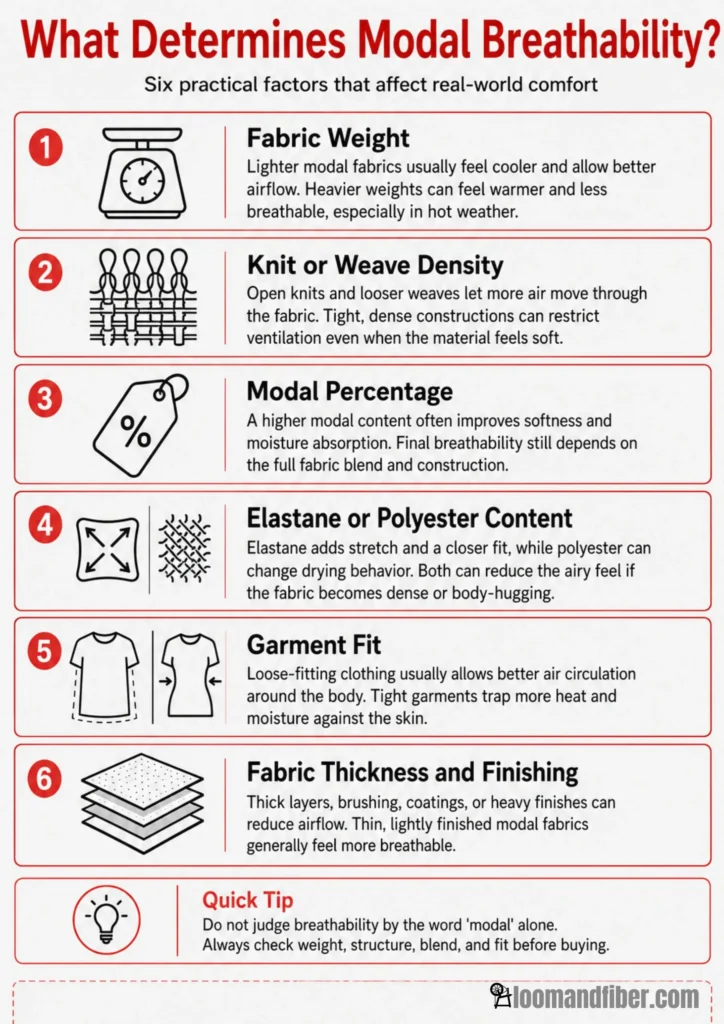
Modal’s fiber chemistry provides only one part of the comfort system. Fabric mass, thickness, porosity, finish, fit, and layering can change performance significantly. Therefore, product-level assessment gives better answers than fiber-level assumptions. Fabric GSM Affect Breathability?
Lightweight modal between approximately 120 and 180 GSM often suits summer garments. Meanwhile, medium weights usually provide greater coverage and durability. Heavy fabrics can increase insulation, particularly when manufacturers use compact or brushed structures.
Lightweight Versus Heavyweight Modal
Lightweight modal usually allows better heat release and faster moisture evaporation. Conversely, heavyweight modal provides structure, opacity, warmth, and improved cold-weather usefulness. Therefore, neither weight works best across every season.
Knit Versus Woven Modal: Which Breathes Better?
Knitted modal stretches easily and often provides comfortable airflow through looped structures. However, compact interlock knits can become dense and less permeable. Woven modal can breathe well when manufacturers use lower yarn densities.
Does Fabric Tightness Matter?
Yes, tighter construction reduces the open spaces available for air movement. Therefore, compact fabrics can feel warmer despite containing moisture-friendly fibers. Studies consistently connect fabric geometry, density, and porosity with air permeability.
Loose modal garments allow air to circulate between fabric and skin. Conversely, fitted garments reduce the available ventilation space. However, fitted clothing may still feel comfortable during low-sweat activities.
Do Brushed and Peached Finishes Reduce Cooling?
Brushing raises surface fibers and creates a softer, warmer texture. Similarly, peaching adds a fine suede-like surface that may increase heat retention. Therefore, avoid these finishes when maximum cooling remains the priority.
Does Mercerization Affect Modal?
Mercerization mainly applies to cotton, although blended fabrics may receive related finishing treatments. Finishes can alter smoothness, dimensional stability, absorbency, and surface behaviour. Therefore, consumers should avoid assuming every soft finish improves breathability.
Do Chemical Finishes Affect Airflow?
Water-resistant, stain-resistant, resin, or coating treatments may reduce vapour or air transmission. However, modern finishes vary widely in chemistry and application level. Therefore, performance claims require testing on the finished fabric.
Does Layering Reduce Modal Ventilation?
Every additional layer increases resistance against airflow and moisture evaporation. Moreover, trapped air between layers increases insulation. Therefore, breathable modal underwear can still feel warm beneath heavy outer clothing.
Is Modal Breathable in Humid Weather?
Modal remains breathable in humidity, but moisture evaporation becomes slower. Consequently, absorbed sweat can remain inside the fabric longer. Lightweight construction, loose fitting, and strong air movement improve modal comfort in tropical conditions.
Is Modal Suitable for Tropical Weather?
Modal can suit tropical weather for casual clothing, underwear, and loose dresses. However, choose thin fabric and avoid heavy polyester-rich blends. Linen may perform better when maximum ventilation matters more than softness.
How Does Monsoon Humidity Affect Modal?
Monsoon air already contains considerable moisture, which reduces sweat evaporation. Therefore, modal can feel damp after prolonged outdoor activity. Additionally, garments may require longer drying periods after washing.
Can Modal Handle Heavy Perspiration in Humidity?
Modal absorbs moderate perspiration effectively during daily activities. However, heavy sweating can eventually saturate the fabric. Therefore, technical quick-drying materials may perform better during intense tropical exercise.
Is Modal Breathable in Winter?
Yes, modal remains breathable during winter because breathability does not mean coldness. The fabric can move moisture while other layers provide insulation. Therefore, modal works well as soft underwear, pajamas, and base-layer blends.
Can Modal Regulate Temperature During Cold Weather?
Modal supports moisture regulation, which can reduce damp discomfort during changing temperatures. However, it provides limited insulation when used as a thin single layer. Wool-modal blends offer better warmth for winter clothing.
Is Modal a Good Winter Base Layer?
Modal works for low-intensity indoor or urban activities. However, it may stay wet during strenuous cold-weather exercise. Merino wool or technical synthetics usually provide safer moisture performance during remote outdoor activities.
Does Modal Trap Body Heat?
Standard lightweight modal does not inherently trap excessive body heat. However, thick construction, brushing, tight fit, and layering can increase insulation. Therefore, shoppers should judge the complete garment rather than blaming the modal fiber.
How Does Modal Release Heat?
Modal can support heat release through moisture absorption, evaporation, and fabric ventilation. However, evaporation requires unsaturated air and sufficient airflow. Therefore, modal feels less cooling during still, humid conditions.
Does Absorbed Moisture Increase Warmth?
Small moisture amounts can support comfort by spreading perspiration away from concentrated areas. However, saturation increases fabric weight and can cause dampness. In cold weather, wet fabric may also accelerate unwanted body cooling.
Is Modal an Insulating Fabric?
Thin modal provides limited insulation, while thick modal can hold more still air. Moreover, brushed surfaces increase warmth by creating additional air-trapping fibers. Therefore, modal can serve either summer or winter products.
Is Modal Better Than Cotton for Breathability?
Modal and cotton both breathe well, but their strengths differ. Modal usually offers smoother drape and stronger moisture absorption. Meanwhile, lightweight cotton constructions can provide excellent airflow and familiar dry comfort.
| Feature | Modal | Cotton |
|---|---|---|
| Airflow | Good when lightweight and open | Good when lightweight and open |
| Sweat absorption | Very good | Very good |
| Moisture distribution | Usually very good | Good |
| Drying speed | Moderate | Usually slow |
| Softness | Very smooth and silky | Soft with a drier hand |
| Wet weight | Can become noticeably heavy | Can also become heavy |
| Shrinkage | Generally controlled by manufacturing | Can shrink without stabilization |
| Wrinkling | Usually lower | Usually higher |
| Shape retention | Good in quality fabrics | Depends on yarn and construction |
| Hot-weather use | Excellent for soft daily clothing | Excellent for broad summer use |
When Is Modal Better Than Cotton?
Choose modal when softness, smooth drape, and moisture regulation remain the main priorities. Additionally, modal often feels gentler in fitted underwear and sleepwear. However, product quality still controls durability and dimensional stability.
When Is Cotton Better Than Modal?
Choose cotton for crisp shirts, structured garments, durable casualwear, and familiar easy-care products. Moreover, cotton percale can feel airier than smooth modal sateen bedding. Cotton also offers wider price and construction choices.
Which Fabric Handles Sweat Better?
Modal often spreads and absorbs everyday perspiration more comfortably than basic cotton. However, neither fabric matches advanced sports synthetics during heavy sweating. Therefore, activity level should guide the final decision.
Is Modal Better Than Bamboo for Breathability?
Modal and bamboo viscose often provide similar softness and moisture behaviour. Both belong to the regenerated cellulose category when bamboo becomes viscose or rayon. Therefore, fabric construction usually creates more difference than the original plant source.
Is Bamboo Fabric Really Bamboo Fiber?
Many soft products marketed as bamboo actually contain rayon or viscose made from bamboo cellulose. The FTC requires accurate rayon or viscose labeling for these products. Therefore, consumers should inspect the fiber label carefully. ls Softer?
Both fabrics can feel exceptionally smooth when manufacturers use fine yarns and suitable finishes. However, branded modal often offers consistent softness and controlled production specifications. Product quality still varies between manufacturers.
Which Controls Odor Better?
Neither modal nor bamboo viscose automatically guarantees antibacterial performance. In particular, bamboo plant properties do not automatically remain after rayon processing. Therefore, odor-control claims require reliable product-specific evidence. More Sustainable?
Sustainability depends on forestry, pulp sourcing, chemical recovery, energy, water, and wastewater controls. Therefore, plant source alone cannot prove lower environmental impact. Look for transparent manufacturers, certification, traceability, and verified lifecycle information.
Is Modal Better Than Polyester in Summer?
Modal usually feels better than basic polyester during casual summer wear. It absorbs moisture, feels smoother, and often reduces the plastic-like skin sensation. However, engineered polyester can outperform modal during intensive physical activity.
Which Fabric Causes More Overheating?
Neither fiber automatically causes overheating because construction controls much of the result. However, dense polyester garments may restrict ventilation and retain surface oils. Dense or brushed modal can also feel warm.
Which Fabric Manages Sweat Better?
Modal absorbs sweat within its cellulose structure and supports a drier skin microclimate. Conversely, performance polyester spreads sweat without absorbing much internally. Therefore, modal suits daily perspiration, while polyester suits rapid drying.
Which Fabric Develops More Odor?
Untreated polyester often retains odor-causing compounds after repeated exercise. Modal may remain fresher during casual wear because it manages moisture differently. However, no fabric remains odor-free without proper washing.
Modal Versus Polyester for Gym Wear
Choose modal for stretching, yoga, walking, warm-ups, and post-workout clothing. However, choose engineered polyester for running, HIIT, cycling, and competitive sports. Sweat volume and drying speed create the main difference.
Modal Versus Polyester for Casual Wear
Modal usually provides better softness, drape, and next-to-skin comfort during daily wear. Moreover, it feels less slick than many polyester fabrics. Therefore, modal often wins for summer T-shirts, underwear, and dresses.
Common Myths About Modal Breathability
Marketing language often exaggerates modal’s cooling and moisture performance. However, modal remains a versatile comfort fiber when manufacturers use suitable construction. The following corrections provide more realistic expectations.
Myth: Modal Is Waterproof
Modal is not waterproof because cellulose readily interacts with moisture. Instead, modal absorbs water and can become saturated. Therefore, it requires coatings or membranes for meaningful rain protection.
Myth: Modal Is Always the Coolest Fabric
Modal feels cool and smooth, but it does not always provide maximum ventilation. Linen often allows more airflow during extreme heat. Meanwhile, technical fabrics may cool athletes better through faster sweat evaporation.
Myth: Modal Never Smells
Modal can develop odors after sweat, bacterial growth, poor drying, or delayed washing. However, proper moisture management may reduce some damp conditions. Regular cleaning remains essential for every fabric.
Myth: Modal Dries Instantly
Modal does not dry instantly because its fibers absorb moisture internally. Therefore, it usually dries slower than lightweight performance polyester. Fabric thickness and surrounding humidity further affect drying time.
Myth: Every Modal Fabric Is Equally Breathable
Modal fabrics can differ in GSM, thickness, density, finishing, and blend composition. Consequently, two modal garments may perform completely differently. Product construction always deserves close examination.
Myth: More Modal Always Means Better Performance
Higher modal content usually increases softness and absorbency. However, it may also increase wet weight and drying time. Therefore, blended fabrics can outperform pure modal for specific uses.
What Are the Best Uses for Breathable Modal Fabric?
Modal excels in products requiring softness, flexible drape, and everyday moisture comfort. However, product construction should match the intended climate and activity. The following ratings assume suitable fabric weight and garment design.
| Product | Suitability Rating | Performance Explanation |
|---|---|---|
| T-shirts | Excellent | Modal provides softness, drape, and everyday moisture comfort. |
| Underwear | Excellent | Smooth fibers reduce friction and manage moderate perspiration. |
| Pajamas | Excellent | Soft drape supports breathable sleepwear and skin comfort. |
| Dresses | Excellent | Lightweight modal hangs well and suits warm-weather movement. |
| Casual activewear | Good | Modal works during yoga, walking, and gentle workouts. |
| Endurance activewear | Limited | Absorbed sweat may increase weight and drying time. |
| Baby clothing | Very good | Soft fabric can reduce rough friction against delicate skin. |
| Bed sheets | Very good | Modal provides smoothness and moisture-regulating comfort. |
| Socks | Good | Modal feels soft but needs durable supporting fibers. |
| Travel clothing | Very good | Modal offers comfort, drape, and moderate wrinkle resistance. |
| Winter base layers | Moderate | Modal suits low activity but may remain wet during exertion. |
| Rainwear | Poor | Modal lacks water resistance without technical protection. |
Is Modal Good for Underwear?
Modal works exceptionally well for underwear because it feels smooth and handles everyday perspiration. Additionally, modal stretches comfortably when manufacturers add a small elastane percentage. However, close-fitting designs still require proper ventilation zones.
Is Modal Good for Baby Clothes?
Soft modal can reduce rough friction against sensitive skin. However, parents should still examine dyes, finishes, seams, and safety compliance. Breathability alone does not determine complete garment safety.
Is Modal Good for Travel Clothing?
Modal works well for flights, urban travel, and relaxed sightseeing. Moreover, it packs easily and feels comfortable during extended sitting. However, quick-drying synthetics perform better during backpacking or repeated sink washing.
Is Modal Good for Socks?
Modal adds softness and moisture absorption to casual socks. However, manufacturers usually add nylon or polyester for abrasion resistance. Therefore, blend design determines durability, drying speed, and odor performance.
Who Should Choose Breathable Modal Fabric?
Modal suits people seeking softness, daily comfort, and moderate moisture management. However, the correct fabric weight remains important for each climate. Buyers should match modal construction with their expected activity level.
Modal Works Especially Well For:
- Hot sleepers benefit from lightweight modal bedding. However, the complete bedding system still affects heat.
- Office workers gain soft all-day comfort. Moreover, modal handles moderate perspiration during commuting.
- Travelers benefit from flexible and smooth clothing. Nevertheless, heavy sweating requires faster-drying fabrics.
- People with sensitive skin may prefer smooth modal surfaces. However, finishes and dyes also affect irritation.
- Daily wear benefits from modal’s balanced performance. Therefore, it suits T-shirts, dresses, and underwear.
- Summer clothing benefits from lightweight modal construction. However, loose designs provide better ventilation.
Modal May Not Suit:
- Mountaineers need dependable cold-weather moisture control. Therefore, wool or technical synthetics often perform better.
- Endurance athletes produce heavy sweat volumes. Consequently, modal may become wet and heavy.
- Rainy outdoor users require water protection. Modal alone cannot provide meaningful waterproofing.
- Minimal-care travelers need rapid drying. Therefore, lightweight synthetics may offer greater convenience.
- Industrial users may require certified protection. Standard modal cannot replace tested protective clothing.
Expert Buying Tips for Breathable Modal Fabric
Fiber labels provide useful information, but they never reveal complete performance. Therefore, buyers should examine fabric weight, structure, stretch, opacity, and intended use. These practical checks can prevent uncomfortable purchases.
1. Choose Lightweight Modal for Summer
Look for modal between approximately 120 and 180 GSM for lightweight summer garments. However, very thin fabrics may become transparent or less durable. Therefore, balance cooling with coverage and expected washing frequency.
2. Examine Fabric Construction
Hold the fabric toward light and check its visible density. More visible spacing often suggests greater airflow, although it may reduce coverage. Additionally, stretch the fabric gently and examine how quickly it recovers.
3. Prefer Loose Garment Designs
Loose sleeves, wider legs, and relaxed bodies allow better air circulation. Conversely, skin-tight modal can restrict ventilation despite feeling smooth. Therefore, fit matters greatly during hot and humid weather.
4. Check the Complete Fiber Blend
Pure modal and cotton-modal blends usually provide excellent daily comfort. However, high polyester percentages can change absorbency, odor, and skin feel. Small elastane percentages mainly improve stretch and recovery.
5. Avoid Thick Brushed Modal During Summer
Brushed modal traps more air around its raised surface fibers. Therefore, it provides softness and warmth rather than maximum cooling. Choose smooth jersey or lightweight woven modal for hot weather.
6. Consider Drying Speed
Modal may require longer drying than performance polyester, especially during humid weather. Therefore, frequent travelers should test drying time before packing limited garments. Thin modal blends usually dry faster than heavy pure modal.
7. Look for Reliable Fiber Sources
Recognized suppliers can offer more consistent fiber specifications, traceability, and performance documentation. TENCEL™ Modal fibers support moisture regulation and long-lasting softness in suitable fabrics. However, finished garment construction still controls actual comfort. Care Instructions
Incorrect washing can shrink, distort, pill, or weaken some modal fabrics. Therefore, follow the garment label and avoid unnecessarily harsh cycles. Gentle washing also helps preserve softness and surface appearance.
9. Test Opacity Before Buying
Lightweight modal can become more transparent when stretched or wet. Therefore, inspect the garment under bright light before purchasing. This check becomes especially important for leggings, dresses, and pale colors.
10. Avoid Unsupported Cooling Claims
Terms like cooling, antibacterial, and temperature regulating can lack measurable standards. Therefore, seek clear test methods or product data when performance matters. General fiber marketing cannot replace finished-fabric testing.
Conclusion-
Yes, modal fabric is breathable and performs especially well in everyday clothing, underwear, pajamas, and bedding. Moreover, its cellulose structure supports moisture absorption and release, creating a comfortable skin microclimate. Lightweight modal also suits summer clothing, warm sleepers, office wear, and gentle exercise.
However, modal is not universally the coolest or fastest-drying fabric. Linen often provides greater airflow during extreme heat. Meanwhile, engineered polyester and nylon usually outperform modal during intense sports and heavy sweating.
Most importantly, breathability depends on more than the modal fiber. Fabric GSM, yarn density, knit structure, weave, finish, layering, and garment fit can change performance significantly. Therefore, choose lightweight and loosely constructed modal when cooling remains the main priority.
FAQs
A comparable lightweight modal knit may provide strong airflow and moisture comfort, but neither fiber always wins. Loose cotton can outperform dense modal, while lightweight modal can outperform tightly knitted cotton. Construction, weight, fit, and finishing determine the final result.
Yes, lightweight and loosely fitted modal is often comfortable in hot weather. Thick modal jersey, tight stretch garments, lining, and high humidity can reduce its cooling performance.
Modal fiber does not inherently trap large amounts of heat, but thick, tight, brushed, layered, or densely knitted modal garments can feel warm.
Modal absorbs moisture well, but absorption is not identical to rapid wicking or drying. High-sweat performance depends on how the yarn and fabric are engineered.
It can be breathable, especially in lightweight underwear or sleepwear. However, the elastane and close fit may reduce airflow compared with a loose 100% modal garment.
MicroModal uses finer modal fibers and can produce lightweight, smooth fabrics. It is not automatically more breathable because fabric density, thickness, and construction still control airflow.
Modal may absorb moderate perspiration comfortably, but it can become damp during heavy sweating. Fast-drying performance fabrics may be more suitable for intense workouts.
Usually yes. Lightweight, loose, unlined modal pajamas are commonly suitable for sleep, while thick or body-hugging modal may feel warmer.