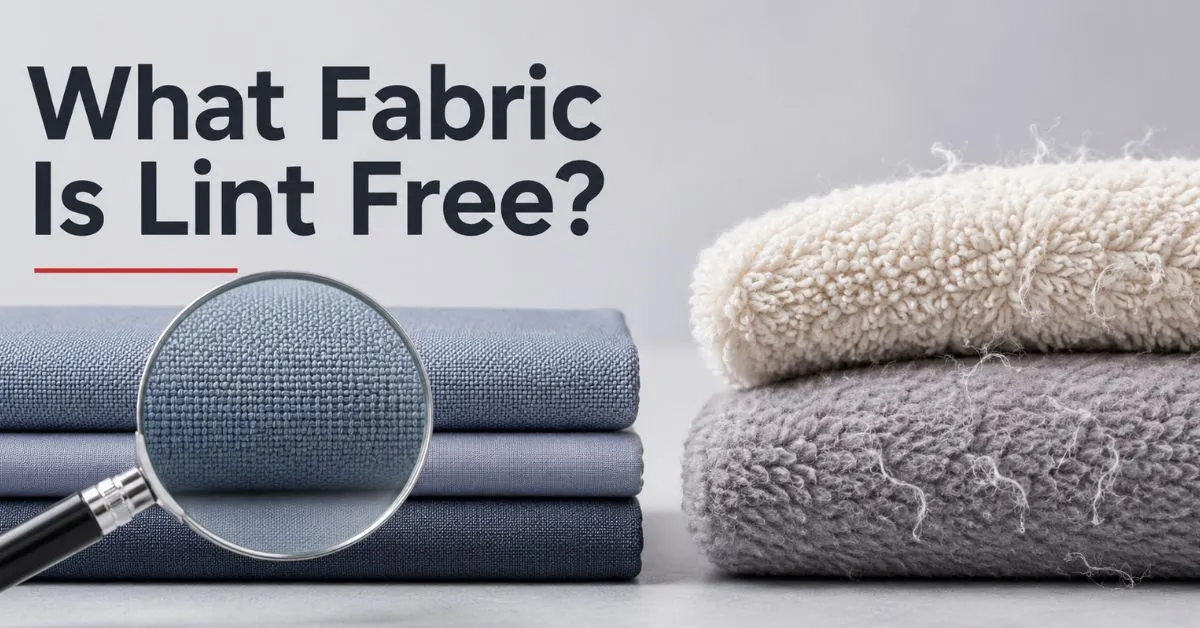

Microfiber, continuous filament polyester, and tightly woven nylon are the best lint-free fabrics. They shed less visible fibers than cotton, wool, fleece, and loosely woven materials.
However, no reusable textile is permanently lint-free under all conditions. Hence, “lint-free” is often a relative term, indicating reduced fiber release.
The yarn construction, weave, surface roughness, cutting, wear, and laundering influence lint generation. Smooth microfiber is a good choice for everyday cleaning, while optical-grade microfiber is necessary for delicate surfaces. Technical industries usually rely on tested low-lint wipes with documented performance.
Hence, the best fabric depends on the surface, cleaning chemicals, clothing, and required cleanliness level.
What Does Lint-Free Fabric Mean?
Lint-free fabric does not shed excessive visible fibers during use. However, it rarely means that the material does not release any particles. “Low-lint” or “low shedding” is a more accurate term because every reusable textile eventually wears out.
Lint is the debris of fibers or their fragments shed from the surface. Friction, cutting, laundering, abrasion, and surface damage can remove short filaments and fuzz.
Therefore, the term “low-lint” is also applied to cloth that does not attract foreign fibers. “Low-pilling” indicates reduced production of fiber balls on the surface, while “dust retention” means the ability to trap particles.
A lint-free polyester T-shirt does not necessarily shed fibers, but its surface may collect lint from other materials. Synthetic fabrics often attract foreign fibers due to static electricity.
The following terms describe different aspects of lint generation:
- Lint shedding – release of fibers from the textile
- Lint attraction – ability to collect foreign fibers
- Pilling – formation of balls of fibers on the surface
- Dust retention – trapping of particles by the fabric
Hence, a lint-free cotton cloth may attract other fibers, lint, dust, or hair.
What Fabric Is Lint Free?
The best lint-free fabric for home use is smooth microfiber. However, there are also other low-lint materials with specific benefits.
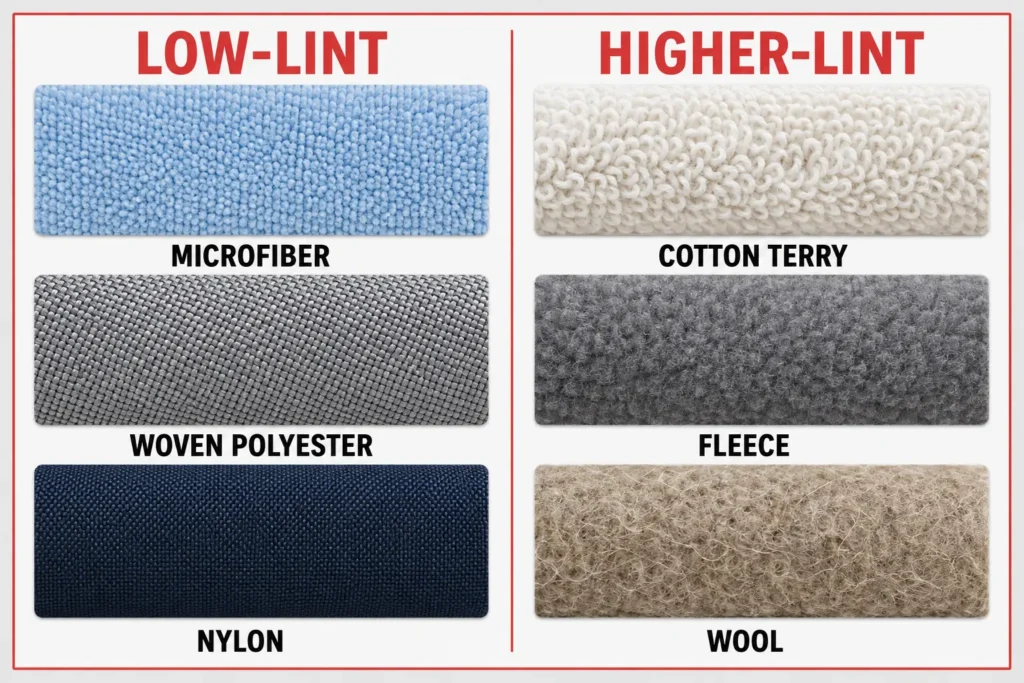
The following textiles are generally low in lint generation:
- Smooth microfiber
- Continuous-filament polyester
- Tightly woven nylon
- Cleanroom-grade polyester wipes
- Specific nonwoven wipes
- Smoothly woven, laundered linen
However, fiber composition is not the only factor affecting lint generation. The yarn construction, weave, finishing, edges, and surface structure are also important.
For example, polyester fleece can shed substantially due to its raised surface. By comparison, smooth continuous-filament polyester has fewer exposed fibers and usually sheds less.
| Fabric | Typical lint level | Best uses | Important limitation |
|---|---|---|---|
| Smooth microfiber | Very low | General cleaning, windows, glass, and cars | Plush versions may leave fibers |
| Optical-grade microfiber | Very low | Lenses, screens, and polished surfaces | Trapped grit may scratch coatings |
| Continuous-filament polyester | Very low | Industrial wiping and cleanrooms | Static may attract external particles |
| Tightly woven nylon | Low | Technical clothing, filters, and reusable wipes | Often absorbs less than microfiber |
| Cleanroom polyester wipe | Very low | Electronics, laboratories, and controlled production | Certification and cleanliness levels vary |
| Nonwoven synthetic wipe | Low to very low | Medical, painting, and industrial work | Many options are disposable |
| Closely woven linen | Low after washing | Glassware, polishing, and kitchen drying | New linen may initially shed |
| Silk | Low | Smooth clothing and delicate applications | It costs more and dislikes rough cleaning |
| Cotton flour-sack cloth | Moderate to low | Kitchen drying and food preparation | It is not technically lint-free |
| Cotton terry cloth | High | Absorbing spills | Loops and short fibers release lint |
| Fleece | High | Warm clothing and insulation | Its raised surface sheds and traps fibers |
| Wool | Moderate to high | Clothing and insulation | Friction can release fuzz and staple fibers |
Why Does Microfiber Produce Less Visible Lint?
Microfiber is often made from polyester or a blend of polyester and polyamide. The yarns are tightly woven or knitted into a fabric with very fine fibers. Hence, microfiber sheets and towels have fewer surface projections, reducing lint generation.
In addition, microfiber is available in smooth variants that minimize friction during cleaning. Split microfiber has a shorter pile and a larger surface area, allowing it to hold more moisture and debris.
However, splitting does not always make microfiber lint-free. The amount of visible lint depends on the weave and finishing.
Short-pile microfiber is ideal for windows and mirrors, while optical-grade microfiber is suitable for delicate surfaces. Plush automotive microfiber has a deeper pile that lifts dirt from the surface. However, long piles can leave fibers on rough edges, so the smoothest microfiber is not always the best choice.
Improper manufacturing can also cause microfiber to shed. Rough edges, damaged yarns, and low-quality finishing generate lint. Extreme heat and harsh chemicals destroy microfiber’s integrity, while incorrect washing can contaminate it with cotton lint.
Finally, note that low visible lint does not mean that microfiber does not shed microscopic fibers. Synthetic microfiber towels and sheets can release fine filaments during laundering.
Is Polyester Lint Free?
Smooth polyester fabric is one of the best low-lint materials. However, polyester is rarely completely lint-free, depending on the weave, finishing, and wear.
Continuous-filament polyester is made by spinning long strands of synthetic fibers. This method produces fewer loose ends compared to natural staple fibers. Hence, continuous-filament polyester is often used in cleanroom-grade wipes and has tightly sealed edges.
By comparison, staple polyester has a short length, and its ends become exposed during use or laundering.
Brushed polyester has more surface projections than smooth variants, making it unsuitable for lint-free applications. Another example is polyester fleece, a type of brushed fabric with a soft surface. Although polyester fleece has beneficial insulating properties, its raised surface is unsuitable for most wiping tasks.
Polyester microfiber is a good option for low-lint wiping materials. However, its pile height, edges, and overall construction influence lint generation. In addition, polyester attracts lint and dust, so static-sensitive environments are not suitable for polyester towels.
Is Nylon Lint Free?
Tightly woven nylon usually sheds little visible lint. This synthetic fiber has high tensile strength and is often used in technical clothing. Continuous-filament nylon is less likely to break during use, reducing fiber release.
Nylon is a good option for reusable wipes, technical garments, and surface cleaning. Its smooth surface repels pet hair, making it suitable for wiping cars. However, ordinary nylon does not have the ultra-fine structure of microfiber and is less efficient at trapping small particles.
Nylon can also develop a static charge that attracts dust, lint, and hair.
Is Cotton Lint Free?
Cotton is not a lint-free material because its staple fibers are relatively short and prone to shedding. This is especially true for loosely woven variants like terry cotton. The fibers become exposed during laundering, use, and abrasion, making cotton unsuitable for lint-free applications.
Terry cotton has loops that hold more surface area, increasing lint generation. Flannel has a brushed surface that also produces lint, albeit in lesser amounts. Cotton jersey can shed fibers when dry-cleaned or rubbed.
By contrast, tightly woven cotton tends to produce less lint. Repeated laundering removes many loose surface fibers, improving its performance. Flour-sack cotton is a good option for kitchen use because it sheds less lint and holds less moisture.
Woven cotton polishing cloth is suitable for home use but has limited benefits over technical polyester. It should not be used in cleanrooms or for electronics due to its limited performance.
Is Linen Lint Free?
Closely woven linen tends to generate less visible lint after repeated laundering. Hence, linen is sometimes used for glassware and polishing. Linen fibers are longer and stronger than cotton, making them less likely to break.
However, freshly woven linen often sheds loose surface fibers. The amount of lint depends on the weave, finishing, and cutting. Linen can also have rough edges that release fibers during use.
Therefore, the best option is to select a smooth, tightly woven, laundered linen cloth. However, it is still inferior to cleanroom-grade polyester in most controlled environments.
Best Lint-Free Fabric by Application
Best Low-Lint Fabric for Windows and Mirrors
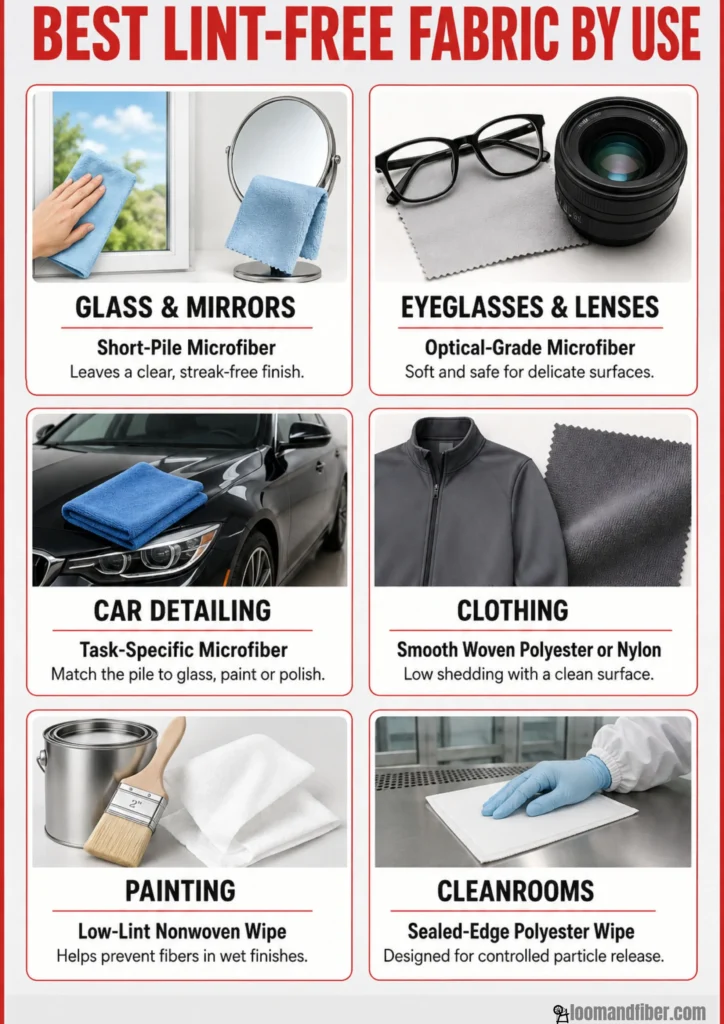
Use smooth short-pile microfiber for windows and mirrors. Its tight surface holds more moisture and leaves less lint after wiping.
Waffle-weave microfiber is also suitable for this application because its unique pattern holds more liquid. However, always check the edges for rough spots that can leave lint.
Avoid using plush detailing towels for rough glass edges because their long pile can leave fibers on the surface.
Best Fabric for Glassware
Use smooth microfiber for glassware cleaning and polishing. Linen is another option, but it should be washed separately from cotton towels to avoid lint contamination.
Best Cloth for Eyeglasses and Camera Lenses
Use a clean optical-grade microfiber cloth to wipe camera lenses and eyeglasses. Its smooth surface prevents lint generation and has reduced friction.
However, always check the cloth for sand or other abrasive particles before use. A lint-free cloth can scratch the coating if it has foreign inclusions.
Avoid using a coarse kitchen cloth to wipe lenses. Always use the cleaning method recommended by the manufacturer.
Best Cloth for Phone and Computer Screens
Use a clean smooth optical-grade microfiber cloth to wipe screens. Avoid fluffy materials that can leave lint around screen ports.
Always use the cleaning solution recommended by the phone or computer manufacturer. Not all liquids are compatible with delicate coatings.
Best Low-Lint Cloth for Cars
Low-lint car cleaning cloths should also be lint-free, soft, and free of particles. Use short-pile microfiber for windows and clean plush microfiber for surfaces.
Low-pile microfiber is good for removing wax, polish, or other contaminants. Avoid using wheel cleaning cloths to wipe the car body because they have a rough surface.
Best Low-Lint Fabric for Sewing and Clothing
Use smooth woven polyester or nylon for sewing and clothing. Other tightly woven blends can also be suitable options.
Silk is another natural fiber that sheds little visible lint. However, it is more expensive and requires special care. Avoid using fluffy fabrics, chenille, sherpa, loosely woven wool, and brushed cotton for similar reasons.
Best Fabric for Pet-Hair Resistance
Pet-hair resistance is a property different from low-lint performance. Some materials do not shed fibers but have a surface structure that attracts animal hair.
Smooth tightly woven polyester and nylon have fewer bonding sites and usually shed less lint. However, static electricity can also play a role in attracting foreign fibers.
Best Cloth for Painting and Wood Finishing
Use special tack cloths or low-lint nonwoven wipes for painting and finishing work. They help remove the maximum amount of lint from the surface before painting or staining.
However, note that some tack cloths may leave residue on the wood or interfere with the top coat. Always follow the manufacturer’s recommendations when preparing the surface.
Ordinary paper towels and cotton rags are not suitable for this task because they shed more lint. In addition, some microfiber materials are incompatible with specific solvents.
Best Wipes for Medical and Laboratory Work
Use the appropriate medical-grade wipes in hospitals and labs. Consumer-grade microfiber towels and sheets are not always suitable for healthcare settings.
Medical facilities should consider the wiping performance, disinfectant compatibility, cross-contamination risk, and laundering instructions.
Best Wipes for Cleanrooms and Electronics
Use validated continuous-filament polyester wipes for cleanrooms and electronics. Always check the edge treatment because rough edges can shed more lint.
Some cleanroom standards are more stringent, so a general-purpose microfiber cloth is unsuitable for all environments. Specify your requirements and ask for test results from the manufacturer.
What Makes a Fabric Low-Lint?
A low-lint fabric typically has special features that reduce visible fiber projections. Hence, several characteristics are usually considered when selecting such materials.
Continuous Filaments
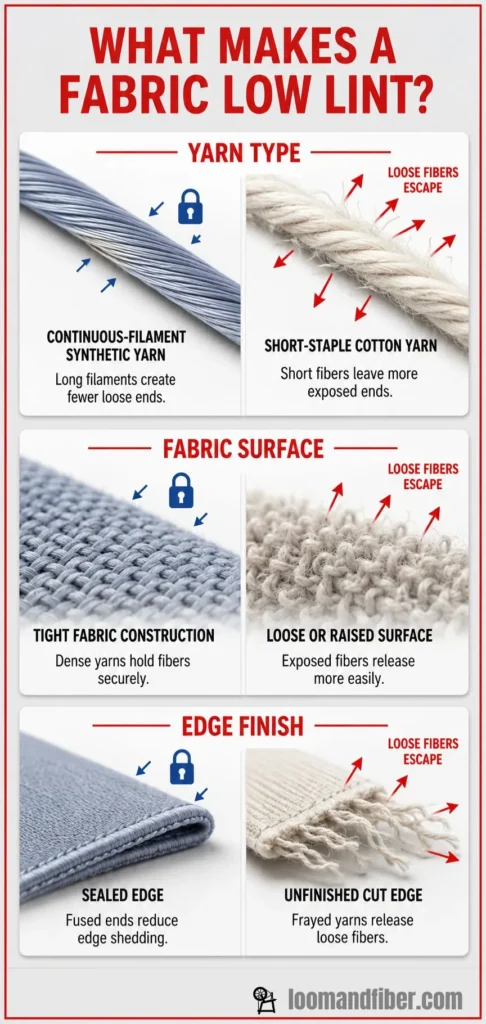
Continuous filaments have fewer exposed ends compared to staple fibers. This property is especially important for wiping materials because the ends can leave lint on the surface.
Polyester, nylon, and silk can have continuous filaments, while cotton and wool typically have staple fibers.
Dense Fabric Construction
A tight weave or knit allows the fabric to hold fibers securely, reducing their exposure. By contrast, loosely woven materials have more surface projections.
However, a dense weave is not always sufficient, especially if the fibers are weak or the material has an abrasive surface.
Smooth Surface Texture
A smooth surface has fewer rough spots that can shed fibers or lint. A raised surface, such as in brushed or looped fabrics, produces more lint during use.
Finished Edges
Unfinished edges often have loose fibers that can shed during use. However, special edge treatments, such as heat sealing or ultrasonic cutting, prevent lint generation.
Laser cutting is another method that can be used for certain synthetic materials. It removes fibers from the edges without damaging the integrity of the fabric.
Strong Yarns
Yarns with high tensile strength do not break easily during laundering or use. This property is especially important for lint-free materials because broken fibers produce lint.
However, extreme temperatures and chemicals can weaken the yarns, so it is important to follow the manufacturer’s care instructions.
Correct Laundering
Proper washing removes surface debris without damaging the fabric. It also prevents lint contamination, especially when laundering microfiber with other materials.
For example, washing microfiber towels with cotton can contaminate them with lint. Hence, it is important to follow the manufacturer’s laundering instructions.
Low-Shedding Fabric Versus Lint-Resistant Fabric
| Property | Low-shedding fabric | Lint-resistant fabric |
|---|---|---|
| Main function | Releases few of its own fibers | Collects little external lint |
| Main influence | Filament and fabric construction | Surface texture and static |
| Common example | Cleanroom polyester wipe | Smooth antistatic fabric |
| Possible weakness | It may still attract dust | It may still shed fibers |
Fabrics That Produce the Most Lint
Most lint-producing fabrics have a loose weave, short fibers, loops, or a raised surface. Examples of such materials are:
- Terry cotton
- Brushed cotton
- Flannel
- Polyester fleece
- Wool
- Chenille
- Sherpa
- Felt
- Velvet
- Loosely knit fabrics
- Short-staple cotton
Terry cloth has loops that are easily damaged, resulting in more lint. Similarly, fleece has a raised surface that sheds fibers. Wool fabrics tend to shed more lint because manufacturers use short staple fibers for their production.
Chenille and sherpa have a rough surface and leave lint on the surface. Felt and velvet also have a raised structure that produces more lint.
Damaged fabrics also tend to shed more fibers than undamaged ones. The lint generation depends on the fiber type, weave, and finishing. High temperatures, abrasion, and chemical exposure can all damage the fabric’s surface.
How to Test Fabric for Lint at Home
A home test can help determine the amount of lint generated by different materials. However, it is a preliminary activity that cannot replace professional testing.
Use the following instructions to check if a particular fabric is lint-free:
- Wash the sample according to the care instructions
- Dry the sample separately from cotton towels
- Clean a piece of black glass with alcohol
- Wipe the glass with each sample using the same pressure
- Examine the glass under a bright light
- Repeat the test several times
- Check the cut edges for lint
- Compare the results for all samples
Always use the same sample size when testing different materials. In addition, test new and laundered samples separately.
A black glass helps observe lint generation because it has a dark background. However, white glass may also be suitable for some materials.
This test can help select the best cloth for glass cleaning, screens, or polishing. However, it does not validate the fabric for use in controlled environments.
How to Buy a Low-Lint Cloth
When selecting a lint-free cloth, it is important to consider the intended use. For example, car cleaning towels have different requirements than optical-grade microfiber.
The following recommendations can help choose a suitable low-lint material:
- Make sure the label states “lint-free” and not just “microfiber”
- Select the appropriate material for the intended use
- Choose smooth or short-pile fabric for glass cleaning
- Look for continuous-filament yarns
- Check if the edges are lint-free
- Select the appropriate level of absorbency
- Make sure the material is compatible with heat and chemicals
- Study the washing instructions
- Ask for linting test results for technical-grade materials
- Use optical-grade materials for coated surfaces
- Select validated materials for cleanrooms and healthcare
- Check the fiber content
The FTC textile regulations require covered manufacturers to state the generic names of fibers on the care label. However, it does not specify the exact percentages because the term “cotton” encompasses many materials.
It is important to study the construction and finishing in addition to fiber content. Technical-grade materials often have detailed specifications that must be reviewed before purchase.
How to Wash Low-Lint Fabric Without Contamination
- Wash microfiber separately from cotton towels and other lint-producing materials. This prevents contamination of microfiber with foreign fibers.
- Avoid washing microfiber with fleece, flannel, or wool garments because they shed more lint. Always follow the manufacturer’s instructions when washing low-lint materials.
- High water temperatures can weaken the fibers and affect the integrity of the edges. Fabric softener can also damage the microfiber by coating it with a thin layer.
- Check the manufacturer’s instructions for bleach and disinfectant compatibility. It is recommended avoiding high-pH and chlorine-containing solutions when washing microfiber.
- Launder microfiber separately from cotton items. Always follow the manufacturer’s washing and storage instructions after laundering.
- Clean the washing machine’s lint filter if applicable. Store the clean cloth in a closed container to prevent contamination. Replace the cloth if its edges are damaged or if it sheds fibers consistently.
Conclusion-
Microfiber is the best lint-free fabric for ordinary cleaning, glass, and polishing. Smooth continuous-filament polyester is a good option for technical wiping and sensitive surfaces. Tightly woven nylon is another useful material that rarely sheds fibers. It is suitable for clothing and technical garments. Linen can also be used for polishing glassware after laundering.
Cotton, fleece, and wool tend to produce more lint, especially when laundered or used repeatedly. Its short fibers, loops, or raised surface contribute to increased lint generation.
However, no fabric is permanently lint-free, and its performance depends on the weave, finishing, and care. Always select the appropriate material for the task and follow the care instructions.
Read More>> Is Washing clothes with vinegar safe?
FAQs
No reusable fabric is totally lint free. Tightly woven microfibers, continuous filament polyester, nylon and specially processed cleanroom wipes are more accurately described as low lint.
A tightly woven, short pile or waffle weave microfiber cloth is usually recommended for use on glass surfaces. It should have nicely finished or enclosed edges and be washed alone in cotton.
No, most cottons can shed lint because short staple yarns are used in weaving. Compact, well laundered cottons will shed less lint than terry cloth or flannelette, but not enough for critical environments.
Microfiber is generally low in lint production, if it has been tightly woven and finished correctly. Shoddy, fluffy or worn microfiber is likely to leave fibers behind.
Smooth, tightly woven nylons and polyesters can contain less lint and pet hair than fleeces, wools, velvets or brushed nylons, but static can cause attraction of particulate matter.
Depending upon the application, alternatives to cotton might include closely woven linen cloths, flour-sack cotton, optical grade tissue, and low lint nonwoven rags and lint free polyester cleanroom wipers.