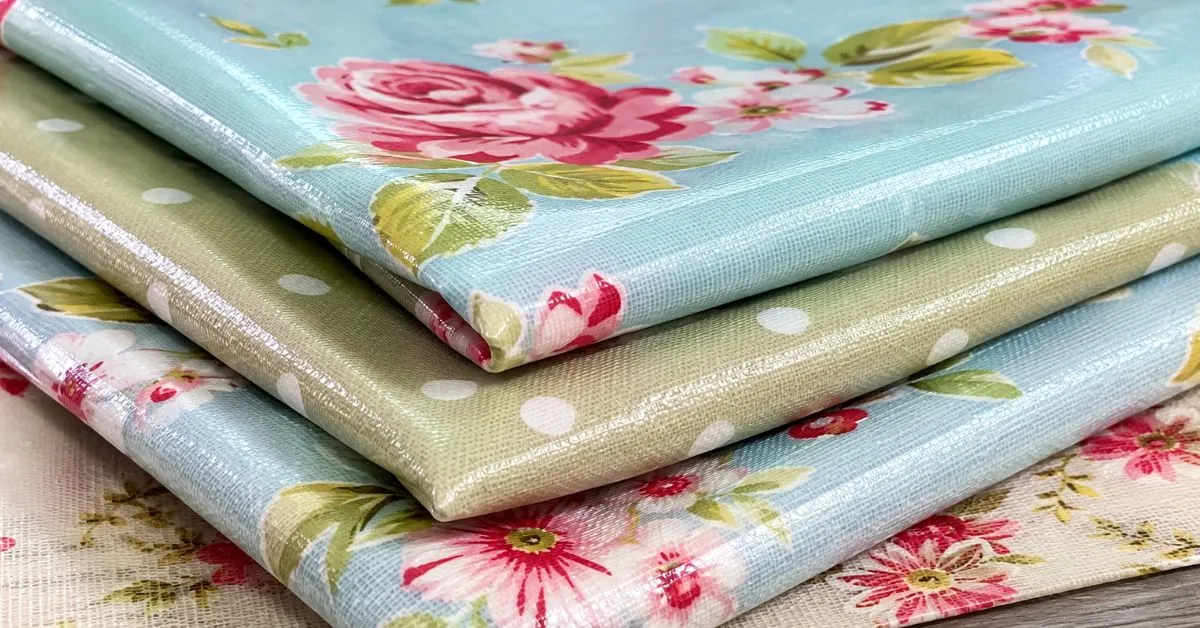

Oilcloth features a woven backing with a protective, water-repellent surface. As a result, spills generally stay on top of oilcloth rather than soaking through the fabric. Traditional and modern oilcloth typically use different coatings. Always research the composition, safety reports, and intended use before buying.
What Is Oilcloth Fabric?
An oilcloth fabric consists of a woven base with a moisture-repellent layer that finishes on top. This layer gives oilcloth its characteristic smoothness and ease of cleaning.
Traditional oilcloth generally comprises cotton, linen, or cotton duck coated with boiled linseed oil. In contrast, modern commercial oilcloth often has a cotton or mesh base and a PVC coating.
A complete oilcloth surface usually repels water, but the coating often fails at the edges, seams, and tears. Therefore, oilcloth is a coated fabric rather than a fiber or weave.
Is Oilcloth a Fabric, Coating or Finish?
Oilcloth is generally a coated fabric, with the woven layer providing the desirable properties of the base material. As such, the term “oilcloth” refers to a composite material rather than a specific yarn or weave.
Some retailers also refer to printed nonwoven vinyl as oilcloth. This composite material often has a minimal amount of woven fabric. As a result, it is critical to check the composition details when purchasing oilcloth fabric. Specifically, look for information about the base fabric and the protective coating.
What Is Oilcloth Made From?
Oilcloth generally comprises a woven base, a printed layer, a protective coating, and a finishing layer. However, the specifics can vary significantly depending on the manufacturer.
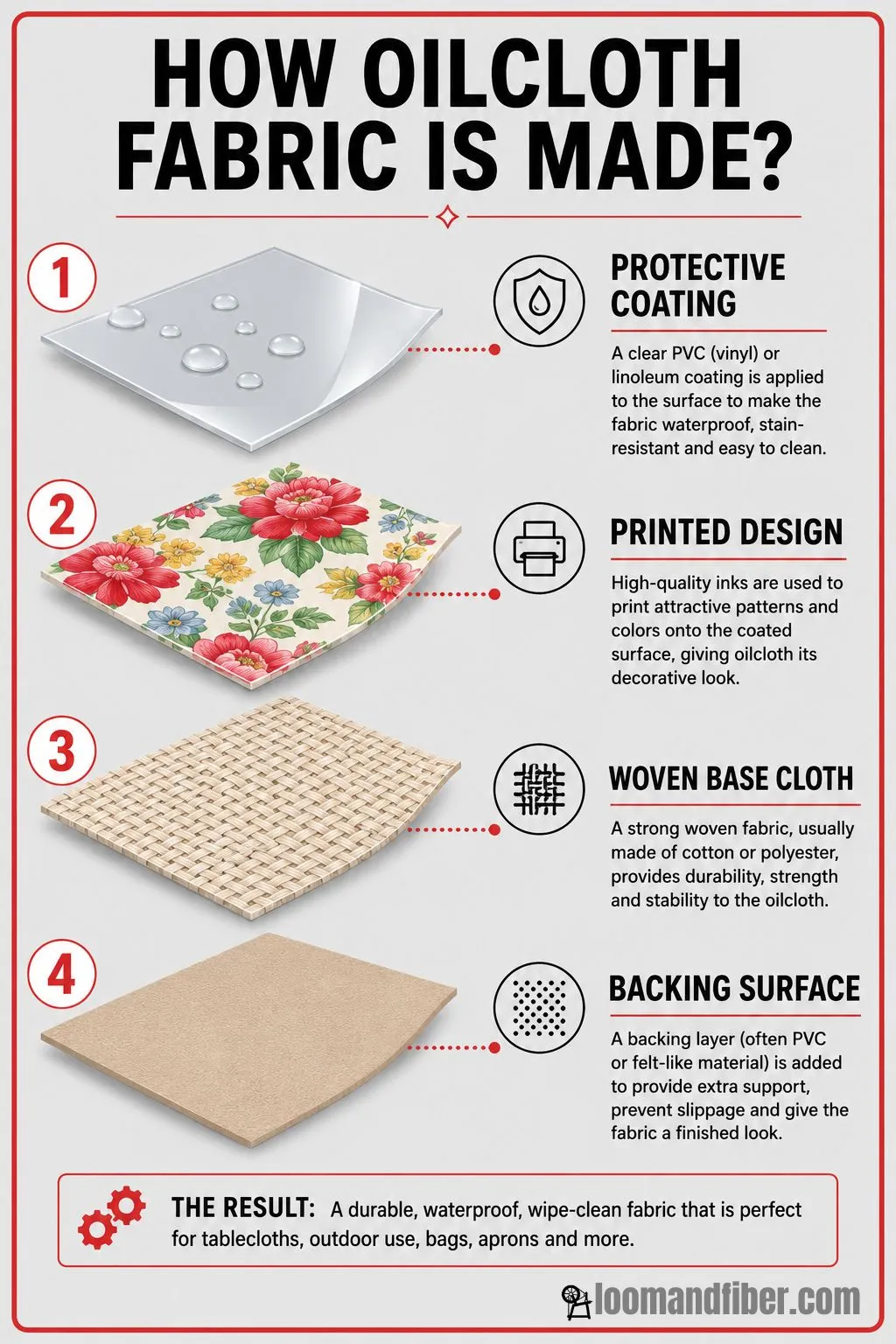
Weave or nonwoven base
Many oilcloth products have cotton as the base material because it is a soft, flexible, and familiar fabric. In contrast, cotton duck provides a sturdier alternative.
In addition, traditional oilcloth products have used linen as an especially durable woven base fabric. Meanwhile, modern products often use blends of polyester, mesh, or nonwoven materials. A stronger base layer generally allows for more robust oilcloth products. However, the strength of the base layer does not affect the damage resistance of the coating.
Printed layer
Many manufacturers apply a print to either the base fabric or the protective layer. Usually, a transparent coating protects printed designs from spills.
Nevertheless, abrasive materials and prolonged exposure to sunlight can damage printed surfaces. As such, look for oilcloth products with especially abrasion-resistant coatings.
Protective coating
Traditional oilcloth products generally have a protective coating of cured linseed oil. According to the Canadian Food Inspection Agency, linseed oil is a drying oil used in various industrial coatings.
In contrast, most modern oilcloth products generally use polyvinyl chloride plastic coatings. Other materials can also be used, including acrylic, polyurethane, TPU, and several proprietary polymers.
It is generally best to request details of the specific polymer used in the product. The coating material significantly affects the product’s general properties and care instructions.
| Component | Common material | Main function |
|---|---|---|
| Base | Cotton, linen, mesh, polyester, or nonwoven backing | Strength and dimensional support |
| Pigment, ink, or incorporated design | Colour and appearance | |
| Coating | Linseed oil, PVC, acrylic, polyurethane, or TPU | Moisture and stain resistance |
| Surface finish | Gloss, matte, satin, or textured finish | Feel, appearance, and cleanability |
History of Oilcloth
Early manufacturers produced oilcloth by coating linen or cotton with a drying oil solution. The resulting material had better water-resistant properties than untreated fabric. The oilcloth producers used the material to make rainwear, bags, floor coverings, and tablecloths. The oilcloth was popular as a decorative and functional household fabric.
Later, rubberized fabric, waxed cotton, and plastic textiles partially replaced oilcloth. These materials were more accessible and had different manufacturing qualities. In the 20th century, the term oilcloth was associated with vinyl-coated tablecloths. Modern manufacturers used the name to indicate a variety of coated materials.
The modern oilcloth usually has little or no oil in its composition. Therefore, separate the historical and contemporary meanings of oilcloth when discussing the material.
Traditional vs Modern Oilcloth
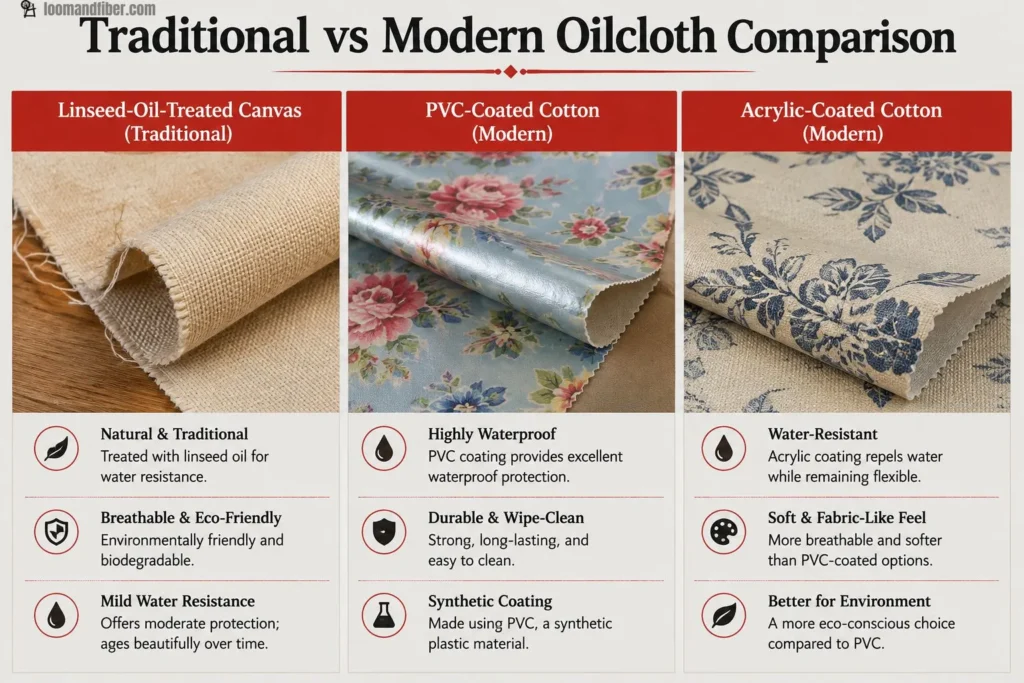
Modern and traditional oilcloth fabrics generally have similar uses. However, there are significant differences between the two materials. Conventional oilcloth products generally use an oil-based coating while modern products generally have a plastic coating.
| Feature | Traditional oilcloth | Modern commercial oilcloth |
|---|---|---|
| Base | Linen, cotton, or cotton duck | Usually cotton, mesh, or synthetic backing |
| Treatment | Cured linseed-oil formulation | Commonly PVC or another polymer |
| Surface | Slightly irregular and aged | Smooth, consistent, and often glossy |
| Flexibility | Changes with formulation and age | Changes with coating thickness |
| Common uses | Historic coverings, luggage, and rain protection | Tablecloths, bags, aprons, and crafts |
| Maintenance | May need specialist care or retreatment | Usually requires wiping only |
| Availability | Specialist or handmade material | Widely available commercially |
| Material identity | Genuine oil-treated cloth | Often plastic-coated fabric |
Traditional oilcloth products generally require multiple applications of an oil coating before curing. In contrast, modern products generally have an industrially applied coating.
Types of Oilcloth Fabrics
Traditional oilcloth (linseed oil)
This category of traditional fabric generally comprises woven cotton, linen, or cotton duck with a protective layer of linseed oil.
However, oilcloth products generally have an inconsistent surface. In addition, old linseed oil products can be particularly brittle and sticky.
As such, historical oilcloth items generally require professional restoration rather than home cleaning.
PVC-coated cotton oilcloth
This type of oilcloth product generally comprises a printed cotton layer with a substantial PVC coating. As a result, PVC-coated oilcloth products generally have a smooth surface which is easy to clean.
However, remember that different plasticizers are generally used to alter the properties of PVC. As such, it is generally important to research specific chemical tolerances.
Mesh oilcloth (PVC-coated)
This type of oilcloth product comprises a mesh base fabric with a plastic coating. As such, mesh oilcloth products generally conform to the shape of an underlying surface.
However, the openness of the mesh greatly reduces the product’s ability to mimic the qualities of woven cotton.
This type of oilcloth is generally well-suited for making structured items. In contrast, mesh oilcloth is generally too stiff to be used in clothing.
Oilcloth with acrylic coating
Acrylic-coated cloth products generally offer a softer alternative to PVC-coated counterparts. As such, products made from acrylic-coated oilcloth generally drape better.
In addition, thinner acrylic coatings often offer reduced stain resistance. As such, it is generally important to test the material.
Polyurethane-coated oilcloth
Polyurethane coatings generally allow to create thinner and more flexible products. As such, polyurethane-coated oilcloth can be used to make pouches and other flexible items.
However, the specific properties of polyurethane oilcloth greatly depend on the material’s thickness. Moreover, the term “polyurethane” generally does not confirm any specific qualities.
Printed vinyl (oilcloth)
Some vinyl products comprise a vinyl face and a nonwoven or woven base. However, many vendors generally refer to these nonwoven materials as oilcloth fabric.
As such, it is always important to verify if the desired product comprises a woven cotton base.
How Is Oilcloth Fabric Made?
Traditional production
The general steps in traditional production are as follows:
- Manufacturers prepare a tightly woven cotton, linen, or cotton duck fabric.
- They apply a thin layer of formula comprising linseed oil.
- Next, they allow the fabric to cure.
- Finally, manufacturers repeat this process until they achieve the desired thickness and colour.
- They then finish the fabric.
The curing process generally takes a long time, and there are variations in the recipes for linseed-oil finishes.
Modern production
The general steps in modern production are as follows:
- Manufacturers prepare a suitable base fabric.
- They often apply a colour or print to the fabric.
- Next, they apply a liquid polymer or film laminate.
- They cure or fuse the protective layer to the plastic fabric.
- They then finish the fabric with rollers to create the desired gloss or texture level.
- Finally, manufacturers inspect the thickness and general appearance of the product.
The industrial production of oilcloth fabrics generally provides more consistent quality than the traditional method. However, it is still important to consider the differences between thick and thin materials.
What Does Oilcloth Feel and Look Like?
Oilcloth often looks similar to a smooth and somewhat dull surface. The material can have a shiny, satin, or dull appearance, depending on the manufacturer.
In addition, the appearance and tactile impression of oilcloth can vary greatly depending on the base fabric and the protective coating. For instance, the reverse side of cotton oilcloth often resembles ordinary cotton.
In contrast, nonwoven oilcloth often has a plastic-like feel on both sides. Oilcloth generally has lesser drape than untreated cotton.
Moreover, the thickness of the coating generally has a significant effect on the degree of stiffness. Heavier coatings generally make the material stiffer and allow it to hold shape better.
Bright patterns and designs generally appear clearly on the surface of oilcloth. In addition, glossy oilcloth often reflects light, making it difficult to work with in low-lit environments.
The thickness of oilcloth often directly affects the crease resistance of the material. However, newly purchased PVC-coated oilcloth often has an unpleasant smell.
As such, it is generally important to request a sample before buying.
Is Oilcloth Waterproof?
The surface of oilcloth generally repels water, and the material is generally water-resistant. As such, many manufacturers sell their products as waterproof or waterproof-rated materials.
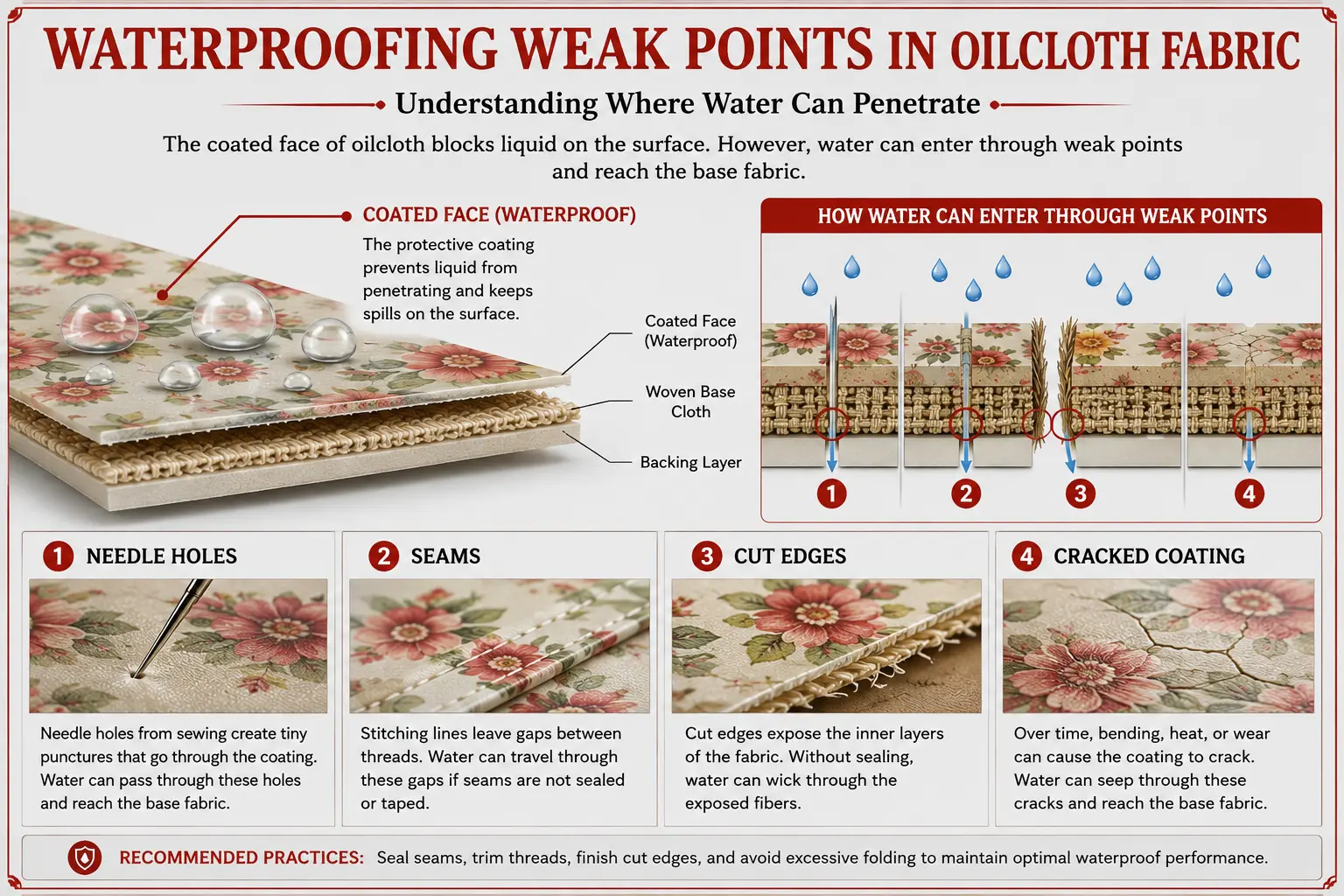
However, keep in mind that a waterproof surface generally does not create a waterproof product. The integrity of oilcloth products generally relies on the entire construction rather than the protective coating.
Spills, stitching, and openings generally allow moisture through most oilcloth products.
Water-resistant materials generally allow them to be exposed to water for a short time before losing their protective qualities.
In turn, waterproof materials generally hold out against water in a broad range of conditions.
As such, ordinary table oilcloth rarely provides sufficient protection for use as rain gear, tarps, or pool covers. Moreover, the material has a broad range of thickness and properties.
It is important to confirm the waterproof rating, seam integrity, and suitability for the intended use. Specifically, look for products with high hydrostatic pressure and reliable coating adhesion.
Read More>> Is Polyester Waterproof or water-resistant?
Key Properties of Oilcloth Fabric
Water resistance
The protective surface of oilcloth generally prevents liquid spills from penetrating the material. However, damaged areas and stitching generally allow moisture through.
Stain resistance
The surface of oilcloth generally prevents frequent household spills from leaving a stain. However, some dyes, oils, and acids can generally permanently mark the fabric.
Wipe-clean surface
Most oilcloth products are easy to clean since common household dirt generally does not penetrate the material’s surface.
Dimensional stability
The protective coating generally prevents stretching and shrinkage, making the material easy to work with.
Resiliency
Heavy-duty oilcloth with a thick protective coating generally can withstand heavy domestic use. However, frequent abrasion can generally affect the appearance of light-duty materials.
Breathability
Most protective coatings generally prevent the passage of air and moisture. As such, oilcloth is generally unsuitable for most types of clothing.
Drape
Oilcloth does not generally have the soft drape of light fabric. As such, the material generally holds its shape.
Edge resistance
Most oilcloth products generally have reduced edge fraying due to the smooth surface. However, the exposed edge generally still allows moisture through and can easily be damaged.
Heat resistance
Plastic-coated oilcloth generally becomes softer and more pliable under the influence of heat.
As such, it is generally unwise to use oilcloth products in direct contact with hot objects such as pans, pots, and heaters. Similarly, it is generally unwise to press oilcloth with a hot iron.
Low-temperature flexibility
Many polymers become more brittle at low temperatures. As such, it is generally unwise to expose oilcloth to freezing temperatures.
For cold-weather applications, always request the cold crack resistance specification from the vendor.
UV-resistance
Exposure to sunlight generally causes the material and prints to degrade over time. As such, UV-treated options generally offer better light resistance. In turn, indoor use rarely exposes oilcloth to light.
Crease resistance
Sharp folds generally leave conspicuous creases on oilcloth. As such, it is generally best to roll the material rather than folding it.
Abrasion resistance
Frequent abrasion generally damages the protective surface of oilcloth products.
Coating durability
The durability of oilcloth products generally depends on the composition, care, and use. Always request product safety data sheets (MSDS) for valuable items.
Pros and Cons of Oilcloth
| Advantages | Limitations |
|---|---|
| Provides an easily wiped surface | Usually unsuitable for machine washing |
| Resists everyday spills | Needle holes normally remain permanent |
| Often needs no traditional hem | Can stick beneath sewing-machine feet |
| Comes in many decorative prints | May crease when folded |
| Supports structured projects | Drapes less naturally than untreated cloth |
| Protects underlying surfaces | May crack, peel, fade, or stiffen |
| Requires little routine maintenance | May lack food or children’s-product approval |
| Often cuts without obvious fraying | Exposed backing can still wear |
| Maintains stable dimensions | Usually offers very limited breathability |
Where Is Oilcloth Fabric Used?
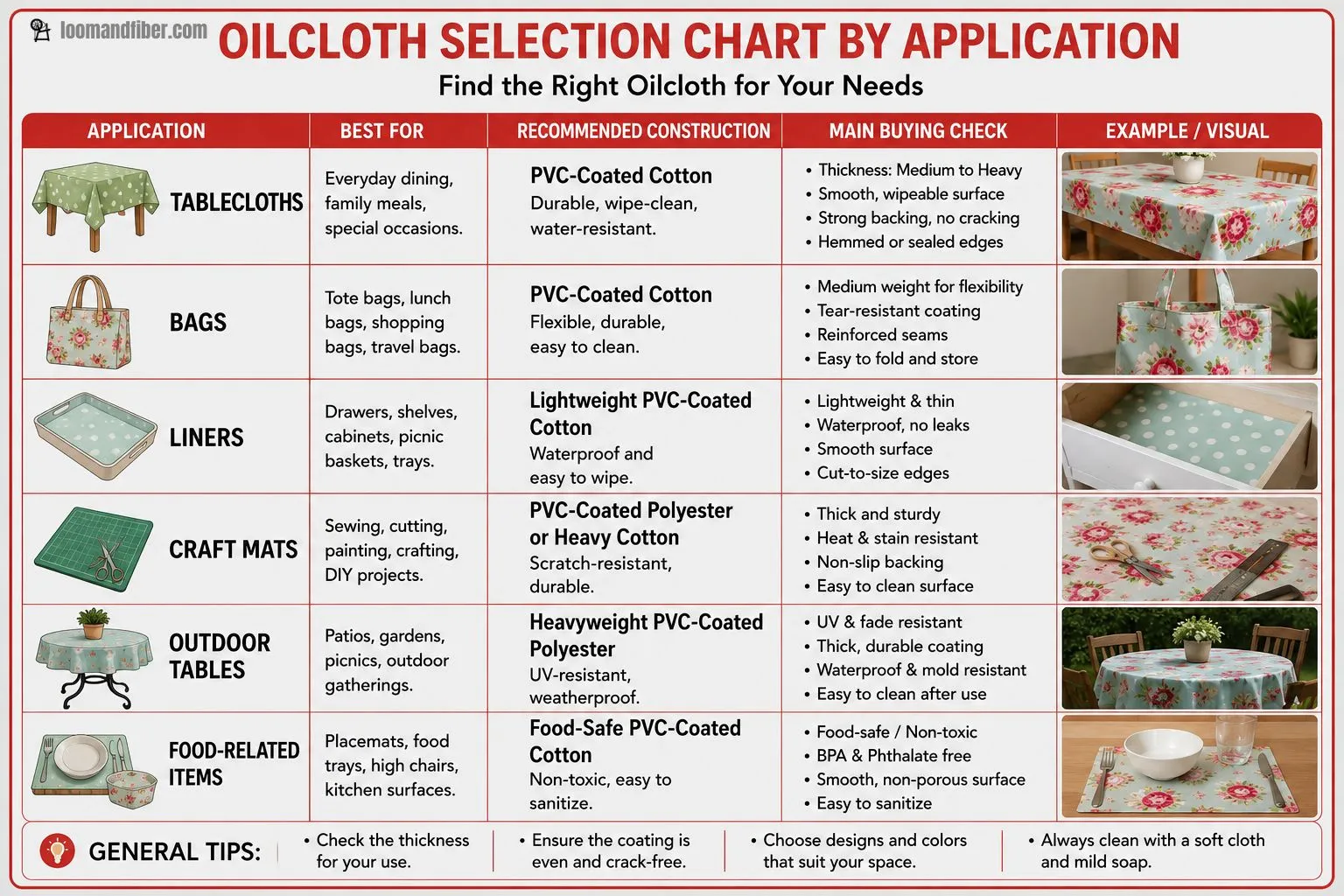
Table protection
Oilcloth generally ensures the surface of a table remains clean during meals. Any spills generally stay on the surface, making tables easier to clean.
As such, oilcloth is often used to make tablecovers, placemats, and shelf covers. However, it is generally unwise to place the material directly on hot cooking appliances.
In addition, oilcloth can be used to make drawer liners, appliance covers, or other items that require surface protection.
Bags and accessories
The material generally holds its shape well, making it ideal for making bags and other personal accessories.
Specifically, it is possible to make handbags, cosmetic pouches, and pencil cases from oilcloth fabric. In addition, the surface repels occasional moisture, making the material ideal for making rain bags.
Oilcloth can also be used to make lunch bags. However, it is generally unwise to store unpackaged food in the material. In many cases, food-contact linings offer a more reliable solution.
Home improvement
The material generally offers protection against occasional moisture, making it ideal for making shelf or counter linings.
It is possible to make craft mats, potting mats, and temporary seat covers from oilcloth fabric.
In addition, oilcloth can be used to make temporary weather protection covers. However, indoor-quality materials generally rarely hold up against the elements.
Sewing and crafting
Oilcloth is also popular among crafter, including those who make bunting, aprons, or baskets. The material allows constructing stiff projects, such as containers or planters.
Crafters can also use oilcloth to make child-friendly tablecovers. However, it is crucial to request child-appropriate products.
Is Oilcloth Food-Safe?
The food-safety properties of oilcloth generally depend on the material composition and intended use. In addition, the protective coating, plasticizers, dyes, and inks generally contribute to the level of safety.
The surface of the material generally allows use with occasional food contact, but it is essential to confirm specific use conditions.
“BPA-free” and “lead-free” generally only confirm the presence or absence of particular toxins. Similarly, generic descriptions of polyvinyl chloride (PVC) generally rarely confirm food-safety properties.
When in doubt, always request the composition, formulation, and intended use from the vendor.
Lunch bags generally benefit from a food-contact liner rather than direct contact with the material. In addition, storing food in separate, certified containers generally is often a more reliable option.
Oilcloth vs Similar Materials
| Material | Treatment | Feel | Breathability | Best use |
|---|---|---|---|---|
| Modern oilcloth | Substantial polymer coating | Smooth and relatively stiff | Very low | Table covers and structured crafts |
| Laminated cotton | Thin film bonded to cotton | Softer and flexible | Low | Bags, pouches, and lighter projects |
| Waxed canvas | Wax applied into or onto canvas | Dry or waxy | Low to moderate | Jackets, bags, and outdoor gear |
| Vinyl fabric | Plastic face with textile backing | Plastic-like | Very low | Upholstery and protective covers |
| PUL | Polyurethane film laminated onto textile | Flexible and technical | Varies | Reusable textile products |
| Acrylic-coated cotton | Acrylic surface treatment | Softer and less plastic-like | Low | Decorative covers and table linens |
Laminated vs Oilcloth cotton
Oilcloth generally is heavier and stiffer than laminated cotton. As such, it generally is less suitable for making lightweight bags and pouches.
Laminated cotton generally is easier to bend, making it more suitable for certain applications.
Oilcloth vs waxed canvas
Oilcloth generally has a different surface finish compared to waxed canvas. In contrast to oilcloth, wax generally melts and clings to the fibers of canvas fabric.
Waxed canvas often has a distinctive feel and can be used to create unique creases and patterns. However, waxed canvas generally is often more challenging to work with compared to oilcloth. In addition, waxed canvas generally generally feels drier than modern oilcloth materials.
Read More>> What is Cotton Canvas Fabric?
Oilcloth vs vinyl
Modern oilcloth generally has a PVC coating, which makes it similar to vinyl materials. However, vinyl materials generally comprise a variety of constructions.
Vinyl generally can have a woven, nonwoven, or knit construction. As such, it is essential to analyze the construction when comparing vinyl and oilcloth materials.
Oilcloth vs PUL
PUL generally comprises a woven or nonwoven fabric with a polyurethane coating. It generally is a thin material that generally can mimic the feel of natural woven materials to some extent.
However, PUL generally significantly differs from oilcloth in terms of stretch and breathability. As such, always follow the specifications when comparing the materials.
How to Choose Oilcloth Fabric?
- Consider the following list when choosing oilcloth:
- Determine the fiber content
- Confirm the protective coating’s chemical name
- Check the overall and usable widths
- Select the preferred surface finish
- Consider the slip resistance
- Confirm the abrasion resistance
- Request the UV resistance
- Ask about the cold-weather suitability
- Review the manufacturer’s care instructions
- Determine the odour
- Select rolled delivery when possible
- Request the necessary food-contact documentation
- Request the necessary children’s-product documentation
- Confirm the continuous width availability
- Check the colour variation between different rolls
A sample is ideal to prevent expensive mistakes. As such, always request a sample and examine it under the intended lighting and temperature conditions. In addition, bend, clean, scratch, and sew the material to confirm that it is suitable for the intended use.
How Many Yards of Oilcloth Do I Need?
Before selecting the desired width, measure the length and width of the desired surface. Then, decide how much the material should hang from the edges.
Cut length=table length+(2×desired drop)
Cut width=table width+(2×desired drop)
Example
Suppose that the table is 180 cm long and 90 cm wide, and the drop is 20 cm on all sides.
180+(2×20)=220 cm
90+(2×20)=130 cm
As such, 220 x 130 cm of fabric is needed. Note that the usable width of the material should be at least 130 cm.
In addition, make sure to add extra material for pattern placement, trimming, or other considerations. Large patterns generally require additional space to align them correctly.
Finally, confirm that the selected roll generally has sufficient material. Remember that multiple pieces generally might be necessary.
How to Sew Oilcloth?
Avoid using pins when working with oilcloth, as they generally leave a permanent imprint on the surface. In addition, select a new needle that is suitable for the selected type of oilcloth. Test the selected needle on an offcut.
A longer stitch generally prevents the formation of numerous small holes. In addition, note that the selected stitch length generally should be appropriate for the selected fabric.
Avoid unnecessary unpicking since the holes generally are visible on many oilcloth products. Generally, always test the selected seam allowance placement before permanently sewing the material.
Use a roller, walking, or non-stick foot when working with the material. Alternatively, put tissue paper under the fabric when possible.
Reduce the pressure of the presser foot when it is possible. This step generally prevents marking the fabric.
Finally, reinforce the selected handles and other load-bearing seams with suitable fabric. The protective coating generally rarely provides sufficient reinforcement.
Most oilcloth products generally have reduced edge fraying on raw edges. Nevertheless, binding the edges generally improves the appearance, durability, and moisture resistance.
Avoid pressing the fabric with a hot iron directly on the material. Instead, always follow the manufacturer’s instructions.
How to Cut and Join Oilcloth Fabrics?
Make sure to keep the material flat before marking or cutting. Sharp folds generally compromise the accuracy of measurements and create visible creases in the material.
A rotary cutter generally allows producing consistent and long incisions on a large sheet of material. However, scissors generally can be sufficient for smaller projects and patterns.
Make sure to always align pattern repeats of the selected material. In addition, always mark the placement on the reverse side of the fabric when possible.
Use clips to secure the seams instead of inserting pins and creating holes.
Topstitching generally can create a clean and stable seam, especially for more structured projects.
Finally, always bind the seams to protect the exposed edge and improve the appearance of the finished product.
Binding generally provides superior protection and smoothness, but these benefits generally come at the expense of thickness.
Moisture-sensitive projects generally require suitable tape or sealant, especially when using nonwoven materials.
Test every applicable seam tape or sealant on a small sample before using them in the actual project.
Several adhesives generally can interact with specific oilcloth finishes in unpredictable ways. Always test adhesives for staining, softening, tackiness, and delamination.
How to Clean Oilcloth Fabric?
Follow these general steps to clean oilcloth:
- Make sure to remove food particles, dust, and loose particles.
- Create a solution of warm water and gentle soap.
- Wipe the material with a soft cloth.
- Remove the excess liquid with another piece of lint-free cloth.
- Make sure to air dry the material on both sides.
- Store the fabric only when it is completely dry.
Do not use abrasive materials to clean the material because they generally scratch the surface. Instead, use soft cloths to prevent the fabric from becoming permanently damaged.
Avoid using bleach, chemical cleaners, and other strong disinfectants. These cleaners generally can permanently ruin the protective coating, especially if the manufacturer does not recommend them.
Machine washing generally can permanently crease, stretch, or damage the material, especially delicate finishes. Similarly, avoid tumble drying the material. These methods generally expose the fabric to excessive heat and mechanical stress.
Always remove food, colored, or acidic spills as soon as possible. The longer these substances remain on the fabric, the more likely they are to permanently stain the material.
Remember that each manufacturer generally specifies particular care instructions. As such, always follow the recommendations of the manufacturer since the protective coating generally determines the most suitable cleaning method.
How to Remove Creases and Store Oilcloth
Prevention is the best treatment for creases. Therefore, store oilcloth rolled on a broad clean cylinder
Avoid crease-inducing activities such as folding and placing heavy objects on it. Otherwise, the oilcloth may develop permanent creases or cracks if the PVC coating is old.
Let the creases outgas at room temperature. Hanging the material on a hook may also help some lightweight oilcloth.
If the manufacturer approves, gently warm the textile with a low-temperature iron. Never iron directly on the PVC coating.
Do not store oilcloth near a radiator, an open flame, or direct sunlight. Moreover, make sure that both sides of the fabric are clean and dry. Some manufacturers recommend rolling the oilcloth with the decorative side out. Therefore, check the care instructions for your product.
How Long Does Oilcloth Last?
There is no standard for oilcloth durability; it depends on the fabric, coating, maintenance, and the environment. Thick coatings resist abrasion more effectively but may stiffen the fabric. Moreover, frequent folding, exposure to sunlight, extreme temperatures, harsh chemicals, and improper cleaning also affect the material’s longevity. Rolling the oilcloth and avoiding rough handling will prolong its life.
The oilcloth needs replacement if it develops:
- Cracks
- Peeling edges
- Persistent tackiness
- Stains
- Delamination
- Brittle edges
- Holes
- Fading
- Loss of water resistance
- Discolouration of other materials
The loss of tackiness may indicate chemical incompatibility of the material. Therefore, stop using the oilcloth near sensitive items or food.
Environmental Considerations and Alternatives
Old and modern oilcloth have different environmental effects; therefore, evaluate the product’s composition.
The cotton fabric backing does not make the composite biodegradable. On the contrary, the coating may make recycling challenging, especially if the factory does not separate the mixture. Similarly, some textile recycling centers may refuse to take oilcloth because it is not purely cotton or plastic.
The environmental impact depends on the oilcloth’s intended use and whether it can be reused. For instance, a heavy-duty table covering may last for years, reducing the waste from multiple single-use covers.
Some alternatives to traditional oilcloth with reduced plastic content are:
- Waxed cotton fabric
- Acrylic-coated cotton
- TPU-coated cotton
- Washable cotton fabric
- Removable glass table protector
- Reusable silicone mat
However, note that all materials have different production and end-use effects. Therefore, research the manufacturer’s sustainability claims and consider the textile’s overall footprint.
FAQs
The oilcloth material consists of an outer coating and an inner textile layer. Traditional oilcloth was made from cotton or linen impregnated with linseed oil. Modern oilcloth may have a cotton, mesh, or synthetic fabric backing. The material is often coated with PVC, acrylic, or polyurethane.
Most oilcloth materials are made from a blend of textile and plastic components. The fabric part gives the material its durability, while the plastic coating makes it easy to clean. However, some products marketed as oilcloth are made from non-woven or synthetic materials. Therefore, it is essential to check the manufacturer’s description to see if the product is made from cloth.
A waterproof oilcloth material should have a coating that does not allow water to pass through. However, the material’s seams, edges, and damaged spots may let water through. Therefore, oilcloth is usually water-resistant but not completely waterproof. A proper waterproof material needs to be tested according to standard testing methods.
Vinyl is a type of plastic, whereas oilcloth is a textile material with a vinyl coating. Therefore, oilcloth is usually made from fabric and plastic, whereas vinyl products are made from plastic. However, some manufacturers label their vinyl products as oilcloth. In such cases, it is essential to check the product description to see what materials the item is made from.
Most modern oilcloth products are made with plastic coatings rather than oil. However, some manufacturers still make traditional oilcloth materials. Therefore, it is essential to check the product description to ensure that the item is made from traditional materials.
Most oilcloth materials are not safe for direct food contact. However, some manufacturers make food-safe oilcloth materials. Therefore, it is essential to contact the manufacturer to ask for references to relevant food safety standards.