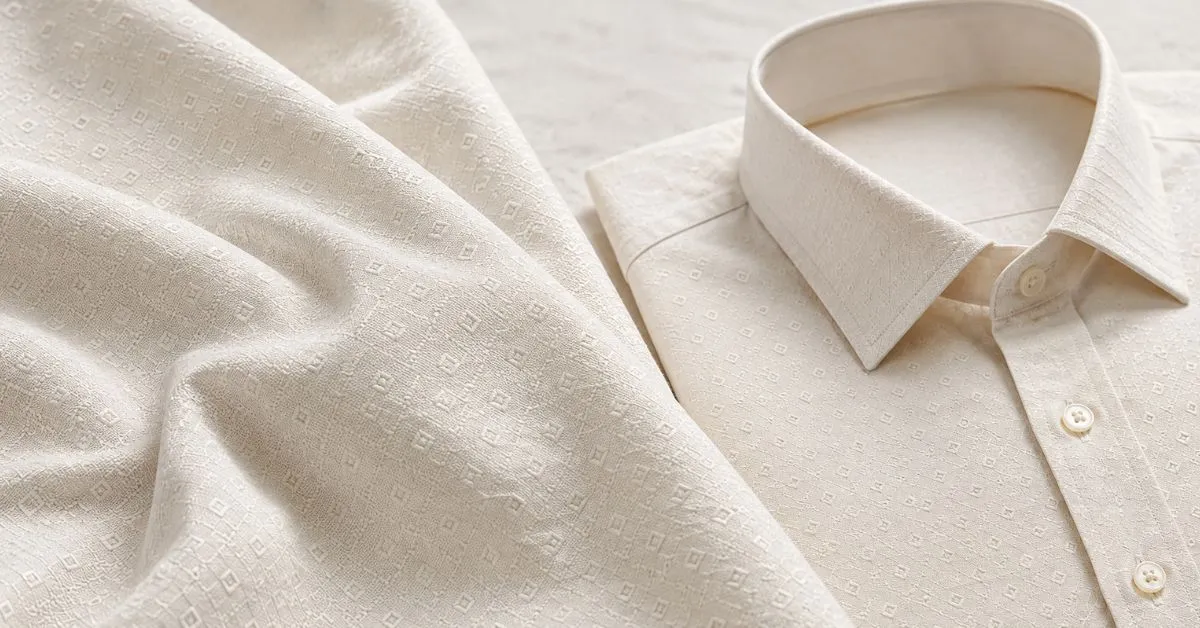

Dobby fabric is a woven fabric with small patterns or surface texture created during weaving. This type of fabric is produced on a dobby loom, where warp yarns are raised or lowered by harnesses at specific intervals to form patterns such as dots, diamonds, squares, stripes, checks, bird’s eye, honeycomb and others.
The term dobbly or dobby refers to the method of weaving, not a particular set of fibers. Fabrics using this weaving method may be made from cotton, polyester, linen, silk, viscose, blends and other materials. As a result, dobby fabrics vary significantly in softness, weight, drape, breathability, printability, durability and other characteristics. These weaves are used for making men’s and women’s dress shirts and blouses, dresses, table linens, curtains, upholstery, and home textiles.
What Does Dobby Mean in Fabric?
The word dobbies refers to a type of loom and the woven patterns that can be formed by this type of loom. This weaving method utilizes multiple harnesses to raise and lower different sets of warp yarns while weft yarns are passed through the fabric.
By changing the set of raised and lowered warp threads, it is possible to create various designs in the fabric. Designs formed by a dobby weaving are inherent to the fabric and cannot be removed by washing or dry cleaning.
Dobby fabrics typically feature small patterns that are often difficult to see until the fabric is held at an angle where the pattern becomes apparent. Some of the most common patterns created using a dobby loom include:
- Dots
- Diamonds
- Squares
- Tiny checks
- Fine stripes
- Honeycomb
- Bird’s eye
- Raised lines or bands
- Small floral motifs
Some patterns appear as areas of the fabric with a different weave, texture, or color.
Is Dobby A Fabric Or Weave?
Dobby is primarily a weaving method, and a fabric produced using this method is referred to as dobby fabric. Textile manufacturers and suppliers often refer to various fabrics as dobbies simply based on their visual appearance. However, a dobby weave can be made from different fibers and have significantly different properties.
For example, a dobby weave made from cotton yarns will have inferior moisture management and temperature regulation properties compared to a polyester dobby. Similarly, a dobby made from viscose will not be as durable or colorfast as a cotton version.
When purchasing fabrics with a dobby weave, it is important to look beyond the pattern and consider fiber, weight, count, thread density, finish, pattern repeat, width, stretch, and colorfastness. All these specifications impact the appearance, comfort, drape, and care of a finished garment or product.
How Is Dobby Fabric Made?
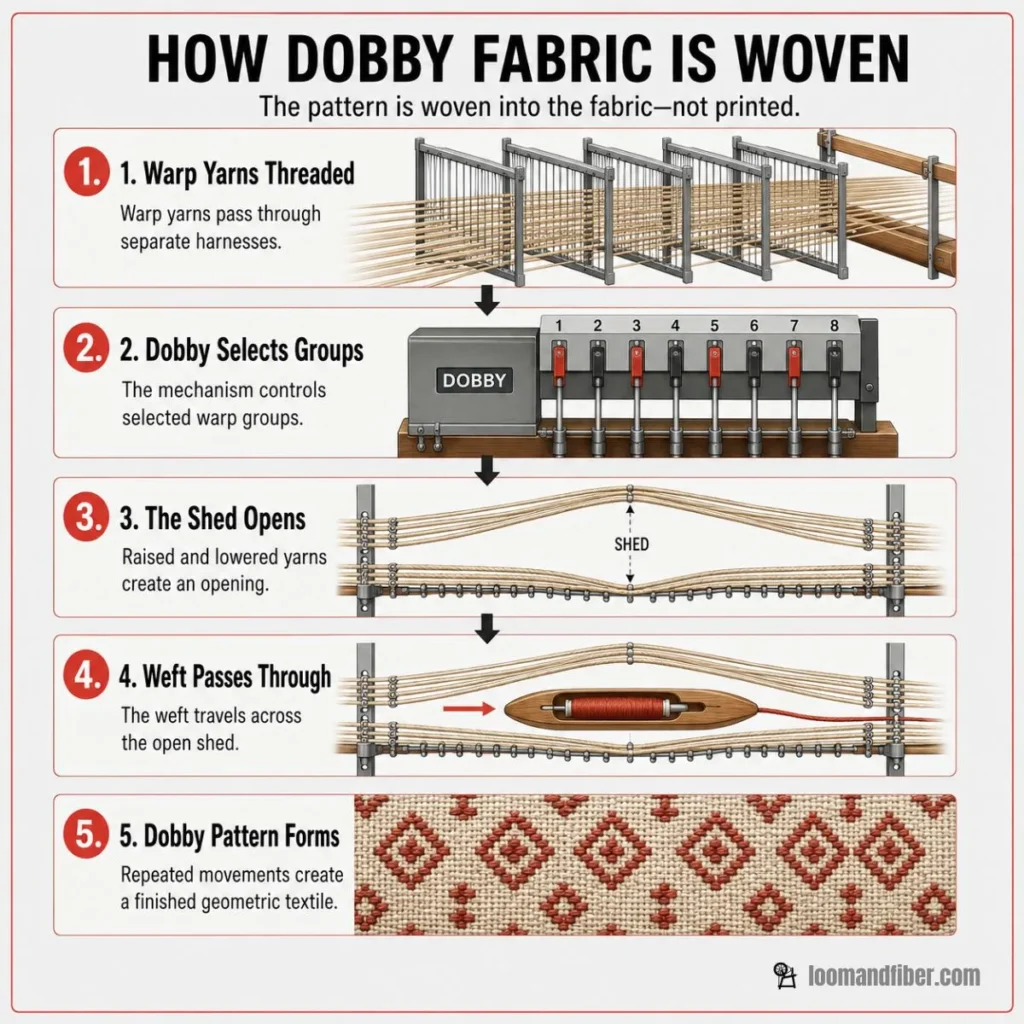
Dobby fabric is produced by weaving together warp and weft yarns on a loom with a dobby mechanism.
Yarn Preparation
The manufacturer will typically choose different sets of yarns based on the desired end result. For example, a light and breathable shirting fabric may be made from cotton, while thicker and harder-to-tear polyester may be used for home furnishings.
The warp yarns are laid out parallel to one another and wrapped onto a warp beam. These yarns will later form the lengthwise threads of the woven fabric.
Threading the Loom
The warp yarns are threaded through heddles on shafts, also called harnesses. Each shaft raises and lowers specific warp threads during the weaving process.
The required pattern is achieved by the relative movement of these shafts. For plain woven fabrics, a simple set of shafts is sufficient. More complex patterns call for additional shafts to be engaged.
Programming the Pattern
Depending on the design, the dobby mechanism is programmed to move specific shafts up and down by either mechanical or electronic means.
The manufacturer chooses the combination of raised and lowered shafts for each inserted weft yarn.
Forming the Weave
The motion of the selected shafts forms a space between the warp yarns known as the shed. The weft yarn is inserted into the shed by the loom’s shuttle.
The same set of shafts is then moved to form the next shed and allow the insertion of the following weft yarn. In this way, every weft thread defines the pattern of the textile. This process is repeated until the desired pattern is achieved.
Finishing the Fabric
The fabric may then be washed, dyed, heat-set, brushed, calendered, or subjected to other finishing treatments to alter its handle, luster, shrinkage, drape, and pattern clarity.
What Does Dobby Fabric Look And Feel Like?
Dobby fabrics typically feature a fine pattern that can take various forms such as dots, lines, checks, honeycomb, and fine floral prints. Textured patterns are achieved by varying the float of warp and weft yarns, using different yarn weights and finishes, or alternating colors of weft and warp yarns.
A white cotton dobby shirt fabric, for example, may appear almost plain at first glance, but will show fine diamonds when held at an angle. Using contrasting colors for warp and weft yarns will make the pattern more prominent.
The hand or feel of dobby fabrics depends on the yarns that are used to make them.
- Fine dobby made from cotton yarns typically feels delicate and airy
- Linen dobby feels stiff, rough, and dry at first, but gradually softens after a few wears
- Viscose dobby feels soft and smooth
- Polyester dobby feels harder than cotton versions but is highly durable
Upholstery-grade dobby fabrics feel very hard and compact due to a higher density and yarn weight.
A dobby weave does not guarantee any particular handfeel. This depends on the fiber, yarn count, processing methods, weave pattern, and weight.
What Are The Different Types of Dobby Fabrics?
Cotton Dobby
Cotton dobby fabrics combine the softness and comfort of cotton fibers with a delicate pattern. They are available in a wide range of weights, from very light to heavyweight. Medium-count cotton dobby is popular for making dresses, blouses, shirts, and children’s clothing.
Cotton dobby can be challenging to work with because it wrinkles easily and shrinks during washing unless it is preshrunk. When purchasing cotton dobby for production, it is important to request a shrinkage test and ask about colorfastness.
Polyester Dobby
Polyester dobby is a very durable and easy-to-care-for fabric with a pattern formed by a dobby weaving method. It resists wrinkles and retains its shape and pattern after multiple washes. This type of fabric is used for making dresses, shirts, linings, bags, uniforms, and decorative home textiles.
Patterned polyester dobby is often lightweight and airy. Breathability depends on the weave structure, yarn weight, and additional finishing.
Linen Dobby
Linen dobby fabrics have a distinctive texture, feel, and look. They are used for summer dresses, skirts, linens, and home textiles. This type of fabric combines the benefits of linen fibers and a subtle pattern formed by a warp and weft yarns.
Linen wrinkles easily, but many designers and manufacturers prefer this characteristic because it gives fabric a unique appearance. Linen blends can be used for achieving desirable softness and reduced wrinkling.
Silk Dobby
Silk dobby combines the softness and shine of silk fibers with fine patterns formed by a dobby weaving method. Patterns in silk dobbs appear due to interlacing of warp and weft yarns at different intervals. The right side of the fabric has fine dots or lines, while the wrong side has a contrasting pattern. Due to light reflection, patterns created by contrasting weft and warp yarns in silk dobby often remain visible from both sides of the fabric.
This type of fabric is used for making high-end dresses, blouses, linings, and scarves.
Viscose Dobby
Viscose dobby fabrics are usually highly breathable and have a delicate pattern. They have a soft drape that makes them perfect for dresses, skirts, blouses, and other clothing items.
Some viscose weaves are quite fragile and lose strength when wet. Before purchasing viscose dobby, it is important to check if the fabric meets the required strength and shrinking performance.
Stretch Dobby
Stretch dobby is a type of fabric with a stretch woven into its structure using elastane or special stretch weaving methods. This textile is used for making all types of clothing including shirts, dresses, skirts, uniforms, and trousers. This fabric is perfect for garments that require a closer fit.
The stretch in the fabric can be tight or medium depending on the manufacturing methods and desired performance. When purchasing a stretch dobby fabric, it is important to ask about the stretch percentage and rebound capacity, as these characteristics may vary greatly between different weaves.
What Are The Characteristics Of Dobby Fabric?
Woven-In Pattern
The primary characteristic of dobbys is that they have a pattern created by interlacing of warp and weft threads at different intervals. A dobby pattern is an integral part of the fabric; it cannot simply be printed on or added on top.
A pattern itself can vary from subtle to very prominent, depending on the type of weave and materials used. The pattern in a textile is often what makes it recognizable and distinguished from other fabrics.
Woven-in patterns are also durable; they do not fade or wash away with regular use. However, they can be affected by abrasion, improper washing, finishing processes, and shrinkage.
Subtle Surface Texture
Many dobby fabrics have fine patterns with a subtle texture, as opposed to very noticeable designs such as floral prints or animal prints.
This characteristic makes this type of weave ideal for cases where a solid color fabric seems bland, yet more prominent design seems too overbearing.
Frequent Pattern Repetition
In dobby fabrics, patterns tend to repeat throughout the fabric. It is rare to see a large pattern made using a dobby weave; this type of textile is more likely to have a check, dots, or lines that repeat dozens of times per square inch.
Variety In Weight And Drape
Dobbs come in a wide variety of weights and densities, from very light to extra heavy. This versatility allows this type of weave to be used in garments, home textiles, and various other applications.
The terms used to describe the weight and drape of different dobby fabrics can vary significantly; the same fabric can feel different depending on the manufacturer. The same dobby pattern in cotton and polyester will feel completely different due to variations in fiber, thread count, weight, and other characteristics.
Two Sides
Depending on the material and weave, different dobby fabrics may look different on both sides. The pattern might be almost invisible on one side and very prominent on the other. In some cases, the patterns in the middle of the fabric and along the selvedge might be different.
Manufacturers must be asked to note the side of a dobby fabric that is intended to be used as the right side.
Is Dobby Fabric Breathable?
Dobby fabric can be breathable, depending on the fibers used in its production, yarn count, weave structure, and finishing.
A cotton dobby fabric with an open weave will be cooler and more breathable than a dobby made from polyester with a closed weave. For a breathable fabric that is comfortable against the skin, consider a textile made from cotton, linen, or lyocell in an open weave with low or medium weight.
To ensure breathability, ask about fiber content, weight and density, openness of the weave, air permeability, and moisture management. Always avoid fabrics with special finishes that can make them harder or less breathable.
A fine pattern on the surface of a fabric is not necessarily an indicator of breathability.
Dobby Fabric Uses
Shirts
Dobbs are a popular choice for men’s and women’s shirting because they add visual interest to a plain white fabric. Small patterns such as dots, lines, and checks do not compete with the color of the shirt but make it stand out from other plain garments.
Dresses
Lightweight cotton and viscose dobby fabrics are great for making dresses, skirts, and tunics. Medium and high-count viscose dobby tends to have a beautiful drape that highlights the silhouette of a woman and allows this type of weave to be used in making feminine clothing. When planning to use a light or medium weight dobby for dresses or skirts, keep in mind that some weaves and colors may require a lining.
Children’s Clothing
Dobby fabrics made from cotton yarn are often used in children’s clothing. Dresses, blouses, and sets for girls are popular, but boys’ items can also be made from this type of weave. Always consider the softness of the fabric, its shrinkage, and colorfastness qualities when choosing dobby for children’s clothing.
Table Linens
Table linens made from cotton or linen are some of the most common household items produced from dabbs. Patterns in these textiles vary from fine dots and lines to large squares and checks. Table linens in dobby weave can also be produced using synthetic fibers.
Upholstery
Upholstery-grade fabrics in a dobby weave can be very dense and durable. Heavier weights in this type of weave are suitable for making chairs, cushions, and settees. Upholstery fabrics should always be tested for wear resistance, tear resistance, pilling, and colorfastness.
Towels
The unique patterns of towels and other personal care items can sometimes be achieved using a dobby weaving method. Towels using a dobby weave can have increased absorbency due to a higher surface area created by floats in the weave. However, performance of these towels still depends on the size and tightness of the weave, yarn material, and other characteristics.
Dobby Fabric vs Plain Weave
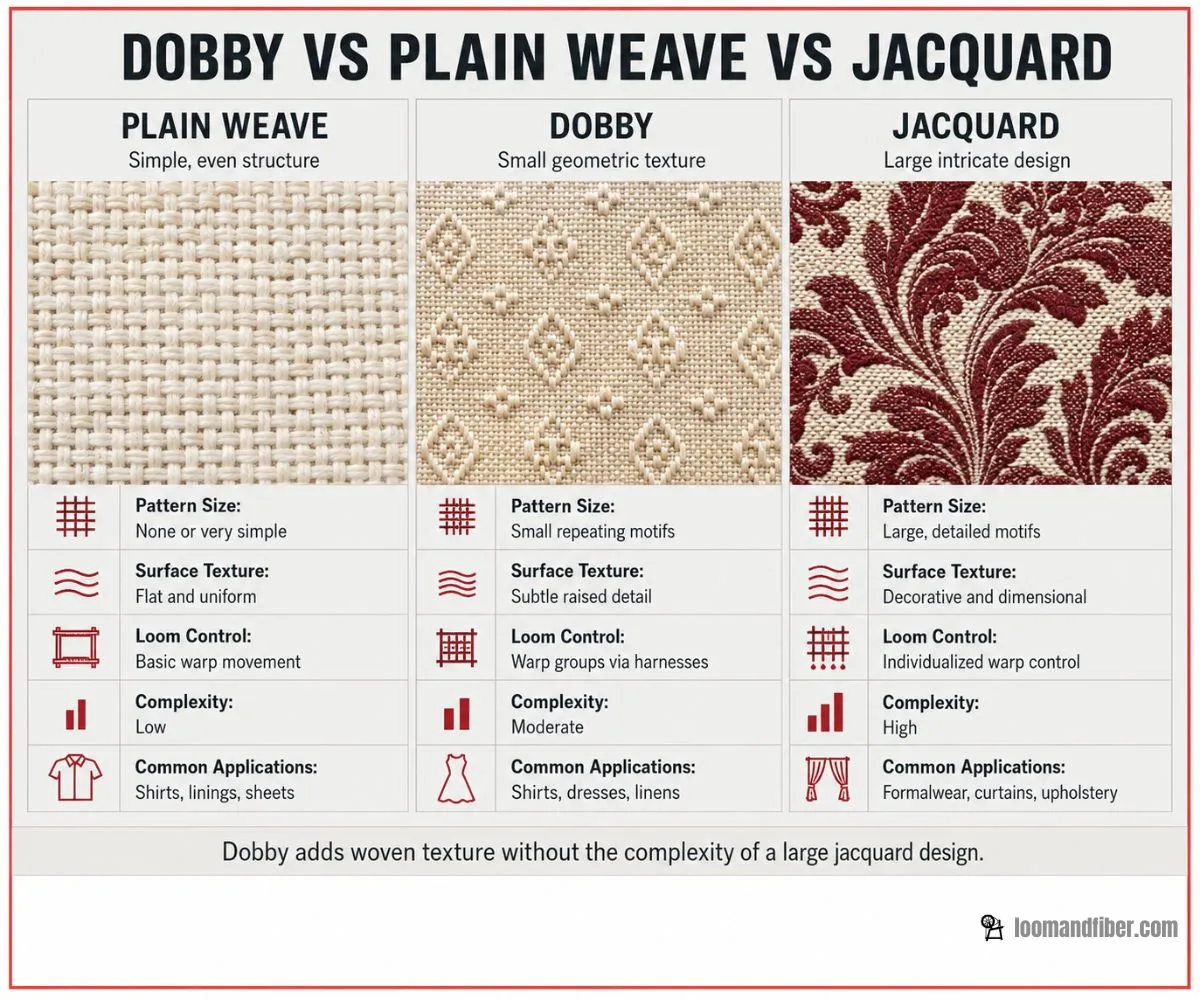
Plain weave is a simple over-and-under pattern that typically results in a balanced, non-patterned surface. Dobby weave produces patterns by manipulating small groups of warp yarns, generally providing more visual interest than a standard plain weave.
However, dobby does not necessarily produce superior quality fabric compared to plain weave. The strength and softness of any woven material depend on factors such as fiber type, yarn construction, thread density, and float length.
Dobby Fabric vs Jacquard Fabric
Dobby and jacquard are both patterned weaving methods, but these terms describe different loom technologies. A dobby loom lifts groups of warp yarns via harnesses into a weave-ready position, enabling the production of small motifs and medium-level pattern complexity.
Meanwhile, a jacquard loom provides individualized control over warp threads, resulting in large-scale florals, pictorial images, and intricate geometric shapes.
| Feature | Dobby fabric | Jacquard fabric |
|---|---|---|
| Typical design | Small geometric repeat | Large or intricate figure |
| Warp control | Groups controlled by shafts | More individualized control |
| Surface | Subtle to moderately textured | Often highly decorative |
| Common uses | Shirts, dresses and linens | Formalwear, drapery and upholstery |
| Production complexity | Moderate | Generally higher |
The primary difference between jacquard and dobby lies in loom technology, which ultimately determines pattern intricacy and motif size.
Dobby Fabric vs Printed Fabric
A dobby pattern is inherent to the weave, while a printed pattern is added to one side of a fabric. Printing techniques enable the placement of precise images and a wide spectrum of colors. A woven pattern adds texture and can be emphasized through the light-shadow interplay.
A printed motif can complement a dobby-woven ground or be integrated into the textile’s surface using specialized dyeing techniques.
Pros of Dobby Fabric
- Pattern is inherent to the weave
- Subtle patterns add dimensionality to solid colors
- Variety of fiber options
- Can be lightweight or heavyweight
- Versatile for garments and home furnishings
- Pattern elements help conceal imperfections
- Self-colored yarns produce subtle tonal variations
- Contrasting yarns create striking visual effects
Cons of Dobby Fabric
- Long floats may snag
- Can be expensive depending on pattern complexity
- Some items need special pressing techniques
- Some motifs have a noticeable “right side”
- Loose constructions may require special stitching
- Pattern matching can increase fabric waste
- Typical fiber considerations apply
- The term “dobby” lacks specificity
Any dobby product can exhibit these potential downsides depending on its construction.
How to Sew Dobby Fabric
Sewing considerations depend on fiber content, weight, and surface character. A fine cotton dobby typically behaves like a shirting-weight woven fabric, while slippery silk or viscose variants need special handling. Wash natural-fiber dobby before cutting to eliminate shrinkage and note the right side of the fabric.
Use the appropriate needle size for the dobby fabric: a sharp smaller size suits fine shirting, while furniture fabric needs a heavier-duty option. Always test-sew on a sample swatch. Align the pattern on pockets, openings, and prominent seams with the garment’s design if the dobby fabric exhibits directional motifs or patterns. Finish raw edges with an overlock stitch, zigzag stitch, or enclosed seams if the dobby fabric frays.
How to Care for Dobby Fabric
The care instructions depend on fiber content and additional finishing rather than the dobby construction itself. Wash/clean according to fiber type and care instructions on the garment’s care tag.
In general:
- Follow temperature guidelines to avoid damaging elastic, thin finishes, or delicate fibers
- Do not rub or scrub raised patterns
- Wash delicate items inside out
- Use a protective cloth when ironing textured surfaces
- Whenever possible, press the fabric from the wrong side
- Avoid pulling out loose floats
- Test any stain-removing solution on a small, inconspicuous spot
Extreme heat may permanently damage delicate finishing treatments on some polyester or cotton dobby fabrics.
How to Identify Dobby Fabric
Examine the fabric at an angle to see if there are any pattern elements that become more defined when the light hits the weave at different angles.
Then, look at the fabric’s surface on both sides: a woven pattern will usually show some variation in the back, whereas a printed design stays on one side.
Next, use a magnifying glass to look closely at the pattern. True dobby patterns will have fine yarn intersections that form small motifs or wavy lines at regular intervals.
How to Choose Dobby Fabric
Prioritize performance characteristics before deciding on dobby fabric. Consider the following factors depending on the end-use of the product:
For garments, think about:
- Hand feel
- Breathability
- Opacity
- Drape
- Shrinkage
- Wrinkle resistance
- Seam slippage
- Pilling
- Colorfastness
- Ease of care
For curtains and upholstery, also consider:
- Abrasion resistance
- Lightfastness
- Tensile and tear strength
- Flammability rating
- Required finished width
- Dimensional stability
- Backing
- Cleaning method
Before purchasing large quantities of a dobby fabric, request a sample that matches the desired fiber content, weight, color, face side, and pattern repeat.
Conclusion
Dobby fabric is a type of patterned woven material produced by lifting selected sets of warp yarns in a special dobby loom. This fabric contains small diamond-shaped, dot, check, stripe, and other motifs formed by the interplay of yarns inherent to the weave. Thus, dobby fabric is not inherently printed, although manufacturers can add extra printed patterns on top of a woven ground.
Dobby material can be lightweight or heavy, depending on its end-use, and can be made from various natural and man-made fibers. Therefore, this type of textile can exhibit different characteristics ranging from extreme softness to coarse texture, exceptional draping properties to high abrasion resistance. All these attributes are determined by fiber selection, yarn count, finishing techniques, and pattern complexity.
Read More>> What is Mikado Fabric?
FAQs
Dobby fabric can be woven from cotton, polyester, linen, silk, viscose, wool, or other fibers. Dobby is not a fiber itself but a weaving technique.
Depending on the construction, light cotton or linen dobby can be suitable for warm weather. Avoid heavy, densely woven, or synthetically finished dobby in hot climates.
Some dobby-woven materials can be soft, but softness is not necessarily a characteristic feature of this type of weave.
Standard dobby typically does not stretch because of its woven construction, but stretch dobby options may contain elastane.
Cotton, linen, viscose, or other natural fiber dobby materials tend to wrinkle, whereas polyesters or specially treated blends resist wrinkling.
A printed pattern is always on top of a woven ground, whereas a dobby pattern is inherent to the fabric. A printed design can be combined with a dobby-woven fabric if the manufacturer wants to achieve specific effects.
Piqué is not necessarily the same as dobby, even though some patterns characteristic of piqué can be found in dobby. The terms describe different textile categories that overlap sometimes.
The right side of the fabric typically has a more interesting pattern or a nicer surface finish, but some dobby materials have both sides usable for garment construction. Always check that you buy the right side of the fabric if this characteristic is essential for your project.