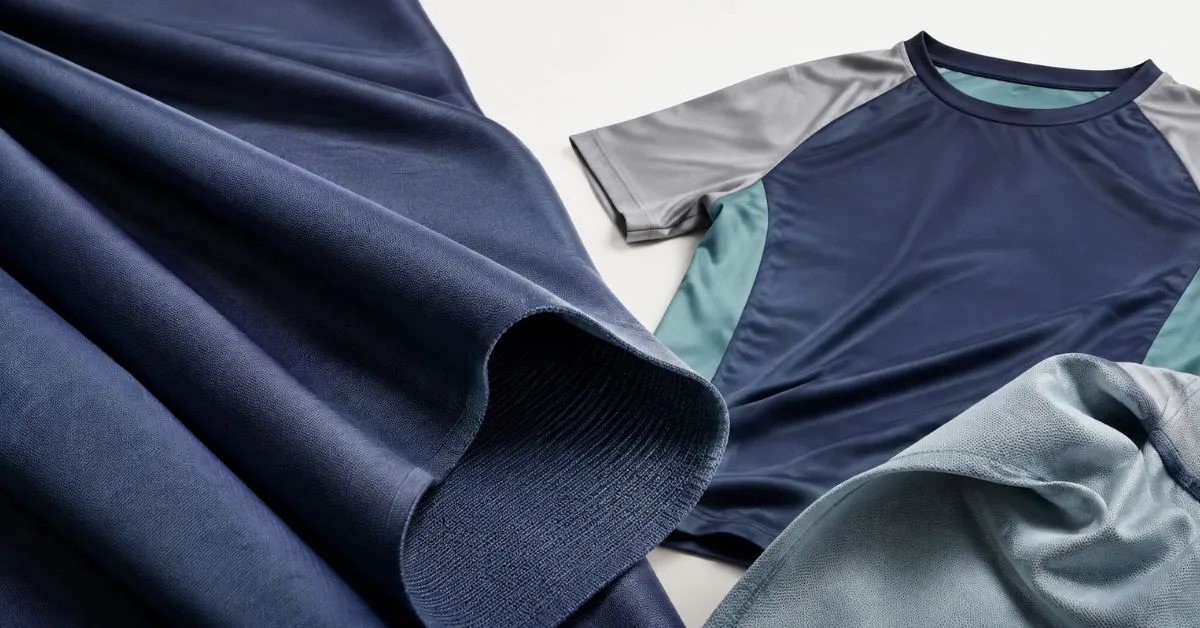

Tricot fabric is a smooth, stable warp knit fabric made by forming interlocking loops in a vertical column across the width of the material.
Usually made from polyester, nylon, spandex, or a blend, tricot is less stretchy (and more shape-retentive) than many weft-knit fabrics. It is often less likely to run, wrinkle, and fray. The surface of tricot is usually smooth on one side and has fine, almost invisible, horizontal ribs on the other.
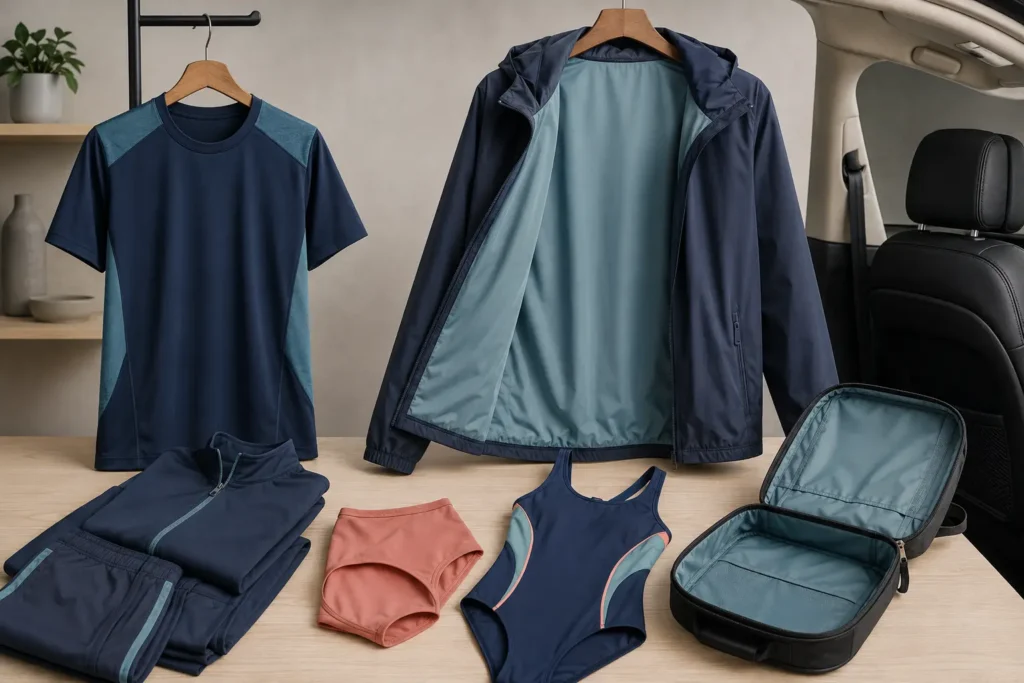
Tricot is used to make sportswear, swimwear, linings, car interiors, luggage, and technical products. It is also used in the production of garments for people and animals due to its softness, low weight, and durability. However, the properties of tricot fabric depend on the type of fibers, stitch, weight, density, and finish.
What Does Tricot Mean?
The term comes from the French language, and in textiles, it refers mainly to warp- knitting and the machines on which this process is performed.
Warps knitting is different from hand knitting and standard ways of knitting T-shirts. In contrast to weft knitting, where one yarn makes up an entire row, in warp knitting, a set of yarns is placed vertically to form two or more rows.
Yarn guides move back and forth so that the vertical columns of loops are connected. This knitting technique produces a stable, hard-to-run fabric with little elasticity.
How Is Tricot Fabric Made?
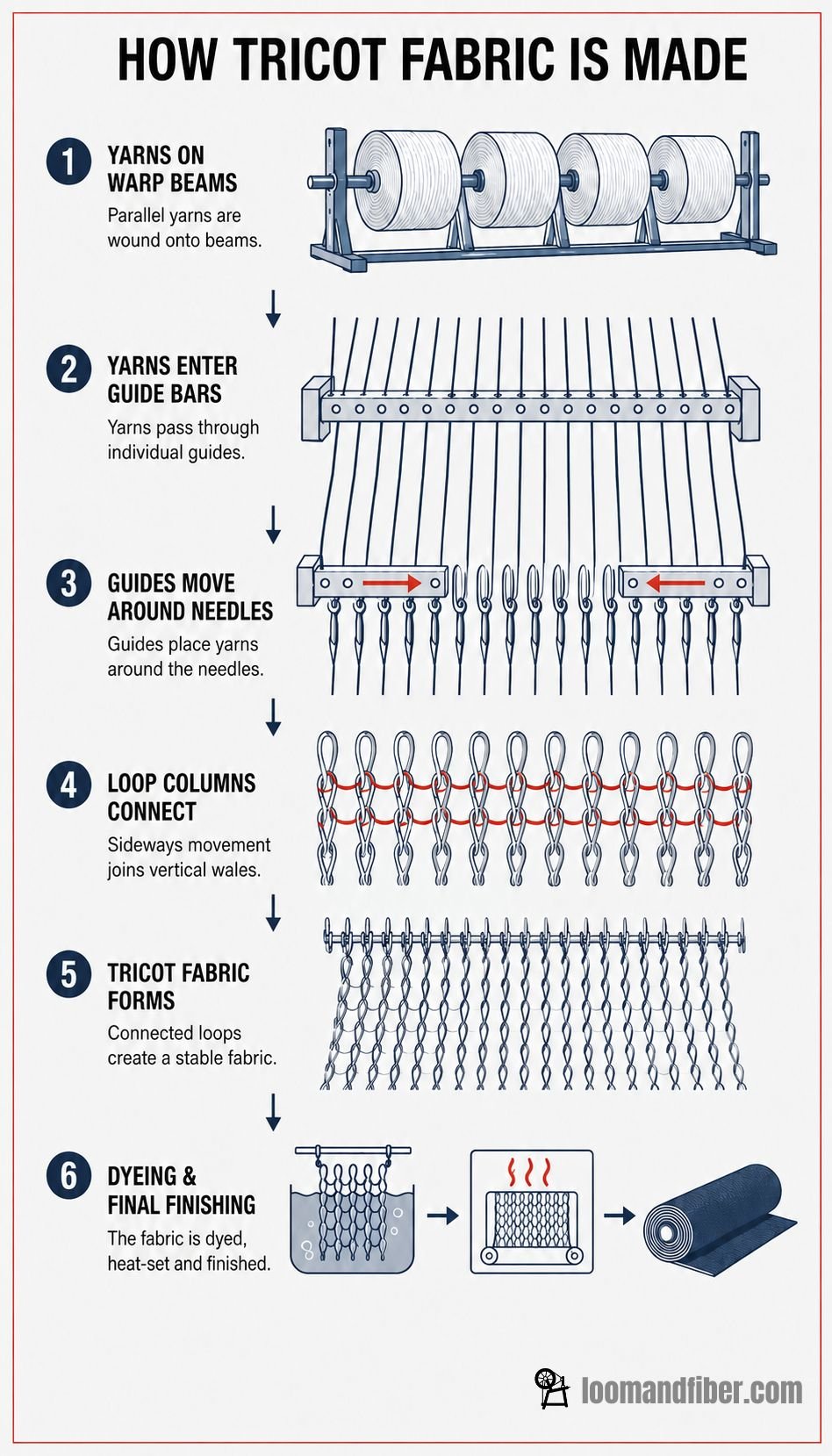
A warp knitting machine with hundreds or thousands of needles arranged side by side usually produces tricot fabric. At the same time, several yarns are wound on large spools and are fed to knitting needles via special guide bars.
By moving back and forth, the guide bars connect the loops formed by the needles, after which the columns of the loops interlock.
The movement of the yarns bars relative to each other is called the lapping motion. Depending on the overlap, the fabric’s properties (stability, elasticity, smoothness) and appearance change.
Most often, two guide bars are used in the tricot knitting process. While one bar forms loops, the other connects loops of one column with loops of the next column. Special tools are used to process the fabric after knitting:
- Scouring – removing oils and residues from the manufacturing process.
- Dyeing – coloring the yarn or fabric in one color or several colors at once.
- Heat setting – removing curls, stabilizing the size, and improving the properties of synthetic fabrics.
- Brushing – raising the fibers to achieve softness and volume.
- Calendering – smoothing the surface and increasing gloss.
- Printing – applying patterns to fabric with sublimation, transfer printing, screen printing, computerized jacquard techniques, or other methods.
- Finishing – improving certain qualities of the fabric: moisture absorption, sweat resistance, static electricity resistance, UV protection, flame retardance.
- Coating or laminating – gluing the fabric to membranes, foam, synthetic leather, or fabric.
The characteristics and appearance of the tricot fabric significantly depend on the type and processing technology of the yarn, knitting stitch, weight, and density. Two similar fabrics may have almost nothing in common if they were made using different technologies.
What Does Tricot Fabric Look and Feel Like?
The tricot fabric is characterized by a fine and uniform surface, and often looks smooth and shiny. On the other side, it may have horizontal ribs, zigzag-shaped loops, or even small bumps. Light tricot fabrics look delicate, have a silky consistency, and are cool to the touch. Heavy tricot may be firm, tight, or scratchy. Some tricot fabrics have a slight sheen, while others have a dull finish.
The tricot fabric can be made from different materials and have various weights and surface structures. Thus, a thin and silky fabric can be used to make underwear, while a thick and rough fabric can be used as a jacket lining.
Main Properties of Tricot Fabric
Tricot fabrics have a wide range of useful properties. Some of these properties are standard for tricot, while others depend on the material, technology, and additives used during the production process.
Dimensional Stability
The tricot fabric usually retains its shape well due to the special knitting technology. The interlocking of the loops allows the fabric to resist stretching. This is especially important for clothing, as the garment should not be deformed due to everyday wear. In addition, this property is critical when technical inserts or linings are used.
Controlled Stretch
Depending on the design, tricot can have little or significant elasticity in the crosswise and/or lengthwise directions. Fabrics with significant elasticity are often made with the addition of elastane.
Resistance to Runs
The interlocking of loops in the tricot knitting structure makes it more difficult for the fabric to “run” when some of the loops are caught. Unlike standard weft knitting, tricot does not unravel as easily.
Low Fray
Because tricot is made using a special knitting process, its edges do not fray as badly as woven fabrics. Nevertheless, depending on the yarn material and structure, the tricot can fray, curl, and shed fibers.
Smooth Surface
A fine gauge tricot, when smooth on one side, can slide easily over the skin or other fabrics, making it ideal for linings and close-fitting underwear or sportswear.
Wrinkle Resistance
Polyester and nylon tricot are highly resistant to wrinkling, and most wrinkles are removed when the fabric is pulled out from a roll. However, some tricot fabrics may require more careful care.
Lightweight Strength
Filament yarns, combined with a special knitting structure, provide good strength and tear resistance while keeping the weight of the garment low. Nevertheless, the actual strength should be checked for each particular fabric.
Quick-Drying Properties
Most tricot fabrics are made from synthetic fibers, which allows them to quickly dry after washing. However, the drying time also depends on the weight, density, fineness of the yarn, and the number of layers of the finished fabric.
Variable Breathability
Depending on the weave and weight, tricot can have high breathability and be suitable for warm weather or, on the contrary, have low breathability and be suitable for cold weather.
The ability of a fabric to resist moisture and temperature changes depends not only on the fibers used but also on the weaving technology, density, weight, and yarn surface structure. For example, fabrics with an open weave allow air to circulate freely, while woven fabrics with a tight weave have lower air permeability.
What Is Tricot Fabric Made Of?
There are different types of tricot fabric, which differ in fiber content, weight, and weaving technology. Most often, tricot is made from polyester and nylon.
Polyester Tricot
Polyester is a synthetic fiber that is often used in textile manufacturing. It allows to achieve good results in terms of fabric strength, shrinkage, and resistance to wrinkling. In addition, polyester tricot is lightweight, breathable, quick-drying, and fairly inexpensive.
Such fabrics are used to make:
- Sports jerseys,
- Tracksuits,
- Shorts,
- Garment linings,
- Flags,
- Bags,
- Automotive fabrics,
- Printed clothing (using sublimation).
White and light polyester tricot is often used for sublimation printing.
Nylon Tricot
Nylon is a strong and relatively lightweight fiber that does not wrinkle. It has good moisture absorption and resistance to abrasion. This allows nylon tricot to be used in clothing that is subject to intense friction. Moreover, nylon tricot is softer than many other fabrics, which makes it ideal for garments that require a close fit to the body.
Nylon tricot is used for:
- Lingerie and underwear,
- Swimwear,
- Slips,
- Clothing linings,
- Lightweight bags and pouches,
- Gloves,
- Costume clothes.
Nylon fabric often absorbs moisture more actively than polyester. In addition, nylon is susceptible to UV damage, which means that such fabric must be protected from direct sunlight.
Polyester-Elastane Tricot
Polyester-elastane tricot is a stretchy fabric that usually has good shape retention. This type of fabric is often printed and used in sportswear production.
Applications:
- Printed tights,
- Cycling clothes,
- Dancewear,
- Swimwear,
- Sport bras,
- Leggings,
- Shirts.
Nylon-Elastane Tricot
Nylon-elastane tricot is often used in the production of high-quality garments that require a close fit to the skin. It is a fairly soft and stretchy type of fabric with good elasticity recovery.
Nylon-elastane tricot is used for:
- Sportswear,
- Swimwear,
- Underwear,
- Intimate clothing,
- Lingerie fashion,
- Body stockings.
The amount of elastane and the quality of knitting directly affect the elasticity of the fabric. Therefore, when buying this type of fabric, it is important to check the stretchiness in both directions.
Special Yarn Tricot
In addition to the standard yarns listed above, manufacturers can also use recycled fiber, solution-dyed yarns, cationic yarns, antistatic yarns, flame-retardant yarns, UV-protected yarns, and yarns with special moisture absorption properties.
It is important to remember that the use of recycled raw materials or yarns with special properties always requires appropriate certifications.
Types of Tricot Fabric
Most often, fabric producers classify tricot by weight, the type of finish, weaving technology, fiber content, and use. The most common are:
Plain Tricot
A plain tricot is a fabric with a fine, almost invisible, texture. It is used in the production of light clothing, linings, costumes, and other garments.
Brushed Tricot
A brushed tricot is made using a special brush that raises the fibers to make the fabric fluffy and warm. It is most often used for:
- Tracksuits,
- Jackets,
- Gloves,
- Lined winter clothes,
- Footwear,
- Laminated fabrics.
Like any brush, the brushing process changes the properties of the fabric. A brushed tricot becomes warmer and softer, but at the same time, it may curl at the edges and pill more easily.
Stretch Tricot
A stretch tricot contains elastane or is made using a special knitting technology that gives the fabric good elasticity. This type of fabric can have a two-way or four-way stretch, which is important for knitwear, swimwear, and tights.
Tricot Mesh
Tricot mesh is a light-weight openwork fabric that has many advantages over conventional针织 fabric. It is often used in the manufacture of laundry bags, sports clothing, and footwear. It can also be used as a breathable insert or an abrasive-resistant layer. Light openwork tricot allows air to circulate, which is important for warm weather.
Note that not all mesh fabrics are tricot, and tricot fabric does not necessarily have an openwork structure.
Printed Tricot
A printed tricot is a fabric with printed patterns or graphics. Often, this type of fabric is made from polyester, because the sublimation printing method allows to achieve the best results on this type of fabric. Printed tricot is used for making t-shirts with graphics, company uniforms, and other printed clothing items.
Laminating Tricot
A laminating tricot is a light fabric that is often used as a reinforcing layer when laminating.
This type of fabric is most often used in the automotive industry, in the manufacture of furniture, and in technical applications. It facilitates adhesion to various surfaces, including foam, fabric, and leather. It can also be used to improve the mechanical strength of the finished material.
Industrial Tricot
An industrial tricot is a technical fabric that differs in a special knitting structure and has specific properties: abrasion resistance, high strength, elasticity, heat resistance, and others. This type of fabric is often used in the production of technical garments, medical devices, filters, and composite materials.
What Is Tricot Fabric Used For?
Sportswear and Activewear
Tricot is used for tracksuits, t-shirts, shorts, warm clothing, sportswear linings, and other garments. This fabric is ideal for athleticswear because it is lightweight, smooth, stretches, and recovers well after being worn. In addition, knitwear made of tricot fabric rarely wrinkles and is quick-drying.
A polyester tricot is often used for sublimated sportswear, since this type of fabric is well-suited for sublimation printing.
Lingerie and Intimate Apparel
Fine knitwear tricot made of nylon or stretch is used for making slips, briefs, bras, nightwear, and other intimate clothing items. The smoothness and softness of the fabric allow it to touch the skin without irritating it.
Swimwear
Nylon-elastane and polyester-elastane tricot can be used for making swimwear. However, before choosing such fabric for swimwear, it is necessary to study its resistance to chlorine, UV light, water, salt, stretching, and fading.
Garment Linings
A finely knit tricot made of a light material is often used as a lining for jackets, skirts, dresses, and other garments. Inside the clothes, the fabric will rub against the skin, which means that rough fabrics are not suitable for this purpose. In addition, the tricot lining will allow you to avoid the stiffness that is inherent to woven materials.
Dancewear and Costumes
A finely knit tricot with a good composition can be used for making dancewear, costumes, and other garments for theatrical performances or for everyday use.
This fabric is great for dancewear because it has a good drape and can have different colors and a slight sheen. It also has the necessary elasticity to be comfortable when dancing.
Bags and Luggage
Tricot fabric can be used as a textile component in the manufacture of bags of all sizes and shapes: school bags, suitcases, handbags, and much more. It can also be used to make cases for sensitive items and as a reinforcing layer inside the bag.
In addition, a tricot fabric can be printed, which opens up many opportunities for individualizing the product. The choice of fabric, its weight, weave, and finish depends on the type of bag and the conditions of its use.
Footwear
Tricot is used in shoe manufacturing as a lining or as a substrate for foams, artificial leather, or laminates. Inside the shoe, the fabric reduces the friction of the foot, which is especially important for closed shoes.
Automotive Interior
An automotive-grade tricot fabric can be used to upholster seats, produce car interior trim, audio system insulation, and much more. In the production of car seats, the fabric is often used in combination with other materials. For example, a fabric lining made of tricot can be glued to foam or another type of fabric to increase the strength and comfort of the seat.
The technical characteristics of automotive tricot depend on the technology and raw materials used. It is important to study the flammability, abrasion resistance, smell, and other properties of the fabric.
Technical and Industrial Products
A technical tricot fabric is used in the production of technical garments, medical devices, filters, special woven materials, and many other products. This type of fabric is different from the above types in that it has specific properties: strength, elasticity, heat resistance, and abrasion resistance.
Advantages of Tricot Fabric
Tricot has several advantages, including:
- Better shape retention than most basic weft knits
- Smooth surface for linings and second layers
- Resistance to runs and unraveling
- Less fraying at edges than woven fabric
- Quick drying for polyester and nylon
- Generally lightweight and wrinkle resistant
- Can be engineered for stretch, ventilation, reinforcement, and insulation
- Accepts dyes, prints, coatings, and functional finishes well
Provides good value for industrial use and garments without being too heavy
Disadvantages of Tricot Fabric
Despite the benefits, tricot also has several disadvantages, including:
- Heavy synthetic tricot can be too warm and less breathable
- Lightweight tricot can snag on rough surfaces
- Fine tricot can slip, curl, and shift during cutting and sewing
- Polyester tricot can retain oily odors
- Synthetic tricot can be glazed, shrunk, or deformed by high heat
- Stretch tricot with low quality elastane can lose shape
- Some tricot fabrics generate static electricity
- Difficult to sew accurately due to the smooth surface
- Untreated synthetic tricot is not waterproof
- Environmental impact depends on the composition, technology, durability, and end-of-life management
The word tricot does not always guarantee softness, durability, comfort, or sustainability. A responsible buyer must study the full specification of a fabric.
Tricot vs Jersey Fabric
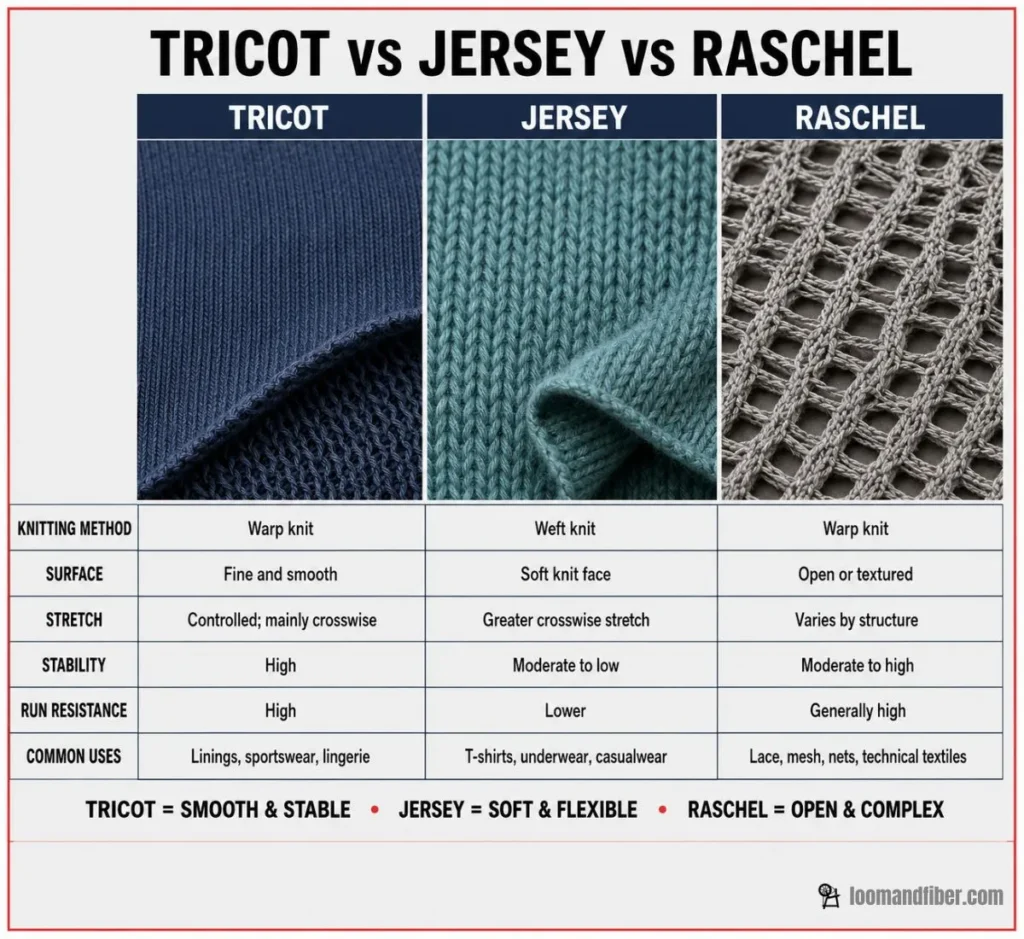
Tricot is a warp knit fabric, while jersey is a weft knit fabric. In tricot, the yarns are arranged vertically and bind together to form columns of loops. In jersey, the yarns are arranged horizontally and bind together to form rows of loops. The two constructions have different properties:
Tricot typically provides:
- Better shape retention than jersey
- More resistance to runs and fraying
- Controlled stretch in width and limited stretch in length
- Less curling and slipping during cutting and sewing
- Smaller loop size for a smoother surface appearance
Jersey typically provides:
- Greater widthwise stretch for a comfortable fit
- Softer handle for everyday garments
- Better stretch recovery than tricot
- More body-hugging and conforming appearance
Jersey is more common for T-shirts, underwear, casual wear, and light knit garments. Tricot is used for linings, sportswear, lingerie, swimwear, and technical products.
Raschel Fabric vs Tricot
Tricot and raschel are two types of warp knit fabrics that are similar in some ways but different in others. Tricot machines typically produce fine, smooth, lightweight, and stable loops. Raschel machines typically allow greater versatility in terms of yarns, weights, and constructions. Raschel is commonly used for:
- Lace
- Netting
- Power mesh
- Spacer fabric
- Decorative knits
- Technical reinforcements
- Heavy warp knit structures
The difference between tricot and raschel is primarily in machines and loops.
Tricot vs Woven Fabric
Woven fabric is formed by interlacing warp and weft yarns at right angles. Tricot is formed by binding yarns together in loops. Woven fabric typically provides a firm handle and less stretch than knit constructions, unless it is made with elastic weft or warp yarns. Tricot typically offers more comfort and freedom of movement. Woven fabric can also be easier to cut and sew accurately. However, woven fabric often requires additional finishing to prevent fraying. The choice between woven and tricot depends on the design, stretch requirements, appearance, and manufacturing considerations.
Is Tricot Fabric Breathable?
Depending on the construction, tricot can be breathable. Light, fine, and open tricot fabrics allow more air to pass through than a heavy, brushed, laminated, or coated fabric. For sportswear, it is important to request air permeability test results. A moisture-wicking fabric transfers sweat away from the skin, but it does not necessarily mean that it is breathable.
Is Tricot Fabric Stretchy?
Tricot provides some stretch across the width of the fabric, but less stretch than most weft knit fabrics. The stretch is controlled by the stitch, yarns, density, and elastane content. The addition of elastane allows the fabric to stretch in two or four directions. A responsible buyer must request laboratory stretch and recovery test results in both directions since fiber content alone does not predict the behavior of the fabric.
Is Tricot Fabric Waterproof?
Most tricot fabrics are not waterproof. Liquids can pass through the spaces between loops. A waterproof coating, membrane, or laminate is necessary to make tricot waterproof or water-resistant. Even a waterproof fabric requires special care in construction to prevent water from penetrating through seams, zippers, openings, and other weak points. A waterproof garment is not necessarily completely waterproof.
Read More>> Is Polyester Waterproof or just Water-resistant?
Is Tricot Fabric Good for Sportswear?
Tricot is a good choice for many sportswear applications because it can be engineered to provide lightness, smoothness, stretch, wrinkle resistance, and quick drying performance. Polyester tricot also allows sublimation printing for colorful team jerseys and other sportswear garments. However, a sportswear buyer must consider other properties beyond the fabric type. Important specifications include:
- GSM
- Stretch and recovery
- Air permeability
- Moisture management
- Resistance to snagging, pilling, and abrasion
- Colorfastness to washing, rubbing, and perspiration
- Light resistance
- Chlorine resistance (for swimwear) if applicable
The choice of tricot construction depends on the sport, climate, garment style, and level of abrasion.
How to Sew Tricot Fabric
Use a ballpoint, jersey, or stretch needle in the appropriate size for the fabric density and elastane content. A universal needle can damage delicate loops in fine tricot. Polyester thread is strong enough for most synthetic tricot and allows some stretch. A narrow zigzag stitch, stretch stitch, or serged seam allows the seam to give with the fabric. Always test the stitch on a sample piece since very fine tricot can pucker or get sucked into the feed dogs. Other useful tips include:
- Cutting with sharp scissors or a rotary cutter
- Using pattern weights to hold slippery fabric in place
- Avoiding stretching the fabric when cutting or sewing
- Using clips or fine pins on delicate fabric constructions
- Reducing the pressure of the presser foot, if possible
- Using a walking foot for slippery or laminated fabric layers
- Stabilizing shoulder seams, openings, and other stress points, if necessary
- Testing the temperature of an iron on a sample piece before pressing
- Using a pressing cloth to avoid shine and damage to the fabric surface
Never use excessive heat when pressing tricot since it can permanently flatten, glaze, shrink, or deform delicate synthetic fibers.
How to Wash and Care for Tricot
Always follow the care instructions on the garment since prints, coatings, elastane, and other finishes may require special treatment. Most polyester and nylon tricot garments can be washed in cold or warm water with a gentle detergent. Some general guidelines include:
- Washing delicate tricot garments in a mesh laundry bag
- Closing hooks and zippers that can snag on other garments
- Washing similar colors together
- Avoiding chlorine bleach, if possible
- Using only a small amount of fabric softener for moisture-wicking garments
- Air-drying or using a low-heat tumble dryer
- Avoiding high-heat settings for delicate garments, including those with elastane
- Using a cool iron, if necessary
- Using a pressing cloth to protect the fabric from direct heat
- High heat can permanently flatten, glaze, shrink, or deform synthetic tricot fibers.
How to Choose Tricot Fabric
When choosing tricot, it is important to think about the finished product. Do not focus only on appearance or price. Ask the supplier for the following information:
- Fiber composition
- Elastane content
- Fabric weight (grams per square meter) and usable width
- Stretch in width and length
- Stretch recovery
- Dimensional stability after washing
- Resistance to abrasion, snagging, and pilling
- Colorfastness to washing, rubbing, and perspiration
- Light resistance
- Chlorine resistance, if applicable
- Air permeability and moisture-management class
- Opacity (dry and wet) and finish
- Required certifications and restricted substances
Once you receive this information, inspect a production sample under the same lighting and stretching conditions as the finished product. For large quantities, request a laboratory dip, print strike-off, yardage sample, or pre-production sample before finalizing the order.
How to Identify Tricot Fabric
- Examine the fabric on both sides. Most tricot fabrics have a smooth surface with fine vertical wales and a reverse side with fine horizontal ribs, zigzag underlaps, or loops.
- Stretch the fabric in both directions. Most tricot fabrics have more give across the width than along the length.
- Another way to identify tricot is to look at the cut edge. Warp-knitted tricot rarely frays, unlike most woven or weft-knitted fabrics.
- However, this is not always the case, especially if the fabric has been brushed, embossed, laminated, or finished in other ways.
- The best way to identify tricot is to ask for a specification sheet from the supplier.
Conclusion-
Tricot is a warp-knitted fabric with a smooth surface, good drape, and resistance to runs and fraying. It typically stretches across the width of the fabric and has limited stretch along the length. Polyester tricot is a popular choice for sportswear, linings, and printed garments. Nylon tricot is often used in lingerie, swimwear, and other intimate apparel. Elastane adds greater stretch for close-fitting garments. The word tricot refers to the construction, not the quality. A responsible buyer should evaluate the fiber content, GSM, stretch, breathability, colorfastness, finishing, and other relevant factors before selecting tricot for apparel or technical products.
Read More>> What is Dobby Fabric?
FAQs
Most tricot is made from polyester, nylon, or elastane. Some tricot fabrics use recycled polyester or other modified yarns for sustainability or performance reasons. The word tricot refers to the warp-knitted construction, not the fiber content.
Light, open, and moisture-managing tricot can be a good choice for summer sportswear and linings. However, heavy tricot with a brushed or laminated finish can be too warm and should be avoided in hot weather. Always check the fabric weight and air permeability.
Properly heat-set polyester and nylon tricot typically shrink little during washing and drying. Poorly set tricot, high washing and drying temperatures, elastane content, and special finishes can also affect the shrinkage.
No, tricot is not the same as mesh. Tricot refers to a warp knitting technique, while mesh refers to an open weave or knit. Some mesh fabrics are made on tricot machines, and some tricot fabrics are made in a mesh-like configuration, but they are not the same.
Yes, tricot is often used for linings, including jackets, skirts, dresses, gloves, costumes, and sportswear. It is a good choice for garments that require a smooth second layer, freedom of movement, and resistance to fraying.
Tricot can pill, depending on the surface finish and fiber type. A brushed surface or a fabric with low-quality fibers is more likely to pill. Continuous filament construction typically pills less than a staple filament construction, but it should always be tested under the intended conditions.