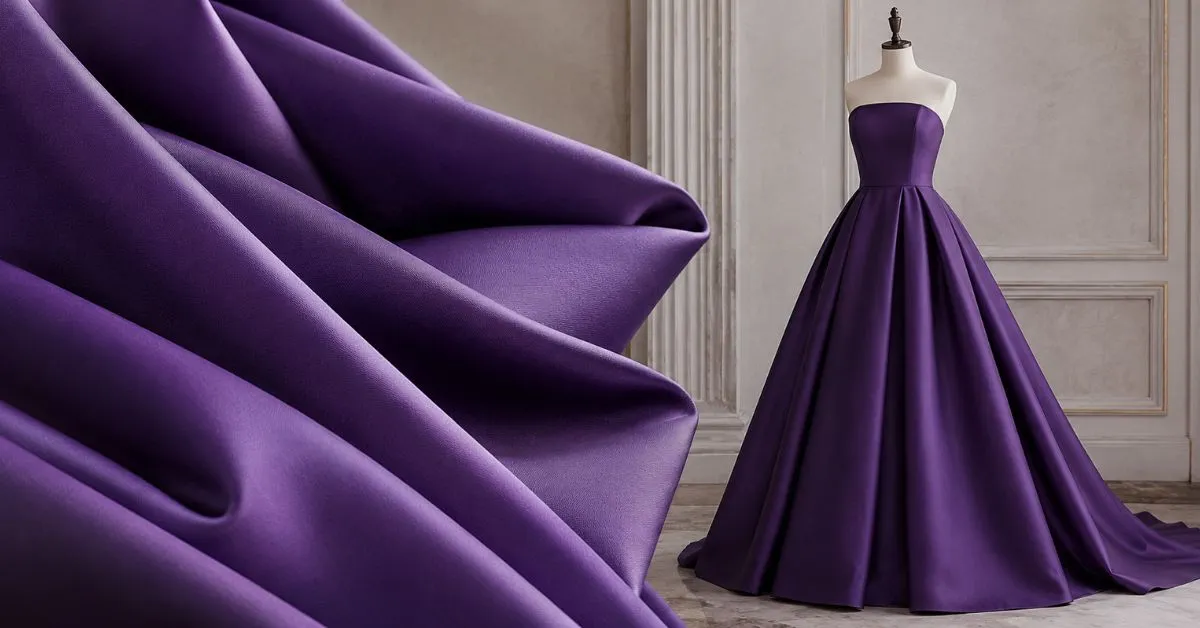

Mikado fabric is a medium-to-heavy dressmaking fabric with a smooth surface, firm body and soft glossy finish. While traditional Mikado is associated with silk, modern variations include polyester, silk-polyester blends and stretch materials. Mikado is a commercial term for a specific type of dress fabric, not one particular fiber or weave. This fabric holds folds, pleats and sculptural shapes better than a softer satin, making it a popular choice for wedding dresses, evening gowns and skirts. Mikado is usually opaque, firm and less fluid than charmeuse, but the weight, stiffness, sheen and fiber content vary greatly depending on the type. It is important to see a sample and check the composition to understand what you are buying.
What Is Mikado Fabric Made Of?
Mikado fabric was traditionally associated with silk, but modern manufacturers offer a wide range of options. Mikado can be made from:
- 100% silk
- Silk and polyester blends
- 100% polyester
- Polyester with elastane
- Recycled polyester
- Other synthetic blends
Silk Mikado has a luxurious sheen, while polyester is more affordable and durable. Stretch Mikado usually contains elastane, which allows the fabric to return to its original shape after being stretched. The word Mikado does not refer to one specific type of fiber, so a fabric made from 100% polyester can be labeled as Mikado as well. Always check the fiber content before buying.
How Is Mikado Fabric Constructed?
Mikado is a firm woven fabric with a dense construction. Many commercial dress fabrics are constructed using a satin weave or a similar pattern. While some weaves are similar to twill, the patterns may vary between manufacturers.
The density and firmness of Mikado give it the following characteristics:
- A firm, substantial hand
- A smooth or slightly textured surface
- Good opacity
- Controlled drape
- Shape retention
- Moderate sheen
Mikado is sometimes referred to as Mikado satin, but it is not the same as satin fabric. Satin is a type of weave or surface finish, while Mikado is a category of structured dress fabrics.
What Does Mikado Fabric Feel Like?
Mikado fabric has a firm, smooth and substantial surface. It is usually stiffer than bridal satin but softer than dupioni or shantung.
The surface of Mikado can vary from completely smooth to slightly textured, depending on the yarns and weave. The fabric can feel dense but not stiff, especially in silk blends. Polyester Mikado can feel stiff or compact, depending on the construction. Unlike delicate chiffon or charmeuse, Mikado does not flow or drape into soft folds. It holds rounded shapes and folds with a firm, smooth surface.
What Does Mikado Fabric Look Like?
Mikado fabric has a neat and luxurious appearance. It usually has a smooth surface that reflects light, giving the fabric a subtle shine. Mikado rarely has the same glossy appearance as cheaper satin fabrics.
The most common visual features of Mikado fabric are:
- A smooth surface
- Subtle sheen
- Deep colors
- Sharp seams
- Prominent folds
- An elegant, substantial appearance
Mikado is often found in white, natural white, ivory and champagne in bridal wear. Fashion dresses use black, navy, emerald, burgundy, red, pink and other colors.
Main Properties of Mikado Fabric
| Property | Typical Performance | Practical Meaning |
|---|---|---|
| Weight | Medium to heavy | Adds substance and may increase garment weight |
| Structure | Firm | Holds pleats, folds and sculptural silhouettes |
| Drape | Controlled | Creates broad folds rather than fluid movement |
| Surface | Smooth or lightly textured | Produces a clean, formal appearance |
| Sheen | Matte to moderately luminous | Looks polished without excessive gloss |
| Opacity | Usually high | Often provides better coverage than lightweight fabrics |
| Stretch | Low unless elastane is added | Standard Mikado may feel restrictive in fitted garments |
| Breathability | Low to moderate | Dense polyester versions may feel warm |
| Wrinkle tendency | Moderate | Folding and compression can leave visible creases |
| Common uses | Bridalwear and formalwear | Best for garments requiring shape and definition |
Firm Structure
Structure is the most notable characteristic of Mikado fabric. It allows the fabric to hold dramatic skirts, folds and bodices with minimal support.
Controlled Drape
Mikado fabric does not drape into soft, flowing folds. It holds volume in rounded shapes. This makes it a good option for dresses and skirts with a structured look.
Subtle Sheen
Most Mikado fabrics have a smooth surface that reflects light. However, it rarely has the same glossy appearance as satin. Silk Mikado has a deeper and more natural shine than polyester blends.
High Opacity
Opacity is another advantage of Mikado fabric. The density of the weave prevents light from passing through. White bridal Mikado often needs a lining for comfort and to prevent seams from being visible.
Crease Visibility
Mikado fabric tends to hold creases and folds. The smooth surface also highlights any marking, so it is important to handle the fabric with care.
Moderate Breathability
The breathability of Mikado fabric depends on the fiber content and weave. Silk tends to be more breathable than polyester blends, but neither is as breathable as chiffon or organza.
Limited Natural Stretch
Most traditional Mikado fabrics do not have significant natural stretch. Stretch blends usually contain elastane or have a special construction.
Types of Mikado Fabric
Silk Mikado
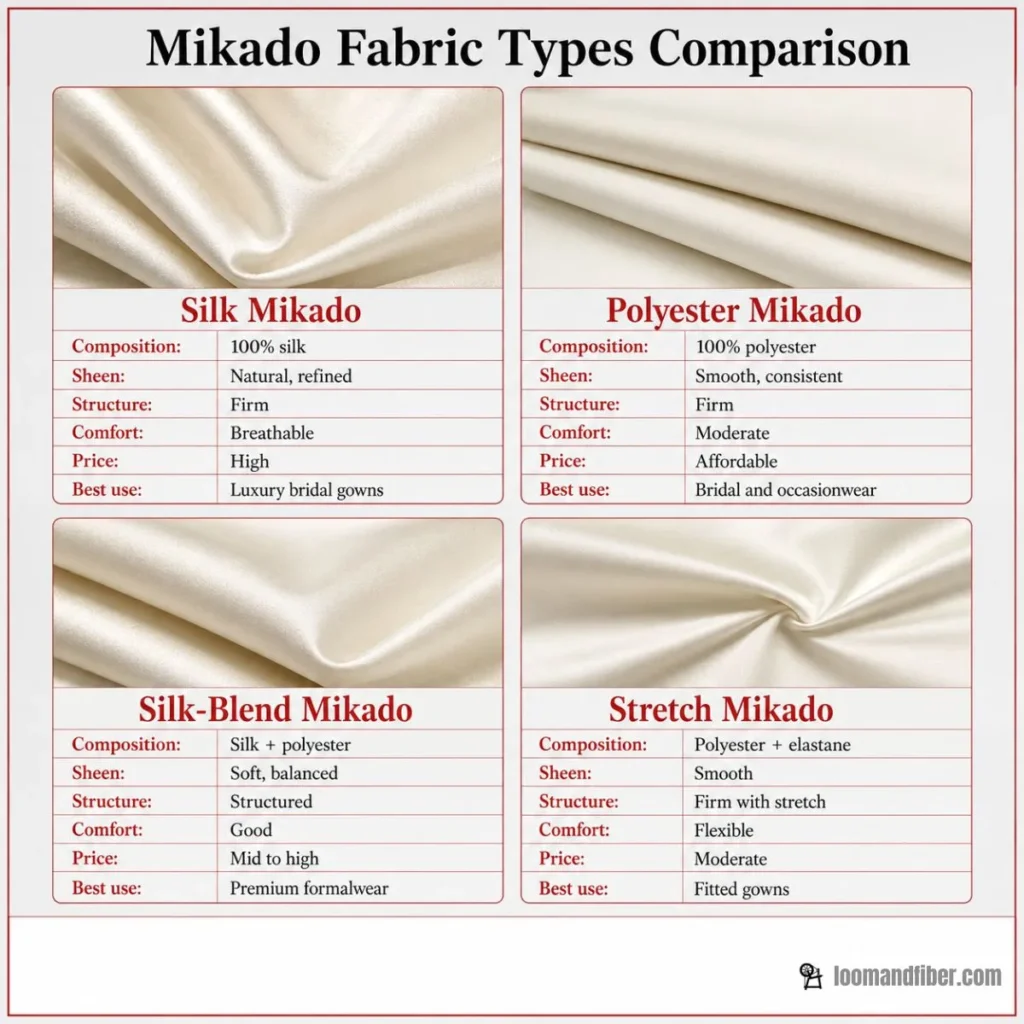
Silk Mikado is a traditional luxury fabric with a rich surface and a natural sheen. This type of Mikado is often used in couture bridal gowns and formal dresses. The main advantages of silk are the natural appearance and luxurious hand. The main disadvantages are the price, sensitivity to moisture and the need for special care.
Polyester Mikado
Polyester Mikado is a more affordable alternative to silk. It is often used in commercial bridal wear, prom dresses and costumes. This type of Mikado holds its shape well and rarely stretches. However, dense weaves can be warm and less breathable.
Silk-Blend Mikado
Silk-blend Mikado is a blend of silk and other fibers. This composition allows the fabric to retain some of the desirable qualities of silk, such as the sheen and hand. Blends can vary in price, density and construction, but most of them are designed to look similar to silk.
Stretch Mikado
Stretch Mikado usually contains polyester and elastane in a blend. It combines the qualities of stretch fabrics and structured weaves to provide a good balance of comfort and control. This type of Mikado is often used in dresses, skirts and structured tops.
Matte Mikado
Matte Mikado has a surface with a limited amount of sheen. It is used in modern bridal gowns and minimalist evening dresses to provide a luxurious appearance without an overly glossy finish.
Textured Mikado
Textured Mikado is a variation that has a more prominent weave. It adds volume and depth to a plain-colored dress without additional embellishments.
What Is Mikado Fabric Used For?
Mikado fabric is used to make structured garments and dresses that require a formal appearance. It is commonly used in the following garments:
- Wedding dresses
- Bridal separates
- Ball gowns
- Evening dresses
- Prom dresses
- Formal skirts
- Structured tops
- Corseted bodices
- Cocktail dresses
- Formal jackets
- Ceremonial clothing
- Couture garments
| Garment or Design | Recommended Mikado | Most Important Buying Check |
|---|---|---|
| Ball gown | Heavy or firm Mikado | Confirm that it holds volume without excessive weight |
| A-line wedding dress | Medium-weight Mikado | Check drape and fold formation |
| Fitted bridal gown | Stretch Mikado | Verify stretch percentage and recovery |
| Minimalist wedding dress | Smooth matte Mikado | Inspect the surface for flaws and excessive shine |
| Structured bodice | Firm Mikado | Test needle marks, seam puckering and pressing |
| Formal skirt | Medium-to-heavy Mikado | Check weight at the waistband |
| Evening dress | Silk or silk-blend Mikado | Evaluate sheen under different lighting |
| Summer wedding dress | Lightweight silk or lighter Mikado | Check breathability, lining and total garment weight |
| Embellished gown | Stable Mikado | Confirm that it supports appliqué or beadwork |
| Children’s formalwear | Lightweight polyester Mikado | Prioritize softness, comfort and easy care |
Mikado fabric is most commonly associated with wedding dresses, but it is also used for evening gowns, skirts and structured tops. Mikado is available in a wide range of colors and patterns, but silk and polyester are the most common fibers. This fabric is ideal for making dresses with a structured look and minimal detail. It is popular in couture bridal wear, but it is also used in commercial bridal fashion.
Why Is Mikado Popular for Wedding Dresses?
Mikado fabric is a popular choice for wedding dresses because it can create a dramatic silhouette without additional embellishments. The smooth surface allows patterned cutting and construction to show, so designers use it to make minimalist dresses with intricate details.
Mikado is popular in wedding dresses because it can:
- Hold a full skirt
- Define the waist
- Hold box pleats and other folds
- Create clean lines
- Hold asymmetrical details
- Provide a luxurious appearance
- Look good in photographs
- Add minimal volume to a minimalist dress
The slight sheen of Mikado fabric enhances the look of ivory and white dresses without making them overly glossy.
Advantages of Mikado Fabric
Mikado fabric has many advantages, including the following:
- Holds structured shapes
- Creates a formal appearance
- Usually opaque
- Suited to minimalist designs
- Holds folds and sculptural details
- Has more body than sheer satins
- Available in silk, synthetic and blended variations
- Hides lines better than clinging fabrics
- Can be used with embroidery, applique and other details
Mikado fabric has a firm surface that holds intricate details and patterned seams. This allows garments to have a structured look while remaining delicate and elegant.
Disadvantages of Mikado Fabric
Mikado fabric is not suitable for every garment or every season. Some of the disadvantages of Mikado are as follows:
- Can feel heavy in a full-length dress
- Can be warm in hot weather
- Cannot create soft, flowing folds
- Can show pinholes and other imperfections
- Can be difficult to press
- Can fray at the edges
- Can be expensive in silk variations
- Can be damaged by water or improper care
- Can be stiff and restrictive
The firmness of Mikado fabric is an advantage in many structured designs, but it can also be a disadvantage in dresses that require soft folds or close-fitting silhouettes.
Mikado vs Similar Formalwear Fabrics
Mikado vs Satin
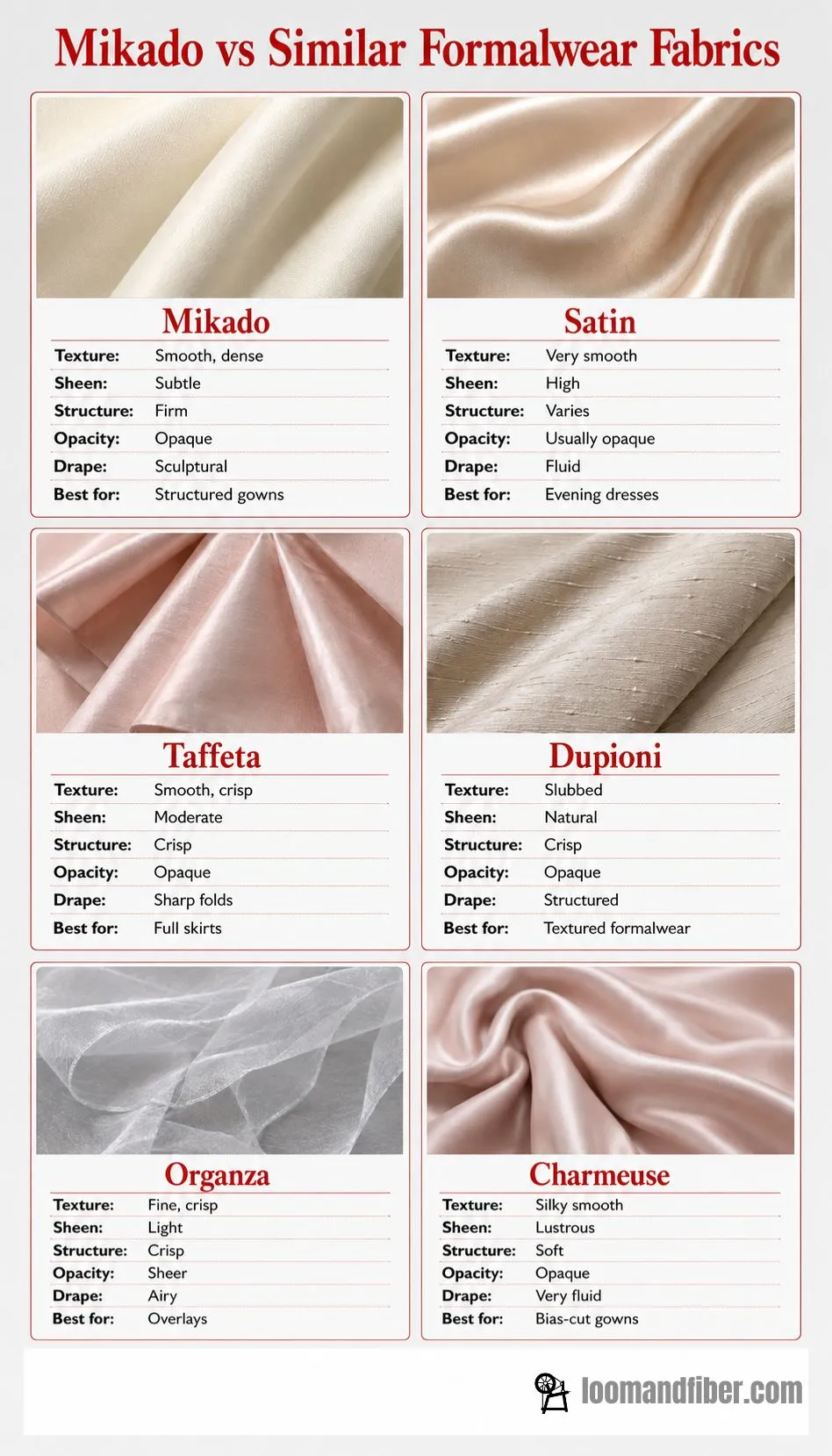
Mikado and satin fabrics can have a similar glossy appearance, but they are usually different in terms of construction and properties. Satin is a weave, while Mikado is a category of structured dress fabrics. Satin weaves can be made from silk, polyester, acetate and other fibers, while Mikado is usually made from silk, polyester or their blends.
Mikado is a firm dress fabric, while satin can vary from soft and slippery to firm and structured. Mikado tends to be heavier and less fluid than most satin weaves. Choose satin for garments that require a soft drape and delicate folds, and choose Mikado for structured designs.
Mikado vs Taffeta
Taffeta is a crisp medium-weight fabric that often has a slight sheen. It usually forms sharp folds and has a noticeable rustling sound when moved. Taffeta is often sheer or semi-sheer and is commonly used in wedding dresses and skirts. Mikado is usually heavier and less sheer than taffeta. The folds of taffeta are crisp and narrow, while the folds of Mikado fabric are rounded and sculptural.
Taffeta is suited to garments that require volume and a crisp appearance, while Mikado is suited to structured and sculptural designs.
Mikado vs Dupioni
Dupioni has a distinctive slubby surface that gives the fabric an organic appearance. The slubs create a unique pattern on the surface of the fabric. Dupioni is usually quite firm, but the surface irregularities allow it to drape into soft folds. Mikado usually has a smoother surface and holds folds more firmly. Dupioni is often used in garments that require an organic look, while Mikado is used in structured designs.
Mikado vs Organza
Organza is a sheer and crisp fabric that is often used to create volume in garments. It is usually quite light, but it can be layered to add weight and structure. Organza is transparent, while Mikado is usually opaque. Organza has a delicate and airy appearance, while Mikado has a firm and substantial appearance. The organza is suited to sheer dresses and skirts, while Mikado is used to create structured garments.
Is Mikado Fabric Suitable for Summer?
Mikado can be worn in summer, but it is not a fabric that is right for hot and humid weather. The tightly woven structure prevents air circulation, and if the Mikado has a polyester outer layer, lining, boning, and multiple skirt layers, it can be downright stifling.
To make a garment from Mikado suitable for warm weather, consider the following:
- A lighter version of Mikado,
- silk instead of polyester,
- a sleeveless or backless design,
- a breathable lining,
- skirt layers,
- a vent in the bodice,
- a shorter train,
- an indoor or evening event.
The construction of the garment is as important as the outer material.
Read More>> Sustainable Fabrics for Summer.
Is Mikado Fabric Easy to Sew?
Mikado is not a difficult fabric for an experienced dressmaker, but it does have its challenges. Unlike slippery charmeuse, it is fairly easy to cut, but the lack of texture often makes it hard to see what you are doing.
Some helpful tips when sewing Mikado include:
- Testing the tip of the needle and thread on a sample swatch,
- using sharp fabric shears or a rotary cutter,
- avoiding pins on the wrong side,
- using fine sharp pins in the seam allowances,
- using a new sharp universal or microtex needle,
- adjusting the tension when sewing the garment,
- finishing the raw edges to prevent fraying,
- supporting the skirt at the waist,
- pressing each seam,
- using a pressing cloth.
Avoid pulling the fabric through the iron to prevent stretching or shine. Lower the temperature for polyester blends and use the appropriate setting for silk when pressing.
How Should Mikado Fabric Be Pressed?
Always test the temperature on a sample swatch of Mikado before pressing an actual garment. The fiber content will dictate the temperature, so use a low to medium setting on a polyester blend and a silk setting on silk Mikado. Whenever possible, press the fabric from the wrong side and use a pressing cloth. Never drag the iron across the fabric; lift and lower it to avoid stretching the fabric and creating shine. Avoid high heat when possible; it can flatten the fabric, causing it to look shiny and stiff, or ruin the synthetic fibers.
How to Care for Mikado Fabric?
The care of Mikado fabric depends on the fiber content, the dye, and the construction of the garment. Most formalwear made from Mikado is professionally dry-cleaned.
- Some general care guidelines for garments made from Mikado include:
- Following the care instructions on the garment care label
- avoiding washing the garment in a machine unless the care label indicates it is suitable,
- avoiding rubbing the fabric when spills occur, blotting them instead,
- avoiding spraying perfumes directly on the garment,
- keeping the garment away from heat,
- storing the garment in a breathable garment bag,
- hanging heavy garments on suitable hangers,
- avoiding compression,
- using acid-free tissue paper around the folds.
Silk Mikado requires special care because water, sweat, and some cleaning solvents can damage it.
How to Choose Mikado Fabric
Ask the seller for a sample before buying fabric for an expensive dress. Pictures cannot do justice to the feel and look of Mikado. Here are some factors to consider when buying Mikado fabric:
Fiber Content
Ask what the fiber content is and whether it is a blend or has stretch in it. The fiber content will dictate how comfortable the finished garment will be, how much it will cost, how it will look, and how to care for it.
Weight and Body
Hold the sample in your hand vertically and form several folds. Do these folds create the fullness you want for your pattern?
Surface Finish
Look at the sample in natural light and under indoor lighting. Some samples look dull in one and shiny in the other.
Opacity
Hold the sample over the lining and undergarments you plan on wearing. Do light-colored fabrics look sheer?
Width
The width of the fabric affects the yardage, so a narrow silk fabric may be more expensive than a wide polyester fabric.
Stretch
Test the stretch of the sample both across the width and lengthwise. Never assume that a “stretch” Mikado fabric has the same amount of stretch in all directions.
Color
Make sure to buy all the fabric you need from the same dye lot. Color variations can be obvious in light fabrics, especially in large skirt panels.
Recovery and Wrinkles
Wrinkles are inevitable when working with Mikado, but how badly does it crease when you scrunch it in your hand? How quickly does it recover from the creasing?
Is Mikado Fabric Expensive?
The price depends on the type of Mikado. Pure silk is the most expensive, while polyester is the cheapest. Blends and recycled polyester fall somewhere in the middle, depending on the manufacturer.
The price should not be the sole criterion for choosing Mikado fabric. Consider the fiber content, the usable width, the surface finish, the number of flaws, the color, and whether the fabric is suitable for the intended garment.
Is Mikado Fabric Sustainable?
Mikado is not inherently sustainable. Sustainability depends on the type of fiber, the water and energy used during finishing, the potential to recycle or resell, and the impact on the environment when the garment is disposed of.
Silk is a natural fiber, but the process of turning mulberry silk into fabric is water and energy-intensive. Polyester is a synthetic fiber that is made from petrochemicals and is not biodegradable. Recycled polyester reduces the demand for virgin fiber, but the recycling process is not perfect.
To help choose a more sustainable option, ask the seller for details about the fiber content, whether the fabric is recycled, the water and energy used during manufacturing, the location of the manufacturer, the chemicals used, the durability of the fabric, and its end-of-life options. The most sustainable option depends on the fabric, the manufacturer, and the intended use.
Conclusion
Mikado is a dense, smooth and firm fabric that holds sculptural shapes beautifully. It is mostly used to make wedding dresses, ball gowns and formal wear. Silk was the main material in traditional Mikado, but modern variations use polyester, blended fibers and elastane.
The fabric’s main benefits include opacity, shape retention, controlled drape and elegant sheen. However, its main disadvantages are its heaviness, lack of breathability, tendency to wrinkle and difficult ironing process. Due to its complexity, Mikado is not a standard fabric, which means that its weight, width, finish, stretch and composition may vary between manufacturers. It is important to request a swatch before buying Mikado to ensure that it is suitable for the intended purpose.
Read More>> What is Bonded Fabric?
FAQs
Mikado is a smooth, structured fabric with a slight sheen. It is used to make wedding dresses and other garments that need to hold their shape.
No, Mikado can be made from silk, polyester, or a blend of silk and polyester. Some versions of Mikado have elastane in them to give it a stretch.
No, Mikado is a specific type of satin. The terms can be used interchangeably, but Mikado satin is a heavier and more structured fabric than regular satin.
Mikado fabric can wrinkle, depending on the fiber content and weight. The heftier the fabric, the more it will wrinkle. The smoother the finish, the easier it will be to see the wrinkles.
Mikado is a firm, structured fabric that does not have much stretch in it. Some versions of Mikado, however, have elastane in them and are stretchy.
Silk Mikado is more breathable than polyester Mikado, but it is not as breathable as cotton. Most versions of Mikado are not ideal for warm weather because of their tightly woven structure.
Some versions of Mikado are opaque enough to be worn without a lining, but most garments made from Mikado are lined for comfort and to prevent the lining from rubbing against the skin.
Yes. Its firm body can be used to create full skirts, deep pleats and sculptural shapes characteristic of ball gowns.