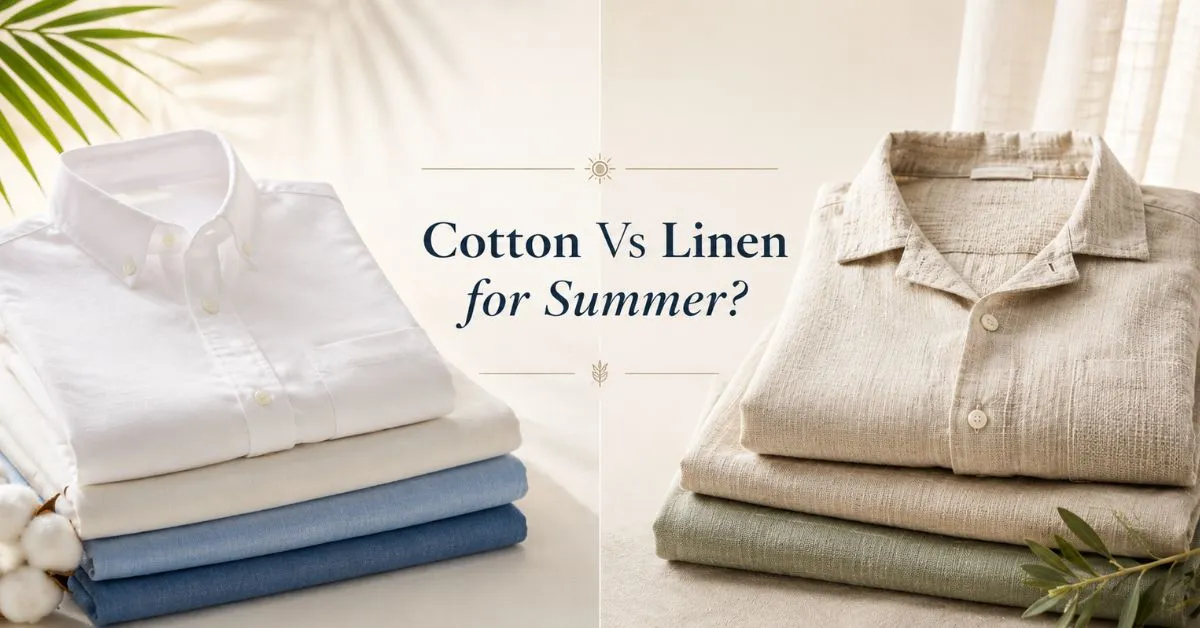

Is Cotton or Linen Better for Summer?
Linen is definitely the best material for ultra hot and humid summer days because it breathes better and it dries faster. It keeps your body cooler. Cotton is the best for summer clothes because it always is the most comfortable and softest, plus it’s easy and cheap. Linen also can be pretty expensive so a linen-cotton blend can be the best option because then you have your nice and breezy summer clothes and with the addition of soft breathable cotton, you also get that easy to maintain material, and good summer shorts that won’t wrinkle too much.
For hot and humid summer days, linen is the fabric of choice. For softness, budget, and everyday comfort, the choice is cotton.
| Use Case | Better Fabric |
|---|---|
| Extreme heat | Linen |
| Humid weather | Linen |
| Heavy sweating | Linen |
| Soft daily wear | Cotton |
| Budget clothing | Cotton |
| Wrinkle resistance | Cotton |
| Office wear | Cotton-linen blend |
| Travel | Linen blend or cotton poplin |
| Summer shirts | Linen or cotton lawn |
| Summer T-shirts | Cotton |
What is Cotton?
Cotton is a natural fiber from the cotton plant, and is a soft, breathable, absorbent, durable, and washable fiber that is very common in daily summer clothing.
Cotton fibers grow in bolls around the plant seeds. These fibers are harvested, cleaned, and spun into yarn to be woven or knitted into fabric. Countless T-shirts, summer outfits, dresses, shirts, baby clothing, and even bed covers are made of cotton.
Cotton is the fabric of choice for daily wear, summer outfits, and most casual and baby clothing, because it is soft and absorbs moisture. When cotton becomes damp, heavy, and sticky, moisture becomes cotton’s biggest drawback.
The Guardian’s summer clothing guidance says cotton is absorbent, breathable, convenient, flexible, and durable clothing. But, it can be heavy from all the absorbed sweat.
What Is Linen?
Linen is made of the fibers of the flax plant. It is naturally crisp, airy, textured, and breathable. It is also absorbent of moisture and cool to the touch.
Linen comes from fibers in the stems of the flax plant, while cotton comes from fibers in the bolls of the cotton plant. Linen fabric is advantageous in hot and humid climates because flax-based linen dries more quickly than cotton.
The airflow and crisp structure of linen also give it a cool-to-the-touch feeling. Compared with cotton, linen is often more comfortable in hot, humid tropical climates, beachwear, and resort clothing because of its moisture absorbency and quick-drying nature.
Linen also has the drawback of being more wrinkly than cotton, as well as being stiffer when new, but it is still like cotton in that it softens the more it is washed and worn.
Cotton vs Linen for Summer: Main Differences Table
| Feature | Cotton | Linen |
|---|---|---|
| Fiber source | Cotton plant bolls | Flax plant stems |
| Feel | Soft, smooth, familiar | Crisp, textured, airy |
| Breathability | Good | Excellent |
| Sweat handling | Absorbs sweat but may stay wet longer | Absorbs moisture and dries faster |
| Drying speed | Slower | Faster |
| Heat comfort | Good in light weaves | Better in hot weather |
| Wrinkles | Fewer wrinkles than linen | Wrinkles easily |
| Durability | Durable | Usually stronger and longer-lasting |
| Care | Easy to wash | Needs gentler care |
| Price | Usually cheaper | Usually more expensive |
| Best for | T-shirts, casual wear, daily basics | Shirts, trousers, dresses, resort wear |
Question: What is the difference between linen and cotton?
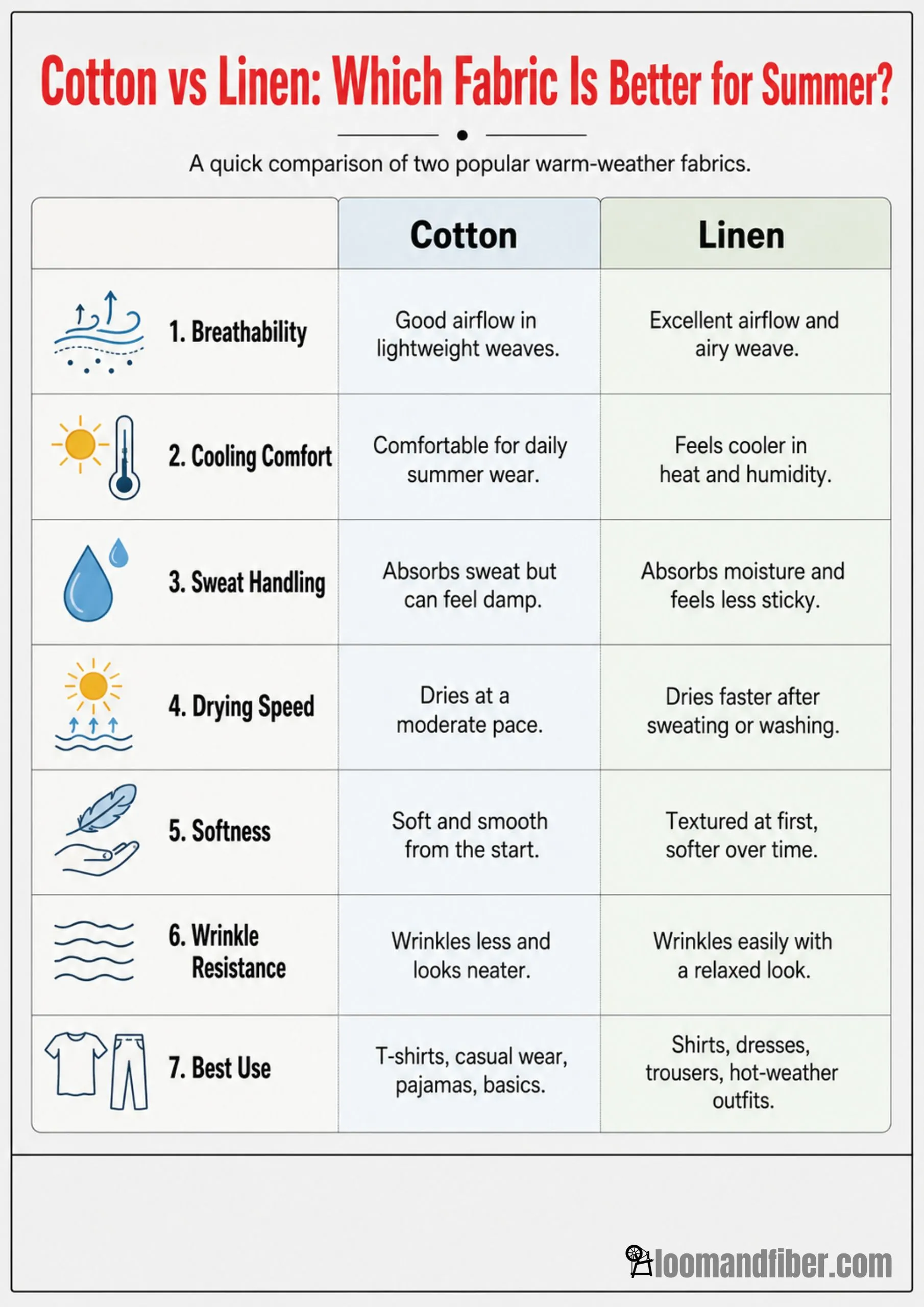
The main differences between linen and cotton are strength, moisture absorbency, cost, drying speed, and climate comfort. Linen generally wins for strength, drying speed, and hot-weather comfort, while cotton usually wins for softness and price.
According to The Spruce, while the stems of the flax plant are used to create linen, the bolls of the cotton plant are used for cotton fabric. The Spruce mentions that linen fabric can be two to three times stronger than cotton fabric and also has quick-drying properties. However, because of the lower elasticity of linen, it wrinkles and costs more.
Which Fabric Is Cooler in Summer?
Question: Is linen cooler than cotton?
Linen fabric is usually cooler than cotton fabric during the summer because it can dry quicker, does not cling to the skin as much when damp, and allows better airflow.
Linen fabric is stiffer than cotton fabric. This creates more space between the linen fabric and the skin, which allows for better heat escape.
Linen also has the advantage of being a good heat conductor and can absorb moisture without feeling heavy, resulting in a cooler fabric during the summer.
Cotton can also be a cooler fabric during the summer, but that is only the case if it is a lightweight, loose, and breathable cotton fabric. Some good summer cotton fabrics include cotton lawn, voile, gauze, chambray, poplin, and seersucker.
Thick or heavy cotton fabrics such as denim, heavy jersey, and fleece are poor summer cotton fabrics because they trap heat and hold sweat longer.
Which fabric is better for humid weather: cotton or linen?
| Climate | Best Choice |
|---|---|
| Hot and dry | Linen, cotton voile, cotton lawn |
| Hot and humid | Linen, linen blend, cotton gauze |
| Tropical climate | Linen, chambray, cotton-linen blend |
| Mild summer | Cotton, linen, cotton poplin |
| Sweaty commute | Linen shirt or cotton-linen blend |
Generally, linen is better for humid weather because it dries more quickly and helps eliminate the sticky feeling that comes from sweating.
Because of humidity, the evaporation of moisture from clothing is slowed. Therefore, the fabric that dries the quickest is generally the most comfortable and linen excels at this because it absorbs moisture and releases it quickly.
Cotton can be more comfortable than linen when the fabric is kept light and loose. However, heavy cotton can become wet and cumbersome.
Read More>> Best Fabrics for Hot Humid Weather.
Cotton vs Linen: Which Fabric Handles Sweat Better?
Linen handles moisture better than cotton because it retains less moisture and dries quicker.
Cotton is more comfortable when it is dry, but that can become problematic when sweating heavily because wet cotton can become heavy and uncomfortable.
Linen handles moisture better than cotton because it retains less and dries quicker. Moreover, the relatively coarse and crisp texture of linen helps reduce moisture cling. However, the type of fiber is just one of the many things that can impact comfort. A lawn cotton shirt can be more comfortable than a thick linen shirt.
Best choice for sweating: Choose linen, linen blends, cotton gauze, or loose woven cotton.
Cotton vs Linen Breathability
Question: Is linen more breathable than cotton?
Linen is typically more breathable than cotton, but weave, weight, and fit also determine airflow.
Breathability is not determined by fiber alone. It is determined by the yarn structure, the thickness of the yarn, how the fabric is woven, and how the garment is fitted.
Linen usually comes out on top because the fibers of flax are crisp and airy. Also, unlike cotton, linen does not tend to collapse against the skin as easily when it is damp.
Cotton can breathe well too—but it needs a construction that is summer-friendly. Fabric construction is also important. This summer-friendly construction could include cotton lawn, cotton voile, cotton gauze, seersucker, cotton chambray, and cotton poplin, as opposed to the much heavier cotton denim or cotton jersey.
A weave that is too tight reduces airflow. Also, a too-small fit (especially in the case of linen) tends to trap heat. A loose fit is better for both comfort and airflow with cotton and linen. Summer comfort is determined by weave, fabric weight, garment fit, color, and fiber type.
Cotton vs Linen Softness
Question: Is cotton softer than linen?
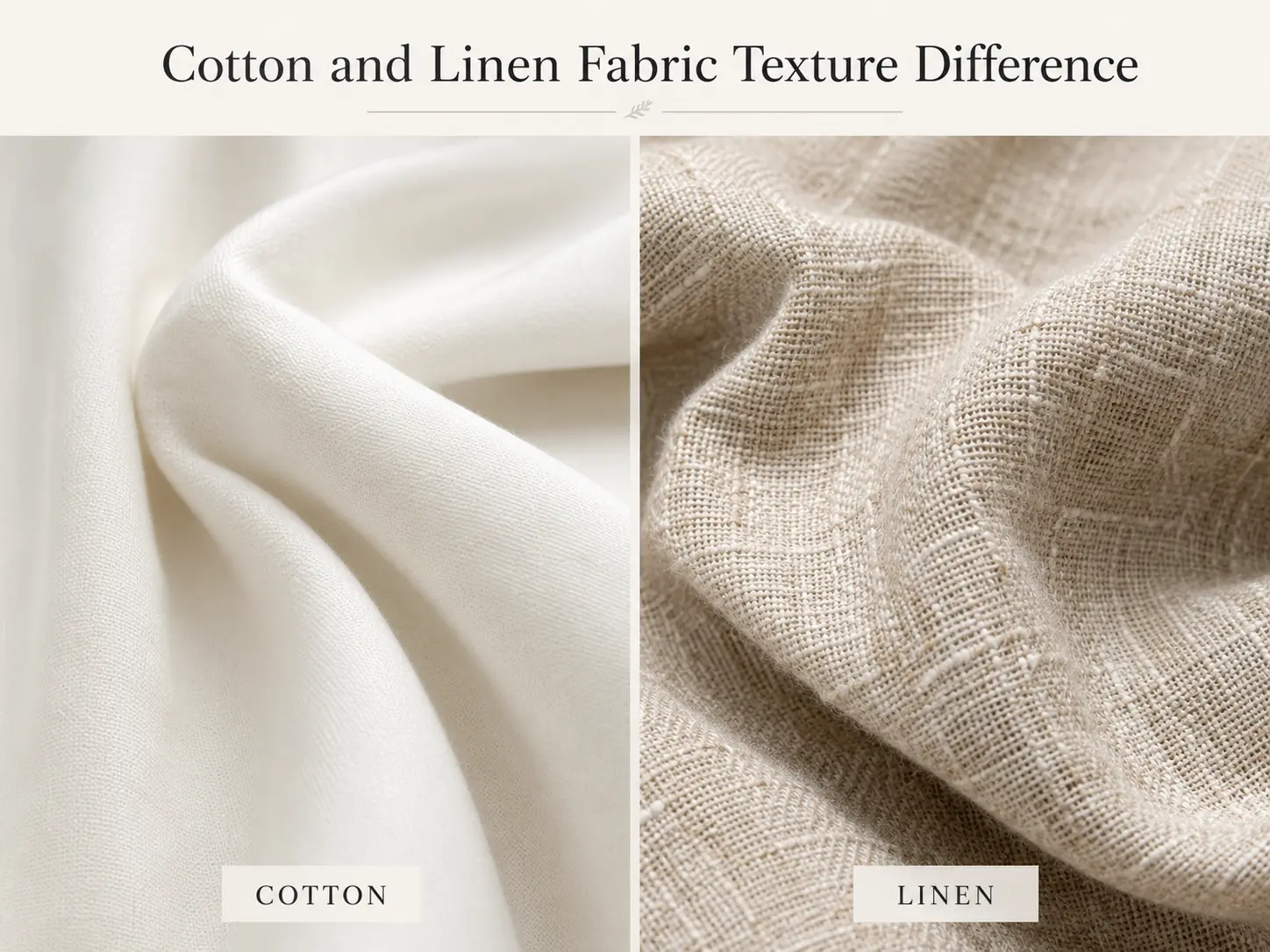
Cotton is softer than linen, especially in new garments. Unwashed linen is crisper, but it softens with washing and wearing.
The smooth and familiar feel of cotton is why it is such a good fiber for making T-shirts, undergarments, loungewear, baby clothing, and garments for sensitive skin.
The airy texture of linen is crisp, and many love this texture, but many also find linen rough or scratchy if it is unwashed or of poor quality.
Washed linen is softer than unwashed linen, and higher-quality linen is usually smoother, stronger, and more comfortable.
Cotton is softer and easier to keep looking polished than linen, which is why cotton is often the best choice for soft summer basics.
Cotton vs. Linen Wrinkles
Question: Does linen wrinkle more than cotton?
Yes, linen wrinkles more than cotton due to lower elasticity in flax fibers. That said, some people view linen wrinkles as a part of the relaxed summer style.
Pure linen fabric wrinkles the most, so it’s not the best choice if you need to look sharp all day. On the other hand, resort wear, relaxed linen shirts, and summer dresses all look good in linen.
Cotton wrinkles less than linen, and cotton poplin and cotton twill can look more polished for the office. That said, cotton will also wrinkle, especially after sitting or sweating.
Cotton-linen blends will wrinkle less than linen, and a linen-viscose blend will have better drape and softer-looking wrinkles. Seersucker cotton, due to its texture, will hide wrinkles.
Cotton vs. Linen Durability
Linen is made of long flax fibers, so it can create a strong fabric. According to The Spruce, linen can be 2-3 times stronger than cotton, and with good care, can last for many years. (thespruce.com)
Cotton is also able to withstand everyday wear and tear. Cotton can wear faster than linen in high-friction garments.
So how do you make your linen and cotton clothes last longer? While the answer is different for both fabrics, generally avoiding high heat when washing or drying and avoiding strong bleach and high-heat drying will help.
Cotton vs Linen Price
Yes. Linen is more expensive than cotton. Why is that? Flax takes longer and is harder to process. Therefore, linen prices are higher, while cotton summer wardrobe basics are usually cheaper.
Cotton is less expensive and easier to process than linen. Sometimes summer budgets can be stretched to buy basic cotton t-shirts, summer shirts, and summer dresses.
However, cotton is not always cheaper and can get expensive. Egyptian cotton, organic cotton, high-thread-count cottons, and Supima cotton can also have higher prices than standard cotton. Linen blends improve value for summer wardrobes, especially with cotton and linen blends.
Higher-quality cottons are also softer and more refined. Ultimately, for budget summer wardrobes, cotton is a better option, but for summer pieces that have premium quality and long-lasting durability, linen is a better option.
Cotton-Linen Blend: Is It the Best Option?
Yes, a cotton-linen blend is one of the best fabrics for summer. Why? Because it combines linen’s airflow and durability with cotton’s softness and better wrinkle resistance. It also combines the nice airflow of linen with the nice soft feel of cotton, meaning it is perfect for those who like the comfort of linen, but who can’t stand the wrinkles.
Blending cotton with linen tends to make the fabric softer than using just linen. Additionally, those blends reduce wrinkles and costs. Because of these properties, blends make excellent fabrics for office shirts, trousers, travel outfits, and summer co-ord sets.
Best Cotton Fabrics for Summer
The best summer cotton fabrics include cotton lawn, voile, gauze, poplin, chambray, seersucker, and muslin.
Cotton Lawn
Lightweight, smooth, and breathable, cotton lawn is great for summer shirts, blouses, dresses, and tunics.
Cotton Voile
Soft, sheer, and airy, cotton voile is perfect for blouses, scarves, beach cover-ups, and light layering.
Cotton Gauze
With a loose, crinkled, and airy structure, cotton gauze is great for beachwear and summer dresses and tops.
Cotton Poplin
Structured and crisp, cotton poplin is excellent for office wear and summer uniforms.
Cotton Chambray
The cotton chambray looks like denim but feels lighter, giving a denim look without the heavy summer heat.
Cotton Seersucker
The puckered surface of cotton seersucker helps the fabric hold its shape away from the body. It also helps conceal wrinkles and minor creasing.
Cotton Muslin
Cotton muslin is soft and loose. It is a great breathable fabric for summer, baby clothes, and other home textiles.
Best Linen Fabrics for Summer
Pure lightweight linen is optimal for shirts and dresses, while linen blends are preferred for softness, drape, and minimal wrinkling.
Lightweight Linen
Shirts, dresses, tunics, and relaxed tops benefit from the maximum airflow provided by lightweight linen.
Medium-Weight Linen
Medium-weight linen is preferred for trousers, overshirts, jackets, and other structured garments. However, it tends to be warmer than its lightweight counterpart.
Linen-Cotton Blend
The linen-cotton blend is a breathable option that is soft and does not wrinkle as much as linen.
Linen-Viscose Blend
Linen-viscose blend has superior drape to plain linen. This makes it a good option for dresses, skirts, and wide-leg pants.
Washed Linen
Softer and more relaxed, washed linen is a good option for casual summer shirts and dresses.
Linen Gauze
Ultra-light and airy, linen gauze is a good option for beachwear, scarves, resort wardrobes, and summer styling.
Cotton vs Linen for Different Clothing Items
| Clothing Item | Best Choice | Why |
|---|---|---|
| Summer shirts | Linen or cotton-linen blend | Airflow and structure |
| T-shirts | Cotton | Softer and more flexible |
| Dresses | Linen, cotton lawn, cotton voile | Breathable and lightweight |
| Pants | Linen blend | Cooler and more breathable |
| Office wear | Cotton poplin or linen blend | Cleaner appearance |
| Beachwear | Linen | Airy and quick-drying |
| Travel clothing | Cotton-linen blend | Less wrinkling than pure linen |
| Pajamas | Cotton | Soft and comfortable |
| Baby clothes | Cotton | Soft against sensitive skin |
| Summer suits | Linen or seersucker cotton | Breathable structure |
For best airflow, choose linen; for best softness, choose cotton; and for a balanced summer fabric, choose cotton-linen blends.
Read More>> What to Wear in Hot Humid Weather? Clothing Selection Guide.
Original Observation: Fit Often Beats Fiber
A loose garment (like a loose cotton gauze shirt) can feel cooler than something fitted (like a fitted linen shirt). Fit matters as much as fiber choice.
For heat comfort, a light color also helps. However, a darker color can help conceal sweat. So, summer clothing can require comfort and some visual planning.
Cotton vs Linen for Men’s Summer Clothing
- For outdoor heat, men should select linen for shirts and trousers. For everyday use, men should select cotton T-shirts. For the office, men should select cotton-linen blends.
- Beachwear, travel, and outdoor event shirts can easily be made from linen. Linen shirts can help airflow and keep the body cooler.
- For everyday use, casual cotton t-shirts can be used. T-shirts can feel softer and stretch easily. Additionally, t-shirts can be washed frequently and do not require special treatment.
- For resort and evening wear, linen trousers can be used. For the office, cotton or cotton-linen trousers can be used and look sharper.
- For men’s summer clothing, seersucker suits can also be a great choice. They create airflow and can hide wrinkles.
Cotton vs Linen for Women’s Summer Clothing
- For loose dresses, trousers, and resort wear, women should choose linen. For t-shirts, casual dresses, sleepwear, and daily basics, women should choose cotton.
- In hot weather, linen dresses can feel light and airy. They can be designed in relaxed, loose, and breathable styles for summer.
- Cotton sundresses can be soft, easy to wear, and made from cotton lawn or voile for a lightweight summer dress.
- Linen wide-leg pants are great for keeping cool. However, cotton-linen blends might be better for travel because they wrinkle less.
- Cotton voile blouses are soft and delicate. Similarly, cotton poplin shirts are great for summer work outfits.
Which Is Better for Sensitive Skin?
Generally, cotton is better for sensitive skin because it is softer and smoother to the touch. Cotton is a soft fabric. As a result, it is good for underwear, baby clothes, pajamas, and basics. Linen can be skin-friendly as well. However, rough or lower-quality linen can be scratchy until it softens, so if it’s important to you, choose washed linen.
If you are avoiding synthetic finishes or chemical treatments, organic cotton can be a good option. Still, in that case, washed linen can be a good option as well. Skin comfort is affected by dyes and finishes too, therefore when considering washed linen or organic cotton, look at the quality as well.
Which Fabric Is Easier to Wash?
Generally, cotton is easier to wash and maintain. Linen requires gentler care to avoid shrinkage, fiber stress, and more wrinkles. In most daily garments, cotton can be washed more frequently, therefore it is perfect for T-shirts, underwear, kids’ clothes, and summer clothing. Linen can often be machine-washed like cotton, but in general, it needs to be washed with more care and gentleness.
Cotton vs Linen for Office Wear
Cotton poplin and cotton-linen blends are typically better suited for office wear than linen. Linen is the coolest fabric, but its quick wrinkling may cause it to feel too casual for some formal environments.
Cotton poplin has a sharp look and works well for structured button-up clothing. Its wrinkling is much less troublesome when compared to linen. For summer office wear, seersucker cotton is especially great. The puckered texture looks intentional, airflow is improved, and wrinkling is better concealed.
Cotton vs Linen for Travel
Cotton-linen blends are great for travel because they combine linen’s breathability with cotton’s softness and better wrinkle resistance. Pure linen is great for hot, tropical retreats, but it can wrinkle heavily in luggage. It can, however, be styled in a relaxed way or hung to dry. Cotton is great to travel with when poplin, gauze, or chambray are the chosen weaves, but can be slow to dry if washed by hand. Cotton-linen blends best balance travel ease, coolness, and wrinkle-resistant packing, and can be made into a variety of clothing.
Cotton vs Linen for Beachwear
When choosing beachwear, choose linen as it is more breathable, dries quicker, and works better for looser-fitting, more relaxed clothing. Linen is preferred for beachwear as it is less clingy, and dries more quickly than most cotton fabrics. So, linen is preferred for shirts, cover-ups, pants, and dresses when near the water.
Cotton gauze works for beachwear, too. It is soft, light, and casual, but still dries slower than linen. Thick cotton hoodies, denim shorts, and heavy cotton jersey are not good choices for the beach. These items hold moisture and reduce comfort.
Suiting up for summer is a struggle. Which fabric is better for us in summer: cotton or linen? Which is better for summer clothing? Here’s the lowdown.
Cotton is more convenient for everyday casual summer outfits. Linen is ideal for summer outdoor events and dressier summer outfits.
Keep in mind that cotton is ideal for everyday outfits that are casual or semi-casual due to its soft and breathable nature. It’s also inexpensive and easy to wash. This makes cotton the ideal material for T-shirts, casual summer dresses, summer pajamas, summer underwear, and kids’ clothing.
Linen is more ideal for breathable summer shirts, summer pants, summer resort dresses, vacation summer clothing, and more intentional summer outfits.
Conclusion: Cotton vs Linen for Summer
Summer fabrics cannot be summed up as simply cotton or linen. For extreme conditions, like heat and humidity, linen is the preferred fabric. However, cotton provides a softer, more affordable option and is easier to wash and care for, and its softness can benefit those with sensitive skin and serves daily, casual needs.
Summer fabrics cannot be defined solely by fiber. The weave, weight, design, and color also play a large role in overall comfort. For example, a cotton lawn shirt can be more appropriate in the summer than a heavy linen jacket.
Linen shirts, trousers, and dresses are great for the summer heat. For daily basics, cotton T-shirts, pajamas, and other essentials work best. For the office, travel, and generally more formal settings, cotton-linen blends are most appropriate.
FAQs
Linen is usually better than cotton for hot, humid summer clothing. Compared to cotton, summer clothing made from linen manages moisture better, dries faster, and sticks to the body less.
Cotton can be good for summer clothing as long as the fabric is lightweight, breathable, and loose. Best options include cotton lawn, voile, gauze, lightweight chambray, poplin, and seersucker.
Yes, linen is cooler than cotton. Linen is usually cooler than cotton because its crisp structure improves airflow and it manages moisture better.
Linen is better than cotton for sweating because cotton, while highly absorbent, can become uncomfortable because it holds moisture longer.
Yes. Linen does wrinkle more than cotton, but cotton-linen blends wrinkle less than pure linen while improving the practicality of everyday wear.
Yes. The cotton-linen blend is an excellent summer fabric because it is more breathable than cotton and softer than pure linen and less wrinkly than pure linen.
Linen, cotton-linen blends, cotton lawn and cotton poplin are the best summer shirt fabrics.