
The best waterproof fabric for raincoats is a waterproof-breathable laminated fabric. It gives excellent rain protection, provides better comfort, and works longer outdoors. But it also depends on the use, budget, climate, and level of activity. Everyday raincoats, PU-coated polyester is a good option as it is the most practical and cost-effective. For hiking, cycling, and other activities that involve being in the rain for a longer time, 2.5-layer or 3-layer membrane fabric is a better option. For industrial rainwear, PVC-coated polyester is the best option as it provides a tough level of waterproof protection, although it is the least breathable. Buyers should look through the fabric type, waterproof rating, breathability, seam sealing, DWR finish, and maintenance before buying a raincoat fabric.
What Is the Best Waterproof Fabric for Raincoats?
The best waterproof fabric for raincoats is laminated fabric that is waterproof-breathable. For budget everyday raincoats, PU-coated polyester is a good option.
A waterproof-breathable membrane fabric balances rain protection and comfort best. It is also the best option for rain protection when the outside rain is allowed to escape in the form of vapor. Because of this, it is great for hiking, cycling, commuting, and all other activities that take a long time in the rain.
PU-covered Polyester is a good budget friendly fabric for raincoats. It is inexpensive to manufacture, offers flexibility, is lightweight, and easy to produce. Because of these benefits, manufacturers use them on casual rain jackets, raincoats for schools, and promotional rainwear.
When it comes to heavy-duty waterproof rainwear, PVC-coated Polyester is the best option. It is great at blocking water but, also becomes very hot and sweaty. It is best used for low-activity wet jobs, like fishing or industrial jobs.
Best Waterproof Fabric by Category
| Category | Best Fabric Choice | Why It Works |
|---|
| Best overall raincoat fabric | 3-layer waterproof-breathable membrane | Strong waterproofing, breathability, and durability |
| Best everyday raincoat fabric | PU-coated polyester | Affordable, light, flexible, and practical |
| Best fabric for heavy rain | 3-layer membrane with 20,000 mm+ rating | Handles long rain exposure better |
| Best breathable fabric | Waterproof-breathable laminated membrane | Reduces sweat buildup and condensation |
| Best budget option | PU-coated polyester | Low cost and easy mass production |
| Best workwear raincoat fabric | PVC-coated polyester or heavy PU-coated polyester | Durable and highly waterproof |
| Best eco-friendlier option | Recycled polyester with PFAS-free DWR | Lower-impact finish and longer product life |
Waterproof vs Water Resistant vs Water Repellent Fabrics
Waterproof fabrics block water under pressure. Water resistant fabrics can withstand a light rain. Water repellent fabrics cause water to bead on the surface.
Waterproof fabrics are made so water cannot pass through them. To achieve this, they will have a coating, lamination, or a membrane/rubberized layer. Also, true waterproof raincoats will have their seams and zippers sealed.
Water resistant fabrics can withstand a light drizzle or a short rain, but they may leak during a heavy rain. Because of this, it also is not the best option for an outdoors raincoat.
Water repellent fabrics have water roll off the surface. Generally, this comes from a DWR finish, but is not a waterproof layer.
According to REI, protection from rainwear varies based on the terms used and the activities they are designed for. Because of this, a consumer needs to know the claims made for the fabrics regarding their breathability and waterproofness when purchasing rainwear.
Best Waterproof Fabrics Used for Raincoats
PU Coated Polyester
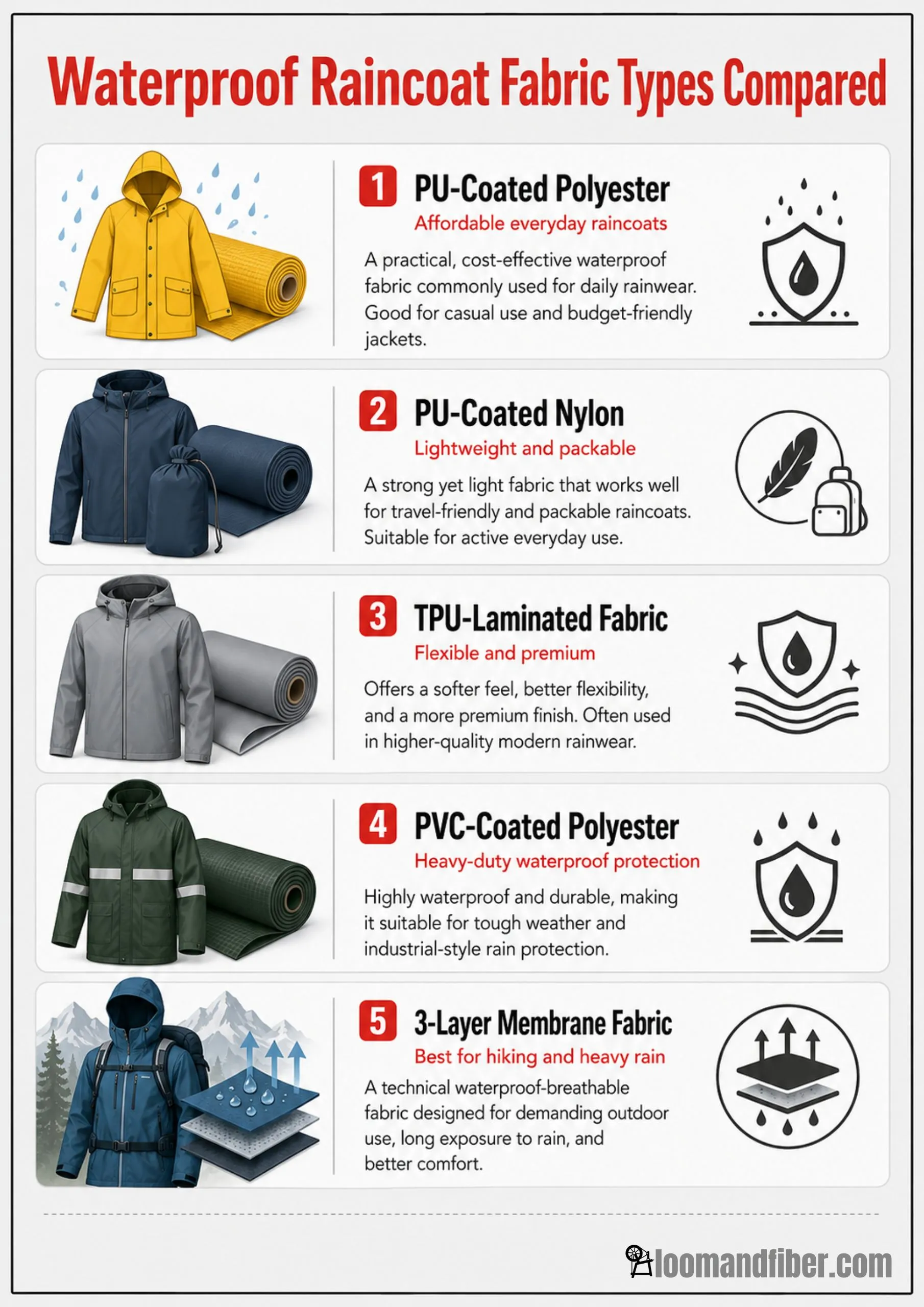
PU Coated Polyester is one of the best fabrics for affordable raincoats.
PU-coated polyester has a base fabric of polyester with a polyurethane coating. The coating protects against water, improving protection against rain, while the polyester fabric makes the PU fabric strong, easily printed, and stable.
This fabric is perfect for use in promotional rain jackets, school rain wear, casual raincoats, and city jackets. This fabric is also perfect for brands that need bulk production and have a limited budget.
PU-coated polyester easily warms up/ traps heat in active use and humid weather because it has low breathability.
Best for:
Promotional jackets, city raincoats, school raincoats, and budget rainwear.
PU-Coated Nylon
PU-coated nylon is ideal for a lightweight packable travel rain jacket.
Nylon is strong, flexible, and lightweight. For these reasons, it is ideal for outdoor shells and packable rain jackets. When a PU coating is added, the nylon base is also made fully waterproof.
PU-coated nylon tends to be more lightweight and less bulkier than polyester shells which makes it ideal for travel raincoats, hiking rain jackets, and emergency rain shells.
However, slightly more moisture can be absorbed by nylon compared to polyester, therefore, the quality of the coating and fabric finishes are crucial.
Best for:
Packable rainwear, lightweight shells, and travel raincoats.
TPU-Laminated Fabric
TPU-laminated fabric incorporates a flexible waterproof layer made from a thermoplastic polyurethane film.
Because of TPU Lamination, the raincoat fabric can be softer and more flexible and provide better waterproofing and comfort compared to some thicker coatings of polyurethane. For this reason, it is often found in technical jackets and premium raincoats.
TPU fabrics can offer a sleek, modern, and smooth finish with a better aesthetic than standard PU fabrics. They also allow more flexible movement during outdoor activities.
Unfortunately, TPU lamination is more expensive than standard PU coating. This makes it more appropriate for mid-range and premium rainwear.
Best for:
Premium raincoats, flexible waterproof jackets, outdoor sportswear, modern technical rainwear.
PVC-Coated Polyester
Yes, PVC-coated polyester is waterproof, and is extremely durable, making it suitable for industrial rainwear.
Since PVC coating creates a strong, durable, water-blocking layer, it is also highly suitable for use in heavy rain, muddy conditions, fish, and industrial cleaning; making it very common for work rain suits and heavy-duty waterproof gear.
Breathability, however is an issue with PVC. It traps body heat and sweat as you move making it very uncomfortable and as a result poor for hikes, cycles, or warm weather.
Best for:
Industrial rainwear, fishing raincoats, heavy-duty rain suits, and low-cost waterproof protection.
Waterproof-Breathable Membrane Fabrics
The best fabric for active rainwear is a waterproof-breathable membrane fabric.
Membrane fabrics use a thin layer of a waterproof membrane sandwiched between textile layers. This layer blocks rain, but allows sweat vapor to pass, making it a much more comfortable fabric for movement.
Common membranes include ePTFE, ePE, PU membranes, and other branded membrane technologies. GORE-TEX markets some of their ePE membranes as waterproof, windproof, and breathable.
These fabrics are excellent for active rain exposure and movement as they are suitable for hiking, mountaineering, cycling, and commuting, however, they are more expensive than basic coated fabrics.
Best for:
Hiking, cycling, mountaineering, commuting, premium raincoats, and technical outdoor jackets.
Waterproof Rating Guide for Raincoat Fabrics
Hydrostatic head quantifies how much water pressure can be withstood by a fabric before it begins to leak and let water through.
It is measured in millimeters such as 5,000 mm or 20,000 mm, with a larger number letting fabric withstand even more water pressure. However, it is not the only measure of comfort.
According to Alpkit, hydrostatic head assesses pressure water can exert on the fabric. They recommend 10,000 mm for most activities, and suggest 20,000 mm for full all-weather protection.
| Waterproof Rating | Protection Level | Best Use |
| 1,500–3,000 mm | Light waterproofing | Short rain, drizzle, casual use |
| 5,000 mm | Moderate waterproofing | City rain and light outdoor use |
| 10,000 mm | Reliable waterproofing | Regular outdoor rain protection |
| 20,000 mm | Strong waterproofing | Heavy rain, hiking, and workwear |
| 30,000 mm | Extreme waterproofing | Mountain weather and harsh exposure |
What Rating Is Enough for Raincoats?
For light rain, a rating of 3,000 mm can work for brief exposures. However, 5,000 mm is a better protection rating for daily use. 10,000 mm is a stronger fabric choice for frequent outdoors.
For heavy rain, 20,000 mm or more is ideal. Also consider taped seams, the design of the hood, and how the zippers are protected. Without that, water can find its way through a lower-quality construction point.
Breathability: Why Some Waterproof Raincoats Feel Sweaty
The fabric of a raincoat can make you sweat if it prevents the escape of sweat vapor.
A raincoat can easily be waterproof and still uncomfortable. This can be the result of blocking both rain and body vapor leading to the condensation of sweat within the fabric.
PVC can be a common cause of sweat in a raincoat since it is low in breathability. A basic PU-coated raincoat can also trap heat during activity which makes it better for short, low-intensity activities.
Breathable waterproof fabrics enhance comfort by permitting water vapor to escape from the inside while blocking rain from the outside. For better airflow, there are also pit zips, mesh lining, vents, and a looser fit.
Breathable raincoats are essential in sticky, hot, and humid weather. In these climates, evaporating your sweat gradually and creating proper ventilation is just as important as keeping the rain out.
2-Layer vs 2.5-Layer vs 3-Layer Raincoat Fabrics
3-layer fabric is best for durability, breathability, and technical raincoats.
The construction of raincoat fabric impacts weight, comfort, and durability and alters the price. For these reasons, consumers can’t base the quality of rainwear on the name of the fabric.
2-Layer Raincoat Fabric
2-layer fabric bonds the outer fabric to the waterproof layer and the lining is placed behind the layer. This design is nice for casual raincoats because it is comfortable.
This fabric is good for city rainwear and everyday jackets, but is often bulkier compared to 2.5-layer shells.
2.5-Layer Raincoat Fabric
2.5-layer fabric consists of an outer fabric, waterproof coating or membrane, and an inner print which is far less in thickness. This design is lightweight and easy to pack. Because of this, it is great for travel and design.
3-Layer Raincoat Fabric
The 3-layer raincoat fabric construction joins the outer shell, the membrane, and the inner layer together. This design is the most advanced construction and is meant to be the most durable and comfortable, therefore, it is best used for all technical raincoats.
3-layer vs 2-layer & 2.5-layer Raincoats
3-layer raincoat fabric suits heavy rain, hiking, and mountaineering. This fabric is also great for workwear, but costs more than 2-layer and 2.5-layer fabrics.
Membrane vs Coating: which is better for raincoats?
Membrane fabrics are better for breathability. Coated fabrics are better for cost.
In coated fabrics, water is blocked by a coating such as PU, PVC, or acrylic. These coatings reduce production costs and are great for waterproof raincoats.
In laminated and membrane fabrics, thin films and membranes are added. Waterproofing and breathability are greatly increased, making these fabrics more ideal for active and premium raincoats.
Coatings also have their place in making rainwear. They are great for budget raincoats, school rainwear, workwear, and promotional jackets.
| Feature | Coated Fabric | Membrane Fabric |
| Cost | Lower | Higher |
| Breathability | Low to medium | Medium to high |
| Waterproofing | Good to excellent | Very good to excellent |
| Comfort | Basic | Better during activity |
| Best use | Budget and work rainwear | Outdoor and premium raincoats |
| Common examples | PU, PVC, acrylic | PU membrane, ePTFE, ePE, TPU |
Nylon vs Polyester for Raincoats
Nylon is better for lightweight rain jackets. Polyester is better for affordable, stable raincoats.
Nylon is strong, lightweight, and packable. These features are great for hiking jackets, travel shells, and outdoor raincoats. Nylon is also flexible during movement.
Polyester is stable, strong, and easy to print. These features make polyester useful for everyday raincoats, rainwear uniforms, and workwear. Polyester also is better than nylon at resisting stretching.
However, waterproofing relies on more membranes, coatings, seam sealing and construction. A raincoat is not waterproof because of the base fabric alone.
| Factor | Nylon | Polyester |
| Weight | Usually lighter | Slightly heavier |
| Strength | Very strong | Strong and stable |
| Packability | Excellent | Good |
| Printing | Good | Very good |
| Workwear use | Good | Very good |
| Everyday raincoats | Good | Excellent |
| Technical shells | Excellent | Good to excellent |
Why Sealed Seams Matter in Waterproof Raincoats
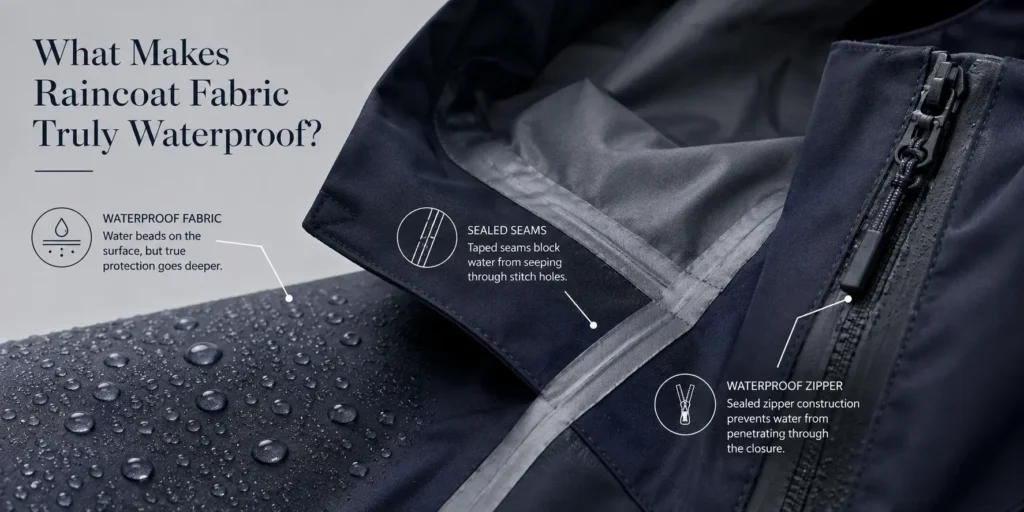
Raincoats can leak at the seams if the seams are not taped, sealed, or welded. Stitching creates small holes for the needles that can allow water through during heavy rain. This is why reinforced fabric is not enough for a raincoat. Taped seams means a seam is covered by a piece of waterproof seam tape to block water from entering. Another method is to use fabric bonding which eliminates the need for stitching.
For heavy rain, use a raincoat with fully taped seams. For moderate rain, a raincoat with critically taped seams may suffice, however, industrial rainwear requires higher levels of seam sealing.
DWR Finish: Why Does Raincoat Fabric Stop Beading Water?
Raincoats stop beading water when the DWR finish is compromised or soiled. DWR stands for durable water repellent finish. It causes water to bead on the surface and roll off, however, it does not replace the waterproof coating or membrane.
The DWR finish causes moisture to bead and roll off the outer fabric, while the coating is the waterproofing system. When DWR is compromised, the fabric can “wet out,” which means it is saturated and the raincoat is colder and more uncomfortable to wear.
Beading can be restored by washing and waterproofing the fabric. However, always follow the care instructions on the label. Using the wrong detergent or fabric softener and using high heat can also ruin the performance.
Best Waterproof Fabric for Raincoats by Use Case
Best Fabric for Everyday Raincoats
PU-coated polyester is the best choice for everyday raincoats.
It is cost-effective for everyday waterproofing. Furthermore, it supports printing, a range of colors, and mass production.
Best Fabric for Hiking Raincoats
2.5-layer or 3-layer membrane fabrics are the best for hiking raincoats.
These fabrics are a great balance of waterproofing, breathability, weight, and packability, making them excellent for an active, outdoor setting.
Best Fabric for Heavy Rain
3-layer membrane fabric with a 20,000 mm+ is the best for heavy rain.
Look for fully taped seams, storm flaps, and a secured hood, or else, rain will come in through the gaps.
Best Fabric for Industrial Rainwear
PVC-coated polyester or heavy PU-coated polyester are the best for industrial rainwear.
These fabrics are highly durable and excellent for water blocking. However, they are less breathable than membrane fabrics.
Best Fabric for Lightweight Packable Raincoats
PU-coated nylon or a 2.5-layer nylon shell are the best for packable raincoats.
These fabrics help reduce weight and save space, making them ideal for travel, hiking, or emergency rainwear.
Best Fabric for Breathable Raincoats
Waterproof-breathable laminated membrane fabric is the best for breathable raincoats.
It allows the escape of sweat vapor while keeping the rain out. This makes it more comfortable than PVC or a basic PU coating.
Best Budget Waterproof Fabric
The best budget waterproof raincoat fabric is PU-coated polyester.
It provides good waterproofing, is cost-effective, and supports easy production. This is why it is favored by many mass-market raincoats.
Best Premium Waterproof Fabric
Direct Answer: 3-layer waterproof breathable membrane fabric. Because of the increased comfort, long-term performance, and durability, this material outperforms the rest.
Raincoat Fabric Comparison Table
| Fabric Type | Waterproof Level | Breathability | Best Use |
|---|---|---|---|
| PU-coated polyester | Good | Low to medium | Everyday raincoats |
| PU-coated nylon | Good | Medium | Packable rain jackets |
| TPU-laminated fabric | Very good | Medium to good | Premium flexible rainwear |
| PVC-coated polyester | Excellent | Low | Industrial rainwear |
| 2.5-layer membrane fabric | Very good | Good | Hiking and travel |
| 3-layer membrane fabric | Excellent | Best | Heavy rain and technical use |
| Waxed cotton | Moderate | Low to medium | Heritage rainwear |
| Rubberized fabric | Excellent | Low | Classic waterproof coats |
Mistakes to Avoid When Choosing Raincoat Fabric
Avoid the mistake of identifying the fabric name with the quality of the raincoat.
- First, do not simply choose a fabric because it says it is waterproof. You must look at the coating and/or the membrane, rating, and how the seams were done.
- Second, do not dismiss waterproof ratings. If the rating is low, the fabric may not be able to withstand strong or prolonged rain.
- Third, don’t overlook sealing the seams. Fabric that is waterproof may still leak where the seams were sewn.
- Fourth, do not buy PVC raincoats if you plan to use it in a high-activity situation. PVC will trap sweat and heat.
- Fifth, do not think that just because a fabric has a DWR finish it means the fabric is waterproof. DWR, at best, will make water bead on the fabric.
- Sixth, do not overlook the fabric’s breathability in a humid environment. Breathability is very important when the body is producing sweat.
- Lastly, do not buy a super cheap raincoat if you plan to be in a heavy rain. Cheap raincoats are poorly constructed and will likely leak at the seams, zippers, and hoods.
Buying Checklist for the Best Waterproof Raincoat Fabric
Buyers should rating of the fabric regarding water resistance, breathability, sealing of the seams, coating, and the use of the raincoat.
| Checklist Point | Why It Matters |
| Waterproof rating | Shows water pressure resistance |
| Breathability rating | Helps reduce sweat buildup |
| Fabric base | Nylon and polyester serve different uses |
| Coating or membrane | Controls waterproofing and comfort |
| Seam sealing | Prevents leakage through stitches |
| Zipper protection | Blocks rain at front openings |
| Hood design | Protects head, face, and neck |
| DWR finish | Helps outer fabric shed water |
| Weight | Affects packability and comfort |
| Denier | Shows fabric thickness and durability |
| Intended use | Matches fabric to activity |
| Care requirements | Protects long-term performance |
| PFAS-free finish | Supports lower-impact rainwear choices |
Best Waterproof Fabric for Raincoat Manufacturing
For bulk raincoat manufacturing, PU-coated polyester is the best fabric. For premium raincoats, membranes are the best.
When selecting a fabric, manufacturers must consider the target market, price, performance, and production method. PU-coated polyester is the ideal budget fabric because it cost-effective, can be printed on, and is orderable in bulk.
TPU lamination and waterproof-breathable membranes are also budget-breathable and budget-flexible fabrics, and improve the comfort of the final garment. However, they introduce a higher price to the fabric.
PVC-coated polyester is a good choice for heavy-duty industrial rain suits, as they remain waterproof and are great for low-movement, passive, dirty, and heavy rains.
Essential Tests for Raincoat Fabrics
Raincoat Hydrostatic Head, Spray Test, Tear Test, Colorfastness, Seam Leak Tests, adhesion and wash durability tests, and Reflective Tape Strength are all important tests. However, for outdoor raincoats, breathability (or drying) and packability (or portability or constructability) are more important than all of the above.
Sustainability and PFAS-Free Waterproof Raincoats
Recycled polyester with PFAS-free DWR is a lower-impact raincoat fabric option.
DWR (Durable Water Repellent) is a water-repellent chemical. PFAS (Perfluoroalkyl and Polyfluoroalkyl Substances) are a large group of long-lasting, chemically waterproof, and hazardous outdoor-apparel constitutive chemicals. Patagonia announced that no new membranes and water-repellent finishes will be incorporated via PFAS from Spring 2025 on.
In waterproof, windproof, and breathable outerwear, the recent ePE membrane products from GORE-TEX help steer the waterproof apparel industry to a more sustainable, less impactful direction. However, the industry also needs to focus on extending the life of the garment. This can be achieved through proper washing and DWR treatment, repair, and durable construction.
FAQs
For high-end raincoats, the best waterproof fabric is a waterproof-breathable membrane fabric. For regular everyday raincoats, the best affordable option is PU-coated Polyester.
For affordable and durable raincoats, Polyester is the better option. On the other hand, Nylon is best for lightweight and packable rain jackets. Raincoat coatings, membranes, and seam sealing also impact waterproof performance.
A raincoat with a waterproof rating of 10,000mm is sufficient for typical rainy days. 20,000mm or higher is recommended for torrential rain, hiking, outdoor work, and all-day rain exposure.
Water-resistant fabrics only offer protection from light rain, while waterproof fabrics will block any rain from passing through. For heavy rain, fabrics of waterproof construction and taped seams are recommended.
Raincoats that are waterproof, but not vapor permeable, will block vapor and sweating will occur. Breathable waterproof fabrics, ventilation zippers, and a mesh lining, reduce sweats.