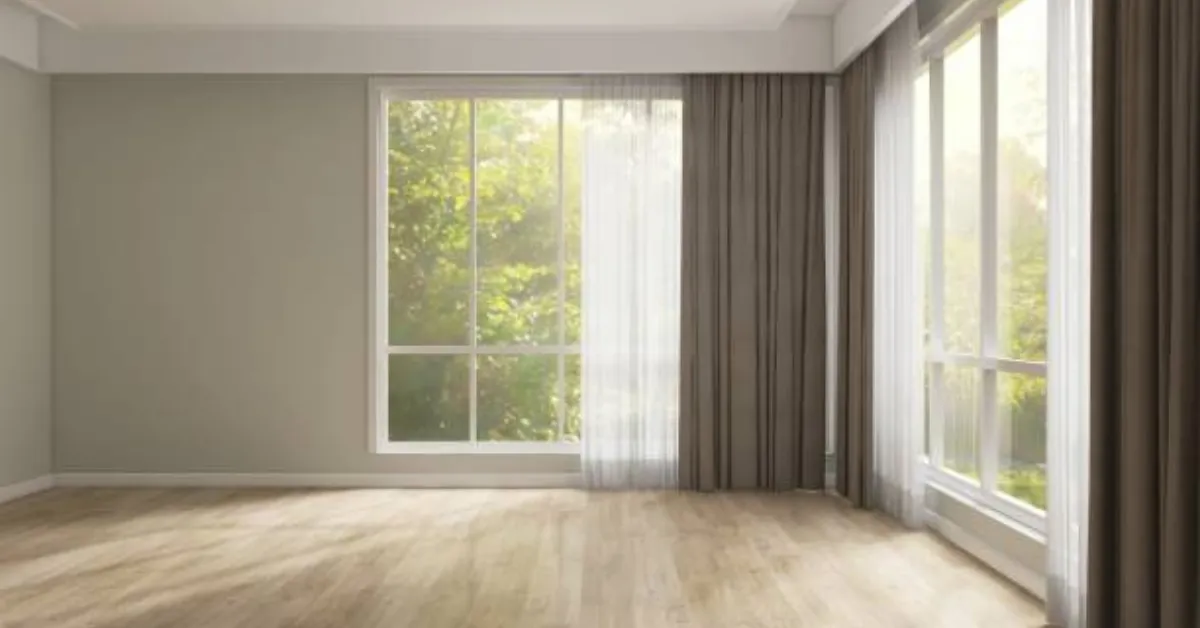

The right curtains transform a living room into a bright, snug or airy space, while also offering everyday benefits such as privacy after sundown, reduced glare on the TV screen or easy opening when you want an unobstructed view.
How to choose curtains and drapes for the living room? First, identify your requirements in terms of privacy and light, then determine the best fabric, heading and size. Light-filtering or sheer panels allow more natural illumination while opaque or suitably lined drapes provide improved privacy and fullness. Combine the two for separate daytime and nighttime functions, or use sheers as the second curtain to achieve a translucent look.
While the look is important, not many would say that a lovely fabric compensates for the narrow panels or inaccessible rings. This guide covers everything needed to make a purchase.
How to Choose Curtains for Living Room
Before choosing a colour, think about how the room is used and what the windows need.
| Your room or priority | A useful starting point | What to check |
|---|---|---|
| A dark living room | Lightweight, light-filtering curtains | Whether the panels can gather clear of the glass |
| A street-facing window | Sheers with a separate opaque layer | Privacy from outside when indoor lights are on |
| Television glare | Room-darkening or blackout-lined curtains | Light gaps around the top, sides and centre |
| A small room | Simple headings and colours close to the walls | How much space the open curtains occupy |
| A formal living room | Tailored pleats with lined fabric | Hardware capacity and cleaning requirements |
| A wide window or sliding door | An appropriately supported track or rod | Smooth operation and clearance from door handles |
| Frequent cleaning or pets | Fabrics with suitable care instructions and hems clear of the floor | Washability, snagging and replacement costs |
Also consider whether the curtains will close regularly or simply serve as decorative panels on either side of the glass. The latter can be effective, but if you intend to close them, measure whether the fabric will be sufficient to cover the entire window.
Curtains vs Drapes: Differences Explained
Curtains are usually lighter and less formal than drapes. The latter are often tailored, lined and made from denser fabric. However, the difference is not absolute, and many shops use the terms interchangeably for products ranging from minimalist sheers to blackout-lined panels.
Curtains Drapes
| Fabric | Lightweight: cotton, linen, polyester, sheers | Heavier: velvet, silk, brocade, thick linen blends |
| Lining | Usually unlined, sometimes lined | Usually lined for body, light control and insulation |
| Length | Sill, apron or floor | Floor-length or slightly puddled |
| Look | Casual, relaxed, airy | Formal, structured, dramatic |
| Sizing | Mostly ready-made stock sizes | Often custom to the window |
| Heading | Rod pocket, grommet, tab top | Pinch pleat, ripple fold, goblet |
| Light and privacy | Filters light; less privacy unless lined | Better light blocking and privacy |
| Rod | Lighter rods, even tension rods | Sturdier rod to carry the weight |
| Cleaning | Often machine-washable | Often dry-clean or steam |
| Price | Lower | Higher, because of fabric, lining and tailoring |
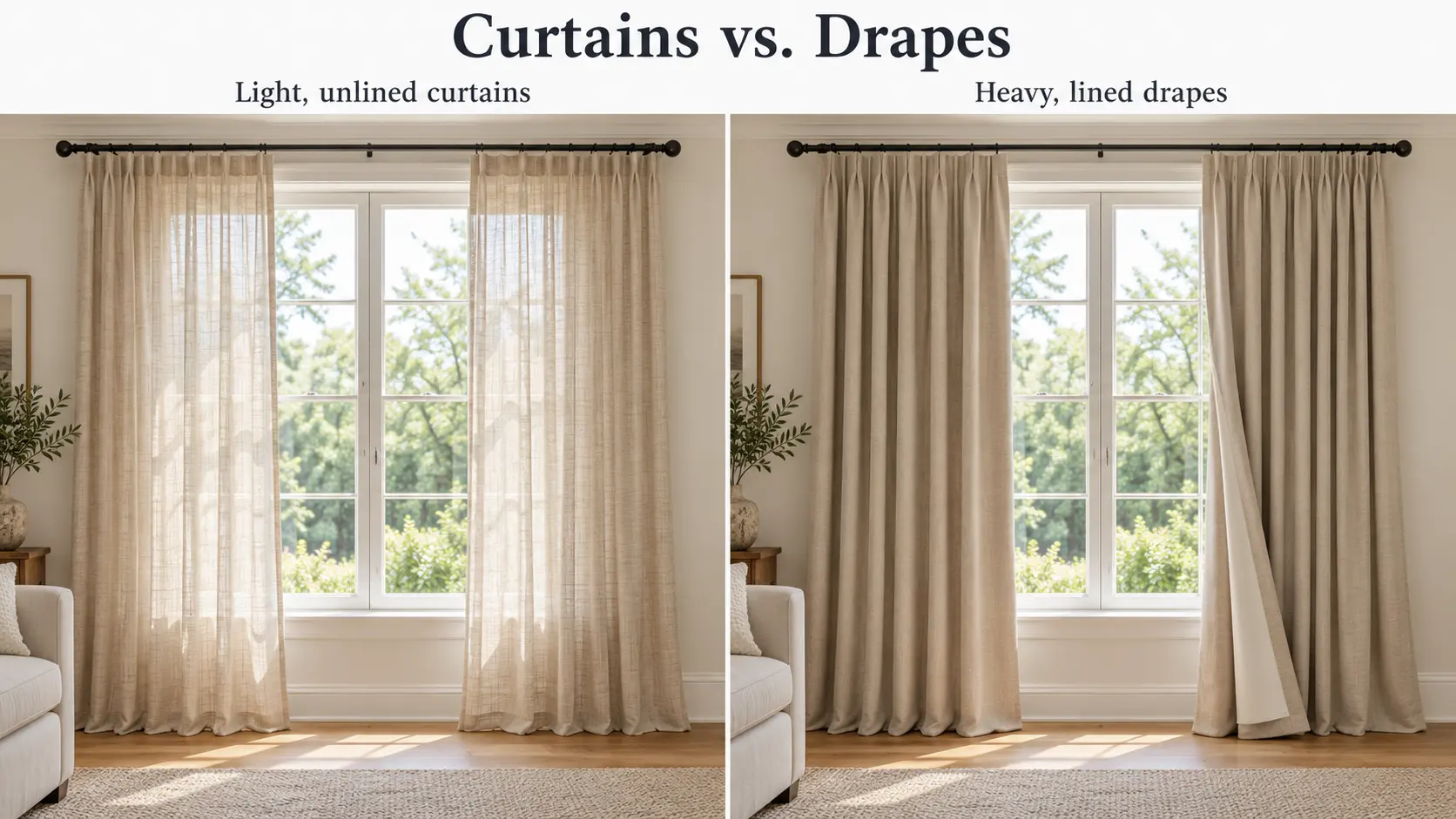
Choose curtains or drapes based on the description and specifications, not the name. Pay attention to the fiber content, lining, size, heading and care instructions before buying.
How to Choose the Light and Privacy Features for Room Curtains
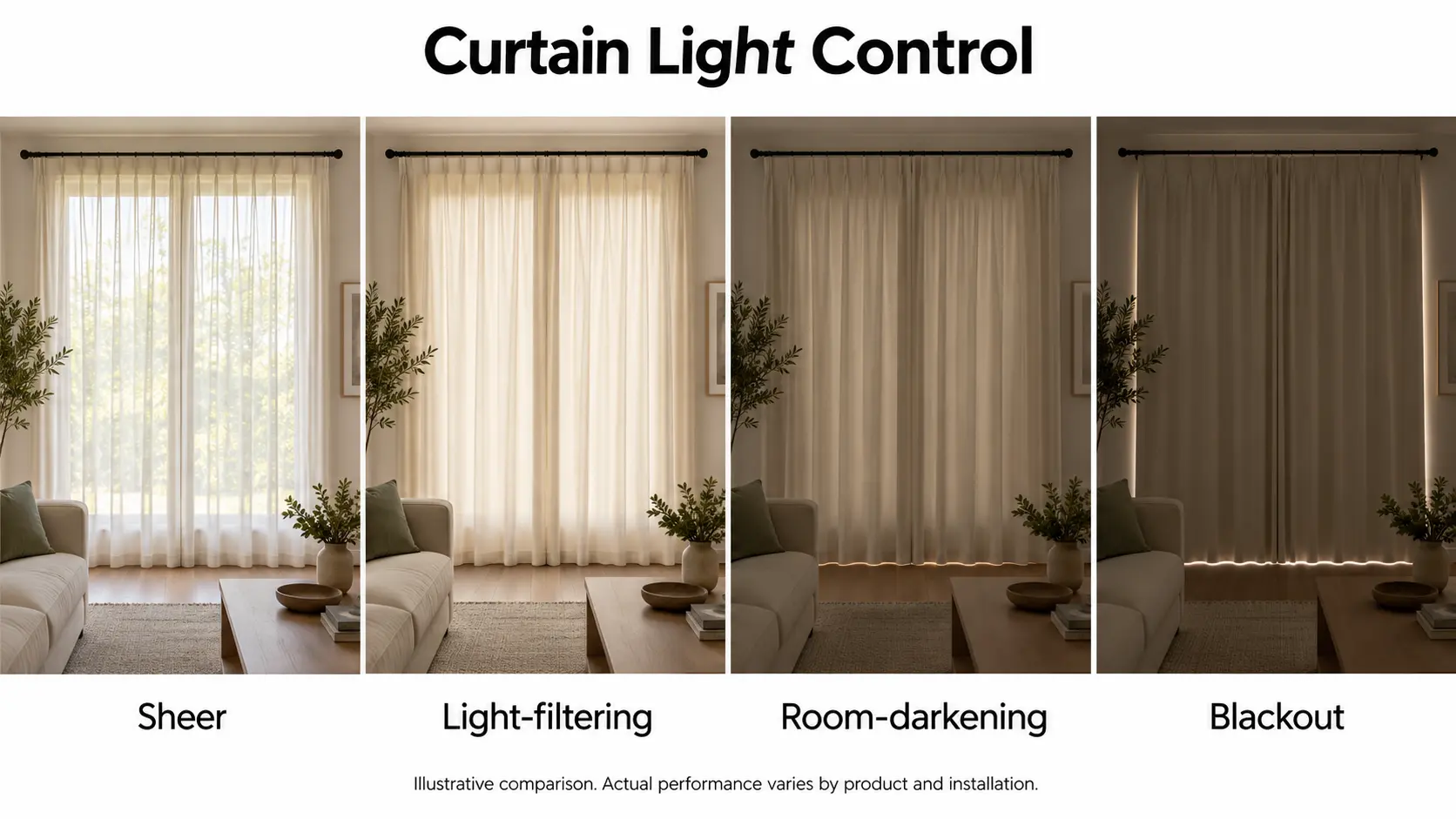
Sheer, light-filtering, light-dimming and blackout are terms that describe different levels of light transmission. They are a helpful reference point, but performance varies between products, and light can enter around even blackout treatments. The ability to see the room from outside depends on the fabric’s opacity and the relative lighting indoors and outdoors.
Sheer Room Curtains
Sheer curtains let in light while softening it, although their effect on the view outdoors varies by fabric. These are ideal as the second curtain in combination with an opaque one that can be brought into use at night or for privacy. However, when the room is brighter than the outside, it becomes possible to see through sheer panels as well.
Light Filtering Curtains
Light-filtering curtains generally allow less illumination than sheers and may provide more privacy, depending on the product. How much light is blocked depends on the weave, color, weight and lining of the fabric. To find out if light-filtering curtains are right for you, take a sample of the material indoors and assess its transparency with a light source behind it.
Room Darkening Curtains
Room-darkening treatments are effective at reducing the amount of natural light entering the space. They can be practical in a living room where television watching or daytime napping are common activities, but do not forget that room-darkening treatments do not necessarily block all light. Privacy should be assessed separately with the indoor lights on.
Blackout Curtains and/or Lining
Blackout lining is designed to prevent light from passing through the material. However, light can still enter through stitching holes or around the installation, and the effectiveness of such treatments depends on the overlap, the width of the track or rod, and the distance between the curtain and the wall. All of these details affect the presence and distribution of light.
Privacy in Day and Night
For rooms where daylight is desired but privacy is also important, think about the use of two independently operating layers: a sheer or light-filtering layer that can remain closed during the day and an opaque treatment that closes at night. Check visibility from outside with the indoor lights on to assess nighttime privacy.
Best Fabrics for Living Room Curtains
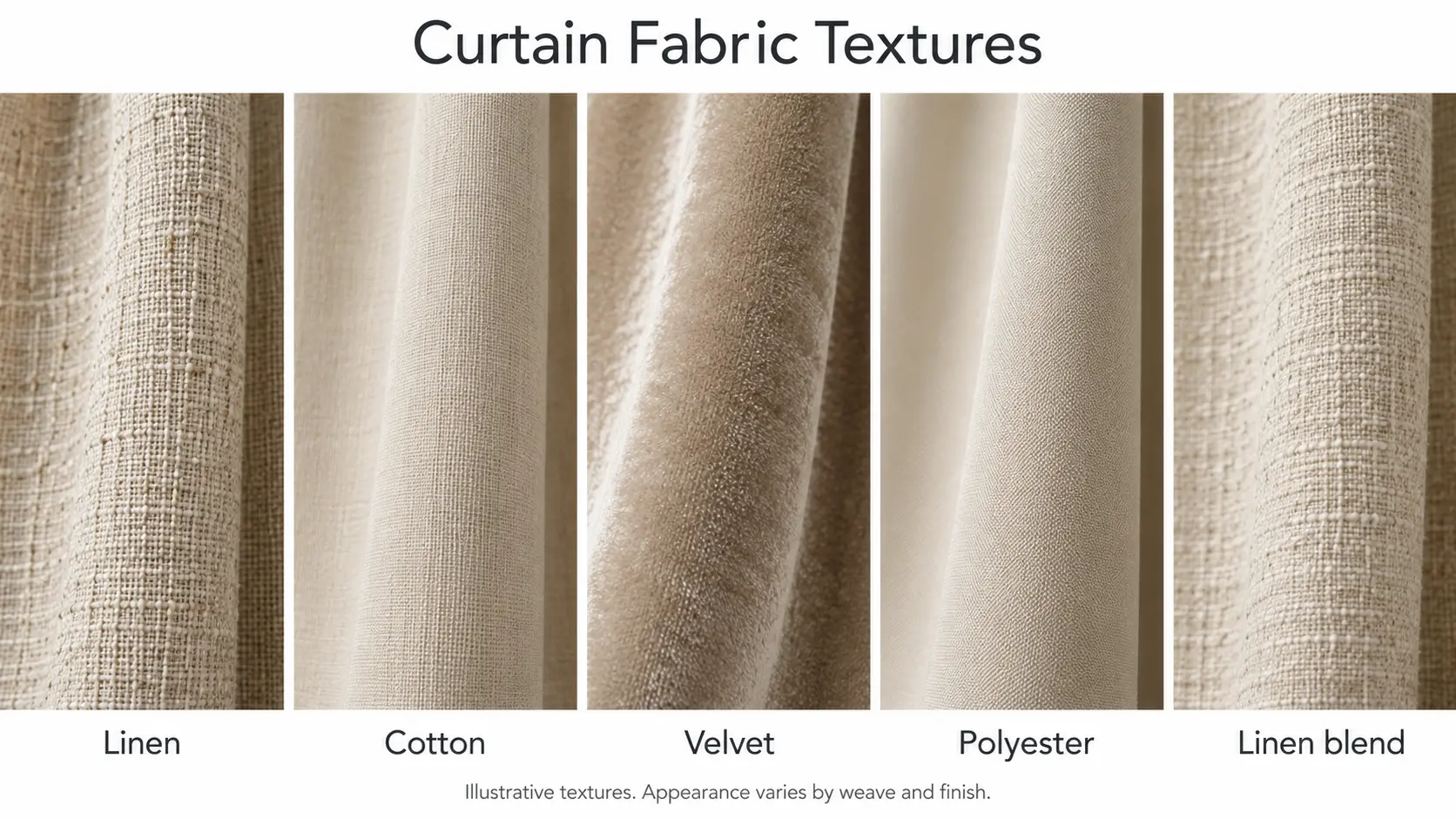
The characteristics of the product, including its drape, weight, maintenance and space occupation, are influenced by the fiber. However, weaving, finish, and the presence or absence of additional elements such as lining are also decisive.
| Fabric | Typical weight (approx.) | Hang and look | Light | Care | Best for |
|---|---|---|---|---|---|
| Sheer voile | 50–120 GSM | Floaty, soft | Diffuses, little privacy by day | Machine wash gentle | Bright rooms, layering |
| Cotton | 120–250 GSM | Crisp, casual | Filters | Easy, machine wash | Everyday family rooms |
| Linen | 150–300 GSM | Relaxed, natural creases | Filters, semi-sheer | Gentle wash or steam | Coastal, Scandinavian, modern |
| Linen-blend | 180–320 GSM | Softer, fewer creases | Filters | Easier than pure linen | Natural look with less fuss |
| Polyester | 100–300 GSM | Smooth, holds shape | Varies | Very easy | Budget, high-traffic rooms |
| Velvet | 300–450 GSM | Rich, heavy folds | Blocks most light | Dry clean or vacuum | Formal, cozy, soundproofing |
| Silk and faux silk | 80–200 GSM | Lustrous, fluid | Semi-sheer unless lined | Dry clean (silk) | Formal, luxe rooms |
| Jacquard and brocade | 250–400 GSM | Structured, patterned | Blocks light | Dry clean | Traditional rooms |
| Chenille | 250–400 GSM | Soft, textured | Blocks light | Vacuum, spot clean | Warm, textured rooms |
| Blackout-lined | 300+ GSM | Thick, structured | Blocks light | Check label | TV rooms, sunny aspects |
Select Curtain Lining Based on Needs
Lining is useful, but it can largely depend on the desired effect and the properties of the material on the surface of the curtains. It is not always necessary to choose heavy curtains with blackout features for the living room. Take into account the presence of other elements in the room and its intended use: lined products are often heavier, so the hardware should support their weight and allow easy opening.
When sustainability is important to you, be sure to inquire about the specifics of the technology and materials used, as well as relevant certificates. In some cases, a natural fiber may not be the most sustainable option.
10 Living Room Curtain Ideas and How to Use Them
1. Textured Neutral Curtains in a Light Living Room
Oatmeal, beige and warm linen tones can complement wooden furniture and neutral walls. Opt for a simple heading so that the texture of the fabric is visible. Close the curtains and assess privacy; add lining if the unlined version does not seem sufficient.
2. Sheers and Opaque Panels for Day/Night Use
Sheer curtains and opaque drapes are a reliable solution for maintaining the desired level of comfort throughout the day. Choose separate rods or tracks so that the two sets of curtains have enough clearance when opened. Note that sheer panels do not reliably conceal the room from outside, especially at night, but combining them with an opaque layer allows more flexible privacy and glare control.
3. Living Room Curtains Similar to Walls
A curtain in a similar color to the walls creates a subtle effect without drawing attention away from the furniture and other features of the room. This option is especially useful if there are patterned items and a colorful carpet. Always check the match in the actual room: the curtain fabric and wall paint may have different undertones and respond differently to the lighting.
4. Tailored Pinch Pleat Drapes for a Classic Interior
Pinch pleat curtains have fixed pleats at the top that create a uniform look. This choice is ideal for both classic and modern interiors. Always clarify the width: some manufacturers quote the flat fabric width, while others quote the finished pleated heading width.
5. Velvet Living Room Curtains in Deep Colors
Velvet adds luxury to the living room without being too flashy, especially in muted colors like olive, rust, navy and brown. Be sure to check the actual weight of the finished curtain when selecting the hardware. Examine a large sample vertically: the pile direction and lighting affect the appearance of the color.
6. Patterned Panels as the Centerpiece of the Interior
In an interior with simple colors and minimal patterns, a curtain becomes a great way to draw attention. Repeat the dominant color from the pattern on other items in the room. For multiple sets, inquire about the specifics of pattern matching, which may affect the final cost and the amount of fabric.
7. Ceiling Mounted Living Room Curtains
A ceiling rail allows curtains to hang from ceiling level to the intended hem position. This method can also minimise visible hardware, depending on the system. Check the load capacity and the suitability of the mounting surface and fasteners. Always measure the span, taking into account the coving, handles and other details.
8. Curtains With Roman Shades or Roller Blinds
Roman or roller blinds are a convenient solution for controlling privacy and light, while also complementing the room. Combine them with curtains for additional softness, but make sure that the two products have enough clearance. Determine which treatment will be used more often: if the blinds provide the main light and privacy control, the curtains for the living room may only act as a decorative accessory.
9. Darker Panels for a Neutral Interior
Darker curtains create a nice background in a neutral room without overwhelming the space. Think about the use of color as an element of interior design. Take into account the effect of the open curtain: in this state, the majority of the fabric may no longer be visible, but the chosen color will still affect the interior.
10. Simple Living Room Curtains With Decorative Trim
A subtle trim or leading edge detail can help transform plain white curtains into a cozy item with a unique pattern. Always clarify the care instructions for such a product: the trim and curtain fabric must be compatible with the same cleaning method. Check that the trim does not hinder the operation of the curtain.
Curtain ideas by decor style
| Style | Fabric | Color | Heading | Hardware |
|---|---|---|---|---|
| Modern | Linen blend, smooth weave | Neutral, monochrome | Ripple fold, grommet | Slim black or brushed metal rod, or a track |
| Farmhouse | Cotton, textured linen | Cream, oatmeal, sage | Rod pocket, back tab | Wrought iron or wood rod with rings |
| Boho | Natural linen, light prints | Terracotta, olive, sand | Tab top, rod pocket | Rattan or wood rod, ring clips |
| Traditional | Velvet, silk, jacquard | Deep jewel tones, ivory | Pinch pleat, goblet | Ornate finials, tiebacks |
| Coastal | Light linen, stripes | White, soft blue, sand | Tailored pleat, grommet | Black iron for contrast |
| Scandinavian | Light linen, cotton | White, grey, pale wood tones | Grommet, rod pocket | Simple matte rod |
| Mid-century | Textured weaves, bold geometric | Mustard, teal, walnut tones | Tailored pleat | Brass or black rod |
How to Choose Colors and Patterns for Living Room Curtains
The most critical elements in a room are its largest features, namely the walls, the sofa and the floor. Determine whether the curtains should complement these items or stand out from them.
Do Living Room Curtains Match the Walls or Sofa?
Both options are possible, but an exact match is not always necessary. It is often sufficient to highlight the dominant tone, for example, by selecting warm neutral colors to complement a beige carpet or using curtains in blue to repeat the color of the cushions.
Color Ideas for Matching or Accented Curtains in Living Room
| Room scheme | Options to sample | What to watch |
|---|---|---|
| White walls | Ivory, flax, muted colour or a contrasting shade | Warm and cool whites can clash |
| Beige walls | Cream, taupe, olive or restrained patterns | Similar beiges may have different undertones |
| Grey walls | Off-white, textured neutrals or muted colour | Grey can lean blue, green, violet or warm brown |
| Dark sofa | Pale curtains for contrast or deeper tones for cohesion | The room’s available daylight |
| Patterned rug | A plain colour drawn from the rug | Competing patterns and colour intensity |
There is no need to follow hard and fast rules when it comes to the relative lightness or darkness of the curtains in comparison to the walls. Choose the option that seems most appropriate in context, but always remember to take a sample into the room to see how the color interacts with the lighting.
How to Measure Living Room Curtains
Choose the desired header and hardware before measuring the length. Different systems have specific requirements, so be sure to take these into account.
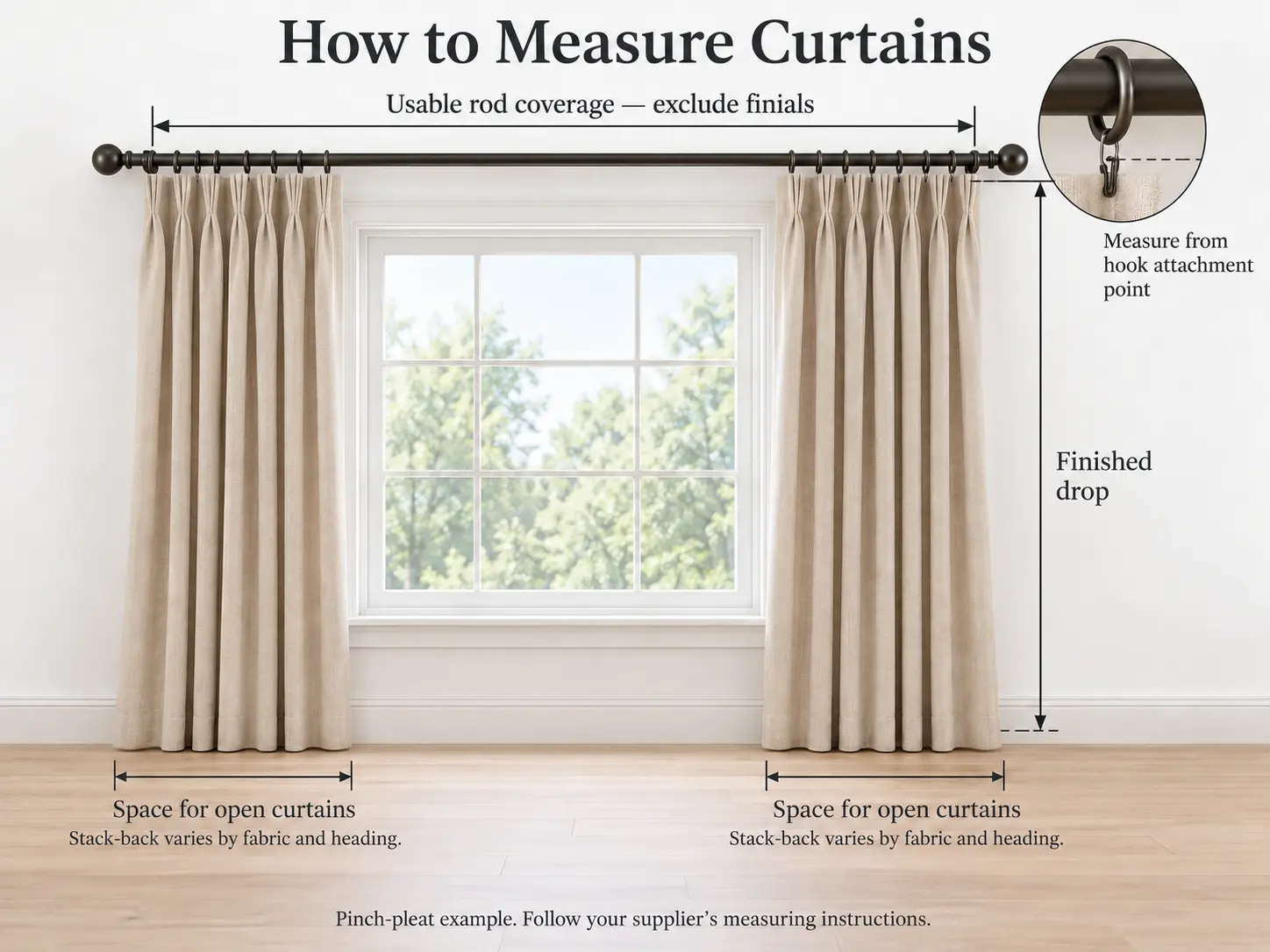
Step 1: Determine Rod or Track Placement
This step is critical and depends on the location of the window, the characteristics of the ceiling and the available fixing points. Higher placement can create the illusion of height in a low room, but it should also be aesthetically pleasing in relation to the coving and window frame. Remember that a fixed distance above the window is not suitable for every room.
Step 2: Determine the Width Coverage
This procedure is straightforward: measure the usable length of the rod or track that the closed curtains need to cover, excluding any finials. Always account for the center overlap, side returns or other details recommended by the manufacturer.
Step 3: Determine the Width of Open Curtains
Even when fully opened, the curtain will occupy some space: this is the so-called stack-back. This must be taken into account when selecting the rod or track, which may need to extend beyond the window to allow the gathered curtains to clear the glass.
Step 4: Measure the Finished Drop of the Curtain
This depends on the chosen system, but as a rule, there are three main options:
- For ring-hung curtains: measure from the specified hook attachment point or ring eye to the intended hem position.
- For track curtains: the measuring point depends on the carrier and hooks.
- For grommet curtains: account for the rod position and the fabric extending above the eyelets, following the supplier’s instructions.
When measuring, take into account that the floor and ceiling may not be parallel. Take measurements at several points and use either centimeters or inches consistently; do not mix them.
How Many Panels Do I Need for My Living Room Curtain?
If the number of panels is selected based on the width of the product in a flat state, the calculation will look like this:
Required fabric width = coverage width × fullness
| Heading style | Typical fullness |
|---|---|
| Grommet or eyelet | 1.5–2 times |
| Rod pocket, tab top | 2 times |
| Pencil pleat | 2–2.5 times |
| Pinch pleat, ripple fold | 2–2.5 times |
| Sheer fabric | 2.5–3 times for a lush look |
Number of panels = required fabric width ÷ width of one panel
Based on the calculations, round up the number of panels, but always clarify whether this will be sufficient for the selected header and whether the pattern will match.
Example:
If the coverage width is 80 inches or approximately 203 cm, and the fullness is 2x, while one panel is 50 inches or 127 cm, the calculation will be as follows:
80 × 2 = 160 inches of the required flat width
160 ÷ 50 = 3.2 panels
In this case, 4 panels will provide 200 inches or 508 cm, which corresponds to the fullness of:
200 ÷ 80 = 2.5 x
Thus, the calculation is correct, but it is important to consider how much volume the curtain will occupy. Two 100-inch-wide panels would provide the same total width and fullness, while a different total width would be needed to reduce the volume.
The example shows only the calculation, but the choice of fullness is no less important and should be made based on the manufacturer’s recommendations and the characteristics of the header.
Flat Width Versus Finished Pleated Width
When the product is purchased, it is vitally important to clarify which measurement system is being used. Flat width means the panel width before the fabric is gathered into folds. At the same time, the finished pleated width indicates the heading width after the pleats have been made. Do not apply an additional fullness multiplier to a finished pleated width unless the supplier instructs you to do so. Do not confuse the width of one panel with the combined width of two panels: check whether the listed measurement applies to each panel or the pair, and confirm pattern matching separately.
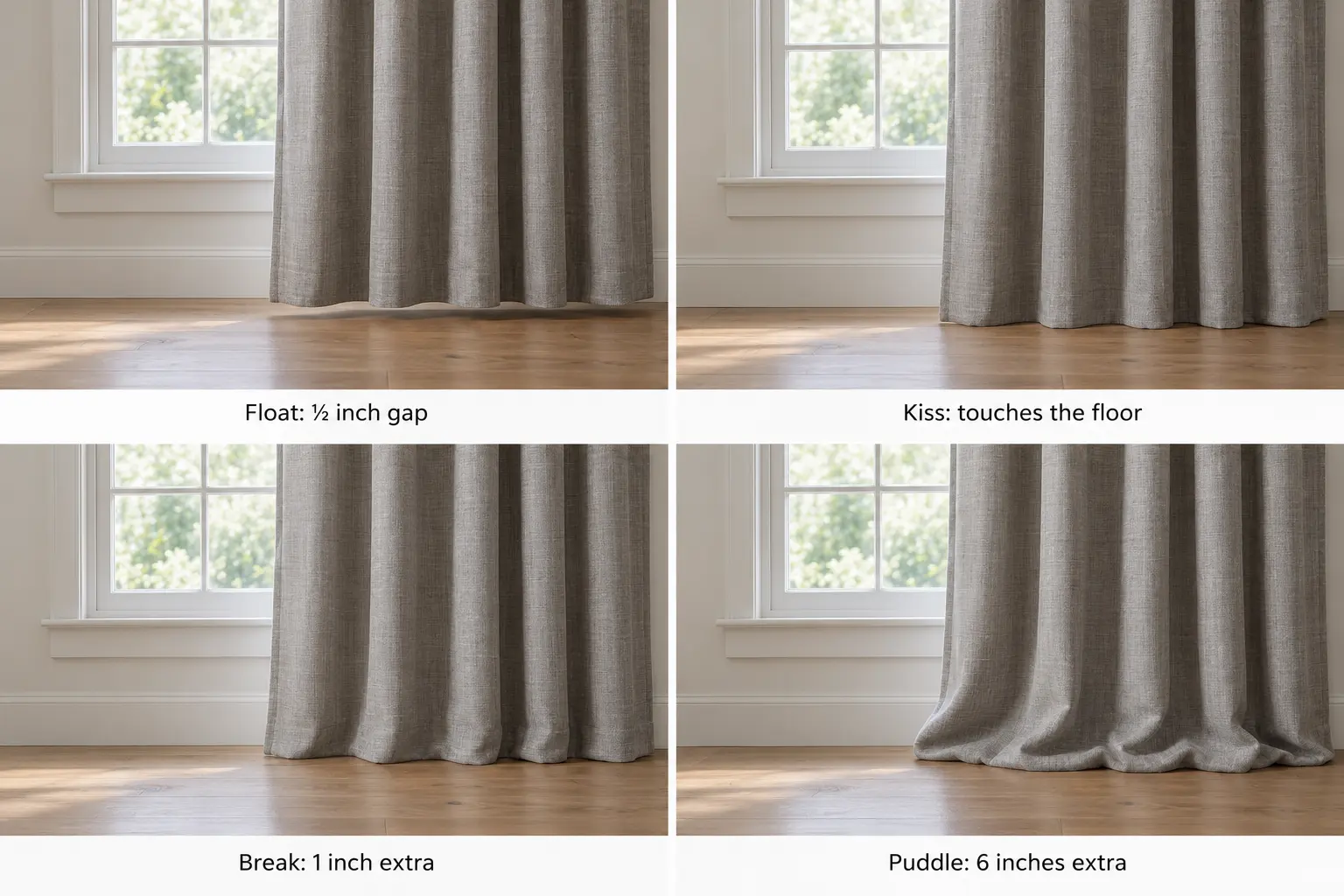
Should Living Room Curtains Touch the Floor?
For curtains opened regularly, an approximate 1 cm clearance between the bottom of the product and the floor can be practical. This helps prevent the fabric from catching on the floor, but in the case of a home with pets or frequent visitors, this distance can be increased. For a less formal look, consider shorter curtains that stop just below the windowsill where the window layout and any obstacles permit.
| Length | Where it ends | Look | Good for |
|---|---|---|---|
| Sill | At the windowsill | Casual | Small windows, kitchens; can look dated in a living room |
| Apron | A few inches below the sill | Neat | Windows with furniture or a radiator below |
| Floor, hovering | About ½ inch above the floor | Tailored, practical | Curtains opened and closed often |
| Floor, touching | Just touches the floor | Polished, formal | Most living rooms |
| Puddle | 2–6 inches of fabric on the floor | Luxurious, dramatic | Formal rooms, rarely moved curtains |
How to Choose the Best Header for Living Room Curtains
The choice of the header type depends on the desired appearance, ease of operation and compatibility with the hardware.
Heading styles compared
| Heading | Look | Slides easily? | Fullness | Best for |
|---|---|---|---|---|
| Rod pocket | Simple, gathered | No, fabric slides in a sleeve | 2 times | Lightweight or stationary panels |
| Back tab | Neat, pleat-like | Moderate | 2 times | Casual, tidy look |
| Tab top | Relaxed, casual | Moderate | 1.5–2 times | Casual rooms, light fabrics |
| Grommet or eyelet | Sleek, modern | Yes, on a rod | 1.5–2 times | Modern rooms, everyday use |
| Pinch pleat | Formal, tailored | Good on rings or a track | 2–2.5 times | Traditional and formal rooms |
| Ripple fold | Clean, wave-like | Very easy on a track | 2–2.5 times | Modern rooms, wide windows |
| Goblet | Ornate, cup-shaped | Stationary mostly | 2–2.5 times | Formal, decorative drapery |
For wider or heavier curtains, suitable brackets and fixings should be selected, following the manufacturer’s load capacity and spacing requirements. Remember that support brackets can restrict curtain travel on some rod systems.
Curtains for Small Rooms and Unusual Windows
Small Living Rooms and Low Ceilings
When choosing products for a small space, pay attention to simple headers, less dense materials and hardware located higher to emphasize the height of the room. Where possible, install the rod or track so that the curtains open away from the glass to allow more light in.
In such a room, light-colored products will not be sufficient if they do not let in enough light or overwhelm the space with their width. Choose curtains that complement the interior rather than overshadow it.
Bay and Corner Windows
When selecting hardware, keep in mind that bay windows or corners may require a shaped track or compatible corner components. The bend affects the movement of the product: it is important to ensure that the opening and closing of the curtain are convenient. Determine whether you want the curtains to operate continuously around the bay window or on separate sections.
Large Windows and Sliding Doors
When selecting products for such a span, pay attention to the direction of opening, the location of door handles and the possibility of using the space. The curtains must not interfere with access through the doorway, so their weight and movement must also be considered.
Radiators and Air Conditioning Vents
When installing a product near heating or air conditioning equipment, follow the instructions from the manufacturer. Do not allow the curtain to rest against the radiator or interfere with the free circulation of air through the vents. In such cases, a shorter curtain or window-mounted blinds may be a better option.
Ready Made or Custom Made Living Room Curtains?
Ready-made options can be a good choice if the available sizes match the required curtain measurements. Custom-made products give you more freedom of choice and allow you to control the placement of patterns, but always remember that the final cost depends on all components of the curtain system, not just panels.
| Consideration | Ready-made | Custom |
|---|---|---|
| Sizes | Limited to available options | Made to specified dimensions |
| Availability | Often quicker | Production time varies |
| Alterations | May be necessary | Usually specified before production |
| Fabric and lining | Set combinations | More choice |
| Unusual windows | Can require compromises | Can accommodate specific requirements |
| Ready-made length | Fits a rod mounted up to about |
|---|---|
| 63 inches | 63 inches from the floor (sill or apron look) |
| 84 inches | 84 inches from the floor |
| 95 inches | 95 inches from the floor |
| 108 inches | 108 inches from the floor, for tall ceilings |
Compare the following:
- Panels and/or lining;
- Rods, tracks, carriers, rings and ends;
- Alteration and pattern matching;
- Installation and hardware.
In some cases, a lower price for the panels themselves does not result in a lower total cost.
Curtain Maintenance, Durability and Common Mistakes
| Fabric | Cleaning method | Notes |
|---|---|---|
| Cotton | Machine wash cool, gentle cycle | May shrink; hang to dry |
| Polyester | Machine wash cool | Dries fast; low iron |
| Linen | Gentle wash or steam | Wrinkles naturally; wash before hemming |
| Velvet | Dry clean or vacuum | Never rub; brush with the pile |
| Silk and faux silk | Dry clean | Fades in sun; keep lined |
| Sheers | Hand or delicate wash | Hang damp to avoid creases |
| Lined drapes | Dry clean or steam | Washing can shrink the lining unevenly |
The most common mistakes when buying curtains include:
- Measuring only the glass;
- Confusion with single panel and two panel products;
- Applying a flat-width fullness calculation to finished pleated curtains;
- Failure to consider the location and size of the hardware;
- Inattention to the stack-back;
- Believing that sheer curtains provide privacy at night;
- Assuming blackout fabric eliminates light gaps around the installation;
- Neglecting the load on the brackets for heavy panels.
Some curtains can soften reflected sound, but thick material alone does not guarantee good sound absorption, and standard drapes should not be described as soundproof. At the same time, the choice of an insulating curtain for thermal efficiency depends on the complete system and the accuracy of its installation, and not on the characteristics of one product.
FAQs
Everything depends on the lighting and privacy needs. Light-filtering curtains let in natural light, but the view through them varies by fabric. For increased privacy, choose opaque drapes. For greater convenience, use two sets of curtains: one for day, and one for night.
It is not necessary to do this, but the choice of fabric and pattern should be coordinated. If the windows are visible from where the room is normally viewed, the unification of all elements will create a harmonious design. At the same time, different curtains can complement each other in terms of color and pattern.
Yes: such products can help reduce glare on the television screen. A combination of sheer and blackout curtains allows softer daylight when the opaque layer is open and greater privacy when it is closed.
Blinds can complement curtains, but their light control and privacy depend on the material, design and fit. It is possible to use both products at the same time, but it is important to leave enough clearance between them and ensure access to the operating mechanism.
Weight alone does not determine opacity or privacy. It is vital to check how much can be seen through the finished curtain, especially when illuminated from behind.
If the room is small, long curtains hung higher can help emphasize height. When gathered clear of the glass, they also expose more daylight and the view outside. These factors can influence how spacious the room appears, but the choice of a particular product also depends on the characteristics of the room.