
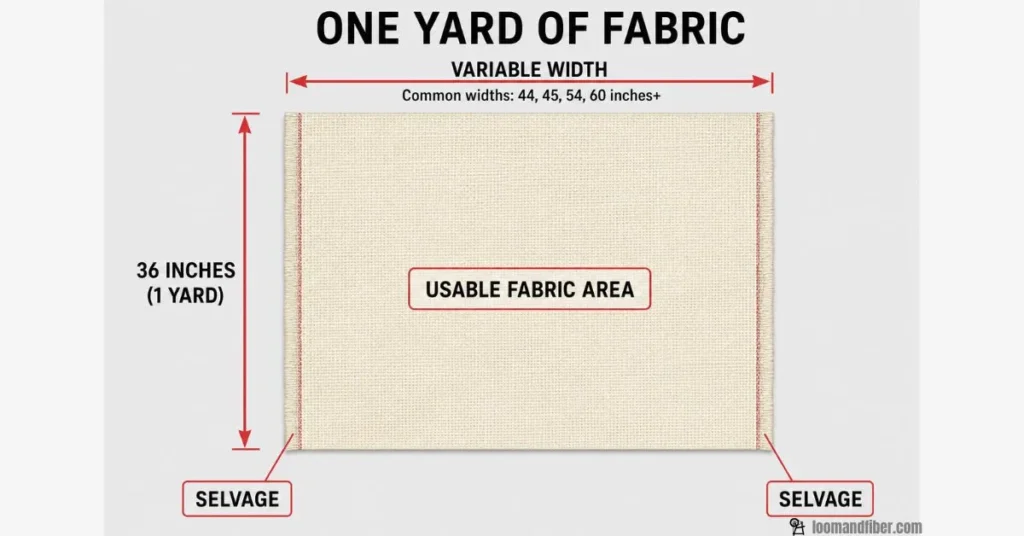
Fabric sold by the yard does not have one fixed rectangular size. Instead, each yard always measures 36 inches along the fabric roll. However, the width depends on how the manufacturer produced the fabric. Therefore, one yard could measure 36 × 44 inches or 36 × 60 inches. Understanding both measurements helps buyers calculate area, plan cutting layouts, and avoid expensive shortages. Moreover, usable width matters more than advertised width for precise projects.
This guide explains fabric dimensions, standard widths, fractional cuts, conversions, and practical yardage calculations.
How Big Is Fabric by the Yard?
A yard measures fabric length along the bolt or roll. One yard always equals 36 inches, three feet, or 0.9144 meters. Fabric width remains a separate measurement. Therefore, the buyer usually receives 36 inches across the fabric’s full listed width. For example, one yard of 44-inch fabric measures 36 × 44 inches. Meanwhile, one yard of 60-inch fabric measures 36 × 60 inches. Consequently, a one-yard fabric cut usually forms a rectangle rather than a square. It forms a square only when the fabric measures exactly 36 inches wide.
Similarly, ordering two yards normally provides 72 inches of length at the same width. However, retailers may divide an order when continuous stock is unavailable.The actual usable dimensions can also be smaller than advertised dimensions. Selvages, shrinkage, printing limits, damage, and uneven cuts can reduce usable fabric.
One-Yard Fabric Dimensions by Width
The following table shows how big one yard becomes at several common widths. These measurements describe total area before deducting selvages or damaged sections.
| Fabric width | Dimensions of one yard | Total area | Square feet |
|---|---|---|---|
| 36 inches | 36 × 36 inches | 1,296 sq in | 9 sq ft |
| 44 inches | 36 × 44 inches | 1,584 sq in | 11 sq ft |
| 45 inches | 36 × 45 inches | 1,620 sq in | 11.25 sq ft |
| 54 inches | 36 × 54 inches | 1,944 sq in | 13.5 sq ft |
| 58 inches | 36 × 58 inches | 2,088 sq in | 14.5 sq ft |
| 60 inches | 36 × 60 inches | 2,160 sq in | 15 sq ft |
| 72 inches | 36 × 72 inches | 2,592 sq in | 18 sq ft |
| 118 inches | 36 × 118 inches | 4,248 sq in | 29.5 sq ft |
One yard of 60-inch fabric contains approximately 36% more area than 44-inch fabric. Therefore, equal yardage does not guarantee equal fabric area because bolt widths vary. To calculate square inches, multiply the yard length by the fabric width. Then, divide square inches by 144 to calculate square feet.
For example, 36 × 60 equals 2,160 square inches. Dividing 2,160 by 144 produces 15 square feet.
Is a Yard of Fabric a Linear Yard or a Square Yard?
Fabric stores normally sell fabric by the linear yard. However, many buyers mistakenly interpret each yard as one square yard.
What Is a Linear Yard?
A linear yard is a 36-inch length across the roll’s available width. Therefore, its total area changes whenever the fabric width changes. For example, a linear yard of 54-inch fabric measures 36 × 54 inches. Nevertheless, its stated length remains one yard.
What Is a Square Yard?
A square yard measures exactly 36 × 36 inches. Consequently, one square yard contains 1,296 square inches or nine square feet. Square yardage measures surface area. In contrast, linear yardage measures length while retaining the material’s existing width.
When Are Linear and Square Yards Equal?
One linear yard equals one square yard only with 36-inch-wide fabric. Wider fabric provides more than one square yard per linear yard. For example, one linear yard of 60-inch fabric contains approximately 1.67 square yards. The calculation is 36 × 60 ÷ 1,296.
Likewise, one linear yard of 44-inch fabric contains approximately 1.22 square yards. Therefore, buyers must consider both length and width.
Why Does Fabric Width Vary?
Manufacturing equipment, knitting methods, weaving methods, fibers, finishing, and intended applications influence finished fabric width. For example, quilting cotton often comes from machinery designed for narrower woven goods. Conversely, backing and drapery fabrics may use extra-wide production equipment. Finishing can also change the original width. Therefore, washing, heat-setting, coating, stretching, or relaxation may alter finished dimensions.
The following ranges represent frequently encountered commercial widths. However, they do not represent universal manufacturing standards.
| Fabric category | Frequently encountered widths |
|---|---|
| Quilting cotton | Approximately 42–45 inches |
| Fashion and apparel fabric | Often 54–60 inches |
| Knit and jersey fabric | Commonly 58–60 inches |
| Upholstery fabric | Often about 54 inches |
| Home décor fabric | Commonly 54–60 inches |
| Wide quilt backing | Approximately 90–118 inches |
| Extra-wide drapery fabric | May reach 118 inches or more |
Actual products can fall outside these ranges. Therefore, always use the product listing or bolt label for calculations. Also, confirm whether the stated width includes selvages. This detail can materially change cutting plans.
Fabric Yard Conversion Chart
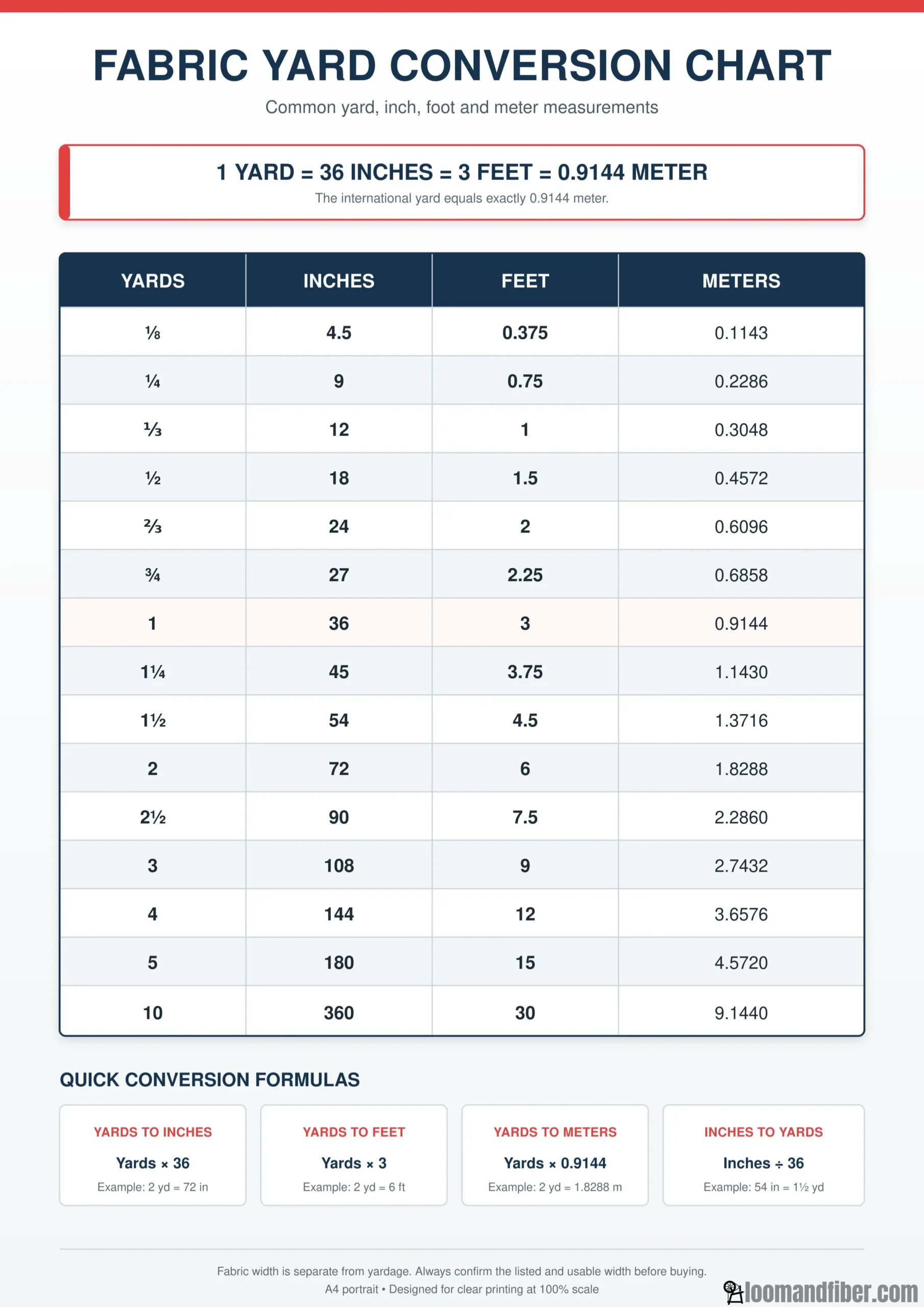
The length of one yard remains constant regardless of fabric width. Therefore, the following conversions apply to every normally sold fabric yard.
Yards to Inches, Feet and Meters
| Yardage | Inches | Feet | Meters |
|---|---|---|---|
| ¼ yard | 9 inches | 0.75 foot | 0.2286 m |
| ½ yard | 18 inches | 1.5 feet | 0.4572 m |
| ¾ yard | 27 inches | 2.25 feet | 0.6858 m |
| 1 yard | 36 inches | 3 feet | 0.9144 m |
| 1½ yards | 54 inches | 4.5 feet | 1.3716 m |
| 2 yards | 72 inches | 6 feet | 1.8288 m |
| 3 yards | 108 inches | 9 feet | 2.7432 m |
| 5 yards | 180 inches | 15 feet | 4.572 m |
Use these formulas for quick conversions:
- Yards to inches: yards × 36
- Inches to yards: inches ÷ 36
- Yards to meters: yards × 0.9144
- Meters to yards: meters ÷ 0.9144
For example, 2.5 yards multiplied by 36 equals 90 inches. Likewise, 90 inches divided by 36 equals 2.5 yards.
However, length conversion alone does not calculate total fabric area. You must also include the actual fabric width.
How Big Are Fractional Fabric Cuts?
Fabric retailers often sell fractions of a linear yard. Each standard fraction retains the fabric’s full available width.
| Fractional cut | Length along the roll |
|---|---|
| One-eighth yard | 4.5 inches |
| One-quarter yard | 9 inches |
| One-third yard | 12 inches |
| One-half yard | 18 inches |
| Two-thirds yard | 24 inches |
| Three-quarter yard | 27 inches |
For example, half a yard of 44-inch fabric measures 18 × 44 inches. Similarly, half a yard of 60-inch fabric measures 18 × 60 inches.
Retailers may use different minimum increments. Some sell eighth-yard increments, while others require quarter-yard or half-yard increments.
Therefore, buyers should check the selling increment before rounding their calculations. The required increment can increase the final purchased amount.
Quarter Yard vs Fat Quarter
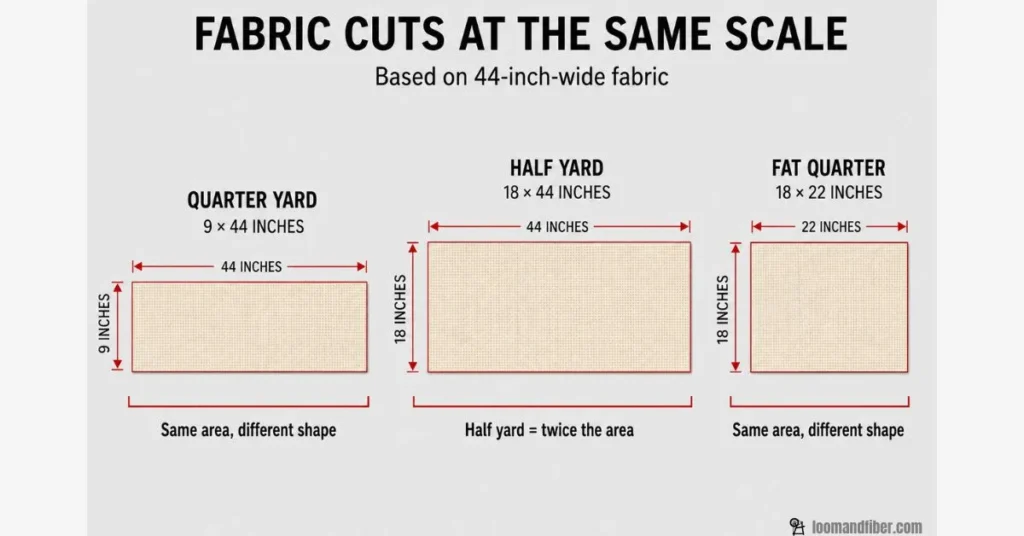
A standard quarter yard and a fat quarter usually contain similar areas. However, they use different shapes and cutting layouts.
For 44-inch-wide quilting cotton, a standard quarter yard measures approximately 9 × 44 inches. Conversely, a typical fat quarter measures approximately 18 × 22 inches.
| Cut type | Typical dimensions | Shape |
|---|---|---|
| Standard quarter yard | 9 × 44 inches | Long and narrow |
| Fat quarter | 18 × 22 inches | Shorter and wider |
Both examples contain 396 square inches. Nevertheless, the different shapes suit different project pieces. A long strip may fit better within a standard quarter yard. Meanwhile, square quilt pieces may fit better within a fat quarter. Fat-quarter sizes can change when the original fabric width differs. Therefore, 18 × 22 inches remains a common size, not a universal rule.
Listed Width vs Usable Fabric Width
Listed fabric width may include both selvage edges. However, those edges may not suit the finished project. Selvages can be thicker, pierced, printed, distorted, or tightly woven. Consequently, manufacturers often remove them before cutting project pieces. Printed designs may also stop before reaching each selvage. Therefore, the available patterned width may be narrower than the total listed width.
For example, 44-inch fabric might provide only 42 usable inches. That difference can change how many pieces fit across one row. Fabric may also arrive slightly off-grain or unevenly cut. Additionally, damage and distorted sections can reduce usable area. Washing may shrink both length and width. Therefore, prewashing can change dimensions before the actual cutting process begins. Usable width excludes selvages and every unsuitable edge area. This measurement matters greatly for quilting, pattern matching, and production planning.
Consequently, precise calculations should always use usable width. Never assume the listed width represents fully usable material.
How to Calculate How Many Yards of Fabric You Need
An accurate yardage estimate requires more than total surface area. Instead, buyers must create a practical cutting layout.
Step 1: Measure Every Required Piece
First, list every fabric piece required for the project. Use cutting dimensions instead of finished project dimensions.
For example, an 18-inch cushion cover may require a 19-inch panel. The additional inch can provide two half-inch seam allowances.
Step 2: Add Construction Allowances
Next, add seam allowances, hems, casings, folds, cushion depth, and turn-under allowances.
Construction details consume fabric even when they remain invisible. Therefore, excluding them will produce an insufficient estimate.
Step 3: Confirm the Usable Fabric Width
Then, measure or confirm the usable width. Avoid generic 44-inch or 60-inch assumptions when specifications exist.
For instance, 54-inch listed fabric may offer only 52 usable inches. That smaller width should control the calculation.
Step 4: Establish the Cutting Direction
Determine whether pieces must follow the grainline, print direction, stretch direction, pile, or nap.
Directional restrictions can prevent rotating pieces. Consequently, a mathematically possible layout may become technically unsuitable.
Step 5: Calculate Pieces Per Row
For simple rectangular pieces, use this formula:
Pieces per row = usable fabric width ÷ required piece width
Always round the answer down to a whole number.
For example, 52 usable inches divided by 19 inches equals 2.73. Therefore, only two complete panels fit across each row.
Step 6: Calculate the Required Rows
Next, use this formula:
Rows required = total pieces ÷ pieces per row
Always round this result upward.
For example, four panels divided by two panels per row equals two rows.
Step 7: Calculate Total Fabric Length
Multiply the required rows by each piece’s cutting length.
Required length = rows × cut-piece length
Then, divide the required inches by 36. Finally, round upward to the retailer’s available selling increment.
Step 8: Add Relevant Overage
Add extra fabric for shrinkage, matching, defects, cutting mistakes, or later repairs.
However, avoid using one universal overage percentage. The correct allowance depends on the fabric and project.
This rectangular formula does not reliably predict garment yardage alone. Garment pieces require careful nesting around grainlines and irregular shapes.
Therefore, follow the sewing pattern’s printed layout whenever available. Also, use the specified fabric-width column.
Worked Fabric Yardage Examples
Practical examples show why width and cutting layout matter. They also expose errors that surface-area calculations can hide.
Example 1: Two 18-Inch Pillow Covers
Assume each pillow cover needs two fabric panels. Therefore, two pillows require four panels.
Suppose each finished cover measures 18 × 18 inches. Add half-inch seam allowances around every edge.
Each required panel will measure 19 × 19 inches. The fabric lists a 54-inch width but offers 52 usable inches.
Divide 52 inches by each panel’s 19-inch width. Two panels fit across, while three panels require 57 inches.
Next, divide four total panels by two panels per row. Therefore, the layout requires two rows.
Each row consumes 19 inches of fabric length. Consequently, two rows require 38 inches.
The exact requirement equals 38 ÷ 36, or approximately 1.06 yards. If sold by eighths, purchase at least 1⅛ yards.
Surface area alone suggests that one yard should work. Four panels contain only 1,444 square inches.
Meanwhile, one yard of 52-inch usable fabric contains 1,872 square inches. However, four square panels cannot fit within its 36-inch length.
Therefore, surface area does not replace a cutting layout.
Example 2: A 72-Inch Table Runner
Assume the finished table runner measures 72 inches long and 16 inches wide.
Add two inches at each end for double-fold hems. Also, add one inch along each side.
The cutting dimensions become 76 × 18 inches. Suppose the fabric provides 52 inches of usable width.
The runner easily fits across the fabric width. However, its required length remains 76 inches.
Divide 76 by 36 to obtain approximately 2.11 yards. Therefore, buy 2¼ yards when sold by quarter-yard increments.
A directional pattern may require additional fabric. Likewise, a large motif may need repositioning for visual balance.
Example 3: Converting 45-Inch Yardage to 60-Inch Fabric
Assume a pattern requires three yards of 45-inch fabric. A preliminary area comparison uses this formula:
Estimated new yardage = original yardage × original width ÷ new width
Therefore:
3 × 45 ÷ 60 = 2.25 yards
The rough estimate suggests 2¼ yards of 60-inch fabric. However, this result does not guarantee a workable layout.
Large pattern pieces may not nest efficiently. Moreover, grainlines and directional prints may prevent rotating pieces.
Nap, pattern repeats, and cutting-on-fold instructions can also remove theoretical savings. Therefore, confirm the layout before purchasing less fabric.
Whenever possible, replace listed widths with usable widths. This adjustment creates a more realistic preliminary estimate.
Why Similar Projects May Need Different Yardage
Two projects with equal finished dimensions may require different fabric amounts. Construction and fabric characteristics create those differences.
Seam and Hem Allowances
Wider seams and deeper hems increase every cutting dimension. Therefore, finished measurements alone cannot determine fabric needs.
Project or Garment Size
Larger sizes require larger pattern pieces. Additionally, some pieces may stop fitting side-by-side across the width.
Usable Fabric Width
Wider usable fabric may fit more pieces per row. Consequently, it can reduce the required linear length.
Directional Prints
Directional prints must face the same direction. Therefore, cutters cannot rotate pieces freely to save fabric.
Plaid, Stripe, and Motif Matching
Visible lines and motifs often require alignment between adjoining pieces. Consequently, matching usually creates extra cutting waste.
Pattern Repeats
A pattern repeat measures when a design starts repeating vertically or horizontally. Large repeats can require substantial additional length.
Nap and Pile
Velvet, corduroy, faux fur, and similar fabrics have directional surfaces. Therefore, every visible piece should usually face one direction.
Fabric Shrinkage
Washing can reduce fabric length and width. Consequently, buyers should include tested shrinkage when calculating prewash quantities.
Grainline Requirements
Garment patterns contain grainline markings for stability and drape. Rotating pieces against those markings can distort the finished garment.
Stretch Direction
Many knits stretch more across their width than along their length. Therefore, correct stretch placement can restrict the cutting layout.
Irregular Pattern Pieces
Curved and angled garment pieces leave unusable spaces between them. Consequently, simple area formulas often underestimate garment yardage.
Mistakes and Future Repairs
Extra material provides protection against cutting errors or hidden defects. It can also support matching repairs later.
What Can You Make With One Yard of Fabric?
One yard can support many small projects. However, project dimensions matter more than the project’s general name.
| Project | Is one yard potentially enough? | What determines the answer? |
|---|---|---|
| Tote bag | Often | Bag size, lining, pockets, and handles |
| Cushion covers | Often | Cushion size, fabric width, and closure |
| Child’s garment | Sometimes | Child’s size, sleeves, length, and fullness |
| Adult skirt | Sometimes | Waist, length, style, and fabric width |
| Adult shirt | Sometimes | Body size, sleeves, style, and layout |
| Quilt blocks | Often for part of a quilt | Block size, cutting waste, and design |
| Dining-chair seat | Often | Seat size, underside allowance, and repeat |
| Curtains | Rarely for complete treatment | Window size, fullness, hems, and matching |
| Sofa upholstery | No | Sofa design, cushions, repeat, and construction |
For example, one yard may produce several small unlined tote bags. However, a large lined bag may consume the entire piece. Likewise, one yard might cover multiple small cushions using wide fabric. Nevertheless, larger cushions may require more length. An adult sleeveless shirt might fit within one wide yard. Conversely, long sleeves or larger sizes can substantially increase requirements.
Therefore, avoid claims stating that one yard always makes a specific item. Verify dimensions and prepare a cutting layout first.
How to Buy Fabric by the Yard Online
Online listings should provide enough information for reliable planning. However, buyers must check every relevant specification before ordering.
Use this checklist:
- Confirm whether the selling unit is one yard or one meter.
- Check both the listed width and usable width.
- Verify the seller’s minimum purchase increment.
- Ask whether multiple units arrive as one continuous cut.
- Check the vertical and horizontal pattern repeat.
- Identify whether the print has one fixed direction.
- Check the fabric’s stretch percentage and direction.
- Review shrinkage and prewashing instructions.
- Confirm whether pricing applies per yard, panel, piece, or roll.
- Purchase one dye lot whenever color consistency matters.
- Check whether the seller accepts returns for cut fabric.
- Order a swatch when color, scale, opacity, or texture matters.
Two ordered yards do not always arrive as one 72-inch piece. Retailer policies and remaining bolt lengths can affect continuity.
Moreover, photographs may not show accurate colors or motif scale. Therefore, swatches provide valuable confirmation for sensitive projects.
Common Fabric-Yardage Mistakes
Small calculation mistakes can cause material shortages or visible mismatches. Therefore, review these common errors before ordering.
Assuming Every Yard Measures 36 × 36 Inches
Only 36-inch-wide fabric creates that measurement. Most fabric yards form rectangles with different widths.
Ignoring Fabric Width
Length alone cannot determine available fabric area. Additionally, width controls how many pieces fit across each row.
Treating Total Area as a Complete Cutting Plan
Equal areas can have incompatible shapes. Therefore, every estimate needs a realistic piece arrangement.
Using Listed Width Instead of Usable Width
Selvages and unprinted edges may reduce workable space. Consequently, listed width can overstate cutting capacity.
Forgetting Construction Allowances
Seams, hems, folds, and casings require additional material. Finished dimensions alone usually produce undersized cuts.
Rotating Grain-Dependent Pieces
Rotating garment pieces may place them against the correct grain. Consequently, the completed item may twist or stretch incorrectly.
Ignoring Pattern Repeat or Nap
Matched motifs and one-way surfaces consume additional length. Therefore, plain-fabric estimates may not apply.
Assuming Separate Cuts Join Invisibly
Seams can interrupt prints, texture, and drape. Additionally, joining short cuts may create unwanted weak points.
Rounding Required Yardage Down
Rounding down creates an immediate shortage. Instead, round upward to the seller’s available purchase increment.
Buying Additional Fabric From Another Dye Lot
Different dye lots may show visible color changes. Therefore, purchase the full requirement together whenever appearance matters.
Conclusion-
One yard of fabric always measures 36 inches along the roll. However, its width depends on the manufactured bolt width. Therefore, one yard might measure 36 × 44, 36 × 54, or 36 × 60 inches. Wider fabric provides more area within the same linear yardage.Nevertheless, area alone cannot determine project requirements. A reliable estimate must include usable width, allowances, grain, direction, and cutting layout.
Finally, always round the calculated requirement upward. Also, purchase suitable overage when shrinkage, matching, defects, or repairs could affect the project.
Read More>> What is GSM in Fabric?
FAQs
One yard has no fixed width. It provides 36 inches of length across the fabric’s manufactured width.
Only fabric measuring exactly 36 inches wide produces that size. One yard of 60-inch fabric measures 36 × 60 inches.
The answer depends on fabric width. A 44-inch yard contains 11 square feet before unusable areas are deducted.
Meanwhile, one yard of 60-inch fabric contains 15 square feet before deductions.
Yes, one meter is approximately 3.37 inches longer than one yard. One meter also equals approximately 1.094 yards.
Half a yard measures 18 inches along the roll. It also retains the fabric’s full available width.
For example, half a yard of 44-inch fabric measures 18 × 44 inches.
Many sellers provide continuous cuts when available. However, buyers should confirm the retailer’s continuous-cut policy before ordering.
One yard may suit certain child-sized, sleeveless, or small designs. However, many adult dresses need considerably more fabric.
Size, sleeves, fullness, length, usable width, and layout determine the final requirement.