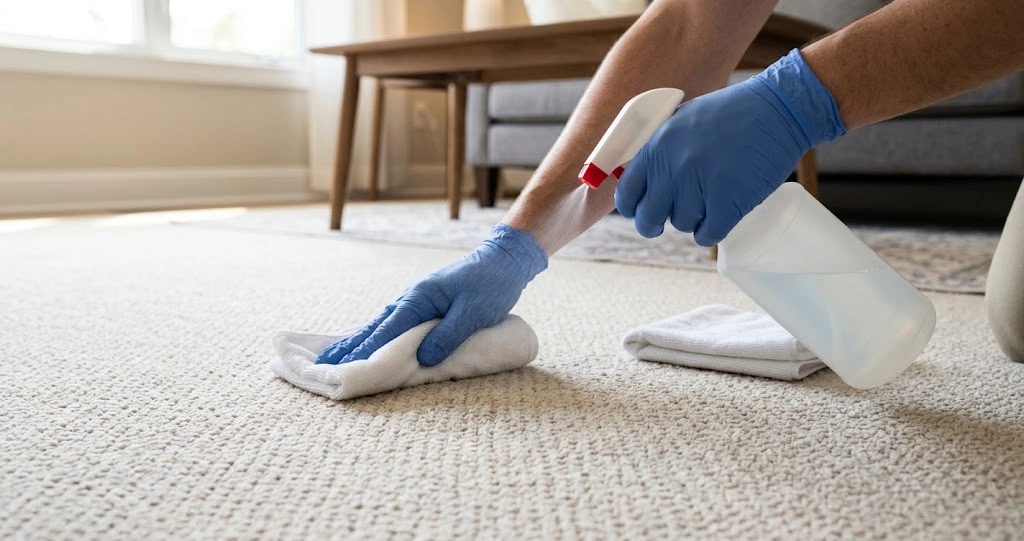

Disinfecting a carpet requires steam or specialized EPA approved chemical sanitizer products. Standard carpet vacuuming does not kill bacteria and viruses. To disinfect a carpet, you have to first remove loose debris, apply a disinfectant solution, wait for the required contact time, and dry thoroughly.
The fibers, backing, and padding of the carpet create obstacles to treating the carpet. A simple spray may not penetrate the fibers or remove contaminants from the carpet. For normal spots and soils, cleaning the carpet is usually enough. Sewage, heavy contamination, and mold requires a more thorough method.
Can You Disinfect Carpet?
Treatment of carpet with antimicrobial products depends on the product, carpet type, targeted organisms, and application guidelines.
A product labeled for disinfecting hard surfaces may only sanitize carpet. Always follow the use instructions on the carpet label rather than application claims.
Carpet and rugs sometimes have different standards than other textile surfaces. An upholstery sanitizer claim does not mean the product is suitable for use on carpet.
Cleaning, Sanitizing, and Disinfecting: What Is the Difference?
| Process | What it does | What it means for carpet |
|---|---|---|
| Cleaning | Removes dirt, debris, and some germs | The starting point for any treatment |
| Sanitizing | Reduces specified bacteria under tested conditions | Does not automatically address viruses |
| Disinfecting | Kills or inactivates the organisms listed on the label | Requires a claim and directions that apply to carpet |
| Deodorizing | Reduces or masks odors | Does not prove germs have been removed |
A fresh smell, a disappearing stain, or clear extraction water cannot confirm disinfection.
When Does Carpet Need More Than Routine Cleaning?
Normal dirt accumulation from pets, people, and the environment usually only requires routine cleaning. Following public-health guidance, soft surfaces should be cleaned with appropriate products, vacuumed, and laundered if possible.
| Carpet problem | Practical first action | Important limit |
|---|---|---|
| Dust and normal household dirt | Vacuum and clean with a compatible carpet cleaner | Routine disinfection is usually unnecessary |
| Pet urine and lingering odor | Blot and use a carpet-safe enzymatic cleaner | Enzyme action alone does not establish disinfection |
| Small vomit or feces accident | Remove waste carefully, then clean the affected area | Further treatment must match the organism and carpet |
| Contaminated washable rug | Launder according to its care label and dry fully | Ordinary washing is not a guaranteed disinfection process |
| Sewage or contaminated floodwater | Restrict access and contact a restoration professional | Carpet and padding may need replacement |
| Visible mold or persistent dampness | Correct the moisture source and arrange assessment | Spraying the surface does not resolve hidden growth |
How to Disinfect Carpet Step by Step
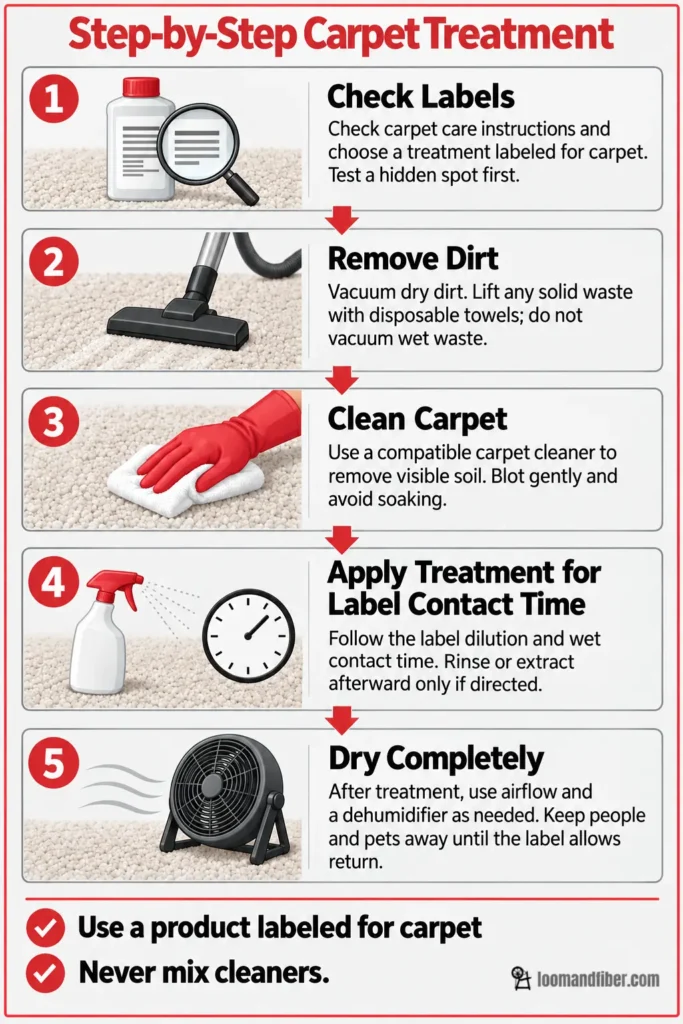
Read the Carpet Care Label
Determine the type of carpet and review the care instructions before using chemical sanitizer products or heat.
Wool, silk, natural fiber rugs, dyes, adhesives, and the backing of the carpet may have special concerns. If you cannot identify the type of carpet, ask the manufacturer or a certified carpet cleaner.
For the treatment product, pay attention to:
- Whether the product is suitable for carpet
- If the carpet claim is cleaning, sanitizing, or disinfecting
- Targeted organisms the claim applies for
- Dilution of the solution
- Application amount
- The contact time the carpet must remain wet
- If extraction or rinsing is required after the treatment
- When it is safe to re-enter the space
In the United States, look for an EPA registration number on the product label. The registration does not necessarily confirm the product makes all its claims on all surfaces.
Prepare the Area
Move light furniture away from the carpet. Place children and pets in another area during the process.
Gather compatible personal protective equipment (PPE), white absorbent cloths, a carpet cleaner, and an antimicrobial treatment product. Ventilate the space as directed by the product’s safety data sheet.
Test each product on an inconspicuous area of carpet before use. After the test application, observe the site for color transfer, discoloration, stiffness, or damage. Do not mix products unless both PPE instructions and the carpet care label approves the combination. Never add disinfectant to a carpet cleaner machine unless both the product and machine instructions specify it is allowed.
Remove Dirt or Waste Before Disinfecting Carpet
For dry soils and pet dander, vacuum the affected area.
For fresh vomit, feces, or other body fluids, do not use a home vacuum cleaner on the spot. Put on gloves and carefully remove as much of the solid material as possible with disposable towels or a plastic scraper. Place the towels and solids in a plastic bag. Blot the remaining liquid with white cloths, working from the edges toward the center of the spot. Replace the towels frequently to avoid transferring material across the surface. Do not scrub the liquid into the carpet fibers.
Clean the Affected Carpet
Apply a suitable carpet cleaner and remove the soil as instructed. Before disinfecting carpet, always remove the visible soil from the carpet unless the disinfectant product instructions specify otherwise.
For small spots, use blotting with controlled applications of cleaner. For larger spot or soils, consider a carpet extraction machine to remove the soil from the fibers. Do not saturate the fibers with liquid. Excess liquid wicks into the padding and backing of the carpet, carrying the soil with it. It also increases the time needed to dry the carpet.
If using an enzymatic cleaner to treat pet waste, follow the instructions for cleaning the soil. Once the product has been rinsed, extracted, or otherwise removed, proceed with a disinfectant if the label instructions recommend it.
Apply the Carpet Labeled Treatment
Mix and apply the antimicrobial treatment product according to the label. If the product instructions call for a specific dilution ratio and application method, do not use a stronger solution. Wet the contaminated surface of the carpet completely, and maintain the contact time specified by the label. The contact time is how long the product remains damp on the surface. It indicates the minimum time the product needs to kill the targeted organisms listed on the label. There is no standard contact time for disinfecting carpet. Do not assume the product needs to be left on the carpet for five or ten minutes. If the label instructions specify conditions the carpet may not support without soaking or compromising the fibers, take the product information to a professional cleaner for discussion.
Finish the Disinfectant Treatment
Some products require extraction or rinsing after the contact time has expired. Other products must be allowed to dry on the carpet.
Follow the finishing instructions for the product you are using. Do not extract a product that specifies it should be rinsed, or leave a product on the carpet if the label says to rinse or extract it. If the label does not specify requirements for the treated carpet beyond the contact time, do not assume the treatment process is complete when the carpet appears dry to the touch.
Dry the Carpet
After the contact time has expired, take measures to ensure the carpet dries completely.
Place a fan to blow air across the surface of the carpet. Use a dehumidifier if the relative humidity is high. Open windows to allow dry air to circulate if the outdoor air is dry enough. Avoid placing items on the carpet until it is completely dry. Keep children and pets away from the treated area until the label indicates it is safe to return. The faster the carpet can dry, the less chance moisture has to remain in the backing and padding to support mold and bacteria growth. The EPA recommends drying out wet materials within 24 to 48 hours of a spill or flood to help prevent mold growth.

Does Steam Cleaning Disinfect Carpet?
Steam has the potential to reduce the number of germs on a carpet. A standard pass of a carpet cleaning machine does not necessarily disinfect the carpet.
Most services offer hot water extraction rather than steam cleaning. The method cleans the carpet, but it does not disinfect. Heat has to be applied to the affected surface long enough to reach a temperature that kills the targeted organisms. The temperature in the machine does not necessarily indicate the temperature of the carpet itself. Only use a steam cleaner that is appropriate for your carpet type. If you are concerned about an infectious disease, ask the service what process they used to treat the carpet, and whether it has been shown to kill the specific microorganism on carpet.
How to Disinfect Carpet Without a Steam Cleaner
If the contaminated area is small and on the surface fibers of the carpet, you may be able to perform some manual cleaning and apply a carpet sanitizer that has been approved for use on carpet.
Clean up the contamination, treat the fibers, and dry the carpet completely. A steam cleaner is not necessary if the product you plan to use does not require it.
Manual cleaning and spot removal cannot reach into the depths of the carpet padding. If the contamination extends into the padding, or if there is a large area soaked into the carpet, consult a professional cleaner rather than attempting to make up a treatment solution.
Do Household Remedies Disinfect Carpet?
White Vinegar
Household vinegar is not labeled for use on carpet for disinfection. It does not have an EPA approved method of application for the range of organisms that you might want to kill.
Additionally, vinegar may damage some types of carpet or rugs. Only use it on a carpet that indicates it can be cleaned with this type of solution.
Baking Soda
Baking soda is not an antimicrobial treatment for use on carpet. It may help control some odors, but eliminating an odor does not eliminate all the bacteria or viruses in the carpet.
Hydrogen Peroxide
A formulated product may contain peroxide and a suitable concentration to disinfect a hard surface. However, this claim does not extend to carpet unless the product has been tested and approved for the use on your type of carpet. It may bleach some carpet dyes.
Never use an off-the-shelf product unless the label specifies it is suitable for use on your type of carpet. A solution that has been mixed without the proper equipment and testing has the potential to damage the carpet fibers.
Bleach
Do not use bleach on a carpet unless the manufacturer of the carpet and the product label specify that it is safe to do so. Bleach can destroy carpet colors and finishes. The bleach solution you might use on a hard surface such as a bathroom tile is not safe for use on carpet. Never mix bleach with vinegar, ammonia, or other common household cleaners.
Enzymatic Pet Cleaner
Pet enzymes from pets’ urine and feces can destroy carpet fibers and leave behind stains and odors. Enzymatic cleaners help by breaking down the organic molecules of the waste. If the label of the product does not show it has been approved for disinfecting, do not assume it has been approved simply because it is a pet product. Always follow the product instructions based on your type of carpet.
How to Handle Carpet After Vomit or Dog Poop
Removing the waste is important. Clean the site, and determine if additional treatment is necessary based on the type of contamination.
For a small accident, consider the following steps:
- Keep children and pets away from the contaminated area.
- Wear gloves and remove any solid matter.
- Use disposable towels to blot the liquid portion of the waste.
- Clean the area with a product appropriate for your type of carpet.
- Apply a carpet sanitizer or disinfectant approved for use with your type of carpet. Always use the product in accordance with the application instructions.
- Finish and dry the carpet according to the product’s instructions.
- Wash any tools used and remove gloves before washing your hands.
If the illness that caused the vomiting or diarrhea is a contagious disease such as norovirus, do not assume a general purpose antibacterial spray for use on hard surfaces will disinfect the carpet. If a product’s label does not specify the type of organisms it has been tested and approved for use against on carpet, contact a professional cleaner to find out if the method of application will work for your carpet type.
For large amounts or contamination of the padding, ask a professional cleaner for advice.
Read More>> How to clean vomit from carpet?
Read More>>How to clan dog poop out of carpet?
Can You Disinfect Moldy Carpet?
A quick spray on the surface of the carpet is not a complete method to kill mold growing in the carpet. The padding beneath the carpet is also a concern. Address the water source that keeps the carpet wet. Mold growing on a carpet requires professional assessment, especially if there is an odor, visible mold growth, history of dampness, or water damage.
For contamination from sewage or contaminated water, contact a professional restoration company before attempting to clean the carpet yourself.
Common Carpet Disinfection Mistakes
| Mistake | Why it causes problems | Better approach |
|---|---|---|
| Spraying over dirt or waste | Soil can interfere with treatment | Remove contamination and clean first |
| Using hard-floor directions on carpet | The claim may not apply to porous fibers | Read the carpet-specific instructions |
| Wiping or extracting immediately | The required contact time is interrupted | Complete the stated treatment period |
| Adding extra concentrate | Can damage materials or leave excess residue | Measure the exact dilution |
| Soaking the carpet | Moisture can reach the padding | Use the prescribed application rate |
| Mixing products | Can create hazardous reactions or incompatible residues | Use products separately as directed |
| Judging results by smell | Fragrance does not measure germ reduction | Judge the process against its instructions |
FAQs
Use a product whose label includes a disinfection claim for carpet to the relevant organism. General fabric freshener, carpet deodorizer, or hard-surface disinfectant is not an equal.
The label instruction for the relevant carpet type should dictate the contact time. The time will depend on the product, the organism to be disinfected, and the application method.
Carpet shampoo is formulated to help remove soil, which can carry germs, from carpets. However, it does not provide disinfection unless the product’s instructions specifically state that it has a disinfection claim and the directions for its use are followed.
There is no general recommendation for households. The carpet should be vacuumed and cleaned per the care instructions based on the level of use. Disinfection beyond cleaning should be considered based on specific circumstances rather than as a regular occurrence.
The instructions provided with the particular product should be followed, and the pets kept away from the treated area until all steps are completed, and it is safe to return. The phrase ‘pet stain remover’ does not necessarily mean a ‘pet-safe’ product that can be used with animals present.
It cannot be determined solely from an appearance or smell. The only reliable course is to apply an appropriate disinfectant to the relevant type of carpet surface for the required contact time as per the manufacturer’s instructions to effectively kill the targeted organisms. Spot treatments do not claim to reach underneath the carpet, where the backing or padding may also be contaminated.