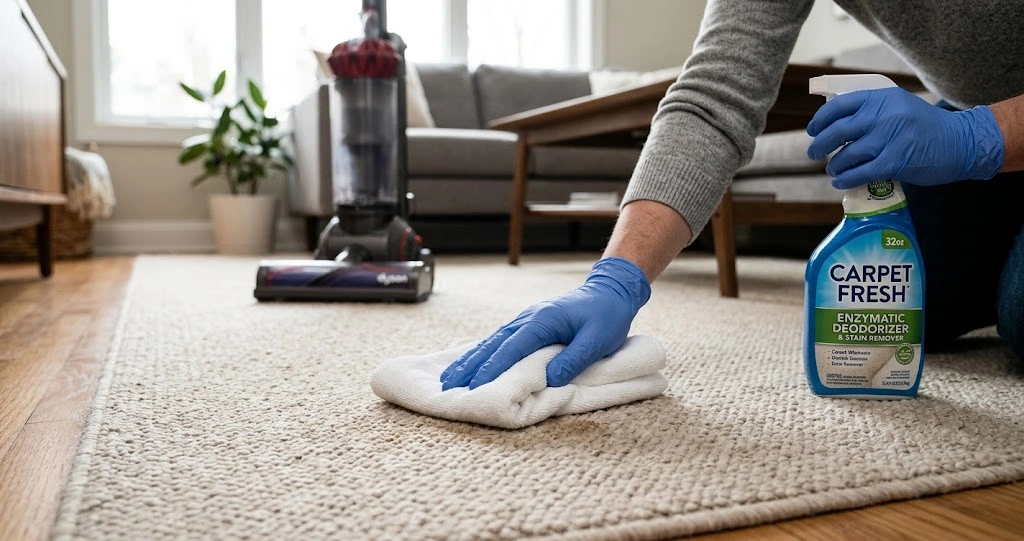

The easiest way to deodorize carpet is to liberally sprinkle baking soda and let it stand for at least 15–30 minutes (or overnight) then thoroughly vacuum it. For more persistent smells, follow up with an enzymatic cleaner or a vinegar and water solution, and steam cleaning if required.
Carpet can smell musty due to trapped moisture, pet accidents, food, smoke, mold, and everyday use. Below are the most proven ways to deodorize carpet, from fastest to deepest.
What Causes Carpet to Smell?
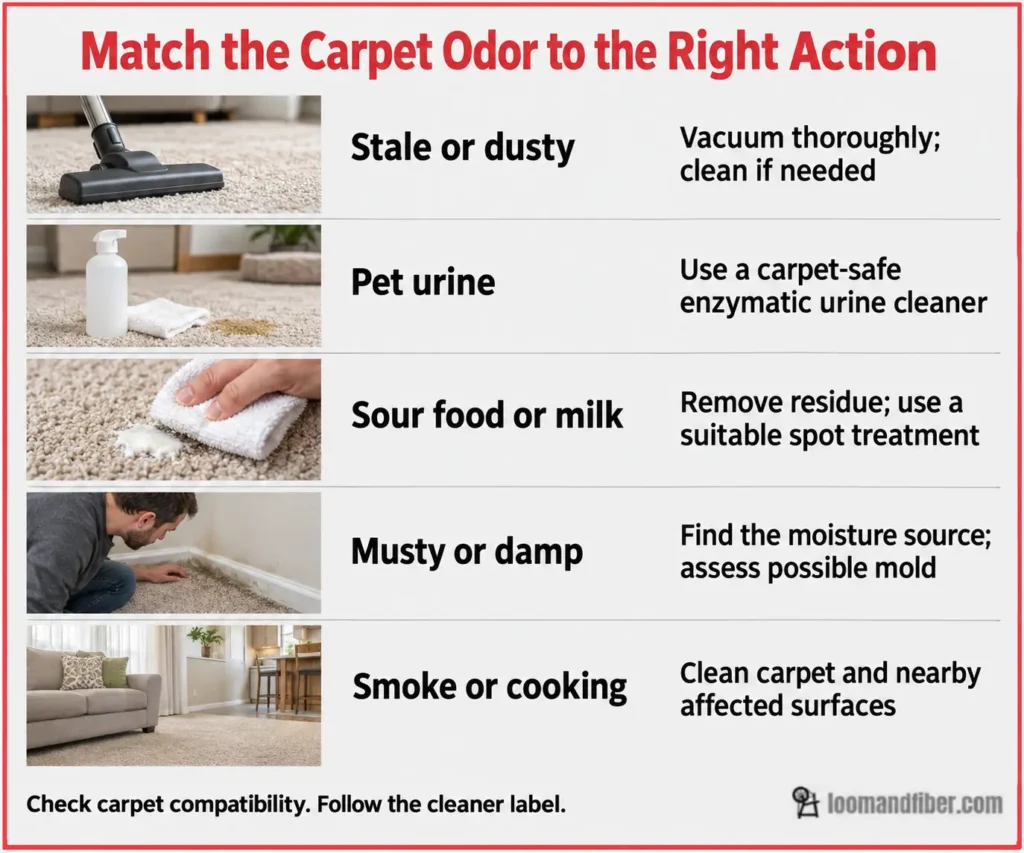
| Carpet odor or condition | Possible cause | Best starting point |
|---|---|---|
| Stale or dusty smell | Dirt, hair, and everyday buildup | Thorough vacuuming, followed by cleaning if needed |
| Urine smell | Pet accidents in the fibers or padding | Carpet-safe enzymatic urine cleaner |
| Sour smell near a spill | Milk, food, or drink residue | Remove residue and use a suitable spot cleaner |
| Musty smell | Trapped moisture or possible mold | Locate moisture, correct the cause, and assess damage |
| Smell after washing | Slow drying, remaining soil, or excess detergent | Improve drying and check for residue |
| Smoke or cooking smell | Residue on carpet and other room surfaces | Clean the carpet and surrounding odor sources |
How to Deodorize Carpet Step by Step
Vacuum the carpet thoroughly
Vacuum dry carpet slowly with overlapping passes to remove dirt, pet hair, and food particles. Consider edges, corners, and under furniture. Avoid using a regular dry vacuum on wet carpet.
Blot fresh spills immediately
Lift solid material with a spoon, then blot with clean white towels. Replace wet towels, continuing blotting until little moisture is being transferred. Avoid scrubbing and pouring water onto the area.
Use an enzymatic cleaner for pet and food odors
Select a carpet-safe enzymatic cleaner labeled for the respective residue, such as urine or milk. Test on a hidden area, then follow the label’s instructions for application, leaving to work, and rinsing or blotting if required.
Spot Clean localized smells
Apply a compatible carpet spot cleaner per the label instructions. Work from the edge of the affected area to the center. Remove cleaner residue as instructed, using minimal water to avoid soaking the backing.
Deep-clean widespread odors
If the carpet manufacturer permits extraction cleaning, use a carpet-cleaning machine and its recommended detergent and dilution. Make additional passes to remove moisture. Avoid excess soap, and arrange professional cleaning for delicate carpets or persistent smell.
Dry the carpet completely
After the required working time from the treatment, absorb excess moisture with dry towels. Place a fan over the cleaned area and use a dehumidifier in wet conditions. Avoid furniture on the carpet until it is completely dry.

Fix moisture problems behind musty smells
Correct any leaks, or condensation, and fix a damp carpet backing. Avoid adding more cleaner to a damp carpet. If there is visible mold, arrange an assessment before vacuuming or blowing fans across it.
Use baking soda only in permitted places
Check that both the carpet manufacturer and the vacuum manufacturer permit fine powders. If permitted, apply a light layer on completely dry carpet and vacuum thoroughly. This may help mild surface odor, but will not remove deep urine contamination or mold.
Clean nearby odor sources
Wash pet bedding and removable covers appropriately. Clean affected upholstery and curtains, empty the vacuum container, and maintain its filters. These items can continue to emit odor after carpet cleaning.
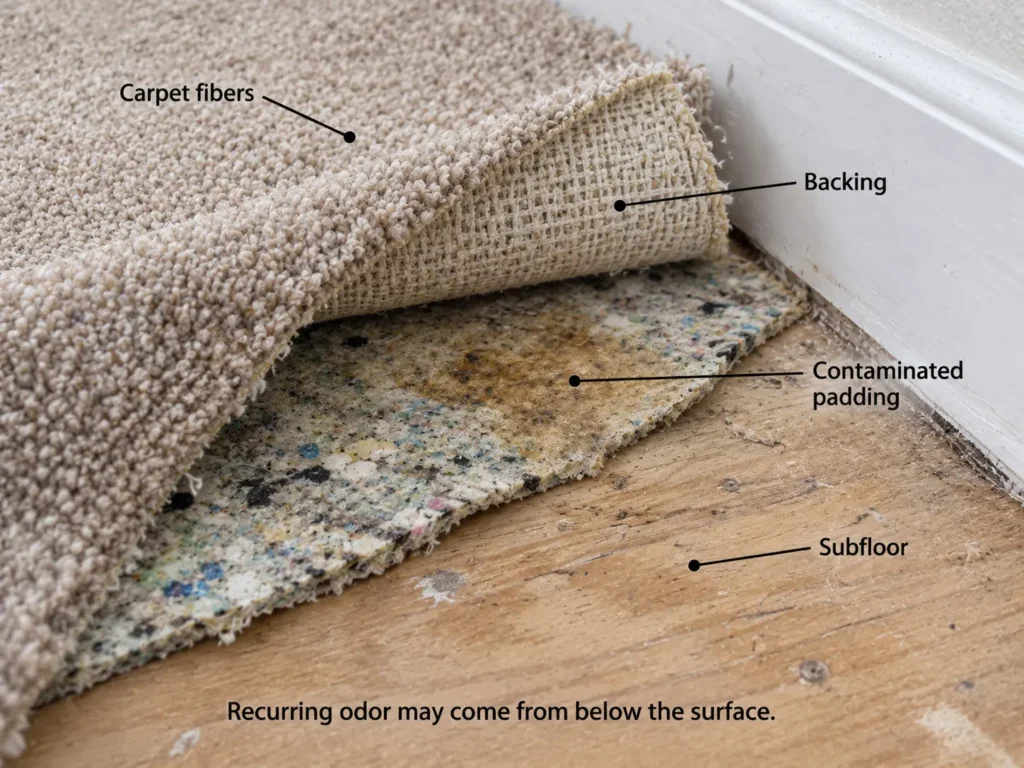
Treat contaminated padding when smells return
If the same odor returns after proper cleaning and drying, then have the backing, padding, and subfloor inspected. A professional may need to replace affected padding and treat the floor.
Read More>> How to clean vomit from carpet?
9 Proven Solutions to Deodorize Carpet that Actually Work
1. Baking Soda (Best All Purpose Deodorizer)
Baking soda is an excellent option for deodorizing due to its ability to neutralize scent molecules, as opposed to simply masking them.
How To Do It:
- Vacuum the carpet to remove any loose dirt.
- Now, liberally apply baking soda over the carpet.
- Let the baking soda sit for at least fifteen or thirty minutes. If you are treating particularly foul or old odors, let the baking soda sit for up to a few hours or overnight.
- Finally, vacuum the carpet until all the baking soda has been removed.
Best For: General foul odors, pet odors, and prior to any other odor removal treatments.
White Vinegar Solution (Best for Pet and Mildew Odors)
White vinegar is incredibly useful in odor removal due to its ability break down bacteria which give off unpleasant smells.
How To Do It:
- Create a solution of equal parts white vinegar and water.
- Lightly mist the carpet in the affected areas.
- Ensure the carpet is fully dry, as residual vinegar can give off a smell itself.
- Vacuum the carpet when it is dry.
Best For: Pet related odors, particularly urine, and mildew.
3. Enzymatic Cleaners (Best for Pet Urine Odors)
Enzymatic cleaners take out pet odors far better than any other method. They work by breaking down the complex molecules which make up the odor.
How To Do It:
- Remove any excess liquid from the carpet.
- Apply enzymatic cleaner over the affected area, ensuring the substance is well saturated.
- Leave the cleaner to work for the advised amount of time, usually several hours.
- Blot or allow the carpet to dry, then vacuum.
Best For: Pet urine, vomit, and other similar odors.
4. Steam Cleaning (Best for Embedded Odors)
Steam cleaning works by removing odor causing microorganisms from carpet fibers deep within the stack, removing their source of nourishment and, consequently, their ability to create unpleasant odors.
How To Do It:
- Ensure the carpet is well vacuumed.
- Hire a professional or utilize a steam cleaner along with a deodorizing carpet shampoo.
- Allow the carpet to thoroughly dry, using fans or opening windows if viable.
Best For: Comprehensive odor removal, embedded smells, and the removal of smoke odors.
5. Activated Charcoal (Best for Musty Odors)
Activated charcoal is often used for odor removal due to its incredible surface area, which allows it to absorb vast quantities of odor molecules from both the air and the carpet.
How To Do It:
- Place bags of activated charcoal or a layer of activated charcoal powder over the carpet in a room, or alternatively sprinkle activated charcoal powder directly over the carpet.
- Leave this to work for several hours, or ideally, an entire day.
- If you choose to use activated charcoal powder in your carpet, be sure to vacuum it up.
Best For: Musty, damp smells, particularly in basements or other high humidity areas.
6. Essential Oil and Baking Soda Mixture (Best for Fresh Scent)
A mixture of baking soda and essential oils is perfect for imparting a pleasant scent onto your carpet.
How To Do It:
- Mix a single cup of baking soda with ten to fifteen drops of essential oils.
- Allow this mixture to stand, uncovered, for several hours.
- When ready, liberally apply this mixture to your carpet.
- Leave the mixture to work for twenty to thirty minutes, then vacuum.
Best For: Routine carpet deodorizing, particularly where pets are not present.
7. Sunlight and Ventilation (Best Free Method)
Ventilation and sunlight are incredibly useful in odor removal, due to the fact that sunlight breaks down odor causing bacteria and the increased airflow reduces humidity, which are key contributors to foul odors.
How To Do It:
- Open windows and use fans to improve general airflow through your house for several hours.
- If possible, take your rugs outside and expose them to direct sunlight.
- Use a dehumidifier in damp areas.
Best For: General carpet deodorizing, smaller rugs, and reducing humidity.
8. Club Soda (Best for Recent Stains)
Club soda is useful in odor removal due to its ability to effectively break down fresh stains, preventing them from setting and giving off unpleasant odors.
How To Do It:
- Blot any liquid from the carpet as soon as possible, using a clean material.
- Apply club soda directly to the affected area of carpet.
- Repeat blotting until the liquid is fully absorbed by the carpet.
Best For: Removal of recent liquid spills, preventing them from giving off a smell.
9. Professional Carpet Cleaner (Best for Persistent Odors)
If all other methods have failed to remove unpleasant odors from your carpet, your best bet is to take your carpet to a professional cleaner. This is particularly the case if the smell is coming from the inner layers of your carpet, particularly the base or the padding.
How To Do It:
Professional cleaners will utilize a hot water extraction method on your carpet, along with powerful deodorizing chemicals that will effectively eliminate the source of the smell. It is possible that if the smell is due to mold or water damage, the professionals might advise you to replace the carpet or padding.
Best For: Eliminating persistent, unpleasant smells that all other methods have failed to remove.
How to Remove Specific Carpet Odors
Pet Urine Smell
For fresh urine, absorb as much liquid as possible with towels. Apply an enzymatic cleaner labeled with urine and compatible with your carpet.
Follow the instructions carefully. Treatment time varies, and removing the product too soon may diminish its effectiveness. Avoid steam cleaning urine spots before removing contamination; heat can set the stain and odor. If the urine has reached the padding, surface cleaning may be insufficient.
If the smell returns after drying, check whether:
- The treated area was over the full accident.
- The cleaner was left for its required treatment time.
- The pet has soiled the same spot again.
- Urine reached the backing, padding, or subfloor.
Repeatedly spraying the surface will not reliably fix contamination underneath. A professional may need to lift the carpet and replace the affected padding and treat the floor.
Read More>> How to Clean Dog Poop out of Carpet?
Sour Milk and Food Smells
After removing the remaining food, blot the affected area with a suitable carpet spot cleaner per its label.
For milk and other organic spills, an enzymatic product specifically labeled for that residue can help. Check fiber compatibility, especially on wool.
Avoid pouring water onto an old spill. This can spread residue beyond the visible spot.
If a large spill soaked through the carpet, arrange extraction or professional cleaning. A clean looking surface can still have odor producing material underneath.
Musty Carpet Smells
A musty smell requires a moisture check before deodorizing. Look for leaks, recent over-wetting, condensation, or room humidity.
For recently damp carpet without suspected mold, remove excess water and start drying promptly. Aim to dry wet materials within 24–48 hours to reduce the risk of mold growth; this is a prevention window, not a guarantee. Moldy carpet may need removal because the growth can penetrate into the porous layers. Persistent mustiness or substantial water damage warrants a professional assessment.
Do not mask the smell with powder or fragrance and assume the problem is solved. If mold is suspected, avoid routine vacuuming or blowing fans across the affected material until it has been assessed.
Smoke and Cooking Odors
Start by stopping the source. Vacuum the carpet and clean it according to your manufacturer’s method.
Also clean nearby surfaces and washable textiles that have the same odor. Curtains, sofas, and pet beds can make the freshly cleaned carpet smell again.
Persistent tobacco smoke or fire related contamination may require specialist cleaning. Carpet treatment alone may not remove residue throughout the room.
Carpet That Smells After Cleaning
First, check that it is not still damp. Improve airflow and moisture removal instead of applying more liquid.
Once dried, check for a sticky feel or visible residue. If excess detergent is present, an additional controlled rinse and extraction may help where the carpet and machine instructions allow it.
If the odor returns in the same place, deeper contamination may remain. Further wetting can aggravate the problem, so schedule an inspection if one correctly performed treatment has not resolved it.
How to Deodorize Carpet Without a Carpet-Cleaning Machine
For small localized odor, a machine is not required.
After vacuuming the dry carpet and removing any residue, treat the spot with a compatible spot treatment, then remove the product as instructed and dry the area.
This works well for surface contamination while large spills, odor not localized, and contaminated padding will likely require more than blotting to treat.
If the manufacturer allows, use a rented extractor on the carpet to remove general soil.
Only use the recommended formula and dilution rate and extract enough times to remove moisture.
Mistakes That Can Cause Carpet Odors
Avoiding these common mistakes can prevent many odor causing issues;
- Do not use a fragrance to mask an untreated spill
- Using too much detergent
- Repeated soaking
- Removing an enzymatic product before the treatment time has passed
- Using incompatible products
- Mixing cleaning products
- Replace furniture on wet carpet
- Furniture should not be replaced on damp carpet until it is completely dry.
- Ignoring damp padding or an active leak
- Deodorizing carpet is not the same as sanitizing or disinfecting carpet.
How to Prevent Carpet Odor
- Vacuum carpets regularly, and pay special attention to areas where pets frequent and heavily trafficked areas.
- Spills should also be cleaned promptly and thoroughly so that they do not penetrate to the padding.
- Washing the bedding for pets that frequent the carpet, as well as any removable covers, is important too.
- Keeping the entry mats clean and the machine’s filters and bag clean is also a good way to prevent carpet odor.
- Keeping indoor humidity below 60% is also important, with the optimal range being between 30 and 50%.
- Having professional cleanings done on the carpet should be done as the manufacturer recommends based on the carpet’s usage.
Read More>> How to Disinfect Carpet?
FAQs
For light odors, a thorough vacuuming and odor source removal may be all that is needed.
For a spot, blot the excess liquid and treat the spot.
Urine or moisture related odors may require removal of the source of the odor and cannot always be masked or quickly removed.
It can vary between carpeting based on what caused the odor and how much it is embedded in the carpet.
Vacuuming can help to remove surface odor, but if a wet cleaning is needed, the time needed to work in the product and allow for it to fully dry should be taken.
Increased humidity can cause moisture trapped in the carpet to increase in odor.
If the odor is recurring, there is likely some residue in the backing or padding that needs to be removed or there is an underlying moisture issue.
Yes.
Proper vacuuming, spot treatment, cleaning, and drying can all help to deodorize carpet without the use of powder products.
If the padding cannot be thoroughly cleaned, such as with urine or mold contaminants, it may be a good idea to replace the padding.
If the carpet has been cleaned, but the odor persists, the backing, padding, and underlying floor should be inspected before replacing the entire carpet.