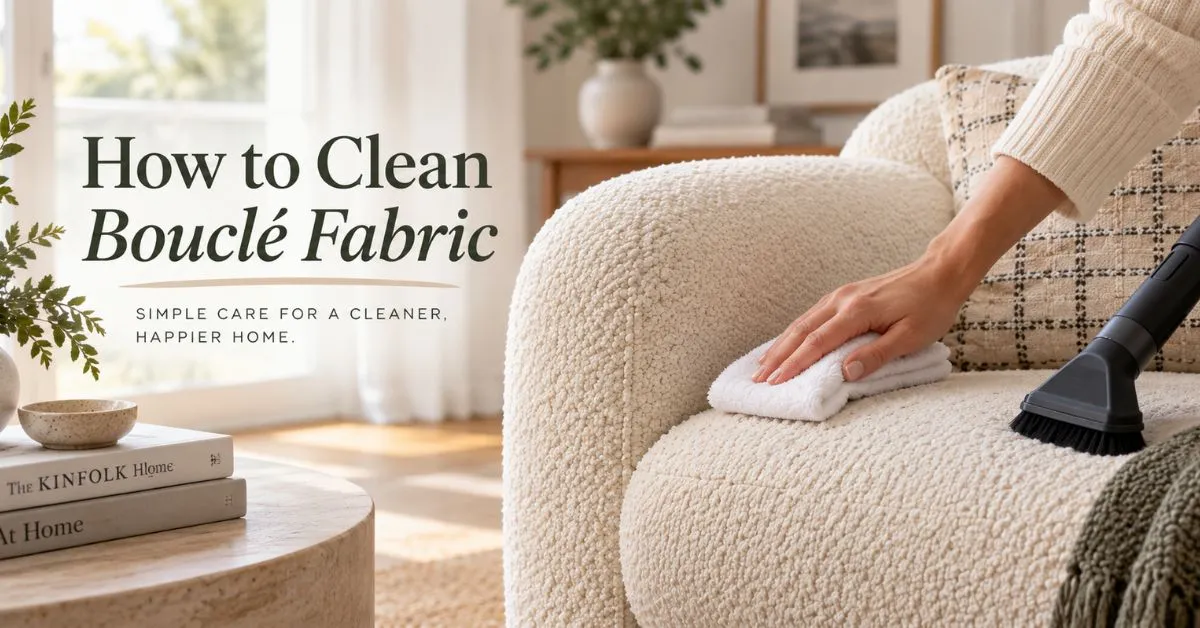

Boucle fabric can be attractive and comfortable to the touch, but it is also more challenging to care for than many other types of fabric.
The loops attract dust, pet hair, food, and other debris, and the fabric needs to be cleaned carefully in order to avoid damaging its delicate surface.
In this article, I will show you how to clean boucle fabric, including methods for removing spots and stains as well as regular maintenance.
What is boucle fabric?
Boucle fabric is a type of yarn with a distinctive looped texture.
The name comes from the French word for “curled.”
Boucle fabric can be used to make a variety of items, including:
- Sofas and chairs
- Dining room chairs
- Ottomans
- Cushions
- Jackets
- Coats
- Skirts
- Handbags or accessories
Boucle fabric is pleasing to the eye, but the loops do make it more challenging to clean than some other materials.
Dust and pet hair can become caught in the loops of the fabric while spots and stains should be blotted rather than scrubbed in order to lift them away without damaging the loops.
How to Clean Boucle Fabric at Home
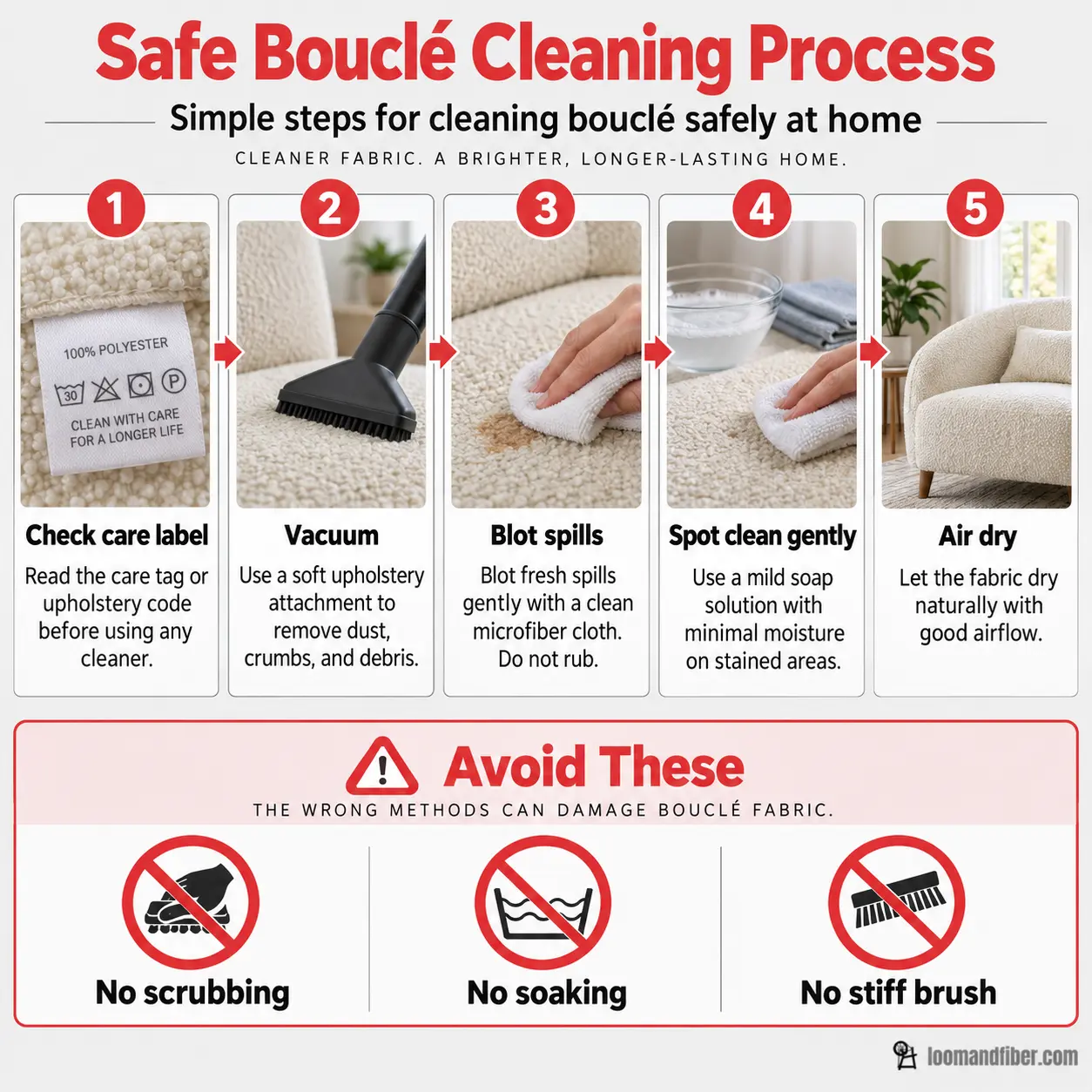
There are several common household methods for cleaning boucle fabric depending on the type of spot or the general maintenance needed. First, always check the care instructions for the item you are cleaning before using any cleaning solutions on it.
Upholstery often has a code printed on tag that tells you what types of cleaning solutions are safe to use.
The chart below shows what each code means.
| Code | Meaning |
|---|
| W | Water-based cleaners are generally allowed |
| S | Solvent-based cleaner only |
| W/S | Water- or solvent-based cleaners may be used |
| X | Vacuuming only; professional cleaning recommended |
If your bouclé chair has an “S” or “X” code water-based cleaning solutions may cause water rings, shrinkage, or other issues if the code on the tag indicates that they are not safe to use.
For clothing, always follow the care instructions on the tag even if another item made of boucle fabric is machine washable.
Method 1: Vacuuming boucle fabric
Vacuuming is an excellent way to clean and maintain boucle fabric upholstery.
Vacuuming helps to remove:
- Dust
- Crumbs
- Pet hair
- Lint
- Dry soil
Other small particles that have become embedded in the loops of the fabric
Use an upholstery attachment or a soft brush attachment when vacuuming.
Be sure to move the vacuum slowly and gently over the loops of the fabric.
How often should I vacuum my boucle fabric?
If you have a sofa or chair that gets used everyday, it is a good idea to vacuum it at least once every one or two weeks to remove embedded dirt. If you have pets or young children who often play on the floor, you may need to vacuum more frequently. A regular schedule of vacuuming helps to ensure that dirt does not become embedded deep within the loops of the fabric.
Avoid using a rough brush
A rough brush can snag the loops of the fabric, so it is best to avoid using a rotating brush when vacuuming boucle fabric. Instead, use suction with a soft upholstery brush attachment.
Method 2: Removing fresh spills
Spills tend to be much simpler to clean than set-in stains. If you have a spill on your boucle fabric, it is important to blot it up as soon as possible.
You will need:
- A clean white microfiber cloth
- A dry towel
Follow these steps:
- Take a clean section of the microfiber cloth and gently blot the liquid away from the spill
- Gently work your way from the edges of the spill toward the middle
- Continue until most of the liquid has been absorbed by the cloth
- Repeat with other sections of the microfiber cloth until most of the liquid has been blotted up
- Avoid pressing down on the microfiber cloth to push liquid deeper into the fabric
Why blotting is better than rubbing
Rubbing a spill can cause it to spread out across the fabric as well as push the liquid deeper into the loops of the fabric. Rubbing can also cause distortion in the loops of the fabric. Blotting is a much gentler way to remove liquid from fabric.
Method 3: Cleaning with mild soap
If the care instructions for your boucle fabric indicate that water-based cleaning solutions are safe to use, try using a solution of mild soap and water.
You will need:
- Lukewarm water
- A few drops of mild dish soap or gentle liquid detergent
- Two clean white microfiber cloths
- A dry towel
- Mix together one or two drops of mild soap with lukewarm water in a small bowl.
- The solution should be very dilute.
- You do not want to create a heavily-foamed solution.
How to apply the cleaning solution
Dampen a section of the microfiber cloth with the cleaning solution. Gently blot the stained area working from the edges of the stain toward the middle. Once you have blotted the entire stained area, use another section of the microfiber cloth to gently blot the area with plain water in order to remove any soap residue.
Finally, press the dry towel gently against the fabric in order to remove excess moisture. Let the fabric air dry completely.
Always test first
Before using any cleaning solution on visible fabric, test it on a hidden area of the fabric first.
Be sure to let the test area dry completely before checking for:
- Color fading
- Water marks
- Changes in texture
- Shrinkage
- Stiffness
Method 4: Using foam instead of water
One of the best methods for cleaning textured upholstery is to use foam rather than water when cleaning.
Mix together a solution of mild soap and water until a small amount of foam forms.
Use a clean cloth or a soft sponge to dab the foam onto the stained area.
By using foam rather than water, you reduce the amount of moisture that gets absorbed into the loops of the fabric.
This can be helpful for furniture since excess water can get absorbed into the padding beneath the fabric.
However, this cleaning method should only be used on fabric that indicates that it is safe to use water-based cleaning solutions.
Method 5: Removing grease or oil spots
When spot cleaning grease or oil stains, it is best to avoid using water right away since water can cause the oil to spread.
Instead, cover the oil spot with a small amount of an absorbent powder such as:
- Cornstarch
- Baking soda
- Talcum powder
Let the powder sit on the spot for about 20 to 30 minutes. For particularly greasy spots, leave the powder on the spot for a longer period of time. The powder will help to draw oil out of the fabric. Gently vacuum the powder away from the fabric.
You may need to repeat this process a few times. If there is still a greasy spot and the fabric indicates that water cleaning is safe, try spot cleaning with the mild soap and water technique shown in Method 3.
Avoid grinding baking soda into the fabric
Baking soda is excellent for removing odors and oil spots, but it should not be ground aggressively into the loops of boucle fabric. Fine powder can get embedded deep into the loops of the fabric. Instead, use a light layer of powder followed by thorough vacuuming.
Method 6: Removing food spots
For solid food spots:
- First, remove any food particles using a spoon or a dull edge
- Then, blot any remaining liquid with a clean cloth
- If the fabric indicates that water cleaning is safe, use a diluted solution of mild soap and water
- Gently blot the spot until it lifts away from the fabric
- Rinse with a slightly damp cloth
- Dry with a towel
Method 7: Removing coffee or tea stains
Coffee or tea stains should be blotted up as soon as possible.
First, blot up as much of the liquid as you can with a white cloth.
Then, mix together a diluted solution of lukewarm water and mild detergent.
Gently blot the stain, working from the edges toward the center.
Avoid flooding the fabric with water.
If the stain continues to run onto the cloth, continue blotting with a new section of the cloth.
Finally, use a slightly damp cloth to blot away any remaining detergent residue.
Let the fabric air dry completely.
Method 8: Removing pet hair from boucle fabric
Pet hair can become tangled in the loops of boucle fabric.
Start by vacuuming the fabric with a soft upholstery brush attachment.
For any remaining hair, gently run a clean rubber glove over the surface of the fabric.
The rubber will create enough friction to lift pet hair from the loops of the fabric.
Another option is to use a slightly damp microfiber cloth.
Use light pressure when running the cloth over the loops of the fabric.
Avoid using lint rollers that aggressively remove pet hair since they can tug at the loops of the fabric.
Method 9: Removing odors from boucle fabric
For light odors, start by vacuuming the fabric.
Then, allow the fabric to air out in order to loosen up the smell.
If the fabric manufacturer indicates that it is safe to do so, you can also try sprinkling a light layer of baking soda over the fabric and letting it sit for about 20 to 30 minutes before vacuuming it away.
Avoid leaving thick layers of baking soda on the fabric.
For more severe odors caused by urine, mildew, smoke, or deeply embedded liquids, it is generally best to have the upholstery professionally cleaned rather than trying to simply clean the surface.
Method 10: Steam cleaning boucle fabric
Steam cleaning can be safe in some cases, but it should not be assumed to be generally safe for all boucle fabric.
Boucle refers to the texture of the fabric rather than the fiber it is made from.
A boucle sofa can be made from:
Different fibers have varying tolerances for steam cleaning.
Excess heat and moisture can cause shrinkage, distortion, water marks, and changes to the loops of the fabric.
Only use a steam cleaner if the fabric manufacturer specifically indicates that it is safe to do so.
Otherwise, professional cleaning is generally the safest option.
Can You Machine Wash Boucle?
Sometimes. Removable boucle cushion covers or items of clothing maybe be machine-washable, depending on the care instructions.
Try using:
- cold or cool water
- a gentle cycle
- and mild detergent
- plus low agitation.
Delicate garments should be placed inside a mesh laundry bag as well. Do not attempt to machine-wash boucle with other garments carrying Velcro, exposed zippers, hooks or rough hardware as these can damage the loops.
Should boucle go in the dryer?
Typically, air drying is best to avoid shrunken, matted, or altered texture from high heat. Lay garments flat, where possible. And for furniture covers, always follow the care instructions provided by the manufacturer.
Can You Hand Wash Boucle?
Some removable boucle may be hand-washed, if the care label indicates it.
Use cool water and mild detergent.
Do not twist or wring the fabric, but rather press out excess water.
If possible, roll the fabric up in a clean, thick towel to remove moisture.
Reshape the fabric while damp and let it dry naturally.
Wool boucle may require a degree more of care and could need to be dry cleaned.
How to Clean Boucle Without Damaging the Texture
Avoid treating boucle as a smooth fabric for upholstery cleaning. The loops of fiber must be handled with care.
Follow these steps:
Do not aggressively scrub
Doing so can flatten, fuzz, or pull the loops.
Use blotting motions.
Do not oversaturate bouclé with water
Too much moisture reaching the padding below can lead to:
- slow drying
- water spots
- mustiness
- potential mold and mildew growth
- and
- distorted fabric
- Use a damp, not soaking wet, cloth.
Avoid using a hard-bristled brush
This can pull individual yarn loops from the fabric. If brushing is required, use an ultra-soft fabric brush for upholstery.
Avoid using strong bleach
This can ruin the color and weaken fibers, even for white bouclé. Always refer to the care label before using any cleaning agent.
Avoid using random DIY cleaning chemicals
Using vinegar, baking soda, detergent, alcohol, peroxide, and other ingredients randomly is not a guarantee of safety or effectiveness. Some combinations can actually cause staining or set it permanently. Start with the mildest upholstery cleaning solution that can clean the desired stain.
Can You Use Vinegar on Boucle Fabric?
Vinegar can be suggested for a homemade upholstery cleaner, but it is not the best choice across the board.
Acidic substances such as vinegar can ruin certain dyes or fibers.
Vinegar can also leave an unpleasant smell when overused.
A diluted vinegar solution may work for water-safe synthetic upholstery fabrics, but a mild detergent is a better starting point.
Always test any cleaning solution in a hidden area.
Can You Use Upholstery Cleaner on Boucle?
Yes, but the product must reflect the care code for your upholstery.
Look for an appropriate cleaner for delicate or textured upholstery.
Do not automatically assume that a “sofa cleaner” will work safely on bouclé.
Always test it first on a hidden area before using it on the entire piece.
How to Deep Clean a Boucle Sofa
To deep clean a bouclé sofa, take extra caution. Start by vacuuming the entire sofa.
Make sure to pay attention to:
- seams on seat cushions
- edges of cushions
- areas underneath cushions
- armrests
- backrest area
- crevices
Once the vacuuming is finished, inspect the sofa for any stain marks. Treat any blemishes before you proceed. If the upholstery is marked “W” or “W/S”, use an appropriate upholstery cleaner that is suitable for your fabric, following the instructions carefully.
Do not soak the sofa.
Only work on the sections requiring cleaning and give the material enough airflow to dry.
You can use fans or open windows to assist the drying process.
Never sit on the furniture while it is damp.
For high-end, wool-rich, viscose, vintage, or designer bouclé furniture, it is well worth the money to have it professionally cleaned.
When Should You Hire a Professional?
Hiring a professional upholstery cleaner is a good idea when:
- the care code is “X”
- the fabric contains wool or viscose
- the sofa is vintage or expensive
- the stain is large
- the stain has been present for a long time
- there is pet urine inside the cushion
- mold or mildew is suspected
- strong odors refuse to come off after surface cleaning
- or
- water rings were left from a previous cleaning.
You may also want to consider hiring a professional if you are unsure what kind of fiber the bouclé is made from. Sometimes, testing multiple upholstery cleaning products can make it harder for a professional to deal with the stain later on.
How to Keep Bouclé Fabric Clean Longer
Preventative measures go a long way in preserving a bouclé piece.
Vacuum it regularly.
Treat spills right away.
Keep foods and brightly-colored drinks away from light-colored bouclé, where possible.
Rotate removable cushions so that they do not always sit in the same place.
Avoid sitting in light-colored bouclé furniture where it will be exposed to direct sunlight for too long, as this can cause the dyes to fade.
Use throws or washable cushion covers in high-traffic areas if you have pets or toddlers around.
Quick Boucle Cleaning Guide
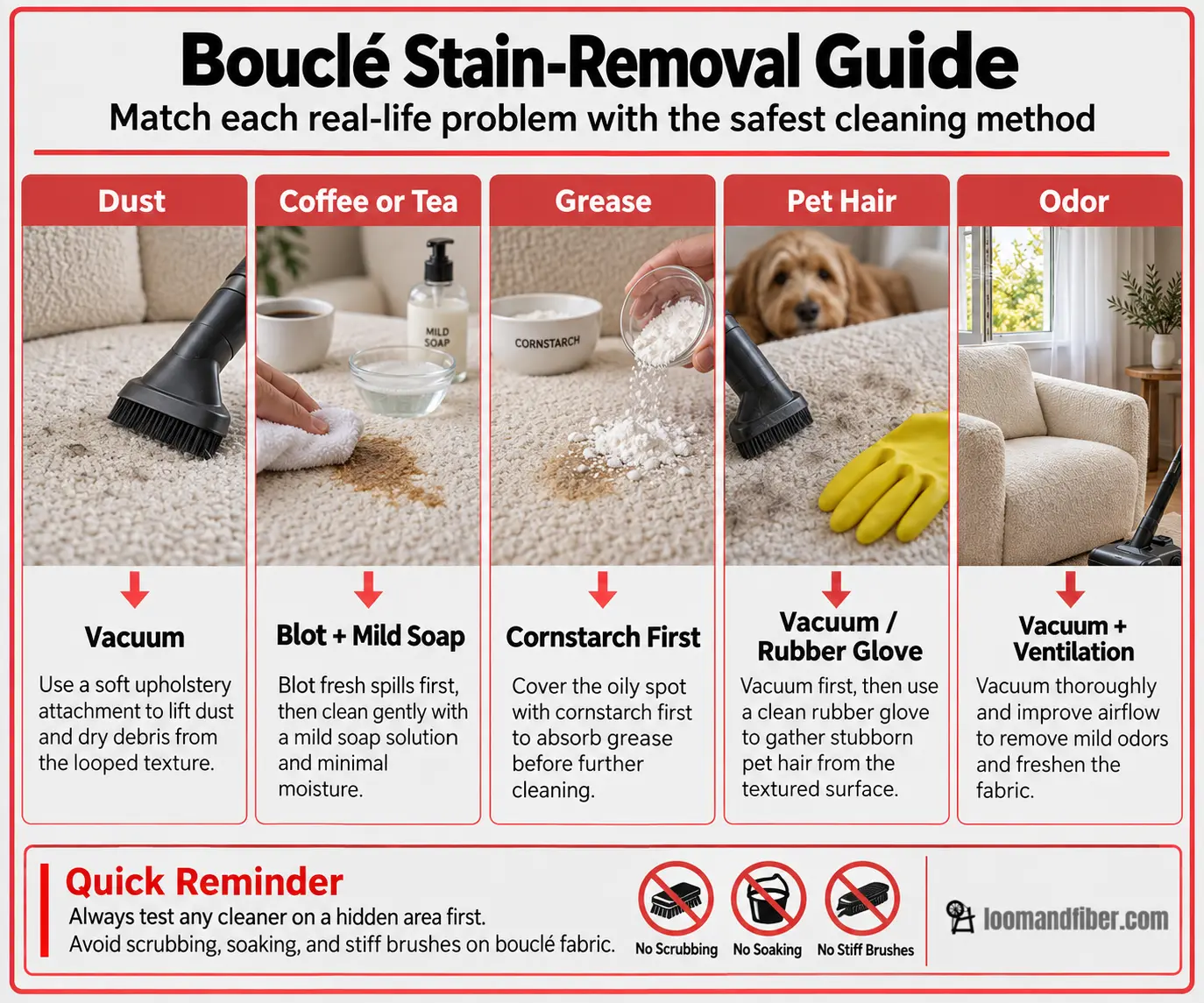
| Problem | Best First Method |
|---|---|
| Dust | Soft upholstery vacuum |
| Crumbs | Vacuum |
| Pet hair | Vacuum + rubber glove |
| Fresh liquid | Blot immediately |
| Coffee or tea | Mild soap solution if water-safe |
| Food stain | Remove solids, then blot |
| Grease | Cornstarch or absorbent powder |
| Mild odor | Vacuum + ventilation |
| Heavy odor | Professional cleaning |
| Deep stain | Upholstery cleaner or professional |
| Unknown fabric | Check label before cleaning |
Conclusion-
How to clean boucle fabric successfully requires gentle handling. For regular cleaning, vacuum your bouclé with a soft upholstery attachment. When dealing with spills, blot them away rather than rubbing them in. If the care label indicates that the fabric can tolerate water, try using a little mild detergent diluted in lukewarm water and be sure to limit moisture.
Avoid scrubbing, stiff brushes, bleach, excessive steam, and soaking. Most importantly, remember that bouclé is a texture, and not a single fiber, so a polyester bouclé sofa may tolerate cleaning methods that would ruin a wool or viscose bouclé sofa.
When the fabric is valuable, heavily stained, or marked for “professional cleaning”, it is best to turn to a trusted upholstery cleaner.
Read More>> How to Remove Sticker Residue from Fabric?
FAQs
Vacuum the fabric and blot any stains with a weak solution of mild soap and water, if the care label allows water-based cleaning. Avoid scrubbing, soaking, hard brushes, and high heat.
For water-safe bouclé, a highly diluted solution of mild detergent is a good start. Always test it on a hidden area first.
Not necessarily. Carpet cleaners can introduce too much water and suction for delicate upholstery. Only use an upholstery machine if the furniture manufacturer says wet extraction is safe.
Avoid aggressive scrubbing. It can pull, flatten, or fray the loops. Blotting and gentle dabbing are safer.
Some bouclé fabrics can withstand water while others cannot. Bouclé is a texture, not a single fiber, so always refer to the upholstery cleaning code or garment care label.
Vacuum it, remove stains carefully, lift flattened fibers gently with a soft upholstery brush (if the manufacturer allows), and do not sit on it until it is completely dry.
Bouclé requires slightly more care than smooth upholstery because it can trap dirt between its loops, but it is not incredibly difficult to clean, so long as you vacuum frequently and treat any spots right away.