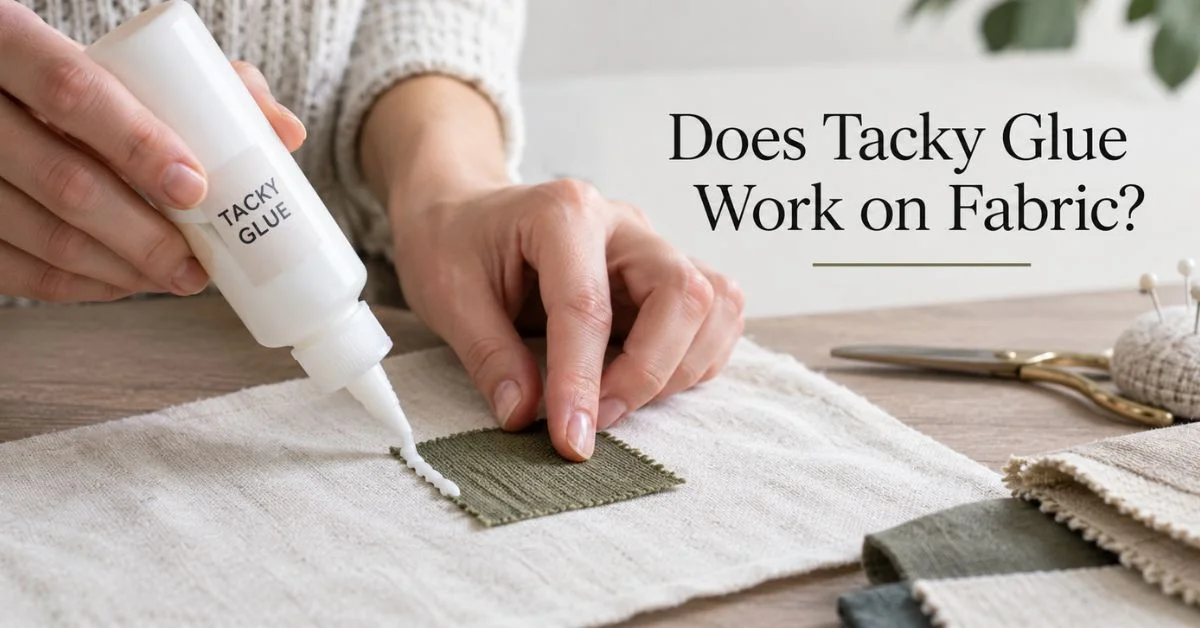

Tacky glue can work on fabric – for crafts, decorations, applique, felt, ribbons, etc. that aren’t washed or stretched often. It’s thick consistency helps the glue grab on quickly and keeps small pieces from sliding around while the glue dries.
However, tacky glue isn’t always the best option for clothing, stretchy fabric and washable projects. Particular formulas can leave the fabric stiff, seep through thin material, and lose its strength with frequent washing. For clothing and stretchy fabric, it’s best to use a dedicated fabric glue.
What Is Tacky Glue?
Tacky glue is thick, water based adhesive commonly used for arts and crafts, paper, wood, felt, foam, and some fabrics. Compared with white craft glue, tacky glue tends to have a thicker consistency that holds shape better rather than running or dripping. This higher viscosity is typically why this glue is used on such things as fabric.
Does Tacky Glue Stick to Fabric?
Yes. Tacky glue tends to adhere quite well to most fabrics, especially ones with texture or porosity.
It tends to work well on:
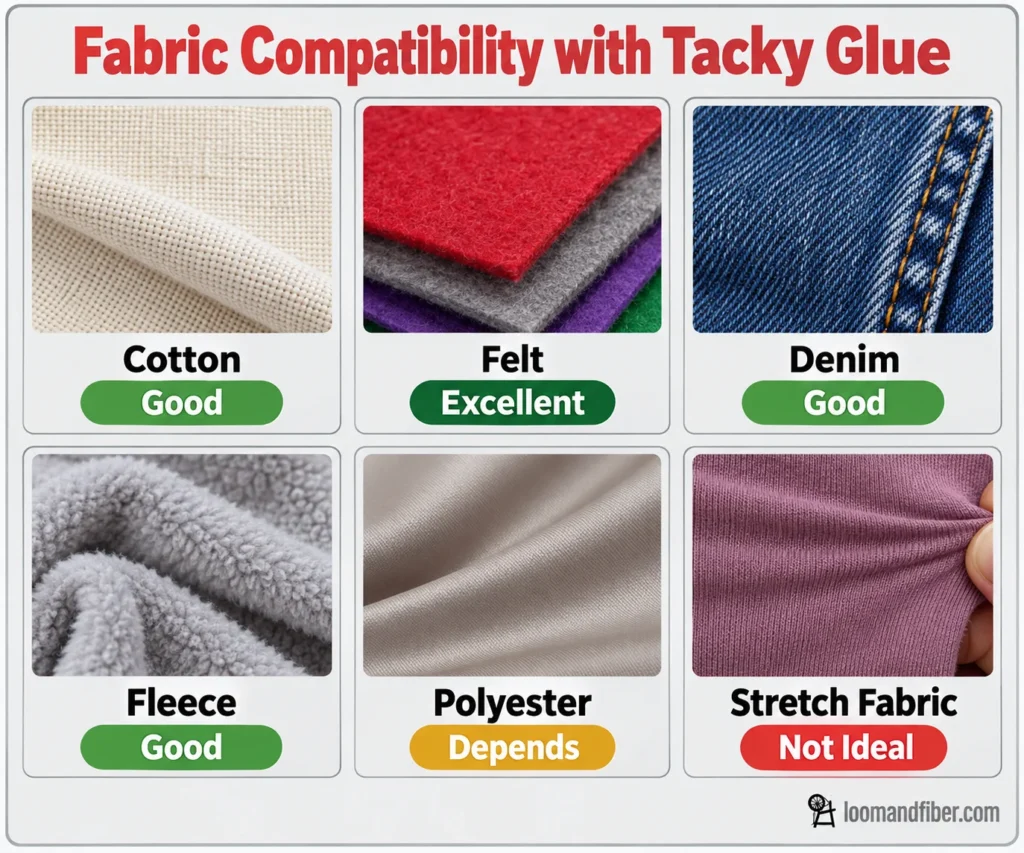
The bond strength varies depending on the fabric, the fabric’s finish, and whether the finished project will stretch much. Smoothe synthetic fabrics are often harder to glue as the adhesive can’t get into the fibers.
Is Tacky Glue Permanent on Fabric?
Tacky glue can give a fairly permanent bond on fabric, but it depends on what you’re using it for.
For decorative items that aren’t worn or washed much, the bond can be quite sturdy.
For clothing and other fabric that’ll be washed, folded, stretched, twisted, etc., the adhesive can lose its strength.
If you’re looking for something permanently washable, look into a permanent fabric glue or washable fabric adhesive.
Can You Use Tacky Glue on Clothes?
You can use tacky glue for certain decorative uses on clothes, but it’s not commonly recommended for actual garments.
It can be used for attaching:
- Fabric patches
- Felt shapes
- Decorative trim
- Costume decorations
- Fabric flowers
- Temporary embellishments
For everyday outfits that’ll be washed regularly, sewing or washable fabric glue is better. Tacky glue can also stiffen the material slightly, which might not be desirable on thinner clothes.
Is Tacky Glue Washable on Fabric?
Many glues that are marketed as tacky can take some moisture, but standard tacky glue should never be assumed to be washable.
Always check the label. Traditional craft tacky glues may lose their tack after multiple washes. Even if the glue doesn’t come off, the bond can become brittle. For washable projects, look for a glue that’s advertised as fabric safe, washable, or flexible and permanent after curing.
These are much more important than the word tacky on the bottle.
Does Tacky Glue Dry Clear on Fabric?
Most common types of tacky glue tend to dry clear or almost clear.
However, how clear the bond is can depend on how much glue you use.
A heavy application can cause the bond to be:
- A glossy spot
- A hardened area
- Darkened fabric
- Glue on the edges of the decoration
Using a thin, even application is usually the best way to avoid these issues. Test the glue on a hidden scrap of fabric first.
Does Tacky Glue Make Fabric Stiff?
Yes. Tacky glue can stiffen fabric in the area of the bond.
It’s especially noticeable on:
- Silky-type fabrics
- Thin cotton
- Lightweight polyester
- Jersey fabric
- Soft knit fabrics
It’s least noticeable on thicker materials such as felt, canvas, denim, and upholstery fabrics. If flexibility is important, a flexible fabric adhesive is a better choice.
Does Tacky Glue Bleed Through Fabric?
It can. Thin or loosely woven fabrics are more likely to show the glue through the fabric.
This includes things such as:
- Chiffon
- Organza
- Thin polyester
- Thin cotton
- Lace
- Satin
Applying the glue too heavily increases the chance of this happening.
Use the least amount needed to get the desired result and test on a scrap first.
Does Tacky Glue Work on Felt?
Yes. Felt is one of the easiest fabrics to use with tacky glue.
The felt’s porous surface allows the glue to adhere to the fibers nicely. Good for things like:
- Felt ornaments
- Kids crafts
- Felt flowers
- Decorations
- Costume pieces
- Felt applique
Since felt doesn’t fray and doesn’t stretch much, tacky glue is particularly good for felt projects.
Does Tacky Glue Work on Denim?
Yes. Tacky glue can adhere to denim as denim has a textured, absorptive surface.
It can work for light-weight decorative applications such as attaching patches or embellishments. However, jeans and denim jackets that stretch and go through the washing machine may not have lasting glue bonds.
For permanently attached patches on denim, it’s best to sew around the edges.
Does Tacky Glue Work on Polyester Fabric?
Sometimes. Polyester can be harder to glue than cotton as synthetic fibers tend to be less absorptive. Tacky glue should work fine on textured polyester, fleece, and polyester blends. Smooth polyester fabric tends to give weaker bonds. Testing the glue on the polyester is especially important for synthetic fiber fabric.
Does Tacky Glue Work on Stretchy Fabric?
Tacky glue isn’t a good choice for highly stretchy fabric.
The dried adhesive doesn’t stretch as well as materials such as:
- Spandex
- Lycra
- Stretch jersey
- Legging fabric
- Swimwear fabric
When the fabric stretches, the bond can break. A flexible fabric adhesive that’s made for stretchy fabric is a better choice.
Can Tacky Glue Be Used Instead of Sewing?
Yes, for some craft projects. Tacky glue can replace sewing for attaching light-weight decorations to fabric that won’t be under much stress.
Such as:
- Wall hangings
- Fabric crafts
- Felt projects
- Decorative banners
- Costumes
- Table decorations
It shouldn’t be used in place of stitching in structural parts of a garment such as:
- Garment seams
- Waistbands
- Bag handles
- Pockets
- Zippers
- High-stress patches
Sewing bonds fabric together mechanically, while glue relies on surface adhesion.
Is Tacky Glue Better Than Fabric Glue?
Not necessarily. They serve slightly different purposes.
| Feature | Tacky Glue | Fabric Glue |
|---|---|---|
| Craft projects | Excellent | Excellent |
| Felt | Excellent | Excellent |
| Clothing | Fair | Better |
| Flexibility | Moderate | Usually better |
| Washability | Depends on formula | Often better |
| Stretch fabric | Not ideal | Some formulas work well |
| Thick craft fabric | Very good | Very good |
Tacky glue is a good general craft adhesive. Fabric glue is usually the better choice when flexibility, washing, and garment durability matter.
Tacky Glue vs Hot Glue on Fabric
Both glues can be used, but they have different characteristics.
Hot glue is quick and easy to use, great for costumes, decorating, and heavy fabrics, but it raises noticeable bumps on the fabric.
Tacky glue does not cure as quickly, but it generally results in a neater finish.
As a rule of thumb, both hot and tacky glue should be tested on a small piece of the desired fabric before working on an actual project.
Tacky Glue vs Super Glue on Fabric
When it comes to everyday crafting, tacky glue is safe to use on most common types of fabric.
Super glue, on the other hand, tends to cure too hard and can even penetrate the fabric, leaving an unpleasant stiff spot.
In addition, super glue is more suitable for small objects and less flexible components than for large fabric surfaces.
How To Use Tacky Glue on Fabric
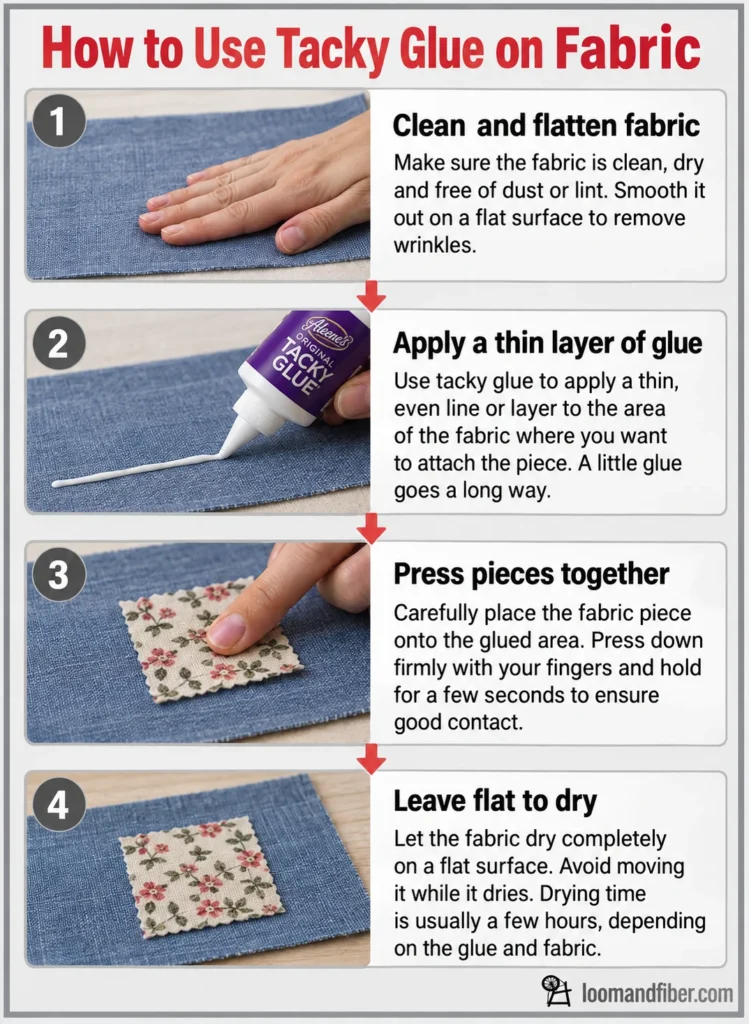
- To achieve the best result, make sure the fabric is clean and dry.
- Apply glue to one side of the fabric piece on a clean surface and press the two pieces together.
- Avoid using too much glue as it will only make the task harder and the resulting spot harder to look at.
- Let it dry on a firm surface.
- Most glues of this type only start to set for a few hours, but they usually need much longer to cure completely.
The time required for curing may vary, so it is best to follow the manufacturer’s recommendations regarding the drying time before washing, wearing, or further manipulation of the glued fabric.
How much Tacky Glue Should I use on fabric?
Use only the amount of glue needed to sufficiently stick the surfaces.
Too much adhesive can lead to:
- Increased curing time,
- Getting the fabric soaked,
- Hard spots,
- Unsightly glue marks.
For small pieces and decorations, it is best to use dots or lines of glue.
How long does tacky glue last on fabric?
The drying time depends on the brand, the amount of glue, the level of humidity, and the thickness of the fabric.
A light spot may be ready in a few hours, but the full curing process may take days.
It is better to err on the side of caution and let the glue set overnight rather than risking damage to the fabric by working on it too soon after applying the adhesive.
In addition, always remember to follow the curing instructions provided by the manufacturer if available.
How do I remove tacky glue from fabric?
Removing fresh glue is usually much easier than trying to get rid of old dried glue.
If the glue is still liquid, just wipe off the excess without rubbing the spot, as this may cause the glue to penetrate deeper into the fabric.
Warm water may help remove some of the spot if the glue is water-based.
Once the glue has dried, use a scraper to remove as much of it as possible.
Do not try to rub the spot, especially on delicate fabrics.
Always remember to check the instructions for removing glue from the chosen brand and test the method on a small piece of fabric first.
When should I avoid using tacky glue on fabric?
Avoid using common tacky glue on projects requiring much flexibility or repeated washing.
It is not suitable for:
- Sports clothes,
- Swimsuits,
- Tights,
- All kinds of stretchy fabric,
- Baby clothes that require frequent washing,
- Important seams of garments,
- Outdoor clothing subject to weather conditions,
- Delicate or expensive fabrics.
In such cases, it is better to use a specially designed textile adhesive or sewing.
What fabric projects are best suited for tacky glue?
Tacky glue is best suited for crafts that are not washed often and do not require much flexibility.
It works great on felt, fabric collages, holiday decorations, costume jewelry, boxes decorated with fabric, fabric patches, banners, ribbon crafts, artificial flowers made of fabric, and scrapbooking. The thicker the glue, the better, as it is much easier to control than thinner household glue.
Conclusion-
Tacky glue works on fabric: felt, cotton, canvas, denim, fleece, ribbon, and most other common types of fabric. The consistency of this type of glue allows for easy use and produces reliable results when working with textiles suitable for decorative purposes. Still, standard glue of this type is not recommended for fabrics that require frequent washing or significant flexibility.
Use tacky glue for lighter tasks and consider other options for washable clothing or more involved textile projects.
Read More>> How to get Hot-glue off fabric?
FAQs
Tacky glue should not ruin most types of fabric, but it may leave stiff spots that are noticeable on some fabrics. To make sure that the glue does not harm the fabric, test it on a small piece of the desired fabric first.
It is best not to iron the fabric with glue spots unless the manufacturer explicitly indicates that the glue is thermally stable.
High temperatures may damage some types of glue, so it is better to avoid high pressure and high temperatures when working with fabric glue.
Tacky glue is great for decorative patches, but if you want to attach functional patches to clothes, sew them on.
Yes, tacky glue works great on fleece fabric because the rough surface of the fibers allows the glue to grip the surface.
Tacky glue can be used on upholstery for minor repairs or decorative purposes, but it is not recommended for areas requiring tension, such as seams. Upholstery glue or sewing should be used for stronger bonds.